
- Retorno do vídeo
- -8,66%
- Chamadas
- 3
- Compra / Venda
- 0 3
- Publicado
Recomendações
Entrada é o preço de fechamento do ativo na data de publicação. Atual é o último fechamento registrado.
-
Entrada $122,92 25 jul 2026Atual $169,34 07 ago 2026Resultado −$46,42
He has reportedly been betting against hot stocks like Palunteer, Nvidia and Micron and he's actually been doing very well with it.
-
Entrada $206,84 25 jul 2026Atual $223,78 07 ago 2026Resultado −$16,94
He has reportedly been betting against hot stocks like Palunteer, Nvidia and Micron and he's actually been doing very well with it.
-
Entrada $920,95 25 jul 2026Atual $858,03 07 ago 2026Resultado +$62,92
He has reportedly been betting against hot stocks like Palunteer, Nvidia and Micron and he's actually been doing very well with it.
Transcrição Completa
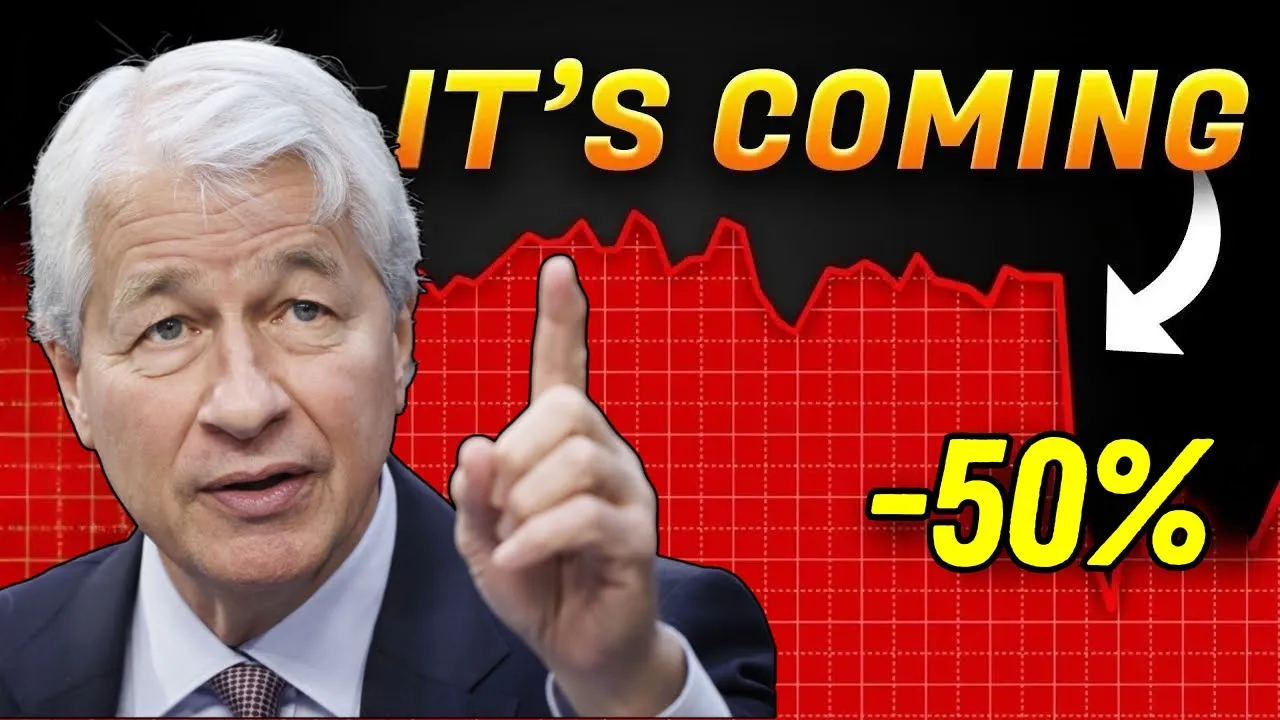
The most powerful banker in America just gave a powerful warning. He runs nearly five trillion dollars at his bank and he's one of the most respected voices in all of finance and he just said he would not buy stocks right now. At the very same time, legendary investors are hoarding record piles of cash and quietly betting against the market. So the question is, is a crash coming? And more importantly, what should you actually do about it? Don't worry because in today's video, we're going to cover all of it. Now, the man giving this warning is Jaime Diamond, the CEO of JP Morgan Chase. And when Jaime Diamond talks, the entire financial world stops and listens. And here's why. JP Morgan is the biggest bank in the United States. We're talking about close to $5 trillion in assets. Diamond has run it for nearly 20 years. He sits across the table from presidents and world leaders and he gets paid something like $43 million a year to steer that giant ship. He is without exaggeration one of the most powerful and plugged in people in the entire economy. So what did he say that got everyone so worked up? It was quite simple but stunning. Jaime Diamond said that at today's prices he would not buy stocks and he wouldn't buy long-term government bonds either. Bonds, by the way, are basically loans you make to the government. So, think about what he's saying. The head of America's biggest bank looked at the market and flat out said, "No thanks. Not at these prices." And this is coming from the person who arguably has the clearest view of the entire economy. He sees the spending, the borrowing, the loans, and the financial health of millions of customers flowing through his bank every single day. When someone with that view says he'd rather hold cash, that is not something you should brush off. But here's the part I really need you to hear because the headlines leave it out. Diamond is not screaming that a crash is coming tomorrow. In fact, he has said that the economy is still pretty resilient right now and he does not expect a crash to happen immediately. His warning is far more subtle than that and honestly far more useful. He is saying that the risks are quietly piling up underneath the surface and investors have stopped paying attention to them and the prices you're being asked to pay today simply leave no room for anything to go wrong. So what exactly is Diamond worried about? He described it in a really vivid way. He said the big risks under the economy are shifting like tectonic plates. His point is that everything looks calm on the surface, but underneath it, real pressure is building. Let me break his worries into three big buckets. Three bare cases for the US stock market in plain English. So, bucket number one and bare case number one, too much debt. Governments all over the world, including ours, are spending way more money than they take in year after year and borrowing the difference. Diamond warns this simply can't go on forever. All that borrowing can push up inflation and could eventually cause a crisis in the bond market, which would send interest rates much higher than people expect and rattle almost everything. Guys, interest rates are basically the price of money. When they spike, it gets more expensive for people to buy homes, for businesses to borrow and grow, and for the government itself to pay its bills. And it makes safe bonds look more attractive than risky stocks. The combination can pull the rug out from underneath the market. And on top of that, countries are now pouring huge amounts of money into their militaries, piling on even more debt. Number two, we live in a dangerous world. We've got active wars going on right now in the Ukraine and the Middle East. Diamond warns that fresh conflict, especially in oilrich regions like Iran, could send energy prices spiking, which slams a whole new wave of inflation right back into the economy. and the ongoing tension between the United States and China is like a permanent crack in the foundation of global trade. Number three, that stubborn inflation and expensive stocks. Diamond compared today to the 1970s when inflation would just not go away and stayed painfully high for years. He worries that tariffs, which are taxes on goods coming in from other countries, are pushing prices up even more. Because guess what? Companies don't swallow those tariffs. They pass them on to the consumer. you and I to pay. That is a tax and inflation on that. And here's the big one for us as investors. He says that stock prices have climbed to levels that just don't reflect all these risks. In plain English, stocks are priced for perfect sunny weather while a storm is quietly brewing. He even warns that when the debt cycle finally turns, the losses could be, in his words, worse than people expect. And guys, that's what causes crashes. when things happen that are not expected. But here's what really bothers Jaime Diamond. He thinks investors have gotten far too comfortable after years of phenomenal returns that have become numb to danger. They're shrugging off every one of these risks like it's not a big deal. And why shouldn't they? The last 15 years have told them that every big issue is not to be worried about. Remember when we had banks failing right and left a few years ago? Move on. In his experience, that kind of comfort and calm is exactly when people get blindsided. And as I said earlier, crashes occur when things that we don't expect to happen actually do. And here's what makes Diamond's warnings even harder to brush off. He's not alone. Some of the greatest investors alive are quietly doing the very same thing right now, backing away from this market. Take Warren Buffett, widely considered the greatest investor of all time. He and his company Birkshshire Hathaway are sitting on a record pile of nearly $400 billion in cash. He's been a net seller of stock for the past 14 quarters in a row, the longest streak in his entire history. And he's even called this market a casino. So when Buffett would rather hold that much cash than buy stocks, that tells you exactly how expensive he thinks that things have gotten. Now, there's Howard Marx, another legend, who points out that when you buy the market at today's pricey levels, history says your returns over the next 10 years have always landed between roughly plus two and minus 2% a year. Basically, nothing. I would actually argue that by some metrics, we have never seen these levels before. And there's an argument to be made that the returns could be even worse than that. Monish Purbry, a brilliant value investor, says he can no longer even tell a beginner to just buy the whole market because it's simply become too overpriced. So imagine that the dollar cost averaging that we recommend and the vast majority of value investors recommend, he can't even do it. And the most dramatic of all, Michael Bur, the investor from the movie The Big Short, has flat out warned that the end is near for this market. Now I get it. People are going to say he has said that many times and he has but all those times have been the last few years and any bull market you go to in the past we don't know when it ends and it can be very very expensive for a long time. He has reportedly been betting against hot stocks like Palunteer, Nvidia and Micron and he's actually been doing very well with it. He even said he'd love to bet against SpaceX but the cost was just too high. So this is not one of those grumpy bankers having a bad day. Some of the sharpest minds in the entire game are flashing the exact same warning. But, and this matters, not everyone agrees. Not even close. In the very same week that Jaime Diamond gave his warning, the CEO of another giant bank, Wells Fargo, said almost the exact opposite. That he is quote big- time bullish on America. two of those most powerful bankers on earth, same market, same week, completely opposite conclusions. In my opinion, one of them is going to end up being very, very wrong. And that's the thing about markets. For every genius warning you it's about to crash, there's another genius telling you to back up the truck and buy. So, now that you've seen the bare case, Diamond's three big concerns echoed by some of the biggest, great, and greatest investors alive. Let's be completely fair and flip it. And here are the three reasons a crash may not be coming at all, and they may surprise you. Now guys, before we dive into that, I want to remind you, never take our titles and thumbnails literally. We're never here to give a stock tip. We're here to teach a process so that one day you can make the process work for you and your own stock so you can sleep better at night knowing that you understand how to value a company, make good assumptions about its future, and understand the price that you are paying. So, these are the three reasons a lot of very smart people think that all this fear is overblown and they're every bit as real as Diamond's warnings. Reason number one, companies are still making a fuckload of money. Despite all the scary headlines, big American companies keep posting strong profits and shoppers keep on spending. In fact, some of the biggest companies are more profitable today than they've ever been, sitting on absolute mountains of cash. And at the same time, they're growing the top revenue and the bottom line at historically fast rates. And over the long run, stock prices follow profits if you pay a reasonable price. Peter Lynch always emphasized that. So, as long as companies keep earning more and more, that acts like a floor underneath the market, helping hold it up. Strong, healthy companies don't just fall apart overnight. This is one of the biggest and most positive arguments in my opinion. Reason number two, and guys, I want to accentuate this is not my opinion, but buybacks are a major bull for a lot of people. Cashrich companies we're just talking about, have so much money that they spend billions of dollars per year buying back of their own stock. And every time they do that, they create steady demand for shares. Buying that can prop the market up and cushion the drops. It's a bit like having a huge reliable customer who shows up to buy every single dip no matter what. And there are still trillions of dollars parked on the sidelines in savings as well. Money that tends to come flooding back into stocks the moment people feel confident again, which can push prices even higher. In addition, share repurchases will reduce the number of shares outstanding, which then help boost earnings per share because now you're dividing the total earnings by a lot less shares, which over the long run can help boost earnings per share as well as the price of a stock. Guys, I want to keep clear. My opinion on that second bull case is very, very different. Buying overpriced shares back is not a positive for companies. Reason three, in certain ways, history is firmly on the bull side. Here's a fact that should give you a real comfort. The US stock market has lived through the Great Depression, multiple world wars, dot crash, financial crisis, and a global pandemic. and every single time it eventually recovered and went on to hit brand new all-time highs. Every single time. And on top of that, so many investors now believe in buying the dip that the moment stocks fall, buyers tend to rush back in, which can stop a small drop from snowballing into a fullblown panic. So, there you have it. Powerful reasons to be scared and powerful reasons to relax, which brings us to the single most important part of this entire video. What you should actually do about all of it. We want to help you take all of this information and use it to your advantage. Now, here's the truth that may completely surprise you if you're new to our channel. At Everything Money, we don't fear crashes. We actually love them. I know that sounds crazy, so let me explain because this one idea can change your entire financial life. When the stock market crashes, the actual businesses don't suddenly become worthless. Coca-Cola still sells its drinks. Apple still sells its phones. People still use Google every single day. The companies themselves are probably just fine, but their stock prices go on sale. So, think about it like this. If your favorite store put everything you wanted on a 50% off sale, would you panic and sprint out of the building and avoid those products? Of course not. You'd back up the truck and buy as much as you could. But for some strange reason, when stocks go on sale, most people do the exact opposite. They get scared and run away. And that is completely backwards. A market crash is simply a chance to buy wonderful companies. Sometimes the very best businesses in the entire world at much lower prices. Lower prices on the same great business means a better deal and a higher future return. I've done this countless times where I show the S&P 500 over the last since 1950 and say if you could only buy six or seven times, when would it be? And of course, it's the lowest points of every market. But guess what? That's the time when everyone felt the most fear. That's the time when the story was the most fear most fear-driven. The crash itself is not the disaster. The crash is the opportunity. The only real disaster is being so scared that you miss out it completely. And think about this. The very best best businesses in the world almost never go on sale. They're too popular. So they usually trade at an elevated price and multiple. A crash is one of the only times that you ever gets the chance to buy those world-class companies at a real discount to fair value. And that's exactly why we get excited when everyone else in the world is panicking. And I'm not talking about theory here, guys. The proof is everywhere in history. When COVID hit back in 2020, the market crashed almost 40% in a matter of four weeks. It was terrifying in the moment. And guess what happened? By the end of the year, it was at all-time highs. In 2008, the financial crisis hit. The market fell more than 50% in half. And anyone who stayed calm and kept buying was rewarded enormously in the years that followed. Even the dot crash, as painful as it was, eventually gave ways to new highs. This pattern repeats over and over and over. And guys, I've only talked about the last 25 years in that. Once you truly understand that pattern, a crash stops being something to run away from and starts being something you're almost excited to see. The financial crisis of '08 and the COVID crash were exciting for me. But guys, the the dot crash was a scary time for me. You know why? I didn't understand that when I b when I'm buying a stock, I'm buying a piece of a business. I did believe the market could go to zero. I wish I had YouTube back then and somebody like me to advise me. You have that benefit now. Stick with us because there will be a time when it feels like the world is ending. And guess what? It's not. Every one of those terrifying moments, looking back, turned out to be one of the greatest buying opportunities of my lifetime. The people who stayed calm and kept buying went on to build real wealth. The people who panicked and sold locked in their losses forever. Same crash, two different outcomes completely decided entirely by how they behaved during the crash. So, how do you actually pull that off? How do you pull off staying calm and buying when everyone else is losing their minds? Well, you need a plan that you've already decided on before the storm ever hits. We call it principal driven investing, and it's the whole reason a warning like Jaime Diamond doesn't scare us one bit. Not me, not our team, not our community members. I'm going to tell you exactly how it works in just a few seconds. But here is the honest truth. Doing this alone is very hard. You're going to second guess yourself. You're going to panic when the stock drops. You're going to sell too early and you're going you're going to watch somebody else write it 10 times over. Guys, I experienced that myself in 2000. I didn't have like-minded people. I just had me thinking I was wrong. And that's exactly why I created Everything Money and why it's so valuable. Imagine having a group of like-minded investors all together in one place sharing ideas. A place where you can learn how to handle the ups and the downs of the stock market through hundreds of years of combined experience and avoid letting your fear control your decisions. Take advantage of the wisdom from investors who've made every mistake and avoid the hard lessons yourself. You're going to have access to the tools that I use every single day to determine what price you're willing to pay for a stock, not what some analyst tells you. Most importantly, you're going to start to view a stock market crash as the buying opportunity when you see our members cheering. Now, I know what you're thinking. Why should I pay for this when I can watch the free videos? And you can, but the free videos give you a lesson. The software and community gives you the tools and support to actually implement all of that. Guys, if you've watched our videos, we use stock analyzer and almost every single one to run the numbers on a stock to determine the right price to pay. You get to do that yourself on anything you want, anytime you want. That's the difference between learning about investing and actually doing it. So, what's that worth to you? Well, I'm going to tell you right now, I guarantee for any reasonable investor, investing yourself for a dollar a day is a screaming deal. And that's the price. And the value is much greater. $7 for seven days. So, if you're tired of watching other people land multiaggers while you sit on the sidelines, this is how you start to fix that. So, guys, do me a favor. Click the link below or in our first pin comment. Sign up for $7 for 7 days and you're going to see why over 70% of the people who do that end up signing up for a year or beyond. Now guys, we don't try to guess exactly when a crash will come. That's a fool's errand and nobody can. Not Jamie Diamond, not Warren Buffett. Instead, we focus on the one thing we can actually control, the price that we're going to pay for a great business. We figure out what the company is worth and we only buy it when the price gives us an ample margin of safety, a cushion that protects us in case we're wrong. And this is the key part. We do not react to crashes and we don't stop buying while sitting around waiting for a recovery. We keep steadily buying great companies or the market at good prices month after month through the scary times and the calm times alike. That quiet discipline is exactly what turns other people's panic into your opportunity. In practice, that feels and looks pretty boring. And boring is exactly what you want. It can be as simple as investing a set amount of money every single month, no matter what the headlines are screaming, and then buying even more of your favorite businesses when they finally go on sale. You're not trying to be a hero who calls the exact bottom. You're just trying to be calm, consistent, and disciplined while everyone else swings wildly between greed and terror. As the great investors love to say, be fearful when others are greedy and greedy when others are fearful. A warning like diamonds doesn't send us running. It just reminds us to stay disciplined and be ready. In fact, the single smartest thing you can do with a warning like this is to get ready right now. Build your list. Write down the wonderful businesses you'd love to own and the price you'd happily pay for each one. That way, when the fear finally does hit and everyone else is frozen in panic, you already know exactly what to buy and exactly what it's worth. Preparation beats prediction every single time. At Everything Money, we call this principal driven investing. And these are the five core tenants that everything comes back to, guys. Tenant number one, we are investors, not speculators. Tenant number two, every investment is the present value of all the future cash flow that it's going to receive. Number three, if we don't understand it, we don't invest in it. Number four, in the short run, stocks are a voting machine. In the long run, they're a weighing machine. And the fifth and probably most important one, and the one that's probably going to confuse people who are new to this, a great story becomes a bad investment if you pay the wrong price. If you want to truly learn and study this approach step by step, the exact rules and guard rails that we use to stay calm and buy smart while everyone else is freaking out, we've put this whole five tenants of principal driven investing into an absolutely free PDF for you. So download that right now. The link is right down in the description or also in the first pin comment with warnings like this one flashing across every screen right now. It might just be the most valuable thing you grab all year. And guys, if a warning like this has you wondering what a disciplined investor is actually buying right now at these exact prices, I've got you covered. I just put out a video walking through the specific stocks that I'm buying with my own money today and the entire process behind it. So, click the video on your screen right now. Thank you for your time.
Comentários 0
Entre para participar da discussão.
EntrarAinda não há comentários. Seja o primeiro a compartilhar sua opinião!