Lloyd: AI Won't Replace Software, it Will Supercharge Companies

- Retorno do vídeo
- +2,76%
- Chamadas
- 1
- Compra / Venda
- 1 0
- Publicado
Recomendações
Entrada é o preço de fechamento do ativo na data de publicação. Atual é o último fechamento registrado.
-
Entrada $115,37 26 jul 2026Atual $118,55 06 ago 2026Resultado +$3,18
we bought a camp, Akamai Technologies a KAM they're basically the highway for the internet. Recently.
Contexto I mean, we've been picking up software names. It seems like almost every single week. I mean, we bought a camp, Akamai Technologies a KAM they're basically the highway for the internet. Recently.
Transcrição Completa
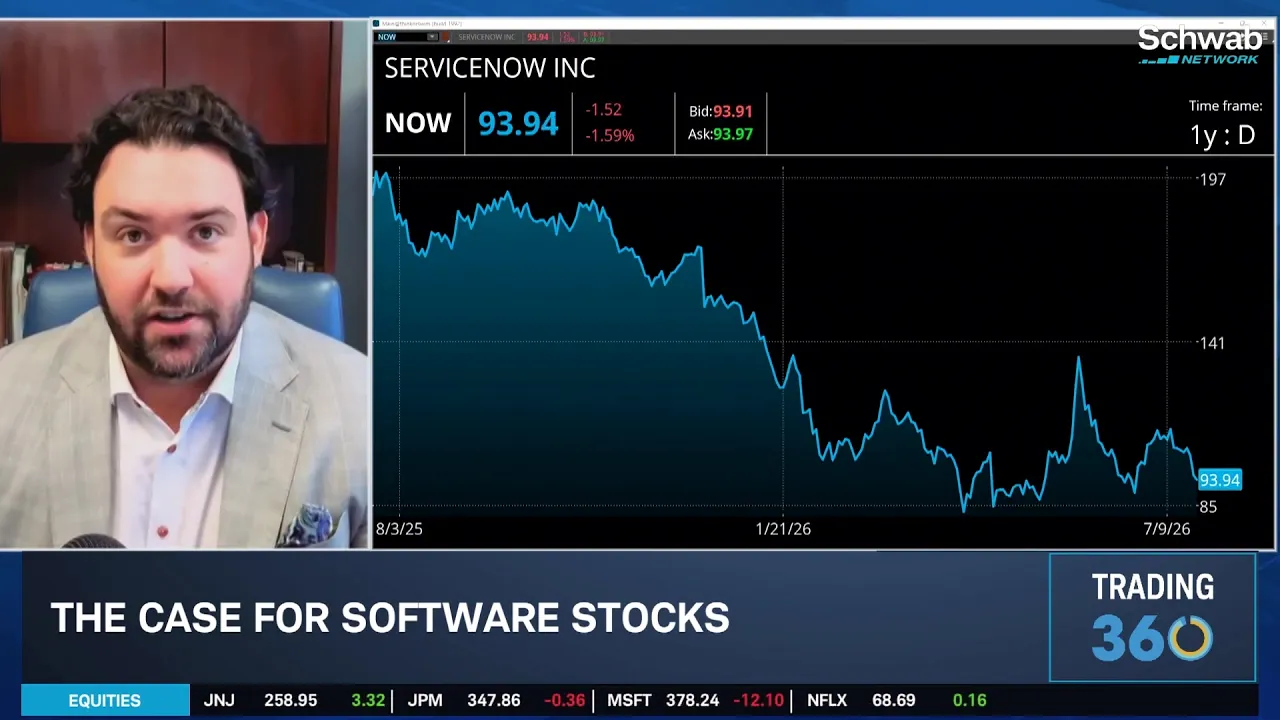
diversified. So lots to cover there. That's Jenny Horne, co-host of Next Gen investing. I do want to broaden out our conversation though. Take a look at the markets and some of the reaction that we're seeing today with our next guest, Luke Lloyd, joining us, president and CEO of Lloyd Financial Group. Luke, great to have you on the show. I mean, what a morning to have you on here. I'm looking across the sea of red on the board. We've got a ten year that's higher than we've seen in a year and a half. We've got oil over $90. We heard from these big names with big expectations. I'm looking at a mag seven that appears to still be red across the board. How are you looking at the market set up right now and what is actually driving the market right now? Well, you're seeing a lot of rotation happening. I mean, I just talked to my chief investment officer, and one of the important points and good points he brought up is if you take a look at the Nasdaq VIX compared to the S&P 500 VIX which is the volatility. It's the highest relative discrepancy since 2017. Specifically because of how high the volatility index is for the Nasdaq. And that shows you that how much rotation is kind of coming out of some of the leading technology stocks or like the even the Teslas of the world or some of the mag seven names, some of the semiconductor names that kind of gotten beaten down the past few weeks relative to the other names that, you know, a lot of money is flowing into like energy and financials and a lot of ways. So that market rotation is happening in some ways. I think that's going to happen, continue to happen. But what's also interesting is I think this is happening for a lot of the wrong reasons. And specifically what I'm referring to is these big tech stocks like Google. I mean, Google had an absolutely rock star earnings report yesterday. And the only reason that I can really find that it's beaten down is that investors and people are concerned because of their CapEx spending on AI. Just like if you remember a few weeks ago, Samsung had a great rock star earnings report and was beaten down because they said they're going to invest $650 billion into AI over the next ten years. So a lot of investors are concerned that they're spending so much money on AI. But I just don't get that. And I think eventually that narrative is going to change in the market. It's probably going to allow these companies to catch a bid eventually because for example, if demand comes out of the equation or we go through some sort of recession or demand falls off the table because the consumer starts to hurt, these companies can just pull back their CapEx spending. It's not like they have to spend money over the next ten years or five years, whatever it being hundreds of billions of dollars in AI if they don't want to. And the second thing is I want companies to grow. I want companies to invest money into the future. And when we talk about artificial intelligence, I know it's a big general macro, high level, you know, thing to say that just AI, there's so many aspects of AI, but AI is truly the next iteration of this technological revolution that's going to add so much productivity to the economic system and frankly, add so much margin to a lot of these companies as they kind of reduce overhead, you know, make their technological, you know, processes more efficient. AI is here to stay. So I want these companies to invest. And I think that narrative eventually is going to change that. They, you know, it's a good thing that these companies are investing in the future of technology and future of the world. You said something I loved in the notes that you sent over specifically about alphabet. You said, how dare they spend money to create AI used by 90% of the fortune 500? I mean, what a great point you bring up there. And also with Samsung, I mean, we've gotten these results that are the numbers everybody wanted. They're better than the numbers everybody wanted, and they're still getting battered because of this argument that they want to see this spend show up with some payoff. But we're in the early innings. So Luke, what has to give here? I mean, I've used this analogy before, but I feel like the goalpost is getting moved on us constantly. They say, oh, they just have to show this and it will be great. Well, they show it. And then all of a sudden we're over here and I'm off camera now. But that's what it feels like. So what has to happen for these companies in this quarter to get a positive reaction? Because I mean, look at Texas Instruments as well. A beat and raise quarter. Their AI is not even a huge part of their business, but the part that is showed huge growth and they're still getting a beat down to what needs to change and happen. And I thought it was going to happen, frankly, yesterday with the start of Google is the messaging. These CEOs and CFOs probably have 5 or 10 coaches that coach them on the messaging. They just continue to get it wrong. I mean, if I was in their shoes, I would talk less about how much money they're investing into the future of AI, because obviously it's not working too well to sustain their stock prices. I would talk more about how to add ROI or how much ROI is already being added because of the AI. Like you said, S&P 590% of them are using a lot of this AI, right? So talk about the ROI it's already delivering that needs to be changed that that needs to change. If that change, if that change this quarter, a lot of these stocks are probably catch a bid instead of be being sold off. I think in a lot of ways. The other thing is, you know, some of these stocks again, are getting unfairly beaten down. Look at what's happened with software in the past 3 or 4 months. Software, in our opinion, has been completely unfairly beaten down. A lot of these software stocks are trading at 14, 15, maybe 16 times forward earnings, which is like 30% less than the forward earnings in the S&P 500 trading between 20 and 21 times. When a lot of these other tech stocks that, you know, continue to catch a bid are way above 21 times forward earnings. So software you know, a lot of these names are so beaten down compared to even 2021 levels. I mean in 2021, some of these stocks were trading at 40 or 50 times forward earnings. So they're a lot of these companies are the same profitability. They have similar growth rates. And they're trading about a third of the valuation. They're trading at back just 4 or 5 years ago. So I think there's so much value out there right now specifically in software. I mean we've been picking up software names. It seems like almost every single week. I mean, we bought a camp, Akamai Technologies a KAM they're basically the highway for the internet. Recently. Cellebrite continues to be one. We like to sell software to defend or defend software to governments around the world. We still own Palantir. We think Palantir is probably going to catch a bid very soon. So is that money kind of rotation stops out of technology in other areas? We think a lot of the, you know, kind of rip your face off rally is going to happen in a lot of ways. And some of these technology names that have been unfairly, again, beaten down. But we just need to see that narrative change. And what's it going to take to change that narrative then? Because we heard from ServiceNow, which I had many conversations about sort of as the the leader of the SaaS occur, sort of the, the initiating cause for when we started to see this beat down in software, we hear from them yesterday better than expected earnings, revenue outlook, maybe a little bit light here. I mean, how are you looking at software? What do we have to hear from the rest of the names reporting to change that narrative to they need what investors need to hear is that AI is not going to replace software, or AI is not going to replace their innovation within software. It's only going to help them and aid them. Again, we need that messaging to be heard across the board within these earnings calls because, I mean, I was just talking about this yesterday on our podcast. You know, it's crazy to me. I have two brother in laws that are software engineers. I'm pretty technologically, I guess, advanced just being in 29 years old. I've been around technology my entire life. But my point to, you know, on this, on this podcast was, you know, I could my grandpa as an example, I was like 2 or 3 years old sitting on my grandpa's lap, playing around like the computer. My grandpa was just laughing the entire time because he couldn't believe how much, you know, I was doing on the computer, how much I knew my grandpa never knew how to operate a computer. He never, I don't think, logged on to the internet one time in his life when it was around for probably 25 years of his life. My point is, technological adoption adaptation takes a while to happen. So when you tell me that you know everyone using cloud or ChatGPT or Gemini and all these softwares are going to program their own software, each individual is going to program their own CRM, or they're going to program their own tax software to replace TurboTax. That's not going to happen. Of course, there's going to be a few very technologically advanced guys that have the time and grit and, you know, are going to leave, you know, wake up in the morning before their job, wake up after or go after their job to go on to cloud and program their stuff. Of course, there's going to be a few people, but not every person in America is going to go program every single software piece to help them in their day to day life. They're going to use other people's software company software. And frankly, the other reason too is I know somebody that programed their own CRM through Claude to replace something like HubSpot or replace something like CRM. It cost them $2,000 a month in cloud credits to maintain that CRM when they can probably spend 400 bucks or $300 a month just buying HubSpot or CRM directly. So not only does it very time intensive to program your own software, but it's also very, very expensive. Of course, as time goes on, some of those costs will come down, but I just don't believe the narrative that AI is going to replace software. I think these companies with big pocketbooks are going to be using AI to innovate their products even quicker and eat up the competition, or eat up the average Joe programing their own stuff. Hats off to the people who have the time and energy to do that when they get home. I don't I don't know about you, but some nights I can barely make dinner, so I'm not building my CRM dinner because I just am in the office all the time. But that's what you got to do sometimes. You know, I it's hard to live your everyday life as it is. You know, sometimes you want to shut your brain off. And I think that's, that's where again, I, I just can't believe the narrative that's been happening again for a long time. For about a week. It was like two months ago. It was going to be AI is going to replace trucking companies. AI is going to replace real estate brokerage companies. It's going to replace financial services. I just don't believe that narrative. Not ever decompression. Very important. I agree with you there, Luke. Great to have
Comentários 0
Entre para participar da discussão.
EntrarAinda não há comentários. Seja o primeiro a compartilhar sua opinião!