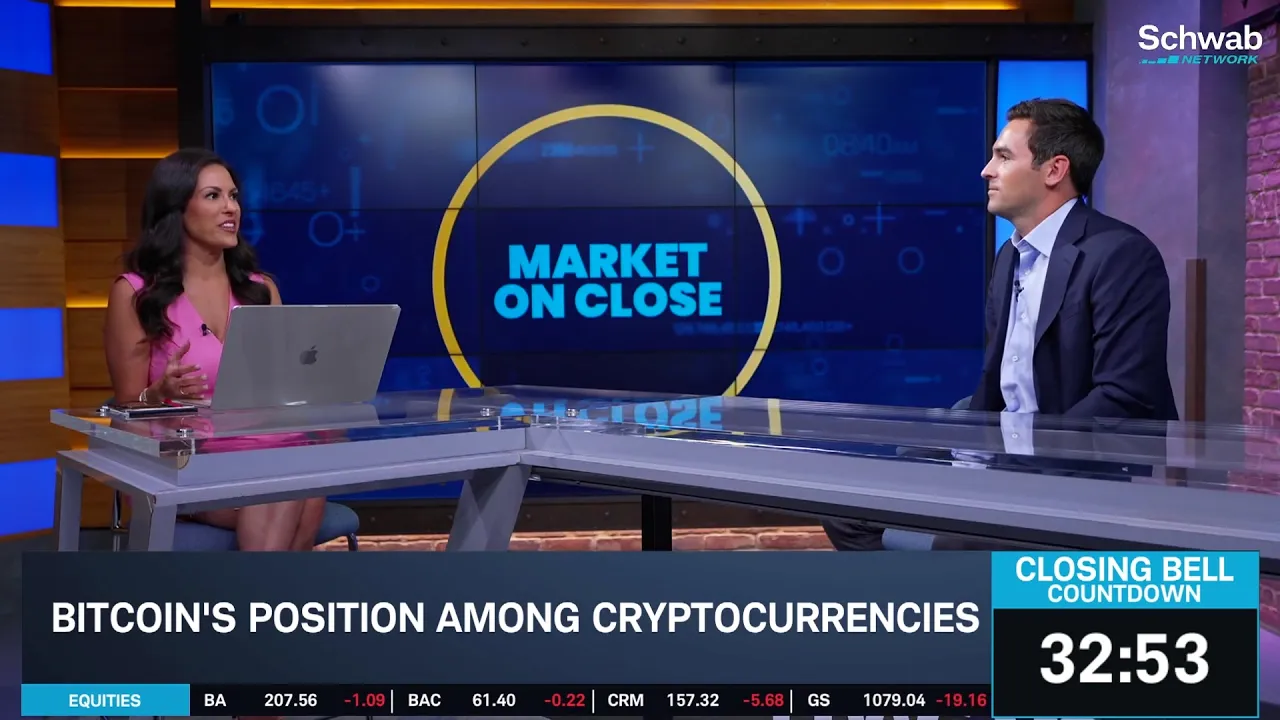
Bitcoin's Bear Market Ending? Bull Case in Clarity Act & Fed

- Retorno do vídeo
- -2,06%
- Chamadas
- 1
- Compra / Venda
- 1 0
- Publicado
Recomendações
Entrada é o preço de fechamento do ativo na data de publicação. Atual é o último fechamento registrado.
-
Entrada $65.614,00 26 jul 2026Atual $64.261,00 07 ago 2026Resultado −$1.353,00
that's why you should really hold an asset like Bitcoin.
Contexto “And so in the long run those trends remain. And that's why you should really hold an asset like Bitcoin.”
Transcrição Completa
Chicago. Thanks so much, Sam. Appreciate that. Joining me now in our Chicago studio to take a look at the future of crypto is a different Sam. Sam Callahan, director of Bitcoin strategy at orange BTC. Sam, great to have you in studio with us. Now as I'm taking a look at Bitcoin today, we're pulling back off of the month highs that we saw yesterday. We've got much higher oil prices. We've got yields higher. What's driving crypto right now. Is it is it the macro backdrop. Is it crypto specific news or a combination thereof. Yeah, I think it's a combination. I think in the beginning of the year, the whole narrative was the debasement trade. Everyone was talking about it. You know, people were really hedging against currency, fiscal or geopolitical uncertainty with the outbreak of the conflict in the Middle East. And then the tail risks kind of subsided. AI started to take off. You know, Bitcoin was competing for the marginal dollar, you know, and so there's a lot of options available for investors. And today Bitcoin is kind of taking a little bit of a breather. And with the macro backdrop where we're talking about more inflation pressures. You talk the fed is not talking about hiking interest rates, tighter liquidity conditions. All that is putting some pressure on Bitcoin. But it is kind of carving out of a bottom here. I think we're closer to the end of the bear market than the beginning. And there's a lot of green shoots ahead of us as well. All right. So if we've got green shoots ahead, I want to go back into this digital gold conversation. We had a lot more of this conversation at the beginning of the year when Bitcoin was closer to those highs. It's been trading a lot more like a risk asset though in we'll call it recent weeks, maybe months, we should say, how are you explaining that? And how are you looking at Bitcoin from a digital gold perspective? And also with the debasement trade that isn't happening as much right now. Yeah. And you know the debasement trade. I didn't really like the moniker because it's not so much of a trade. It's actually structural. When you look at the amount of debt in the system today and the risk of more currency debasement in the future, it's quite high. And Bitcoin has certain characteristics similar to gold. The scarcity, the resistance to debasement. Obviously, you can't really print any more Bitcoin. All those things are still true. But Bitcoin is still viewed broadly as a risk asset because of its short term volatility. People kind of bucket it together even though it has very different fundamentals than, say, tech stock. Now, as Bitcoin has grown more mature and it kind of has shared investors across different asset classes, now they kind of trade with the same investors, same flows, same rebalancing, same hedging strategies. So correlations can kind of come together and it kind of trades short term with liquidity conditions. But over the long term, Bitcoin's value proposition is the same. And it's a it's an asset that's decentralized, that can't be debased, that can't be censored. And in an environment of rising risks like that, it's still a long term asset and still has value as a diversification part of a portfolio. So as we look at the long term case here, we have to bring the inflation conversation in here because of the higher energy prices at the top of the show I was talking about, we've got oil right now just under $92 a barrel. How does that affect where we are in the cycle? You said you think we're nearing the end of the bear market. Does that delay the next leg higher for for Bitcoin. How closely do you view the correlation there. Well, if the fed comes out like Warsh last week in his testimony said that hey we're going to fight inflation. It's our number one priority to get price stability where we need it to be. If they start hiking interest rates, that could tighten liquidity conditions and put pressure on long duration non-yielding assets like Bitcoin, like gold. It has matured. It has it trades more like a macro asset in some ways. But another thing Morris said last week that caught my attention was said during crises. I will be quite aggressive with the balance sheet, with the assets that I buy, and that's what matters for a Bitcoin investor, because what we're betting on is that they're going to when when crises come, they'll continue to intervene. The fed put is alive and well. They'll expand the balance sheet. They'll come in and provide liquidity. And that's when Bitcoin really runs, because it's a bet on long term trends of higher debt accumulation, fed balance sheet expansion and more currency debasement because of these dynamics. And so when you look at the government spending, we're on track to spend more than last year. Nothing's really changed in terms of the fiscal outlook. And that's really what you're betting against with Bitcoin. So yes, if they come out and start hiking rates in the short term, it could put some pressure. But in the long run those trends remain. And that's why you should really hold an asset like Bitcoin. And so then let's talk about right now we're having these renewed conversations about the Clarity Act. It's trying it's seemingly trying to get itself passed before we get the recess on August 10th. It seems though today, maybe, perhaps its passage is becoming slightly less clear as we're getting more commentary on the release of the draft that we got yesterday. How important is that legislation to institutional adoption? I think it is quite important because if you look at any kind of survey, what's holding a lot of institutional investors back is a lack of regulatory clarity. When you look at the digital asset space, over the last years, there's been a need for some investor protections. And this is really more about outside of Bitcoin. It's really the broader space. It's how do you classify state stablecoins, other cryptocurrencies that might be labeled as securities? Who has oversight over them? That's the answers that the Clarity Act is trying to answer. And when you when you look at what it could do is it could make it easier for these financial institutions to build, to really lean into providing products and services around Bitcoin and digital assets. And Bitcoin being the largest, most well-established, most liquid asset will benefit because if investors feel more comfortable and have more confidence allocating to the space because they have more regulatory clarity, Bitcoin will probably be one of the biggest benefactors of that. So it matters. But Bitcoin has had regulatory clarity for ten years. It's a commodity. This is more about the broader digital asset space. I suggest that investors separate Bitcoin with the rest of the digital asset space, because it is very different in its technology, its value proposition. It is classified as a commodity. But in general, if somebody is waiting to allocate to digital assets and they have the Clarity Act passed, they'll feel more comfortable and Bitcoin will benefit from it. I want to dive into what you just said there, because I have had guests make the counterargument to me that they want all the crypto assets put together and viewed as a basket and not have Bitcoin in a separate conversation. So take me through. Yes, Bitcoin, you bring up a great point, has had its own regulatory framework for a longer period of time. It's certainly the most widely discussed and the most widely adopted at this point. But why do you view it as it should be held in a separate conversation? Because Bitcoin is the only one that truly is decentralized. It was the first. It has no issuer, no foundation. There's no marketing department around Bitcoin. It truly is a decentralized commodity. And it's trying to be a store of value. It's trying to be a new form of money. These other ones should be thought of as maybe riskier venture bets. There are technologies that are trying to develop different platforms, improve the efficiencies of the payment system or the traditional financial system. Bitcoin is trying to be a new store of value reserve asset, a digital money. It's a different bucket, different underlying technology, different value proposition different community. And so it really should be kind of viewed in that safe haven, gold like bucket, whereas the other one should be viewed as more of like venture, I would say different risk profile, different technologies, different different agendas completely. So that's how I view it. And I think that's how over time, most investors actually kind of come to that conclusion once they start to learn more about the underlying technologies. Sam, really appreciate you highlighting that. I always love when someone can bring their expertise and put into focus for us, why we should perhaps look at something more differently than the broader conversation is. Really appreciate you joining us today, especially here in studio. We love having the guests
Comentários 0
Entre para participar da discussão.
EntrarAinda não há comentários. Seja o primeiro a compartilhar sua opinião!