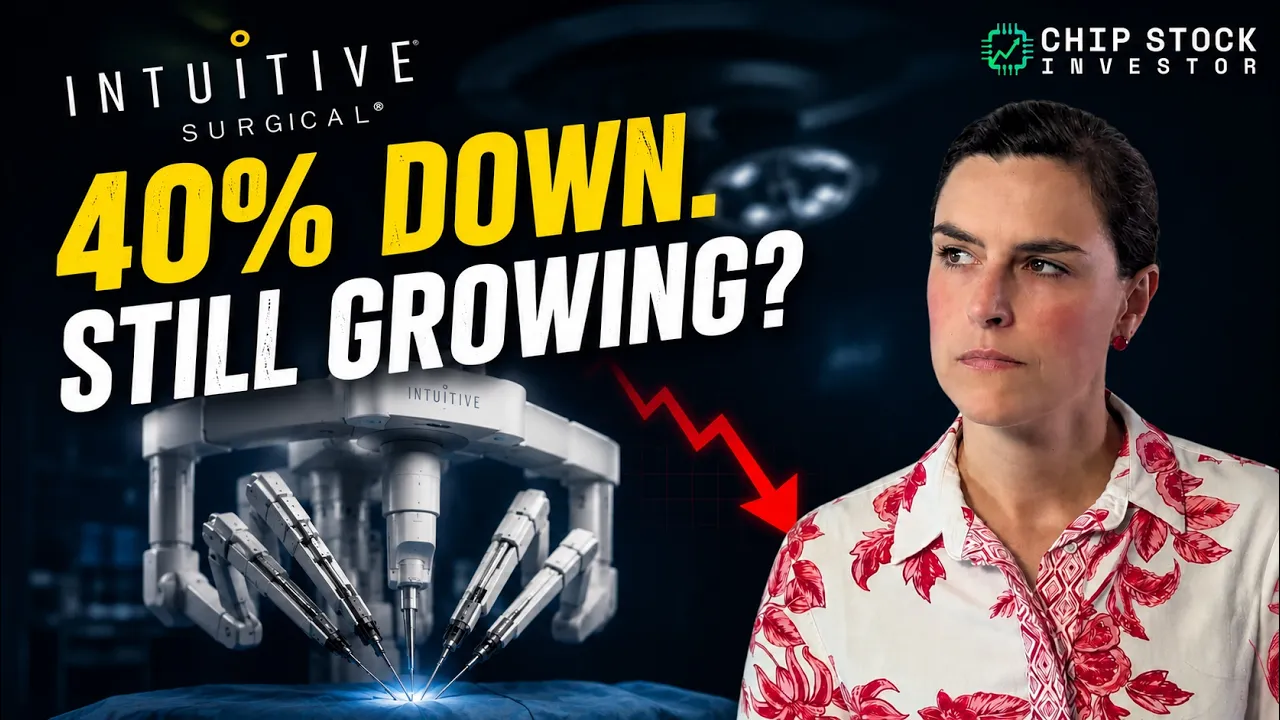
Is Intuitive Surgical a Buy After This 40% Drop?

- Retorno do vídeo
- +3,29%
- Chamadas
- 2
- Compra / Venda
- 2 0
- Publicado
Recomendações
Entrada é o preço de fechamento do ativo na data de publicação. Atual é o último fechamento registrado.
-
Entrada $361,80 28 jul 2026Atual $378,66 07 ago 2026Resultado +$16,86
whether that repricing has gone far enough to make Intuitive a buy-the-dip candidate.
Contexto ...whether that repricing has gone far enough to make Intuitive a buy-the-dip candidate. Let's take a look at the numbers for this most recent quarter.
-
Entrada $361,80 28 jul 2026Atual $378,66 07 ago 2026Resultado +$16,86
So is the stock a buy? Of course, we'll leave that up to you. ... So it's possible that at this price we might take a nibble.
Contexto "So is the stock a buy?" segment near the end of the transcript
Transcrição Completa
Intuitive Surgical just reported
their Q2 2026 earnings that on a standalone basis look like a really good
quarter for a really great business. But the stock does not
look like that's the story. Here's a look at the stock
chart over the last five years. You can see the price of Intuitive
Surgical down to three hundred and forty-five dollars at the time
of this recording, off well over forty percent from its early twenty
twenty-five and twenty twenty-six highs, touching nearly six hundred dollars. And I just wanna call out, we're
going to be using a number of charts from our friends over at fiscal.ai. Of course, they don't just have charts
like this, like a stock chart, they have some great tools to help you
analyze businesses, see where their revenue's coming from, see where
there's risk, like this one right here. Intuitive Surgical's revenue breakdown. We're gonna take a look at this here
in just a moment, but seeing that recurring revenue versus the systems
revenue versus the services revenue, super helpful in understanding what's
going on at Intuitive Surgical. Make sure you check out fiscal.ai/csi. That link gets you 15% off any paid plan. Check it out, fiscal.ai/csi. You can see that the CAGR over
the last five years for the stock is actually pretty bad, only
about 1.7% annualized growth. And over that same period of
time, all the other metrics for Intuitive Surgical has gone up. I'm talking about procedures,
their installed base, revenue, earnings, cash pile. Everything has gone up, but the
stock is back down to this level. So one of the things that we've mentioned
here about Intuitive Surgical is that it is always traded at a premium. But it seems that the market
is repricing what it's willing to pay for Intuitive Surgical. So the question we wanna answer
is why, and whether that repricing has gone far enough to make
Intuitive a buy-the-dip candidate. Let's take a look at the numbers
for this most recent quarter. Da Vinci procedure growth up 15%
year-over-year, which is right near the top of management's
maintained full-year 2026 guidance. The installed base of Da Vinci systems up
12%, nearly 12,000 systems worldwide now. There were 468 Da Vinci
systems placed in the quarter. And by the numbers, revenue
nearly $3 billion at $2.9 billion, up 19% year-over-year. And their non-GAAP gross margin up a bit
as well from the previous quarter to 70%. So they're finally catching up with
some of those manufacturing and scalability things like getting
the Da Vinci 5 out as well. Here's the geography of
these da Vinci systems. The vast majority, of course, 6.6
thousand in the United States. Europe, a growing market, 2.3 thousand. Asia as well, starting to
expand at just over 2,000 there. Rest of world, 659. We've talked about this. Intuitive Surgical continues to
talk about their ability to expand in some of these other geographies,
which they are very obviously doing. Let's go back to this chart from fiscal.ai
on Intuitive Surgical's revenue breakdown. In blue, you have instruments and
accessories revenue, in orange systems revenue, and in purple services revenue. This is one of the things that we
really like about Intuitive Surgical. They have a recurring revenue stream here
with their instruments and accessories. In fact, three-quarters of the
business revenue is recurring surgical instruments, and that shows up whether
or not a hospital system decides to buy a new da Vinci system or Ion
system or not in any given quarter. Every surgery that needs to be
completed has instruments associated with that procedure, which we're
gonna touch on a little bit later here in just a few moments. But up until this point, these
surgical instruments are either a one-time use or a very limited
time use if they're reprocessed. And their systems being the most
volatile revenue line item because not every quarter is going to be the same. They're not gonna be placing the same
amount of systems every single quarter. But it's also the fastest grower
as far as revenue goes, twenty-four percent CAGR over the last few years. And this makes sense, especially since the
average selling price for a new da Vinci system, the fifth generation units, are
still in the early innings of release. But now they're over
1.6 million per device. Intuitive Surgical has had a fantastic
balance sheet for quite some time, 8.6 billion in cash and equivalents, no debt. So whatever the storm that the market
thinks is coming for the US healthcare sector, Intuitive definitely has a nice
cash cushion for some negative scenarios. And maybe you're wondering why I
mention that right now, maybe, a storm coming for the US healthcare sector. We're gonna touch on that later. We had a great CSI Live where we recently
talked about healthcare and investing in healthcare and why it's so hard. One of the reasons is the US healthcare
system is quite the mess, and we're gonna touch on this here later
in this episode in just a moment. Now let's segue into some
expectations for Intuitive Surgical. This is another fiscal chart, and
one of the nice things is they have the expectations from Wall Street
embedded in their charting system here. So you can see this most recent
quarter on the left, and then the expectations over the next calendar year. And so on a trailing 12-month basis
for full year 2026, that would bring the earnings per share to about
$10, and perhaps up to $12 earnings per share for full year 2027. That's gonna come in handy when we talk
about the reverse DCF at the end of this video and maybe what the market is
pricing in to the stock price currently. But before we get to that, I just
want to show you a few charts that Intuitive Surgical supplied showing
their growth of systems and their utilization rates because this
is very important to the story. So here's three of their flagship
products, the da Vinci MultiPort, the da Vinci 5 is the newest of these. Procedure growth up, install base
growth up, and the utilization rates are climbing as well. The da Vinci single port, you can
see massive amount of growth in their procedures there, 87% year over year. Installed base is up 39% year over year,
and the utilization up nearly 30% as well. And one that I am really
excited about is the Ion. This one is for lung biopsies
and lung examination. Procedures up 51%, installed base up 24%,
and growing utilization for that as well. Cool tech, saves lives, and now the
numbers are finally getting big enough to move the needle for Intuitive Surgical. Here's a look at the system placements
and installed base on a geographical basis on the right, and on the
left we have greenfield or new system placements versus trade-in. You can see that trade-ins are
starting to make a good portion of the system placements. That's because of that new da Vinci 5. Hospital systems are trading
in older equipment, upgrading to this newest system. In the installed base on the right
there, United States, as we showed you earlier, the biggest portion of the pie. But some of these other markets are
definitely starting to pick up some steam. And this leads us to the answering
of our question, why did the stock take such a beating, and
is this a buy the dip candidate? Now, there's a few things that management
called out and definitely analysts were concerned about in the call. One of them is the impact
from the Affordable Care Act or ACA subsidy expirations. ACA up until this point had a
number of subsidies helping folks afford some of that affordable
healthcare, and those are running out. And so what that means is folks
are actually opting not to renew those insurance premiums. It's getting too expensive, and so they
think, you know what, I'm actually going to take the tax hit, and I'm just gonna go
without insurance, which leads to an issue with, quote unquote, elective procedures. Elective procedures meaning something
that you could possibly put off. Most surgeries are not elective. There's very few that actually fit into
that category, but at least some patients are deciding to put some of those off
because of their lack of health insurance. Management talked about
this on the earnings call. This quote from Jamie Samath, who
is the CFO at Intuitive, he said that, "Based on customer feedback,
we believe there's a modest adverse impact to Q2 US da Vinci procedure
growth from those patients impacted by the expiration of subsidies for ACA or
Affordable Care Act enhanced premiums." Basically, long story short,
the affordable in the Affordable Care Act is getting much less
affordable, and Americans are making a really tough decision. And so how exposed is Intuitive
Surgical really to this market? This is another comment
made by CEO David Rosa. He said that they don't have a
precise estimate, but a significant portion of the business is private
pay or commercial insurance. Medicare is a lower portion,
and Medicaid is lower yet again. So they don't have an exact estimate,
or they weren't willing to share an exact estimate of what portion
is affected by the business based on those ACA subsidies expiring. But that is definitely something
the market wants to know, whether or not they're gonna be
affected by something like this. And the reason investors could be and
probably should be worried about this is if ACA falls off, if Medicaid patients
become a bigger portion of the pie, hospitals have to eat more bad debt. And when hospitals have more debt,
they are probably not in the market for nearly two million dollar machines. But again, management stressed
that they feel like the US capital environment has been stable. There's been healthy system
placements in the US, up to 24%. They feel like there is plenty
of flexibility in capital budget constraints, and so they feel
like this is not something to be too concerned about at this time. I also wanna give a shout-out to the
semiconductor memory market, because that was specifically mentioned on the call. The management said that is a
factor, higher costs for freight and semiconductor memory. So even companies like Intuitive
Surgical are feeling the squeeze from the semiconductor industry. But a couple of positive catalysts that
we wanna call out here, the extended use program that management mentioned. They're gonna increase a number of uses
on a subset of the EndoWrist instruments to lower customer cost per procedure. So their thinking is lower cost
equals broader adoption equals higher utilization, which means they can
innovate more at Intuitive Surgical. So small give and take here. Maybe allow their customers to use
these instruments for a little bit longer than they have previously,
allow them to reprocess them, and in turn, the hospital saves money
and can spend more money later on. Another interesting thing that
management mentioned is that they submitted to the FDA a 510 clearance
for a flexible robotic endoscope for the GI tract or gastrointestinal tract. We don't know if that's going to
go through or what the timeframe is on that there, but something
to keep in mind for the future. Let's move on to the
guidance for full year 2026. Management just reiterated what
they said earlier this year. They said 13.5 to 15.5% procedure growth. Expectation is they're gonna
land near the midpoint of that. This range already bakes in this
ACA patient behavior headwind, China pricing pressure, European healthcare
capital pressure, Japan GLP-1 obesity, lowering bariatric procedures. All of those things are baked
into that guidance again. The last time we covered Intuitive
Surgical over on Chip Stock Investor, at the time, the stock price was much
higher, and it required about a 22% per share growth rate for a decade to justify
the price it was at that time, which is obviously quite the high bar to clear. So the stock price has come down now. Let's look at a couple of
scenarios that could be baked into the stock price right now. Okay, so here is the first one. This one is over a shorter
time horizon, only five years. Terminal growth rate of 6%, and that
would require a 17% earnings per share growth rate for the next five years. Before we get too far into the weeds
here, let's show you the second one, which is a 10-year time horizon. Terminal growth rate of 4%, lower than
that 6%, gets us to a growth rate of 15% per year over the next 10 years to justify
the stock price at around $347 per share. So keeping those two in mind, there's
a few scenarios that we think either one or a combination of all three could
be why the market got to the current valuation that the stock is at right now. The first one, slower growth
because investors fear a healthcare bubble and growing cracks in
the US healthcare foundation. This could be what's happening
with that shorter time horizon. Investors maybe are willing to go with
that first reverse DCF time horizon of five years, but they can't see clearly
enough past the possibility of the real issues that we talked about, including
the ACA enrollees dropping, maybe Medicaid tightening, maybe hospital bad debt,
elective surgeries getting deferred. So they shorten that growth
window instead of extending it. So in this scenario, maybe you believe
that the stock is fairly valued if you think that the growth story can
hold on for about five years before there is some US health system strains
and maybe has a crisis, if at all. The second scenario may be a
slower growing but longer duration. That's the 10-year time horizon. The market could be saying that
Intuitive Surgical keeps compounding for a decade, but at 15% rather than a
higher growth rate, and it eventually matures to a 4% terminal, which is below
the historical premium for Intuitive. The issues that could play out
here is a growing competition. Although Intuitive Surgical, as
we have mentioned is way ahead of any of its other competitors. But over the years, that gap could narrow. GLP-1s could continue to erode
the bariatric surgical procedures. And ultimately, as Intuitive installs
more devices, more systems in hospital systems, maybe the growth rate just
starts to mature and level out as well. And then finally, let's go to
scenario three, which is actually the simplest of all explanations on
why Intuitive has taken such a hit. There's a $1 trillion market rotation, as
in investor money is just not generally interested in healthcare right now. Maybe something with all of the
manufacturing that has been announced over the coming year and a half through
2027, all of the US reshoring and manufacturing and AI infrastructure,
healthcare is just broadly out of favor. Investors are paying less
for the same earnings. So it could be one of those scenarios,
it could be all three of those scenario. Most of the time, as you know here at
CSI, we preach radical moderation, so we think that it's somewhere in the
middle of all of these three scenarios. Intuitive has always been a premium stock. Now it's down significantly. So is the stock a buy? Of course, we'll leave that up to you. But this is the first time in a
good long while that some of the reverse DCF scenarios are asking
for a growth rate that is below what the business is actually delivering. They have a great balance sheet,
platform optionality, growth innovation. So it's possible that at this
price we might take a nibble. We haven't made any firm decisions yet,
but we need to assess whether or not we're in need of more large cap value
positioning in our portfolio personally. Make sure you check out fiscal.ai/csi
where you can make great charts like you saw in this video, and make
sure you hit the subscribe button. Check out chipstockinvestor.com and
if you wanna know more about that tech rotation, the $1 trillion tech
rotation, check out this video that we did just last week on that right here
on hyperscaler capital expenditures. Watch it now.
Comentários 0
Entre para participar da discussão.
EntrarAinda não há comentários. Seja o primeiro a compartilhar sua opinião!