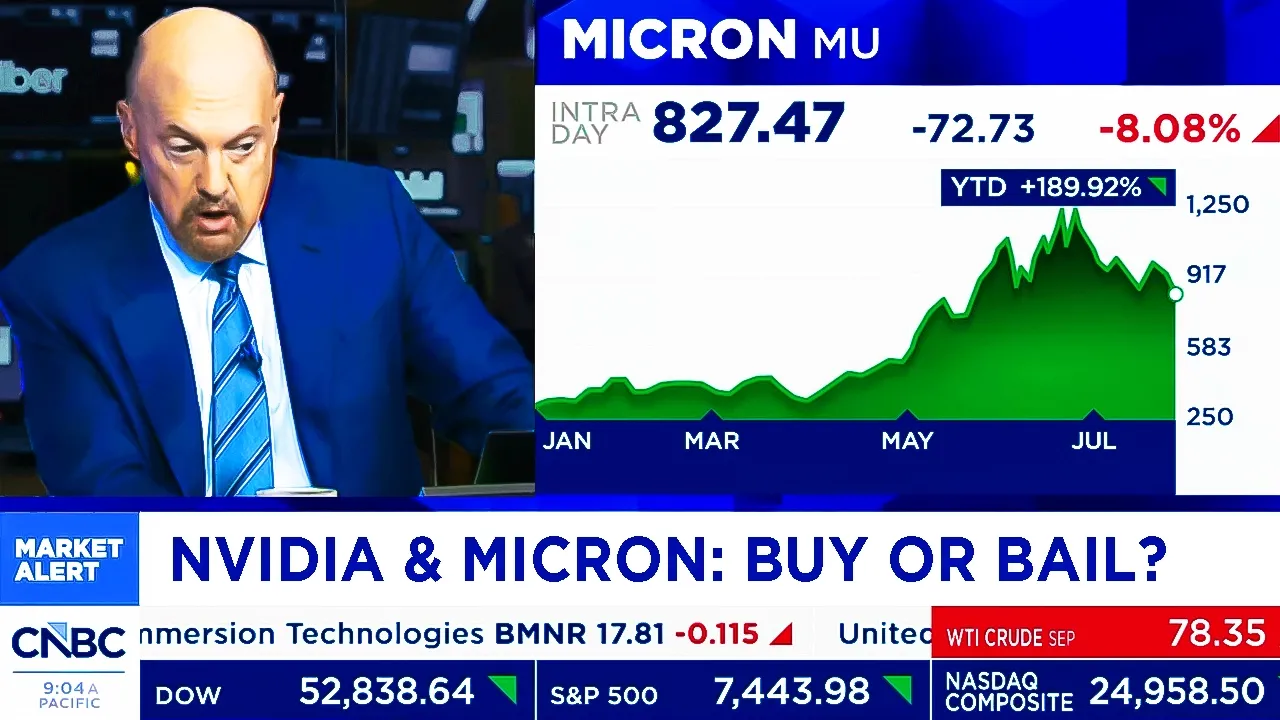
CNBC & Fox Today On NVIDIA Stock, Micron Stock, SK Hynix Stock - NVDA Update

- Retorno do vídeo
- +5,21%
- Chamadas
- 2
- Compra / Venda
- 2 0
- Publicado
Recomendações
Entrada é o preço de fechamento do ativo na data de publicação. Atual é o último fechamento registrado.
-
Entrada $820,53 28 jul 2026Atual $858,03 07 ago 2026Resultado +$37,50
I thought that was a good time to take a little small position.
Contexto "Micron is not a lagard by any means, but it fell 30% and I thought that was a good time to take a little small position."
-
Entrada $354,27 28 jul 2026Atual $364,87 05 ago 2026Resultado +$10,60
if you want, go by Sherwin Williams.
Contexto "IVE BEEN SAYING IF YOU WANT, GO BY SHERWIN WILLIAMS. THAT PAINT doesn’t dry as slow as the other paint."
Transcrição Completa
It's chip stock seller off again. Pull out and video. Let's have a look at that. They've lost 250 billion in market cap. The same amount of money that they're putting into their massive open AI data project. Are they just spending too much? Is that why he's down? >> I don't think they're spending too much, Steve. So, to read into that report from yesterday a little bit more with Nvidia and OpenAI, they are backing OpenAI taking out this loan, but Nvidia itself is not writing that check. They're coming in and saying, "We have a great balance sheet. we would support OpenAI if they were to default. So if OpenAI defaults, then Nvidia has to pay. But if you look at Nvidia's free cash flow estimates for the next year, I mean, they're estimated to bring in $24 billion in 2027 and only spend 8 billion. So they end up having to foot that bill if OpenAI can't pay. And I think that's the market's problem here because OpenAI is an Nvidia customer. That's like me giving you a giving a customer a loan saying, "Okay, you you own a sandwich shop. I'm a property owner. if you can't pay the loan, I'll back the loan for you. Well, at the end of the day, that's an issue because the two businesses are related. And so, that's the issue with Nvidia right now. Not necessarily how much they're spending, but the circular financing argument is definitely back in vogue right now. >> People got the analysts got ahead of the companies in many different cases and we're just repealing we're repealing a lot of the gains, but I also think there's this undercurrent um and it's about Nvidia. Uh Nvidia can bounce it. Why not? It's a great company. where they were guaranteeing companies like OpenAI. And if OpenAI can't come public as high as it did the last round, >> well, that would be in venture capital world disaster. >> Uh Nvidia uh joined the CDS party watch uh yesterday. Cheaper than it's been since 2015. Your Glowworm, Jim, that's a 55% draw down in 4 weeks. >> We sold that stock over and over again. I couldn't believe it was hanging up there. And every time we sold it went up. And every time I said, "I'm an idiot. I'm an Well, you look a little smarter now." >> Yeah, you do. >> But I've got to tell you, David, any one of these, look at Micron. >> But I'm taking I'm going to take issue with uh your thesis here, my friend. >> Why are you taking issue? >> Because because at the end of the day, it's not clear to me that there is any uh slowing of spending whatsoever by any any company, any of the customers, of the data centers, any of it. There's no slowing. Well, that what I'm saying is the money's going to run out because the people who are lending these people who want to keep spending forever are done. They're sick of it. They don't want to do it. If you pull out the Black Rocket, how great that is. You pull that out. >> Money's not running out. Money's not running out. >> It's getting more expensive. >> It's not going to run out. They're not >> It is going to run out. It is going to run out. >> Rich McInn, it is going to run out. I I remember being with Lucid right at the end of the year and they told me if this Brazil order comes through, if the Brazil order, the Brazil order, remember the Brazil order? >> I remember the Brazil. >> I remember Rich, >> you know, I mean, Brazilian nuts. I mean, it was just incredible how bad it was at the end. And they were all saying it was great and there was so much money. Now these are all much better companies but the people who trigger pull many of them either look the charts the symbol passed out from JP Morgan saying look these are you just covered them up just saying look this do you don't even know which year it is or they're saying enough I sent I sent a note today meta sent me real long thing about how we did this and jobs created job I said no it doesn't work anymore in response to the times piece about Hyperion yesterday >> this is the one that they put out about this. But to the point you're making the gym, the money is not running out. Last night, last night, >> Black Rockck did a $12.5 billion 144A bond sale. There was a time not that long ago when a 12.5 billion bond sale overnight would have been something we' been, Wow, that's a lot of money. This is this is they snapped it up. You know why? because Meta is the ultimate customer for what's going to be 1 gawatt of a data center down in uh El Paso area of Texas. They had planned this, but now Black Rockck is coming in as their partner. They'll own 80% of the equity. Meta will own 20% and then Meta is going to spend this is going to cost 14 billion. And then Metagim is going to spend I don't know what the number is. They're not sharing it, but I'll guess based on one gigawatt $35 billion to fill up all the stuff inside. >> You want your stock to explode in your Amazon? You say, "You know what? We've got all we need. We've got all we need." >> You think You think more >> one of them's going to blink. >> You think lower? >> Now, this market is saying one of them will blink. >> Well, if you're right, then we got a lot longer down. >> What? Oh, where's you been? >> I've been sitting next to you. >> I've been saying this. I'VE BEEN SAYING IF YOU WANT, GO BY SHERWIN WILLIAMS. THAT PAINT doesn't dry as slow as the other paint. >> THAT'S FAST DRY. Let's have a look at Nvidia. Are they just spending too much money without getting the results that people demand? >> The market's starting to believe that. Uh Stuart, I can tell you I watched the credit markets and I will tell you their um uh CDs, the credit default uh swaps, the price for them skyrocketed yesterday the most ever. So there's a a simple disbelief as far as the numbers. And your guest earlier said the two magic words uh which are not so magical and that's circular financing where companies are funding other companies to buy their product and I will tell you that that is a worrisome sign and the numbers being bandied about are just gargantuan and a lot of companies have already paid a stiff price uh for these type of things. I remember Oracle uh a year ago announced gargantuan numbers and the stock's down 60%. So uh we're being very careful here. The uh semis AI trade right now is under serious pressure and I I just be very careful not withstanding any bounces at this time. >> We had a big debate fight between Jim and David about whether or not >> fight we never fight >> about whether capex guidance does get a second derivative moment. >> You think it does? >> So what do you mean by that? >> Just meaning we're going to raise our capex next year less than we have in the past. Maybe we keep it steady. >> Yeah. So I think the delta on capex is going to slow right that doesn't mean it's going to stop but 2027 and 28 the delta into those years are going to slow but I don't think that that slows down negative no and I don't think it slows down the supply demand imbalance for semiconductor chips right now there's a 70% increase in demand for chips and a 30% increase in supply that can close but I still think that that leads you to believe that you should be invested in that theme >> so yeah You're a long-term believer. You've said it already. Yeah. In this capital spending cycle just continuing and in AI ultimately proving those who are spending the money right in terms of the returns it will bring. >> Yeah, that's right, David. In the but in the near term, you can't ignore that value is outperforming growth this year that the equated S&P 500 is trouncing the cap weighted S&P 500. But again, I think that has more to do with the profitability of those sectors other than tech than an alarm. Well, when you do get to a multiple on Nvidia that's sort of in the low teens. I mean, >> yeah, it's it's >> it can become alluring, can't it? >> It certainly can become alluring and and that's what I said earlier, right? So, now we're at a a decade low in the premium of Mag 7 versus the 493. So, if you have an investment horizon that's reasonable, I think that's a very attractive entry point there. Let's begin with tech though and this selloff that we've seen across some of the biggest names in semis. joining us here as we said at post9 city research global head of tech and communications Heath Terry H. It's great to have you back. >> Yeah, great to be our >> feel like we do this every few weeks. We have you in and try to get a gut check on whether the this reset makes sense and whether it's going to manifest itself in real changes to capex guidance, let's say. >> Yeah, look, I I I think it does make sense, right? There's a lot that's happened since the last time I was here. You know, I I think I was here around the the the same time that the stocks was at an all-time high. we were up 115% or so year to date at that point. We're still up about 55% so far here. Um so it gives you a sense of the scale of the correction that you've seen. But in that time we've seen data center delays. We've seen um open model competition. We've seen a lot of regulatory issues that have that have crept up um that have created issues for the for the frontier model providers. And then you've seen a lot of positioning which I think more than anything is what's impacting uh the the market broadly. you had sort of max positioning in favor of things like memory and storage. Um you've seen some of that obviously unwind as the leverage piece of it became more and more of an issue for for a lot of investors and the timing part of it right when we see these data center delays right we've had 300 um different data center moratoriums at a local level come through since the beginning of the year including the state of New York um that pushes a lot of that supply back up the supply chain which impacts the the uh the broader market um for the spot market and I I think that's what has people worried right now. >> You do think though that to the degree that there's newfound price sensitivity, right, for all for all these components and services that that extends the cycle. Is it is it good news? >> Yeah, abs. Absolutely. I mean, I I think and and to be clear, there's there doesn't seem to be a lot of price sensitivity, right? We we heard it in the Alphabet earnings last week. They're increasing their capbacks investments. They're actually pulling things forward into into this investment. We'll see what Meta and Microsoft and Amazon have to to say this week, but I suspect it's going to be very similar with regard to capex. You just had a post on uh Twitter yesterday from uh one of Microsoft's AI leads about the only sustainable competitive advantage being compute. That's not something that somebody who's thinking about cutting their capex spend or who has suddenly become price sensitive about what they're paying for chips um posts a couple of days before earnings. do does is stock price action a negative uh reaction function? In other words, can these companies continue to guide that way seeing how stocks are tending to react? Yeah, cuz I don't think we've I don't think we've seen the kind of negative reaction that changes behavior here yet. Um, borrowing costs are getting higher, which is why Nvidia reportedly is stepping in with $750 billion of of investment in this space, which of course is that circular investment that bothers all of of market participants. Um, and so it's it's a question of sort of short short-term versus long-term. There's no company out there, and again, you saw it with Google earlier last last week, there's no company out there that wants to blink in terms of the pacing of building out versus their competitors. We've seen, you know, Microsoft kind of did that last year and they've regretted it ever since. >> And you think that, you think that environment remains? It does. But anybody who is who chickens out, so to speak, will regret it later. >> Nobody wants to be in that in that position. The the the guiding principle for all of these companies, and they told us this almost 3 years ago now, the risk of underinvesting is far greater than the risk of overinvesting. That hasn't changed. >> Right. How about the action in Korea? Is it is it infecting you think a US mindset in a way? >> Yeah, absolutely. Because all of this stuff is is tied together, right? Especially now that that Highex is listed here in the US. Micron is obviously very closely tied to that and is a big part of the sentiment around around all of this. But the touchstone that we come back to on this is always enterprise demand. Is the enterprise demand that's there from companies like Fizer and Walmart and Unilver and Visa. is the enterprise demand for these kind of uh these kind of AI tools still strong enough to justify the investment that's being made and you see it in the backlog numbers for all of the hyperscalers the acceleration that we've seen in hyperscaler backlog and we'll see in hyperscaler backlog this week the acceleration in the AI revenues out of out of GCP last week from Alphabet um all of that reflects that enterprise demand accelerating and that's that's ultimately the main thing that matters >> so that journal piece over the weekend corporate America has stopped blowing money on AI. I assume you think that is thematically off base. >> It it it's it's just every everyone stopped blowing money on AI to the extent that you were just spending with no real thought around the return that you were getting from it, which not many companies were doing that in the first place to be clear. Um that is, you know, that's that's off the table. Every company is looking at efficiency. How do they develop routing technologies? How do they optimize? whether it's using open source, whether it's using over older older models to make sure that they're getting the most out of their their their spend, but the overall spend is going up. The cost per query uh is is declining as we get more efficient around that, but everyone's overall spend is going to continue to accelerate. Are you a couple of weeks ago I took a personal position purely based on momentum in Nvidia Mike was up about 5 a half% didn't want to lose 5% on the trade had a stop down below >> to lose 5% guess what got stopped out this morning here comes the reversal it's now higher by a few pennies and I'm saving America and everyone that's logging video >> so we threw your position into the volcano as a sacrifice I guess that worked uh Steph here's the thing with saying that it is a pure positioning unwind and the rest of the market has actually benefited from this rotation. On the way up, it was largely a position stampede. It was a crowding into what was winning and we don't know where the equilibrium is. Right? You have Wells Fargo this morning saying that, you know, are semis discounting much slower growth and is that a correct thing that the market's doing? Essentially compressing the valuations and saying we're not really sure how many years uh we can count on this earnings story. So if you think that the semi cycle is over, then you think that the capex cycle is over. And I firmly believe that we are not at the end of the capex cycle. The hyperscalers are going to spend about $800 billion this year. I would not be surprised, Mike, if they go to $1.6 trillion next year because they have to, right? They they see the growth. They see the momentum in their business. We are short everything from memory to compute to copper to aluminum to everything. So to me I don't think the cycle is over. This could be a pause and maybe you don't want to own the hyperscalers cuz they haven't done that well this year. Um and maybe maybe semiconductors do take a pause. What I think is interesting is like every day it's either the semis are on and the software names are off or the software names are up and the semis are down. Um, so the way I've taken uh the the approach is the the semis that I own, they've actually been the lagards. It's Broadcom. I just initiated a position in Nvidia. Micron is not a lagard by any means, but it fell 30% and I thought that was a good time to take a little small position. But with with Broadcom and Nvidia specifically, they have derated. Their multiples are actually quite attractive at this moment in time. I mean, Nvidia's at 18 times. It's the cheapest since 2019. Broadcom's at 21 times. Its long-term average is 28. It got as high as 45. So to me, and and both stocks have lagged this the sector by 52% year to date. So to me, like if I can say they're a little safer, they feel a little safer and the fundamentals are very very strong. So I think you want to pay attention to the semis. It's 19% of the S&P 500. Uh software is only 7%. So you know, you got you want to own both. I think um that's the way I'm I'm I'm playing it. having a broad having a barbell >> Josh um semis are you know whatever they are just under 20% depending on how we're taking the snapshot um if capex is going up and the semis therefore are are undergurted by that earning story then what are we doing with the the companies spending the money because that's been the problem we've sent all we know this it's been just a broken record the free cash flow is going from the hyperscalers to the hardware food chain the hyperscalers used to trade at a higher multiple the food chain trades at lower multiples. It doesn't help the overall S&P 500. Let's not yet talk about the non- tech parts of the market which are working. But how does this play out? It doesn't matter for for an investor. I think the good news is that it's such a healthy bull market that in real time some of the leadership groups are going through this kind of alternating uh bubble burst, but it's not knocking the major uh secular uptrend off course. And what I mean by that is a lot of times you'll see a monster rally in one narrow area of the market and maybe we'll see some of those superlatives where that area of the market becomes 10% of an index, 20% of an index and then the investor class gets so uh gets so sucked into it that it almost has to cause a marketwide event for that market to to clear and sanity to return. We don't have that in this case because there are so many uh things working that we could see this bubble burst in real time and have the rest of the market within a percent or two of all-time record highs. This is like what you pray for in advance. If I tell you there's a bull market coming, this is exactly the description of the bull market that you would ask for if you know anything about history. Every stock in the SMH is now below its 50-day moving average. The average 52- week draw down for each SMH component is 30%. And the RSIs of these names have been completely wiped out. They've gone from momentum darling one-way trade consensus long must own as recently as June to an average RSI of 39. This is great news because we have enough strength all over the tape to absorb this kind of pain happening in what was the leadership group for this market in the first half. I don't see how you could be glass half empty on this. >> All right, I hope you're all doing well today and staying calm in this market. Today was another mixed day in a market with many software stocks trading higher while many tech hardware stocks and stocks of companies associated with the data center buildout traded notably lower. Much like Monday's session, the divergence among tech stocks on Tuesday is even more visible when looking at a heat map of the NASDAQ 100. Nvidia initially traded lower in the morning, but recovered from the lows of the day before market close. I'm going to cover today's news, but really quick, let me provide some context from Monday because it's directly relevant to the news I'm about to cover. On Monday, market participants began selling off many tech hardware stocks in what I believe was an overreaction to multiple news stories that I covered in Monday night's video. One of those stories was a report published by the Wall Street Journal Sunday night claiming that Nvidia is in talks with OpenAI to guarantee $250 billion in financing for a data center project in Ohio. As I mentioned in Monday night's video, the project is 10 gawatt. The first phase of 800 megawatts is expected to be finished in 2028. That is only 8% of the total project's power, and it's not even expected to be finished until 2028. The $250 billion would be a guarantee supporting a series of financing vehicles over the project's buildout, not an immediate cash investment by Nvidia. We are not talking about Nvidia handing over a check worth $250 billion to OpenAI all at once. Nvidia would effectively lend its creditworthiness to the transaction, allowing the developer to raise debt on better terms, then it could base solely on OpenAI's lack of an investment grade credit rating. This would essentially serve as a credit back stop if OpenAI or the financing vehicles were unable to meet the covered obligations. That does not mean that OpenAI will default. It's simply a credit back stop. Additionally, we've yet to receive confirmation as to whether the report is true or not. But market participants don't care about any of that. They immediately assumed something's wrong with Open AI and decided to sell off Nvidia and other tech hardware stocks on Monday. And now with that context in mind, let's cover Tuesday's news. On Tuesday, the Financial Times published a report with a headline, "Nvidia behind $50 billion lease on Texas data center that will use its chips." You can imagine how bad the headline sounds to the unknowing reader after what the Wall Street Journal just reported about Nvidia and Open AI Sunday. But the details of the article reveal something much less concerning than what the headline implies. The FT says that Nvidia is leasing Hut 8's 1 gawatt campus in Texas with initial 15-year contracts worth about $20 billion. Yes, $20 billion spread out over 15 years. And then there is a renewal option after the 15 years that if exercise would bring the total amount to roughly $50 billion. Again, that's over the course of 30 years. $50 billion spread out over 30 years is less than $2 billion per year. That is nothing for Nvidia. As a brief reminder, Nvidia designs chips and systems, but they do not manufacture those products. Nvidia also needs a lot of compute capacity for their own internal workloads. Back in late 2025, there was a bunch of panic among market participants after it was reported that Nvidia would be renting capacity from Core Weave. Some market participants began crying circular financing while failing to understand what was actually happening. Jensen later told us at CES in January that Nvidia had built up a massive amount of DGS capacity in order to develop open- source models that drive the entire industry forward. Then at GTC in March, Jensen reiterated that Nvidia is committed to being the leader in open- source models. As I've explained in previous videos, Nvidia being the leader in open source should lead to a very favorable situation in which many popular AI applications are built upon Nvidia's own models. Additionally, open models drive greater consumption throughout the ecosystem. Greater consumption results in greater compute demand. And of course, Nvidia sells the compute. But notice this. In order for all of that to happen, Nvidia needs a lot of compute capacity to train and serve their models. And remember, they do not manufacture their products. And so, if Nvidia needs access to a large amount of compute, it makes sense for Nvidia to simply rent that capacity from other companies. That way, Nvidia doesn't have to deal with the additional risk and headache of securing land and power, constructing data centers, dealing with local governments, and so on. Instead, Nvidia can just let other companies deal with those things while Nvidia simply rents the capacity they need for their own internal workloads. That's not circular financing. It's simply good business and strategy on Nvidia's part. The FT claims that Nvidia intends to rent capacity from HUD 88. And given that it's less than $2 billion per year, this is nothing to be concerned about despite the sensationalized headline. In other news, Jensen Huang met with lawmakers and the commerce secretary on Tuesday. Jensen spoke about the importance of open- source and openweight AI, Nvidia's plan investments in the US and US leadership in AI. Now, I want to address some things regarding memory stocks. I want to remind you of what I said Monday night about the information story claiming that an unnamed stateback company in China is mass- prodducing immersion DUV systems. This in combination with CXMT's successful IPO in China on Monday is a big reason for the sell-off in memory stocks this week. In my opinion, this is a sensationalized headline and the market severely overreacted to it. ASML already sells immersion DUV systems in China. The unnamed company in the report is expected to produce five machines in 2026 and 20 machines in 2027. ASML shipped more DUV systems than that to China in just Q2 alone. The phrase mass production in the headline appears to contradict the details of the article and the market overreacted. Additionally, we need to be careful about assuming that domestically sourced DUV systems in China are automatically going to have yields that are comparable to ASML systems as that is unlikely to be the case. But regardless of the nuance, this story along with others has led memory stocks to trade lower. And that brings me to a very important point. A lot of the price action we've seen in memory stocks over the past month has been driven by headlines and sentiment as market participants are nervous about additional supply coming online that would challenge the memory makers pricing power. Listen to what I said about this back on July 8th. But for right now, especially considering the run that memory stocks have had this year, many market participants are extra sensitive to any news or speculation that they perceive as being a threat to the memory makers pricing power. And so anytime you get a headline or a rumor about additional supply coming online, memory stocks get hammered. even if that new supply doesn't come online for multiple years. Unfortunately, you're going to see some outlets capitalize on that nervous sentiment by publishing stories they cannot prove. Stories that will cause short-term price swings and knee-jerk reactions in the market. My honest opinion is that the recent action in many tech hardware stocks is just short-term noise. The fundamentals remain firmly in place despite the nervousness in the market. That is exactly what we're seeing today. Market participants are extra nervous regarding memory stocks because the memory business has been cyclical for decades. And so a headline or a rumor is enough to knock these stocks lower in the short term. Even if those rumors or headlines are not entirely accurate. Another unfortunate reality that I've mentioned in recent videos is that because memory has been cyclical for decades, we're in a lose-lose situation when it comes to market sentiment regarding Memory Makers earnings. If memory makers report great results, their stocks get punished because some market participants assume that we must be at the peak of the cycle since the results are so good. Consider what happened with Samsung recently when they reported operating profit up more than 1,800% year-over-year. the stock traded lower on that news because of what I just mentioned. And on the other hand, if expectations run too hot and memory makers miss those lofty expectations, you're going to have some market participants who assume that the cycle has already peaked and that it's starting to roll over, even if the fundamentals remain firmly in place. It's unfortunate, but that's where we find ourselves right now as it relates to market sentiment regarding the memory makers. And that brings me to SK Heinix earnings. This is what caused SKH Heinix Micron and other related stocks to drop suddenly in after hours trading on Tuesday. SKH Heinix reported earnings in South Korea Wednesday morning. So that's Tuesday evening for those of us in the United States. And SKH results fell short of high expectations. Revenue missed consensus by about 5.6%. Operating profit missed by about 5.5% and operating margin came in in line with expectations. So the miss on revenue and operating profit caused the stock to drop about 10% in after hours when the results were released. At the same time, it's important to consider that although they missed expectations, revenue was up 257% year-over-year and operating profit increased 557% year-over-year. You can also see the growth quarter over quarter in the graphic from SKH Heinix. SKH Highix also shared that mass shipments of HBM4 began in Q2. Customer demand continues to exceed available supply. Both DRAM and NAN pricing increased significantly quarter over-arter and SKH Heinix has finalized long-term agreements with roughly 10 customers. In a press release, SKH Heinix also spoke about expanding capacity that in combination with the miss on consensus expectations contributed to memory stocks trading lower when the report was released. SK Heinix also said in the press release that the momentum in memory demand is expected to persist. So overall results were strong even though they did fall short of consensus expectations. Now it's important to remember what is driving memory demand and therefore driving the memory makaker's pricing power. Memory cycles of the past were heavily dependent on in demand from consumers. As a result, the business was highly cyclical. Today, the in demand is primarily coming from large businesses. Hyperscalers, AI labs, Neoclouds, enterprises, and sovereigns provide much more durable demand than consumers. And so, when trying to answer the question of how long the memory makers pricing power will persist, we need to consider the demand signals that we're seeing. And based on what we can see today, in demand appears to remain strong. Alphabet just reported Google Cloud revenue up 82% year-over-year, which indicates strong enterprise AI demand. Intel just told us on their earnings call that they expect some demand destruction among consumers later this year due to high memory prices. That's another indication that the shortage is severe ultimately because of the demand from AI. The leading labs revenues are surging thanks largely to the rapid adoption of Agentic AI and the proliferation of Agentic AI in the world's leading enterprises. The revenues of leading labs like Open AI and Anthropic are directly tied to compute. Their demand continues to exceed their supply of compute. Therefore, if they had more compute, they would have greater revenues. AWS just raised GPU rental prices by 20% on July 1st due to strong demand. IBM recently released preliminary earnings results early. They did that because the results were worse than expected. IBM CEO explained that a big reason for the preliminary earnings release was that large customers abruptly shifted their budgets toward hardware such as servers, memory, and storage. In late June, CXMT in China has reportedly been raising prices for months as demand exceeds supply. GM recently spoke on their earnings call about the importance of their partnerships with memory makers Samsung and Micron. Alphabet CEO said they're committed to remaining at the frontier and they will need larger base models to do it. That ultimately means more memory will be needed. Elon Musk specifically thanked Micron on the Tesla earnings call and spoke about memory prices being high and I could keep going. The point is that based on what I can see today in demand from hyperscalers, AI labs, Neoclouds, enterprises and sovereigns continues to increase. Memory demand also continues to increase and so will the memory makers pricing power diminish at some point? Yes, it likely will at some point. But I don't think it's this year. And I'm not convinced that it's next year either. Based on what I can see today, I expect the world to be compute constrained at least through the first half of 2028, possibly longer. Especially so considering that we haven't even seen physical AI ramp at scale yet. I also think based on what I can see today that it's reasonable to be bullish on memory makers like Micron and SKH at least through most of 2027, possibly longer depending on what happens. As time goes on and more information becomes available, I will have to adjust my view. Whether that means shortening or extending my expected time horizon. I don't know what the future holds and I could always be wrong. I'll have to adjust my view as time goes on. Looking ahead, we have more hypers scale earnings with Meta and Microsoft earnings scheduled for July 29th and Amazon earnings scheduled for July 30th. Overall, I'm expecting each of the hypers scale companies to provide strong guidance and commentary regarding capex this earning season. As for Meta, I'm expecting them to announce strong capex guidance. I know there was a bunch of hoopla on July 1st after Bloomberg reported that Meta was developing plans for cloud business. Some days after that report, Zuckerberg clarified that they do not have excess compute. It's just that some of the deals are very attractive and Meta could charge a premium if they rented out a portion of their capacity given the constraints throughout the industry. Meta also recently announced they're expanding their Hyperion data center in Louisiana from 2 GW up to 5 gawatt. Last earning season, Meta CFO said that they continue to underestimate their compute needs even as they've been ramping capacity significantly. Plus, Meta Super Intelligence Labs just recently launched Muse Image, Muse Video, Muse 1.1, and a new model API. Meta is not dropping out of the AI race anytime soon. and I expect their capex guidance to be strong. As for Amazon, I'm also expecting strong commentary and guidance regarding capex. Amazon CEO Andy Jasse spoke at length last earning season about Amazon having very high confidence that they will monetize the capacity they're bringing online. As a reminder, AWS is monetizing new capacity as soon as it comes online. Last earning season, Jasse said, quote, "The faster AWS grows, the more short-term capex will spend." And then on July 1st, AWS raised GPU rental prices by 20%. And they made that decision based on supply and demand. In other words, demand is very strong and outpacing available supply. As Jasse said last earning season, the faster AWS grows, the more they will spend on capex. AWS is clearly growing and so I expect strong capex guidance from Amazon. Now, let's talk about Microsoft because I think this is the most interesting of the four this earning season. I want to remind you of a few things. First, Microsoft will be reporting results for the end of their fiscal year. And so, they're likely to provide commentary on the earnings call regarding capex over the next 12 months. This is going to be a very important earnings call for the entire AI ecosystem. As a reminder, last earnings call Microsoft guided fiscal Q4 capex at $40 billion. They also told us that for calendar 2026, they expect to spend $190 billion. Again, that's for the calendar year. And so, calendar 2026 would include the third and fourth quarters of fiscal 2026, as well as the first two quarters of fiscal 2027. And so if Q3 capex was 31.9 billion and let's just assume Q4 is $40 billion as Microsoft guided that leaves $118.1 billion that Microsoft intends to spend in just the first two quarters of fiscal 2027. That would be an average of roughly $59 billion per quarter, much higher than their capex so far. What's the reason for that increase? There are two reasons. First, Microsoft is investing heavily in additional capacity for their cloud business. And secondly, Microsoft stated earlier this year that they want to have their own state-of-the-art models inhouse by 2027. and they're going to need a lot of capacity to do it. As I said repeatedly ahead of Microsoft's last earnings report, I thought their capex guidance was going to be notably higher than what many market participants were expecting. That turned out to be correct. Now, I'll be completely honest. I don't know what they're going to say on the earnings call regarding capex over the next 12 months for fiscal 2027. If I had to guess, given the fact that they need additional capacity to compete on cloud, they need to have enough capacity to train their own state-of-the-art models and also what we're seeing in rising component costs, especially in memory. I think we're likely to get strong next quarter capex guidance. But I just want you to know that market participants main focus as it relates to capex is what Microsoft will say about capex over the next 12 months in fiscal 2027. That is what will likely have an impact on the stocks of companies like Nvidia, Micron, SKH, the Neoclouds, and many others. There's some important nuance in Microsoft's AI strategy. And so we need to listen in to the earnings call to get a better understanding of what's going on. If I could only listen to one earnings call from the four major hypers scale companies this earning season, I would choose Microsoft's. What they say about capex over the next 12 months will likely determine how tech hardware stocks trade the next day. Overall, I'm expecting all four of the major hypers scale companies to report strong capex guidance and important commentary regarding AI monetization this earning season. I don't know what's going to happen in the short term, but from a long-term perspective, I am very confident that Nvidia will be worth much more in future years than it is today. When Jensen was on the Lex Freedman podcast not that long ago, he was very seriously raising the possibility of Nvidia becoming a $3 trillion revenue company in the near future. If that happens in the coming years, then it is very plausible that Nvidia could one day be worth tens of trillions of dollars in market cap. That might sound crazy, but that's what Jensen is implying when he raises the possibility of Nvidia becoming a $3 trillion revenue company. I guess the question at that point is what multiple the street will be willing to give Nvidia. I don't know the answer to that question, but I truly do think that Nvidia will be worth much more in future years than it is today based purely on the fundamental growth of the business. Based on everything I'm seeing, the world is still compute constrained and I expect that to continue at least through the first half of calendar 2028. In a computed environment, developers will use whatever viable compute they can get their hands on. Today, there are no GPUs that are sitting dark due to a lack of demand. Like, there was fiber sitting dark due to a lack of demand at the height of the.com bubble. Back then, companies were laying fiber in the hopes that use cases and demand would eventually show up. Today, we are seeing the complete opposite. As I've said many times, when market participants compare this AI revolution to the dotcom bubble, they ignore the fact that the internet is already here this time. This means that mass adoption of the technology and new use case development at scale are immediately possible. We don't have to wait years for it to show up. It's already here. The world is compute constrained, which means there is not enough supply to satisfy demand. New capacity is utilized as soon as it comes online. The hyperscalers are monetizing capacity as soon as it comes online. Each of the hyperscalers spoke about being supply constrained on their most recent earnings calls. Additionally, many of the clouds are building out into contracted demand. They're not blindly building in the hopes that demand will eventually show up. No, they're building out because they have signed contracts and in some cases significant prepayments from their paying customers. This AI revolution is fundamentally different from the do-com bubble. And 2026 will be a pivotal year for the AI industry thanks to the rapid adoption of Agentic AI and the proliferation of Agentic systems in the world's leading enterprises. The leading AI labs revenues are surging right now. Agentic coding and the implementation of Agentic systems in large enterprises are new use cases that are increasing inference demand significantly. That subsequently is increasing compute demand. The rapid adoption of Agenic AI is why we're seeing an inflection in inference demand. It's why we're seeing the leading AI labs revenues surge. I wish both Anthropic and Open AI were public so the public could see the ramp in their revenues. Anthropic ARR has surpassed $47 billion, up from $9 billion just at the end of 2025. Open AAI is growing rapidly as well. I think the leading labs surging revenues may be the initial proof point that grabs market participants attention and causes them to realize that there will be a clear ROI on AI infrastructure. I think the leading labs surging revenues will also help assure investors of the longevity of Nvidia's growth since these labs revenues are directly tied to compute. If they had more compute, they would have greater revenues. It really is that simple. Demand is not the problem. The problem is a lack of supply to meet the demand. As I've said previously, I expect the world to be compute constrained at least through the first half of 2028, possibly longer. And so, regardless of what happens in the short term, it's important for long-term investors to remain focused on the fundamentals. Maintain a long-term perspective. And remember that we are only in the early stages of Agenic systems being adopted at scale. This will increase compute demand significantly. And after that, the next surge in compute demand will likely be fueled by physical AI. We're no longer talking about digital agents performing digital tasks. With physical AI, we're talking about physical AI agents performing physical tasks in the real world. NVIDIA CFO has called physical AI quote a multi- trillion dollar opportunity and the next leg of growth for NVIDIA. This industry will fundamentally transform society and Nvidia has positioned themselves to benefit massively. NVIDIA sells the hardware for the data centers where the models are trained. They offer omniverse where the models are taught and tested. And Nvidia also sells the hardware that allows ondevice real-time inference through NVIDIA AGX, allowing robots to have intelligent interactions with the real world, even when they are not connected to a data center. Notice that Nvidia is taking a holistic platform approach to physical AI, and they're embedding themselves as the underlying foundation supporting all of it. Over 2 million developers are already building on the Nvidia robotic stack, and this is not getting enough attention. As for production ramps, Blackwell Ultra has ramped quickly and remains in high demand. Reuben is on track to launch in 2026. Then we're expecting Nvidia Gro 3 LPX in the second half of 2026. Later on, we're expecting the launch of Reuben Ultra in 2027 and Fineman after that in 2028. We have a clear data center product roadmap stretching into 2028. And Jensen believes that AI infrastructure spinning will reach three to$4 trillion annually by the end of the decade. That means Jensen is expecting growing AI demand and an expanding total addressable market underpinning all of this. I don't think we are anywhere near any type of bubble bursting type of event. With all of this in mind, I seriously think that Nvidia still has plenty of runway ahead of it, and I think this company will be worth substantially more in future years than it is today. At least that's my view of the situation. Quick note before I wrap up, all of the compilations on this channel are edited by Finn Vid with original structure and commentary. Occasionally, the same edits appear elsewhere on YouTube. If you're looking for the original version, it's always here on this channel. Thanks for watching, Finn Vid. I appreciate your support. Remember to stay calm in this market. Remember to maintain a long-term perspective and do not make any hasty or irrational decisions. With all of that being said, I hope you all have a great rest of the day and I'm curious to hear your thoughts about Nvidia in the comments below. Please leave a like on this video so more people will see it. And while you're down there, please consider subscribing. It's free and you can always change your mind. Thanks for watching and hopefully I'll see you in the next
Comentários 0
Entre para participar da discussão.
EntrarAinda não há comentários. Seja o primeiro a compartilhar sua opinião!