Why I Invested $97,000 in Microsoft — MSFT Stock Analysis

- Retorno do vídeo
- +10,81%
- Chamadas
- 1
- Compra / Venda
- 1 0
- Publicado
Recomendações
Entrada é o preço de fechamento do ativo na data de publicação. Atual é o último fechamento registrado.
-
Entrada $451,10 30 jul 2026Atual $502,97 07 ago 2026Resultado +$51,87
I remain very confident in holding. And if there is another dip, I'm going to consider adding more.
Transcrição Completa
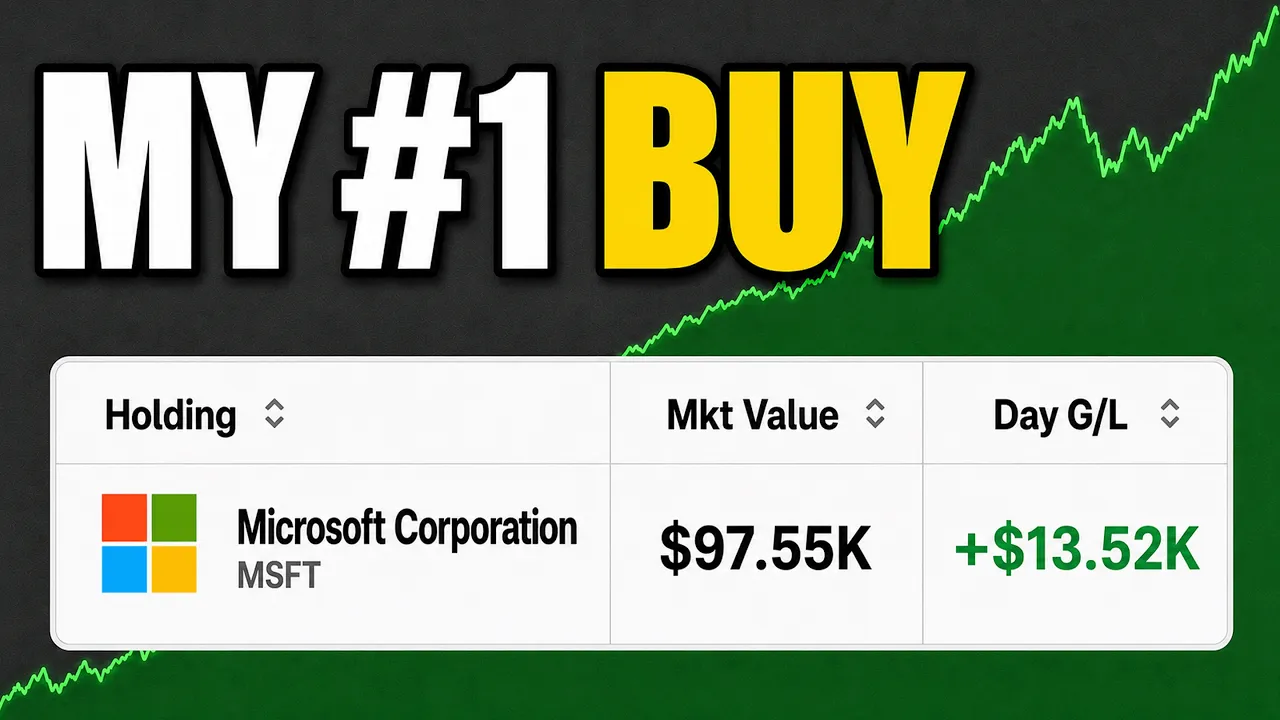
Microsoft, ticker symbol MSFT, just reported earnings, and the stock is up 16% on the day. This is the largest 1-day gain on the stock since 2020. Microsoft is my largest stock purchase of 2026 in my long-term dividend growth stock portfolio. It's now valued at over $97,000. On paper, it's up $13,500 from the day's gains. This is a position I plan to own for many years to come. The core business is set to continue growing and it's arguably still undervalued after the 16% rise. More on that later. Currently, I view Microsoft as the cornerstone of my dividend growth portfolio. That's my personal account that I've been updating here on this channel for many years. It's a core part of my financial future. So, this Microsoft investment is real money that I'm investing for my future. I think Microsoft will provide a market beating total return while paying out reliable growing dividend income along the way. So what happened in the earnings report that made the market as bullish as I am? Well, they beat earnings per share estimates by 11.8%. And earnings growth overall has been fantastic and accelerating. More on that and all the latest financials later, but it's really more about the AI story. The market has been worried about the return on this massive capex spend. We're talking $115 billion dollars over the trailing 12 months, and that's going up. But it seems like Wall Street is starting to trust Microsoft more as a capital allocator. I'll explain why. In today's video, I'll give my thoughts on Microsoft stock after this massive price surge. I'll give a full breakdown on their latest earnings report and explain why the stock may still be undervalued at today's price. With that said, let's roll the intro and get into today's Microsoft stock analysis. The following reflects the opinions ions of a man who spends far too much time thinking about stocks. Please do your own research before making any investment decisions. Nothing in this video is personal financial advice. Continue at your own risk. My name is Zach. This is Dividend Data, and you should leave a like and subscribe to the channel if you enjoy the video. Throughout, I'm going to be using the next generation version of dividend.com, which we launched recently. I spent a ton of time building out this tool, and in my opinion, it's the best stock research tool on the planet. So, if you want to follow along and research Microsoft stock with me, the link is in the description and pin comment of the video, or you can scan that QR code in the corner of the screen. And to celebrate the launch of our new tool, we have a founding member deal. This is the best price we will ever offer. You can lock in 50% off annual membership and keep that discounted price for life. If the tool helps you find just one better stock, it way more than pays for itself. Honestly, it's a no-brainer. If you're someone like me who's investing for their financial future, the return on investment is there. It's clear. I know it's helped me improve my investing and find better investments. You can also get the link to this sale in the description and pin comment. So, with that said, let's jump right into this Microsoft stock analysis. As you can see, it's now up 16.57% on the day. So, it continues climbing. But, I want to start with a big picture look at Microsoft, its overall financials, and help you put your mind where it should be, which is over the long term. On this channel, we try to make content for long-term investors. So, as we look over here for the past 5 years of Microsoft stock, if we look at the price return, it's up 59.32%, which is a 9.76% compound annual growth rate. This is actually underperforming the S&P 500 in that time period, which has grown at an 11% compound annual growth rate. Even when we look at the total return, which is including dividends reinvested, the S&P 500's up 80%. That's a 12.58% compound annual growth rate. Microsoft's up 66% when we include dividends reinvested. That's a 10.67% compound annual growth rate. But it's when we zoom out that we start to see the long-term compounding that has been happening at Microsoft. And this slower performance over the past 5 years may prove to be a good buying opportunity as a lot of this long-term growth has been backed up by fundamentals. Over the past 10 years, the price return at Microsoft stock is up 702%. That's a 23.17% keer. The total return is up 807%. That's a 24.69% kegger. This beats the total return of the S&P 500 by a significant margin. And if we look all time per Microsoft stock going back to 1986, the stock has a total return of 761,000%. That's a 24.78% compound annual growth rate. And you can see on this long, long time horizon, the impact that reinvested dividends has had in Microsoft's return. 295,000% of that is directly attributed to reinvested dividends. As you can see, 761,000 versus 466,000. So even in a low yield stock, the dividends do matter in the long run. And when we're analyzing a company like Microsoft, these returns come from growth in the fundamentals. They're not trading at crazy valuations. The business is growing. Over the trailing 12 months, Microsoft's revenue is 331.84 billion. That's up 17.79% year-over-year. And over the past 10 years, they've grown revenue 282%. That's a 14.74% compound annual growth rate. Over the trailing 12 months, Microsoft has generated 182.94 billion of operating cash flow. That's up 34.35% year-over-year. And over the past 10 years, operating cash flow has grown 408%. That's an 18.15% kegger. And we'll come back to cash flow because the whole capex and free cash flow situation is one of the potential red flags around Microsoft stock that has been keeping the stock price down so far in 2026. And I'll dive into that and explain why. If we take a look at Microsoft's earnings per share, you can see over the trailing 12 months, they've generated $17.28 in earnings per share. That's up 26.69%. 69% year-over-year. And if we look over 10 years, earnings per share is up 506%. That's a 20.25% compound annual growth rate. So you can see over the past 10 years, a large part of this Microsoft stock price increase is just growth of their earnings. At that same time, they also got rerated upwards slightly and started trading at a higher P multiple. And why did that happen? Because their growth was accelerating. They transitioned to a subscription cloud enterprise software business. Microsoft 365 and their cloud data center business was growing massively in that time. Microsoft Azure which just hits some huge milestones in the quarter and is fueling a lot of the current growth at Microsoft. We'll talk about that as we dive into the latest earnings report. But first, let's dive into that cash flow situation I was mentioning. Microsoft has seen massive growth in their operating cash flow over the long term. And that really comes from two segments. They have their software side of the business, Microsoft 365, and that's extremely high margin subscription revenue. Software is very low cost to serve. So, it's a huge profit generator for the company. But then over the past decade, they've been building out the more capital intensive side of Microsoft, which is their cloud business. However, that's proven to be a very important growth driver and it's generated pretty good returns for the company historically. I'll explain that in a second. But there's also a strategic insight related to their building out of cloud infrastructure. As I just mentioned, Microsoft 365 is in the cloud. So they transition their most important product suite into being a cloud product. So Microsoft went allin on being a cloud company and they operate some of the largest data centers in the world. They are what's known as a hyperscaler. Amazon Web Services AWS is the largest cloud and it's growing pretty well. Second place is Microsoft with Microsoft Azure that is growing even faster. More on that later. Third place is Google with Google Cloud and that is growing the fastest of the three. So, as I mentioned, they had a more capital inensive side of the business with the cloud side and it's generated pretty good returns. The return on invested capital over the past 5 years has averaged 22.8%. So, historically, Microsoft has proven to be a pretty good capital allocator. And as of this fiscal year, which just ended, their return on invested capital set at 20.6%. 6%. So, as we zoom out all time and look at the capex at Microsoft, you can see historically this was a super capital-like business model. It really wasn't until the 2010s when they started investing more heavily in infrastructure. And by 2020, they're investing 13 to 14 billion a year in capex. But over the past 5 years, this has ramped up massively, going from $24.5 billion of capex in 2023 to now $115.95 billion over the trailing 12 months, up 79.62% year-over-year. In the latest quarter, their capex was $ 35.8 billion, and this is expected to continue going up. So despite Microsoft having a lot of operating cash flow growth in that time, these capital expenditures increasing have lowered the free cash flow growth at Microsoft. Over the past 5 years, free cash flow is up only 10% in that time. They've generated 66.99 billion of free cash flow in the trailing 12 months. And over the past 5 years, it's only grown at 2.2% compound annual growth rate despite the overall business growing massively. Now, why does this matter? Well, ultimately in the long run, free cash flow is the most important financial metric. It's all of the money left over after all of your expenses and capital investments. It's what you could use to pay dividends, buy back stock, pay off debt. If you were a sole business owner, this would be the money you would actually have left over that you could distribute to yourself as the owner. And that's why in the long run, it's considered the ultimate metric to value a stock. It's the free cash flow Microsoft has generated as historically allowed them to buy back stock and has allowed them to pay out dividends. Over the trying 12 months, the company has paid out 26.45 billion in dividends. Microsoft is a dividend growth stock. The current forward-looking dividend payment is $364. That gives it a 0.93% dividend yield at the current price. And over the past 10 years, Microsoft's dividend has grown 152%. That's a 9.72% compound annual growth rate. Now, this is very much still a growth business. Microsoft has a lot of opportunities to invest and actually grow their earnings and operating cash flow over time. So, Microsoft is very conservative with their dividend payment. They choose to have a low payout ratio. They choose to have lower growth than they could, but that's because they're investing for the future in the growth of the business. If we look at the earnings payout ratio for Microsoft, it's around 18% based on their DAP earnings per share. And this is typically in the 20% range. However, if we look at the free cash flow payout ratio, it's increasing now at 39% for fiscal year 2026, which they just ended. And based on free cash flow, the payout ratio has been more in that 30% range. But this is increasing now. Overall, the dividend data.com we have a safety score grade of an A for Microsoft. But the market was starting to get worried about the increases in capex and whether Microsoft's free cash flow might end up declining and even be taken to zero like you're seeing with Google and Amazon. They are being even more aggressive with their capex spend and it's arguably the correct decision. So, let's dive into the latest earnings report for Microsoft stock. And afterwards, I'll give you my thoughts on whether Microsoft is still a buy today. And I'll base that based on analyst estimates for continued growth. I'll give you a price projection for Microsoft stock. I'll explain whether it looks like it's a discount relative to historic multiples Microsoft has traded at and on which metrics there are still a potential red flag. Plus, I'll share analyst price targets on the company. But first, let's get to that earnings report. So, this was Microsoft's fourth quarter 2026. They're on a little bit of an accelerated fiscal calendar. Some companies this week, they just reported their Q2. So, here are some of the highlights. Revenue was $90 billion. That's up 18% year-over-year. Operating income for the quarter was 40.6 billion, up 18% year-over-year. Net income was $ 35.8 billion. It's up 31% on a GAP basis, and it increased 22% year-over-year on a non-GAAP basis. And that's because they had some investment gains in the quarter. One of them that was mentioned was their investment in Thropic. Actually, you can see it right here. Includes a $3.2 billion gain from their investment in Enthropic. And the earnings per share numbers I mentioned earlier following the same gap and non-GAAP accounting. That investment in Enthropic is much smaller than their ownership stake in OpenAI. I believe they own 27% of Open AAI. And the non-GAAP results do exclude the impact of those investments. And here's some of the most important business results that I'll mention from the quarter. Microsoft Azure which is the core part of their cloud business that surpassed 100 billion dollars of revenue for the first time in 2026. So this means that the fastest growing part of Microsoft is now nearly onethird of their overall revenue. Other news, Microsoft 365 co-pilot reached 30 million paid seats. The reason why this matters is this is basically the start of Microsoft's monetization on top of their application side of the business in bringing AI to enterprises. And I'll talk a lot more about that in a second. And in the final quarter of 2026, Microsoft cloud revenue came in at 59.3 billion, up 27% year-over-year. The other notable figure here is that their commercial remaining performance obligations or RPOS, increased 84% year-over-year to 678 billion. And this is part of the reason why they're investing so heavily in more data center infrastructure. They have so much booked revenue that if they just build the capacity for they can make more money. You can see Microsoft 365 commercial cloud increased 16% year-over-year. Their Microsoft 365 consumer cloud increased 24% year-over-year. LinkedIn, which they also own, the largest social network for employees, job search, and enterprises that increased 12% year-over-year. Dynamics 365, this is their CRM kind of product. It increased 13% year-over-year. But the largest business in Microsoft now is now the intelligent cloud. That came in at $39.3 billion in the quarter. It increased 32% year-over-year. And within that, the largest business is Microsoft Azure. That increased 43% year-over-year. Now, this is not as high as Google Cloud's recent quarter where they said 80 something% growth year-over-year, but Google Cloud is coming from a much smaller base compared to Microsoft Azure. Microsoft Azure is a larger business and Microsoft is growing much faster than Amazon Web Services. Now to be fair, Amazon Web Services is larger than Microsoft Azure. And then what I would consider to be a rounding error here with Microsoft is their more personal computing segment. $12.9 billion down 4% but this is pretty much low margin. I personally don't calculate much into the valuation of the company. This includes their Windows OEM devices. It includes Xbox. It includes like Bing search advertising revenue. If you're investing in Microsoft stock, you're really looking at cloud and in enterprise software. There's also additional context in this report about their investment in OpenAI. They own a huge percentage of the company and the valuation of the business continues to grow and it's probably going to cross over the trillion mark soon and it will IPO probably sometime in the next couple years. But OpenAI is also losing money. Now, they did just raise a war chest of like 80 something billion dollars, but they are burning money. They're trying to retain market share, and they're focused on growth at all costs. It's a startup. That's the phase they're in. And they're in a pretty heated war right now with Enthropic. OpenAI has a big advantage in the consumer side, they have like 10 times as many users, maybe even 20 times. But in the enterprise side and in the revenue side, Enthropic actually passed them up earlier in 2026. pretty much one of the biggest stories if you're following, you know, the economic capitalism markets. Pretty interesting. I don't have enough time to go through a full deep dive of OpenAI versus Enthropic here. But on the enterprise side, they're in a war, but both businesses, they're seeing a huge revenue ramp up right now. The company did report guidance for Q1 2027 in their earnings call. They're expecting revenue of 89.85 to 90.95 billion. That's 16 to 17% growth year-over-year. They're expecting Microsoft Azure growth to be 45% year-over-year. constant currency and they're expecting double-digit revenue and operating income growth for the full year 2027. And before I give my thoughts on whether Microsoft stock is still undervalued after going up this much, first let me give some more big picture thoughts on the company and that return on invested capital question. On the earnings call, Microsoft spent a lot of time talking about return on invested capital. And after the call, the CEO Satia Nadella posted on X and he shared a tool he made where he was analyzing the hypers scale return on invested capital. And in that there was a little bit of an Easter egg where he put the average return at 29.7%. If you're worried about return invested capital, I would suggest you listen to that earnings call. But in general, I would say Microsoft will probably lean on the more conservative side compared to some of the other hyperscalers. And I would say it's unlikely at Microsoft you'll see them take their free cash flow down so much like you're seeing at Google and Amazon. But I personally as an investor, I think it's the right move for them to continue ramping up capex intelligently. They mentioned that they brought on one gigawatt of compute last quarter and they're expecting to double their total compute next year. And I think one of the underrated things going on right now with the data center buildout is that these assets are becoming more valuable, not less. GPU rental prices are increasing. There is a huge compute shortage. This is why you saw Enthropic start renting compute from SpaceX. Google is also renting compute from SpaceX. Enthropic is paying SpaceX $1.25 billion per month. That is for the Colossus 1 data center that they built out, which is a little over 300 megawatt. So Microsoft over the last quarter built out 1 gawatt of compute, more than three times that. These assets are very valuable. And in an environment where we're in a compute shortage and it takes years to build out these large data centers, having large installed compute is going to prove to be incredibly valuable. And there is a big AI flywheel happening right now within Microsoft that is not being talked about and it directly impacts their core businesses. One, the cloud business and then two, enterprise software and tools. And the first has to do with the massive growth driver over the past seven or eight months which has been coding agents. It has been an explosion of useful productive AI which is incredibly valuable and this can be seen on Microsoft's own platform GitHub the world's largest code repository. There is more code being written now than ever. This is from the COO of GitHub. There were 1 billion commits to GitHub in 2025 and this tweet was back in April. It's probably much higher now. He goes on to say, "Now it's 275 million per week, on pace for 14 billion this year if growth remains linear. Spoiler, it won't. It's going to keep accelerating." So, commits to GitHub is increasing at least 14x in one year. This has been causing GitHub to need to be scaled up massively. And while GitHub itself necessarily isn't a big monetization driver for Microsoft, it's the software flywheel that powers every aspect of the company. All you have to do is ask the question, where is all the software going to be hosted? Where is it going to run? Where are the APIs going to happen? Where's the storage going to be? Where is the AI inference within the applications? Where is the AI inference of developers using these AI coding agents? All of this is in the cloud. It's why you're seeing such an explosion of demand. And in the decades to come, there's going to be an explosion of software and applications being created. It will be used for humans. It will be used in back-end systems you don't even know about. It will be used by AI agents. Microsoft's business is at the center of this growth. Now, they don't have a monopoly on it by any means, but they're in the game. They have a slice of this massive growing pie. They're helping to serve that demand. this 14x increase in code committed. What is that from? It's mostly from anthropic with cloud code and it's from codeex from open AAI and Microsoft has equity stakes in both those companies. Those companies run AI inference partly on Microsoft's infrastructure. So while Microsoft itself isn't the top coding agent at the moment, GitHub Copilot has fallen in usage dramatically and most developers they are not that excited about GitHub copilot. They're using cloud code. They're using cursor. They're using codecs. But Microsoft, they do own VS Code. They have GitHub Copilot. So, there is definitely room for Microsoft to fast follow and basically just copy them. But even if the demand isn't going through their application or their UI, they're serving it partly in the cloud. But that's really only scratching the surface. The coding agent is just the first useful, productive, and extremely valuable application of AI. and it's the coding agent that has caused this massive revenue ramp at Enthropic. The company started the year at $10 billion of annual recurring revenue and that is projected to have hit $74 billion in July. Anthropic has become the fastest growing company ever and that's because they've directly increased the productivity of an extremely high valuable profession in software engineering. And this is just the start. These coding agents are going to become increasingly better year after year. They will be operating increasingly autonomously and the growth does not seem capped. And this is just one field of intelligence. The overall enterprise applications of AI, we are so early in what that's going to end up being. It will be a huge market. Going back to Microsoft, not only do they have equity stakes in both these companies, they serve their demand. The reality of the situation is that Microsoft already is a trusted enterprise partner. They are fast following and copying basically all of the innovations that Enthropic and OpenAI are doing. They're creating the same exact applications. That's Microsoft C-Pilot. They're now building a super app that has Microsoft C-Pilot chat, co-work, and code all in one platform. They're developing their own models. They're hosting open models on their infrastructure. They of course offer the anthropic and open AI models as well. They're building their own harnesses on top of it. They're building enterprisegrade secure solutions to bring AI to enterprises. And this is going to be a decade plus transition. And the growth in enterprise AI and applications is going to be huge. And Microsoft, they don't have any monopoly in this scenario. But the pie is expanding. The pi is growing. And Microsoft only has to capture a small part of it. And they're already in position to do that. And they are working towards that end. So, those are my big picture thoughts on Microsoft and why it's one of my top holdings. But now, I'll give you the argument for why it still may be undervalued even after going up 16.75% today. And to start evaluating that, I will be taking a look at what is the value graph tool on dividend.com. This lets you see all of the key metrics for the stock and see the daily version of that historic multiple for all those different metrics over different selected time periods. In this example, we're looking at earnings per share, the adjusted earnings per share over the past 5 years. Microsoft is currently trading at a 26.36p ratio over the trailing 12 months adjusted earnings per share. Now, historically, the median multiple over the past 5 years for Microsoft has been 34. So, even after the stock price has gone up today, it is still 22% below the implied fair value if it goes back to that 34 median multiple. And if we click this here, you can see that if the company hits that 34P ratio, that would mean an implied fair value price of $58752, which would be 29% upside from today's price. And if we look over the past 10 years, Microsoft's median multiple for earnings per share was 31. In that case, the stock is 15% below fair value. And if we based it on that 31 median multiple, the implied fair value would be $536, which is upside of 17.8%. But here's the thing. You'll notice this fair value, it's increasing over time. And that's because the fundamental earning power of Microsoft's business is growing over time. The intrinsic value is growing over time. In this example, their earnings per share is growing over time. If we take a look at Microsoft stock based on its dividend, its trailing 12 months dividend yield is 0.78% right now. So it's right around fair value over the past 5 years. On a forward-looking basis, it's right at fair value 0.8%. But as I mentioned, the dividend has been growing slower as they've been focusing much more on increasing capex. If we look at Microsoft's operating cash flow in this time period, the current multiple is 18.57. The median multiple over the past five years of price to operating cash flow is 26.09. So even after the price has gone up, it's still 29% below the implied fair value. And even today, based on operating cash flow, Microsoft is cheaper today than it was at the low of 2022. That was when I first started building my position in Microsoft. And if the company gets back up to that 26 times price to operating cash flow ratio, that would be an implied fair value of $64245. That's 40.5% upside from here. And this is just going back to the media. There is an argument to be made that Microsoft should actually be trading at a premium. The core fundamentals of Microsoft, they're improving and in some cases they're accelerating. And when I think about the growth prospects today versus in 2020 or 2022, I feel more confident in today. That said, there is one metric where Microsoft looks expensive, and that is free cash flow. I've been teasing this throughout the video. Yes, their overall business is growing, their earnings are growing, their operating cash flow is growing, but they're spending more capex than ever. So their actual free cash flow left over they can distribute to shareholders, it's not growing at the same rate. And if we look at the average free cash flow multiple over the past 5 years, the median multiple is 41.83 and currently it's at 50.7 times price to free cash flow ratio. So if it went back to the median, that would imply a fair value of $377.18. That would be 17.5% downside from here. And it's this fundamental reason why the stock has been underperforming because a large amount of people, they question the return on invested capital of this capex for Microsoft. They think they're just lighting the money on fire. And that's why year to date, Microsoft stock is still downg.33%. Even after, oh, now it's up 17.37% on the day. And over the past one year, Microsoft is still down 10.92%. So, if I was someone who is looking to buy Microsoft stock today, I would have been a lot more confident in doing it last week. I would have rather not bought it after it's gone up 17%. With that said, I personally don't think the stock is expensive right now. Yes, the free cash flow is lower and it's for this reason why I would actually be extra conservative with buying Microsoft stock because I don't trust the market to necessarily stay bullish. a large segment of them, they don't like this capex. And I think there could be another year or two before that return on invested capital starts to become obvious. And especially with how much the AI market can shift around, there is definitely a possibility we'll have some bearish days along the way. So, I wouldn't be chasing to buy Microsoft stock after it just went up. But overall, I remain very confident in holding. And if there is another dip, I'm going to consider adding more. And that's because Microsoft is a growing business. Analysts are projecting doubledigit earnings per share growth in the coming years. 14% 17% 18% 22%. Based on this, in fiscal year 2030, they're projecting $3321 in earnings per share. That would imply a 13.8 P ratio based on today's price. And if the company trades at a 23.5p ratio, then by the time they wrap up fiscal year 2030, that would imply a projected price of $780.32. at 70% upside from here, which would be 14.6% annually. And if the company gets rerated to that 30.2 multiple, which I think is incredibly possible considering that this is the median multiple historically. And if the company's growing, then why not? That would imply a projected price in 2030 of $1,02. That'd be 119.3% upside from here or 22.2% annual growth. And it was actually this exact estimate that I used in my mental model right here in my head for why I started building up a position in Microsoft. My personal mental price target was $1,000 in 2030. And that is why I felt so confident in building up this position. Now, of course, I could be wrong. You should do your own research before making any investing decisions. And for some additional context, we'll go over some Wall Street price targets. Currently, the consensus price target on Wall Street is $584. And you can see today we just had a swarm of increased price targets. All of them being raises or bullish ratings. You can see 525, 550, 510, 522, 647, 528, 640, 550, 512. And overall right now there's an 80% analyst buy rating. So that wraps up my Microsoft stock analysis video. If you want to use the same exact research tools that I do, check out dividend.com. The link is in the description and pin comment the video. We have a 50% off sale where you can lock in half off annual membership, keep that discounted price for life, and if the tool helps you identify just one better investment, it way more than pays for itself. Make sure to leave a like, comment, and subscribe to the channel if you want to see future stock analysis videos, as well as my monthly portfolio update, which will be coming soon. With that said, thanks for watching and I'll see you in the next
Comentários 0
Entre para participar da discussão.
EntrarAinda não há comentários. Seja o primeiro a compartilhar sua opinião!