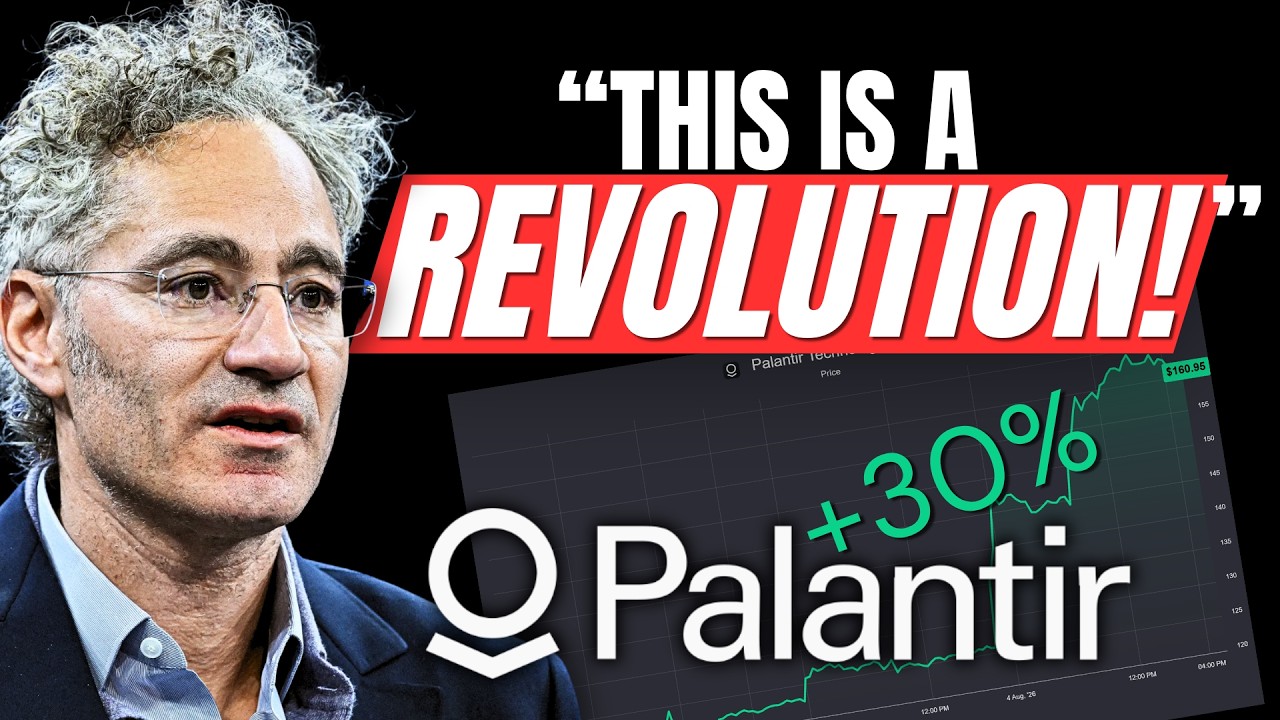
The Palantir Numbers Are Getting Ridiculous (Earnings Review)

- Retorno do vídeo
- -5,99%
- Chamadas
- 1
- Compra / Venda
- 1 0
- Publicado
Recomendações
Entrada é o preço de fechamento do ativo na data de publicação. Atual é o último fechamento registrado.
-
Entrada $162,66 04 ago 2026Atual $169,34 07 ago 2026Resultado +$6,68
I actually think that a lot of this 30% bump is absolutely justified. not only because I thought that it was undervalued before this earnings call, but because it went above and beyond my own expectations. ... I actually think that these are very very reasonable prices to pay even after we're up 30%.
Contexto "I actually think that a lot of this 30% bump is absolutely justified. not only because I thought that it was undervalued before this earnings call..." and later "I actually think that these are very very reasonable prices to pay even after we're up 30%."
Transcrição Completa
Palanteer might have delivered one of the strongest quarters that we've ever seen from a software company, but does that automatically make Palunteer stock a buy at today's valuation, up more than 30% on the day? In this video, we react to Alex Karp's latest CNBC interview, break down Palanteer's incredible Q2 financial results, and then take a hard look at the valuation to determine how much future growth is already priced into the stock. So, without further ado, please enjoy these quick clips from the Alex Karp CNBC interview. We grew our business 93%. 93 >> better than what analysts were expecting. >> Okay, that's not >> No. Okay, great. Forget consensus. No business in to my knowledge, no businesses at our scale even grown half this much. We grew 85% last quarter or like that was crazy. 93% is like a revolution. So, by the way, and then you would say, is the revolution growing in a way that's profitable? Our adjusted free cash flow margins are at 63%. A rule of 40 is 155. The US business, the business that really counts, we are at massive scale. We grew 115%. 115%. The first thing that any normal person does is spit out their dentures. And after they spit out their dentures, they turn the numbers to see if these numbers are even possible. And then legit then the question is, can this business grow at this rate? Can the business grow at a greater greater than 100% for the next 18 months? And what you see in both the sovereign demand for our product, the product offering, our alliances, both DA compute all the way up, including helping to open up the world to being receptive to openweight models and their fine-tuning, beginning to fine-tune these models. So the models work at Frontier is a business unlike any other business that is poised to grow with these margins and with this revenue growth for another 18 months. Palanteer, we get paid a lot of money. Why do we get paid a lot of money? Because we create value for the customer first and value where that they keep. If a a lab or palunteer or an openw weight model or people deploying open model create a billion dollars in value, they should make $300 million. You make that's a fair thing. >> I highlighted these two main clips because they were the real big takeaways from the CNBC interview. First, that they want to grow over the next 18 months about how fast they grew in US commercial growth. In the second side, we also ended up seeing them talk about potentially wanting to charge roughly 30% of how much you're actually generating for the companies that are using your software, whether that's in savings or new potential revenue. So, that's going to help us with these numbers going forward, but please take a look at the financials. Overall, Q2 was a smash. I'm not selling a single share, and in fact, I actually think that a lot of this 30% bump is absolutely justified. not only because I thought that it was undervalued before this earnings call, but because it went above and beyond my own expectations. So, let's talk about why Palunteer's earnings ended up crushing. First of all, they are really promoting this AI sovereignty. They're talking about how Palunteer can insulate your business away from the anthropics and open AAIs which do have amazing models, but at what price? At the price of you losing your data and how your business actually performs. So then open AAI and Enthropic can train their models and then teach every single business how to do your business. How do you charge a premium on that? Palunteer saying, "We can actually help save you from this and also help lower the cost of some of these tokens, but we're going to be the middleman and help be the orchestrator of a lot of that cost." You can see from the revenue whether or not people believe them in the types of contracts that they're signing and how they're actually showing up in 93% revenue growth is the greatest sign that a company is seeing success in what they're selling. Then on that 30% comment that Alex Karp just talked about, this one I thought was amazing here. So this was Centress Energy. They said the nearly 300 million in savings that we have identified to date is only the beginning. 300 million is what you're saving. How much did you pay Palunteer? So whenever they're going to build these types of contracts, do you think somewhere along the lines of $100 million might be a fair price to charge for a company that's saving 300 million? And that's 300 million in savings. That might even be net of their cost. So it might even be more, but that's the type of thing that Palunteer can do for businesses and why they're happy to show up and pay for it. On top of that, we also saw the diversification of their revenue both not just in commercial side, but also in government as well. Showing up on the government side was 79% growth rates year-over-year, continuously increasing faster than last quarter, but really showing up in commercial at 110% or 109.7%. This was on commercial in total, not US commercial, which actually was a little bit higher than this at 149%. But even here, Palanteer said, "Maven has also continued to win as a developer and builder platform for the joint force with over 25,000 builders, uniform service members, civilians, contractors, and companies are developing agents and applications in or on the platform at the speed of war. For all that growth, the Department of War is in the trailing 12-month revenue is spending less than 25 basis points on the Pentagon's budgets is going towards Maven. So, whenever you're talking about total addressable market, are we even remotely there? This is one department for one contract spending a fraction a fraction of a fraction of 1% of their budget with Palunteer and yet they're able to charge pretty high rates doing so. So, gross margin ended up showing at a new company high 1.6 6 billion. Gross margin showed up at roughly 84%. Really freaking high. And then on the operating expense side, we continued to see more of what we expected from last quarter. So don't look here in terms of the LTM that's not actually supposed to be there, but from this period, you can see the decreasing amount each and every quarter. Sales and marketing ended up lowering to a new low of 17.5%. And then general and administrative and research and development also dropped to new lows roughly about 10% on each of those categories which if you just look a few years ago was roughly three times higher two times higher comparatively to past metrics. So they're getting more efficient. That efficiency shows up in operating profits $912 million 47% operating margin new company high. And then net income actually came in higher than operating profit at 1.06. 06 billion. You wonder how the heck did they even do that? 54% net income profit. And a lot of this actually had to do with SpaceX. So we found out that Palanteer actually has shares of SpaceX. The IPO actually helped them bring in roughly a boosted EPS of 3 cents there or $91 million. That's where you see that little differential between the taxes that they've paid and all these things is nonoperating income. If you continue down the scale, you end up getting to free cash flow. free cash flow, $1.2 billion, 62% margin on free cash flow. This is the cash generation machine. That brought up their cash pile, another roughly $1.4 billion, $9.4 billion with 0 in debt, 56% year-over-year on their cash position. None of this is going into buybacks just yet because they can't. But what's the flexibility of a company that has $9.4 billion in cash and net dollar retentions? their customers coming back after one year to buy more and more of their products. This just continued to another new high and if you look over the past three years we've gone from 107% which is very very common in the software industry and some would even say that still is respectable up to 111 120 this starts to get exceptional like very very good 139 this is starting to be like some of the companies by far the best in the industry 150 is unheard of 157 we're starting to get comical this is starting to get a little bit delusionally high in terms of both the margin and the growth rate. But this is why the stock is up 30% right now. Alex Karp also said, "People always write about these things about customer adoption and maybe but the net dollar retention number is incredibly strong. There's also going to be a shift and as hard as it is to believe become even more positive because some of our older partners we haven't really interacted with are also showing up. So he's saying net dollar retention of 157, as hard as it is to believe, is not going to be the top." That's pretty ridiculous. Billings ended up growing an additional 88% to over $2 billion. And RPO also both on the short term and long-term performance ended up seeing roughly similar growth rates. They both kind of doubled year-over-year. So we went from 1 billion to 2 billion on the short term and then the long-term RPO 1.4 to 2.8. They're almost identical. Both doubling roughly 100% growth rate there. So that looks amazing. Total customer count, this is the surprising part. total customers actually did not grow as much as people would have thought. 42 new customers, but yet those 42 new customers are bringing in net dollar retentions of 157% likely to go even higher. And you're seeing this massive amount of money that they're wanting to bring in off of such a low customer base, which really goes to show you that the total addressable market is so much larger than what they're even able to do because they're not in the mass majority of the customers that they could be. What's the likelihood that they go from 1,000 to 2,000 or 2,000 to 4,000 different customers starting to tackle smaller and smaller businesses, get more and more of their business? The TAM here is so unbelievably big whenever you consider the amount that they're charging just based off the customers that they already have. It's pretty wild. Then we got to talk about guidance. This one is really exciting and I think why the company has popped up so much. Revenue surprised to the upside by roughly 6.8% again. EPS surprised by roughly 24%. So instead of the 33 cents that we were expecting, we got 41 cents. This has been a constant constant beats on revenue, constant beats on EPS. And this is why I think that the guidance going forward expecting 69% growth for next quarter and just continuing in that sort of phase of they believe that revenue is just going to drop off a cliff. Opposite of what Alex Karp has said is really what's going to bring the stock up much higher. Alex Karp said, "I'm driving the business to grow at a rate equal or above to what we have in US commercial for the next 18 months." I'm driving the business to grow at the rate that US commercial 149% year-over-year for the next 18 months. That is unbelievable, guys. Wall Street does not have it pegged anywhere near this. So, that's why Wall Street is starting to come out and give higher and higher prices. But honestly, if they do deliver on that, 200 is going to seem like a joke. You're going to quickly see these prices get rised up probably another 50%, probably up towards 300% if they do end up delivering at 150% for the next 18 months. That is insanely high. What does the net dollar retention have to look like for that to happen? What does the rule of 40 look like whenever you're putting up margins of 60 70% growing at 150%. Does Palanteer actually get to a rule of 40 of roughly 220? Like it doesn't even make sense. And yet, whenever you look at valuation, this is where people say we're starting to get a little bit euphoric. We do have a price to earnings in the 120 ranges. And forward, and by the way, forward P is off of what Wall Street is saying, which I think is criminally low right now, of roughly 85 times. Now, looking back to where we are, this is historically one of the cheapest prices that we've been able to get Palunteer, but it still is high for the industry. But everything in Palanteer is very high for the industry. So whenever you also go to look at free cash flow and you see that forward free cash flow is at 68 times. I actually think that these are very very reasonable prices to pay even after we're up 30%. Because if we can end up hitting or achieving that 150 plus percent growth, we don't need customer accounts to explode to end up seeing the increased usage and these pushing the teams to want more and more and more that they will end up achieving their goals of hopefully bringing the stock price even higher than where we are today. That's how I'm seeing Palunteer right now. Extremely happy. I think that it's very deserved that this stock ends up popping. But honestly, I I wouldn't look too much at does this earnings deserve this company to pop 30%. rather did this company ever deserve to be down in sort of the 122 range or whatever it was whenever the earnings were actually going into this pop that I actually think was undervalued. Now there's a percentage that gets us to fair value and then obviously looking forward to where revisions are going to happen on Palunteer going forward. That's what I would really look forward to over the next 3 12 18 months or so is what happens to the revisions on Palunteer's earnings. If every single quarter they beat and they raise up expectations, you have to start looking at this company and say, "Okay, back in the day we used to anticipate 2030s earnings being $1.17, then $2.20, then $8.56, now $9.11." So, if you can't get it right, you used to say $118, now you're saying $911. How much more is that going to continue? Like, how off are these numbers? And do we need to revise these even higher? That's I think the expectation going forward. Very happy for Palanteer. I'm a happy shareholder. I'll be continuing to hold though, not looking to trim at all.
Comentários 0
Entre para participar da discussão.
EntrarAinda não há comentários. Seja o primeiro a compartilhar sua opinião!