Contexto
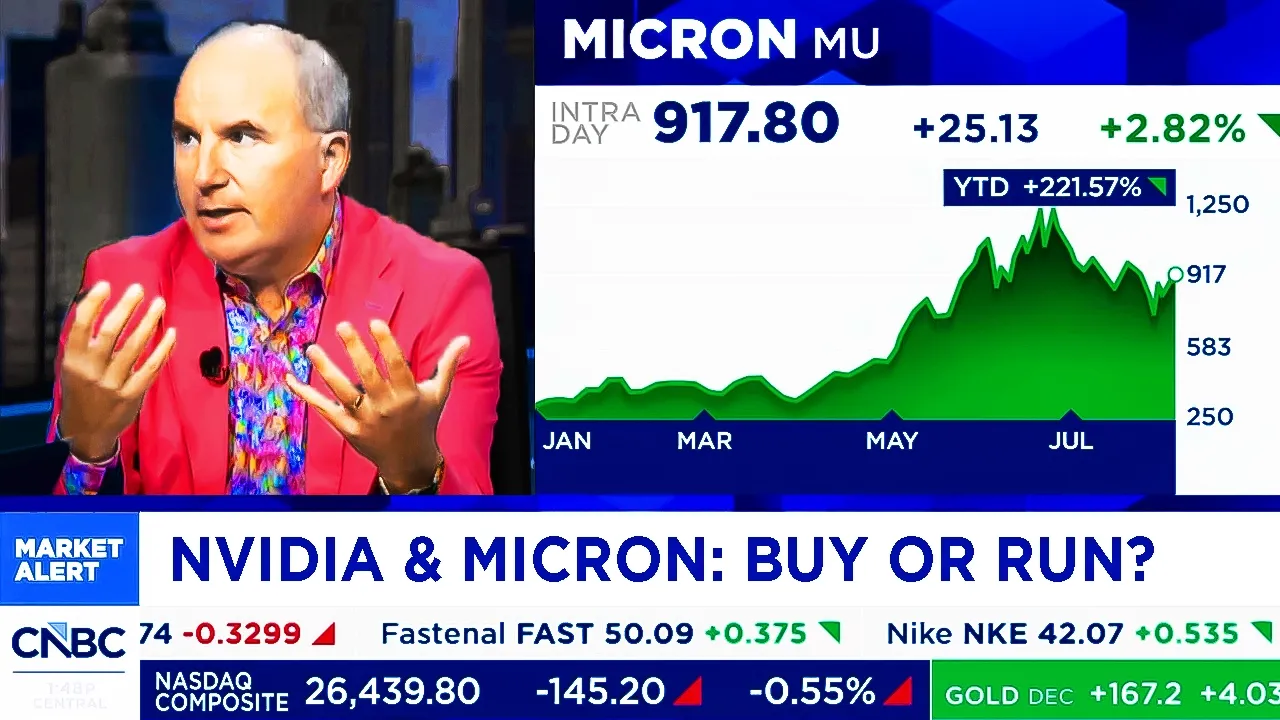
we actually sold out of Micron last quarter, which hurt when we sold it around $7,800.
Transcrição Completa
Musk also disclosing an exclusive partnership with Nvidia both on Earth and in space with the first AI compute satellites expected to launch next year. And CFO Brett Johnson saying, quote, "We expect the supply demand imbalance in the compute market to continue the current economics of translating into a less than one-year payback on our new capital deployments for compute." >> Sam Dives of York for lives writing the following. the capex tugof-war between SpaceX and investors is a necessary buildout that will require patience. Dan joins us now for more. Dan, whose patience and how much pain will we see for the stock in between? >> Look, I think and this is a barometer for what we're seeing across tech because the reality is this is an arms race and when you think about what SpaceX is doing, the only way to get there is capbacks. And I think that's look that's the double-edged sword as going public because the scrutiny is going to be there. But look, we've seen it across big tech, you know, when it comes to the hyperscalers on a on a different version. That's essentially what's happening with SpaceX as they're trying to catch up to open AI anthropic and as we used to talked about really building out the vision. Do you think that this is the right move, Dan, to really lean into the hyperscaler side of things, the compute side of things when really the money is coming from the space and the telecom sides of things? >> Yeah, I think that's the quagmire that they're going through. And look, it's no different than so many other companies that we've seen. I mean, you go back to Nvidia, right, where it's gaming and going after AI. The reality is is that the gold at the end of the rainbow is is around data AI. It's going after that opportunity. And I think that's what they're that's doing. Look, it speaks to X AI and ultimately what probably could be Tesla as well. That's the broader vision of Musk, but the only way to get there is capex. And I think when you're going through this arms race where and you see it from all the chip players, all the memory players, costs are getting more expensive. And you are not just you're not just one of one in a room, you're one of many trying to get after those chips and the buildout. >> Dan, if you were trying to figure out where you were going to lend your pool of cash, why would you choose SpaceX for some of those data AI LLM types of promises and dreams rather than either anthropic and open AI on one side or Microsoft and Amazon on the other? >> Oh, no doubt. I mean that they definitely are at the low end of the totem pole relative to those players and I think that for them is the challenge. the hyperscalers if you just think about this earning season. I mean, they come out flexing muscles relative to what we're seeing. And when you look at OpenAI Anthropic, I mean, it's really their world. Everyone else is paying rent. Everyone's trying to play catchup. And that's the challenge. Now, for Musk, he's been there many times before, but that's really the opportunity. Look, if anyone's buying into SpaceX, you're buying Musk, you're buying the vision, and you're playing catchup. >> The price of capital, Dan, for these guys is going up. It's higher. In the next doubt, we're going to have a conversation around this table about how rate insensitive these spending plans are. But I do believe everything's got a price and at some point, Dan, there is a price at which these companies are no longer willing to pay. Are we close to that, Dan? Where markets and the push back, whether it's equity or whether it's debt, begins to dictate or even influence the spending plans of these companies. >> Look, I think right now, I mean, I think Oracle will be a great example, you know, relative to the Open AI deal and just taking on debt. what's happened to that stock. Look, I think for these companies, it's a it's a balancing act because they know if they lighten up on capex, they go to the back of the line and it goes back to like, you know, this is a the building of the Vegas strip 1955. >> Well, I think that's the issue though. Just allow me to jump in. Why do you want to buy them as they go through that difficult phase? Why do you want to be buying them now? I think if you look at Microsoft and you look at Alphabet, those are two good examples where as they're going through it, you you're basically in the buildout phase. Investors now the switch has gone on. You've actually seen the monetization. I the question John is that when do you start to see the monetization switch and investors are basically betting near-term pain for long-term gain but there is a pushpull point and I think as we get into the debt market and these companies take on more debt and more equity I think Meta is a great example you have to show it you can't just talk it alphabet Microsoft you look at Amazon I think you got to prove it because it can't be the doggy the homework every quarter >> I mean the numbers by the way that Everybody's going up for for next year in terms of what they expect this company's going to spend on capex. I think Morgan Stanley is now at 163 billion. JP Morgan >> is at 196 billion. Am I looking at these numbers correctly? I mean, that gets them right up there with the likes of Alphabet and Microsoft and Amazon and Capex spend. Except that they're going to have to raise a lot of money, >> right? So that's why people don't want to take Nvidia up as much as they should because people feel they don't have enough money. What happens if Nvidia funds them? That's that's what Amelia's point was last night. >> I know. I went over it with him. He was he was smart. >> Although was gonna front everybody. >> Here's 250 billion for you. Here's 250 billion for you. Here's 250 billion for you. What? What? >> No. No. He's talking about the annual the revenue of hundred billion. >> Yes, we can get to that. >> Even that's a two to three gigs. >> Understood. >> Yeah. Not. >> But how about if you get six gigs? How do they go to end scale? Ncale is it? Don't confuse what we're talking about here. The capex numbers are going to go ramp up so much that it's clear they're going to have to raise capital. >> Yes, but >> and we already know what happened to their bonds, Carl. So, what are they going to raise? >> It could be the First National Bank of Nvidia or it could be the public. >> I mean, Wells Fargo says they're going to need to raise over 100 billion of capital over the next 18 months. >> The public will give it to him. Ron Baron will give it to him. I don't know. Kathy Wood will give it to >> Actually, the important thing you just said there is I don't know. IDK. IDK. >> Yes. >> Yeah. IDK. All right. Howie Roseman will give it to him. I don't know who's going to give it to him. >> He said it again. I don't know. >> No. No. I'm just saying that if you look things over, he has a plan. >> He always managed to raise money. Do with Tesla. He's There's nobody better. >> You doubt this man. I have quotes from you about him and Nvidia. Do you remember the interview where he was not high on Nvidia in your interview? Oh, let me tell you. >> He was high. Of course he what are you talking about was getting higher but he did not go out and say >> when I talked to him that's over a year ago >> we're going to talk >> he said he was buying a million GPUs >> we will talk to Lisa Sue about what he said all right so Lisa just want to go over the elephant in the room first of all it is very clear that your stock started falling after the analyst didn't get their 14 billion which was a whisper number a lot of people feel your stock was falling because of something that Elon Musk said that actually was after and it did not really impact the stock but I want to go over it Uh Elon says we've this is on the SpaceX. We've decided to build exclusively on Nvidia because we think the Verir Rubin architecture is the best architecture. We think it's the best AI computer. We greatly value our close cooperation partnership many levels with Nvidia. You had a partnership with Elon Musk too. What do you think uh is the reason why you decided to go exclusively uh because I think you would argue that your compute and your memory are every bit as good and the next generation better than Nvidia? Well, first of all, I would say SpaceX is an incredibly important technology company. We have, you know, extreme respect for what they're trying to do. Uh, when you think about the technology that they're putting forward and we're proud of the work that we're doing with them across a number of areas. You know, when I think about compute, Jim, one of the things that I say often, and you've heard me say this often is you need the right compute for the right workload. And from our standpoint, uh, we have extremely strong roadmap as we think about Helios and going forward to our MI500 series. So, you know, we're proud of the fact that we have, you know, broad relationships across the board and, you know, we look forward to really helping all tech companies really have the right compute for the right workload. >> All right. So I want to be sure again uh when David interviewed him I think it was on May 2025 uh he said that he was going to buy Nvidia but he also talked about the idea that he felt that that AMD he's going to buy some from AMD. Um that is just specifically you're talking about a certain kind of compute and that you're still doing a lot of business with with uh with much that I don't know about. >> Well think about it this way. Um Jim, our portfolio is very broad. I mean it includes CPUs, includes GPUs, includes um uh FPGAAS, adaptive computing across the board. And I would say we do business with just about every tech company out there. Uh especially in the space market. This is a market that we think is extremely important and we'll continue to believe is extremely important going forward and I have tremendous respect for Elon and everything that he has done and so we look forward to continuing to partner over the longer term. >> Uh Nvidia is up today. It is the only of the mega cap tech names that actually is green now and it's nearly a 4% move. We think in part because Elon Musk gave the company an endorsement as part of the SpaceX earnings call said they have the best AI computer. That's that's a quote. Uh so Nvidia's up on that. Melius is talking about they love the endorsement. How could you not given what he said? What what do you think >> about Nvidia or SpaceX? I mean, Nvidia, I I think this you can buy it right here. Just to cut to the chase. Um right here. >> Yep. I do. Uh new money that comes into accounts at our firm, we're putting in Nvidia. We're not hesitating, by the way. Uh it's about five about six or sevenish% away from an all-time high. I think it will get there. may not be in August when we get this light liquidity, but news like we get where Elon Musk is endorsing it just continues to show that Nvidia will have more demand that it than it can supply for the foreseeable future and its multiple roughly 19 times 20 times forward earnings is to me attractive giving you the earnings per share growth rate that is around 30 35%. Okay, the other uh semiconductor name that I want to look at is AMD uh because I see it down almost 6%. Despite what was a good earnings report, I I don't know what you could pick at and and not like. What do you think? >> I think Elon Musk spoke uh at length about Vera Rubin chips and the relationship with SpaceX and Nvidia. We didn't hear very much about AMD. Now AMD has relations with Meta, OpenAI and Anthropic, but in return there are warrants on 160 million shares there. Much different relationship. You could also look at Nvidia relative to AMD. By the way, nothing like you said, it's got nothing wrong with AMD's earnings except what we heard last night from Elon Musk. If it was happening on another day, you'd get a better reaction out of AMD. But it does remind people when you look at the forward multiple, you're looking at AMD mid-40s. You're looking at Nvidia at somewhere around 19.5. And I agree with Jimmy. Nvidia, it is it is literally a hanging curveball down the middle. I bought it at 199. I got stopped out at 193 while you were on vacation. I said it's the next Apple. I'm 100% right in what I saw and I handled the position wrong. It's going to a new alltime high. Okay, >> let's talk about in the chip complex where you think the buys are relative to others. >> Well, it's fascinating. I know a lot of people use socks. Some people use SMH. I think socks is a more diversified approach because SMH has about a 22% exposure to Nvidia, but we've been trying to dance between the raindrops owning some of the semiconductors. If you think about the KA, the applied materials, some of the nonpopular names, but of course Nvidia is something we have to own here. So, we're being considerate, but we're also trying to trim to be active in our Mango Growth ETF, Gary. We've been very active and taking profits. We actually sold out of Micron. Talking about memory, we sold out of Micron last quarter, which hurt when we sold it around $7,800. But end of the day, Dom, you're not going to go broke taking profits. On the other side of that, the hyperscalers, they came on really strong last week. Nvidia, by the way, looks like a world beater today after Elon proclaimed that the best company out there is usually Jensen given other companies a big boost in their stock. Now, as much as we celebrate the rally broadening out, we always kind of talk about that. Investors in markets need heavyweight leadership. Let's just start then with the big one, Nvidia having a hell of a session today. Uh, and it's crazy because Jensen is the one that over the last year he's kind of annoyed at companies like I like this company. Puts money in them. They go to the moon. All of a sudden, Elon says this is the best and it seems like the market's waking up to that. >> Yeah, that's right. I mean, first of all, Nvidia has not particularly gone anywhere, relatively speaking, relative to memory uh chip stock. So, I think it is due for a catchup. Uh but also, I I think it's not just SpaceX, but it's also all the other hyperscalers. They came out last week and they delivered one story, which is more capex across the board for this year, next year, and the year after that. So, you know, clearly, uh compute is going to continue to be a big beneficiary of that. So don't count out those stocks yet and that's the chart Charles right you know if you look at three months ago capex was lower than it is expected today but look at the 27 28 29 numbers we're really starting to see those come up as well so big benefit to uh the ecosystem. Well, here's the thing, though, because it felt like if you go back to, let's say, uh, 23, uh, you know, they weren't investing enough money. That was a gripe. 24 maybe. Then last year, they're investing too much. There won't be a return on investment. This year, seesawed back and forth going into Google's earnings. Uh, we want to see something. Well, Google had cloud numbers are up 80%, the street was looking for 63%, the margins went through the roof, and yet the stock got hammered, and then after that, all the other hyperscalers went up. So, it's somewhat confusing. Do you think there's more evidence though that they're going to eventually make big money off of these investments? >> Exactly. I think there is more evidence and actually that's what we heard from the hyperscalers in aggregate. If you look at the cloud backlog, it continues to move higher. I remember looking at the number this time last quarter is $1.5 trillion. This time it's $1.7.8 trillion. And what we've realized I think Charles as investors there's a mismatch. You put in all of these dollars into the ground into data centers, compute, etc. And eventually you do get an ROI on that investment but eventually doesn't mean this quarter it doesn't mean next quarter it takes a little bit of time but the point is the fact that they are upgrading those backlogs that is return on investment that investors like to see and eventually a quick point here the free cash flow that the credit market investors worry about eventually that free cash flow should turn back to positive territory I say give it a year year and a half >> I've seen charts like by 2930 it'll be at levels that were unimaginable just a few years ago in other words the payoff will be there. >> That's right. The payoff will be there. And you know, we should talk about the semiconductor part of the story because semiconductors right now you see the exact opposite happening where their free cash flow because they're able to charge just exorbitant average selling prices. At some point that comes down and that goes to the bottom line of these hyperscalers. >> Uh another issue the the Chinese chip market it's small. the CMXT. We're going to bring a CMXT uh just to show folks just how the market share the memory part here. Um it's small, but it's growing fast, right? I mean, they they did the a hot IPO. Uh the they're breaking ground. Here's the chart I was looking for. So, they're breaking ground. Uh and and you know, the thing for me that I I'm concerned about is that there you see the the sliver here, folks. We know how quickly the Chinese companies can take market share. Now, I trace all this AI weakness. I trace it back to Tim Cook threatening almost to use their chips when he couldn't get the deal he wanted from Micron. Now, all of a sudden, they're telling uh that telling Tim Cook, listen, we're not going to give you a cheap price. So, that's a that's sort of a sigh of relief. You say for now, CMXT is not a a major threat. I I I said that before last week and I'm saying this again because 6MT's own internal demand from Zomi and Huawei is is they can't even fill that >> right >> their cost of production is 30% higher and they are not a threat directly to SKHEX and Micron because of H their HBM component is only 2% of their entire memory >> the high bandwidth memory where that's where it's at right now that's the next big big money driver for in the memory base. >> Yes, that's where Micron and SKH Highix is moving their mix higher mix because that's where the ASPs are. That's where the long-term agreements are being signed. So, um I CXMT is not a threat now. Where they're a threat, right? And that is legit is in the commodity DRM space. They are going to increase their capacity to 350,000 wafers a month at the end of this year, which is very close to microns, 375,000. And over time they're projecting 600,000. >> Annie, let me jump in here because uh we have a little bit of time left and I got to get your thoughts. It's on Sandis. They report after the close. What are you anticipating? >> Uh their revenues are going to be just mind-blowing. Uh what we have to look for is they're definitely going to get higher pricing. How much higher pricing? And we what I am looking for is long-term agreements and seas just like Micron is signing for that to be the next leg of growth for Sandates. There's no question on demand for Sanders. >> Right. Right. Okay. And I know that you've said before and you still say DRAM it's it's making a series of lower lows, lower highs. That's a thing you want. You want weakness because you want to own that. All right. Let's talk about the rest of August. You mentioned that these names don't have a lot of overhead, right? The the coast is is clear so to speak. Palunteer was crushed it yesterday. Nvidia's killing it today. I mean, you know, listen, maybe I don't know what Jensen had planned to get Elon Musk for Christmas, but it's going to be something even sweeter after after the day. Uh, where do you see these going right now? I mean, we're talking back maybe new all-time highs. Can they get back there? Absolutely, they can. And and earnings are going to justify valuations and future growth, but what's more important on these holdings is the guidance going forward. And since Nvidia is now the AI utility for everything AI, everyone's writing a check to them. Elon just confessed to that fact. These are companies that you definitely want own as core staples at least over the next 6 to 12 months before spending could potentially pull back. >> One of the primary uses he wants ultimately to perform is to install data centers in space. Don't laugh. Don't snicker even. Sure, they're heavy. But the entire goal of the space business is to be able to send up heavier and heavier goods. It's kind of what he's great at. better than everybody else in the world. I know the idea of a data center in space sounds kind of crazy. Sure, you can save on air conditioning, but is that really enough? Look, you know who believes in the concept? The person that maybe I trust the most in business. How about Jensen Wong, the visionary CEO of Nvidia? As far as I could see right now, there are no physical limits. There's no laws of physics uh limitation. There are a lot of technical challenges. Some things are way easier, some things are way harder, of course. Um, but one of the things that's really terrific is that the amount of energy that we'll have in space is, you know, basically practically infinite. And so, so I think that that's a a very big plus and and a really a really great motivator and a a reason to to really endeavor to put data centers out in space. >> Sure, Jensen stands to win here. I know that he's talking his book. Oh, yeah. Mus has committed to SpaceX being an old Nvidia house, so they'll make the GPUs for these data centers in orbit. But so what? He's a believer. It's not idle and it's not farfetched. Lot of sun, very cold. After I spoke to Lisa Sue, the remarkable CEO of AMD was walking the street this morning, I realized that there's room for many companies in each step of the AI food chain. It's not kill or be killed. People in Wall Street tend to describe it like a horse race where there's no place or show. That is wrong. Take yesterday when AMD reported after the close. The stock got hit hard when the company didn't raise its forecast enough. Then it got hit again when Elon Musk declared that SpaceX would be buying its GPUs exclusively from Nvidia, not AMD. Almost immediately, the economist said he turned on AMD and piloted Nvidia. AMD shares finished the day down 7%. Nvidia ended up more than 3%. Oh, I get some of this analysis. Evo Musk has a very good eye for value and he certainly thinks he can make a lot of money from Nvidia GPUs, which is exactly what CU CEO Jensen Wong of Nvidia said what happened. I told you at the top of the show, but that does not mean AMD's toast. Far from it. Su is a phenomenal business. This is a stock that's done spectacularly well. It's up 125% year to date. Even after today's pullback, Nvidia stocks only up 17.5%. AMD's got a terrific GPU franchise that competes with Nvidia and an amazing CPU business that competes with Intel. There may be trillions of dollars in CPU and GPU demand by 2030. And if you think Nvidia can capture all that by itself, I like what what are you smoking? There's more business than any one of these companies can handle their own. That's true in CPUs and it's true in GPUs even as Google co-designs it GPUs with Broadcom or TPUs as they call them while Amazon does the same thing with Marvel tech. I think there's enough room for all of them. In the end, none of these businesses are winner take all loser take none because nobody has the production capacity to meet all the demand. Yet, it's reflexively treated as winner take all by Wall Street. And that's not unusual. I mean, even when it's wrong, we have so often viewed the rivalry among the retailers a winner take all, loser take none. We we usually believe that TJX, Burlington, uh Raw Stores as capable producing only one winner. In reality, they've all been great performers. Sure, at any given time, one might be doing better than others. Ros Stores has been on fires. It's up 40% year to date. Now, some of that's due to the leadership of CEO Jim Conroy. He did a fantastic job at Booart. To me, the better long-term value is TJX, but they all work in the right environment. We get the same framing with the cyber security space is either Palo Alto Networks or Crowdstrike. Oh, come on. That's wrong. which is why we own both stocks for the travel trust. There's so much business to go around cyber security that you can buy octa, you can buy cloudflare, too. Sure, there are some genuinely zero sum situations out there, viciously competitive industries where demand is limited. But those are the opposite. Big opportunities with lots of room for multiple winners. The trick, don't buy into these false dichotoies. The best stocks often belong to companies that have plenty of competition simply because there's plenty of business to go around. Intel, AMD, Nvidia, all three are terrific. Any of them can be bought. All of them should be bought because the opportunity that lies ahead is just so massive. All right, I hope you're all doing well today and staying calm in this market. Today was a mixed day throughout the market following the gains we've seen so far this week. Most of Mega Cap tech was lower with Nvidia being a notable exception. Really quick before I cover today's news, let me briefly revisit Elon's comments about Nvidia and memory that he made on a SpaceX earnings call Tuesday evening in case you missed last night's video. Because Elon's comments are the main reason why Nvidia traded higher on Wednesday. Elon said, quote, "Going forward, we've decided to build exclusively on Nvidia because we think the Vera Rubin architecture is the best architecture. We think it's the best AI computer and we greatly value our close cooperation and partnership on many levels with Nvidia. We're exclusive to Nvidia. That is the main reason why Nvidia traded higher Tuesday evening during after hours." Later in the call, Elon added to that by saying, quote, "Our understanding with Nvidia is that we will receive a very significant percentage of their GPUs next year. All of that is very positive for Nvidia. We're essentially talking about SpaceX being another major hypers scale customer for Nvidia. And in contrast to the other hypers scale customers, SpaceX, based on Elon's comments, will be exclusively building on Nvidia's architecture going forward. That is very positive for Nvidia. Hopefully, that will help calm some investors concerns about rising competition and market share. As I keep saying, now is not the time for Nvidia investors to be worried about market share. Elon also made some very bullish comments about memory on the earnings call by saying quote look at the rate at which logic and memory is being produced. One must always consider the limiting factor here. Limiting factor currently is memory. The memory output is increasing by around 20% per year. Now normally that would be fantastically fast and amazing for any large mature industry. Ask yourself is the demand increasing by 20% a year? No. The demand is increasing by 200% a year maybe higher. If you have got demand increasing much faster than supply economics 101 would suggest that the price increases. It does not decrease. Elon's comments were very positive for Nvidia memory makers and AI demand more broadly. On Wednesday, SanDisk reported strong results with revenue EPS and gross margin beating consensus expectations. SanDisk's next quarter revenue guidance came in slightly below consensus expectations. About twothirds of SanDisk sequential revenue growth during the quarter came from higher pricing. One-third of sequential revenue growth was driven by higher volumes. SanDisk also approved an additional $14 billion share buyback program. SanDisk said, quote, "Demand from our customers is growing faster than our supply, and we expect bits to remain on allocation beyond calendar 2027." SanDisk also announced additional NBM agreements, three agreements with new customers and two expansions of previously signed agreements since the last earnings call. SanDisk now has 10 NBM agreements with customers. So overall, I would say that results were strong and commentary about demand was positive. That said, SanDisk next quarter revenue guidance did slightly missed consensus expectations. SanDisk is also working to reduce the cyclicality of their business with multi-year customer agreements, which is positive. As I've said recently, for right now, we're in somewhat of a lose-lose situation as it relates to market sentiment regarding Memory Makers earnings. The memory business has been cyclical for decades. Because of that, if memory makers report results that are very strong, some market participants assume that we're at the peak. And on the other hand, if expectations run too hot and memory makers slightly miss those lofty expectations, some market participants assume that the peak is behind us and that the cycle is starting to roll over. It's unfortunate, but that lose-lose situation is what we're dealing with in the short term when it comes to market sentiment regarding Memory Makers earnings. In other news, it's being reported that China's CXMT has rejected Apple's request for a price cut during negotiations as Apple is reportedly interested in purchasing memory from CXMT and is reportedly lobbying the US government for permission to do so. The report that CXMT rejected a request for a price cut from Apple lines up with what Reuters reported a couple weeks ago when they said that CXMT has been raising prices for months and even charging some customers more than Samsung and SKHix. CXMT would not be charging higher prices if there were a surplus of supply. In other news, Anthropic announced they're building an in-house team to design custom chips. I'm not going to spend much time on this because I think most people were expecting this. I'll just briefly mention that Morgan Stanley spoke with Nvidia executives in July and learned that Nvidia is rapidly gaining comput share at Anthropic. They didn't mention Anthropic by name, but they made it obvious that they were talking about Anthropic. The reality is that Anthropic has so much demand right now that they need all the capacity they can get from whomever they can get it. The world is compute constrained and there's plenty of room in the market for multiple chip makers to succeed simultaneously. As I keep saying, now is not the time for Nvidia investors to worry about market share or competition. Also, keep in mind what Elon just said about Nvidia on the SpaceX earnings call. Also on Wednesday, Reuters reported that they obtained statements from both Samsung and SKH about increasing shareholder returns. According to Reuters, Samsung told them, quote, "While we remain focused on maintaining a healthy balance sheet to manage cyclical risks and fund growth initiatives, we are also exploring ways to enhance shareholder returns in a sustainable manner." In a separate statement, SK Heinix told Reuters, quote, "based on record high cash generation capabilities, the company believes that it can meaningfully expand shareholder returns while maintaining investments and financial soundness." SK Heinix also said it is quote reviewing various options for additional shareholder returns. That is all positive for shareholders. It's also important to consider the timing of this because in December, Micron's restrictions on conducting share buybacks related to the chips act will begin to ease. After that point, we could potentially see Micron return a sizable amount of cash to shareholders in the form of share repurchases. With that on the horizon, it makes sense that both Samsung and SKH will be considering ways to increase their shareholder returns as well. That is all positive for shareholders of the big three memory makers. Looking ahead, we have Nvidia earnings later this month on Wednesday, August 26th. Now, in case you're new to the channel, I want to make sure that you have at least a basic understanding of the underlying long-term thesis. So, let's cover that. Now, I don't know what's going to happen in the short term. But from a long-term perspective, I am very confident that Nvidia will be worth much more in future years than it is today. When Jensen was on the Lex Freedman podcast not that long ago, he was very seriously raising the possibility of Nvidia becoming a $3 trillion revenue company in the near future. If that happens in the coming years, then it is very plausible that Nvidia could one day be worth tens of trillions of dollars in market cap. That might sound crazy, but that's what Jensen is implying when he raises the possibility of Nvidia becoming a $3 trillion revenue company. I guess the question at that point is what multiple the street will be willing to give Nvidia. I don't know the answer to that question, but I truly do think that Nvidia will be worth much more in future years than it is today based purely on the fundamental growth of the business. Based on everything I'm seeing, the world is still computed and I expect that to continue at least through the first half of calendar 2028. In a computed environment, developers will use whatever viable compute they can get their hands on. Today, there are no GPUs that are sitting dark due to a lack of demand. Like, there was fiber sitting dark due to a lack of demand at the height of the.com bubble. Back then, companies were laying fiber in the hopes that use cases and demand would eventually show up. Today, we are seeing the complete opposite. As I've said many times, when market participants compare this AI revolution to the do-com bubble, they ignore the fact that the internet is already here this time. This means that mass adoption of the technology and new use case development at scale are immediately possible. We don't have to wait years for it to show up. It's already here. The world is compute constrained which means there is not enough supply to satisfy demand. New capacity is utilized as soon as it comes online. The hyperscalers are monetizing capacity as soon as it comes online. Each of the hyperscalers spoke about being supply constrained on their most recent earnings calls. Additionally, many of the clouds are building out into contracted demand. They're not blindly building in the hopes that demand will eventually show up. No, they're building out because they have signed contracts and in some cases significant prepayments from their paying customers. This AI revolution is fundamentally different from the dotcom bubble and 2026 will be a pivotal year for the AI industry. Thanks to the rapid adoption of Agentic AI and the proliferation of Agentic systems in the world's leading enterprises, the leading AI labs revenues are surging right now. Agentic coding and the implementation of Agentic systems in large enterprises are new use cases that are increasing inference demand significantly that subsequently is increasing compute demand. The rapid adoption of Agentic AI is why we're seeing an inflection in inference demand. It's why we're seeing the leading AI labs revenue surge. I wish both Anthropic and Open AI were public so the public could see the ramp in their revenues. Anthropic ARR has surpassed 47 billion up from $9 billion just at the end of 2025. Open AAI is growing rapidly as well. I think the leading labs surging revenues may be the initial proof point that grabs market participants attention and causes them to realize that there will be a clear ROI on AI infrastructure. I think the leading labs surging revenues will also help assure investors of the longevity of Nvidia's growth since these labs revenues are directly tied to compute. If they had more compute, they would have greater revenues. It really is that simple. Demand is not the problem. The problem is a lack of supply to meet the demand. As I've said previously, I expect the world to be compute constrained at least through the first half of 2028, possibly longer. And so regardless of what happens in the short term, it's important for long-term investors to remain focused on the fundamentals, maintain a long-term perspective, and remember that we are only in the early stages of Agenic systems being adopted at scale. This will increase compute demand significantly. And after that, the next surge in compute demand will likely be fueled by physical AI. We're no longer talking about digital agents performing digital tasks. With physical AI, we're talking about physical AI agents performing physical tasks in the real world. NVIDIA CFO has called physical AI quote a multi- trillion dollar opportunity and the next leg of growth for Nvidia. This industry will fundamentally transform society and Nvidia has positioned themselves to benefit massively. Nvidia sells the hardware for the data centers where the models are trained. They offer omniverse where the models are taught and tested and Nvidia also sells the hardware that allows ondevice real-time inference through Nvidia AGX allowing robots to have intelligent interactions with the real world even when they are not connected to a data center. Notice that Nvidia is taking a holistic platform approach to physical AI and they're embedding themselves as the underlying foundation supporting all of it. Over two million developers are already building on the NVIDIA robotic stack and this is not getting enough attention. As for production ramps, Blackwell Ultra has ramped quickly and remains in high demand. Reuben is on track to launch in 2026. Then we're expecting Nvidia Gro 3 LPX in the second half of 2026. Later on, we're expecting the launch of Reuben Ultra in 2027 and Fineman after that in 2028. We have a clear data center product roadmap stretching into 2028. And Jensen believes that AI infrastructure spinning will reach three to $4 trillion annually by the end of the decade. That means Jensen is expecting growing AI demand and an expanding total addressable market underpinning all of this. I don't think we are anywhere near any type of bubble bursting type of event. With all of this in mind, I seriously think that Nvidia still has plenty of runway ahead of it and I think this company will be worth substantially more in future years than it is today. At least that's my view of the situation. Quick note before I wrap up. All of the compilations on this channel are edited by Finn Vid with original structure and commentary. Occasionally, the same edits appear elsewhere on YouTube. If you're looking for the original version, it's always here on this channel. Thanks for watching, Finn Vid. I appreciate your support. Remember to stay calm in this market. Remember to maintain a long-term perspective and do not make any hasty or irrational decisions. With all of that being said, I hope you all have a great rest of the day. And I'm curious to hear your thoughts about Nvidia in the comments below. Please leave a like on this video so more people will see it. And while you're down there, please consider subscribing. It's free and you can always change your mind.

Comentários 0
Entre para participar da discussão.
EntrarAinda não há comentários. Seja o primeiro a compartilhar sua opinião!