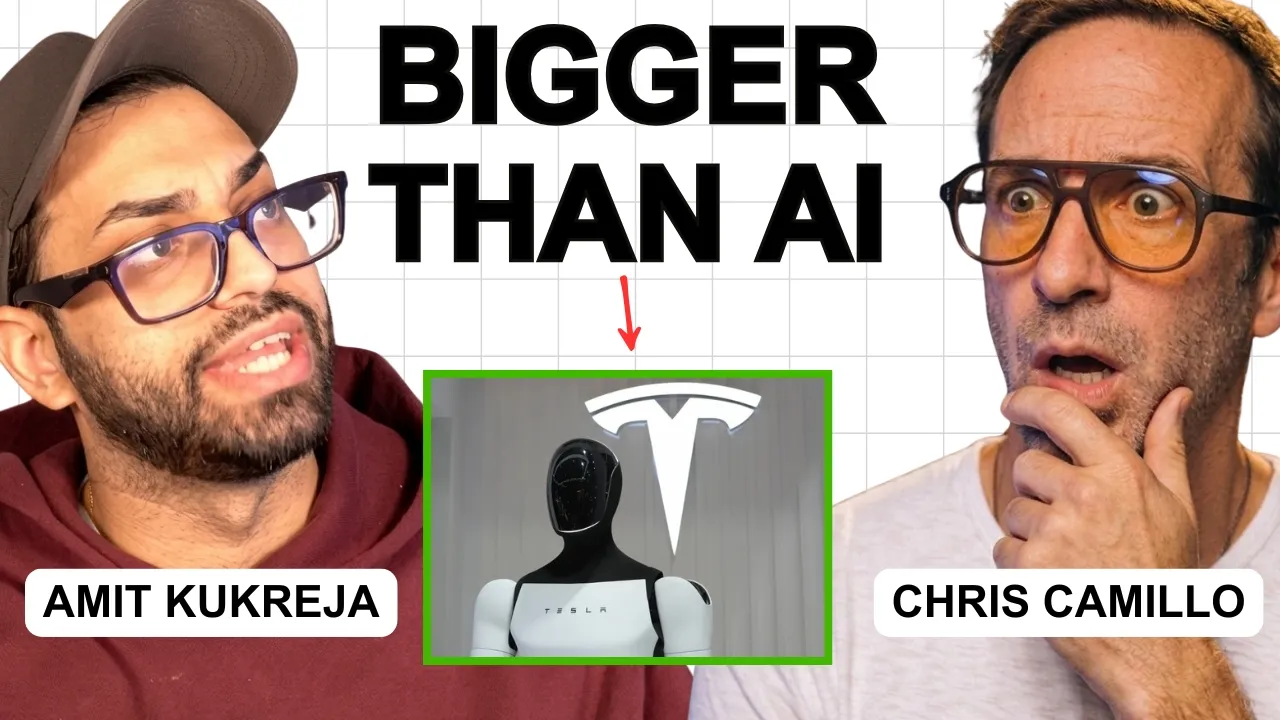
Chris Camillo & Amit Kukreja: The Humanoid Robot Boom Is Just Getting Started

- Retorno do vídeo
- —
- Chamadas
- 1
- Compra / Venda
- 1 0
- Publicado
Recomendações
Entrada é o preço de fechamento do ativo na data de publicação. Atual é o último fechamento registrado.
-
Entrada $328,58 08 ago 2026Atual $328,58 07 ago 2026Resultado +$0,00
we have that one public market play in Tesla.
Contexto "Yeah. Um, you know, obviously we have that one public market play in Tesla. I don't think there is another uh viable public market play at this moment that is meaningful on robotics..."
Transcrição Completa
We are joined again by the legends Chris Camilillo and Amit is investing to talk about humanoid robotics today. So kind of a next level to that AI conversation that we had previously. We're going to roll through a bunch of topics including the hands, the timeline, market opportunities, macro, and pieces like that. Let's start out with some of the fun stuff. Chris, this is an area that you have been privately investing in, publicly investing in. You're uh very emphatic about it. I know that it ties a little bit into even that Amazon thesis and around some of that Amazon trade as well because they're doing so much with robots. When you think humanoid robotics, where does your mind first go in terms of investment opportunities in the future? >> Yeah. Um, you know, obviously we have that one public market play in Tesla. I don't think there is another uh viable public market play at this moment that is meaningful on robotics unless you want to kind of invest in a diversified robo strategy fund. I don't know anything about that or how it's structured but that would be another way to invest in the privates. Really all the action in this sector is in privates right now. There are three meaningful companies on the private side. There's uh Figure AI uh out of San Francisco. There is Appronic out of Austin. There is uh Boston Dynamics uh you know obviously a subsidiary of Hyundai. And there are some things that are rumored that are happening there. We could discuss all three of these companies. Then you have companies that are more on the neural network model side that are starting to potentially at some point I think back into the hardware themselves. uh companies like Skilled companies like uh physical intelligence companies like um excuse me one other that's kind of both on the model side and on the hardware side which is Sunday uh they have a wheeled robot that's been getting a lot of eyeballs and traction the last year and have raised a bit of financing so then you actually have open AAI and Anthropic that are both in the very earliest stages of making their own moves of building out team >> uh around humanoid robotics. We'll kind of see where that goes. Uh there is a team the earliest stages a team that's kind of coming together been rumored at Meta as well uh around humanoids. Uh Apple uh the latest intel that I got is they do not have a full humanoid program but they kind of still have that arm in a box that weird thing that they're working on which is befunneling to me. >> I would love an Apple robot. I man you have you have no idea like I had a conversation about this last night with someone like it's I'm hoping Apple acquires someone in this space but um you know last last uh but certainly not at least and now you have Google obviously they've made a decision to really go all in on the model side right on the model side uh and they want to be like the model for all hardware companies all robot companies kind of like you know the iOS layer the the Android layer but for uh hardware And uh then you have Amazon and Amazon has just a whole host of things happening in robotics that's so major, so big uh not necessarily like aggressively pursuing the humanoid form factor as much as some of the other companies are, but you cannot count out Amazon by any means. So that's just kind of overview. My I mean I don't know if you have any thoughts color on that, but uh that's my overview on the sector, who the players are, right? Oh, by the way, uh, you know, I said Boston Dynamics, the latest rumor is that they are more aggressively moving to be part of Hyundai, meaning that company is going to be literally just going to be Hyundai kind of robotics. And I think that's why they probably lost a lot of their top talent this last year is, you know, that's just generally not a culture that US tech employees want to work under. uh a foreign company like that where you know the communication, the autonomy, uh the work culture, uh the ability to kind of have direct ownership in the thing you're building as opposed to ownership in something else that is a parent company that your ownership is more diluted. So I think there are a lot of negative pieces there for Boston Dynamics. They still have an amazing piece of hardware uh that's out in the in their last robot. So, but they they have to be factored in as a meaningful competitor in the space >> for sure. >> Oh, you have one other, of course, that just went uh is going public via Spack. I'm I'm so sorry. I I keep forgetting. You have the Digit Robot uh uh that that that's coming in under Spack. It's it's not it's not one that I love. uh personally uh it's not a full humanoid but they they do have their full humanoid uh kind of a remodel of their hardware platform that's that is re that is coming out with the new fresh capital that they're raising as part of this uh spa agility is the parent company behind the digital robot so I think that's a pretty good skill did I miss anything there who am I missing >> I think you got uh a lot of them obviously you know a lot of these players have been around for a while some of them have reached massive valuations in the private markets which is I think a lot of people are wondering, you know, is there a opportunity in the supply chain of these robotics? I mean, if we're going to build a billion robots, like we have hundreds of millions of GPUs, there's going to be a lot of different opportunities to participate in that. So, uh, Tesla and Amazon, the big ones, Tesla with Optimus, I think today's discussion will be really important around the viability of those robots becoming real because I see a lot of retail excitement. Chris, I'm sure you see the same, but it's like Elon was just on the call and said, "Guys, it's going to be the biggest thing ever, but you got to give me some time." And for Elon to say that when he's usually optimistic about bringing the timeline forward makes me think that it might take a bit longer than expected >> it to who's been saying that for the last two years when no one else was. >> You know, it's funny because your your thread on robots went viral a year ago and I that's where I discovered robots. That's where so many people I know discovered robots. Um, and the the ending of that thread was like, I think this is bigger than the iPhone, but it's going to take them. It's not going to happen tomorrow. You know, pretty pretty much every conversation I have behind the curtain with people around the world that are deeply considering big in institutional investments into the sector that are vetting these companies, meeting all the CEOs, goes right to the timeline. And they tell me, I've been the only guy the last two years that has been saying this and now it's kind of becoming obvious that the timelines are going to become more extended for deployment. Uh for one, landing on a fully scalable commercialized hardware platform. two where the models are really ready and accurate enough to mesh with those hardware platforms to be viable bots in the field. Three, uh the deployment challenges are massive, meaning it's not about making the robots. I know Elon is all about, well, we can make the robots. Well, that's not a problem, guys. These are like 150 lbs. We're not making cars here. There's like factories all around the world that are very capable of making a lot of robots and scaling this stuff out. So that's not the issue. The issue is deployment change transformation. Uh if this is most similar to when IBM made uh mainframes in the 80s, they didn't just produce them and send them to companies and get them installed. You had to go through years and years of change transformation to become a company that was going to dive into computing for the first time. If you are one of the top one or 200 potential users of generalized robotics in the world, big companies of warehouses and logistics facilities and all the places where you need thousands, hundreds of thousands of robots working generalized, you have to go through so much work uh in change transformation to prepare to take on 500 robots at a site or even a hundred robots at a site, much less thousands and tens and thousands. That's the dirty little problem that no one's really being honest about and that's what's going to extend the deployment timeline. By the way, none of this is a bad thing, guys. I want to be very clear here for the winners, for the companies that are able to raise capital, build out teams, figure out the pieces of this puzzle, these are the moes. This is the moat that as an investor you get excited about. Okay? Because when you have these massive moes in deployment and change transformation, deep sticky engagements where you might have to work with these companies for years before they spend a hundred million, a billion a year with you, two billion a year with you, that means they can't just flip to another hardware robot company because they think that bot works 5% faster or, you know, they like the hand a little better, right? Like like investors have gotten all this wrong. Uh and and so that's what I want to talk about today. But but it you you just brought something really let's just jump to this part of the conversation. I think it's boring. You talked about supply chain because this comes up a lot too. Let's talk about the FCC ruling. Okay. Uh this kind of it's ban on Chinese bots. All right. So this is critical guys. It's not a ban on Chinese bots. Let's just make that clear. It's a ban on all non US bots. Okay. And the way that it is written is that 65% of the bomb cost okay components of these bots has to be made here in America. Now by 20 I think it's like what 2030 or 33 like some date I forget the date maybe 2030 2032 2033 someone can find out what the date is. Uh that goes to 80%. Guys this is a big deal. I cannot emphasize this enough. This is such a big deal right now. My knowledge that might be wrong, I I think I think this has been shared and rumored and discussed amongst people that know the vast majority of Optimus's supply chain, I believe, is Chinese right now. So, listen, not that Elon can't figure out that problem. I'm sure Tesla is going to rework that, but that could be a big big part of the delay that Elon is talking about and that they might have to rework the entirety of that robot supply chain to be here in the US. Uh I know one of the companies that I work closely with and I'm you know very well um Appronic has been laser focused on this for years. uh they're a Texas company and has felt strongly that in a world where uh they've been even before this ruling they were very excited about you know thinking deeply about supply chain and US uh supply chain so this is going to be a fascinating story to watch play out if we have to move do you guys if we had to move the physical AI supply chain to US dude that that's going to be wild dude. >> What? >> That's definitely possible. >> So what what I'm interested in here, there are a couple companies, Atronic and OneX, for people that are in the humanoid space know this. Their uh DNA is in actuation, right? They are deeply I mean those are two of the top actuation specialists in the world that founded both Appronic and well that now is CEO of 1X and I I think 1X is a is a tricky tricky company. I I I I love them but I have some concerns you know like we'll see. I I don't know where they are with their fundraising quite honestly, but I think the actuation piece is going to become exceptionally important for these companies that have the internal kind of teams and skill set uh for all their own actuation design and and can really think deeply about how they put together that supply chain for actuation where they're not necessarily fully relying on external actuation but they are basically grounds up actuation internally at those companies probably have a little bit of an edge here because that actuation is going to need to be put together essentially entirely in the US uh under this this this clause. >> Amid have you been doing like deep research in this area especially because you are looking more at the private side now? >> A lot of it was when I be made some of those investments early on in 2024. Um, a lot of the research over the past couple months has been a little bit more geared towards other sectors of the GPU supply chain stack more so because those are the names that have started to pop up and show the earnings growth. But in general, what what when Chris mentions the actuators, I think that's a really big part of this entire story, the uh ambidextrous nature of the hands of the robots actually being able to do stuff. That's why all these different companies, whether it's X1 or Tesla, their figure, try to show off what the hands are doing. I think that is going to be an opportunity for a lot of investors. But to Chris's point, like the supply chain to be able to build that stuff domestically in a meaningful way that keeps everything safe and and and then more importantly um allows the opportunity for those suppliers to scale up. Like one of Nvidia's biggest problem is their suppliers don't have enough uh don't have enough supply to supply the demand. I mean, if you do have what is unlimited demand, which I think Chris is very clear on that there this is essentially an infinite TAM, do we have the suppliers to catch up with that? So, I think from an investment time horizon, that's the biggest question that people care about, but obviously the technology continues to improve every day and that's what we saw with Figures live stream for what 10 days they ran straight of just a robot doing like those things are important for the ecosystem to feel that this has a chance of actually being real. Yeah, I I I the latest intel I have on hands is that everybody's cooking right now. And you know, I I knew this was going to happen because I guess about a year ago there was an explosion of hand companies globally. Like I was befuddled by it because I was like, how can you have this many robotic hand companies and they're all raising capital? And I'm like, that just doesn't necessarily make sense to me because you have a handful, just a very small number of humanoid companies that are working on their own hands. Maybe they buy a couple of these companies but >> right, >> it's just too many companies working on hands. That's creative destructionism. But it's good for the sector. It's good for the sector because you have a lot of very smart people that are were thinking about hands the last 12 months. They are working on all sorts of creative problem solving techniques for uh the way that robotic hands work. And I don't think anybody's fully landed on the on what is the best what's like the best uh road map, but every single road map for hands is being aggressively pursued right now. I have a pretty good confidence and we'll talk about timelines in a bit, but like when we get around to those kind of deployment uh timelines and when we start to see a little bit of scaling that the we're going to have good enough hands to do what needs to be done. And when I say good enough hands, I'm not necessarily just referring to the ability of the hands to do things. You've already seen guys that that can happen. It it's about hands that can do the stuff that we need them to do which we already know that exists that are cost effective that you can actually maintain get in there like there's a lot more to making a good hand. Uh cost effective scalable supply chain ready uh serviceable uh durable uh meaning you know like they they actually don't fall apart every 3 weeks right so there are just a lot of things you have to do to nail the hand. By the way, none of these hands are going to be even remotely close to what we'll see in 5 years when Melt Your Mind hands come out. But like they'll be good enough to do the job by the time we get to the point, which is kind of exciting, guys, cuz everyone was worried about the hands. I'm like not so worried about hands right now. Well, I I think this is part of why we're seeing right now the robots that are actually being put into the field are more like the quadripeds and pieces like that. I was talking with well I'm going to be chatting more with the team from Robo Strategy and Andrew there but also some others in this area and they're showing you know the quadriped robots being used as like firefighters already and they can run up and they can have the hose on their back. They can carry payloads. They can do all that type of stuff. So those are already coming into the field but specifically to humanoid it feels like it's a pretty big jump. I think most of those companies that are building hands are just trying to get acquired right that's really the end goal there in that area is just built to get acquired. When it comes to the hands, just to get a little bit more detailed, is it also not just building the full hand? Like I think I was reading a story a while back, you know, Tesla or another company acquired a company that they just did the fingertips. They just did like the sensors in the fingertips. So, it's different pieces of the hand. It It's a complex problem, man. We're going to be working on hands for the next 15 years for robots, right? They're just going to get better and better. We're going to look back at these first hands that these robots will be deployed with and laugh at them in 10 years like they're like dinosaurs, right? Like this is the fun part and this is the part where it's so cool to think that we are on the ground floor of building the world's first human robots and that that are going to enter the world for real, guys. like the the we are a couple years away from seeing things start to enter the world. We're talking about humanized robots, guys. It It's just crazy that we're sitting here talking about this. It's taking a little longer, but it's coming. It's definitely coming. Uh by the way, uh I think there's a little You guys are obviously familiar with the uh kind of open weight versus close weight debate on AI, right? That's like the biggest discussion AI right now. Well, I have news for you. There's going to be an even bigger discussion when it comes to open versus closed weight in the world of robotics. Uh I think some things will come out in the next year and all of these robot companies are going to have very difficult decisions to make. Do they want to go down the road of open weight and kind of building on top of that internally with their own models or do they want to partner deeply with one of several major kind of closedweight uh models right from some of the big mega tech companies and or one of the startups that are doing great work in this space that I think is a big decision for every robot company right now. And I don't know what the right decision is. I really don't. I've thought about this deeply. I've had conversations with some CEOs in the space and I don't think there's a clear answer yet on what >> it's not as it's it's not as simple as open source models that can code either, right? Because these are much more complex models with >> physi physics and vision and language and movement. So on the on the open on the open wave side I think the roadmap there is that a lot of the b you'll be doing a lot of post-training on these models right so you kind of take these open lake models you do a lot of your own proprietary uh you know post- training on the models to develop your own proprietary you know model for your hardware and that's definitely an option uh you know likewise you can kind of get into bed with one of the closedw weightight models that are going to do a lot of that work for you or uh you'll be a company that's kind of deeply partnered with them kind of doing that work in unison. I think we're still pretty early and honestly guys I think we're still pretty early on this. It'll be an interesting debate to watch unfold and I don't know who the winners are going to be in in that >> early like 10 years early or early as it >> No, I I think this will all play out in the next two years like two to three years and we'll kind of see which companies it'll be interesting to see like which of the big robot companies pick which road mapap to chase and and whether that's what that's the right one or not uh or if they choose to kind of go down dual paths. Uh because no one really knows. If you pick a closed weight model, I I think you're to some extent putting a little more faith in your closed weight partner that's developing it where if you go with an open weight model, which is going to entail a lot of your own proprietary kind of post post uh training, uh you have I think a little bit more control internally. So, we'll see. We'll see. We'll see how that plays out. But that will be a technology discussion that will be had over the next couple years and it will be a pretty intense debate, I think. >> People in the sector. >> Yeah. Yeah. Do you think we see a for the government Palunteer robots? >> I don't think Pal is going to make robots, but uh you know, all robots need a centralized operating system to become more effective. So, I think there's definitely a role there. I think the broader question, and we can get into this if you want, is I'm actually curious. I I don't know Chris's opinion, is uh I mean, do we really have these companies give their robots to the military? Because I know a lot of these founders like Brett at Figure said, "We will never give to the military." I think Elon's come around to saying, "Well, they want to order 100,000 robots. Maybe that saves 100,000 lives instead." Like that would be the biggest buyer of robots, right? the the early the early thinking on this from all the CEOs is no. Okay. Uh and the reason why they're saying no is not because yes it's a big opportunity but it's a relatively small opportunity when taken in the context of the commercial opportunity. So the commercial opportunity is all the companies, hundreds and hundreds of big companies that all have massive demand and will spend billions a year with you for bots, right? So you would rather have a diversified base of clients and when it's that it's the biggest ham we've ever seen. So you don't need the military. You don't need that big order, right? And to some extent, if you choose to go down the path of making those bots, there is a reasonably high likelihood that a lot of these companies for PR will choose not to work with you because they just do not want that hot debate with their employees, their customers. Wait a second. You guys are supporting this company that's making military bots. Listen, we all can have an internal debate about whether that's right, wrong. It's happening anyway. It's for defense purposes. Wouldn't you want them in our military when everyone's doing them? It really doesn't matter, guys. I It's It's a PR issue. And whether it's right or wrong, companies generally tend to just want to if they have multiple options, they would prefer the option that doesn't involve them in a big debate. that doesn't result in their employees, you know, picketing and their customers, you know, basically not buying their product because they have a different thought on that on that hot issue. So, I think for that reason, a lot of the companies are like, "Hey, we're just going to stay away. We don't need military dollars. We don't need that." And then I think some other companies that were maybe I'll call them like kind of B-level humanoid companies. You just look at the fundraising chart like who has raised the most funds. Those are kind of your A-list companies that are kind of in the front tier. And then there's another set of companies that have had some issues raising funds. And I think to some extent those companies have said we're going to work with the military. You know, we're going to we'll take those dollars. And I'm not saying it's right or wrong. I have no idea. But I think still right now the frontline companies in the space are for the most part not committing to to making bots with guns. And so by the way, there is an enormous demand for the military to employ bots to move things. So my understanding is that every military base around the world, anyone that's brings a box or a crate onto the base, I heard has to be like escorted by two government officials. This is insane, right? So, how much easier would it be if once the crate, the box, the delivery got to the edge of the base if a humanoid wheeled or bipedal, which we should talk about in a minute, just takes it and takes it into the base, takes it to the right place, stacks it, moves it around the base, unpacks it, does all that stuff. So we can be talking about a multibillion dollar annualized revenue stream of def the bots employed by US services that never touch a weapon and never defend anybody from they're just logistically proficient bots moving crates and boxes around bases all around the world. Okay, that that's actually a big opportunity. basically Amazon. Uh >> yeah. Yeah. I mean guys, when you start thinking about this, the TAM, and this is what got us so excited about generalized robotics and humanoids years ago, the TAM is freaking insane, guys. This is the biggest market we've ever witnessed. And the the moes are way clearer to see than with just AI, right? So like cuz there's hardware, there's deployment, change transformation, there's service. By the way, think about what is entailed with servicing millions, tens of millions of robots that are hardware that are always getting run down, that need to be maintained, that need to be repaired, that need to be moved and shipped all around. That is going to become a massive industry. And these are the this is what I'm saying. Like people are concerned about humans having jobs. The number of jobs that will be created and obviously it'll be a hybrid of humans and robots doing this stuff. Right? There are new This is an industry that's going to require an insane number of humans working in it to work with the bots just to maintain them and to service them and to help move them and do all the things that the bots themselves can't do. So >> until they get to build themselves and maintain themselves, right? Guys, this is this is going to be transformational over the next 20 years. It's going to be a wild journey for to watch this sector. >> Yeah. >> Um, by the way, let's talk let's talk about one of the things I think people are least knowledgeable on, which is bipedal versus wheeled. Uh, nobody wants to talk about wheeled because it ain't sexy and a lot of people can do wheeled robots. And so if you're one of these big companies that like Amond and I have been like working with the last couple years, you want to tout your bipedal bot because the bipedal bot I think is where we ultimately land for most of the biggest use cases. definitely where we land for the home use case eventually, which will be a billion bots, you know, in and around the homes around the world. So, they don't want to really talk about the fact that in the first few years we're going to see a massive number of wheeled bots. Wheeled bots is where all I think the deployments are going to take place. Wheelbots are cheaper. They are way safer. Way safer. Uh and they can do like 80% of the early deployments. So if you look at where all the early deployments are in warehousing, logistics, all this stuff, you don't need bipedal guys. You don't need it for a lot of them. [gasps] So I think we're going to see wheeled bots in 28, 29, 30. A lot more wheeled bots than bipedal bots until we can kind of perfect bipedal and get some of the co the cost down. Bipedal is expensive, guys. Safety is expensive, too. >> Interesting. What did what have you seen when you looked into that? >> I have not even looked into that. [laughter] >> There's a lot more about that. >> Well, well, here well, here's the thing. All of these companies that are doing wheeled, you know, the bipedal bots are going to I say all most will have a wheeled version and the wheeled version essentially uses the identical upper body. So you're getting all the learning, all the proficiency, all of that training data, and then all of the optimization that will happen every 3 to 6 months when you're making tweaks will w will benefit the bipedal bot as well. So, this is where you get efficiencies at scale is that you're not having like a wheelbot that's totally different from a bipedal bot that's totally different from the bot that's on a stick on an assembly line that never needs to move. because the majority of that bot and all the things that you're constantly improving, making better every 6 months with every iteration of your hardware stack and and the software stack as well is on essentially the identical skew just with a different lower half to it. So it all works together, but this leads us into another conversation which is critically important which is safety. And I think there's going to be a massive debate with safety as well, very similar to the Tesla versus Whimo debate. So Tesla, as we know, has taken uh an approach to self-driving and robo taxi that does is a different type of safety standards, right? They're they're obviously just using visual and cameras, right? as opposed to the other tool sets being you know utilized by Whimo and other companies. Two very different approaches and I think you know I know people have strong feelings here but I like to think pragmatically that that debate has not been settled yet. We just don't know for sure. We don't know for sure uh which was the right road map to go down. I think we will have a similar debate with robotics when it comes to safety in that there are just numerous approaches to safety and there are some companies and some users that aren't going to care that much and there's other users meaning companies that will care. Now think of it this way. uh when it comes to robo taxi and it comes to self-driving, you can make a case that safety is more important because these things are flying at 70 miles an hour, 60 m hour, right? Uh and could just literally run someone over. >> But you could also make a case that many people die uh from car crashes all the time. So, we're going to ultimately have to accept that driverless vehicles are going to come with a, you know, hopefully a much lower incidence of crash rates and deaths, but it's unreasonable to say they can result in zero. Meanwhile, if we talk about robotics on the other hand, people are not dying. Uh, generally in warehouses, I mean, it theoretically happens, right? But for the most part, your workers are not just like dying because, you know, someone's arm just hit them randomly or or or or something fell on them, right? Like that's just like like another human like fell on top of them. So these things carry insane amounts of force, right? The these robots. So if you have one death or you have one critical injury early on from a robot that could end up being a meaningful thing to that client, that end client, right? And those employees, it's already a sensitive subject potentially displacing humans, right, with robots. You displace a human with a robot that kills somebody, [laughter] right? That's a big deal. So I don't know how this is going to play out but all of these robot companies will have to choose varying levels of safety from this you know the models to the hardware to the systems that are integrated uh with each company to the processes involved. Do we take 6 months to deploy or two years and 6 months so we can slowly understand the safety elements here at this company. the this will be a major factor guys and I think each robot company is going to have to make a decision. Do they go more on the Tesla side as it relates to just let's look at performance let's let's like orient towards performance and accept like a a slightly lower degree of safety or do we go more on the whim side where we have just a multitude of of approaches that we combine for safety. I don't know, but it's going to be a conversation that has to be had. >> Do you uh do you do you think the charging approach is going to be universal across the industry? Like kind of standing up charging or is there a more innovative approach there? >> I I personally don't understand. What do you mean standing up on something to like charge? Yeah, like standing on a pad and just standing there for two hours and then >> I do not understand that at all. I do not understand why anybody would think that that is a solution to a problem that doesn't exist. These are robots that have batteries that last 3 to 5 hours. Okay? They are robots that are capable of doing things. The e one of the easiest things to do would be for a robot to simply change its own battery, meaning like go to a battery swap station and changing it or just having a single robot walking around changing batteries on other robots. Uh I'm so confused why we would need to have some sophisticated standing on something to charge a battery. That makes zero sense to me. First of all, if a robot's standing in the same place all day, it can just be plugged in and hardwired. Okay? It doesn't need to charge at all. Uh, so that makes no sense to me. And if a robot needs to be maneuverable and it's moving around and it's not standing on something and the battery needs to be replaced every 4 hours, have the robot walk over to the battery charging station for 2 minutes and swap out its battery. or have another robot stand up behind it, swap out the battery, right? Like I I I don't I I every time I hear about this battery changing thing like we do with the magnet or it doesn't make sense. It's a solution to a problem that doesn't exist. Why why why are we even talking about it? >> Yeah, it's a fair point. Qu question for you Aid because I saw some people talking about this on the timeline today and then then I this is more on the uh I guess investment themes and stuff like that and then maybe we can pull back some of these other topics but a lot of people are talking about how AI has been the big runner for the last few years. You know, obviously if you're able to catch the thesis early, right when Chhat GBT came out, that was a big moment. Stuff took off. And then what is that next investable theme that we're going to roll into it? It does feel maybe like it's a little early on the robotic side. Curious as you look through your research, are there any names publicly traded that you're looking at it saying, I do think that there's an investable opportunity here or, you know, with Tesla, is it just too far off right now to kind of weigh it in there and some of these other companies? >> It's a good question. I I went through a lot of different names. I think Goldman Sachs put out a primer on all the names they're looking at. Um the edge AI names are also really interesting when it comes to this stuff because of the level of compute that you're going to need at the edge. There was some news the other day about Amberella potentially getting acquired as well. Obviously, you have your Symbotics and all these different names that are out there that are, you know, getting people's attention. Then you have the agility robotics as Chris mentioned. I just think that people are looking for the next sector to be excited about and they want to be early to that because if you knew, >> you know, if you knew about Micron 2 years ago and how important HBM would be for GPUs, you made a crap ton of money. people like okay what is the micron of the humanoid robotic sector and and you know as as much as an that's important to understand and realize I think now that there's so much hype around robots without robots delivering I mean there is no chatbt yet of robots theoretically that you know billions of people or even hundreds of millions have access to you know a lot of this stuff I don't know if it's investable so like agility robotics I know they're going public with a spack soon and everyone's like this is the pure play theme for robots and I'm like well like is it because everyone else is saying private for a reason. And so like you start asking Tesla doesn't even have a robot doing dances that they've posted in 6 months. Like there's not even any new videos from Tesla. So we're going to trust some private company to say like we're going to be the public name for robots. I I think there's a lot more hype than there is uh focus on the supply chain. And eventually there will be a massive supply chain opportunity and there will be plenty of names to go after. It's just again we got to get some of those robots in the factories doing stuff at scale, not just in these pilots for things to really play out. Yeah, I'll give you my take on timelines which I might change right over the next few months. Here's my take. We will see some very tiny early deployments later this year. Uh we'll continue to see small deployments throughout 2027. I think we start to see our first scale deployments in 28. Okay. I I think that is at this moment in time a pragmatic and reasonable timeline of what we're actually going to see. I don't think that anyone has a commercially scalable bot right now. And so any deployments you see today and in 207 or early 27 at least uh will be the non-commercially scalable hardware platform whether the companies admit to that or not. And I think the deployments we see in 28 or possibly late 27 will be the large companies first truly scalable commercial bots. So that's kind of a best estimate of timelines. If you're a retail investor right now and you're trying to figure out when do these companies go public, I'm thinking there's a good likelihood we can see an IPO window in 28. Why? At that moment in time, we will have one or more companies that have a robot that they can prove meets all of the KPIs. By then, hopefully the investing public will be knowledgeable on what all these KPIs are. uh but they have met all of the KPIs to have a commercially viable scalable hardware platform and the software the model side of this will be up to par enough right uh that they will work together and and will actually have a viable robot that can work in a factory and do a pretty decent job and not go down too often not need that level of human interaction but that they'll be still be pretty small but the but as investors we will have hard proof. We will be able to see the product that can be scaled. We will also be able to see uh we'll have insight into the contract volume that I know exists already >> of the world's largest companies that are prepared to spend hundreds of millions to in some cases billions a year on these bots if and when they meet performance metrics. Okay. So I think a lot of these contracts will be performanceoriented. What I mean by that is the contract will be like we will spend this huge amount of money with you but your robots need to be able to achieve these things because ultimately the end clients in this space only care about one thing. They don't care what your robot looks like. They only care about what it can produce. So if your robot is able to achieve this task, basically what a human does at this rate, we will pay you this wage for it. They're they're thinking of this like humans. And so yeah, absolutely. We know we need this many of them. And so if you can do that, we'll pay you this. So as an investor, I need to be able to see the demand is there, but I also need to be able to see that you actually have a viable product that can theoretically deliver on that performance contract. Now, we're still missing one piece from that equation, and that is the time to deploy. So, even if you have the product, even if you have the contract, you still can't physically ramp up from 20 bots to 15,000 bots at a company. It just doesn't work like that. So, that's going to take a long time. But I don't think investors care because if investors know the demand is there and they know that you have the product that can actually deliver on that and it just takes time to go through change transformation to ramp up the number of qualified people that can maintain these bots and it just takes time for a company to like prepare to take on thousands tens of thousands of bots where they used to have humans working or build new facilities for these bots. I think investors are willing to wait for that because the TAM they they have visibility that everything is real and [snorts] they will wait knowing that it could be a few more years before the dollars hit. Okay, because the moes are there, the product's there, the demand's there. So, I think I think we'll be there by 2028 or at least we'll have one or more companies will be there that are currently private >> and will be IPOable based on contracts, based on the products that they have, based on the teams they've employed, based on the capital and the resources that they have, the talent that they have accumulated. as an investor, we'll be able to check off all those boxes and go, "Yep, they have everything they need to be successful in this place." And now it's just a matter of deployment and execution on the plan. So, but by the way, it took years and years and years to get us to 2028 with these companies that we've been talking about, Figure, Appronic, whoever else comes behind them. So, I'm excited about 28, guys. Uh but it is it's not now it's not 26. Okay. So so everyone needs to be a bit patient about how this happens. And by the way Tesla's right there hopefully uh in the same window. So it's not an IPO for Tesla. But I think it's kind of like when you can get really excited is like at some point later in 27 going into 28 when we get this visibility. Tesla's obviously a company that can scale once this happens. Yeah, great points. Amit, I know that you have a hard stop coming up here in a couple of minutes. Um, but the episode here was awesome. The chat's been awesome, too. I don't know if you guys are looking at that at all, but a ton of people in the chat talking about uh some things along the lines of what we're talking about in terms of companies to look at as potential robotic plays, uh, charging, some of the other different areas. So, love the chat. Appreciate you all being super active. Obviously, if you haven't yet already, make sure you're following Chris. You can see Chris Camilillo on here. are also done Money on YouTube and then Amit at Ominous Investing. Probably a lot of you watch it on a daily basis. Anyways, so thanks for coming over from uh his channel if that's where you're coming from. Make sure you're subscribing to the Wolf channel here. We try to do, you know, live streams like this pretty commonly. These guys coming on usually about once a month or so and a bunch of others. More videos to come. Emit, uh, did you have any final comments that you wanted to share on this one? >> Yeah, I'm just really excited about this. I mean, I think Camilo has become like the go-to thought leader in this space. he's obviously invested a lot of time and money in helping a lot of these robotics companies get off the ground and understand you know what it means to commercially scale. So I am just inspired by a world in which the tasks that suck for humans to do the backbreaking work gets replaced and that feels like a world I want to live in. It feels like a world my kids kids would want to live in. It feels like a world we should have if AI is going to make things better for all of humanity. But there's just a lot of tech that's involved to get there and it it feels like it is inevitable that it will happen. It's just as Chris said, it's going to take some time, but it's a an incredibly inspiring future that I think a lot of people will want to invest in. >> I think it's going to lift the third world too, guys. I think it's going to lift the third world. I just spent some time in Africa again last week and >> dude, uh not the good part of Africa, right? Like so I it's there's so many people so many so much of this world needs more resources. They need to build. They need to like some people might be living in abundance in 20 years. I don't know. But other people just need to like get out of poverty. So I think AI I think embodied AI robots. It's going to happen. By the way, for me, uh it took me like 20 years, but my my stuff is finally on Instagram and Tik Tok. So if you follow Daily Chris Camilo on Instagram or Tik Tok, uh you can see two clips a day because I would not want to listen to myself speak for more than like 30 seconds. That's a good digestible amount of me every day. Uh just the highlights of all the podcast I do. So love you guys. You guys are big on it. I I love getting on with you, man. And uh yeah, we need to all catch up in New York next time I'm up there. >> For sure. Chris, when Mr. Beast does the I gave 10 robots to each African village. We need you down there in the video. >> Oh, I'm working on it, man. I'm working on it, dude. Trust me, I'm I'm bringing all my worlds together once we get there. Uh, >> dude. No, but Chris, that's like there absolutely will be a Mr. Beast Robots video and you absolutely have to be the guy he should know about to be in that. I mean, that >> Oh, I I mean I was I was with I was there with him last week in Africa. All Trust me, I'm on it. I'm on it, guys. I'm on it. Yeah. >> Oh, interesting. >> Okay. >> Yeah, we'll we'll make it happen when the bots are ready. He He's Yeah, we we need the bots. We need the bots for a lot of that stuff, for sure. F first bot, the dishes bot. I'm telling you, the divorce rate's going to go down in America. That is that is going to be the first bot. Dishes bot. It's going to save save marriages. They just have to figure out how to get it waterproof. >> I I want the picking up the dog poop from the sideyard bot. That's what I want. Okay, >> I could use one of those, too. I just got a puppy. Um, super cool. Thank you to the chat. Appreciate all the kind words. A lot of people loving loving this episode. Uh, we'll think maybe uh what other futuristic tech to talk about in the next one. But for now, thanks everyone for watching. Thank you, Emit. Thank you, Chris. You guys are the best. Looking forward to doing this again. Wishing everybody a great day. We're going to close out here. Thanks for watching today's video. If you enjoyed it, go check out the Wool Financial Newsletter. Did you know that we make a ton of content? We host 60 plus hours of Twitter spaces and live streams every single week. We're posting on the timeline over and over and over. We put up YouTube videos and one of our prime gems is our newsletter. and it's free into your inbox multiple times a week. We mix it up. We give stock picks, market headlines, research, info. It's a great way for you to stay in touch with the stock market and your portfolio without having to spend eight hours a day staring at your brokerage screen. So again, link is below. It is free to grab and you're going to love the content in
Comentários 0
Entre para participar da discussão.
EntrarAinda não há comentários. Seja o primeiro a compartilhar sua opinião!