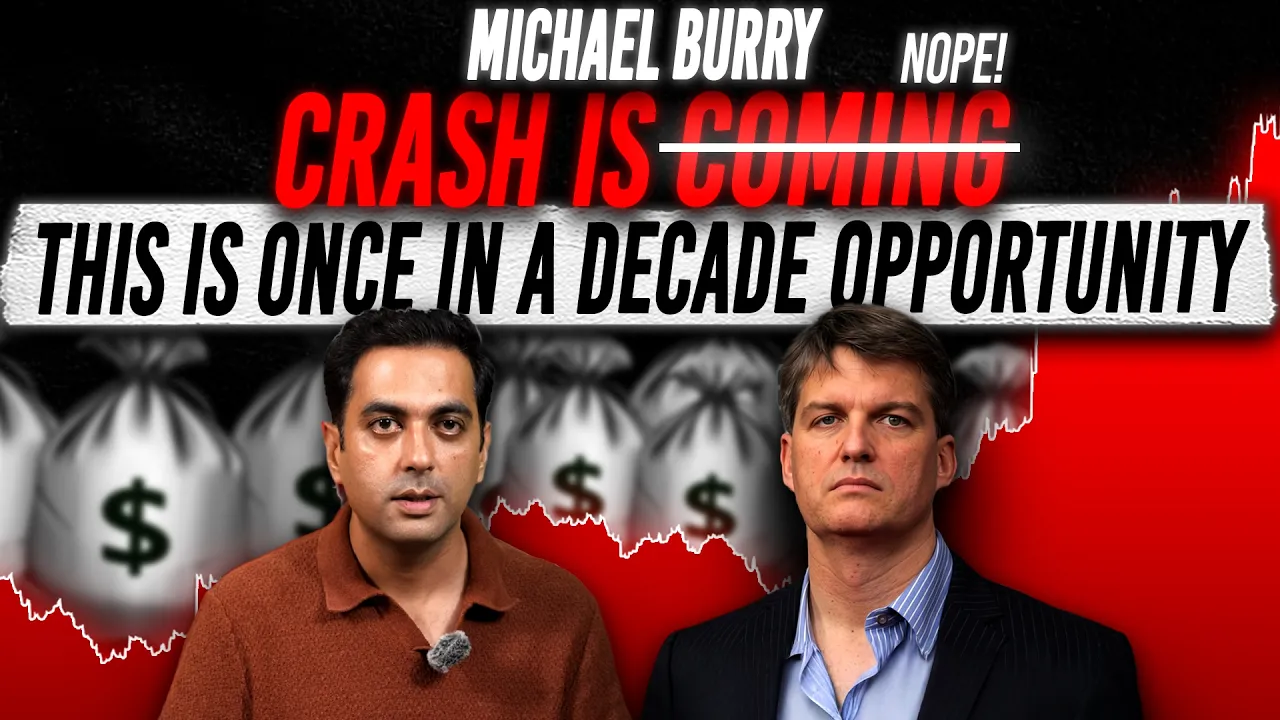
Michael Burry Warns Of 1987-Style FLASH CRASH Is Coming - Here's WHY I'm Buying His Top Short Target

- Retorno do vídeo
- —
- Chamadas
- 3
- Compra / Venda
- 3 0
- Publicado
Recomendações
Entrada é o preço de fechamento do ativo na data de publicação. Atual é o último fechamento registrado.
-
Entrada $223,96 08 ago 2026Atual $223,96 07 ago 2026Resultado +$0,00
The number one stock that I will be buying in this market is the very stock Michael Burry is shorting, Nvidia.
-
Entrada $877,57 08 ago 2026Atual $877,57 07 ago 2026Resultado +$0,00
Stock number two is Micron.
-
Entrada $499,99 08 ago 2026Atual $499,99 07 ago 2026Resultado +$0,00
Number three is my personal favorite, Microsoft.
Transcrição Completa
The big short investor, Michael Burry, is predicting an imminent 1987-style flash crash for US markets. On October 19, 1987, Dow Jones fell 22.6% in a single day. That historic collapse is why the day became known as Black Monday. If Burry is right this time, investors could face one of the most severe collapses in modern history. However, personally, I don't agree with Michael Burry. And I'm glad that a large number of analysts also don't agree with Michael Burry. In fact, most of the analysts predict that we will be hitting a new all-time high pretty soon. Listen to this clip from Tom Lee. >> I mean, earnings this quarter is coming in more than $15 ahead of what people expected at the start of the quarter, but what's really more impressive is 2027 earnings are up now $8. So, we're probably close to 410 for 2027 earnings. And we're only 3 weeks into earning season. I I actually think it might settle out closer to 425 by the time earning season's over. And now I think as earnings have been good, and I think there's a rethink of how inflation might be cooler than expected, and of course AI is still strong, there's going to be a chase. I think that chase takes us towards 7,900 8,000. >> Most The commentary across the board from the card companies who I mention every quarter about consumer spending just fine. So, you have all the investment themes going on, AI, power generation, etc., etc. The consumer's doing fine. Job is claims 2 weeks in a row sub 200. These are exceedingly incredible numbers. There's lots of evidence that this is not just some Fed or an AI-infused rally, specifically in the United States. There's lots of things going well, and again, getting back to the original point to tie it up, every company in every industry is basically saying, "We're good good." >> Here are five reasons why Michael Burry's imminent crash prediction is wrong. Number one, the AI boom is supported by contracted demand. The largest technology companies are not spending billions purely on speculation. Their investments are supported by paying customers, signed contracts, and capacity shortages. Microsoft's commercial backlog reached 678 billion, increasing 84% while Microsoft cloud revenue grew 27%. Azure demand continues to exceed available capacity. Amazon, Alphabet, and Meta are also expanding infrastructure because customers require more AI computing power. Micron, Samsung, and SK Hynix have reportedly allocated their entire projected 2027 DRAM and HBM supply. This differs from a classic bubble in which capacity is built without visible demand. Heavy spending creates risks, but contracted revenue and supply shortages provide substantial evidence of real economic demand. Reason number two, corporate earnings remain extremely strong. Crashes become more dangerous when stock prices rise while profits weaken. That is not what current earnings data show. FactSet reported that second quarter 2026 S&P 500 earnings were growing approximately 47% year over year. Even after excluding Alphabet and Amazon, two major contributors, growth remains strong, about 29%. Analysts were also projecting earnings growth of approximately 24% for the third quarter and 22% for the fourth quarter. The S&P 500's net profit margin reached roughly 15.7%, the highest level recorded by FactSet since tracking began in 2009. Valuations are elevated, but strong earnings provide genuine support beneath current prices. Reason number three, today's largest companies are stronger businesses. The 1987 market was dominated by financial, energy, and highly cyclical companies. Today's largest index members include Microsoft, Nvidia, Alphabet, Amazon, and Apple. Businesses with global operations, strong balance sheets, recurring revenue, and enormous cash generation. Microsoft recently reported quarterly revenue of 90 billion, while Nvidia's revenue increased 85% to 81.6 billion. These are not speculative companies surviving entirely on borrowed money. They are profitable businesses financing much of their expansion from operating cash flow. Concentration remains a real risk because a few companies carry enormous index weight. However, market concentration in highly profitable companies is fundamentally different from speculation unsupported by revenue, earnings, or cash flow. Reason number four, economic data does not signal an approaching collapse. A 1987-style warning becomes more convincing when the economy is contracting, consumers are retreating, and unemployment is surging. However, current data show a different picture. The US economy expanded at a 1.5% annual rate during the second quarter, but underlying private domestic demand grew a much stronger at 3.9%. Consumer spending accelerated to 3.2% compared with only 0.5% in the previous quarter. Unemployment stood at 4.1% while core inflation slowed to 2.6% annually and was unchanged in June. Some might argue that economic growth is moderating, but the numbers do not currently indicate a recession or the collapse in demand required to support Berry's extreme prediction. Reason number five, history rewards investors who survived volatility. Berry may correctly identify overvaluation and still be wrong about the timing or scale of a collapse. The market has survived 19 major crashes since the 1870s and continued creating long-term wealth. Even after Black Monday, the Dow recovered its previous high in approximately 20 months, and the US economy avoided recession. Following the 2020 pandemic crash, the S&P 500 recovered within months and reached new records. Investors who sold during panic often miss the recovery. Corrections of 10 to 20% are normal, but a correction is not automatically another 1987. History favors disciplined accumulation, diversification, and patience over repeatedly abandoning profitable businesses whenever a famous investor predicts disaster. The number one stock that I will be buying in this market is the very stock Michael Burry is shorting, Nvidia. Nvidia remains the clearest beneficiary of the AI infrastructure boom. The company provides the GPUs, networking equipment, and software needed to train and operate artificial intelligence-based models. Its latest quarterly revenue increased 85% year-over-year to a record 81.6 billion. Nvidia generated approximately 61 billion in gross profit, while its gross profit margin remained close to 75%. These numbers describe a highly profitable market leader, not a speculative company entirely built on future promises. Microsoft, Amazon, Alphabet, and Meta continue spending enormous amounts on AI infrastructure. Microsoft said approximately 2/3 of its capital expenditure went toward short-lived assets, mainly GPUs and CPUs. These assets require regular upgrades, creating a powerful replacement cycle for Nvidia. Competition and export restrictions remain risks. However, Nvidia's hardware, networking, and CUDA software ecosystem provide an advantage that competitors cannot easily reproduce. Stock number two is Micron. Every advanced GPU requires high-performance memory. As more GPUs are deployed, demand for DRAM and high-bandwidth memory rises with them. Micron's latest quarterly revenue increased 346% year-over-year to 41.46 billion. Operating cash flow reached 25.39 billion, while adjusted free cash flow climbed to approximately 18.3 billion. More importantly, Micron has signed 16 strategic customer agreements covering approximately 20% of its DRAM and 1/3 of its NAND volume. These agreements include roughly 22 billion in customer deposits and financial commitments. Industry reports also suggest that Micron, Samsung, and SK Hynix have already allocated their projected 2027 DRAM and HBM supply. Customers are reportedly receiving only 60 to 70% of the volumes requested. Tight supply, stronger demand, and longer contracts could make this memory cycle more durable than previous cycles. Number three is my personal favorite, Microsoft. Microsoft offers a more diversified way to invest in AI. It owns the cloud infrastructure through Azure and distributes AI through Microsoft 365, GitHub, security products, and enterprise software. Quarterly revenue increased approximately 18% to 90 billion, while Microsoft cloud revenue grew 27% to 59.3 billion. Commercial remaining performance obligations surged 84% to 678 billion, providing exceptional visibility into the future revenue. Azure's strong growth confirms that Microsoft's enormous AI spending is producing measurable commercial demand. The company also provides access to models from several developers, reducing its dependence on OpenAI alone. These three companies operate at different levels of the same AI ecosystem. Nvidia provides computing power, Micron supplies essential memory, and Microsoft delivers AI services to customers. Their latest results suggest that market weakness is creating selective opportunities, not confirming that a historical collapse is inevitable.
Comentários 0
Entre para participar da discussão.
EntrarAinda não há comentários. Seja o primeiro a compartilhar sua opinião!