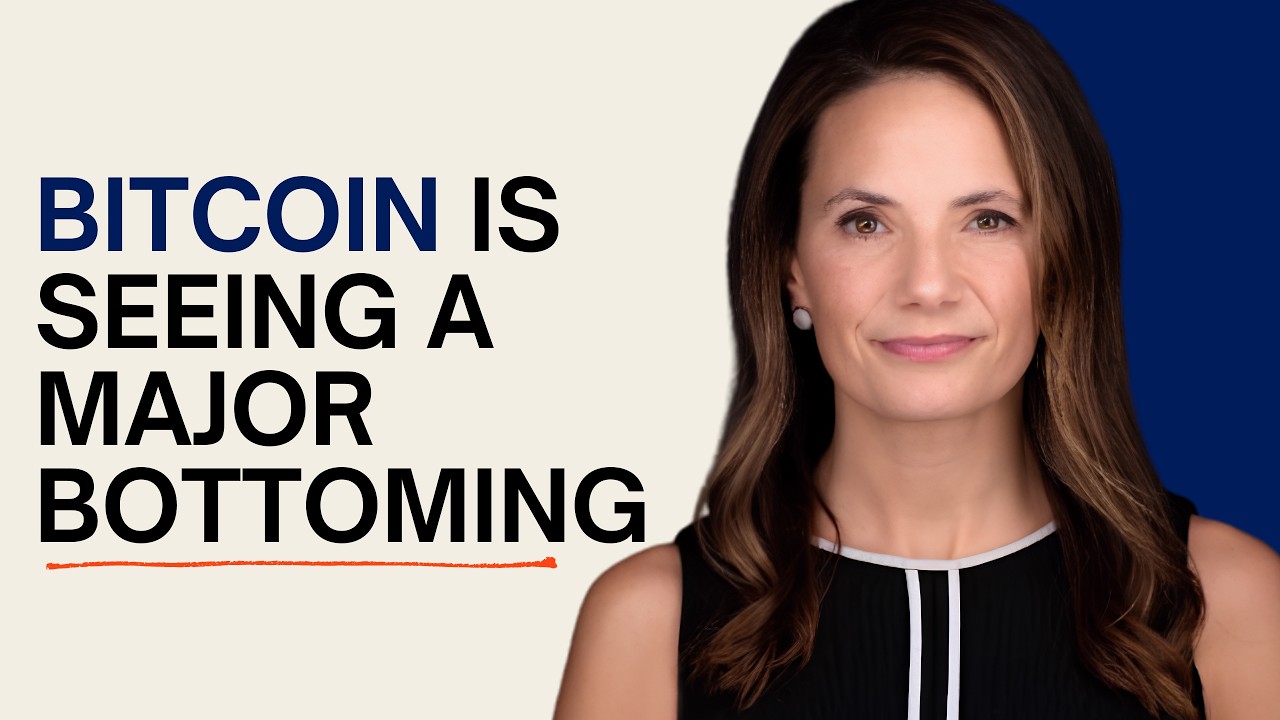
Bitcoin Is Showing Signs of a Major Bottom, Says Fairlead’s Katie Stockton

- Retorno do vídeo
- -0,16%
- Chamadas
- 2
- Compra / Venda
- 2 0
- Publicado
Recomendações
Entrada é o preço de fechamento do ativo na data de publicação. Atual é o último fechamento registrado.
-
Entrada $63.985,00 10 ago 2026Atual $63.881,00 11 ago 2026Resultado −$104,00
Every time you call back to where the previous highs were and you consolidate, that's a good buying opportunity.
-
Entrada $63.985,00 10 ago 2026Atual $63.881,00 11 ago 2026Resultado −$104,00
it's more like let's watch and wait, make sure that the momentum is turning in a meaningful way, and then that's where um you know, you want to get more aggressively long Bitcoin.
Transcrição Completa
I would agree that we are seeing those signs of long-term downside exhaustion already. We're evaluating Bitcoin from a technical perspective over multiple time frames, and that's really an important takeaway in that we're looking at the long-term setup. Not only is there a long-term oversold condition, which is measurable, but then also we have a momentum uptick on a long-term basis that's really very intriguing. Just very naturally from a psychology perspective, where there was once demand, [music] there's more likely to be demand there going forward. Bitcoin, in a way, has a better chance of putting in a major low, of meaning a long-term or lasting low. >> Welcome in to another edition of Coinage. I'm your host Zach Guzman, coming to you live from our Brooklyn studios here in New York City as we are watching markets continue to react to that big jobs report on Friday. A big miss and the market quickly reacting in terms of expectations around September's Fed decision, and whether or not we will see rate hikes or potentially now more steady as she goes. I'm excited to have on with us today a guest that can dig into some of the the technical pieces of the moves playing out right now and the best opportunities in the market today on Coinage. We got Katie Stockton, Fairlead Strategies founder and a chartered market technician as well. Katie, it's good to see you. Good morning. >> You too, Zach. Good morning. >> It's I'm obviously excited to dig into your guys' ETF on the Bitcoin side, which we'll get into in a little bit, the tactical Bitcoin ETF that kind of times the right moves around here. But I just want to start with your reaction to kind of what you're seeing right now, given the fact that I think it was it was almost the entire market on the same page around odds of a hike come September. Now not the case, not even consensus anymore. So quick changes there. But what are you seeing right now in terms of uh where markets sit in your eyes? >> Yeah, well, so we saw a breakout by the S&P 500 from what was a two-month trading range or corrective phase. There was much of June and July that we saw this unfold and we feel that the breakouts are generally actionable. We get excited when we see them because they remove resistance from the chart or potential supply. And they usually act as a positive catalyst for additional upside momentum. I think importantly also this breakout that we saw from the range did reflect a pretty notable shift and and an abrupt one at that in market sentiment. So we saw a good reaction of course to short-term oversold conditions. But then also just that very strong several-day run-up and it was like all of a sudden the AI trade came back. We saw the rotation back into the semiconductor stocks. The mega caps were a bit mixed but overall were contributing positively as well. >> Yeah, I mean when it comes to kind of I guess expectations moving forward, it has been interesting to watch. A a fellow CNBC contributor of yours, Tom Lee, basically calling for ups and downs, some chop into year-end. I mean, obviously the breakout, I hear what you're saying around kind of this being a positive signal. But when it comes to I guess the best ways to play around rates, I don't know if you're seeing anything when it comes to that AI rotation. Things looked a bit shaky just a couple weeks ago. So are you saying we're out of the out of the woods in that in that sense? >> Well, I think we have to have to just acknowledge the breakout as being short-term as opposed to long-term because a two-month range, listen, it's not that big of a deal to see that cleared. If it were a two-year range, well, that would be something that has long-term implications, but this is just a short-term breakout. So it certainly wouldn't preclude more volatility. We've been calling for the same, more choppiness through year-end. And there is a lot of reasons to expect that. For us, it's all just based on the charts. And what we're seeing on some of the longer-term charts, we like to use monthly bar charts to that end, are some signs of upside exhaustion for the major indices, S&P 500, Nasdaq 100. These aren't immediate issues for the market, but they do suggest that we're in this cycle that has been maturing. And even the correction that we've already would would hint at that as well. That a little bit of a losing its grip on that momentum stronghold and the leadership shift that we saw during that. Those are things that should keep us on guard. Um, but even still, you can position to take advantage of a breakout and then just be sure to manage risk. And there's of course many ways to do that. On the charts, that might mean using a stop-loss based on a support level or adhering to short-term momentum gauges, things like a daily MACD indicator. It's a very common trend-following tool for technicians. So, there's ways to try to navigate this even though it might feel overdone. I think, you know, short-term, that's for us several weeks in that in terms of the implications. >> I mean, when it comes to I guess I'm just bringing up your guys' tactical sector ETF over here as well for our for checking that one out. But I guess in terms of recently, I wonder if it's any more frustrating when it comes to kind of being more of a technician in today's market given the fact that so much can kind of swing on the other piece. Obviously, this week people are kind of looking at the jobs front but around inflation expectations there just given that everything can change kind of on a tweet right now as people watch oil and that market impacting things. It almost seems very difficult, but I I guess if there if there's one takeaway, not to put you on the defensive around technicians and how they look at things, but how do you kind of I guess think about the world we're in now when so much is kind of being driven right now by Trump? >> I think it technicians know to be adaptable rather than just predicting what might happen, right? So, oftentimes we're reacting to moves as opposed to predicting them. And that's an important distinction. I think there's almost a misperception that, you know, we can see the future. We know where the S&P 500 will be at year-end. Uh but of course that's not the case because, you know, it's impossible. But rather what we try to do is just put more weight of the evidence in our favor. And I think that's something every trader or investor should do. And that means from a technical perspective having the momentum gauges pointing the right way over your uh preferred time horizon. It might mean that you see these technical catalysts like breakouts, uh like buy signals in some of the indicators that we track. So, it's a matter of just putting that weight of the evidence in the favor of your positioning. And when things change, you need to be adaptable and to be able to change with them because at the end of the day the market really is the boss. And we need to listen to it, not try to tell it what to do. >> It's a good point. And I think also, I guess, if if you look at maybe the opportunities on the table right now, I don't know if there's anything that you're watching specifically when you dig into maybe some of those components uh in the S&P 500 or specific names that you're saying maybe well positioned just kind of given that, you know, it's the summer, maybe not the most active trading time uh per se, but what are you watching right now for maybe some of the best opportunities? >> Well, so now with this new found short-term momentum behind the market, we did see a return to the leadership ahead of the corrective phase. And that's pretty normal to see the technology sector exhibit upside leadership when it's a strong tape. And then to further that or to sort of narrow in on the group level, it would be really the semiconductors and then the AI trade you know, on the periphery of that. So the the same former leadership is what we should see outperform as we you know, advance from this corrective phase. That could change abruptly. Again, so to remain adaptable, I think is important when of course there is perhaps elevated headline risk. There's always that. There's always headline risk coming from some direction. This time it does feel a bit more acute, so I would acknowledge that as your earlier question. But even still, the indicators will help us adapt because they they can be sensitive enough to these swings to suggest, "Okay, well, this is either noise or this is a meaningful shift." And for right now, they do point higher and they would suggest that we source the AI trade and those previous leaders, you know, coming off of the March-April lows as the source of relative performance. When we have these breakouts, we do tend to see pretty broad participation. So if the relative performance isn't as important, then listen, I think there's a lot of great-looking charts out there to try to take advantage of. We highlighted positively recently the biotech sector. There's certainly some breakouts there to be had. So we we source the sectors that have the best momentum and and relative performance for idea generation in our research. >> Well, one of those areas that I know you guys research quite a bit is is on the crypto side. Before we get over into that, it was interesting to see from our friends at CryptoQuant also kind of digging into some I guess macro data, if you want to call it that, when it comes to kind of where some positioning from from larger funds uh are right now. And uh Ki Young Ju is just kind of flagging here that hedge funds on CME flipped net long Bitcoin futures. Uh that chart kind of interesting just kind of when you think about how most, I guess, on the institutional side have been using the basis trade to kind of play this market. Kind of interesting developments there. And then also just kind of looking at uh the the correlation between gold and Bitcoin. So, many people talk about Bitcoin as digital gold. Uh kind of starting to flip as well right now. And I know having seen your your takes before, you kind of start to look for some of the momentum shifts happening before you kind of obviously I guess that's what your ETFs all about. But, I'll talk to you kind of what you're seeing right now when it comes to everything beyond stocks, especially if we're talking about rates and expectation shifting there. I almost feel like Bitcoin, gold, and some of those commodities may be the biggest benefactors. >> Yeah, I mean we we look at everything independently and with the hopes that there will be no biases coming in from some other direction, right? So, we're not letting ourselves be swayed by macro data nor just general market sentiment. And that it just keeps us honest, right? And ideally what we see on kind of like the macro technical front will make sense. And if it doesn't, well maybe there's information in that too just from a fundamental perspective. So, when we look at yields, the 10-year Treasury yield, long-term trading range up near some resistance around 4 and 3/4, just kind of digesting close to that level. A breakout would be a pretty big deal for yields because it would resolve a long-term range to the upside. So, that's the action that we're watching on that front. And for the price of gold, well it's been a cyclical downtrend much like Bitcoin's actually. So, the correlations that we always find interest in, uh to us they're not something to use as a market timing device per se but just as a interest point right something that can maybe inform your bias but not necessarily send actual signals because these correlations they themselves are somewhat cyclical it seems as it as it pertains to gold versus Bitcoin or even equities Nasdaq 100 index versus Bitcoin these correlations come and go so we wouldn't rely on those as informational when making a decision but they can be pretty interesting at the same time with the price of gold we are seeing stabilization cleared the 50-day moving average last week for the first time in a while as it advanced from a consolidation phase so that kind of action acts as a positive short-term catalyst and I think gold investors might well that they'll certainly welcome that if we see a more substantial relief rally as that indicates and then perhaps it's also tradeable but unfortunately gold has seen a pretty meaningful loss of long-term upside momentum and of course that's happened for Bitcoin as well but they're quite different in that Bitcoin had already become oversold on the monthly chart whereas gold was not quite there yet so I think that's a differentiating factor to acknowledge that Bitcoin in a way has a better chance of putting in a major low meaning a long-term or lasting low as opposed to gold which perhaps is just seen an intermediate term low something that that sort of interrupts the cyclical down move as opposed to marks its culmination would be the thinking on that front so we treat them independently we find points of interest when the correlations are there but we don't make our decisions based on those correlations >> Much larger price levels than what we're seeing right now as gold kind of gets back to those June highs, but it is I think interesting for those in the Bitcoin community kind of think about gold's moves generally leading what we see from Bitcoin later on. I know you've taken a longer term view to kind of where you see Bitcoin eventually kind of returning to or kind of the reasons to be bullish on Bitcoin. Talk to me about how that kind of plays into what you guys do with the Amplify fairly tactical Bitcoin ETF. We'll bring that up in a second. BNAV. And and I guess if you look at it specifically, where you think things could start to shift if some of these signals play out. >> Yeah, of course. So, I mean the way we look at it is again strictly from a technical perspective. We're long-term sort of secular bulls when it comes to Bitcoin and cryptocurrencies more broadly. That's really more fundamental than it is technical, but we think that that's the opportunity, right? We have an asset class that also has a lot of volatility and again that's opportunity, right? So, the long-term opportunity is there just in terms of the technology and the the nascent asset class that it is, but then also that volatility creates opportunity from a trading perspective. So, I think the marrying of the disciplines here is really important and technical analysis I think has already sort of made itself a good name when it comes to analyzing Bitcoin because it at least in the earlier stages it was one of the only things that we felt like we could rely upon reliably. And but now, you know, what what we do with the BNAV ETF or BNAV, we're evaluating Bitcoin from a technical perspective over multiple time frames and that's really an important takeaway in that we're looking at the long-term setup, we're looking at the intermediate term setup, and then drilling into the short-term setup to inform our sort of decision-making. And so we we do honor the long-term trend in our research, but we're able to refine the momentum signals by going down to the daily time horizon. So while it's not a high-frequency trading model, there are times at which the market is warranting leverage positioning. So what we do with the BNA VETF is that we have a base level exposure to Bitcoin of about 70% and when the market warrants it, we will move to a leverage position of about 150% and that's where you can see you can build on returns that way of course, but then also just by the nature of trend following and and adhering to momentum indicators, it's also able to potentially limit drawdowns because of that sort of respect for the primary trend. >> Yeah, it's interesting too and I I I've heard right now I think I guess there's a lot of discussion in the Bitcoin community maybe outside of the technical charts, but just kind of more in a four-year cycle uh discussion framework because we're getting very close to where historically you might start to see this bear market end. We did catch up with Sandy Cull from Franklin Templeton just a little bit ago at the Out East Summit. Just want to play a little bit of what she had to say from her trader lens and get your take on the other side if if you're in that camp too. Here's why she thinks that maybe traders are already pricing in a bit of what we could see in that four-year rotation. Take a listen. >> I have spent my entire career in markets. I traded for many many years. There is such a psychological component to markets that just the fact that everybody says by October the markets are going to turn, the markets will probably start to turn prior to October. That anticipation of that event, people are going to want to be positioned before that. And I think we're already starting to see some signs of stability. Every time you call back to where the previous highs were and you consolidate, that's a good buying opportunity. That's how I think of it from just my pure trader instincts. >> Now, I am not a CMT, Katie, so I'm going to turn this to you, but I mean generally, I guess the idea of the four-year cycle is that you come down to these lows that you reach in kind of the last cycle and then you bounce off that. We're kind of here when you look at the longer five-term five-year chart uh for Bitcoin right now, but what camp are you in? >> Well, I'm not really a cycles follower per se. I think again it's it's a point of interest, but it's not a reason to make an investment decision. Not until you see the momentum gauges and trend following inputs turn in in favor of that cyclical low. So, it's more like let's watch and wait, make sure that the momentum is turning in a meaningful way, and then that's where um you know, you want to get more aggressively long Bitcoin. Um so, but I think her point on market psychology is really a very good one because I you know, it's such a global liquid deep market, right? So, I wouldn't say that it can necessarily like just the chatter out there can move the market. Uh but certainly sentiment is what drives some of these turning points. So, um it it's you see it in the equity market, too, that when that sentiment pivots, just about every stock bottoms right on the same day. Um so, I you know, we don't have maybe enough history to know for some of the altcoins if that's the case, but but typically you see that pretty uh sort of collective sentiment shift in the charts. And I would agree that we are seeing those signs of long-term downside exhaustion already. And those are coming from our trend-following gauges. Not only is there a a long-term oversold condition, which is measurable, and we have that long-term oversold indicated by two of our indicators. Uh but then also we have a momentum uptick on a long-term basis that's really very um intriguing following what was expanding momentum on the downside before we we hit the initial low around 60,000. The other point would be support discovery. So when you see um Bitcoin and other cryptocurrencies come into a level where they've either had demand before perhaps it's a level based on an indicator or a Fibonacci retracement level. We use something called the cloud model. We like that too. So there's different ways of gauging potential support. And indeed that comes into our biases as well. That it just very naturally from a psychology perspective where there was once demand, there's more likely to be demand there going forward. So very simple sort of concepts behind um market psychology are what are driving these levels and their importance. >> I didn't realize too that the the ETF is so new. I guess it's a relatively uh new development here that we are talking about. But I guess uh one of our viewers obviously being a community on show, we source a lot of questions uh from those watching. Um one of the questions is how you build in the leverage around that as you mentioned kind of ramping up or down depending on what you're seeing. What's what's the easiest way to do so? >> Yeah, indeed it is brand new as of last week. So last two weeks. Um so with BNAF we're using synthetic exposure to achieve the the Bitcoin exposure. And that's how it makes its way into the ETF vehicle. And um of course ETFs are very easy to trade for investors. So that's a welcome thing. And they have their own sort of inherent tax advantages. Uh so that's why we wanted to go with that structure, was ease of use in part. And with that synthetic exposure, we were able to use derivatives to get that sort of 150% leveraged position and then also go back to the 70% base position. And the leverage is uh you know, operating at sometimes, certainly not the vast majority of the time. It's really only there in use at times when we have not just the long-term setup, but the intermediate term and also the short-term uh sort of refinement all lining up to support that positioning. And these are all it's a proprietary model, but it's 100% systematic. It is driven by momentum indicators primarily and we will just listen to the market. If I think the Bitcoin chart has a a certain characteristic to it. Uh that could change, frankly. It right now it has this propensity to consolidate for long periods and then it shoots up or shoots down, right? So you really want to be there for uh when it is shooting up, of course, to take advantage of that. So we see this type of strategy as a great replacement for a buy and hold because it will have that kind of inherent trading um and then also without all of the um you know, complexities of doing that with spot Bitcoin. >> Yeah, no, it makes sense and I I guess maybe going back to the chart that we showed earlier, maybe some of these elements that we're discussing, thinking around here, uh futures and and what's happening with leverage right now. And pairing Sandy's point, I think this chart's pretty interesting from kind of a a situational uh piece. Uh the last question I have for you two cuz I know I I was just reading your guys' note around uh Bitcoin relative to Ethereum as well. It's been something that's been kind of interesting, particularly I'm sure where you sit, too, uh and what you hear from CNBC contributors and other things like that, is tokenization is very hot right now. Maybe more of an Ethereum story than it is a Bitcoin story, but uh one of the other charts that I enjoy looking at is just ETH to BTC, and the idea of kind of which one relative to what you're talking about when there is kind of a turn in markets, normally we see Ethereum kind of somewhat outperform or some of those other altcoins start to outperform. This is kind of maybe the first cycle where we are seeing institutions and tokenization become something on the scale that we're seeing it. So, how do you kind of expect that to play out? I don't know if there's anything from a technical lens that may be there right now. >> Yeah, I mean, we we almost see the Bitcoin to Ether ratio as something that can give us a sense of whether the environment is risk on or risk off. It's not always reliable as such, but certainly you can drive some information from that. And of course, Ether recently has been a source of outperformance. So, you know, that that to us is you know, has us basically paying attention. Um and and looking for those indications of a turning point that is more meaningful. Uh we also look at altcoin rotations in general, and you'll you'll see that most of the altcoins we use relative rotation graphs to this end or RRGs. And generally they'll kind of move together. Their trajectories will move together. Um but Ether can be very informational when it comes to risk on, risk off. And then of course, it's a you know, a good asset class to trade as well using technical analysis. >> Yeah, well, I mean, all of this obviously, again, uh congratulations on the launch of the new uh Bitcoin ETF. I hadn't known that it was so recent, uh but it's been cool to kind of dig into all that. And obviously, I think this is the first time we've had you on Coin Desk. can't thank you enough for coming on and and talking about a little bit of this and and hope to have you back on soon. >> Same here, Zach. Thanks for having me. >> Thanks so much. Uh that there, as we heard it uh from Katie Stockton, perhaps more reasons to become a little bit more bullish on what we're seeing play out here, uh the founder of Fairlead Strategies. I want to shift to some of the other elements that we've seen as well from uh the other big player in the Bitcoin space when it comes to what we've seen play out because we haven't talked about it too much uh recently on the show, but certainly I think important to kind of dig into when it comes to elements around why maybe people are feeling more comfortable digging back in. And it all it has everything to do, perhaps as everything in Bitcoin does, to do with Michael Saylor and Strategy. Just want to take a look at the dashboard that we're seeing there because, as we've discussed the last few weeks, this number is no longer as worrying as it once was. Uh 2.7 years now in terms of the cash buffer uh that Strategy has at its disposal. $4.65 billion now because of the recent moves, and I just want to bring up uh the recent filings from Strategy as well to kind of dig into this because it uh it highlights, I think, a little bit of the of the thinking around how Michael Saylor is moving forward. It was uh about $108 million that they sold in Bitcoin this time around. And interesting just kind of how they've been sticking to their guns. I think we saw the panic earlier this year in Bitcoin's price when the market and investors were trying to figure out how much Bitcoin is Michael Saylor actually going to sell. How long is this going to go? And they did I think I don't think enough credit gets given to the Strategy team for what they actually did in laying out um what they were going to do because they effectively said, "Look, if prices are here, here's what we're going to do. If prices are there, here's what we're going to do." And they've kind of stuck to it. And I think the market has finally wrapped their heads around what exactly is coming and focusing on the numbers that are important. I think everyone thinks it's easy to do. But as far as as a founder in the crypto space myself, I can say it is it is generally very difficult to communicate and get the market to believe that you are going to do what you say you're going to do. And this is the filing. I just want to bring it up because in fact they did continue to sell more common stock. About $653 million worth of MSTR shares sold. Um and on the flip side, again, they said they would do this. They'll sell Bitcoin. They sold $108 million worth of Bitcoin. And also bought back essentially the same equivalent. So sold the Bitcoin and bought back stretch their perpetual dividend uh preferred shares. Uh and if you look at that on their dashboard as well, let's just go over here and take a look at stretch. 95.18. Keep in mind, this was a stock that we saw trade as low as about $75 just a few weeks ago when it has a par value of a hundred bucks. Um so the bounce back there has been pretty significant. And on the other side of things, you would think, "Oh wow, they continue to dilute stretch uh or sorry, MSTR shareholders." And if you look at that stock over there, basically holding I mean, it's a pretty impressive chart that they're getting back to about a hundred bucks. Obviously, the bounce back is not as significant as what we saw from stretch given, you know, it's supposed to trade at a hundred dollars par. Um but in general, so far the things are holding up. I bring this up because if it were the case that you start to see maybe some of the momentum drivers that we just discussed with Katie start to shift. I mean, you want to talk about leverage, Uh no one's done it more so and really been the face of all of that in the Bitcoin space, obviously, than Michael Saylor. Um and so, let's just say, and we pair these dots right now, if it is the case that more and more people are preparing for what could be the 4-year cycle returning come October, and you do have Sandy call from Franklin Templeton saying that more people are indeed front running that return come October. And you have the correlation between gold coming back as we're seeing it in the charts, and the fact that historically gold has moved higher right before Bitcoin moves higher. And to put the final touch on, as we just heard from Katie, more and more people potentially seeing this as a time to go long when they've not been not been positioned like that in a while. I think it is kind of interesting to pair all these points and think maybe year-end could be as strong as some people are hoping to kind of get back to. Arthur Hayes was just out, I think, not too long ago saying that ETH could be at eight. I think he had it at eight. Um pretty sure. Let's just double-check that real quick in live time, shall we? Uh because if that is the case that Ethereum can get there, where do you think Bitcoin can go? Um and that is the big question that we were discussing here. Uh per usual, though, you can catch all the big headlines around the world of crypto at coinage.media and catch our other interviews. We've got a lot more coming up this week uh as we continue to roll out interviews we captured from out east at the ties conference. Uh and you just heard from Katie Stockton, who now has the new tactical Bitcoin ETF as well. Um for her, for myself, for everybody here at Coinage, just going to do it for today's show. Hopefully, we'll see you again soon. I'm Zachary Montana here.
Comentários 0
Entre para participar da discussão.
EntrarAinda não há comentários. Seja o primeiro a compartilhar sua opinião!