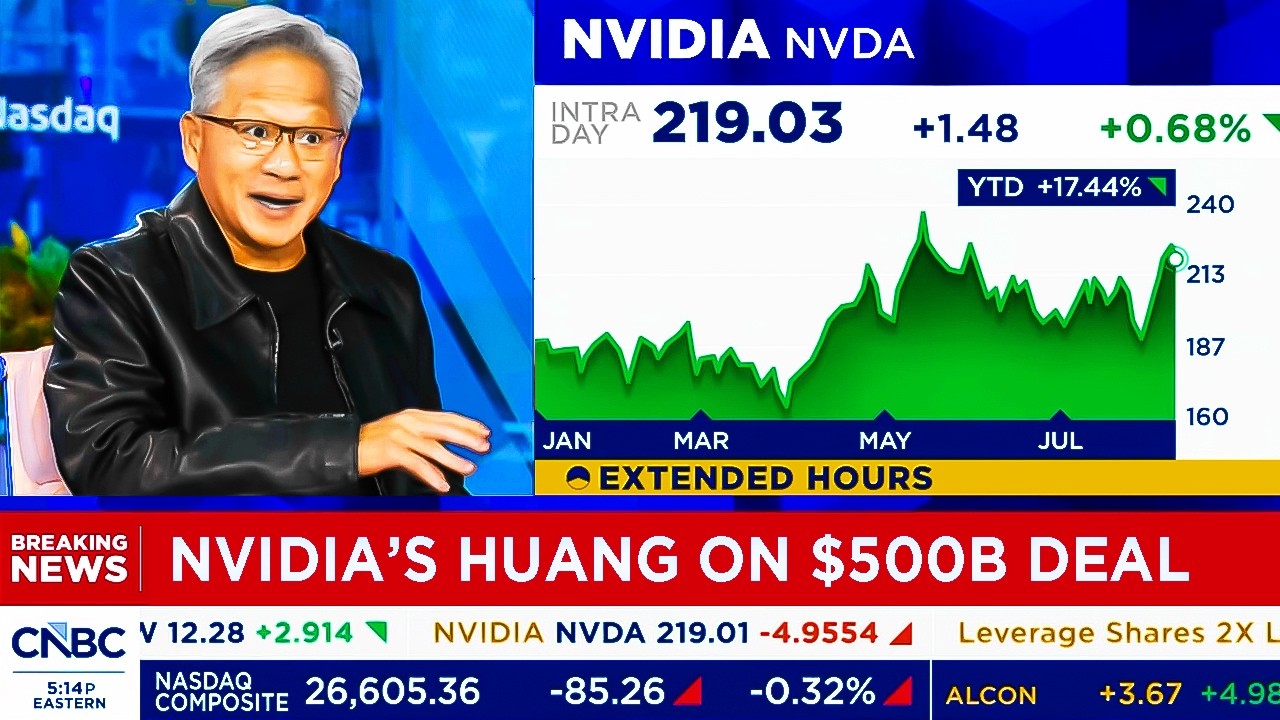
NVIDIA's Jensen Huang & Partners Today On NVIDIA $500B Partnership, Micron, SK Hynix - NVDA Update

- Retorno do vídeo
- —
- Chamadas
- 3
- Compra / Venda
- 3 0
- Publicado
Recomendações
Entrada é o preço de fechamento do ativo na data de publicação. Atual é o último fechamento registrado.
-
Entrada $217,55 10 ago 2026Atual $217,55 10 ago 2026Resultado +$0,00
I am very confident that Nvidia will be worth much more in future years than it is today based purely on the fundamental growth of the business.
-
Entrada $217,55 10 ago 2026Atual $217,55 10 ago 2026Resultado +$0,00
I seriously think that Nvidia still has plenty of runway ahead of it and I think this company will be worth substantially more in future years than it is today.
-
Entrada $861,00 10 ago 2026Atual $861,00 10 ago 2026Resultado +$0,00
I think we're going to see a very positive response in the shares of stocks like Nvidia, Micron, SKHix, and the rest of Nvidia's ecosystem partners.
Transcrição Completa
Welcome back to Closing Bell Overtime. We have this big breaking news this afternoon about what's been happening when it comes to the AI infrastructure build. This is news that uh was first out a little earlier today, but we can confirm that news at this point. Nvidia working with some of the biggest names on Wall Street to secure financing for its customers. Joining right now with us to talk about all of this is Jensen Wong. He of course is Nvidia's founder and CEO. David Solomon is the CEO of Goldman Sachs. Larry Frink is BlackRock CEO. John Gray is Blackstone's president. Vladimir Lasac is global head of digital infrastructure at KKR. Jim Zelter is Apollo's president and Bruce Flatt is Brookfield CEO. And gentlemen, welcome to all of you today. It's kind of amazing to get this group around the table and Larry to have you joining us remotely, too. Um, but we have to start with this news, Jensen. Um, this is a big deal and it's a big number. half a trillion dollars, more than that in terms of financing. We know this is an expensive build, but tell us a little bit about how this came together and what exactly it is. >> Well, first of all, I want to thank all of my partners for joining me here today. I think this is first time this has ever happened before and and uh I can't imagine a more important time to do it. We're announcing six partnerships today. These partnerships are going to pull together independent long-term capital to fund and support AI infrastructure buildout. This is an extraordinary time as you know because this is the first time in some 60 years that the computing industry is going through a fundamental platform shift from the way that software was done before to the way that it's going to be done in the future called artificial intelligence. Fundamentally what's different about this industry and this way of doing computing is that the computer is now part of the infrastructure like electricity like the internet and so you have to think about it like its infrastructure and build it out accordingly. Every company will be powered by it. every country will build it. And so we're talking about a extraordinarily significant infrastructure build. This is >> with a very hefty price tag. >> It's a hefty price tag. Each gigawatt is something like 5060 billion. And so there's there's energy involved. There's land power and shell involved. And of course there's the computing part of it. Um this is of course also a milestone for our company. We used to build chips that we sell and and these are technology components that people buy and use. But now Nvidia's AI factory platform is really an investable asset, an infrastructure asset. And the reason for that is because it's productive, is re revenue generating. It is fungeable. It's used by just about every cloud service provider. It runs every AI model. It runs algorithms of all different types. And so it has really broad deep reach and offtakers. This is a really great opportunity for us to build out the infrastructure, take advantage of an asset that is investable, long life, and productive. And with the partnerships that we have here, we can support a really broad ecosystem buildout. >> John, I'll say it's very unusual to have all of you in one place. Most of you compete on one level or another. A lot of times you work together on things, too. But how did this come together? How did they all come to you? And David, I'll start with you on this. Well, I mean it it you know, Jensen Jensen approached us and, you know, we've got a deep belief and a lot of confidence in Nvidia and what they're doing. We have a we have a deep belief in the opportunity set that's ahead. We like all the partners at the table have been spending a lot of time raising capital and thinking about the capital that's necessary and how we create the best access to that capital for people that need it to move things forward. I think one of the things Goldman Sachs um brings to the tables, we have an extraordinary distribution network. So we obviously we bring capital but we also bring a very very unique distribution network but Jensen came approached us with the idea and we said you know we we'd love to talk to you about it. We we have a deep belief in the direction of travel and the opportunity set over the course of the next 3 5 7 10 years. As Jensen highlighted, it's a big infrastructure build and the capital markets are signaling that there's lots of capital available to support it. And we're trying to find all the different ways that we as an organization in partnership with other great firms that are doing similar things can participate in getting the capital to the right places to extend this or accelerate this infrastructure building. You know, I I described it before as if if I buy a GM car, I might get financing from GM. This is you kind of bringing other people from the outside to say these will be the partners that do this financing. >> You know, this really really >> And by the way, it's not Nvidia's money that's coming up on this. >> That's right. This is all third party independent long-term capital that that all of my partners are going to go help us uh pull together. This is really quite an extraordinary. This is a phase shift in the way that people think about computing. It used to be, you know, technology, now it's infrastructure. And I always add like you know this is really what David just explained. Uh this is calling all precincts. This is American exceptionalism exceptionalism and what Nvidia has created over the last 33 years coming together right now. But this is calling all precincts because really now compute is an asset class. And when we think about the last hundred years, the last century of water and power and utilities, >> you know, in 2026 and beyond the next decade, a you will lead this. It's it's a global imperative, but it's a it's a US imperative. And as I said before, this is really all precincts coming together, not just one market of equity or debt or banks, but it's all it's need it needs any and all >> American exceptionalism meaning that you are going to be building with an American company, Nvidia and others. But this is financing that could go around the globe. >> No, no, no doubt. But but the the the depth and breadth of the uh US global markets in aggregate is the envy of the world. Nvidia is one of the envys of the world what they've created and what you're seeing here this consortium of partners and yes we do compete but we finance a tremendous amount together as well and in the end of the day this will this will benefit the US economy as a competitive tool for the advancement for the next decade. Larry, let me get you in because you're not here around the table today, but I I'd like to get your perspective on this. Is this new money that's going to be spent? Have you already raised this money? Is this money that you were going to be deploying into AI anyway and it's just kind of funneling it towards certain partners? >> Well, first of all, hi everyone, Jensen, thank you. Thank you for the trust that you given Black Rockck. Uh we have some capital now, but we're going to be raising quite a bit more capital. Um, as Jensen said, each gigawatt costs 50 to60 billion dollars to build out and we're talking about in the United States alone, we're going to need over 70 gawatts of power to fuel this. And then you add up everything else around the world, um, it's it's going to be an enormous financial opportunity. As Jim is talking about Americans exceptionalism, it has to flow through the American capital markets because this is the biggest source of capital. But the other angle that I think this is so important that we must also understand, you know, there is quite a bit of negativity around AI in data centers right now. But let's be clear, this is going to be creating a huge amount of jobs. Um, you know, you think about even a 100 megawws of of a data center requires as much as 3 million hours of workers. And and so this should be looked upon as a great growth opportunity for the United States, furthering growth elsewhere in the world. And most importantly, we need to raise this money as fast as possible and and put this to work. uh because I think it's really imperative that the United States is the leader in AI in the world and I think we need to be the leader in the dispersement of this technology around the world and I think this is why this is so critical and I applaud what Nvidia has has done bringing all these firms together and saying we have a common goal we need to raise $500 billion obviously that's an unprecedented amount of money but we're going to have to raise trillions of dollars over the coming years and and I do believe this is going to be representing a fant fantastic investment. In fact, I think it's going to be such a large investment over time, you're going to see more and more allocation in in into this asset class. Jim talked about compute as an asset class, but importantly, I look at the financing of data centers. Um, this is the very beginning like what it was when I started in the mortgage back securities market in the 1970s. And I look upon this as as a next future for financial engineering. All right, let let me ask a question. Larry, David, you guys might be able to weigh in on this a little bit, too. And John, I think you too, but just the idea of how much money you need to raise with this. Is there enough money within the public and private markets? Do you need government money that would do I mean, if you think of national highway system when you had a buildout like this, it had to be government money that was spending some of this. Is there enough money in our capital markets to to handle this? And is it profitable for the investors? like who wants to take it? John, why don't you jump in? >> Sure. I I would say first off, it's great to be here. What Jensen has built is incredible. What I would say is our markets are large and it's one of the great strengths when we talk about America, when you look at our ability to finance $700 billion a year in automotive or a couple trillion dollars a year in housing, I think we're going to see a similar dynamic. And what is supporting it is supply and demand. So today at our companies, we've seen a sevenfold increase in demand for LLMs in the last 6 months. And yet the amount of compute is not keeping up. The data centers, the power, the chips. And so what you're going to see here is people are going to begin to recognize that this is a financable asset class. So when you think about your home, you know, when you go to buy a house, the bank underwrites you, but they also look at the value of your home. >> When an airline goes to buy a plane, they look at the credit of that company, but also the plane. I think historically here the limitation has been investors have said, "Oh, I only want so much exposure to this hyperscaler or maybe to this foundational model company." I think when people recognize how powerful and valuable this compute is, no matter who's using it, and in Jensen's case, they've got very fungeable, flexible capabilities with their GPUs and the CUDA software. So what I think is markets are going to recognize the opportunity if the scale gets very very big which it is pricing could widen out but I think in the fullness of time the recognition of the supply demand imbalance and the value of the compute is going to draw capital in. >> Can I just add one thing? >> Yeah we'll go we'll we'll jump here and here. Okay let's talk about Brookfield in particular what you guys are doing. Look, I just on Brookfield in particular, we've been building out backbone infrastructure since the company started and uh and originally it started with enormous amounts of power uh uh solar, wind, gas. We moved to data centers and with Jensen we've now been moving to compute >> uh both financing but also building this compute and we cannot build enough power. we cannot build enough compute for the demand that John's talking about. So this is not about uh is there too much financing being made. It's that we can't build it fast enough. >> But the question always becomes will the demand stay at those levels and and Jensen you see this you see further up than probably anybody on what's happening here. Is there a point where we can't keep up at the moment but the demand changes? Look, I think what's what's and Jensen will have a an really good opinion on this one, but what we're seeing in our industrial businesses is we are just scratching the surfaces in using AI and the productivity advances that it's giving us. And we don't even know how to use it yet, but the productivity advances are giving us are incredible. And this is it's going to this why this backbone is it's laying the foundation in the world for the next evolution of business and wealth creation is because it's so evolutionary or revolutionary that it's going to change everything we do in the world. And and that's why it's so important and that's why with Jensen pulling capital together the I I was going to start to go back to what John was talking about is we're at a point where the situation is that there hasn't been the format for investors to invest into this and we David in particular need to create the structures and Jensen's leading this to create structures because there's there's hundreds of trillions of dollars of money in the world. The structures look like what they have low financing. They basically are you get Nvidia's stamp of approval like these are customers that we're working with that we are giving our limited supplies to to >> and the system architectures are going to be specified in such a way that when we know that they deploy it we can continuously improve it. We can bring all kinds of funible and flexible AI models to it and if anything were to happen uh somebody else could take it over and operate it. And so that architect that's that's important too that this will be used by somebody even if the players mentioned run out of cash at some point. >> There will always be a a customer for that computing platform. And the reason for that is because as you know Nvidia's architecture is fairly universally adopted every week. We we Jensen and us announced a deal in Korea. He's putting up a billion dollars. We're putting up $9 billion. uh neighbor is going to use the compute and it's a it's a it's it's a system you can now systematize that what we need to do is take that and do it all across the world and all across companies to be able to systemize to bring more compute capacity to the market >> well Jensen that that brings and and I want to get to Belmar in just a moment but that brings up this important question there have been all these big numbers that have thrown been thrown around what you're doing with SK um there was a Wall Street Journal story recently that suggests Ed, you'd be backstopping financing for $250 billion for an open AI plant in Ohio potentially. That's a lot of money. It's a lot of things to carry on your balance sheet. This is not that because this is not money that Nvidia is backstopping in any way, shape, or form. But >> those two those two things are not that either. In the case of uh SK, as you know, we're one of the largest users of memories in the world. We're the largest computer company in the world. And so we use a lot of memory and our partnership with SK is multi-year and most of that's related to memory consumption and memory partnership. And so so that's what that's that's the SK. Uh with respect to OpenAI, uh I'm not I won't comment about rumors. Um however, today's partnerships is really about expanding it beyond a larger broader set of ecosystem partners. >> But you have $200 billion in free cash flow. You've got a huge balance sheet. Is it your prerogative to say, "Look, we are not going to pledge our balance sheet against all of these things because you can. Do you have other things you're doing it and that's why you bring in outside financing partners?" >> No, it's really because there's a phase shift in how we think about computing now and and uh all my partners here have have all talked about it really eloquently. This is really the first time that technology chips have become an investable asset class. This is a very big concept. It's a this big concept because the computers these these systems are not like our PCs are like our phones. These are revenue generating assets now. They're they're productive. They're long lived. Uh they're fungeable. They're flexible. You can use it for all kinds of different things. And so you have the abil you have the opportunity to support a very large ecosystem of offtakers and Nvidia developers and AI clouds and AI partners and enterprises all around the world and it's incredibly revenue generating. Does that change how you see the investor that brings into this or how you look at it on a >> the capital markets have always I mean this is it in in in a simple form and you you did it yourself when you opened and you talked about GM financing a car the capital markets have been assetback financing markets for a long long time. You asked the question about capital availability. Um what we're doing is we're trying to find different ways to raise or to participate in raising the enormous amount of capital that's necessary to fund this infrastructure buildout. And you're starting to see in a sense, you know, assetbased financing against this infrastructure build. And that's not surprising because these are real assets. They have real value. You can put a tangible value on it. And there's a lot of capital out there. I mean, one of the things I always step back and think about, there's $9 trillion when you think about the US capital markets. There's $9 trillion in US money market funds. There's a hundred trund trillion dollars in US equities. There's a lot of capital out there. It's our job as stewards of the capital markets as also asset management firms that steward capital for other investors to find the best way to deploy this. And will it be a straight line? No. Will there be points to John's point where spreads widen out and it feels like things are going too fast? Yes. Will the returns from all of these things be ample? Of course not. There'll be winners and losers, but that's what the capital markets do. And the capital markets are pretty effective and pretty efficient at getting those things right. Thomar let's talk a little bit about what you've been doing as the global head of digital infrastructure at KKR you've been doing this for a long time what's changed what's different and what's so important about these announcements this memorandums of me memorandum of under memorandums of understanding yeah I guess that you would put into that how does that um change the equation for what you've been doing for a long time >> well thank you for having me and this is an incredible panel of of experts and Jensen thank you for the partnership we're obviously building on the partnership we've establish with Helix digital infrastructure which is really an innovative way of building the entire stack of the value chain from from power from molecule we call it to the token which is I think what we're all describing here >> um I think what has changed is the speed if you think about the buildout of of internet over 15 years couple of gigawatts of of of power was effectively consumed in a centralized fashion the cloud is the next evolution 101 15 years maybe 3x that today we're adding that much capacity on a quarterly basis which is just incredible to think about it which it takes a whole village to finance this. So we think about it as capital and capability. Uh and that's something we know really well at KKR. We've been doing this for for quite some time. Uh big investors in data centers and power and I think we we view this as a really a generational investment opportunity. I want to touch on one thing which is which is I think what John mentioned the the the intrinsic value of the compute layer. So I think we're big believers that that integration is occurring and the centralization of compute and needs to move up and the fungibility of compute. Of course, Nvidia is incredible innovator. Just talked about Vera Rubin earlier and rolling that out and the efficiency of production of tokens per watt of energy consumed is a step change function which means that compute is declining rapidly and adoption is increasing even more rapid rapidly. That's why price per token is down 99% and probably collapse into cents which means you have to have a very efficient way to finance it which is I think the parties around here and then build it infrastructure at scale at scale and that means time to market and and innovate. What's really interesting is that AI A100s, right? So, you would think about it that six years into it, maybe six or seven years into it, there is still a market for it. You still actually are revenue generating to Jensen's point, the the utilization of those chips is very high. The price per chip is very high. And so, you actually are getting revenue on that. And in that way, you can think about it as a revenue stream and you can securitize it or effectively divide that risk and sell it sell it to investors who want to participate anywhere in that stack. And that that really what gets us excited about about this moving upstream but also owning the big part of the downstream as as and Jensen calls it is the land power and shell. >> Hey Jim, just a couple of weeks ago you and Blackstone or a couple of months ago I should say you and Blackstone had your own deal that you put together that was pretty similar to financing like this. I think it was $ 35 billion for Broadcom. How is how is this different and how how do you kind of view these things? I think it's another example that what what Jensen was describing a few minutes ago, this whole ecosystem with compute and GPUs being a financial asset you could actually fund in finance. I think those are coming into the mainstream and I think as we've all around the table have been doing this for three and four decades the constant evolution of of capitalism and David's right there will be excesses there will be pullbacks but what I think is different right now in 26 is in the past we've thought about these things being financed either through the equity market or maybe the narrow market of private credit as I said earlier this is a calling all precincts any and all but what we've seen is in the equity market people don't mind having concentrated bets by the fact that we're bringing a more of an ecosystem and a variety ofUS it allows the concentration concerns about one company or one counterparty what John described is the value between not only in the company but actually facility that's also going to bring in more dollars around the globe so we're at a point in time right now not only is the global industrial renaissance at a peak but also we have a situation we have more global folks who need long-term long duration retirement solutions So whether that's done, you know, institutionally or globally or however it is, that's going to be the key to bringing this all together. So >> David, let me ask you one question on this though. We did have Steve Eisman of the big short fame who was on Squawkbox just about a week and a half ago. He came in and said, "Look, the AI trade is the entire market at this point." He said, "That could be a great thing or it could be a bad thing." But he said wherever you look there are growth and it's not just the chip stocks. It's not just the hyperscalers. It is not just the infrastructure companies that are doing all of this. He says it's the banks because they're financing so much of this too. Is he right? He said look it could be a really wonderful thing or it could be a little concerning because of just the concentration it at this point. Do you agree with him on that or or do you see other places in the economy right now that are driving? >> Well, let's step back. you know, across the S&P, earnings growth in the S&P has been excellent across the S&P. One of the things and my my, you know, colleague John Waldron was on uh was was on I think it was on Squawk earlier this week and he was talking about momentum and earnings growth and so you've had really strong earnings growth across the S&P. There are a lot of things that are fueling the market. The economy is in very very good shape. Is there a lot that's coming out of this enormous opportunity set? Absolutely. Um I'll go back to what I said. Whenever you have an acceleration like this that brings together in the capital markets lots of capital. The markets don't get it exactly right. There'll be capital allocated to things that don't work perfectly. But the capital markets also sort it out and you know they sort it out relatively effectively. I'm excited about this opportunity. I look forward. I'm not smart enough to tell you what's going to happen in the markets next week, next month, you know, 3 months from now. But when I think about three, five, seven years from now, the productivity gains in the economy, the way the US is positioned in the world, the opportunity for real economic growth and acceleration of economic growth as this technology gets deployed in the economy is enormous. And we're going to see that filter through and it won't be a straight line, but we're going to wake up a decade from now and those benefits are going to be real. And I think it's a very exciting time because of that. And you know, it's our job to play a role in trying to, you know, um, for lack of a better term, intermediate that as either asset managers or participants in the capital markets. But there's a lot to be optimistic about when you look forward. >> And this is going to impact literally every single trade. And the reason for that is because at first principles, we are going through a platform shift in computing. There's not one industry, there's not one company that's not impacted fundamentally by computing. And of course, we're talking about artificial intelligence, the digitalization of intelligence. There's not one company, one industry, one person that is not affected by intelligence. And so, in every single way when you say every every company, every industry is affected by the AI trade, it is not surprising. And on first principles, it makes perfect sense. >> Yeah. And there will be there will be winners and losers. I mean, there going to be big companies just as there have been in other super technology cycles. There'll be big companies that win. There'll be big companies that turn out to be not what people expected. That's part of the capital market. It's one of the things that makes the US so exceptional is that people, Americans, want to invest in the market. They want to take risk. Okay? And that's that's one of the things that makes our capital market so special. And so, of course, it's not going to be perfect. And there can be people on either side of the trade. But I'm looking out 3, five, seven, 10 years. And I'm very optimistic about what this can bring to productivity in the economy and how that ultimately will bring everybody along. >> And and I would just add, you know, and Dave is right. It's in the end of the day it's about revenue and cash flow. That's really what matters and certainly Nvidia has proven that. But in my in our 42 years, US economy has gone from three three trillion to 33 trillion. I believe that growth is going to probably be accelerate accelerated the next two decades. And if you believe that there will be winners and losers. So Steve is right in the sense that there will be winners and losers but this is accelerates the global economy like we've not seen. And also just one thing if you think about it Becky enterprises are never early adopters right today AI is mostly consumerdriven applications right just put a prompt comes out >> in aentic AI I think the use cases will just be profound and I think as Jensen mentioned this is not a vertical disruptor it's a horizontal disruptor across everything and that that is really difficult to quantify and I know that makes things a bit scary as an investor because you're trying to triangulate on risk and the in the scale of investment but I I We're seeing it in our portfolio companies and what Bruce mentioned earlier, you're seeing that payout to be really magnified as we start deploying AI in a systematically and still very early stages of that. >> And because it's multi-industry, the fact that we have a platform that is fungeable by all industries, it really derisks the investment and makes this infrastructure much more investable. Larry, I want to get your perspective on this too in in terms of you probably represent individual shareholders who want to get access to this too. It's been frustrating in some ways for them to get access because so many of the big companies have stayed private for so long. What what what does this mean? What what does an opportunity like this mean for people who are are looking at the retirement funds and and how they get access to this? Well, we're going to be doing both private financing and public financing for this across the board. U we're going to be working with pension funds across uh the world. Uh so I I think u the access to these types of um bond issuance is going to be much larger. Um and so I think we're going to see a much broadening of participation. Um as David said, $9 trillion of money market funds. you know, this is going to be a very attractive opportunity to move away from a short-term money market return to a a longdated return. So, I I look at this as a real long-term opportunity. I actually see this as also an opportunity for those who are overinvested in equities, they're going to be moving into these this asset class too. Uh so th this is just going to be expanding the opportunities to invest in a high credit quality investment with long-term returns. The thing that I think we we we cannot escape though, we need to make sure that not only this is good for America and good for um our investors, we need to make sure that this is good for everybody. We need to make sure that we're we're we're broadening participation in AI. One way is investing in these AI uh uh uh securities. But importantly, um it is important for all of us to explain why this is good for every community and this is obviously a big conversation going on. you know, we in our own state, uh, the the governor put a moratorium on data centers >> and so so we need to make sure we're properly telling the story and that we're telling the story and showing that this is going to be working. And I'm confident we're going to be able to show that this is working for more and more men and women in the trades. But we need to make sure that we're showing why this is not just a good investment opportunity, but it's a good opportunity for all of Americans. >> Becky, I would just add um a couple of things. I agree strongly with what Larry has said. You know, there's all this negativity around AI and yet we're going to have a bluecollar job boom coming from this. We're going to see advances in healthcare that people cannot imagine. And I know you spend a lot of time in this area, but what AI can do with visualization at looking at um collating different information, pulling it together, it's going to radically change outcomes. It's going to make all sorts of individuals able to become entrepreneurs. It's critical for American national defense. There all these things that have value. I'd also point out I don't think it's a coincidence most of us here spend our time in private capital because to build this out the first few years there's no income once this gets stabilized once these are yield-based products then it's easier to sell them in the public markets but having this robust private market here is super helpful and then ultimately a lot of this will migrate and by the way we've seen in the evolution companies here that didn't have great credit you know you look at a core weave which Jensen backed Early on we did a bunch of financings. Today their cost of borrowing has come down dramatically as they've gone public. As Anthropic and Open AI get public their cost of funding will come down. It starts with our private capital which all of us are accessing. Then we go to the public markets and then this virtual cycle goes. I agree not everything's going to work out. But this is powerful what it's going to mean for society and certainly markets. Bruce, the >> the one thing I would just end with is that the power is what drives all of this, >> the access to energy. >> Yes, the access to energy and we need to build more faster and there is a financing system for power. Like it's not new what Jensen's doing with compute. It will compute will get to where power is. There is but it physically has to get bitten underwritten and like we have 14 nuclear plants >> that were in various stages of construction today. >> Wow. >> And it will be another 40 with another hundred coming. Oh, they're we're going to get them done. >> And this is the first time in a long time that marketdriven forces can build out the sustainable energy necessary around the world. business without government without government funding. This is all this all market driven. >> We're we're building these uh ourselves and they're going to get built all across the United States and and remember we bought Westinghouse out of bankruptcy 7 years ago. Nobody was building a nuclear plant and there's going there's a renaissance going on today in the United States uh led by Westinghouse that is incredible largely because it's it's carbon-f free it's base load and it's the next energy that's coming like today today you're everyone's worried about today but if they knew there was more coming that's why it takes 5 years to build a plant but if you know what's coming you can consume more of your margin of safety of energy >> so are these concerns about whether we can meet this demand over overdone at this point. Do do you think Jensen that from where you see things the demand level and how we're building up around it that it's going to be okay? It'll all work out. We're going to be constrained for some time and pretty much across the board from chips to memories to packaging to systems um photonics connectors land power construction workers uh the whole thing the the entire supply chain up and down behind behind me upstream all the way downstream and this is happening at a time when AI has become useful because it's starting to do productive work and it's happening all over all over the world. And AI tokens are profitable. Incredibly profitable. When you have something profitable, everybody wants to make more of it. >> Yeah. >> Great demand, great profitability. The conditions are exactly right for the work that we're doing right now. >> Jensen, why these companies? Uh, and did you go to any partners who said no? >> No one said no. But th this is the six premier world's premier institutional financeers for infrastructure. This is the best of the best. >> What John said that right now you're you're you'll be less likely to have public capital that comes into this because a lot of these are companies that aren't making money yet. Um is he right on that or are there going to be big banks and others that kind of step up? I believe within months you're going to realize that these companies are extremely profitable. These are the fastest growing technology companies in history. >> Your customers, you name >> that's right. These are fastest growing technology companies in history and the tokens they're generating are incredibly profitable. You know, if if uh the wafers that we buy from TSMC are incredibly profitable. There's incredible demand for it. I'm going to want to buy a lot more. >> Who are we talking about? Your customers, which customers will have access to these? >> AI labs. AI labs. >> AI labs are the ones. That's the ones that you think are profitable. But this will this >> AI labs AI startups um you know as you know this last 6 months the world put in about $500 billion in AI startups. >> 500 billion the largest investing investing period probably in recent history. And uh these companies need compute and so we now have the vehicle to do so. >> Um when will we see the first deals? >> Well, it's up to these guys. They got we've gota, you know, we gota really we've got to really hustle. >> There's plenty in the hopper. >> I think there's plenty in the hopper. >> Plenty in the hopper. >> The demand's not the issue now. We got to hustle and get our get all of our agreements done. >> Okay. You said in the next few months, you think that we will see that these companies are profitable. The AI labs. >> Well, when they go public, it's going to be the biggest IPOs in history. >> Yeah. >> Yeah. >> All right. I hope you're all doing well today and staying calm in this market. Monday was a mixed day in a market with many tech hardware stocks trading lower and much of software trading higher. We also saw a solid move higher in oil, which put some additional pressure on momentum. I'm going to cover Monday's big Nvidia news in just a moment. But first, let me quickly cover some other important news stories. First, we got TSMC's July revenue report showing revenue up 5.6% month- over-month and up 44.7% year-over-year. During the first 7 months of the year, revenue was up 37% compared to the same period a year ago. This is solid growth showing that the long-term trend remains firmly intact. Also on Monday, we learned a lot of important details as Micron CBO spoke an event hosted by Keybank. I'm going to rapid fire important points that stuck out to me. Micron CBO said that customer demand signals have increased further since Micron's latest earnings. He said that the shortage is broad-based but most acute in data centers. He said Micron often can supply no more than roughly half of what data center customers want. Customers increasingly tell Micron that their number one constraint is DRAM. He also said that HBM4 is in robust production and that Micron is developing custom HBM4 ESQs. That's very interesting considering the rumors I covered at the end of last week about Nvidia possibly offering multiple variants of Reuben Ultra that contain differing amounts of memory. On that note, Micron CBO also said that customers are despecifying some are dim densities in the server market because of supply limits, not because of price. He said that even with such adjustments, total demand continues to rise. As I mentioned last week, even if we see variants of Reuben Ultra with less memory content per GPU, that does not automatically mean that the memory makers will have lesser pricing power or lower total bit shipments. It's not that simple. Micron CBO also said that Micron has signed additional strategic customer agreements since their latest earnings report beyond the original 16 agreements. Most of the agreements extend through calendar 2030. They're take or pay and customers have no contractual outs under the agreements. Remember that the next time you hear someone claim that Micron's SCAS are the same as the LTAs of past memory cycles because there are key fundamental differences between the two. Also, over the weekend, the Wall Street Journal reported that Apple has begun testing DRAM from China CXMT in multiple product lines and has held preliminary talks about potentially using CXMT components in some products sold in China. The report also claims that HP and Acer have begun using CXMT memory in devices sold outside the US. This piece of news is likely the main reason why we saw Micron open lower on Monday. It's important to remember that in that same piece from the Wall Street Journal, they say that CXMT has maxed out production for this year and is prioritizing domestic customers like Bite Dance and Xiaomi, which limits the incremental supply it can provide to Apple or foreign OEMs in the near term. That said, market participants are extra sensitive right now to any news that they perceive as being a potential threat to memory makers pricing power. Also on Monday, Zuckerberg announced that Meta would open the ways for its new Muse Spark 1.2 model. He also said that Meta would launch a new family of open source models called Muse Glimmer that are designed to run on edge devices. As I've said many times before, open source models are not bad for AI infrastructure companies like Nvidia. They actually help drive greater consumption throughout the ecosystem, which ultimately leads to more compute demand, not less. Open models are fantastic for Nvidia, and there's a fundamental reason why Nvidia is the leader in open- source models, as it should lead to a very favorable position for Nvidia in the future. Ultimately, greater consumption increases compute demand. Now, let's cover Monday's big Nvidia news. Nvidia announced they've partnered with Apollo, Black Rockck, Blackstone, Brookfield, Goldman Sachs, and KKR to establish AI compute infrastructure financing platforms to mobilize over $500 billion of thirdparty capital. These new financing platforms turn Nvidia compute and full stack infrastructure into an investable asset class for global capital. As a brief side note, as I've said many times, now is not the time for Nvidia investors to worry about market share. There's plenty of room for multiple chip makers to succeed. At the same time, Nvidia is in a league of its own, far ahead of the competition. And now Nvidia's compute is an investable asset providing the lowest token cost, highest revenue, and longest useful life with the largest install base and rich ecosystem built upon Nvidia's CUDA platform. MUS have been signed with the six financial institutions to create partnerships aimed at establishing the first compute financing platforms of their kind at global scale. Nvidia will work with these institutions to create dedicated pools of capital at significant scale at attractive rates for Nvidia customers. Let me briefly simplify things in case anyone isn't following so far. These are new platforms that are intended to mobilize more than 500 billion dollars of thirdparty capital for AI infrastructure over time. The idea is to create large pools of financing that Nvidia customers can use to build Nvidia based AI factories. Importantly, Nvidia is not committing the $500 billion itself. These are thirdparty financing platforms. Nvidia hasn't disclosed capital commitments or deployment timetable. I think this news concerns some market participants given all the talk about circular financing over recent months. That said, this will likely turn out to be very positive for Nvidia. We're talking about hundreds of billions of dollars worth of thirdparty capital being mobilized over time to help fund the buildout of Nvidia based AI factories. That's positive for Nvidia. Monday evening, Jensen Hang joined CNBC and partners to discuss the news. In that interview, Jensen said, quote, "AI tokens are incredibly profitable." And when speaking about AI labs, Jensen said, quote, I believe that within months, you're going to realize that these companies are extremely profitable and the tokens they're generating are incredibly profitable. That is very exciting to hear because I've been saying it for many months now. I think the leading labs surging revenues as well as their profitability may be the initial proof point that grabs market participants attention and causes them to realize that there will be a clear ROI on AI infrastructure. I really wish open AI and anthropic were public right now so market participants could see it. That's something to look forward to as it's on the horizon. As a reminder, at the end of last week in a piece about SpaceX's AI buildout, Semi analysis pointed out that serving inference tokens is unbelievably profitable for the Frontier model companies saying that Open AI and Anthropic can generate over $100 billion of revenue per gigawatt per year when selling API inference on a GB300 cluster. That is significantly more than the cost of renting a GB 300 cluster for one year at current cloud prices. Once market participants realize that there is an incredible return on investments in AI infrastructure, I think we're going to see a very positive response in the shares of stocks like Nvidia, Micron, SKHix, and the rest of Nvidia's ecosystem partners. That is something for investors to look forward to, and Jensen believes it will happen within months. Looking ahead, we have Nvidia earnings later this month on Wednesday, August 26th. Now, in case you're new to the channel, I want to make sure that you have at least a basic understanding of the underlying long-term thesis. So, let's cover that. Now, I don't know what's going to happen in the short term, but from a long-term perspective, I am very confident that Nvidia will be worth much more in future years than it is today. When Jensen was on the Lex Freedman podcast not that long ago, he was very seriously raising the possibility of Nvidia becoming a $3 trillion revenue company in the near future. If that happens in the coming years, then it is very plausible that Nvidia could one day be worth tens of trillions of dollars in market cap. That might sound crazy, but that's what Jensen is implying when he raises the possibility of Nvidia becoming a $3 trillion revenue company. I guess the question at that point is what multiple the street will be willing to give Nvidia. I don't know the answer to that question, but I truly do think that Nvidia will be worth much more in future years than it is today based purely on the fundamental growth of the business. Based on everything I'm seeing, the world is still computed and I expect that to continue at least through the first half of calendar 2028. In a computed environment, developers will use whatever viable compute they can get their hands on. Today, there are no GPUs that are sitting dark due to a lack of demand like there was fiber sitting dark due to a lack of demand at the height of the dotcom bubble. Back then, companies were laying fiber in the hopes that use cases and demand would eventually show up. Today, we are seeing the complete opposite. As I've said many times, when market participants compare this AI revolution to the dot bubble, they ignore the fact that the internet is already here this time. This means that mass adoption of the technology and new use case development at scale are immediately possible. We don't have to wait years for it to show up. It's already here. The world is compute constrained which means there is not enough supply to satisfy demand. New capacity is utilized as soon as it comes online. The hyperscalers are monetizing capacity as soon as it comes online. Each of the hyperscalers spoke about being supply constrained on their most recent earnings calls. Additionally, many of the clouds are building out into contracted demand. They're not blindly building in the hopes that demand will eventually show up. No, they're building out because they have signed contracts and in some cases significant prepayments from their paying customers. This AI revolution is fundamentally different from the dotcom bubble and 2026 will be a pivotal year for the AI industry. Thanks to the rapid adoption of Agentic AI and the proliferation of agentic systems in the world's leading enterprises. The leading AI labs revenues are surging right now. Agentic coding and the implementation of agentic systems in large enterprises are new use cases that are increasing inference demand significantly that subsequently is increasing compute demand. The rapid adoption of agentic AI is why we're seeing an inflection in inference demand. It's why we're seeing the leading AI labs revenue surge. I wish both Anthropic and Open AI were public so the public could see the ramp in their revenues. Anthropics ARR has surpassed $47 billion, up from $9 billion just at the end of 2025. Open AAI is growing rapidly. As well, I think the leading labs surging revenues may be the initial proof point that grabs market participants attention and causes them to realize that there will be a clear ROI on AI infrastructure. I think the leading labs surging revenues will also help assure investors of the longevity of Nvidia's growth since these labs revenues are directly tied to compute. If they had more compute, they would have greater revenues. It really is that simple. Demand is not the problem. The problem is a lack of supply to meet the demand. As I've said previously, I expect the world to be compute constrained at least through the first half of 2028, possibly longer. And so regardless of what happens in the short term, it's important for long-term investors to remain focused on the fundamentals, maintain a long-term perspective, and remember that we are only in the early stages of Agenic systems being adopted at scale. This will increase compute demand significantly. And after that, the next surge in compute demand will likely be fueled by physical AI. We're no longer talking about digital agents performing digital tasks. With physical AI, we're talking about physical AI agents performing physical tasks in the real world. NVIDIA CFO has called physical AI quote a multi-t trillion dollar opportunity and the next leg of growth for NVIDIA. This industry will fundamentally transform society and Nvidia has positioned themselves to benefit massively. NVIDIA sells the hardware for the data centers where the models are trained. They offer omniverse where the models are taught and tested and Nvidia also sells the hardware that allows ondevice real-time inference through Nvidia AGX allowing robots to have intelligent interactions with the real world even when they are not connected to a data center. Notice that Nvidia is taking a holistic platform approach to physical AI and they're embedding themselves as the underlying foundation supporting all of it. Over two million developers are already building on the NVIDIA robotic stack and this is not getting enough attention. As for production ramps, Blackwell Ultra has ramped quickly and remains in high demand. Reuben is on track to launch in 2026. Then we're expecting Nvidia Gro 3 LPX in the second half of 2026. Later on, we're expecting the launch of Reuben Ultra in 2027 and Fineman after that in 2028. We have a clear data center product roadmap stretching into 2028. And Jensen believes that AI infrastructure spending will reach 3 to4 trillion annually by the end of the decade. That means Jensen is expecting growing AI demand and an expanding total addressable market underpinning all of this. I don't think we are anywhere near any type of bubble bursting type of event. With all of this in mind, I seriously think that Nvidia still has plenty of runway ahead of it and I think this company will be worth substantially more in future years than it is today. At least that's my view of the situation. Quick note before I wrap up. All of the compilations on this channel are edited by Finn Vid with original structure and commentary. Occasionally, the same edits appear elsewhere on YouTube. If you're looking for the original version, it's always here on this channel. Thanks for watching, Finn Vid. I appreciate your support. Remember to stay calm in this market. Remember to maintain a long-term perspective and do not make any hasty or irrational decisions. With all of that being said, I hope you all have a great rest of the day, and I'm curious to hear your thoughts about Nvidia in the comments below. Please leave a like on this video so more people will see it. And while you're down there, please consider subscribing. It's free and you can always change your mind.
Comentários 0
Entre para participar da discussão.
EntrarAinda não há comentários. Seja o primeiro a compartilhar sua opinião!