Contexto
"Another popular 3 ETF strategy is the boggle head strategy where you might have 30% in a US ETF like VTI, 30% in an international ETF like VXUS, and 30% in a total bond ETF like BND."
...he really liked SPYM, QQQM, and SHD just like me
Contexto
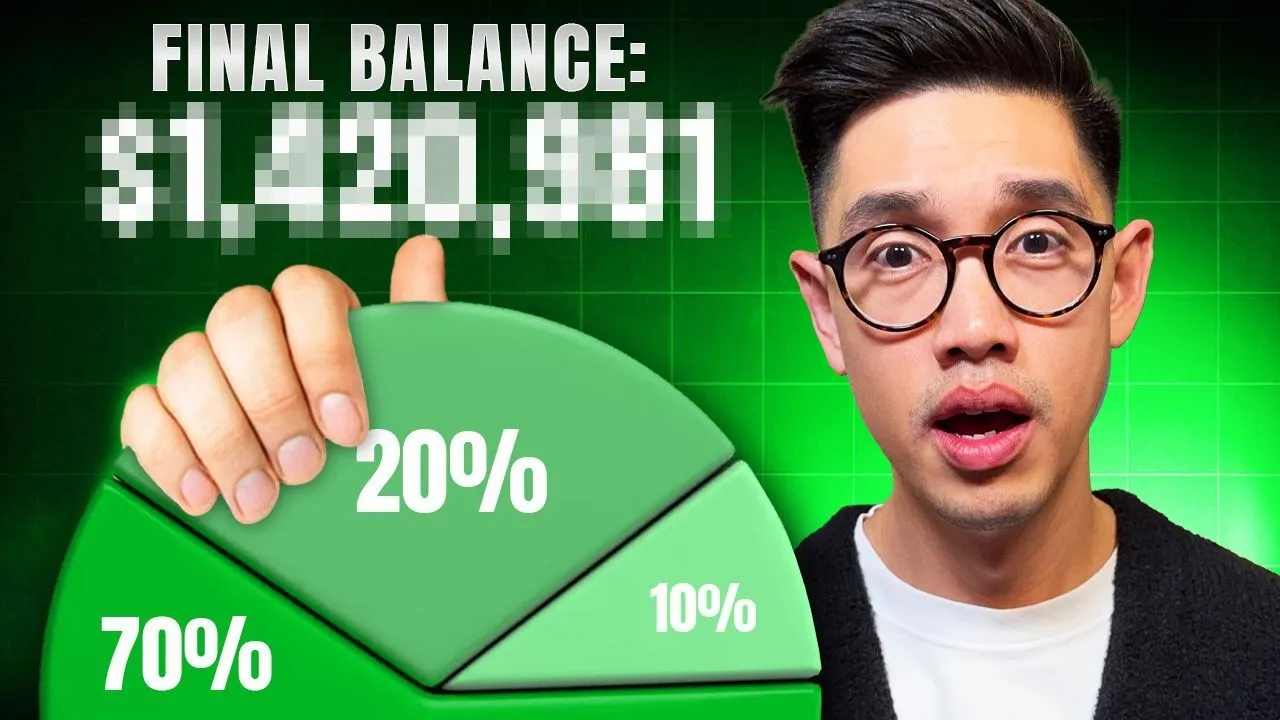
"...I recommended he structure things like this. First, he had to decide which ETFs he wanted in the core 70% of his portfolio... he really liked SPYM, QQQM, and SHD just like me..."
for me personally, I really like Amazon and Google
Contexto
"...Second, he had to choose the individual stocks on which he would sell covered calls. And at the time, for me personally, I really like Amazon and Google..."
for me personally, I really like Amazon and Google
Contexto
"...Second, he had to choose the individual stocks on which he would sell covered calls. And at the time, for me personally, I really like Amazon and Google..."
Transcrição Completa
So, maybe you already know how to buy an ETF. Maybe you've even figured out which ones are solid long-term investments. But randomly buying ETFs you like can get kind of messy. What you really need is a clear portfolio structure, something that you can follow every month without changing your mind because of a thumbnail that you saw on YouTube. A portfolio is simply your allocation plan. It's where you decide what percentage of your money goes into which investment. Building a portfolio is a bit like training for a marathon. Everyone has a plan and everyone swears theirs works the best. But what really matters is whether the plan fits your investment personality and risk tolerance. And that's where most beginners get stuck. So in this video, I'm going to show you how to allocate your portfolio as a complete beginner so you can see which one makes sense for you. Now, to explain this, I want to tell you about a friend of mine. We'll call him Maverick. Now, Maverick got promoted at work and suddenly had an extra $200 each month that he could invest. On top of that, he'd saved up about $50,000 that he wanted to use as a lump sum to get started. Like most beginners, he did his homework. He learned about ETFs, compared brokerages, figured out how expense ratios actually worked, and took the time to understand how to place his first trade. Then he started investing. With his initial $50,000, he put $30,000 into SPY and $20,000 into QQQ. The following month, he had another $200 to invest and decided to put all of it into QQQ because his developer friends swore that tech was unstoppable. A month after that, he saw a few reels on Instagram saying that VO and IVV were the best S&P 500 ETFs right now. So, he split that month's $200 between them. Then, he got excited about dividend ETFs like SHD, VM, and DGRO. So, the following month, he put $65 into each of those. By the end of his first year, Maverick had invested just over $52,400. Markets were decent that year, so his portfolio grew to roughly $56,000. And to be clear, that's fantastic. Most people never even get started. They talk about investing for years and never actually move. So when I heard that my friend was actually doing this, I was really happy for him. But investing without a defined portfolio allocation, a defined plan, also comes with some downsides. Maverick and I have known each other since we were kids. And he was always the wild one. When we were about 11, he was the first to build a wooden ramp in his driveway and the first to test it before anyone else even agreed that it was a good idea. And that's just how he is. He commits first and figures it out midair. So, I was surprised when he showed me his portfolio. Around 70% of his money was sitting in broad market ETFs like SPY, V, and IVV, which all track the S&P 500. These are excellent long-term investments, but they're relatively steady and don't usually deliver dramatic short-term spikes. And as someone who spent years picking gravel out of his elbows, I wasn't surprised that he told me that he was frustrated because everything felt slow and completely handsoff. On top of this, he owned 16 different ETFs, many of which held the same large US companies, just packaged slightly differently and charging different expense ratios. This means that he was more duplicated than diversified. Sporadic investing had misaligned two things for Maverick. First is the level of risk that he was actually taking and second, how his money was really being allocated. Instead of having a clear 7030 or 8020 structure that matched his personality, he had accumulated positions month by month based on whatever sounded compelling at the time. If he had started with a defined portfolio allocation or a defined plan, he likely would have owned a smaller number of ETFs, each with a specific purpose, and his allocation would have reflected his true risk tolerance. And while Maverick didn't struggle to get started, having a clear allocation can also help people actually take action instead of staying stuck for months while their lump stump sits in their checking account, barely earning anything and just slowly losing value to inflation. Now, let's look at three beginner investment portfolios. First is the set it and forget it portfolio. This is an extremely simple setup where you choose your all-time favorite ETFs and just automate consistent additions into it. You'll often hear this referred to as QQQ and chill or V and chill, where you invest 90% of your money into one reliable ETF and maybe keep around 5 to 10% in cash. And remember, whenever I say cash, I mean keeping it in a high yield vehicle, like maybe a money market fund. So, if you're using something like Fidelity, which is the brokerage that I use, this cash is automatically swept into a money market fund called SP AXX. If you're using another brokerage, maybe like Schwab, which I also have, just make sure that your cash is set to sweep into a money market fund so it earns reasonable returns instead of just sitting idle. The five or maybe 10% that you keep there gives you flexibility if you see an opportunity like a temporary dip in the market or your favorite ETF trading at an attractive price. So this way you have some money or what they call dry powder to invest in while the other 90% remains untouched long term. And just to keep everything simple and standardized for the entire video, we'll say that we'll keep around 5 to 10% as cash for all these different allocation examples. So, who should choose a set it and forget it portfolio? Well, definitely not Maverick. This is a much better fit for the Sandras of the world who are the nononsense professionals who work hard, value wealth building, but don't want investing to become a second job. She's a purist, the kind of person who orders a margarita pizza because it's simple and reliable. not the one loaded with prime steak, truffle oil, and 12 toppings. Should you rather stick with what works and let time and consistency pay off? A question that I often get asked is whether you can choose absolutely any ETF for a set it and forget it portfolio. And technically, yeah, you can do whatever it is that you want, but personally, I focus on broad diversified ETFs like maybe V, IV, or SPYM, or maybe even a total market fund like VTI or if you want to invest in international stocks, VXUS. These ETFs basically give you exposure to hundreds of companies in one purchase. For me, I'd avoid highly concentrated or thematic ETFs for this strategy. Things like single sector funds like leverage ETFs or trendbased products like cannabis focus ETFs that popped up when marijuana stocks suddenly became the next big thing. To me, these aren't really designed to be the long-term chill holdings. So, if I were setting this up for myself and if I were back in my 20s again, I'd probably be a spym and chill kind of guy. Next, let's look at the three bucket portfolio. This is often called a balanced portfolio because it involves investing equal parts into three different buckets, which helps reduce concentration risk. For example, if you choose QQQ for your set it and forget it portfolio and tech companies suddenly experience a big dip, you're going to feel the full force of that decline. But in a three bucket portfolio, you can invest in maybe something like 30% in a steady backbone ETF such as SPYM, VT, VTI, or VO, which tracks the broad market and give you exposure to hundreds or even sometimes thousands of companies across different sectors. You could also invest in maybe 30% in a growth ETF such as QQQM, QQQ, VUG or VGT, which are known for higher growth potential but also higher volatility. And you can also invest, say again, 30% in a dividend ETF such as VIM, SPYD, or SHD, which pays you a steady stream of dividends while still allowing for long-term growth. And again, if you haven't downloaded my $1 million portfolio, I pretty much listed all of these ETFs and compared everything in these tables and on this Google sheet. So, if you want it, you can download it down below. But yeah, just like the set it and forget it portfolio, you'll keep around 10% in cash so that you still have some flexibility. Another popular 3 ETF strategy is the boggle head strategy where you might have 30% in a US ETF like VTI, 30% in an international ETF like VXUS, and 30% in a total bond ETF like BND. Now, with the majority of my RT1 students that I work with, they usually like this three bucket allocation the most. You basically get exposure to growth, income, and the broad market without leaning too heavily in any one direction. So right now I'm invested in SCHD, QQQM, and SPYM. And I keep around 5 to 10% in cash. And I know some of you are going to say that SPYM and QQQM has a lot of overlap. But again, I'm very bullish in the US stock market. And again, for me, I like to keep a portion of my portfolio as cash in some sort of high yield vehicle like SBAX. So this way, I'm not overexposed to any one thing. And really, it just helps me sleep a little bit better at night where I know that I'm not investing all of my money into the stock market. Next, let's look at the 702010 core and satellite portfolio, which is what a lot of my accelerators have. Traditionally, this meant keeping the majority of your money in broad diversified index funds or the core and then allocating a smaller percentage to higher conviction or more active investments called the satellites. But I've seen many investors add a twist to this where they might keep 70% in a core portfolio of three to five ETFs around five or maybe 10% as cash and 20% in individual blue chip stocks for cover calls. And I've talked about cover calls many times on this channel, but for those of you who don't know, cover calls are an option strategy that you can use on certain stocks or ETFs. If you own at least 100 shares of a stock, and yes, it must be 100 shares cuz I know you guys keep asking me this in the comments. and say that Microsoft is trading at $420 per share, you could sell a cover call against your shares where you agree to sell your shares at a higher price, maybe like $440 within a set time frame. If by the end of the time frame, let's say 30 days or by a month, and the share price reaches $440 or higher, your shares get sold at the agreed price. Now, if it doesn't, you still get to keep your shares. But in both cases, you get to keep the premium you receive upfront for selling that cover call, which could be something like $400 to maybe even $800 depending on the contract. If your shares are called away, you can use that cash to repurchase the same stock or invest elsewhere. The trade-off is that if the stock shoots up to say $450, you still have to sell your shares at $440. So, you give up that potential profit. Now, over time, cover calls can generate additional income similar to dividends, but they require active decision-making. And as you've guessed, this is where Maverick's eyes lit up. This is the kind of portfolio that lets him take action and fiddle with his investments, upping the risk whenever he feels like it's slowing down too much. When I was chatting with him at the time, I recommended he structure things like this. First, he had to decide which ETFs he wanted in the core 70% of his portfolio. And it turns out that he really liked SPYM, QQQM, and SHD just like me, which was perfect because that gave him a broad market ETF, a growth ETF, and a dividend ETF nicely balanced. Second, he had to choose the individual stocks on which he would sell covered calls. And at the time, for me personally, I really like Amazon and Google because they're large established companies with strong liquidity and very active option chains. If like Maverick, you've already made sporadic investments, it doesn't mean that you're stuck forever. You can reallocate your portfolio by simply calculating what 70%, 20%, and 10% of your total balance should be and then adjusting your positions to match those targets. Now, just be careful not to sell all of your 400 spym shares only to turn around to buy another 450 spym shares 10 minutes later. Instead, look at what you already own, right? Like, if your new target allocation requires 450 shares and you already own 400 shares, you don't need to reset everything. you can simply buy the additional 50 shares to close the gap. Now, as I mentioned at the beginning, these are just three allocation ideas. In the end, do your own research because you want to see what allocation is the most comfortable for you. If you want a list of my other different allocation ideas and you just want to see everything on a Google Sheets, I actually put everything in my $1 million road map. If you're interested, you can download it down below. It's absolutely free and I really hope it helps. All right, I hope this video was useful and I will see you in the next video here.

Comentários 0
Entre para participar da discussão.
EntrarAinda não há comentários. Seja o primeiro a compartilhar sua opinião!