Why Stanley Druckenmiller Is Betting Against US Treasury Bonds

- Retorno do vídeo
- —
- Chamadas
- 1
- Compra / Venda
- 1 0
- Publicado
Recomendações
Entrada é o preço de fechamento do ativo na data de publicação. Atual é o último fechamento registrado.
-
Entrada $345,90 16 ago 2026Atual $345,90 14 ago 2026Resultado +$0,00
Google is probably one of the best best purchasing companies in the planet and in the AI race because they have a cash machine and they also probably have the best training data in the world with Gmail, YouTube, search data, all these things.
Contexto “what they don't have and we think Google is probably one of the best best purchasing companies in the planet and in the AI race because they have a cash machine and they also probably have the best training data in the world with Gmail, YouTube, search data, all these things.”
Transcrição Completa
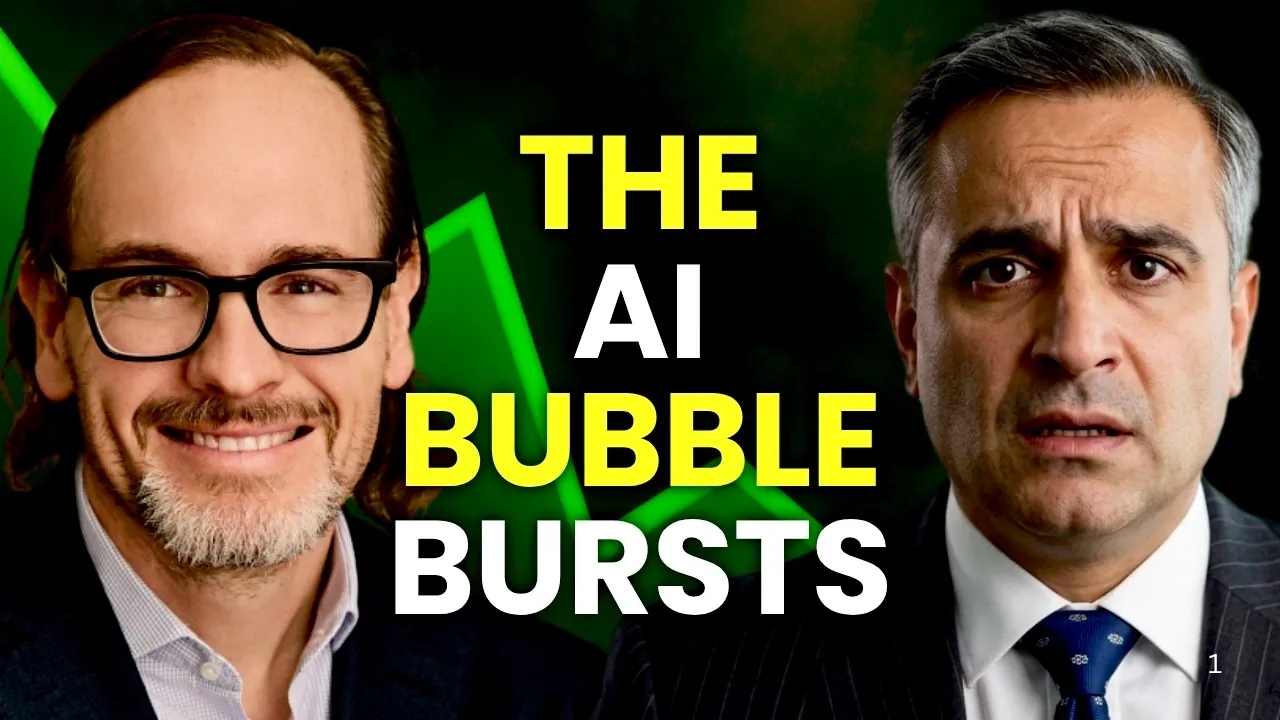
Trillion dollar infrastructure investments are currently being poured into artificial intelligence. Yet, there is little evidence of immediate returns on that massive capital outlay. Mitchell Green, founding partner at Lead Edge Capital, joined CNBC recently to weigh in on whether this historic tech spending spree has officially entered bubble territory. By the end of this video, you will understand why the current AI cycle is drawing direct comparisons to the dot era and why experts believe a near-term correction is becoming inevitable. If you are holding 10-year or 30-year Treasury bonds, you are essentially picking up pennies in front of a steamroller. This is why Draen Miller is treating the US Treasury market not as a safe haven, but as a primary target for a short position. I'll play you Green's CNBC interview uninterrupted, and after that, I'll give you my own reaction breakdown to what he said. >> Mitchell Green, founding partner of Lead Edge Capital and a man I just learned is originally from Michigan, so I automatically like you more. Mitchell, welcome. >> Thanks so much for having me. Yeah, I mean that is the question. Listen, yesterday you had Sundar Pachchive, Google saying 1 billion Gemini users. Now I don't know if that's Google, you know, Gmail get Gemini is embedded in that. How many are paying? Maybe we don't know, maybe we do. At 20 bucks a month per per retail user, can Google, these other companies, OpenAI make up the trillions in spending? >> It's a small question to start the interview. >> You figure that question out like they're going to need the Bank of Jensen to, you know, help uh help do it. Well, they got it. They got Yeah. Well, they got part of it two days ago. >> Uh, and they're going to, I think, need a lot more of it over time, too. The amount of spending, the answer, the answer is AI is going to change the world. It is going to revolutionize things. It will probably be bigger than the internet. But are we like in a bubble right now? Absolutely. Has there is there >> Okay, define bubble then. What What does that mean? Bubble means different things to different people. >> Yeah, it will be a bubble and it will probably pop. Will we probably overbuild at some point for the near term? Like probably. Will people get over excited about things? You hear big companies right now talk about like are they seeing near-term ROI? Right now there's obviously one killer use case for AI coding. >> Will there probably be others? Yes. Had we sat here in 99 and 2000? >> So >> yeah, >> I was in this in this studio in 1999. I think I was the first person to ever broadcast from here at least one of them. >> And I have a picture and maybe I'll tweet it out of me standing in front of that wall right there. And there's all these companies that no longer exist that were at $250 and 1/8. That's when we use fractions. >> Yeah. Yeah. Yeah. >> Per share. But those were garbage companies that had no revenue and analysts were creating fake metrics like revenue per eyeball. That was actually a metric that they used. >> Is it different this time, Mitchell, that these companies, most the ones we talk about, these are real companies with real revenues. They're not socks.net. >> Didn't say earnings, but yes. Um >> fair point. I think >> most don't have earnings. They're losing billions. >> But what's interesting is if had we been on the show, we would have debated whether e toys or you know, eBags or pets.com are going to, you know, put out a business >> or commerce, Ariba, ICGI, CGI, keep what's interesting is a lot of the incumbents did great. Most of the new guys busted. A few of them became gigantic. But I think the interesting thing is had we sat there, we never would have talked about like social media. like we wouldn't even talked about it like this which is a $5 trillion market today. So I think you're going to see giant businesses come out over the next five to 20 years leveraging AI that we're not even talking about right now. And I think coding is just the first category. And I am sure people will overspend just like they did in the telecom bubble. And you what's what's a little scary this time is the amount of leverage being put on this system and like the amount of implicit leverage. Like if a company, you know, says in 2030 they're going to do X in revenue and they're going to b and they're going to like borrow debt, but they're going to like have an IOU with Nvidia that's going to pay Oracle and all this circular stuff. That's what worries us a bit. And it to try to figure it all out is insanely complex, >> of course. And and the payback assumptions um basically are the whole equation. And look, you have SpaceX saying we have a one year or less than one year payback on the the AI compute that we built. >> Yeah. >> Capitalism is not supposed to work that way. Okay. So, every single company piling on more capacity and and if nothing else, it's making tech so much more asset intensive. >> Correct. >> And capital intensive. opposite of like what's what with all the like hyperscalers. >> What are the implications of that either for valuation or winners and losers? >> Valuations don't matter anymore, I guess. >> Yeah. >> Well, how much of that comes down to token economics though because that's another part of the debate that's really shifted over the last few months and this idea that, >> you know, multinational companies are are are being a little bit more discretionary about token costs. They expect them to accelerate in the second half of the year, but they're they're monitoring it. are finding ways to kind of pair back how much their companies are potentially spending on AI. How does that ripple through? >> No, it was all system. It was all about token maximizing obviously in the every encouraging everybody. But you can use and it's why you're and you're going to start to see a lot more about these open source models. There's companies like fireworks.ai AI and base 10 that a bunch of your that have just like exploded in popularity which help big companies like cursor or companies like Uber any companies that have tons of data Spotify Airbnb that have huge amounts of data run inference and they can run inference at like onetenth the cost of these big models which is incredible and then you wonder like okay well >> well does that kill the big model then >> it doesn't kill the big models but it's definitely could lead to pricing pressure and like we think over time token prices are going to come down over time, fall dramatically, but they >> will they become commoditized? >> That's the million-dollar question that nobody knows. Uh we tend to think they probably will, but like who the heck knows? Um but the real question is this. You know, the the frontier models continue to get better and better and better and better for most use cases at my firm. You know, we've got a bunch of like type A personalities of people that work here and we all need Fable and Opus. Actually, you probably don't. you can probably, you know, scan your emails with Sonnet. And so this I think what's going to get to a point, I don't know if we're there yet, but you're going to get to a point where a bunch of these models, at least for current use cases, where we haven't like come up with the next social media quote uh use case, you don't need like the the model that was out a year ago is good enough. And in which case, the open- source models aren't that far behind. Mhm. >> No, I I think what's what will happen is running these massive uh parameter open source models can be very complicated for most companies for a lot of companies small and large. And so I think there's going to be companies like B 10 and uh and Fireworks and others that are already exploding that will continue to grow a lot and there'll be new ones created and you see companies like open router that is rumored to be being acquired because companies are trying to figure out how to like what's the best model to answer the best question. We are like in the very early of all this stuff. What do you think that all means then for the potential philanthropic and open AAI to go public? Because we we assume they're unprofitable. We speak like they're unprofitable. We don't know what their numbers are. >> We've never seen the we've never seen the I can see what's rumored in the press. We're not investors in either of them. Shame on us. I guess we should have been because we could have invested years ago. Um, but I'm as excited about you guys to see those companies file S1's and to actually see where they where they put stuff in gross margins and where they don't. There's millions of different ways to classify things. Uh, look, these thing you see how much money these companies are spending on capex. They need to be public companies. what they don't have and we think Google is probably one of the best best purchasing companies in the planet and in the AI race because they have a cash machine and they also probably have the best training data in the world with Gmail, YouTube, search data, all these things. >> That's been great. >> To understand the historical context that drives Dereken Miller's current thinking, we have to look back at the monetary policy failures of the 1970s. In his recent remarks, Dereken Miller frequently draws parallels to the tenure of former Fed chairman Arthur Burns, who repeatedly cut interest rates too early at the first sign of economic weakness, only to watch inflation roar back even stronger. My take is that history is indeed rhyming here by declaring victory over inflation prematurely. The current Federal Reserve risks repeating the exact same stopand go policy that decimated the purchasing power of the American consumer 50 years ago. Once inflation expectations become deeply embedded in the public consciousness, they become incredibly difficult to root out, requiring far more painful interest rate hikes down the road. This historical parallel brings us to a concept that is rapidly gaining traction among elite macroeconomists known as fiscal dominance. This occurs when a country's public debt is so massive that the central bank can no longer raise interest rates effectively because doing so would bankrupt the government. In a state of fiscal dominance, monetary policy becomes subservient to fiscal policy. When I look at the math, we are dangerously close to this reality. If the interest on the national debt continues to consume a larger share of federal tax revenues, the Fed will be under immense political pressure to keep interest rates artificially low, regardless of how high inflation climbs. For investors, this is the ultimate nightmare scenario, as it guarantees a long-term erosion of real wealth through negative real yields. This structural trap is exactly what makes Ducken Miller's short position so compelling, but the host of the program didn't let him off the hook easily. During the sitdown, the interviewer pressed him on the classic counterargument that every bond bearer eventually faces. What happens if the economy hits a wall? In a typical recession, investors panic, growth slows, and money floods into the safety of US government debt, driving yields down, and bond prices up. If that happens, anyone holding a massive short position on longduration bonds is going to get absolutely carried out on a stretcher. It is a legitimate concern and it is the primary reason most institutional managers are hesitant to go allin on a treasury short. But Dereken Miller's response exposed why this cycle is fundamentally different from anything we have seen in the post-war era. He didn't dismiss the possibility of an economic downturn. In fact, he expects one. But his argument is that the sheer volume of government debt has broken the traditional relationship between recessions and bond yields. We are no longer living in a normal economic reality. The US government is currently running a massive 6% budget deficit. To put that in perspective, that is a deficit typical of a deep economic crisis. Yet, we are seeing it during a period of low unemployment and steady GDP growth. When the next recession actually arrives, tax revenues will collapse, safety net spending will skyrocket, and that deficit will easily balloon to 10 or 12% of GDP. My take on this is that the Treasury will have no choice but to flood the market with an unprecedented deluge of new debt to fund that gap. Who is going to buy all those bonds? The traditional buyers are gone. The Federal Reserve is trying to shrink its balance sheet, not expand it. Foreign central banks are actively reducing their exposure to US dollar assets to protect their own currencies. That leaves price sensitive domestic private investors to absorb trillions of dollars in new paper. To convince those investors to take on that risk, yields will have to go up, even in a recession. The old playbook of using treasuries as a safe haven hedge is dead because the government's fiscal recklessness has turned the hedge itself into the primary source of risk. If you're getting value out of this, a like and a subscribe to the channel would mean a lot. Let that sink in for a moment. If the ultimate safe asset is no longer safe, where does capital actually go when things fall apart? This is where the political dimension of the crisis becomes unavoidable. The host asked Duken Miller if a change in leadership in Washington after the upcoming election could alter this trajectory. His answer was brutally honest and completely nonpartisan. He made it clear that neither major political party has any real interest in fiscal discipline. One side is fully committed to extending tax cuts without making any corresponding cuts to spending while the other side wants to continuously expand social benefits and industrial subsidies. The result is a bipartisan consensus of fiscal expansion that guarantees the national debt will keep climbing regardless of who is in power. This political reality creates a structural floor under inflation and yields. We are witnessing the slow death of political consequence when it comes to the national balance sheet. In past decades, a group of investors known as the bond vigilantes acted as a natural check on political excess. If Congress spent too much, these investors sold off government bonds, forcing yields higher and borrowing costs up until politicians were forced to rein in their budgets. Today, however, politicians believe they can bypass this mechanism forever by relying on the central bank to backs stop the market. But as Draen Miller pointed out during the conversation, you can ignore the laws of arithmetic for a very long time, but eventually they assert themselves with a vengeance. But there is one specific highly controversial asset Draen Miller is using as an ultimate insurance policy for this exact scenario, and it is not what most traditional macro investors would expect. We will get to that in a moment. First, we have to look at how this plays out for the stock market. The host asked him if this sovereign debt crisis means we are heading into a prolonged bare market for equities. Ducken Miller's view is highly sophisticated. He doesn't believe you should simply short the entire stock market. But he warned that the era of passive indexing lifting all boats is officially over. In a zero interest rate world, the cost of capital was effectively zero. That meant even highly leveraged unprofitable companies could survive and see their stock prices rise. But when interest rates are sustained at five or 6%, the cost of capital becomes a brutal filtering mechanism. Under this new regime, companies with weak balance sheets, high debt burdens, and no pricing power will face an existential crisis. Even market darlings like Nvidia, ticker symbol NVDA, will see their valuation multiples compressed if the risk-free rate of return remains elevated. On the flip side, businesses with pristine balance sheets, secular growth drivers, and the ability to raise prices without destroying demand will thrive. What I'd watch here is the dramatic divergence between the winners and the losers. We are transitioning from a macro-driven market where central bank liquidity determined everything to a micro-driven market where individual company fundamentals are the only thing that matters. This shift back to active stockpicking is a major theme in Draen Miller's current portfolio strategy. He is actively looking for companies that can grow their earnings faster than the rate of inflation, treating them as a form of equity-based currency hedge. If a company can successfully pass rising costs onto its customers while maintaining its margins, its stock becomes a highly effective store of value. It is a completely different way of thinking about equity risk. Instead of trying to time the market cycles, he is focusing on finding businesses that can compound capital in a high cost of capital world. Are you prepared for a market where the index goes nowhere for a decade but individual stocks rise by hundreds of percent? Because that is exactly the environment we are entering. This brings us back to that controversial insurance policy I mentioned earlier, Bitcoin. When the host pushed him on where to store wealth if both cash and bonds are losing value, Dereken Miller didn't just point to the usual safe havens like gold. He openly admitted that he sees the appeal of digital assets for a younger generation. This is a massive shift for a legendary investor who made his career in traditional fiat markets. It shows that the search for hard undebasable assets is no longer confined to the fringes of finance. It is entering the mainstream because the mathematical reality of our fiscal path offers no other alternative. Think of it like a game of musical chairs. For 40 years, the music kept playing because inflation was low and interest rates were falling. Now the music is stopping and everyone is realizing there are far more people in the room than there are chairs. The implications of this transition extend far geopolitical. When the US government is forced to spend more on interest payments than on national defense, it limits the country's geopolitical flexibility. The host raised this concern, asking how the fiscal crisis impacts America's standing on the global stage. Ducken Miller's response was sobering. A nation that is financially constrained cannot project power effectively, nor can it respond to unexpected global crises with the same force as it did in the past. The fiscal crisis is at its core a national security crisis. When I look at the global landscape, this domestic weakness is occurring at the worst possible time. Geopolitical tensions are rising, global supply chains are fragmenting, and the era of cheap outsourced labor is ending. All of these structural trends are inherently inflationary. This means the Federal Reserve is fighting a multiffront war. They are trying to bring inflation down to their 2% target while dealing with a government that is actively fueling inflation through deficit spending and a global economy that is structurally shifting toward higher costs. It is a battle the Fed simply cannot win using interest rates alone. Where I land on this is that we are approaching a major inflection point. The monetary and fiscal policies of the past 15 years have painted policymakers into a corner. They can either protect the purchasing power of the dollar by keeping interest rates high and risk triggering a sovereign debt crisis or they can protect the government's solveny by keeping interest rates low and allowing inflation to run hot. There is no third option. Draen Miller's short position on long-term treasuries is a direct bet that they will ultimately choose the latter, sacrificing the bond holder to save the state. For individual investors, the takeaway is clear. The traditional safe haven assets that protected wealth in previous decades are now the very assets that expose you to the greatest risk of real loss. Surviving this regime shift requires letting go of old assumptions, understanding the structural forces at play, and positioning your capital and assets that have real tangible value. The road ahead is going to be highly volatile. But for those who understand the macro game board, it also represents an extraordinary opportunity to build lasting wealth. The true test for the market in the coming years will be how it handles the collision between soaring debt issuance and a central bank trapped by its own past decisions. If Duken Miller is even half right, the bond market is about to deliver a painful lesson to anyone still treating it as a risk-free investment. I appreciate you watching. Give it a like and subscribe to the channel and I'll see you in the next
Comentários 0
Entre para participar da discussão.
EntrarAinda não há comentários. Seja o primeiro a compartilhar sua opinião!