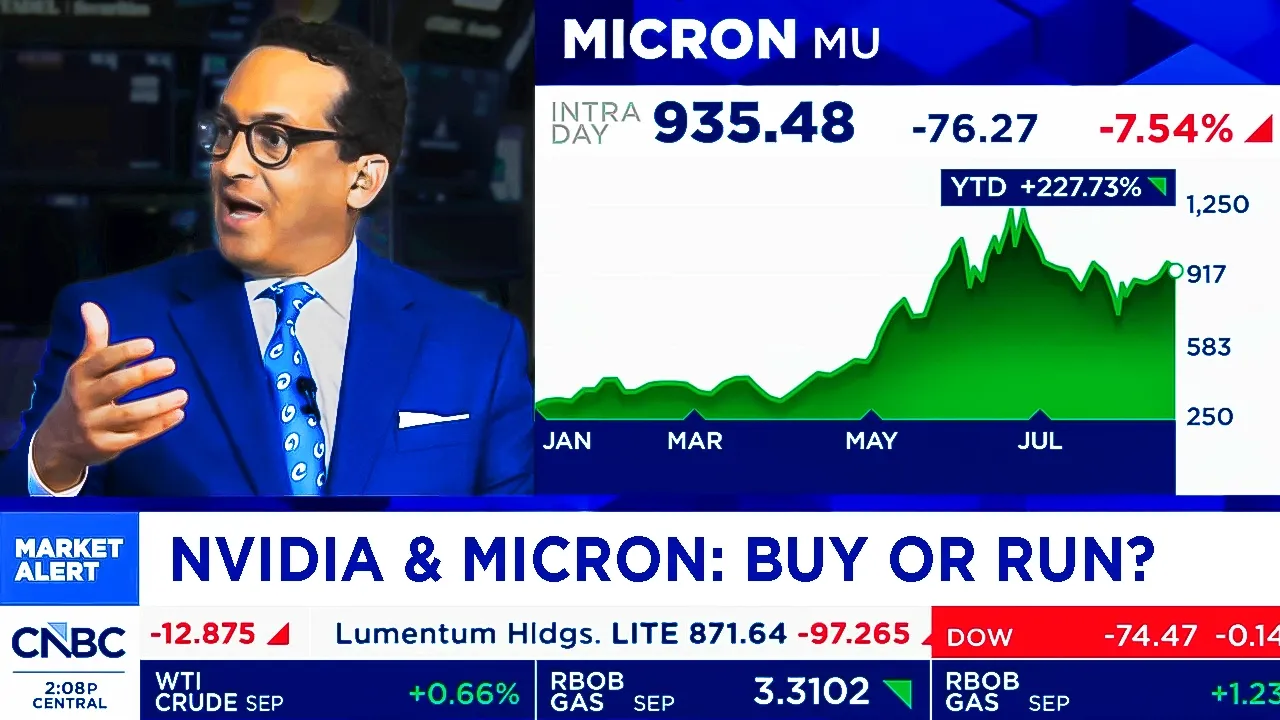
I also like LRCX, I have Taiwan Semiconductor. Um, these stocks are down today. Uh, we've seen a lot of volatility in these names, but again, this is very typical and historical for August and September. And that usually gives me a great opportunity to buy these strong relative strength names on a discount.
Contexto
"I also like LRCX, I have Taiwan Semiconductor... gives me a great opportunity to buy these strong relative strength names on a discount."
I also like LRCX, I have Taiwan Semiconductor. Um, these stocks are down today. Uh, we've seen a lot of volatility in these names, but again, this is very typical and historical for August and September. And that usually gives me a great opportunity to buy these strong relative strength names on a discount.
Contexto
"I also like LRCX, I have Taiwan Semiconductor... gives me a great opportunity to buy these strong relative strength names on a discount."
Transcrição Completa
Well, I think the biggest risk of the bullish momentum is something that we don't expect Nvidia to say when earnings are reported next week. I think that's where all eyes will be focused because the story has been earnings. Earnings continue to grow and we saw two earnings that really stuck out to me. We had Amazon and we had Meta wasn't the earnings. They they both beat revenue is good. The spend continues, but it was that explanation of the spend. Amazon went through things point by point and gave a great guide. Meta did not. So Nvidia has been it's going to beat it's going to raise uh the guide should be tremendous. But what is that spend? What kind of momentum can it continue with? Because right now it's got momentum. It is back above key moving averages. It's got its eyes set on that 240 level which is around the all-time high. So I think Nvidia is going to be the one telltale sign and you don't want to single out one stock but we can when it comes to the importance of this one. So, let's see what Jensen says next week. Otherwise, continue to see some rotation under the surface. The market has been doing extremely well, but it seems like it's a little tired and you add in those seasonal factors and some concerns that this continues in the straight and we may stumble a little bit here. >> So, explain the economics of for example this plant that's this is this data center and what it's going to cost to build, how you think about the chips in it. We keep talking about the chips are collateralizing uh part of this uh what the depreciation schedule is for these things. I mean I think that's a sort of a big part of what you think of the the longer term implications of the this ecosystem. >> Yeah. So our our role in the project is really the developer. So we're securing the land. We're doing the power solution and we're going to build the shells the the turnkey data centers. Uh we're not working to bring in the the compute hardware uh the chip and system. That's that'll be open AI. uh in this case Nvidia secured exclusivity on the site so it'll be the full Nvidia suite of products uh but our role is uh you know if you think about maybe a $500 billion project our role is 30 to 40% of that uh and then the compute hardware comes in after so if you take the news yesterday uh Nvidia is is working with us on our piece of it so that's that's the scope of the announcement um they're securing the exclusivity uh for the rest of their hardware uh but this isn't financing chips. Do you think though of the idea of Nvidia financing even your even part of your piece of it as a net I mean could you find financing I guess the better question is could you find financing elsewhere >> so we ran a uh competitive process for for the site uh it's it's a really unique site it's one of the most unique sites in the world to be at this scale uh to have this amount of community support to have a power solution that is that is firm uh so we ran a competitive process had lots of interest And uh the winning bid was a bid between OpenAI and Nvidia. It was a joint bid. Um OpenAI is paying the lease though. So our lease is a 20-year lease with OpenAI. They're paying their own way. Um they're our customer. And we're really excited to support them with something like this. What we've seen increasingly is compute is really the crit critical constraint uh in the industry. Uh companies like OpenAI, more compute allows them to have more intelligence, which yields more products, which yields more revenue. >> Do you have and that's what we're doing. Do you have any concern about their ability to pay over the next 20 years? >> So if you look at the frontier models like like AI like anthropic uh we're seeing tremendous revenue growth, tremendous customer adoption and again compute is really that scarce resource and that's what we do as a company. So if you think about that compute to intelligence to products to revenue our piece I'm asking you somebody had to sit around and go we think open AI is going to be a good credit for the next 20 years. Right. >> Mhm. >> Um, you're also saying that they came in with the best bid. >> They did. >> And one of the things that I that I was curious about is in terms of backing. >> Was there any anybody in the financial space that was bidding for this or we're just talking about hyperscalers or who are who are the people bidding for the space? >> Yeah, so we um we went out to the leading hyperscalers, cloud providers, AI Frontier Labs um and there was a lot of interest in the product. Uh the the reason that we have Nvidia >> getting a lot of bids. >> A lot of bids. Correct. uh was a very competitive process. I think that's emblematic of the demand we're seeing for compute. It's not just open AI, it's not just enthropic. I mean, you look at the growth on cloud as well. There's a lot of need for more compute in the space. And again, that's >> clearly one of the things you're suggesting is OpenAI and Nvidia were the most aggressive in terms of their bid. >> They they were the most competitive. Correct. >> Right. So, Amazon and Google and Microsoft were not as competitive. >> They all every so we had strong bids. Uh you know, we you always have to have a winner. Right. >> Right. And in this case it was open eye and and and Nvidia. And again the reason Nvidia is you know on our part of the equation here is that you know helps us to unlock things like investment grade financing. It helps to ensure the project is success right and this is a real project. It's a real infrastructure project. We've got real contracts. We're we're start you know building the project and that's what really distinguishes it. >> Core weaves worth worth watching. So are Nvidia CDS which I think are getting close back to the July highs. Well, I mean, Nvidia is the wealthiest company on earth, so we can >> I mean, it's Yeah, but people will use it as a hedge. There it is. Yeah. >> Yeah. Well, I'll sell that piece of paper. I mean, look, Nvidia Nvidia is doing something uh all which is to say, okay, listen, we are going to lend you um and you can buy our chips. But I have on the one hand all of those people and I have on the other hand Elon Musk saying what yesterday he'll buy everything Nvidia makes and today saying he'll buy everything Micron makes. And in many ways he is at the fulcrum of this market. You said this and we don't talk about him enough because he has the ability to make Nvidia's year. I mean he needs as many chips as he can get >> and he's not buying the TPUs from Google and he's not buying trannium from Amazon. He wants the real deal and he can buy them. He has unlimited C. He's like the US government and the justice department going after people who own you don't mean out of his personal wealth. I mean they're going to have to finance it. No, I'm just saying that they don't seem to be ever strapped for cash. I mean, they seem to be able to raise whatever they want. And if he wants to buy all the Micron chips, I guess he could do it. I one of the reason I want to go out to Micron. Look, they're not going to show me the order book. Sanjay is never going to do that. But I do want to get a sense is customer A asking for everything, customer B. And then by the way, remember there's a little bad blood with Apple because when was doing badly, they wanted some Apple orders. Uh Sanjay wanted some Apple. They didn't really didn't really get those orders. So, there's long memories and this stuff. Look, these are great. They're not Payton Place, but there's some real good stories out there. >> That reference will get lost on some viewers. >> I know. And by the way, uh decent book, but what is a decent book People forget? >> I want to zero in on Nvidia in particular, which reports next week, right? Um, and I'm just wondering if you think that is sort of the next big signal to the AI trade or are the earnings themselves less important than they once were? >> Well, Nvidia makes headlines nearly every day now. uh whether it's related to uh the the fundraising plan and their uh the working with a significant number of prominent Wall Street institutions to help kind of fund this buildout, the investments that they've made uh in other companies like NeoCloud providers and the like. But we view Nvidia earnings not just for its impact from a weight perspective uh on the tech trade and then broader indices but it's it really is a macro event because it has been the tip of the spear uh for the AI buildout and you know our expectations is that as usual um they'll have unbelievable earnings likely continue to guide higher but really what investors are going to start focusing on is not just uh are their ability to beat guidance but where does their free cash flow mix. Uh we know memory prices have gone up. That impacts um some of their chipm as well. Where does that look from their ability to continue to kind of meet demand uh that's out there and actually supply that demand? Um so to me, I think Nvidia is going to likely set the tone um for the market, but we have to get through the next week uh before we uh hit next Wednesday. >> So that brings us to the Nvidia story of the last 10 days. Jensen gets six Wall Street giants or investment firms to try and use them as a conduit to third party capital. You set up an SPV, I think, borrow money, buy the GPUs and lease them to an Nvidia customer. To lots of people that was difficult to understand. What did you make of it? >> So my interpretation of all of this is and I'll I'll go back to what I talked about. You have hyperscaler and then you have enterprises and sovereigns and the rest of the market. I think in Jensen's mind he thinks there's a place for a globally distributed standardized cloud and that is based on Nvidia and that's Blackwells that's Reuben's Vera Rubin's um um Fineman which will be coming at some point and to the extent that he's right about that and this and and the duration it makes a lot of sense to have third party capital to help finance that. So I think in the broader scheme and the strategy for Nvidia, it makes a lot of sense and just seeing you, you know, external partners have that confidence in the strategy as well and being willing to syndicate syndicate that type of funding is a really important um barometer uh for the AI um spending trend. >> We're out of time, but next time we'll talk about computers collateral. The idea this is an asset class of its own. Denny Fish, Janice Henderson, portfolio manager. We're talking about Nvidia. >> That's right, Scott. Earnings next week for the stock, I think, are most interesting when viewed in context of the company's relationship to its sector. Nvidia's underperformed the SMH by 35 percentage points this year, but its volatility has also been lower. And at this point, some stability in the sector would be welcome. Options pricing suggests a roughly 5% move after earnings, but the implied move has a consistent history of overpricing the actual swing. Nvidia's moved just 2 and a.5% on average after its past four reports. More encouraging for bulls is that options flows right now lean towards calls. About 2/3 of options premium today was tied to calls and more than twice as much money was spent buying calls than puts. That is notably more optimistic than what we see in the sector ETF where put buying dominates the tape today. 2:1 buy volume versus calls, including the second day in a row of some big outright speculative put buying. Scott, >> interesting. All right, Bob, we got earnings in I guess a little more than a week. Oliver, thanks. Oliver Renick, how you feeling about these earnings coming up? I mean, the stocks had a nice run to say the least. It's certainly woken up. um and what that means perhaps for where the bar is going into the number now. >> Yeah, it's up 20% in the last month. So, and I just think that massive investment they've made into the alt managers is going to change the dynamics in terms of investing into the space. So, I really like Nvidia here and and on a going basis. >> Yeah, Brenn quick. >> Yeah, I mean I still think 228 is going to be tough to get through. the stock should be higher, but the market's saying it should not be. >> And specifically, we have Nvidia and Broadcom earnings coming up. So, typically what I look for is I look for key names in the space to be positive catalysts to bring the area to the upside. I also like LRCX, I have Taiwan Semiconductor. Um, these stocks are down today. Uh, we've seen a lot of volatility in these names, but again, this is very typical and historical for August and September. And that usually gives me a great opportunity to buy these strong relative strength names on a discount. >> Okay. So, buy the dip is essentially what you're saying. And it feels like every time the big popular names pull back, investors jump back in. You dropped the name Nvidia. I I was kind of trying not to do it because we still have what, eight trading days or so, eight days before their big earnings on Wednesday of next week. Um, this is a bell weather for AI. This is a $5.3 trillion company. Jensen Wong is a genius. How can they disappoint us? >> Well, because expectations are high. That's generally what has started to happen more recently with some of these names. You know, the Mag 7, they were such high growth names for so long and they're still great stocks to have as the base of your portfolio, but what has happened is the growth has substantially slowed down. And so specifically with Nvidia, because expectations are high, it's absolutely possible for them to blow earnings out of the water and still see a slight pullback in the stock. But the thing is is that the fundamentals are there and they are a leader and we have already seen a rally going into this earnings report. So I'm continuing to hold Nvidia >> and especially Broadcom as well. >> Yeah. What kind of revenue run rate are you looking at for Nvidia? The expectations are billion in in revenue in a three-month period. I mean, can they keep growing at this rate? >> No, they're not going to continue growing at this exponential rate forever. And we absolutely have seen that rate of growth slow down, but at this point, they still continue to beat earnings estimates. They still continue to rally going into earnings. And what I like about this stock on a technical basis is the fact that it continues to consolidate on that weekly time frame. And that for me tends to be one of my absolute best times to buy long-term stocks because you get that consolidation and you build up that energy before it breaks out. So I still continue to like it though admittedly it doesn't have the same growth rate that it used to have in the past. >> Do you see a lot of upside potential for Nvidia and if so why? >> I I do. I mean Nvidia still is the absolute choke point in AI and they're absolutely essential to this growth which is still quite phenomenal. And when you think about it, in most all these tech companies, what I'm liking >> is that the E is growing faster than the P. If you look at PE ratios, earnings are growing faster than prices are. Nvidia is like what, 22? Take a look at a company that's growing as fast as they are with the earnings growing as fast as they are and having a Ford PE of 22. So I think I would agree with Bank of America on this. >> Yeah. And Bank of America actually said that there this call here is because of the $ 105 billion investment commitment to with open AI. That's one of the reasons along with many others just the shift and the commitment that that Nvidia is showing. Um the benefits of AI we're waiting for the monetization but this just shows the trend overall. Is that right? >> I think so. But when we talk about AI, you've got to remember, you know, 56% of the companies in America now have an AI account and they're they're they're paying for this stuff. And of and of those 71% of them are showing increases in labor productivity. So when you think about and then like maybe only 7% of them say that they fully integrated. So you you see this huge opportunity for AI integration and we're still just building out this infrastructure and Nvidia and many of these companies are absolutely essential to that. So I think you've got a a very strong continued push in what's going on because in the end if AI is increasing labor productivity people are going to buy it. I if it didn't increase labor productivity it'd be just an interesting you know parlor game or >> you feel like they're being so I mean this is not a bank of America segment but the price target we could discuss that where you really 50% upside really when they call 350 it's a 219 or so it certainly shows an aggressive move I mean they're not saying 250 do you really think that some of these tech names can move 20 30 40 50% you have a slew of names that we're going to be discussing in here I mean you have Nvidia and Microsoft two of the sort of the big names that people know and like are those the kinds of names that can move 20 30 40 50%. when when earnings are moving 20 30 40 and 50% which is happening yeah >> then the price of the stock is record earnings are going to be record stock prices and and honestly I think if I'm looking at the distribution of outcomes to say 2028 or 2029 earnings I think they're skewed wildly to the positive because I still don't think people truly get the impact that AI is going to have on productivity for a lot of the big companies >> well interesting I mean are you are you thinking about what the Fed chair may say next week or how are thinking about Nvidia, which is probably the the biggest issue right in front of us. Now, you also have to put into context that stock's had a really nice move. >> It's had a nice nice bounce off lows. Look, you know, my view is that by the time this AI cycle is over, several years from now, uh this stock will be probably twice as as as high as it is now. You know, probably 10 trillion is the is the is is the ultimate destination, if not higher. And the reason is they're going to grow at a really strong rate for a really long time. They have less cyclical earnings than say Micron or others. And I think they're the prime example of where the skew to the upside is out in 28 or 29. So near-term I I think the challenge is everyone knows a quarter strong uh and um the the hyperscaler capex has remained strong and they're primary beneficiary. I think if you look out um any meaningful period of time, this company's just going to generate a ton of cash flow. So I'm bullish on both Micron and Nvidia. Yeah. So I think you can buy some there's tons of stuff to buy. But I think ultimately when we started the the top of the hour with Nvidia and Micron, I think they're going higher and meaningfully higher over the next, you know, 1 2 3 years because the way I'm thinking about the world is AI started in May of 2023 with Nvidia's first upward sales revision 3 years 3 months ago. Okay? And it's an 8 to 12 year spending cycle. We're not even halfway done with what's going to happen in the spending there. And so the total amount of cash flows and earnings that are going to acrue to compute is just going to be massive. >> Oh wow. So then you think the bull market's got a a really long way. >> I do. Yeah. I mean I think 28 and 29 earnings could be very big and I don't think it's all in the price yet. So I I that's the north star that we've been talking about for years about semis being the northstar. Yeah. And and you got to hedge it because when you get diversify when you get big pullbacks it's it's sharp and you see businesses that there really isn't a growth scare and all of a sudden Nebius is in half for no reason or whatever. you can get pullbacks that are meaningful. So you have to diversify. Maybe you buy some uh diversified consumer. Maybe you buy healthcare services. Maybe you buy oil be stocks because the the price is up. I mean you got to have a portfolio. But the northstar is still semis win. Okay. >> All right. I hope you're all doing well today and staying calm in this market. Today was a red day throughout much of the market led by chip makers and other data center related stocks. Concerns regarding inflation, government debt, and the conflict in the Middle East kept yields elevated which weighed on stocks. There's been a lot of attention this week on Nvidia's arrangement with OpenAI and SB Energy that was announced on Monday. I went over the details in Monday night's video. And so you can check out that video if you want to know the details. But put simply, Nvidia is providing a credit back stop of $ 105 billion for a data center campus in Ohio where Open AAI is the tenant. That is a credit back stop that would be triggered if Open AI were to default. That news broke on Monday. Then on Tuesday, S&P Global published a press release addressing the arrangement. In that press release, they say the negative impact on Nvidia's credit metrics is modest. They affirmed their ratings on Nvidia, including the double A issuer credit rating, and they said the outlook remains stable. As Nvidia stated in their press release on Monday, this is not circular financing. Open AAI will pay the lease. Nvidia is providing a credit back stop that would trigger if Open AAI were to default. It's important to remember that OpenAI doesn't have the same creditworthiness of the major CSPs. And so, it does make sense that Nvidia would lend the creditworthiness of its balance sheet as long as they have clear visibility into OpenAI's customer demand, which Nvidia does. Nvidia also invested $1.5 billion in SB Energy. SP Energy's job is to secure and develop the land power and shell capacity, build the data center, and then operate the site. Again, this is not circular financing between Nvidia and OpenAI. This whole arrangement hinges on OpenAI paying the lease. If Open AI is not able to pay the lease, then the capacity could be resold to another customer in Nvidia's global ecosystem. I've also seen many media outlets claiming that the $ 105 billion is financing from Nvidia. That is incorrect. The $15 billion is a credit back stop that would be triggered if Open AI were to default. Nvidia is not providing $ 105 billion to build the site. This is not circular financing. I've heard many bad takes on this topic over the past couple days and I think the concerns are largely overdone. I noticed Bank of America analyst VC Arya is arguing that investors are focusing too much on the financing/ircularity issues and that Nvidia's strong free cash flow makes the commitments manageable. He remains bullish on Nvidia. On Tuesday, LG announced an accelerated robotics collaboration with Nvidia, saying it's expanding its work with Nvidia around its new data factory in Seoul, combining LG's manufacturing and logistics data with Nvidia's Omniverse, Cosmos, and Isaac Robotic Stack. The facility is expected to have several hundred robots operating by year end. By the end of this year, training data collected directly at the facility and data synthetically generated and augmented using NVIDIA Cosmos open world models are expected to total 100,000 hours. That's equivalent to roughly 12 years of data. On Tuesday, Trend 4 shared that its latest industry research reveals that AI server demand remains steady in Q2 with the combined revenue of the top five Nan flash brands rising 77% quarter-over-arter. They also said that Micron benefited from a significant increase in ASPs with NAND flash revenue up 99.2% quarter-over-arter. That's the highest growth rate among the top five brands, lifting Micron to third place, according to Trend Force. The downward price action we saw in memory stocks on Tuesday appears to have begun overnight shortly after this story from Bloomberg was published. Let me provide some context first. Back in November, South Korea committed to invest $350 billion in the US as part of the US Korea trade deal. Then Monday evening, a Korean newspaper published a story claiming that Washington unexpectedly requested that Soul make investments in US memory chip manufacturing facilities as part of its $350 billion commitment. Then Monday night, Bloomberg reported that the South Korean presidential office denied the report, saying that the claim that the countries were discussing semiconductors as the first strategic investment project is not true. Bloomberg also emphasized that Samsung and SKH Heinix had already committed hundreds of billions of dollars to expand memory capacity. That likely spooked market participants who were worried about additional supply coming online that would challenge the memory makaker's pricing power. I think this piece also piqued investors concerns regarding the United States trade relationship with South Korea. Samsung and SKH Heinix are both based in South Korea. So any fears about potential tariffs would weigh on stocks like SKH Heinix, which would also weigh on other memory stocks like Micron. All of that to say that this story from Bloomberg appears to be the catalyst that started the move lower in memory stocks overnight. As for memory stocks, I think this is just short-term noise that was exacerbated by market participants worrying about Treasury yields. I'm not aware of anything new that negatively changes the fundamental thesis. Looking ahead, we have Nvidia earnings on Wednesday, August 26th. Last I checked, consensus expectations for the quarter were revenue of roughly $91.1 billion, EPS of $28, and gross margins of 75%. As for next quarter revenue guidance, it appears that the consensus is $14 billion, but I've noticed that multiple analysts are expecting Q3 revenue guidance closer to the range of 107 to 108 billion. Q3 gross margin guidance is expected to be in the mid70% range. Keep in mind that those are the expectations the last time I checked, so things could have changed since then. Now, I'll be completely honest with you. I expect results and guidance to be strong, but I don't know for certain how the stock will react. It's very common for Nvidia to trade higher ahead of earnings in anticipation and then to trade lower after earnings. So, that's definitely a possibility and we've seen it happen many times before and the stock has been trading higher ahead of earnings, which raises the bar even higher. That said, the stock is arguably cheap versus the company's future growth. Regardless of how market participants react in the short term, I expect this earnings report and earnings call to reaffirm that the long-term thesis is intact. I'll be very interested to hear what leadership have to say on the earnings call regarding rumors about reduced memory content per GPU. Frontier model company's profitability, China sales, and the rollout of Vera Rubin among other topics. I'll try to provide a recap of the highlights from Nvidia's earnings and earnings call on this channel on the night of Wednesday, August 26th. So, be on the lookout for that. That video will probably be posted either late Wednesday night or early Thursday morning, depending on how long it takes to make the video. I'm expecting that video will probably take 8 hours or more to make. So, please bear with me on that. Now, in case you're new to the channel, I want to make sure that you have at least a basic understanding of the underlying long-term thesis. So, let's cover that. Now, I don't know what's going to happen in the short term, but from a long-term perspective, I am very confident that Nvidia will be worth much more in future years than it is today. When Jensen was on the Lex Freedman podcast not that long ago, he was very seriously raising the possibility of Nvidia becoming a $3 trillion revenue company in the near future. If that happens in the coming years, then it is very plausible that Nvidia could one day be worth tens of trillions of dollars in market cap. That might sound crazy, but that's what Jensen is implying when he raises the possibility of Nvidia becoming a $3 trillion revenue company. I guess the question at that point is what multiple the street will be willing to give Nvidia. I don't know the answer to that question, but I truly do think that Nvidia will be worth much more in future years than it is today based purely on the fundamental growth of the business. Based on everything I'm seeing, the world is still computed and I expect that to continue at least through the first half of calendar 2028. In a computed environment, developers will use whatever viable compute they can get their hands on. Today, there are no GPUs that are sitting dark due to a lack of demand. Like there was fiber sitting dark due to a lack of demand at the height of the dotcom bubble. Back then, companies were laying fiber in the hopes that use cases and demand would eventually show up. Today, we are seeing the complete opposite. As I've said many times, when market participants compare this AI revolution to the dotcom bubble, they ignore the fact that the internet is already here this time. This means that mass adoption of the technology and new use case development at scale are immediately possible. We don't have to wait years for it to show up. It's already here. The world is compute constrained which means there is not enough supply to satisfy demand. New capacity is utilized as soon as it comes online. The hyperscalers are monetizing capacity as soon as it comes online. Each of the hyperscalers spoke about being supply constrained on their most recent earnings calls. Additionally, many of the clouds are building out into contracted demand. They're not blindly building in the hopes that demand will eventually show up. No, they're building out because they have signed contracts and in some cases significant prepayments from their paying customers. This AI revolution is fundamentally different from the dotcom bubble and 2026 will be a pivotal year for the AI industry thanks to the rapid adoption of agentic AI and the proliferation of agentic systems in the world's leading enterprises. The leading AI labs revenues are surging right now. Aentic coding and the implementation of agentic systems in large enterprises are new use cases that are increasing inference demand significantly that subsequently is increasing compute demand. The rapid adoption of agentic AI is why we're seeing an inflection in inference demand. It's why we're seeing the leading AI labs revenue surge. I wish both Anthropic and Open AAI were public so the public could see the ramp in their revenues. Anthropic ARR has surpassed 47 billion up from $9 billion just at the end of 2025. Open AI is growing rapidly as well. I think the leading labs surging revenues may be the initial proof point that grabs market participants attention and causes them to realize that there will be a clear ROI on AI infrastructure. I think the leading labs surging revenues will also help assure investors of the longevity of Nvidia's growth since these labs revenues are directly tied to compute. If they had more compute, they would have greater revenues. It really is that simple. Demand is not the problem. The problem is a lack of supply to meet the demand. As I've said previously, I expect the world to be compute constrained at least through the first half of 2028, possibly longer. And so regardless of what happens in the short term, it's important for long-term investors to remain focused on the fundamentals, maintain a long-term perspective, and remember that we are only in the early stages of aic systems being adopted at scale. This will increase compute demand significantly. And after that, the next surge in compute demand will likely be fueled by physical AI. We're no longer talking about digital agents performing digital tasks. With physical AI, we're talking about physical AI agents performing physical tasks in the real world. NVIDIA CFO has called physical AI quote, "A multi- trillion dollar opportunity." and the next leg of growth for Nvidia. This industry will fundamentally transform society and Nvidia has positioned themselves to benefit massively. NVIDIA sells the hardware for the data centers where the models are trained. They offer omniverse where the models are taught and tested. And Nvidia also sells the hardware that allows ondevice real-time inference through NVIDIA AGX allowing robots to have intelligent interactions with the real world even when they are not connected to a data center. Notice that Nvidia is taking a holistic platform approach to physical AI and they're embedding themselves as the underlying foundation supporting all of it. Over two million developers are already building on the Nvidia robotic stack and this is not getting enough attention. As for production ramps, Blackwell Ultra has ramped quickly and remains in high demand. Reuben is on track to launch in 2026. Then we're expecting Nvidia Gro 3 LPX in the second half of 2026. Later on, we're expecting the launch of Reuben Ultra in 2027 and Fineman after that in 2028. We have a clear data center product roadmap stretching into 2028 and Jensen believes that AI infrastructure spinning will reach 3 to4 trillion annually by the end of the decade. That means Jensen is expecting growing AI demand and an expanding total addressable market underpinning all of this. I don't think we are anywhere near any type of bubble bursting type of event. With all of this in mind, I seriously think that Nvidia still has plenty of runway ahead of it. And I think this company will be worth substantially more in future years than it is today. At least that's my view of the situation. Quick note before I wrap up. All of the compilations on this channel are edited by Finn Vid with original structure and commentary. Occasionally the same edits appear elsewhere on YouTube. If you're looking for the original version, it's always here on this channel. Thanks for watching. and Finnvid, I appreciate your support. Remember to stay calm in this market. Remember to maintain a long-term perspective and do not make any hasty or irrational decisions. With all of that being said, I hope you all have a great rest of the day. And I'm curious to hear your thoughts about Nvidia in the comments below. Please leave a like on this video so more people will see it. And while you're down there, please consider subscribing. It's free and you can always change your mind. Thanks for watching and hopefully I'll see you in the next

Comentários 0
Entre para participar da discussão.
EntrarAinda não há comentários. Seja o primeiro a compartilhar sua opinião!