The News Today On NVIDIA Stock, Micron Stock, OpenAI, Anthropic, SK Hynix - NVDA Update

- Retorno do vídeo
- —
- Chamadas
- 2
- Compra / Venda
- 2 0
- Publicado
Recomendações
Entrada é o preço de fechamento do ativo na data de publicação. Atual é o último fechamento registrado.
-
Entrada $217,56 19 ago 2026Atual $217,56 19 ago 2026Resultado +$0,00
Nvidia is a buy now ahead of what we'll hear a week from today.
Contexto Talk to me about Nvidia. One week from today, Jensen Wong tells us how his company is doing. You say Nvidia is a buy now ahead of what we'll hear a week from today. Why?
-
Entrada $217,56 19 ago 2026Atual $217,56 19 ago 2026Resultado +$0,00
if they pull back to that 195 to 200 level, time to back up the truck of the AI trade.
Contexto ... if they pull back to that 195 to 200 level, time to back up the truck of the AI trade.
Transcrição Completa
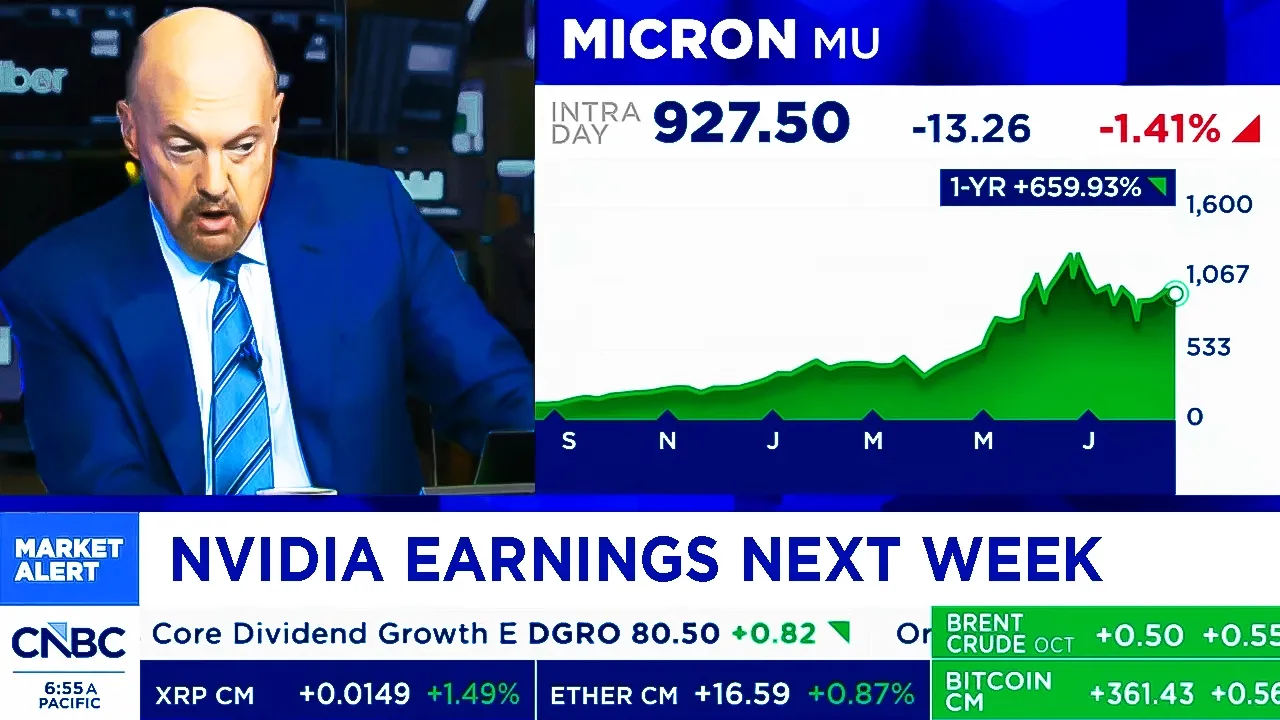
We're seeing a lot of puts in the in the uh uh Micron area. Micron going to the me that's on my mind going to micron. Uh but it's SKH uh after issuing all that stock here comes back. I mean I think Carl people want this rally preserved in the worst way and some would say they're doing it in the worst way. >> Uh >> well the the Highix buyback would be I think the largest buyback in South Korea's history. They did one of the largest issuances. I mean, look, I'm not saying it's noounded. They wanted to list here. I think there were other ways to do it such as dumping a lot of stock here and then saying, "Listen, we'll buy it back there. I buy I sell it here. I buy it back there." No, I'm saying that we need to build because Amazon gave us a road map that showed that if you build, you make a lot of money. It's different. >> It's no longer field of dreams. David, well, >> I don't know. I mean this open AI story uh according to the journal today looking at revenue up 18 quarteron quarter the quarterly loss widening to 12.3 billion operating margin further into the red I mean this people are reading this as an admission that they're not going to get enough comput >> why didn't tanker what's it Berber why didn't Berber jin talk about how July grew 20% month over month August the same same clip enterprise grew 32% month over month in July we have July data why did he not include July data How do you >> Who are you talking about? The reporter on the story. Is that what you're saying? I'm sorry. Who is that person's name? >> I got it wrong. I should tank. >> Is it B? >> Oh, Georgie. Yes. >> Bourbon. Bourbagen. >> This is Summer. I got it wrong. >> Well, this is the problem with all of these projections, Jim, is you can slice the ARR by week, by month, by quarter. Jim, you can defend. >> I have July data. You could have had I have July data. Why couldn't he get my July? >> You know what? Tell me what the July data was and do it more slowly. Would you do that for me, please? First you had the joke about spatted out there so quickly nobody can hear you anyway and then you're making fun of the guy's name goes down 100 points data you have what do you have >> I have July data >> all right what was it >> it grew 20% month over month that's better >> 20% month this is open AI >> I have August >> August is not over yet I have August so far it's continuing to grow at 20% okay >> the enterprise which is what I care about because we want them to start doing better in enterprise because it's sticky grew 32% been a large number of enterprises respond to this report which ended by the way at the end of the second quarter saying that their growth rate is now improved from them >> even though they did lose more money than even their revenue number >> what I am saying is there's a way to report it and it's the way that you would have reported >> and by the way these numbers move around a lot and they depend in part on the introduction of a new model on the ability to add even more compute there's no doubt and yesterday the market was digesting that $60 billion AR R that was going around involving Anthropic which may have put some pressure on the AI ecosystem overall as well. The and then by the way people even looking at next year on anthropic and saying well what's the real number and there's debate between Brad Gersonner and Gavin Baker you made yeah he thinks maybe some of those higher numbers were too ambitious >> too ambitious. This is part of the narrative. I can't wait till these companies are public so we can actually number 11 off of growth but it was still growth. Okay. And I am telling you this is an acceleration of growth for open AI and it's worth reporting on because that data stopped at the end of June. I've got in August. Who has August besides me? >> Nobody. And so that's why I had you as you just completed. >> The prosecution rests case >> and it was again it was August so far was 20%. Correct or more? >> August was look. Oh, sorry. I have to look it up. Like I have every number of my fingertips. Yes, I do. >> 13 Fs are into June. I I don't know what the problem is with this with at the end of June. Jim, >> look, I just Okay, that's absolutely true. >> Jim's got an exclusive tomorrow with Micron's Sanjay Morotra live from the company's R&D fab in Boise. Uh Jim, I saw you packed your bags walking in this morning. >> Yes, I Oh, yeah. I mean, they're too heavy. Um I got to tell you that the stock being down is strange because it really is very much linked to SKH Highix. Uh but you know what? Go ahead and sell it ahead of the interview. Just go ahead and make my day. >> You going to do the show tomorrow from Boise? I just need to know your schedule. >> I'm going to do it from Boise. Yeah. Okay. With that? >> Yeah. No, I want to know >> what's in your coffee. Something happened to your coffee. >> Nothing. Why? >> Well, I don't. >> Yeah. We are only a few days out from the earnings report of all earnings reports from Chip King Nvidia on August 26th. What I am wondering at the moment is if the stock has gotten too darn cheap. BFA analyst VC Arya said today in a note that Nvidia may be 50% undervalued. I mean why not 80% but he said 50%. Taking uh this one to the round table. Jar let me get back to you. Uh the call out is interesting in the sense Nvidia stock is coming up against that all-time high I believe hit on May 14th. >> Yeah. So it's a really interesting setup here and there's going to be a lot of questions uh about their not their free cash flow but the way it's deployed. And so the way Bank of America is coming at this is through a sum of parts free cash flow and they're comparing Nvidia to some of their peers like uh Marll or AMD which on that basis are very much over uh you can see AMD Marll for 2027 they got those 46 49 times uh multiple and then uh BFA kind of backs into the calculation you know Nvidia has all these so-called circular financing deals even if you impair 50% of its cash flow they still end up with uh some pretty big numbers. And so based on that, yeah, they're saying Nvidia should be trading a lot higher or should be a lot more expensive. In other words, it's cheap right now. Um I think there's going to be two really interesting things to come on the call. First, what is Nvidia doing with buybacks? And this is something that BFA really calls out here because if you're if you increase your buybacks and Nvidia hasn't done as many as a percent of its total free cash flow as some of its peers, but if you increase that, a lot of the concerns about uh circular financing deals go away because you're giving shareholders back the the cash flow. The other is uh all their investments including off balance sheet investments and the size of those and how they're being treated uh on you know on an accounting basis. So, I think those are two things that investors are really going to look for. And uh that's something that kind of blows my mind because a year ago that was on nobody's radar. >> Uh Eric, it's days like this where I miss picking stocks because I would have come out and made this call uh on Nvidia head of earnings. Well, uh, I've thought it's been cheap for a while, but if I could pretend I'm Jared and say, "Hey, let's go to Wi-Fi Interactive and you can pull up a, you know, the last threeear chart of video." >> Go ahead, Eric. >> You know, and so I think it's sort of law of large numbers that's that's plaguing them. A great company, great CEO, got nothing bad to say about Jensen, but I think, you know, there's a reason why Marll is a is a higher multiple. cuz it's smaller and the market sort of believes the growth is is coming. So, I I don't know is can stock buybacks do the trick to kind of juice this thing? I mean, I guess it did for Apple, but it didn't do it right away. It took a couple of years for the market to realize that the EPS was getting better over time and so forth. So, I'm not sure. I I you know, I I think that uh names like Nvidia and all the memory stocks, they've obviously all had a run. Nvidia had it first, then the memory stocks later. I think the market is kind of smiffing out like what are going to be the next set of stocks to benefit from AI that are going to go 5x or so forth. >> And Eric, I think investors are are not given the respect uh this portfolio of stocks that Nvidia or companies the companies or the companies Nvidia has invested in enough respect. Why is it so bad that Nvidia has invested in Open AI and Enthropic? I mean, I get they're basically the same companies, but still both of them are likely to have massive IPOs. Nvidia is going to get paid. It's not bad. It It's a good thing. It's not cir I don't I I I I don't have time for these people to say it's all circular financing. Oh, do it's a house of cards is going to fall. I mean, these are just the bears that are per perennial bears. Uh I you know, there's a reason why they want to support this uh ecosystem around them to to buy their chips. So, makes perfect sense from an operating perspective. And that's a different question from is the stock going to work over the next 6 12 months. >> Okay. Is the AI boom running out of steam? >> Okay, no is the short answer. But look, so don't take my word for it. Look at the earnings that are being announced by companies like Nvidia. Look, look at what Nvidia is doing. Look at the financing that's coming for data centers. It all to run all of this. We need chips. So whether or not you should buy today or yesterday or tomorrow, these are companies that trade for the most part at very low multiples. So there's so much demand for their product. They have pricing. They're going to be able to deliver for the foreseeable future. So no, we are not running out of steam. >> Look at Marbell. They're bucking the trend. They're up 6%. I wonder why. Yeah. I I'm not asking for commentary on one stock like that, but it is bucking the trend. It >> it is. And if you look at all of these, they've been been trading in ranges. So So they run up to a high end and then sell off. But at some point, the fundamentals are going to matter and they're all going to be trading quite a bit higher than where they are today. Apparently, Marvel has a deal with Google. Yeah. And that's why >> their custom chips and they're offering Google a stake potentially in their company. >> Okay. Surprise, surprise. He likes Nvidia. >> Nvidia. >> Yes. So, this is although the stock had a big run up and now it's kind of settled in in this $220 range, so to speak. It's still trading very inexpensive. It It's trading based on two years out, it's trading 17 times earnings. So, this company has continued to deliver. Now, you could, if you don't believe in it, you could say they're not going to continue to deliver these earnings. I'm a believer. I've owned the stock for a very, very long time. And I think Jensen Wong will continue to deliver. Early innings of AI, a lot of upside for Nvidia. >> And then you're like, Micron, that's been all over the place. >> It's been all over the place, but for the most part up um but now this one, when you talk about cheap AI stocks, Micron's trading in the single digit singledigit multiple. And the reason for that is as you people say that their chips they will not have the pricing power. There'll be demand possibly but they won't have pricing power that it's a commodity what they sell. >> I I disagree completely. So even if you put a 10 or 12 multiple on earnings for next year on micron the stocks a double from here. So I I think you it's back up in the $1,500 range on the next upswing. >> Now now that's the kind of gain you like. You do for sure. You really like that. does. >> It's not like you put into a retailer and you might get four or 5%. >> That doesn't move the needle. >> Doesn't move anybody's needle. No. Thanks Mike. >> You mentioned Nvidia. As far as a broader market indicator, I mean, does the market need Nvidia more than Nvidia needs itself because the story seems to be one of, you know, obviously valuation compression here, consolidated growth, but still the fundamentals holding up pretty well. Um, but also just as you touch on the the circular financing, I mean Jensen was out last week talking about, you know, obviously trying to find new check writers um from some of the guys here on Wall Street. >> Yeah, there there's been a little bit of a decoupling, I would say, the last few months, Sam, between just Nvidia and the overall market. And I think a lot of that goes to um what we've seen uh in terms of maybe some of the sector rotations. So, you know, Nvidia for a while was kind of stuck in the mud between 190 to 200 and and and finally kind of broke out. Uh but you know, I I think the narrative is more important than maybe just uh you know the overall move itself. I think the narrative that there's still demand out there for the chips that they still have the ability to raise prices. you still seeing, you know, multi- and double digit moves in terms of revenue and in terms of earnings growth that and the margins. I think that's going to be another big story too as well is is just at some point you're going to see those compress. I think we continue to to to think that that can get pushed out to 2027 and even 202028 uh for you know through a lot of the analyst expectations. Uh but I I I do think that you know kind of given and the other thing I'll add to that too Sam is it's it's a slow news flow right now right so anything that Nvidia says is going to be magnified a little bit more just because of the fact that there's not much else going on we're at the end of the earnings calendar and it really is a staple event >> how do you view these ARR reports and was open AI disappointing >> yeah look I I I think what you you have to take that um second quarter number in the context of this was before they had really launched on AWS Right. And so they launched on AWS late June. They were you know that basically meant that they were missing you know 65% of the enterprise market. Then you get that July uh report out of them that you know they had added more new net ARR in July than they had added in all of June. Gives you a sense of what the real time pacing is. So to Kate's point this being backward-looking the forward-looking numbers I think are much more uh much more encouraging. Do you on the profitability though point and and the margin point do you are you what do you make of people increasingly argue that the an IPO is certainly not imminent this year or maybe next? >> Well, you know, I I think we'll we'll we'll see what individual companies decide on the the IPO front because obviously, you know, we have this long period of companies making the decision to stay private longer. This is a different economic environment in terms of, you know, the capital needs for this industry. So you're going to see different decisions getting made. Um as far as you know the the numbers below the ARR line. These so much of this is dependent on how you've structured your business around how much infrastructure you own versus how much infrastructure you rent, how much capital expense you're taking on versus how much operating expense to to to pay for for inference. And so until we really see the the full numbers, it's hard to draw any real conclusions except for the fact that we do know um you know one company has a much bigger expense base than the other because one company is very focused on just the enterprise whereas um you know other AI labs are trying to kind of do everything. As we think about just the importance of an open AI and an anthropic in the economy, have we gotten to the point given just their downstream integration that they're just too big to fail? Not that an 18% quarter-over-quarter growth is anything, you know, close to failure. But as we just think about kind of academically their importance in the economy and their importance to Nvidia and Oracle and all of these other hyperscalers, should we be asking those questions? It definitely important questions to ask but what we always come back to the north star for us on all of this is how much enterprise demand is there are the customers there for these companies because AI is not like search or social or even e-commerce where it's dominated by one company the question if if one of those companies or both of those companies were to somehow go away tomorrow it's probably not going to slow down Fizer's adoption of AI it's not going to slow down JP Morgan's adoption of AI if you used to be a a customer of one of those big AI labs and they're not there tomorrow, you quickly become a customer of the other one or of Google or of AWS. So, I I don't think the the macro risk of these AI labs being as big and as important as they are, um I think it gets overstated a lot just because the end customer demand is still so um so much of what's driving all of all of this. Let's take your temperature on on open- source or cheaper Chinese models and what it's doing to some of these token expenditure uh measures. I mean, could we end up in a real price war? I mean, a real one. >> No, you know, look, I I think a lot of what's about what what you have in open source is misunderstood. Um, people compare sort of the the frontline, you know, list prices uh without actually looking at the total cost of ownership. And so when you look at that um that total cost of ownership because most of the open models tend to be more token consumptive. So you're paying less per token but you're burning more tokens to get to the same answer. That narrows a lot of the the gap. There's also a lot of of misunderstanding around the the benchmark performance numbers. The open open models do really well on um public benchmarks where you can train against the test. when you look at the scores against private benchmarks that are out there, there's a much wider performance gap and it's one of the reasons that you're not seeing more adoption for those those models in the the enterprise. Also, talk to any CIO cost is like the fifth thing that they think about right? It's it's service, it's customer support, it's documentation, it's performance, you know, the the the cost piece of it is what they get to after they have checked a lot of other boxes, >> right? Nvidia's H200 chips, small batches into China. Remind us what is the H200? Is that one of the older >> It's a little bit older, but >> little bit older, but still valuable. >> Very, very valuable, especially in the training stage. So, in March, I I saw Jensen Wong in the hallway. Asked him specifically, did you get a deal with China? He said yes. They got a green light. In April, something happened on the China front. They stopped the uh like the the deal was in place. The orders were in place. They just hadn't shipped the chips to China. Now, we're starting to hear more news trickling from specifically the FT today saying that 10,000 chips had been sent to Tencent and Bite Dance, two Chinese major tech giants as we know, and more to come. Um, this falls in line with what Nvidia has shared that there are deals. It's a big question as whether this is going to be incremental to guidance in this upcoming earnings report on August 26 because it could potentially be, you know, billions and billions of dollars, especially if all of the smaller firms too are allowed to buy these H200s. So, it is a a strong sign for Nvidia even though the shares aren't really reacting because there's been so much back and forth with this, >> but and sometimes they even exclude whatever's going on in China from kind of what analysts are looking for just because it's so volatile. But it exactly it hasn't been modeled in in reports for so long because of the back and forth in the headlines and Nvidia hasn't actually put out an official statement today too confirming this. >> Memory stocks roller coaster, but mostly higher in recent months. Um, what memory stocks do you like? >> Yeah, I mean I think that the class of memory stocks are going to continue to play out. So if you look at the names like Micron, SK Heinix, I I think that you know these are long-term trades. As AI continues to build out and we talk about this, you know, this this futuristic day here, whether it's through quantum computing, superconductors, humanoid robots, you're going to need these AI chips to to >> Yeah. And SKH Highix really turned to the market early this morning when they announced the 29 billion buyback because I I think they're saying they think their stock is undervalued. >> Yes. Yes. And I think that most of these companies will tell you that they think that their stocks are overvalued in terms of the potential total addressable market for AI and where we are in its infancy. You know, you asked the question before to Jerry like how am I going to start recognizing this in their lives? And the truth is in my life, you know, the truth is we're just now seeing that, right? And once this starts to bleed into the different earning seasons, whether it's the Madnas, the the drug companies and things like this where they've shown how they've used AI to to generate data, move a thousand times faster with a quantum computer and come up with a cure. You know, I I think I think we're at stage one. >> Talk to me about Nvidia. One week from today, Jensen Wong tells us how his company is doing. You say Nvidia is a buy now ahead of what we'll hear a week from today. Why? Well, look there there's a lot that's going on in terms of demand for AI and data center and Nvidia remains extremely well positioned for that. All the hyperscalers have taken up their capital spending numbers and expected to do so again next year. Uh Neoclouds are ramping their spending. Companies like SpaceX, Coreweave and the like. So the demand backdrop is very favorable. Where where I get a little concerned with Nvidia is there's always high expectations and we've seen the stock fall off post earnings more than a few times because although the reported quarter is robust, guidance is strong, it just falls a little short of those whisper numbers and we've seen more of that this time around in the current quarter that's being reported from a number of different companies. At what point will the Chinese market be open to Nvidia chips? The Financial Times is reporting that a lesser powerful AI chip, the H200, um, is allow Treasury, we we are allowed to give China that chip, those chips, but Chinese companies aren't accepting them. That might be changing. >> Yes, 100%. And that would actually be a very positive sign for Nvidia because it hasn't shipped product to China in some time and its forward guidance earlier this year its most recent quarter it reported did not include any revenue from China. So the extent that there is a workaround potentially by shipping the the chips to Hong Kong. Um that would be a positive for Nvidia and a reason for folks to get even more bullish on the shares in the back half of this year and into 2027. Uh Nvidia is trading at 219 now. Uh the earlier high is 236. Where do you see shares? >> Uh we see shares going higher over the long term. I again g given my concern about the guidance factor. We could see them pull back. But if they do, Lauren, if you look at the shares on a PEG basis or price to earnings growth ratio, they're extremely cheap. If they pull back to that 195 to 200 level, time to back up the truck >> of the AI trade. Okay. You said that you had quote pulled back a bit and rebalanced when it came to companies directly related to AI. >> I think you were talking a lot about the momentum aspect of it and some of the memory names and things that have gone parabolic and then had come down and then now had done well again. >> Yeah. >> So what are you doing now? So that July experience was pretty extraordinary and particularly in things like memory compute infra uh energy like now you're now some of these equities are trading in multiples particularly in compute memory not just in the US Korea Japan those are pretty I mean so we've added some a decent amount of that type of paper >> you added I like you did >> yeah and I and so those multiples because we know we've got 2 3 four years of committed backlog. Boy, you can get pretty comfortable at multiples in the certainly in some of them mid to low single digits that I'm pretty certain that we're going to get we're going to get return off of that. So, we've added some of that. >> You know, I would say in the mega cap we are neutral. You know, we've shifted some names around um but pretty neutral. But, you know, I still like I you know, more like memory, compute, infra, and some of the energy names. And by the way, every day that they move around. You know, we do some of those names, you get to sell volatility alongside your position and get paid an awful lot to lower your break even. All right, I hope you're all doing well today and staying calm in this market. Today was a mixed day in the market after the Treasury announced it intends to increase purchases of longerdated bonds. This comes as many market participants have been worried about elevated yields. The Financial Times is reporting that China has begun allowing limited shipments of Nvidia's H200 into mainland China. According to the FT, Bite Dance and Tencent have both received roughly 10,000 H200s each. Several other Chinese tech companies could soon receive approvals for similar size batches. Chinese regulators are permitting companies to deploy H200s in Hong Kong, and the FT says Nvidia has roughly 500,000 H200s available for Chinese customers. I will say that the FT has a good track record of accurately reporting on Nvidia China rumors, so this is worth paying attention to. That said, there's been a lot of back and forth on this topic for over a year now. China revenue is not included in most analyst models and the US government is taking a 25% cut of all China sales. At the same time, any China revenue would be additional upside for Nvidia that most analysts are not including in their current models. Also on Wednesday, SKH Heinix announced they will repurchase and fully cancel roughly 28.6 billion worth of shares. SKH plans to repurchase and cancel up the 24.07 million shares or about 3.3% of total shares issued. SKH Heinix also raised its shareholder return commitment from within 50% of cumulative free cash flow to over 50%. The repurchase period is scheduled to run for approximately 3 months starting this Thursday, August 20th. All repurchase shares are to be canceled upon completion of the acquisition. There have also been recent reports about Samsung preparing to increase shareholder returns. It's worth considering that starting this December, Micron's limitations on conducting share repurchases related to the Chips Act will begin to ease. After that, Micron can start repurchasing shares and returning cash to shareholders. With that context in mind, it makes sense that both SKH and Samsung will be increasing shareholder returns. Now, I want to address Open AI and Anthropic because I've noticed some people online who are disappointed in the reported revenue growth at those companies. Let me provide some context so you know what's going on and then I'll address the concerns after that. Tuesday night, the Wall Street Journal published a piece saying that OpenAI's Q2 revenue rose 18% from $5.7 billion in Q1 to $6.7 billion in Q2. It was also reported that OpenAI's operating margin dropped further into the red with operating loss widening to 12.3 billion in Q2 versus $9.3 billion in Q1. That would imply losses growing faster than revenue during Q2. The Wall Street Journal credits the divergence partly to slower chat GPT growth and the rapid success of Anthropic Cloud Code. The Wall Street Journal said that OpenAI's Q2 results disappointed some investors. Open AAI says its growth accelerated again in Q3, which is not reflected in the numbers reported by the Wall Street Journal. At the end of July, CNBC reported that OpenAI's CFO told employees that Net new ARR added in July topped all net new ARR added in Q2. Bloomberg recently reported that OpenAI's ARR had surpassed $40 billion and that Greg Brockman told OpenAI employees that ARR increased more than 20% month overmonth in July. So, we're looking at 18% quarter-over-arter revenue growth in Q2, followed by more than 20% month- over-month growth in ARR in July. That indicates acceleration. And then Wednesday afternoon, CNBC published a piece saying that slides shown during an internal meeting at OpenAI showed that ARR was a 35% quarter to date. Again, that's quarter to date, not quarter- quarter. Meaning ARR has increased 35% since the start of July. It gets a little tricky to calculate the specific number because the Wall Street Journal's reporting provided the Q2 revenue number. We could annualize that number, but that is different from ARR at a specific moment in time. June 30th was the last day of Q2. Open AAI grew throughout Q2. And so OpenAI's ARR on June 30th would be higher than ARR averaged across all of Q2. If ARR was $30 billion at the end of June and then increased 35% as CNBC reported, then that gets us to an ARR of slightly more than $40 billion, which lines up with Bloomberg's recent reporting. Also, earlier this week, Bloomberg reported that Anthropics ARR surpassed $65 billion at the end of July. As a reminder, Anthropics ARR at the end of 2025 was roughly $9 billion. And then they told us in May that ARR surpassed $47 billion. If Bloomberg's claimed that ARR surpassed $65 billion at the end of July is correct, then that would be more than a 7x in ARR in 7 months. That's incredible. That said, it was also less than what some investors were expecting. As I've said before, I'm trying to keep you updated on what media outlets and certain industry professionals are saying. That said, with all of these numbers, we need to wait for official confirmation from the companies themselves. I do think that the recent reports about Open AI and Anthropics revenue growth are part of the reason why we've seen some pressure on many AI stocks this week because while the reported revenue growth is very impressive, it's also less than what some investors were expecting. This is happening at a time when the bearish narrative has shifted slightly away from the claim that there is no return on AI to the new narrative that the ecosystem is too heavily dependent upon open AI and anthropic. That narrative shift happened because the three major CSPs all just reported accelerating cloud revenue growth and expanding cloud operating margins. That substantially weakened the narrative that there is no return on AI. And so now the bearish focus is shifting more toward the frontier model companies. I'll have more to say about the frontier model companies in a moment, but first let me address something else that's been getting a lot of attention online, which is falling token prices. As I have said repeatedly on this channel many times, lower token costs are not bad for infrastructure companies like Nvidia. Lower token costs catalyze greater usage throughout the ecosystem, which ultimately leads to more compute demand, not less. Many of the charts circulating online showing token costs falling do not consider the increase in usage and rising GPU rental contract prices that are occurring as a result of falling token prices. On this topic, I noticed a bearish voice online today. I'm not going to mention their name out of respect for their privacy, but they argue that the claim that lower token prices will lead to greater usage is a farce. Their logic for that claim was to just say, "Look at how that worked out with the shale revolution. Look at how that worked out with the railroads. Basically, they were implying that during previous economic booms, there were also investors who were saying that lower commodity prices would lead to greater demand, but that ultimately did not work out well for those investors. I do see a flaw in their logic. Don't get me wrong, there are similarities between this AI revolution and past economic booms. That said, there are also key fundamental differences. Previous booms like the shale revolution and the railroads involve demand for physical commodities. However, in this current AI revolution, demand is digital. Yes, physical AI is coming, but that's a separate topic for another time. Now, notice this. Digital demand grows exponentially. Physical infrastructure cannot keep up. Also, with AI, in contrast to oil and railroads, there are many different use cases and new use cases are unlocked much more rapidly than in previous economic booms. You can only use oil for so many things. You can only use railroads for so many things. In both cases, the number of use cases are very limited. That is very different from AI. With AI, new use cases are much easier to unlock. When valuable new use cases are unlocked as we saw earlier this year with a decoding usage skyrockets and again digital demand grows exponentially. Physical infrastructure cannot keep up with the digital demand and likely won't be able to keep up for multiple years. Now going back to token costs. Contrary to investors assumptions during past economic booms that lower commodity prices would lead to greater demand. Today lower token costs actually do result in greater demand. With lower token costs developers can build more, iterate faster and unlock new use cases. That was not the case with the shale revolution or the railroads. The number of use cases for AI are far greater than the number of use cases for oil and railroads. Comparing those economic booms of the past with the AI revolution of the present is like comparing apples to oranges. Sure, there are similarities, but there are also fundamental differences with massive implications. Lower token costs are great for hardware companies like Nvidia, Micron, and so on. There's a fundamental reason why Nvidia is driving token costs lower with each architecture. Nvidia is also determined to be the leader in open-source models that drive the industry forward. That includes cheaper open source models with substantially lower token costs. Nvidia is determined to drive token costs lower and there's a fundamental reason as to why. Again, lower token costs catalyze greater usage. More usage leads to greater compute demand. And of course, Nvidia sells the compute. Lower token costs are great for almost every company in the AI ecosystem. However, lower token costs do pose a competitive challenge for the frontier model companies like OpenAI and Anthropic. This in combination with the bear's recent fixation on the Frontier Labs in combination with reports of Frontier model company's revenue growth rates that appear to be less than what some market participants had expected. All of that appears to have weight on stocks in the AI ecosystem this week. It's important to remember that each new generation architecture from Nvidia will reduce the cost to produce tokens. That should benefit the hyperscalers, the frontier model companies and their customers. Additionally, while some companies are adopting open- source models in an attempt to save on costs, I don't think the Frontier Labs are going away anytime soon. I think there will always be demand for leading Frontier intelligence and as better models are released by the Frontier Labs, new use cases will be unlocked which drives more demand. And let's be real about the reported revenue figures. If Bloomberg and the Wall Street Journal's reports are true, then Anthropic's ARR just increased more than 7x in 7 months. And OpenAI's ARR basically doubled in roughly 7 months with acceleration occurring within the latter portion of that time frame. Regardless of investor expectations, both of those growth rates are incredible. Let's not miss the forest for the trees. And if token costs come down at the Frontier Labs, you're going to see a notable increase in usage among their customers. The Frontier Labs monetize usage. I think that the fears about the Frontier Lab survival are largely overblown at this point. I also expect the Frontier model company's margins to improve over time. If new information becomes available that indicates the contrary, I'm willing to change my mind. Looking ahead, we have Nvidia earnings on Wednesday, August 26th. Last I checked, consensus expectation for the quarter were revenue of roughly $91.1 billion, EPS of $28, and gross margins of 75%. As for next quarter revenue guidance, it appears that the consensus is $14 billion, but I've noticed that multiple analysts are expecting Q3 revenue guidance closer to the range of 107 to 108 billion. Q3 gross margin guidance is expected to be in the mid70% range. Keep in mind that those were the expectations the last time I checked, so things could have changed since then. Now, I'll be completely honest with you. I expect results and guidance to be strong, but I don't know for certain how the stock will react. It's very common for Nvidia to trade higher ahead of earnings in anticipation and then to trade lower after earnings. So, that's definitely a possibility and we've seen it happen many times before and the stock has been trading higher ahead of earnings, which raises the bar even higher. That said, the stock is arguably cheap versus the company's future growth. Regardless of how market participants react in the short term, I expect this earnings report and earnings call to reaffirm that the long-term thesis is intact. I'll be very interested to hear what leadership have to say on the earnings call regarding rumors about reduced memory content per GPU Frontier model company's profitability, China sales, and the rollout of Vera Rubin among other topics. I'll try to provide a recap of the highlights from Nvidia's earnings and earnings call on this channel on the night of Wednesday, August 26th. So, be on the lookout for that. That video will probably be posted either late Wednesday night or early Thursday morning, depending on how long it takes to make the video. I'm expecting that video will probably take 8 hours or more to make, so please bear with me on that. Now, in case you're new to the channel, I want to make sure that you have at least a basic understanding of the underlying long-term thesis. So, let's cover that. Now, I don't know what's going to happen in the short term, but from a long-term perspective, I am very confident that Nvidia will be worth much more in future years than it is today. When Jensen was on the Lex Freedman podcast not that long ago, he was very seriously raising the possibility of Nvidia becoming a $3 trillion revenue company in the near future. If that happens in the coming years, then it is very plausible that Nvidia could one day be worth tens of trillions of dollars in market cap. That might sound crazy, but that's what Jensen is implying when he raises the possibility of Nvidia becoming a $3 trillion revenue company. I guess the question at that point is what multiple the street will be willing to give Nvidia. I don't know the answer to that question, but I truly do think that Nvidia will be worth much more in future years than it is today based purely on the fundamental growth of the business. Based on everything I'm seeing, the world is still computed and I expect that to continue at least through the first half of calendar 2028. In a computed environment, developers will use whatever viable compute they can get their hands on. Today, there are no GPUs that are sitting dark due to a lack of demand. Like there was fiber sitting dark due to a lack of demand at the height of the dotcom bubble. Back then, companies were laying fiber in the hopes that use cases and demand would eventually show up. Today, we are seeing the complete opposite. As I've said many times, when market participants compare this AI revolution to the dot bubble, they ignore the fact that the internet is already here this time. This means that mass adoption of the technology and new use case development at scale are immediately possible. We don't have to wait years for it to show up. It's already here. The world is compute constrained which means there is not enough supply to satisfy demand. New capacity is utilized as soon as it comes online. The hyperscalers are monetizing capacity as soon as it comes online. Each of the hyperscalers spoke about being supply constrained on their most recent earnings calls. Additionally, many of the clouds are building out into contracted demand. They're not blindly building in the hopes that demand will eventually show up. No, they're building out because they have signed contracts and in some cases significant prepayments from their paying customers. This AI revolution is fundamentally different from the dotcom bubble and 2026 will be a pivotal year for the AI industry. Thanks to the rapid adoption of Agentic AI and the proliferation of agentic systems in the world's leading enterprises, the leading AI labs revenues are surging right now. Agentic coding and the implementation of agentic systems in large enterprises are new use cases that are increasing inference demand significantly that subsequently is increasing compute demand. The rapid adoption of agentic AI is why we're seeing an inflection in inference demand. It's why we're seeing the leading AI labs revenue surge. I wish both Anthropic and Open AI were public so the public could see the ramp in their revenues. Anthropics ARR has surpassed $47 billion, up from $9 billion just at the end of 2025. Open AI is growing rapidly as well. I think the leading labs surging revenues may be the initial proof point that grabs market participants attention and causes them to realize that there will be a clear ROI on AI infrastructure. I think the leading labs surging revenues will also help assure investors of the longevity of Nvidia's growth since these labs revenues are directly tied to compute. If they had more compute, they would have greater revenues. It really is that simple. Demand is not the problem. The problem is a lack of supply to meet the demand. As I've said previously, I expect the world to be compute constrained at least through the first half of 2028, possibly longer. And so regardless of what happens in the short term, it's important for long-term investors to remain focused on the fundamentals, maintain a long-term perspective, and remember that we are only in the early stages of aic systems being adopted at scale. This will increase compute demand significantly. And after that, the next surge in compute demand will likely be fueled by physical AI. We're no longer talking about digital agents performing digital tasks. With physical AI, we're talking about physical AI agents performing physical tasks in the real world. NVIDIA CFO has called physical AI quote a multi-t trillion dollar opportunity and the next leg of growth for NVIDIA. This industry will fundamentally transform society and Nvidia has positioned themselves to benefit massively. Nvidia sells the hardware for the data centers where the models are trained. They offer omniverse where the models are taught and tested and NVIDIA also sells the hardware that allows ondevice real-time inference through NVIDIA AGX allowing robots to have intelligent interactions with the real world even when they are not connected to a data center. Notice that Nvidia is taking a holistic platform approach to physical AI and they're embedding themselves as the underlying foundation supporting all of it. Over 2 million developers are already building on the Nvidia robotic stack and this is not getting enough attention. As for production ramps, Blackwell Ultra has ramped quickly and remains in high demand. Reuben is on track to launch in 2026. Then we're expecting Nvidia Gro 3 LPX in the second half of 2026. Later on, we're expecting the launch of Reuben Ultra in 2027 and Fineman after that in 2028. We have a clear data center product roadmap stretching into 2028. And Jensen believes that AI infrastructure spending will reach three to$4 trillion annually by the end of the decade. That means Jensen is expecting growing AI demand and an expanding total addressable market underpinning all of this. I don't think we are anywhere near any type of bubble bursting type of event. With all of this in mind, I seriously think that Nvidia still has plenty of runway ahead of it. And I think this company will be worth substantially more in future years than it is today. At least that's my view of the situation. Quick note before I wrap up. All of the compilations on this channel are edited by Finn Vid with original structure and commentary. Occasionally, the same edits appear elsewhere on YouTube. If you're looking for the original version, it's always here on this channel. Thanks for watching, Finn Vid. I appreciate your support. Remember to stay calm in this market. Remember to maintain a long-term perspective and do not make any hasty or irrational decisions. With all of that being said, I hope you all have a great rest of the day. And I'm curious to hear your thoughts about Nvidia in the comments below. Please leave a like on this video so more people will see it. And while you're down there, please consider subscribing. It's free and you can always change your mind.
Comentários 0
Entre para participar da discussão.
EntrarAinda não há comentários. Seja o primeiro a compartilhar sua opinião!