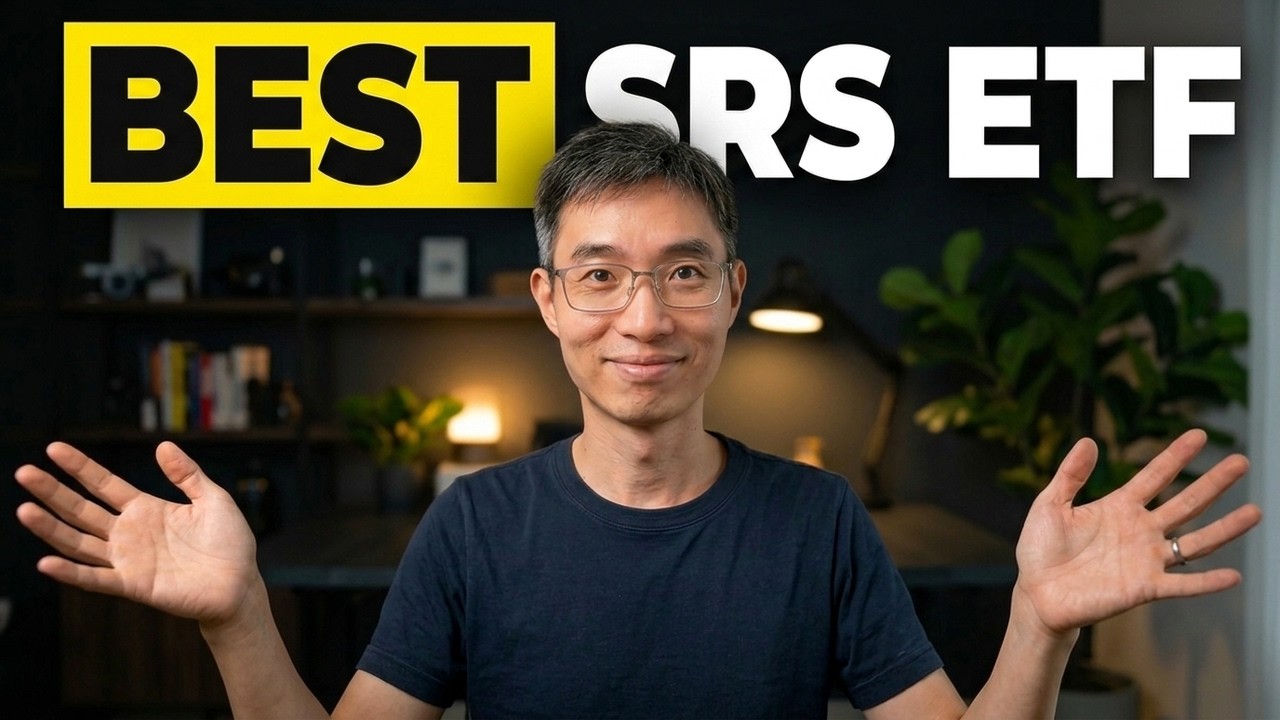
The 5 Best ETFs To Invest Your SRS Money In 2026

- Retorno do vídeo
- —
- Chamadas
- 1
- Compra / Venda
- 1 0
- Publicado
Recomendações
Entrada é o preço de fechamento do ativo na data de publicação. Atual é o último fechamento registrado.
-
Entrada $713,44 22 ago 2026Atual $713,44 21 ago 2026Resultado +$0,00
the cheapest growth fund your SRS can invest in would be QQQ, which again, is available on StashAway ETF Explorer.
Transcrição Completa
Picking the wrong fund to invest your SRS money
can quietly cost you a few thousand dollars over the long term. So in this video, I want to
show you the cheapest way to invest your SRS money across every major category, from
the S&P 500, to global, growth, dividends and Singapore. For each one, I'll cover the best
fund you can actually buy, and where to buy it. So, let's not waste any time and let's
start with the first category, the S&P 500. For this category, my top pick would be
CSPX, the iShares Core S&P 500 UCITS ETF, which is available on StashAway's ETF Explorer. Just like any other S&P 500
ETF, CSPX holds the top 500 companies listed in the US. So it has
Nvidia, Apple, Microsoft and so on. CSPX has a very low expense ratio of 0.07%. And
because it is an Ireland Domiciled ETF, it only has a 15% dividend withholding tax, as compared
to every other fund on this list, which is at 30%. So, when you add up both the expense
ratio and the dividend withholding tax, the fee that you have to pay every year on this
fund would come out to around 0.234%. This is way cheaper than all the other funds, where
the annual fees can add up to 0.35% or more. Meanwhile, StashAway ETF Explorer itself doesn't
charge recurring platform fee, and dividends get reinvested free of charge. Though, you do need
to pay a flat USD 1 fee for every trade you make, plus there's a 0.32% currency spread. However,
even after adding these one time fees to the annual cost, it still comes out cheaper
as compared to investing in other funds. Oh yeah, and speaking of StashAway, they're
currently running a National Day campaign, where you get to enjoy a 6.2% per annum yield
to maturity on your cash, and SGD 61 worth of ETF rebates when you invest in Simple Plus or
any SGX-listed ETF Explorer portfolio by 11 September 2026. So if you are interested,
you can sign up via my link down below. Next, while the S&P500 is great, the truth is
that nobody actually knows which country might do well next. So if you would rather not put all
your funds in the US basket, you could invest in the entire world instead. Because, you'll always
pick the winner, if you are picking all of them. For global, my pick would be ISAC, the iShares
MSCI ACWI UCITS ETF, which is also available on StashAway ETF Explorer. This ETF holds over 1,600
companies across developed and emerging market. It has an expense ratio of 0.2%, and
again, because it's domiciled in Ireland, it only has a 15% dividend withholding tax,
thereby letting you keep more of your dividends. So, when you add up the expense ratio, the
withholding tax and that one time currency spread, a SGD 100,000 investment
in ISAC over 10 years would cost you around SGD 3,730. That's way cheaper as
compared to investing in the other 2 funds. However, if you feel that both the S&P 500 and
the global fund aren't aggressive enough for you, and you want even more growth, then the cheapest
growth fund your SRS can invest in would be QQQ, which again, is available
on StashAway ETF Explorer. QQQ tracks the Nasdaq-100, which is the 100
biggest non-financial companies listed on the Nasdaq. It has a 0.18% expense ratio, and
because this ETF is registered in the US, your dividends get taxed at 30%. But
that would barely cost you anything, since these growth companies pay
almost no dividends to begin with. When you add up the expense ratio,
the dividend withholding tax, and the FX spread, SGD 100,000 over
10 years in QQQ would only come out to around SGD 3,650. This is over 4 times
cheaper as compared to the other 2 funds. Though, this isn't really a 1 to 1 comparison,
since the other 2 funds are actively managed, meaning a human is picking the stocks, and
they aren't trying to do the same thing either. While QQQ tracks the 100 biggest
companies on the Nasdaq exchange, UOBAM United Global Quality Growth is a
fund that focuses on quality companies from not just the US, but all over
the world. Meanwhile the Franklin US Opportunities fund picks US companies that
it thinks can grow in a sustainable way. Though, despite the active management of both
funds, neither of them has gone very far over the past 5 years. Franklin is only up around 20%,
while the UOBAM fund is actually slightly down, despite the past 5 years being one of the
strongest bull markets we have ever seen. In short, if you've got a bigger risk
appetite and you want a growth tilt, QQQ is the cheapest fund that
you can invest your SRS in. Next up, if you like having some income
coming in every few months, then this is the dividend category. Here you've actually got
5 funds to pick from. The cheapest one is VYM, the Vanguard High Dividend Yield ETF, which
is available on StashAway ETF Explorer. VYM holds 605 US companies that pay above
average dividends, and it yields around 2.4%. Its expense ratio is only 0.04%, which is the
cheapest fund in this entire video. But because this ETF is registered in the US, 30% of every
dividend gets taken before it even reaches you. And that's huge. On a 2.4% yield,
the tax works out to 0.72% a year, so when you add up the fees, investing
SGD 100,000 over 10 years would cost you around SGD 7,920, with around 90% of
that being the dividend withholding tax. Though, this fee pales in comparison to
the other 4 funds. Because the 4 funds are actively managed unit trusts listed on
Endowus, they not only have an incredibly high fund level fee of anywhere between
0.8% to 1.16%, but they also come with the 0.3% platform fee which Endowus charge, in
addition to the 30% dividend withholding tax. Looking at their performance, VYM
and Allspring are basically neck and neck at the top, while the other
3 trail behind. Which is interesting, because Allspring is a global
fund, and not a pure US one. Nevertheless, if you are looking for the
cheapest dividend paying fund to invest in, it's VYM, but just note that you're
handing 30% of that dividend to Uncle Sam. Last but not least, if you would like some
exposure to our home market, Singapore, then the 2 cheapest funds would be the 2 Amova
STI ETFs. GAB is the accumulating version, where it automatically reinvests the
dividends for you, while G3B pays them out. Both of them track the Straits Times Index, which holds the top 30 companies in
Singapore, like DBS, OCBC and Singtel. They have the lowest 0.24% expense ratio, as compared to ES3, or the SPDR STI ETF which
has a slightly higher expense ratio of 0.28%. And because the funds are domiciled in Singapore, there's no dividend withholding tax to worry
about. On SGD 100,000 invested over 10 years, after taking into account the expense ratio,
both GAB and G3B would cost you SGD 2,400. All 3 funds are available on both FSMOne
and POEMS. FSMOne charges a flat SGD 3.80 for every SGX ETF trade, no
matter how big the order is, while POEMS charges 0.08% of whatever
you're buying, with no minimum. Because of that, if you are
investing less than SGD 4,750, POEMS is cheaper. But anything above it,
FSMOne would end up as the cheaper broker. However with that being said, FSMOne
has an ongoing promo where if you use their Regular Savings Plan to invest,
you'll get to enjoy 0 fee. This makes FSMOne the cheapest platform to use. Sign
up link down below if you are interested. So there you have it, these are the
cheapest funds you can buy with SRS in every category. Now if you're not sure
where to start, here's how I'd think about it. If you want just one fund and never want to think
about it ever again, ISAC lets you invest in the entire world, where you'll always be investing
in the winners no matter who comes out ahead. Otherwise, if you believe that the US will
continue doing well over the long term, then you could go with CSPX
via StashAway ETF Explorer. But if you've got a bigger risk appetite,
and you can stomach the bigger swings, QQQ would give you exposure to the
fastest growing companies in the US. And if you want dividends instead, VYM would give you exposure to the high
dividend paying companies in the US. And lastly, if you just want
some Singapore exposure, GAB or G3B would be the cheapest fund to go for. Anyway, that's all for this video. Hope you found it useful. Like, share, and subscribe as
I'll be posting new videos every week.
Comentários 0
Entre para participar da discussão.
EntrarAinda não há comentários. Seja o primeiro a compartilhar sua opinião!