maintaining a buy rating on the stock with a price target of 300
Contexto
Gilura of DA Davidson maintaining a buy rating on the stock with a price target of 300, writing, Nvidia should be able to exceed consensus expectations and guide higher
So Nvidia is still our largest position in the portfolio. We think the combination of earnings growth and the valuation that we're seeing on our outyear numbers still makes it attractive for our portfolios.
Contexto
Jeremiah Buckley on Nvidia: "So Nvidia is still our largest position in the portfolio... still makes it attractive for our portfolios."
And I love how it broke up above the 50 SMA on the daily chart recently, which is a buy signal.
Transcrição Completa
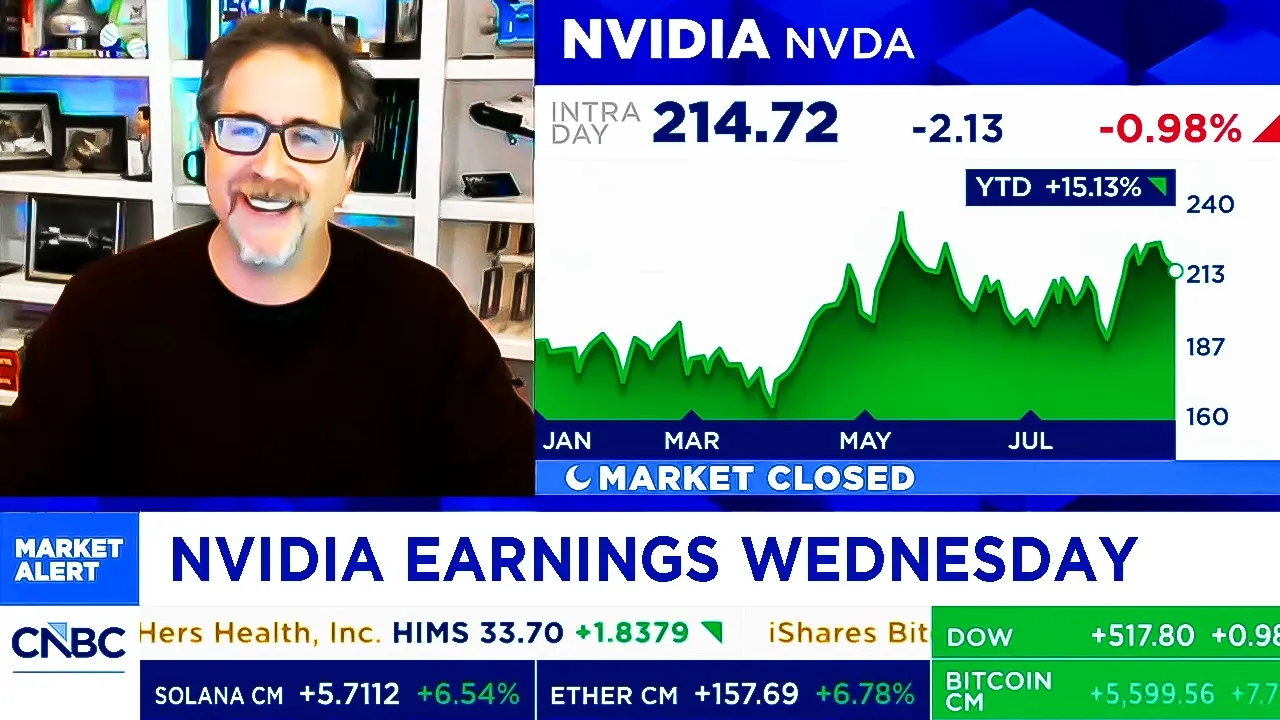
Nvidia looking to snap a five-day losing streak. The stock is going to be in focus next week, reporting earnings. Gilura of DA Davidson maintaining a buy rating on the stock with a price target of 300, writing, Nvidia should be able to exceed consensus expectations and guide higher, but investors will be focused on competition and financing. Gil joins us now for more. Gil, welcome. We've heard from their biggest customers. We've got a decent read on this company. What else is left to find out? Yeah. So, just as with the last few reports, we know that if the customers double their capex, then Nvidia's results will nearly double, and that will happen next week. Not only will they nearly double their revenue, they'll nearly double their earnings as well. uh we have very good visibility to that but um we we've become ungrateful and it's likely that investors will will shrug at that and be focused more on uh what Nvidia is doing to compete with alternative solutions the ones from uh Google and Broadcom uh Amazon and Marlluts from AMD that's going to be a lot of the focus and then we're going to continue this conversation about uh quoteunquote circular financing uh Nvidia funding its customers uh being willing to backs stop some of its customers investment. I think the company will be asked a lot about that and need to provide a good answer for why they keep doing that and if that is sustainable. >> Gil Lisa's going to have questions on that just in a moment. You mentioned competition. Just quickly, do you think the competition is starting to hold back the multiple on this stock? I >> I think that is the fundamental factor. I think the main thing that's held the stock back is just that that the momentum trade has moved on. Almost all the profit is going to Nvidia and the three memory companies and yet the market has moved on to all the other semis and opticals and semicap etc where those multiples are 30 40 and higher implying continued growth for five years where if you look at Nvidia and the memory companies the multiples imply that the cycle's already over. Nvidia is trading as if it it'll grow at a GDP rate from this point on again in spite of the fact that they're doubling their revenue and earnings right now. So the concern is competition and the reality is when you start with nearly 100% market share by definition other companies are going to take some of that and that share will diminish over time and that is the fundamental factor that's holding the stock back. There also though, and just to build on the circular financing point, is a concern that they're financing a lot of their demand personally with their balance sheet and that ultimately this isn't necessarily demand that can stand up on its own without that backs stop. Is there good accounting for that? Can we see all of the financing and clear relief in the earnings >> for Nvidia? very little of their demand comes from them funding their customers directly. Right? They funded companies like Cororee and Nebius. That's a relatively small part. They're not funding Amazon, Microsoft, and Google who are by far their largest customers. Meta, Elon, uh they are funding some of their smaller customers. They're funding a lot of the ecosystem. But as we talk about circular financing, we have to remember like we don't like it when companies fund their customers, right? That's that's a truism. But if you look at what Amazon and Google did investing in Anthropic, their customer, look at what they're the return they're going to get. We just talked about that $2 trillion IPO. Amazon and Google actually own a decent amount of that. That was a very good investment and they don't have to repeat that investment. Now, as Anthropic goes public, it will secure its own capital. And Amazon and Google won by investing in a company that grew very fast and by investing in a customer that will continue to funnel tens of billions of dollars each their way driving their own growth. So as long as that initial investment in your customer pays off and that customer can become independent and and generate its own cash flow, that's okay. It's it's when you invest in customers that are not viable and that's when we start talking about Neoclouds. Are those viable? Can that continue? That's the stuff that we have to look for. But in Nvidia's case, that's actually a relatively small part of their revenue and uh profits is coming from those types of customers. >> It's always good to say. >> And what are we expecting next week with Nvidia? >> Yeah, massive quarter, right? Nvidia's guided for the period revenue of $91 billion plus or minus 2%. But the consensus ranges are the story, right? How high the bar is. It ranges from $92 billion to $95 billion. Um, a year ago, Nvidia posted in the same period 46 billion dollars of of of sales. And so, you know, the numbers will factor in, but as is always the case with Nvidia that, you know, the market always wants that sort of handholding of the future. How severe is the supply constraint relative to demand? What is happening with TSMC capacity, the memory bottleneck etc. um all with the underlying stat that they will post you know $92 billion of sales in a quarter which is extraordinary >> for this quarter for Nvidia Ed where is the bar for them there was a time where we got used to exponential growth and anything that wasn't even close to that would disappoint markets is that still the case today >> well in in a funny way it kind of comes uh to to the execution of the current generation of technology so for the last few days different Nvidia executives have been posting on social media about how Vera Rubin is in full production and it's likely that the street will very closely track how that's going you know when Nvidia jumps from one generation blackwell to another Vera Rubin they want to see the ramp they want to see how the margin profile is changing etc but at the end of the day Nvidia is now such a large participant in capital markets at large they'll also want to get a sense from Nvidia of just like the aggregate demand And beyond that generation of system and again it will come back to what is Jensen Hang's projection of the severity of imbalance how much compute the world has relative to what the demand for it is going forward >> well could the catalyst be Nvidia right I mean Nvidia has been a tricky one because because the last few quarters the stock has fallen afterwards and I think you can pretty easily argue like don't worry about the day after it's more about the longer term but do you think that there's anything that they say that helps the the that medium medium-term narrative. >> Well, Nvidia has been kind of the exception to the rule when we're looking at the chip and and memory space. And so, I think heading into its its own earnings report, there's some valuation opportunity potentially with that name. And of course, Nvidia is not just Nvidia. Nvidia is a macro indicator and it's a certainly an indicator for the health of the AI trade. So, I think there is room. Nvidia likes to surprise. We got some surprise announcements around, you know, potentially kind of structured product like around around AI from Nvidia. So, there's always room for that. But I think when we're looking at earnings, there's also going to be just a a very heavy focus on what this means for Nvidia itself because so many are wondering about competition from custom silicon and all the different things that Nvidia also has to grapple with. So, I I think there's this micro macro element to those earnings. I'm not sure if it's entirely going to change the state of the trade from memory and semi more broadly. >> Um your thoughts on a name let's say opin micron for example which had been running up and now uh when we look this week is down but had been at 1255 right now it's at 967. Some of your thoughts on some of these memory names. Well, you know, these stocks have pulled back pretty substantially throughout the summer, and I won't be surprised at all if they see continued volatility throughout September and October due to seasonality. However, I continue to love this space, and I'm going to continue to invest on this pullback. Specifically with Micron, this stock has a history of rallying going into earnings and we're just entering that pre-earnings time frame next week. So, if you take a look at this stock and look at the past pre-earnings rallies, on average, it moves about 13%. So, I am long this stock right now, I am looking for a potential rally going into September. And I love how it broke up above the 50 SMA on the daily chart recently, which is a buy signal. >> Yeah, that's something that everybody's watching. I've heard so many references to the 50-day, not only on Micron, but also just across the board on the NASDAQ. um key levels to watch here. You mentioned Micron here and you are long this one. Are there others that you also like here? Because at this point you you talked about even being so bullish. You tal looked at a bullish trade that you said um looking at,00 on this name. Could you tell me about that before I move on to Seagate and Sandis? >> Sure. So I love trading 50 simple breakouts. It's one of my favorite moves. And you know, because it is such a common level, it does become a little bit of a self-fulfilling prophecy. You know, when you see a sector underneath that zone and then suddenly you get that nice high volume breakout. It's just one of my favorite entry points. And so looking at Micron here, um I have butterflies on in the options market 1,100, 1,200, and I'm targeting that for the September expiration series. And so with Micron uh you know that just gives you an ability to put an options trade on that is pretty wide in nature. However, it brings down the cost of the long call pretty substantially and it just it really just gives you a zone of profitability. So that's typically how I trade this stock. Uh you know, you don't want to place butterflies in the actual earning series itself. So I typically do those the week before earnings uh to capture that rally going into that earnings report. Nvidia is set to report earnings on Wednesday. Obviously, the biggest of the big AI names out there and a lot of questions about whether it keeps the AI trade going. Jeremiah Buckley joins us right now, portfolio manager over at Janice Henderson. And that is where I want to start here. Uh Jeremiah, not so much with the earnings themselves. We know they're phenomenal. They're going to more than double on a year-over-year basis here, but more importantly about the investability of the stock itself. So whether you're taking a Micron, a SanDisk, Nvidia, a Google, Amazon, etc. Do you still look at these names, their current price levels and multiples and think to yourself, yeah, that's still attractive. >> Yeah, we do. So Nvidia is still our largest position in the portfolio. We think the combination of earnings growth and the valuation that we're seeing on our outyear numbers still makes it attractive for our portfolios. you know, they've also increased their capital return to shareholders with a significant increase in the dividend. And so, we continue to believe given the growth outlook that we have for AI spending as well as the return on that spending that uh Nvidia continues to be attractive opportunity for our shareholders. >> Yeah, speaking of AI oriented debt, I mean, what do you think about the idea of Nvidia and other tech firms actually becoming like banks um you know and helping lower finance costs for the whole industry? Do you see this as concerning? >> Yeah. So, I think it's something we need to definitely watch. We want Nvidia shareholders to be very disciplined with their balance sheet. They have an incredibly strong balance sheet and they're going to generate substantial amounts of free cash flow uh going forward. Um, but we want them to be disciplined with that. I think it's important for them to continue to support the growth of of the industry. Um but we need to be you know careful and cognizant that they're getting return on that and they're not taking uh risk uh on the balance sheet. I think it's important that they announce some third-party financial sponsors as well to partner with them. Uh and I think that was an important development and you know we look forward to hearing more about that. The firm naming Nvidia as its top pick calling it the de facto leader with full stack hardware and software and market share dominance. This comes as Wall Street gets ready for Nvidia's earnings results next Wednesday. Joining us now is the author of that note, Harsh Kumar from Beimo. Uh, great to see you, Harsh. I mean, you you had a chance, I guess, to size up uh the whole group and and sort of relaunch coverage here. What in your view is the market missing about Nvidia after you know this period when the stock has not quite uh performed and had its valuation compressed? >> Well, Mike, first of all, thank you for having me on your show as always. Um, look, we look at AI demand. We're very bullish on AI. We look at AI demand as in a very simple manner. There's the near-term demand. There's a near to mid-term demand and the mid-to long-term demand. The near-term demand is all being driven by hyperscalers. There is some enterprise uh demand in there, but but hyperscalers are overshadowing all the press. In the midterm, you have real companies such as banks, pharmaceutical, manufacturing that kick in. that's about two years plus out two to five years and then mid to long term there's self-driving robotics you know sovereign uh things like enterprise that continue to kick in so we look at very long legs and then the other thing you have to take into account is LLMs are getting more complex they're up about 10x uh on year-on-year basis I can go back and tell you that the latest LLM is about 1.5 to two trillion parameters two years ago Chad GPT3 3 was 175 billion. The tokens used are going up dramatically. But in order to make the token economics work, you need to drop the cost of the tokens. And the way you do that is through upgrades. So even for these hyperscalers, they need to constantly think about upgrades to have reasonably economic tokens, which is kind of the core of our thesis for hyperscaler upgrades. But then of course, you have enterprise, you have these new applications. We are not concerned about Nvidia earnings whatsoever. We think demand is exceptionally strong there. >> I suppose the demand side is not what a lot of folks have questioned about at least in the near term. Um I assume Nvidia next week will be asked to uh to elaborate further on a lot of uh sort of the financing efforts and the the stakes it's taking in other parts of uh the ecosystem. I mean is is how much uh is that part of your conversation with clients about the name? >> It it has come up a little bit in the conversation with clients. Look, the the reality is uh some of these private companies are staying private for a very long time. I in my initiation I cited Enthropic it's doing something like 11.5 billion dollars a quarter up almost 1,400% something like that year on year 400% sequentially. My point here is something that big that is growing that fast has required a lot of capital. Wall Street didn't have a great mechanism because they didn't a lot of the big banks didn't understand the business because the money the business wasn't making any money at that point but companies like Nvidia did and so companies like Nvidia were very happy to finance the growth because they understood these models. Now Nvidia has a very you know clear clause that they their capital is not to be used for their equipment purchases. Uh so yeah there you know I I think finally we're getting some capital that is allocated through Apollo and some of these other large financing arms along with Nvidia to facilitate this kind of growth that we're seeing but it's a it's a function of companies staying private for long. It's also I look at the capital as a moat. It's it stands right there with technology, CUDA, software, the ability to manufacture complex systems and if you have the balance sheet, why not use it? >> That for more on what to expect from Nvidia next week, let's bring in Stacy Ras on Bernstein, senior semis analyst. Stacy, uh, great to have you. What What are you most uh listening for as we get these numbers? >> Yeah, you bet. Um, so they report next week on Wednesday. I think the the numbers broadly should be very very good. We're we're entering right into the start of the Reuben cycle, which is their next generation platform. Um they've already given kind of color for growth through this year and actually into next year. And actually, we're looking, we're hoping that they may even uh take that up. They said a trillion dollars unbelievably over a three-year period, which would suggest something close to $500 billion in data center revenues next year. Um, I think if you look at some of the build plans and things like that for the new platform, numbers that are higher than that start to become pretty plausible. And so I'd love to see if they would actually commit to that or not on on this trend. Um, beyond that, I think we're looking for the sustainability of gross margins, particularly as things like memory pricing and wafer pricing is coming up and they've priorly said that they could hold gross margins in the current range, which is sort of mid70s and love to see them uh continue to confirm that. And then finally, I think any color on some of the uh the financing back stops that we've heard recently. There's been a lot of um uh news flow around some of the the the the financing for data center projects which could be hundreds of billions of dollars and Nvidia in some sense has been sort of um donating their credit rating kind of um and offering back stops for some of those deals. And so any more details we can get on that I think would would would be uh useful and helpful. >> Stacy, it's Karen. Thanks for being on. So, do you think that that last thing that you talked about, this credit issue is bigger than the actual earnings or what the gross margin is? How much of the story is is really resting on that? >> Yeah, I I don't know if the story is resting on it, but but I mean the the dollars that are looking to get spent are large. Um, and there becomes this question of of of how to pay for it. And I I think all the questions of the returns and things that that can drive that in in my mind are starting to get more and more settled in the favor of of the idea that there is a return. But some of the customers that are potentially looking to to do this, they they're they're startups, even big startups, but but they're startups and they don't have the kind of track record and and so the fact that there is a backs stop of of the leases and other things I think to help that get going, I think is okay. Um, Nvidia has clearly a lot of money and balance sheet to deploy it. It's another one of their strategic uh advantages beyond technology and ecosystem and everything else. And I mean I personally I'm I'm kind of hardressed to think of a better use of their excess cash versus investing, you know, in the ecosystem to grow it and and develop it around their their products. But there's been lots of headlines and lots of big numbers and not a lot of details on how this stuff is really going to work yet. And so I think color that they could give on that would would be helpful, I think, in in helping to put uh some investors minds at at ease on on some of this. >> So Stacy, it's a great company. It always seems to knock it out of the park when you bet against them. Why the underperformance? And even if they have another stellar quarter, what makes me believe that my money should be put into that stock that's underperformed drastically? its peers. >> Yeah. And and to be fair, like like I'll be honest, I THINK IT'S going to be A GOOD PRINT. I don't know what the stock is going to do in the near term. Like most of my coverage is reported earnings. By and large, they've all had very good prints and I I've barely had any stocks actually go up um the the day after the the print. So, like I I guess we'll just have to to to see. Um that being said, like everybody's getting excited about they've been excited about AI. Like none of AI ultimately works if if Nvidia is is not working. the stock has treaded water a little bit last year or so. Um, investors have been playing [clears throat] more of the the things that I think were viewed as having higher torque to the upside. There there was a big thing around the bottleneck plays for example for for quite a while. I would say that recently Nvidia started outperforming. I think your your chart has showed it a little bit. Um, uh, some of that started to reverse. I think if you look at least over the last month, the socks index is down about 5%. Nvidia is actually up four or 5%. So, it's actually started a little bit of a reversal relative to the rest of the group over the last month or so. And I would be hopeful that that can continue because like I said, I do think we are right at the beginning now of their next product cycle, which those product cycles tend to be good things for for for the stock um when they get going >> and we're there. So, I would hope that that can reverse. Um in this environment though, I'll be honest, I I don't know what the stock's going to do. Um but I do think the numbers will be will be good. >> Well, we'll see. I mean, there's a scarcity of free cash flow now in this market and it's all going to Lvidia. See if they people respond to that. Stacy, thank you very much. >> All right, I hope you're all doing well today and staying calm in this market. Friday was overall a positive day throughout much of the market. We have news about multiple Nvidia deals. First, Nvidia has entered into a strategic partnership with Cloverleaf Infrastructure and taken a minority stake in Cloverleaf. Cloverleaf specializes in finding and developing powered data center sites across the US. This echoes Nvidia's recently announced deal with SB Energy. Land power and shell is increasingly becoming a key bottleneck in the AI buildout. That's a big reason why I'm bullish on iron. By the way, landpower and shell are becoming increasingly important given the growing public push back against data center construction in various places around the country. Also on Friday, Bloomberg reported that Nvidia is an earlystage discussions with Rebellions, which is a South Korean AI inference company. The possibilities reportedly range from a technical partnership or equity investment all the way to an acquisition. Jensen Hong reportedly met with Rebellion's co-founder and CEO at Nvidia headquarters this week. This story is very interesting given that they specialize in accelerators for inference. I'm not very familiar with Rebellion's work, but it appears that they're focused on accelerators specifically for serving AI models efficiently. Rebellion's architecture appears to be closer to Nvidia structurally than Grock or Cerebras. It also appears that Rebellions has been working toward becoming a full stack inference company rather than simply selling accelerators. Inference will become increasingly important moving forward and Rebellion's architecture appears to be pursuing advantages in high utilization and performance per watt at scale scale. We'll have to keep an eye on this one because it seems very interesting. If Nvidia and Rebellions reach a deal of some kind, we could potentially see Rebellion's NPUs integrated into Nvidia's road map. We could see a situation in which Nvidia's GPUs handle things like training prefill and general compute, while Rebellion's specialized NPUs handle portions of high volume inference and decode. In other news, StarCloud announced a $250 million extension to its funding round at a $2.3 billion valuation. TechCrunch reports that Nvidia contributed $25 million. As a reminder, StarCloud already operates an NVIDIA H100 in space, and they're sharing what they learn with NVIDIA. The concept of orbital compute is very interesting given the abundance of energy and cooling that space offers. And with a growing public push back against data center construction in the US, orbital data centers seem even more promising from a long-term perspective. In other news, Edgewater Research says that Nvidia may have signed multi-year memory supply agreements with SKH Highix and Micron covering HBM and DRAM. This is especially relevant given the recent rumors of Nvidia using less HBM content per Ruben Ultra GPU than what market participants originally expected. As I mentioned when covering those rumors, some reports seem to indicate that we could see multiple variants of Reuben Ultra containing differing amounts of memory depending on customers needs. Of course, that's not yet confirmed by Nvidia, but that appears to be a possibility based on various reports. Also, I'll briefly mention that if memory is the limiting factor and Nvidia uses less HBM per GPU than was originally expected, then we could potentially see a scenario in which Nvidia ships more GPUs. If that happens, then HBM revenues and total bit shipments could actually end up being greater than would otherwise have been the case. Additionally, if there's less memory per GPU, then customers are going to need more GPUs to achieve the same result. In that scenario, we're actually likely to see higher HBM revenues and greater total bit shipments, even though there would be less memory content per GPU. Less HBM content per GPU does not automatically mean less HBM demand or lower total bit shipments. It's not that simple. In other news, it's been reported that SKHix is considering building a new fab in northeast Japan. SKHix reportedly responded to the reports by saying no decision had been made, but that quote, "Any location with a necessary infrastructure could be a potential candidate." Also, China's YMTC filed for a roughly $4.9 billion IPO in Shanghai. YMTC's perspectus included some interesting details. Q1 revenue was up nearly 5x year-over-year. Q1 net profit was already more than twice full year 2025 profit. NANSPs were 173% above the 2025 range. Gross margin was 76.8% versus 35.3% in 2025. Factories were running close to full capacity. And YMTC says AI cloud data center storage demand is a major driver. All of that is positive from memory investors. On the other hand, a large portion of YMTC's IPO proceeds are earmarked for production line upgrades. So, NAN capacity continues to expand. Right now, investors are nervous about additional capacity coming online and any perceived threat to memory makers pricing power. We'll see how market participants react in the days ahead. I would say that YMTC's perspectus is bittersweet for memory investors. Positive metrics that indicate the shortage is alive and well, and at the same time, an understanding that a large portion of proceeds will be used to expand capacity. In other news, Samsung said that 2026 shareholder returns could reach roughly $79.5 billion. That's more than five times its previous annual record. Additional buybacks and share cancellations will be determined later. This comes after SKH Heinix announced it will buy back and cancel roughly 3.3% of total shares issued. That buyback program began this past Thursday and is expected to run for 3 months. And this is all happening as Micron will soon be able to conduct share buybacks again. Micron is currently restricted from conducting typical share repurchases due to the chips act, but starting this December, those restrictions will ease. After that, Micron can return a considerable amount of cash to shareholders. In a Thursday interview with Jim Kramer, Micron CEO spoke about Micron's commitment to shareholder returns, saying, quote, "Of course, excess cash we will return to shareholders, and we are best positioned ever to grow the business as well as provide return to our shareholders at larger levels than before. And yes, we are committed to doing that." With that context in mind, it makes sense that both SKH Highix and Samsung would be working to increase shareholder returns as well. All of that is positive for investors in the big three memory makers. Looking ahead, we have Nvidia earnings on Wednesday, August 26th. Last I checked, consensus expectations for the quarter were revenue of $92.06 billion, EPS of $29, and gross margins of 75%. As for next quarter revenue guidance, it appears that the consensus is $104 billion, but I've noticed that multiple analysts are expecting Q3 revenue guidance closer to the range of 107 to $18 billion. Q3 gross margin guidance is expected to be in the mid70% range. Keep in mind that those were the expectations the last time I checked, so things could have changed since then. Now, I'll be completely honest with you. I expect results and guidance to be strong, but I don't know for certain how the stock will react. It's very common for Nvidia to trade higher ahead of earnings in anticipation and then to trade lower after earnings. So, that's definitely a possibility and we've seen it happen many times before. That said, the stock is arguably cheap versus the company's future growth. Regardless of how market participants react in the short term, I expect this earnings report and earnings call to reaffirm that the long-term thesis is intact. I'll be very interested to hear what leadership have to say on the earnings call regarding rumors about reduced memory content per GPU, Frontier model company's profitability, China sales, and the rollout of Vera Rubin among other topics. I'll try to provide a recap of the highlights from Nvidia's earnings and earnings call on this channel on the night of Wednesday, August 26th. So, be on the lookout for that. That video will probably be posted either late Wednesday night or early Thursday morning, depending on how long it takes to make the video. I'm expecting that video will probably take 8 hours or more to make. So, please bear with me on that. Now, in case you're new to the channel, I want to make sure that you have at least a basic understanding of the underlying long-term thesis. So, let's cover that. Now, I don't know what's going to happen in the short term, but from a long-term perspective, I am very confident that Nvidia will be worth much more in future years than it is today. When Jensen was on the Lex Friedman podcast not that long ago, he was very seriously raising the possibility of Nvidia becoming a $3 trillion revenue company in the near future. If that happens in the coming years, then it is very plausible that Nvidia could one day be worth tens of trillions of dollars in market cap. That might sound crazy, but that's what Jensen is implying when he raises the possibility of Nvidia becoming a $3 trillion revenue company. I guess the question at that point is what multiple the street will be willing to give Nvidia. I don't know the answer to that question, but I truly do think that Nvidia will be worth much more in future years than it is today based purely on the fundamental growth of the business. Based on everything I'm seeing, the world is still computed and I expect that to continue at least through the first half of calendar 2028. In a computed environment, developers will use whatever viable compute they can get their hands on. Today, there are no GPUs that are sitting dark due to a lack of demand. like there was fiber sitting dark due to a lack of demand at the height of the dotcom bubble. Back then, companies were laying fiber in the hopes that use cases and demand would eventually show up. Today, we are seeing the complete opposite. As I've said many times, when market participants compare this AI revolution to the do-com bubble, they ignore the fact that the internet is already here this time. This means that mass adoption of the technology and new use case development at scale are immediately possible. We don't have to wait years for it to show up. It's already here. The world is computed, which means there is not enough supply to satisfy demand. New capacity is utilized as soon as it comes online. The hyperscalers are monetizing capacity as soon as it comes online. Each of the hyperscalers spoke about being supply constrained on their most recent earnings calls. Additionally, many of the clouds are building out into contracted demand. They're not blindly building in the hopes that demand will eventually show up. No, they're building out because they have signed contracts and in some cases significant prepayments from their paying customers. This AI revolution is fundamentally different from the dotcom bubble and 2026 will be a pivotal year for the AI industry thanks to the rapid adoption of Agentic AI and the proliferation of agentic systems in the world's leading enterprises. The leading AI labs revenues are surging right now. Agentic coding and the implementation of Agentic systems in large enterprises are new use cases that are increasing inference demand significantly that subsequently is increasing compute demand. The rapid adoption of Agentic AI is why we're seeing an inflection in inference demand. It's why we're seeing the leading AI labs revenues surge. I wish both Anthropic and Open AI were public so the public could see the ramp in their revenues. I think the leading labs surging revenues may be the initial proof point that grabs market participants attention and causes them to realize that there will be a clear ROI on AI infrastructure. I think the leading labs surging revenues will also help assure investors of the longevity of Nvidia's growth since these labs revenues are directly tied to compute. If they had more compute, they would have greater revenues. It really is that simple. Demand is not the problem. The problem is a lack of supply to meet the demand. As I've said previously, I expect the world to be compute constrained at least through the first half of 2028, possibly longer. And so, regardless of what happens in the short term, it's important for long-term investors to remain focused on the fundamentals, maintain a long-term perspective, and remember that we are only in the early stages of aic systems being adopted at scale. This will increase compute demand significantly, and after that, the next surge in compute demand will likely be fueled by physical AI. We're no longer talking about digital agents performing digital tasks. With physical AI, we're talking about physical AI agents performing physical tasks in the real world. NVIDIA CFO has called physical AI quote a multi-t trillion dollar opportunity and the next leg of growth for NVIDIA. This industry will fundamentally transform society and Nvidia has positioned themselves to benefit massively. Nvidia sells the hardware for the data centers where the models are trained. They offer omniverse where the models are taught and tested. And NVIDIA also sells the hardware that allows ondevice real-time inference through NVIDIA AGX, allowing robots to have intelligent interactions with the real world, even when they are not connected to a data center. Notice that Nvidia is taking a holistic platform approach to physical AI, and they're embedding themselves as the underlying foundation supporting all of it. Over 2 million developers are already building on the Nvidia robotic stack, and this is not getting enough attention. As for production ramps, Blackwell Ultra has ramped quickly and remains in high demand. Reuben is on track to launch in 2026. Then we're expecting Nvidia Gro 3 LPX in the second half of 2026. Later on, we're expecting the launch of Reuben Ultra in 2027 and Fineman after that in 2028. We have a clear data center product roadmap stretching into 2028. And Jensen believes that AI infrastructure spending will reach three to$4 trillion annually by the end of the decade. That means Jensen is expecting growing AI demand and an expanding total addressable market underpinning all of this. I don't think we are anywhere near any type of bubble bursting type of event. With all of this in mind, I seriously think that Nvidia still has plenty of runway ahead of it, and I think this company will be worth substantially more in future years than it is today. At least that's my view of the situation. Quick note before I wrap up, all of the compilations on this channel are edited by Finn Vid with original structure and commentary. Occasionally, the same edits appear elsewhere on YouTube. If you're looking for the original version, it's always here on this channel. Thanks for watching, Finn Vid. I appreciate your support. Remember to stay calm in this market. Remember to maintain a long-term perspective and do not make any hasty or irrational decisions. With all of that being said, I hope you all have a great rest of the day and I'm curious to hear your thoughts about Nvidia in the comments below. Please leave a like on this video so more people will see it. And while you're down there, please consider subscribing. It's free and you can always change your mind. Thanks for watching and hopefully I'll see you in the next

Comentários 0
Entre para participar da discussão.
EntrarAinda não há comentários. Seja o primeiro a compartilhar sua opinião!