
- Retorno do vídeo
- —
- Chamadas
- 2
- Compra / Venda
- 0 2
- Publicado
Recomendações
Entrada é o preço de fechamento do ativo na data de publicação. Atual é o último fechamento registrado.
-
Entrada $185,43 24 ago 2026Atual $185,43 24 ago 2026Resultado +$0,00
we wouldn't buy Cerebras above $84 a share
Contexto Now, our own SVR limit is 24. That's three times our catalog average roughly, which means we wouldn't buy Cerebras above $84 a share.
-
Entrada $185,43 24 ago 2026Atual $185,43 24 ago 2026Resultado +$0,00
We wouldn't buy it at any price with those customer concentration risks, frankly.
Transcrição Completa
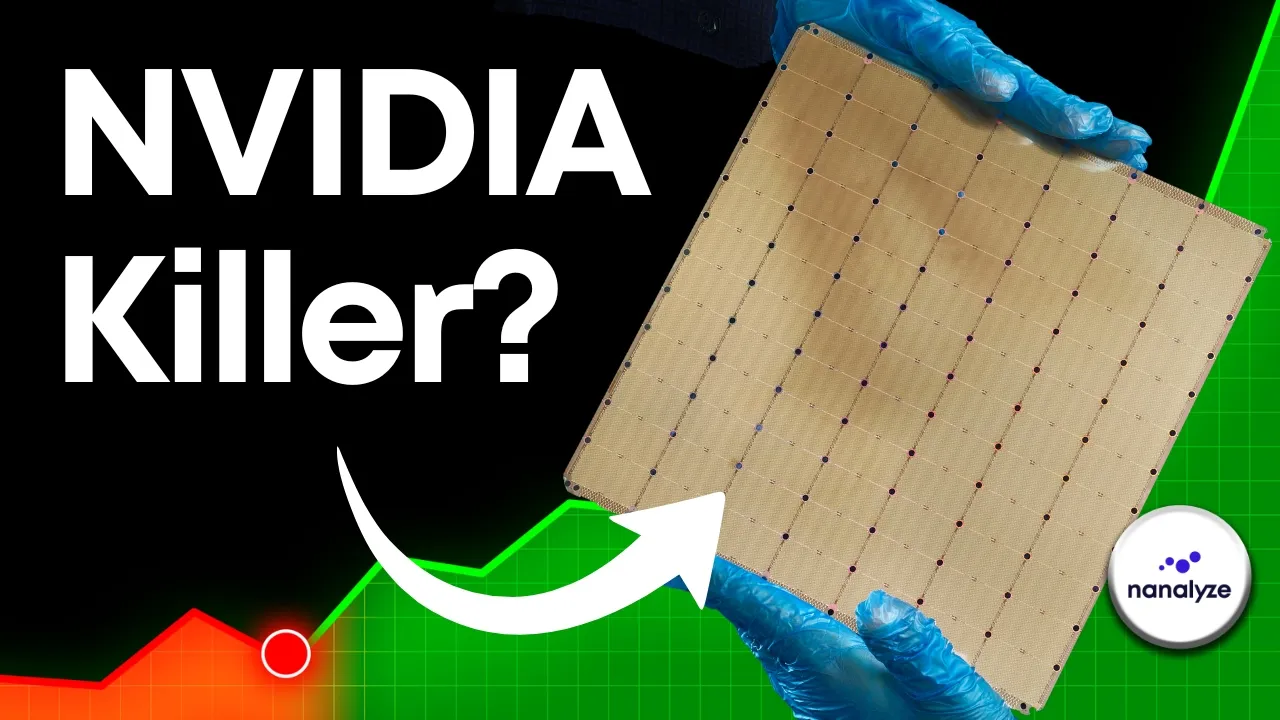
Cerebras just raised $5.5 billion and they plan to use that to take down Nvidia. "We're working with all AI gear makers except Nvidia," the CEO recently told Bloomberg in a blatant diss on the biggest success story the AI boom has brought us. Now they've partnered with AMD and a $20 billion contract with OpenAI. What's next? A partnership with Amazon? Well, they got that, too. Is Cerebras and their plate-sized chips a threat to Nvidia or is the CEO just blowing hot air? If you're an investor in Cerebras or Nvidia or AMD, then this video is a must-watch. Our story starts a decade ago when we first invested in Nvidia around a $40 billion market cap and decided to start assessing the competition. You like that little humble brag, huh? Huh? So, after identifying Nvidia as the closest thing there is at the moment to a pure-play artificial intelligence stock over a decade ago, oh yeah, babe, we then decided to assess the competition. Obviously, we looked at AMD and their machine learning efforts at the time and also Xilinx, which we invested in prior to them being acquired by AMD. We also looked at 12 startups building AI chips at the time. One of them was Cerebras. That was in 2017, a year after they were founded, and they were still rocking it in stealth mode. Over the next several years, we kept revisiting the company as new information was being made available. They were building chips the size of plates, the biggest chips that mankind had seen with over a trillion transistors. They were doing amazing things, supposedly, but still in stealth fashion. That was until October of 2024 when they filed for an IPO. Now, that IPO didn't happen at the time, but it was a blessing in disguise. We were able to analyze the company well before they actually went public, and now we can look and see if our concerns were resolved. Our biggest talking points at that time were as follows. They had one client, a firm called G42, which accounted for 83% of their revenues and 95% of their hardware revenues the year before. Hardware and services had accounted for 76% and 24% of revenues respectively for the first half of that year. What are services? Aren't they supposed to be selling hardware? Their combined margin was around 41%, so nowhere near the 75% gross margins that Nvidia was realizing and is realizing today. And they had an applied simple valuation ratio of around 27 at the time. Now, we're going to talk about valuation later. Then earlier this year, the Cerebras IPO actually happened and with their first SEC filing document post IPO, we can see that revenues are going through the roof. Almost $800 million in annualized revenues, but about 42% of that coming from services. Again, what are services? We'll get to that in a bit, but the biggest problem with services seems to be the dismal gross margin. So, hardware at 59%, that sounds good. Services at 32%, well, that's dragging the entire ship down to a blended gross margin of around 46%. Now, this number is marginally better if we back out pass-through costs and revenues. What do I mean by that? Well, late last year, Cerebras entered into a big contract with OpenAI, which represents a substantial portion of their projected revenues over the next several years, up to $20 billion. So, it's a big deal. OpenAI has promised to buy and pay for around 750 MW of compute from Cerebras between 2026 and 2028. Cerebras is going to build and run these special computers and deliver the compute to OpenAI mostly as a cloud service. And then OpenAI can choose, if they like, to take more compute later, up to 2 gigawatts in total. And Open AI also lent Cerebras about a billion dollars to help them build everything faster, and they have the right to buy some Cerebras shares rather cheaply. So, beginning in Q1 2026, earlier this year, they have data center costs with their contract with Open AI that they're passing through with a 3% markup, and you can see that here. So, they've provided this table in their recent quarterly filing, and they've simply backed out these pass-through revenues and pass-through costs. They're building data centers for Open AI basically at cost with a 3% markup, but after that, they're going to charge Open AI a whole lot more. It's fair to say at least that Cerebras is heavily dependent on Open AI for their success in the coming years. That creates what we call customer concentration risk, though Cerebras already has a major problem with that. Look at this, in 2024, 85% of the revenues came from a single customer, and that moved to 86% from two customers in 2025, both of these being related parties, so basically the same customer. And when you calculate this number going forward, it's very important that you remove those pass-through revenues, right? Otherwise, it's going to show this concentration decreasing when in fact it isn't. Now, when we look over the last quarter, we can see, all right, this customer concentration risk is slowly dropping from 88% to 74% As I said, we would consider these to be one customer. You might ask, well, what's an acceptable number? Well, these days the AI trade has become increasingly circular and concentrated. So, if we look to Nvidia, for example, last quarter, they had three direct customers account for 21%, 17%, and 16% of total revenue, so around 54% coming from three customers. Let's just say no single customer ought to account for more than 25% of revenues. So, some questions to ask here. Cerebras has built these tremendously powerful AI chips, right? Their primary mandate should be to build these as fast as they can and maximize the revenue they get from selling hardware. Their core competency is not building data centers. They leave that to the neo clouds. Let other people deal with that mess. Having someone else tell you to build them data centers at a 3% markup, that just seems off. Why not just sell the hardware and use the tremendous demand for your hardware to boost your margins just like Nvidia did. Well, Cerebras has also recently partnered with AMD, so they're going to deploy AMD hardware into the data centers they're building. And we also see they have a partnership with Amazon, so they can make their hardware available via the cloud. And the bull case would be that once their data center capacity catches up, gross margins are going to move towards the long-term target of 60% operating margins to 40%. Well, you can compare that to Nvidia, which has 75% gross margins and incredible 64% operating margins today. Just remember that these pass-through costs are low margin noise. That's not their core business. So, always make sure you back these out if you're invested in the company and monitoring them going forward. Now, higher utilization and pricing power from the scarcity of their extremely fast tokens supports this thesis. And here's a big one. They don't need to rely on high bandwidth memory. So, all that HBM shortage stuff, it doesn't affect Cerebras. Now, the bear case would be that OpenAI is now the overwhelming driver of their backlog and future success. If OpenAI slows deployment, renegotiates, shifts more workload to their own chips or Broadcom or Nvidia or others, or terminates for performance reasons, Cerebras loses a majority of the visibility into their future success overnight, and that $1 billion loan they took can accelerate and become immediately payable. If this speed advantage that they offer with their hardware narrows because of the competition, or it doesn't translate into broad economic superiority at scale, that's going to impact demand, right? And, you know, in the recent earnings call they talk about temporarily renting their own systems back from an existing customer. Well, that just shows poor execution and a BSD that has you by the cojones. >> With that colorful image that Joe just painted, let's stop and ask ourselves a very important question. We've always talked about so far the risks and rewards, would you pay a premium for Cerebras stock? Well, clearly some of you would because Cerebras shares came racing out of the gate up 60% on its first day of trading. Our own rule says that we won't invest in any new IPO until they filed at least one 10-Q or 10-K with the SEC. And in this case, that rule would have worked out really well. Shares of Cerebras stock are down 40% between their IPO and their first 10-Q filing. Now that that dust has settled, let's see what kind of valuation shares command today. We'll use our simple valuation ratio, which is market cap divided by annualized revenues. We have a current market cap of $51 billion and last quarter revenue of $180 million. That gives us a simple valuation ratio of 71, or about eight times the average of our disruptive tech stock catalog. Sure, sales alone don't tell the full story, but Nvidia is printing cash, growing like a weed, and you can invest at a simple valuation ratio of 16.7. So, you can pay a higher multiple for a less profitable, more risky company. Makes total sense, right? So, Cerebras shares have an SVR of 71. That's much too rich for us. But what valuation would you be willing to pay for shares? Our cutoff for any stock is a simple valuation ratio of 24, but you might have a higher cutoff. One of our esteemed premium subscribers named Haine actually suggested making a simple valuation ratio cutoff that scales based on how large the opportunity is. It's a good idea. So, how big is the opportunity for Cerebras, Joe? >> The addressable market for Cerebras AI inference is estimated to be around $251 billion in 2025 and grows at a 28% compound annual growth to 672 billion by 2029. So, it's growing more than twice as fast as AI training infrastructure through 2029. So, once you train your AI algorithms, then inference is when they actually operate and start to infer things about the world. That's where the push is going to the all the demand is happening now is for hardware that helps you optimize that step. So, a quarter of a trillion-dollar TAM moving up to over a half a billion-dollar TAM that's growing quite fast. Well, that could command a premium, one could argue. But what about competition? Is this a blue ocean? Well, today hyperscalers run large volumes of their inference tasks on their own custom silicon. And Nvidia leads in broad production scale inference hardware and overall market control. And Cerebras currently leads many of the pure speed latency-sensitive inference benchmarks and is the strongest specialized challenger gaining commercial momentum. So, really the leader the leader depends on the metrics you're using. Now, our own SVR limit is 24. That's three times our catalog average roughly, which means we wouldn't buy Cerebras above $84 a share. We wouldn't buy it at any price with those customer concentration risks, frankly. And if you ascribe a higher SVR because of the large TAM, here's what the price targets might look like at those levels. My price targets. You can see at three times the average so are not to exceed would be 84 at four times it's 112 at five times it's 140. You can calculate these yourselves. What you can then do is give it some time and then start using the historical average over the past four quarters as your benchmark and then buy below that. We use that to define our own targets in our new money report for example. So it all comes down to this really. Data center space and power not wafer supply from TSMC are the binding constraint here for Cerebras unfortunately. If you have the greatest AI hardware in the world and you're selling it primarily to one or two customers, why is that? If you had any leverage at all, you'd tell Open AI that if they want to use your powerful hardware, they can buy it and put it in their own data centers. Data centers shouldn't be your problem. If Nvidia can do this, why can't Cerebras? Now Cerebras isn't the only AI chip IPO that's happened recently. A physical AI company has recently filed for an IPO if it's not already trading by the time you watch this and it's not what you might think. So give that piece a watch next. Thanks so much for taking the time to watch this video today.
Comentários 0
Entre para participar da discussão.
EntrarAinda não há comentários. Seja o primeiro a compartilhar sua opinião!