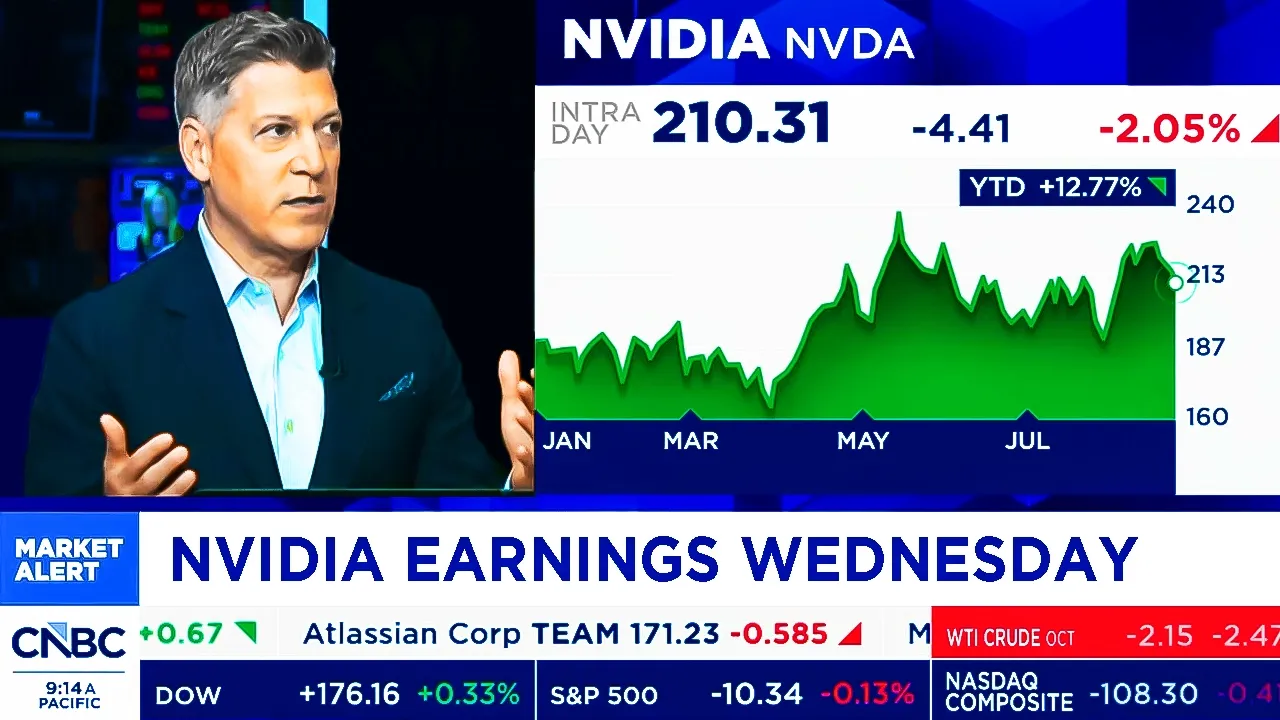
CNBC, Fox, Yahoo Today On NVIDIA Stock, Micron Stock, NVIDIA Earnings - NVDA Update

- Retorno do vídeo
- —
- Chamadas
- 6
- Compra / Venda
- 6 0
- Publicado
Recomendações
Entrada é o preço de fechamento do ativo na data de publicação. Atual é o último fechamento registrado.
-
Entrada $910,43 24 ago 2026Atual $910,43 24 ago 2026Resultado +$0,00
That's why I said go to Micro which fundamentally has an amazing product is doing the right thing with water, doing the right thing with the environment, doing the right thing with electricity.
-
Entrada $25,67 24 ago 2026Atual $25,67 24 ago 2026Resultado +$0,00
The party that says listen let's go by Craft Hind.
-
Entrada $67,28 24 ago 2026Atual $67,28 24 ago 2026Resultado +$0,00
the party that said by Bristol Myers take for 596.
-
Entrada $208,48 24 ago 2026Atual $208,48 24 ago 2026Resultado +$0,00
I don't care if it's Nvidia or Micron. These are buys right here.
-
Entrada $910,43 24 ago 2026Atual $910,43 24 ago 2026Resultado +$0,00
I don't care if it's Nvidia or Micron. These are buys right here.
-
Entrada $208,48 24 ago 2026Atual $208,48 24 ago 2026Resultado +$0,00
it's a great stock to have in your portfolio trading at a very reasonable multiple and growing its earnings and its revenues and its gross margins at a tremendous pace.
Transcrição Completa
Now, I was out at Micron and it was very clear the demand is incredible. They're going to make a fortune. But this weekend, the Samsung buyback was regarded as being not good enough. And that's cuz they didn't end up crunching shares on like SKH High. So, you have this Koreas and I saw Korea drop our tech this morning. It just killed us. Yeah. >> That's why I said go to Micro which fundamentally has an amazing product is doing the right thing with water, doing the right thing with the environment, doing the right thing with electricity. Uh but it doesn't matter. See, because Samsung's buyback was non-existent. It was chimera. Yeah. And that's what's in that's what controls Micron. That's why look, IT'S DOWN 34 POINTS BECAUSE NOT because of anything it did. 34 points because people decided the Samsung buyback. >> I know. >> Well, I mean, are they really joints to the hip? It it doesn't matter whether it's not whether they should be, it's that they are. >> Well, Jim, and we're going to talk about Nvidia in a moment. this is connected to it, but how seriously are you weighing uh and taking this growing opposition that is getting a great deal of coverage as well to data centers? And it is not just it it's on both sides of the political aisle. Now, you mentioned Greg Abbott, the the uh governor of Texas, >> which you know, of course, was a state that embraced >> um the construction of data centers wholeheartedly until very recently. Governor Shapiro >> and Governor Shapiro as well. Um, >> well, this is what I said I misjudged. >> I said I felt that well I felt I look at Louden Virginia and they looked like that they were the data center capital of the world and everything's fine. Then I see a couple articles about how loud is not right. It's very obvious that all these companies were in so were coming in some so fast. A lot of them buffaloed the communities. A lot of them buffaloed the states. There many that are want that are like in a queue to be approved. For all I know it's a scalper thing. You buy them and you flip them. >> We're We'll talk in video here because we said we're going to even though frankly 9:13 we got >> We got another day and a half to talk. It's not like it's tomorrow. >> I mean like you know I I hated the journal Monday in August. >> You know the party will the party continue. What >> almost what party? What party? The party that says listen let's go by Craft Hind. The party that says Abs went from 92 to 116. That's the party. That's the party. This stock's exactly where it was last quarter. >> So you're you're offended by that. >> Well, I the party that said by Bristol Myers take for 596. They're not buy there's no party going on. If that's a party, I want to go to another party. >> What are the chances that Nvidia is not going to not going to report an incredibly strong quarter? Now what the reaction is to that reaction is at this point is let me tell you what was wrong with that quarter. You know when you looked at the open models they really there David think I spent too much David. the whole thing was circular reasoning. Anyway, David, the you may hear that these things are only worth that that they last seven years. But I've got an an article from Sha, right? The latest the latest uh headlines over the weekend. They're going to spend six billion to build a powerful US alternative to Chinese AI. >> They put 8 billion as they continue to champion open source despite the fact that they sell many of their chips to the likes of anthropic and open AI or at least those who are building the data center. >> You want to do it right? We double our buyback from 80 to 160 billion and we complete it by November. So that that's how you that takes the stock. >> What what could the revenue number be at this company in 2028? Do we know? >> It's irrelevant. What does that mean? >> Because what matters is the buyback. >> The buyback. But they're spending all this money to support the entire ecosystem around them. Should they just spend all of it to buy back stock? >> Stock. You want to talk reality? >> They're going to generate hundreds of billions in free cash flow over the next few years, right? I mean, >> uh, that is what I mean, look, I I've made my piece. I've spoken to them. I've argued for a >> I have no idea. By the way, based on what you've just said in the last two minutes, I have no idea where your thesis is. >> No, my thesis is is that the only thing this market cares about is the size of the buyback and one stock crunch. Hence why SK Highness went a big after they did their buyback. The Samsung buyback that was announced was really was not a crunching. It was just buying shares and giving them to the employees. did not uh did not uh did did not trounce the ship in the share account. What I have told and asked and pleaded with Nvidia was to sit down and look at what Apple did during a period where where people didn't like Apple, they went and bought almost every share and they shrunk it by a third. And look at how Apple stock did even though everyone disliked Apple. And what I'm saying, listen, if you want the stock to go up, you have to do that. But you come back and say, look, if you want long-term dominance, don't buy back the stock, >> right? It might keep them from a lot of the different support that is out there that they provide for the buying of their own chips. The construction of for competitors for creating an open source market they would do exactly what you said we are all people care about survival. >> All right. >> It's not right. >> Okay. >> And that's what they told me like Jim you know we have a company to run. >> Of course all eyes on Nvidia this week. They report earnings on Wednesday. What does their report need to show to impress investors, do you think? >> Well, you're talking about a company actually number one that's got 13 consecutive cores of beating estimates, but the last four or five we've seen some sharp drops afterwards because they haven't met the whisper numbers. You know, I think investors need to focus on great results. I'm expecting 100% on topline, nearly 100% on bottom line EPS. That's the stuff you want to pay attention to, never mind the short-term noise. Is Wall Street counting on Nvidia, do you think, to keep the AI AI party going here? >> Well, I think so because there's a lot of money that's looking for a home. So, they're looking for it on two levels. Number one, they want a very short-term trade to shake out the weak money so that they can continue to buy for the long term, just like the investors who are smart enough to watch your program right now. >> When Nvidia reports its must-read earnings report on Wednesday evening, it will be confronting this frustrating reality. And I wrote about this this morning on yahoos.com. Strong earnings reports haven't been too kind to Nvidia's stock of late. Nvidia shares have fall in response to earnings in six of the past eight quarters, including the last four per Yahoo Finance Alphas analysis. Love, Alphaspace. The reality is that the market is positioned for the company to post something great and for CEO Jensen Wong to sound super bullish on the earnings call. Jim, Art, and Jen are here. Art, let me start with you here. Um, should the average investor out there just ignore the market reaction to these Nvidia earnings? And I bring this up because this company is still crushing on the top and bottom line. We're going to have this discussion 3, six, uh, I don't know, 12 months from now, and it's still going to be the same discussion. They're crushing it on the top and bottom lines. >> Yeah, it's such a great point. And the the reaction function may be a bit easier this go around because it's about 10% below its all-time high. It's trading at 20 times 21 times next 12 months, which will likely go down to 18 times after they raise their guidance. They'll likely do way more than the 92 billion that's expected in revenues. And clearly they'll continue to have 75% margin. So if you're going to play this stock as a long-term investor because of the you know its earnings reports probably a mistake. It's it's it's a great stock to have in your portfolio trading at a very reasonable multiple and growing its earnings and its revenues and its gross margins at a tremendous pace. So I think the reaction to you as a long-term investor is to ignore the noise around this and just understand it's one of the greatest companies and sits at the center of the artificial intelligence revolution. >> All right. And in its most simple simplest terms, why does Nvidia ch trade uh at these types of lower valuations compared to others in tech? It almost doesn't make any sense. >> It doesn't make any sense. I think there is some concern about what they're using their balance sheet for and how much vendor financing they're doing with some of the largest clients. And then there also is some concern that perhaps one of the large language model builders will eventually drop out of this race and instead of having five or six, we'll have three or four large language model builders. and there will be less demand for invid Nvidia products. So, I think it's that the concern that perhaps AMD comes out with something that's good enough in its next generation. So, there's always been that concern, but you know, I think in real time looking at a company of the magnitude of Nvidia trading at a S&P multiple is probably one of the the most ridiculous things you can think of. >> I'm with you, Art. I think it's absolutely looney. >> Right now to Nvidia, the big name on the earnings calendar this week, lower for a seventh day in a row. A new report says the company could be looking to hike prices for its largest customers. Christina Partnovas has that story for us. Christina. >> Right. So, Nvidia is supposedly telling its customers that prices on its flagship AI servers at specifically Blackwell and Ruben could climb almost 17% on systems shipping early uh next year. And this is according to the information that lifts the cost of a single gigawatt of computing by roughly $5 billion on top of a already massive capex bill for hyperscalers and neoclouds. The reason right now is memory. A big part of it I should say. The high bandwidth memory these chips need has roughly doubled in price. Deote just put out a report and estimates memory now runs about a quarter of what an AI server rack costs and expects that crunch to actually last into 2029 or even 2030 which is obviously good for the m the memory makers. The instinct though right away is that margins are cracking. That's why they have to raise prices. But this looks like a maybe a plain cost inflation and Nvidia's pricing to protect its margins, not give them up. Gross margins in the mid70s is likely still in reach. uh you can see the third point there 74.8. So there is a you know attraction of going slightly lower. So the real question though into Wednesday's earnings print isn't collapsed is whether Nvidia's pricing power fully covers the memory bill as Ruben scales. Meanwhile, Nvidia is behaving less like a chipmaker right now and more like a finance year to help all that spending get funded. It's taken stakes across the industry this year in OpenAI Anthropic SpaceX and lined up more than $500 billion in financing with six Wall Street firms to help customers buy its chips. It's also uh looking to license its way in most recently and this is the news for today uh the $6 billion poolside deal. So buying the software more specifically IP and engineers behind the software's startups openweight AI models and then overnight the information reported is now in talks to back Perplexity at more than 30 billion. Perplexity and Nvidia have a great relationship already. So this is just the latest sign that Nvidia isn't just selling we know this the Pix and Shovels anymore. They say they're not a GPU company. It's funding the miners too guys. >> Christine, any thoughts as to why given what you mentioned about margins and price hikes and scarcity that the chip complex is down so significantly today? >> The chip complex or more specifically Nvidia has been used as a short funding uh for quite some time. So when you're looking for other pockets within the AI ecosystem, money has come out of Nvidia. Why? Because people are just thinking this a lot of large longer large numbers. There's not as much upside with each earnings report. Nvidia has consistently beat their data center revenues by three billion bucks every single quarter. And that seems to be the expectation. So what is the major expectation that is going to put it past three billion and so that's what seems to be missing from a lot of conversations which is why people are like well maybe I won't go into Nvidia. use Nvidia as a source of funding for all of the other AI players like the SKHENX IPO like the upcoming IPOs with Anthropic and OpenAI uh like all of the momentum names from coherent lumen momentum lumenum uh and the memory name so I think that's probably more of the issue not that people dislike Nvidia and don't believe in its road map and its successes it's more so they need money and it's coming from there >> week there are other reports today Nvidia discussing a perplexity investment according to the information uh 30 billion plus valuation for perplexity which you know at the rewind like a year or so two years ago uh I felt like sort of perplexity was really deep in this conversation doesn't feel so much that way because open AI and anthropic have taken all the oxygen yes but that would be uh an interesting move they're also spending 6 billion to build a a US alternative to Chinese AI according to the Wall Street Journal but as you think about the shares that you own Again, remember this. Two weeks ago, the stock had made this incredible move back, right? Okay. >> And then here we are talking about six down days in a row. I don't know what that does for expectations in the print, but >> that's the pattern. So stay on that for a second. The last four quarters, 30 days prior to the earnings report, you see the spike in shares for Nvidia. You see a lot of call buying. the anticipation, the understanding as concurrent with that, the analyst community comes out and begins to put out those reports telling you overwhelmingly what a phenomenal quarter this is going to be for the company. So, I think you pull forward a lot of the positive return potential. That's been the pattern over the last year or so. It doesn't mean on the other side of earnings there's something very ominous. It's just as though the price excitement really comes in front of you. Um, I think that's what we're faced with here today. I also wonder when you mentioned what is it exactly that Jensen Wong has to address. I wonder if he has to take a turn into discussing this relationship that the states now have with data centers and understanding what those relationships ultimately might look like. That's a good point. He's right there at the center of it. So, I've been asking Weiss, I'll ask you this question because I've asked others, you know, whether it's this program or or closing bell and I did this past Friday too to Professor Seagull uh and Tom Lee as to whether this now spreading backlash towards data centers is at least in some degree this existential issue for this AI trade which may be having a negative impact on Nvidia and the way it's traded over the last 6 days, which may be impacting the way the momentum trade has gone lately and is only going to get louder as the midterms get closer. >> Yeah, I I think it is clearly when we saw the announcement come out last week had an immediate impact on the stocks and I think that is going to continue. I think longer term it's a good thing because there are a number of people I speak to and I'm one who believe this that you're overbuilding for data centers. If all the plans came to fruition, there'd be too much capacity. So it's actually going to be good for the data centers in terms of what they can charge in terms of compute etc. However, I think the biggest issue and everybody's mentioned it, but the biggest issue right now for Nvidia in my view is all their commitments. We don't know what those contracts say. Are there milestones to the funding that they're giving out? Are they truly bringing in demand? I mean, if I offer lowcost financing somebody to do something, they're going to take it rather or not whether or not they actually have demand for it. And then there's the double and triple ordering that always happens when you've got a cycle like this and that includes in memory. So I personally think for the near term regardless of what Nvidia says, we've seen the peak in AI euphoria and we'll see that valuations will come down as they are with CAD and others that still have these inflated multiples based upon euphoria over AI. So I'm not saying they won't at some point revisit the highs. We saw that early last week. They recovered nicely, but I do not believe you'll see a sustained move higher. Regardless of what Jensen Wong says, >> the semis haven't traded all that well. you know, more broadly as we've talked about, I thought last week's comment by the Micron CEO with Kramer who was doing that interview and this notion that semis or memory specifically is no longer a commodity, I thought was as important a comment as we've heard from anybody in this space. I mean, you could say, well, of course, what do you think he's going to say? he's talking his book maybe, >> but that's still a pretty profound statement because it it definitely impacts the way that investors he thinks should think about valuations. >> Yeah. >> Today versus historically. U typically a historically cyclical trade which some are trying to make the case is now a secular grower or at least the cycle has been tremendously elongated. That's where I am that this is an incredibly elongated cycle which may look a lot like a secular change and frankly if that's the case I don't care. Um I look at a stock like Micron which you're bringing up Scott at roughly six times forward earnings and I say if this is an elongated cycle or if this is a secular change that's way too cheap. Six times forward earnings is is implying that the cycle is going to change and go negative in the next 6 to 12 months which I just don't see happening. By the way, one could extend that valuation argument to Nvidia, which we were just talking about. I know it's a higher number at roughly 19 times forward earnings, but the growth rate of that earnings is roughly 35% PEG ratio of 0.5. Everybody knows I like the PEG ratio below one. The point being is that it almost doesn't matter. In fact, it doesn't matter whether this is an elongated cycle or a secular change. These stocks are cheap right now. What is concerning, Scott, and you started with this, is how rapidly this rotation is going on. It was just Wednesday afternoon that we had Micron up about 1,50 and now it's in the low 900s. I will tell you the value of Micron as a company hasn't gone down by 10% in the last 4 days. That's just not what happens. The market may be trading perhaps in anticipation of Nvidia's earnings, but if you're a long-term investor, I don't care if it's Nvidia or Micron. These are buys right here. You know, biggest report on earnings season obviously is on deck this week after the close. We're going to get Nvidia. Your thoughts on this one? >> Yeah, I mean, wow. I mean, there's just so much invested right now in what what Nvidia comes out and says on Wednesday is unbelievable, right? I mean, they're still at this the center of that whole universe at this point. Uh they're operating on all cylinders. They're doing absolutely everything correctly at this point. Uh unfortunately, you know, even the best of companies at some point you have to slow down. You can't always only have good news. We're anticipating good news here. Uh but so is everybody. So good news is not any not good enough anymore as you well know. Uh and any kind of misread or misstep on this Wednesday could be a big challenge for us. Look, it depends on what I always look at that as an opportunity, right? So, there will probably be opportunities, right? They're doing nothing wrong at this point. Their runway can keep going for quite some time at this point, even with the bounces, right? We'd prefer to only go up, but we know things don't only only always go up, >> always go up. Well, no, Kenny Pari on with me this morning and he said, look, you know, he said expectations are so enormous in Nvidia that a beat may not be enough. They've got to beat in a big way, which I thought was really interesting. But there's other names. You said this in your note. You said that we're getting three different layers of the new AI economy all at the same time on Wednesday afternoon with Nvidia, with Crowdstrike, with Salesforce. When you do think about Nvidia and where it is trading right now, we're looking at the company trading 25 times 2027 earnings. It's only up in line with the S&P 500. So, what do we need to hear on Wednesday night from what is or was the the godfather of AI, Jensen Wong? >> Yeah, I I don't envy Jensen's position right now because I think right now you're clearly seeing the market tell everyone that the capex is peaking this year and it's going to essentially go lower and lower as year as open model gains momentum and as time goes on. But all Nvidia and Jensen can do is show up every single quarter and prove that they're physically shipping more and more of their product and that's going to result in a lot more revenue. I think right now we're anticipating $95 billion this quarter. They're probably going to guide somewhere around $ 110 billion for the following quarter. If they can do that while maintaining margins at 75%. That tells me that they can put up this kind of growth while keeping margin at this level that their customers are still willing to pay the premium that Nvidia has to offer which shows that there is no easing supply constraints at all. But I will say though the next thing I'm watching specifically for Nvidia is demand needs to widen out a bit. I think you're seeing Nvidia start communicating to everyone the differences between their hyperscaler demand and their um ACIE is what they call it the companies outside the hyperscalers because that is where the next leg of this rerating on the stock is going to come from because everyone's just kind of poking holes in the Nvidia story that the hyperscalers are going to slow down their capbacks. They're creating their own custom silicon chips. AMD is becoming a competitor. But if this separate group, the ACIE can actually maintain triple digit growth and continue showing a lot of momentum over time, that has a lot of momentum to where Jensen can kind of pass a baton off to this brand new group of demand pool, then the market finally can maybe stop arguing uh against why they deserve an undermarket multiple. And also don't don't uh call out SpaceX as well. Like that's a large part of where the demand's going to go in next year or two. I mean, right now SpaceX is around 4% of the revenue for uh Nvidia. I wouldn't be surprised seeing that over 10% next year, especially when you heard Elon talk about that planned compute buildout that he's anticipating by 2027. >> All right, I hope you're all doing well today and staying calm in this market. Monday was a red day for much of tech hardware. We got more back and forth over tariffs and the situation in the Middle East continues. That's how we did see oil move lower on Monday. We have multiple pieces of Nvidia and memory news. But before I cover those, let me briefly clarify the Samsung buyback situation because there appears to be some confusion. Last week, Samsung said shareholder returns for 2026 could reach up to roughly $79.5 billion. That includes a third quarter dividend of roughly $21.7 billion. The remaining 43 to 58 billion worth of 2026 shareholder returns are to be determined in late January and will consist of some combination of dividends and share repurchases/ cancellations. Now, what caused some confusion is that Samsung separately announced a roughly $10.8 $8 billion share repurchase that started on Monday. And that share repurchase is meant for employee stockbased compensation that is separate from Samsung's roughly 79.5 billion 2026 shareholder returns. After we learned of the $10.8 billion buyback meant for employee stockbased compensation, it appears that some people incorrectly assume that all the shares that Samsung repurchases will go toward employee stockbased compensation. But that's not necessarily the case. Again, the $10.8 8 billion buyback that started on Monday is separate from the roughly $79.5 billion in shareholder returns for 2026. Anyway, that whole situation plus the lack of specific details surrounding Samsung's buyback plans and the resulting confusion seems to have weighed on Samsung and SKH Heinix overnight in South Korea, which also put some pressure on tech hardware stocks in the US like Micron. It also appears that many investors wanted Samsung to return even more cash to shareholders. It's worth mentioning that SKH Highix was much more direct about its buyback plans last week when they announced they would buy back and cancel roughly 3.3% of total shares issued over the course of three months. That was much more specific than Samsung's announcement. It's worth bearing in mind that starting this December, restrictions on Micron's ability to conduct typical share repurchases related to the chips act will ease. After that, Micron will be able to return a considerable amount of cash to shareholders. Now, let's cover today's Nvidia news and then I'll cover some important memory news after that. On Monday, Nvidia announced that Nvidia Gro 3 LPX is in full production. Gro 3 LPX delivers a major boost in AI inference by enabling ultra fast token generation for highly responsive agentic systems. This is important for providing premium user experiences for context heavy workloads so agents can act at extreme speeds. Brock 3 LPX delivered a record 3,400 output tokens per second in artificial analysis benchmarking running Gemma 431B an open source agentic model with a 100,000 token context critical for agentic systems the fastest performance ever recorded for the model. Gro 3 LPX enables agentic tasks such as coding in minutes versus hours providing 4x faster responsiveness for agents and latency sensitive workloads than the nearest alternative platform. This is very important as it should lead to greater levels of usage particularly in high-v value latency sensitive workloads such as agent decoding. This is very important because we're talking about companies such as SpaceX, OpenAI, Anthropic, and others being able to serve more of a premium offering and charge notably more than they do for other users. Nvidia Gro 3 LPX is more important than many people realize. Also, as a reminder, back at GTC, Jensen shared that Nvidia sees $1 trillion in cumulative revenue from Blackwell and Reuben in 2025 through 2027. Later at a financial analyst Q&A, Jensen said that if all Nvidia's customers adopted Grock 3 LPX, that could add another 25% on top of the $1 trillion forecast. So, it's important to Nvidia in that context, but again, it's also very important to the profitability of the Frontier model companies because this will enable them to serve a more premium offering and charge substantially more per user when it comes to highv value latency sensitive workloads. So, it's very important for Nvidia and it's also very important for Nvidia's customers. Inference is where monetization occurs and we're talking about low latency inference for high-v value workloads. Also on Monday, Nvidia announced that SpaceX AI will deploy Nvidia Vera CPUs to accelerate its next generation of agenici applications. SpaceX plans to expand its AI infrastructure behind Grock on Nvidia's Vera Rubin platform while extending an optimized Vera Rubin NVL72 into space with its first generation Starmine satellite. As Elon recently said on the SpaceX earnings call, they will be building exclusively on Nvidia's platform moving forward. And now their first generation Starmind AI satellite will be based on an optimized Nvidia Vera Rubin NVL72 system with all of the public push back against data center construction in the US. Orbital compute is looking much more promising as a long-term solution. Also on Monday, Nvidia shared that new measure performance data shows NVIDIA Vera Rubin NVL72 systems deliver up to 30x higher throughput per megawatt and 35x lower token cost than Nvidia GB 300 NVL72 on agentic workloads. The 30x result used semi- analysis agentex workload and Nvidia says the measurements are still pending semi- analysis review. As I've said many times before, Nvidia benefits from lower token cost as that drives greater usage throughout the ecosystem. Whether you're generating an open- source token or a closed source frontier token, you need infrastructure to generate the token. Nvidia sells that infrastructure and there's a fundamental reason why Nvidia is driving token cost lower. It increases usage which results in greater compute demand and it also directly impacts the bottom lines of Nvidia's customers. We should see both Hyperscaler and Frontier model companies margins gradually improve with each new generation architecture from Nvidia. As I've said many times, I expect the Frontier Labs margins will gradually improve over time, and I think a lot of the fears surrounding their spending commitments are overblown and miss the larger long-term picture. Lower token costs are not a reason to be bearish on Nvidia. Lower token costs will speed up the unlock of new valuable use cases that will drive even greater demand for tokens and compute. I want to clarify something I said in a recent video on this topic. Previously, I said that the number of use cases for AI is substantially greater than the number of use cases for railroads or oil. I said, quote, "You can only use oil for so many things." Now, I should have been more specific when I said that if we're just talking about oil by itself without comparing it to AI, then sure, there are many use cases. However, when we compare the number of use cases for oil to the number of use cases for AI, it's not even close. With AI, there are already thousands of meaningful use cases with potentially millions of task level applications. So when we're comparing the number of use cases for oil with the number of use cases for AI, it's not even close. I want you to understand that there are far more use cases for AI. And so while during the shale revolution, there were some investors who said that lower oil prices would lead to greater demand, the truth is that there are only so many use cases for oil. And so the expected increase in demand as a result of lower commodity pricing was very limited. On the other hand, there are far far more use cases for AI. Put simply, tokens equal intelligence. There is a much larger TAM for intelligence than there is for oil. Lower token costs will lead to the unlock of new valuable use cases. Unlocking new valuable use cases results in greater demand for tokens and compute. What we saw earlier this year with agent decoding is a great example of that. And so in this particular technology shift, lower token costs actually do catalyze greater usage and demand throughout the ecosystem. And while oil is relatively limited in the number of new use cases that could be unlocked by producing more oil, AI is not the same in that regard because there are so many more use cases for AI. And those new use cases will be unlocked as token costs come down. So to put it simply, there are far more use cases for AI. New use cases will be unlocked much faster than in previous economic booms. And those new use cases will drive even greater demand. Comparing this AI revolution to the shale revolution or the railroad boom is like comparing apples to oranges. There are some similarities, but there are also fundamental differences with major implications. Also, over the weekend, The Information published a story claiming that Nvidia is in talks to invest in Perplexity as part of an equity funding round that would value Perplexity at more than $30 billion. The report claims that Perplexity's annualized revenue has risen from less than $250 million at the start of the year to now more than $750 million. So, roughly a 3x in annualized revenue year to date if the report is correct. Also over the weekend, Bloomberg reported that some of Nvidia's largest customers have been told by server makers that prices for servers containing Nvidia chips will rise by more than 15% in many cases, beginning with systems shipped in early 2027. The amount of the price increases will depend on GPU generation and memory configuration. This pertains to Grace Blackwell and Vera Rubin systems. Server manufacturers site higher memory costs as being the main driver behind the price increase. That bodess well from memory makers. According to Bloomberg, Nvidia declined to comment. As I've mentioned before, I think Nvidia has much more pricing power than what the market gives them credit for. If Nvidia needed to raise prices in order to maintain their margins, I'm confident they will be able to do so given the strong demand for their products. All right, now let's cover some more memory news. Over the weekend, a post from a leaker that goes by the name Mobile Chip Expert got a lot of attention. The post implies that Apple may be allowed to purchase Chinese memory from CXMT and YMTC after Presidents Trump and she meet in September. The post implies that Apple being allowed to purchase Chinese memory will be presented by Trump to Shei as a gift after the two leaders meet. This is likely the main reason why memory stocks traded lower on Monday. As a reminder, Apple has reportedly been lobbying the administration to allow Apple to purchase Chinese memory. And executives from Micron have reportedly been lobbying the White House to prevent Apple from purchasing Chinese memory, arguing that it would threaten domestic memory manufacturing in the US. It's important to consider that CXMT cannot fully meet the demand in China, much less the rest of the globe, as demand far exceeds supply. Not that long ago, it was reported that CXMT is charging some customers higher prices than Samsung and SKHix. They would not be charging higher prices if there was a surplus of supply. Also, Friday night, it was reported that Amazon has raised prices for multiple consumer devices due to significant increases in memory costs. According to Fortune, an Amazon spokeswoman said that the consumer electronics industry is quote facing significant increases in memory and storage component costs. After absorbing these increases for as long as we could, we recently adjusted pricing across our product lines. Looking ahead, we have Nvidia earnings on Wednesday, August 26th. Last I checked, consensus expectations for the quarter were revenue of $92.06 billion, EPS of $29, and gross margins of 75%. As for next quarter revenue guidance, it appears that the consensus is $14 billion, but I've noticed that multiple analysts are expecting Q3 revenue guidance closer to the range of 107 to $ 108 billion. Q3 gross margin guidance is expected to be in the mid70% range. Keep in mind that those are the expectations the last time I checked, so things could have changed since then. Now, I'll be completely honest with you. I expect results and guidance to be strong, but I don't know for certain how the stock will react. It's very common for Nvidia to trade higher ahead of earnings in anticipation and then to trade lower after earnings. So, that's definitely a possibility and we've seen it happen many times before. That said, the stock is arguably cheap versus the company's future growth. Regardless of how market participants react in the short term, I expect this earnings report and earnings call to reaffirm that the long-term thesis is intact. I'll be very interested to hear what leadership have to say on the earnings call regarding rumors about reduced memory content per GPU, Frontier Model Company's profitability, China sales, and the rollout of Vera Rubin among other topics. I'll try to provide a recap of the highlights from Nvidia's earnings and earnings call on this channel on the night of Wednesday, August 26th. So, be on the lookout for that. That video will probably be posted either late Wednesday night or early Thursday morning, depending on how long it takes to make the video. I'm expecting that video will probably take 8 hours or more to make. So, please bear with me on that. Now, in case you're new to the channel, I want to make sure that you have at least a basic understanding of the underlying long-term thesis. So, let's cover that. Now, I don't know what's going to happen in the short term, but from a long-term perspective, I am very confident that Nvidia will be worth much more in future years than it is today. When Jensen was on the Lex Freedman podcast not that long ago, he was very seriously raising the possibility of Nvidia becoming a $3 trillion revenue company in the near future. If that happens in the coming years, then it is very plausible that Nvidia could one day be worth tens of trillions of dollars in market cap. That might sound crazy, but that's what Jensen is implying when he raises the possibility of Nvidia becoming a $3 trillion revenue company. I guess the question at that point is what multiple the street will be willing to give Nvidia. I don't know the answer to that question, but I truly do think that Nvidia will be worth much more in future years than it is today based purely on the fundamental growth of the business. Based on everything I'm seeing, the world is still computed and I expect that to continue at least through the first half of calendar 2028. In a computed environment, developers will use whatever viable compute they can get their hands on. Today, there are no GPUs that are sitting dark due to a lack of demand. like there was fiber sitting dark due to a lack of demand at the height of the dotcom bubble. Back then, companies were laying fiber in the hopes that use cases and demand would eventually show up. Today, we are seeing the complete opposite. As I've said many times, when market participants compare this AI revolution to the dot bubble, they ignore the fact that the internet is already here this time. This means that mass adoption of the technology and new use case development at scale are immediately possible. We don't have to wait years for it to show up. It's already here. The world is compute constrained, which means there is not enough supply to satisfy demand. New capacity is utilized as soon as it comes online. The hyperscalers are monetizing capacity as soon as it comes online. Each of the hyperscalers spoke about being supply constrained on their most recent earnings calls. Additionally, many of the clouds are building out into contracted demand. They're not blindly building in the hopes that demand will eventually show up. No, they're building out because they have signed contracts and in some cases significant prepayments from their paying customers. This AI revolution is fundamentally different from the do-com bubble and 2026 will be a pivotal year for the AI industry thanks to the rapid adoption of agentic AI and the proliferation of agentic systems in the world's leading enterprises. The leading AI labs revenues are surging right now. Agentic coding and the implementation of agentic systems in large enterprises are new use cases that are increasing inference demand significantly that subsequently is increasing compute demand. The rapid adoption of agentic AI is why we're seeing an inflection in inference demand. It's why we're seeing the leading AI labs revenues surge. I wish both Anthropic and Open AI were public so the public could see the ramp in their revenues. I think the leading labs surging revenues may be the initial proof point that grabs market participants attention and causes them to realize that there will be a clear ROI on AI infrastructure. I think the leading labs surging revenues will also help assure investors of the longevity of Nvidia's growth since these labs revenues are directly tied to compute. If they had more compute, they would have greater revenues. It really is that simple. Demand is not the problem. The problem is a lack of supply to meet the demand. As I've said previously, I expect the world to be compute constrained at least through the first half of 2028, possibly longer. And so regardless of what happens in the short term, it's important for long-term investors to remain focused on the fundamentals, maintain a long-term perspective, and remember that we are only in the early stages of aic systems being adopted at scale. This will increase compute demand significantly, and after that, the next surge in compute demand will likely be fueled by physical AI. We're no longer talking about digital agents performing digital tasks. With physical AI, we're talking about physical AI agents performing physical tasks in the real world. NVIDIA CFO has called physical AI, quote, a multi- trillion dollar opportunity and the next leg of growth for NVIDIA. This industry will fundamentally transform society and Nvidia has positioned themselves to benefit massively. NVIDIA sells the hardware for the data centers where the models are trained. They offer omniverse where the models are taught and tested. And Nvidia also sells the hardware that allows ondevice real-time inference through NVIDIA AGX, allowing robots to have intelligent interactions with the real world, even when they are not connected to a data center. Notice that Nvidia is taking a holistic platform approach to physical AI, and they're embedding themselves as the underlying foundation supporting all of it. Over 2 million developers are already building on the NVIDIA robotic stack, and this is not getting enough attention. As for production ramps, Blackwell Ultra has ramped quickly and remains in high demand. Reuben is on track to launch in 2026. Then we're expecting Nvidia Gro 3 LPX in the second half of 2026. Later on, we're expecting the launch of Reuben Ultra in 2027 and Fineman after that in 2028. We have a clear data center product roadmap stretching into 2028. And Jensen believes that AI infrastructure spinning will reach 3 to4 trillion annually by the end of the decade. That means Jensen is expecting growing AI demand and an expanding total addressable market underpinning all of this. I don't think we are anywhere near any type of bubble bursting type of event. With all of this in mind, I seriously think that Nvidia still has plenty of runway ahead of it, and I think this company will be worth substantially more in future years than it is today. At least that's my view of the situation. Quick note before I wrap up, all of the compilations on this channel are edited by Finn Vid with original structure and commentary. Occasionally, the same edits appear elsewhere on YouTube. If you're looking for the original version, it's always here on this channel. Thanks for watching, Finn Vid. I appreciate your support. Remember to stay calm in this market. Remember to maintain a long-term perspective and do not make any hasty or irrational decisions. With all of that being said, I hope you all have a great rest of the day and I'm curious to hear your thoughts about Nvidia in the comments below. Please leave a like on this video so more people will see it. And while you're down there, please consider subscribing. It's free and you can always change your mind. Thanks for watching and hopefully I'll see you in the next
Comentários 0
Entre para participar da discussão.
EntrarAinda não há comentários. Seja o primeiro a compartilhar sua opinião!