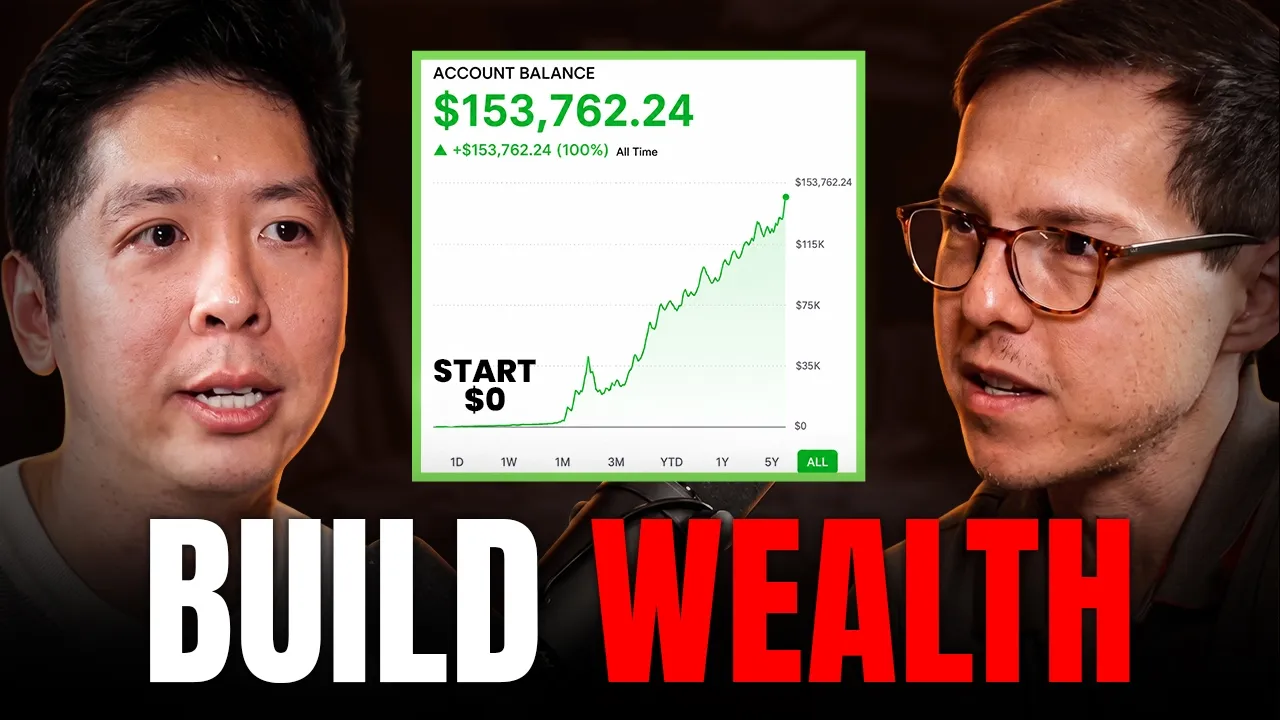
How To Start Investing From $0 In 2027

- Retorno do vídeo
- —
- Chamadas
- 3
- Compra / Venda
- 3 0
- Publicado
Recomendações
Entrada é o preço de fechamento do ativo na data de publicação. Atual é o último fechamento registrado.
-
Entrada $710,72 25 ago 2026Atual $710,72 25 ago 2026Resultado +$0,00
buy QQQ
Contexto "but buy spy, buy QQQ, maybe buy $1 of Google, right?"
-
Entrada $346,96 25 ago 2026Atual $346,96 25 ago 2026Resultado +$0,00
maybe buy $1 of Google
Contexto "but buy spy, buy QQQ, maybe buy $1 of Google, right?"
-
Entrada $346,96 25 ago 2026Atual $346,96 25 ago 2026Resultado +$0,00
Buy Google
Contexto "Buy Google."
Transcrição Completa
load up your Robinhood account. Buy something, right? It doesn't have to be an individual stock. I think most people don't have never even bought a stock in their life. They have their 401k automatically buy one or something. Uh but buy spy, buy QQQ, maybe buy $1 of Google, right? Once you have money invested in something, you just care so much more about it and start tracking it, right? Start seeing what people are thinking about it. Start watching YouTube videos about it. Start educating yourself about what it means to be either an investor or trader and then gradually uh basically, you know, kind of do kind of do paper trades in your head, right? Like, "Oh, yeah, that guy was talking about, you know, uh Nvidia uh might have good earnings. I'm not going to do it, but like let imagine I did today, right?" And then oh, it was right. And it basically kind of retroactively analyze, "Oh, why was it right?" You know, "Maybe I'll do the next one." or something like that. >> I agree. For a lot of my friends that do have a little bit of margin in their life, meaning like money between what they earn and what they need to spend on their necessity expenses. So, like this kind of like entertainment budget, whatever the budget is that they can the discretionary spending. I always say of that money, invest first, spend later. Yeah. Like, you should As soon as I get paid, like even when I was getting paid like 4,000 bucks a month, like immediately, I was shipping off 1,500 into my Robinhood account and then the additional 2,500 was just like rent, taxes, and then like I had a a little bit of money for food. And that was really it. Like, invest first and then everything else comes later. >> Yeah, that's also great advice. >> Do you think people spend too much time though trying to find the next 10x stock and not enough time just trying to increase their income? >> It really depends on your your your growth potential at your job, right? Like, a lot of people, I mean, you could work really really hard and get a 3% increase that year and maybe that time was better spent elsewhere. I mean, that's kind of where I I bring it back to this weird like angst that I noticed. Uh it's called financial nihilism. You know, a lot of people have written about it. Uh that just feels like your effort yeah, does not translate into results anymore. Um but there's this app on your phone now that does translate your effort into results good or bad, right? I think that that agency, that feel of control, is like more and more important for people these days. I I I think generally, I think if you're just like aware of like what you're doing, and also aware of like what the payback time period is, right? So, like you mentioned your early example, if you're making $60,000 a year and you have a $1,000 discretionary income, you know, you make that back in like a week, right? And so, like if you, you know, did something and it cost you a week of time, then don't do anything for a week. Like recuperate and then figure out as long as you're learning something. >> If you were to start from zero and build back to 10 million ideally, what stocks would you explore and how exactly would you do it? Like what are like maybe three main picks you'd look into? >> My my pick right now is uh Shaz, right? Share and AI the Neo Cloud based in Australia, uh because I think this data center build out is only going to continue. Um another one that's actually really interesting is Nokia. >> [gasps] >> Really? >> Yeah, yeah. Because they recently got a billion-dollar investment from Nvidia itself. And they also make these um uh local edge node chips. So, basically um as computer increases, the they get slower, too, right? And so, you want them to go really, really fast. And so, instead of like everything like happening in the cloud and coming back, it could happen at your local like telco like tower or something like that. And so, that's kind of uh another really interesting one. >> Now, for somebody who does not want to trade stocks or swing trade, but they want to build their wealth over the next 10 years, what do you recommend? >> Buy Google. >> [laughter] >> I mean, if I were to distill it down to the simplest piece of advice, right? Like buy Google. Why Google? They're at the enter center of everything, right? They're they they have the consumers, right? Via Google, YouTube, Google Maps, Android, everything like that. They're building the, you know, one of the best models out there. They have Google Deep Brain and all these really, really intelligent people. They're they're the only one at that intersection, actually. If you think about it. Like there are a bunch of, you know, AI infrastructure specific only plays and there are a bunch of companies that have, you know, a lot of consumers, but there's no other company in the world that has both. And I think that's just is incredible mode and it'll just keep continuing growing. >> What's a realistic annualized return that you think someone could expect over the next 5 10 years? >> I mean, I think the spy is going to make like 10 to 20% uh >> You think it's going to continue with that trajectory? >> Yeah. Like I think um the profits, the revenue numbers are all there and the companies are going to continue getting bigger. Uh like I said, this is our version of the industrial revolution. Uh and so I think if you're trying to trade, you're actually trying to beat that. >> Didn't that somewhat end though with the 1920s Great Depression? >> There was a lot of margin, there were a lot of other factors like the Dust Bowl and stuff like that, right? We're seeing a mini version of that right now in Korea. I don't know if you know >> I'm watching I get that Twitter notification and it's like the stock market circuit breaker just you know, it down 10% but then I'm looking at the US markets and we're up. >> Yeah. Yeah, I think you know, we have developed a lot of rules and regulations and got and and and guardrails since the 1920s, right? I think the market also moves a lot faster and any bubbles you know, kind of kind of mini pop and any corrections get a mini bounce a lot faster. And so I don't think we're going to get like some kind of crazy depression. I think we'll have a lot of volatility but I still expect that you know, like good good 10 plus percent per year over next 5 years. >> I am always worried that we've gone up so much over these last 15 16 years since 2010. I'm like how much longer can this continue before we start averaging like 2 to 6% a year for a while >> And then kind of like a forgotten period right? >> Right. And then people kind of grow bored of it and then they reallocate their assets somewhere else because the stock market's not doing anything. >> I mean, what else do you invest in, right? Like America's >> T-bills. >> Graham Graham has what? 25% cash? >> Yeah, it's 20 to 25% somewhere around there. >> Yeah, I have four. >> Also cash, it's tax free muni bonds. >> Tax free muni bonds. >> Making blended 4% tax free. >> It's great, it's great. >> No state income tax. >> transfer it to uh X money, 6%. >> You know what's so funny? So, I could take out a pledged asset line below that 6%. I I I did all the math on this and net taxes, it's not worth it for me to transfer over. Like it's such a small increase that I would be able to get and I would have to take millions of dollars to even make it worthwhile. And I'm like, am I really going to risk millions of dollars for like a point something percent annualized return? It's not worth it. But I thought of it. And I I worked every which way if I could take margin, if I could take a pledged asset line and move it over here. Wasn't worth it. But it is very appealing. >> The line only goes up, right? Like America's still the number one country, the US dollar is still the most important currency. You have foreign okay still reinvesting into spy reit. You have Trump accounts now that are also going to be invested into the into the markets, right? The best companies are in America and like I said, they're going to only going to keep growing. I I I don't see a bear case. >> Man, I feel like this is what everyone says though, right before. It's like we we cut to like a month later and like something happened, right? >> the 2022 blip is is a blip now, right? I mean, yes, like two I mean, this is you know, we're we're too young to remember like what was 2001 to 2008 like, right? Because that in theory was kind of like a flat for for for the US stock market. Albeit, that's from that's from top to top. 2001 to 2008, right? Like many people have talked about how euphoric and senseless the dot com bubble actually was with you know, literally fake revenue and stuff like that. We're not seeing that now. And again, I think everything just gets corrected now because you have social media, because you have like this forum of people arguing every single bear case that exists out there. All the ideas kind of get out. All the like people talk about like, you know, the circular financial engineering or whatever. Like companies are like people are talking about openly, right? Like, you know, no one's finding anything. It's not scaring billions of dollars to keep getting pushed in. So, I think, yeah. >> What about any black swan event? Now, really quick, every business is asking themselves the same question. How do we make AI work for us? The possibilities are limitless, but guessing is too risky and sitting on the sidelines is not an option because one thing is certain, if you're not doing it, your competitors are already making their move. And that's where our sponsor NetSuite by Oracle comes in. It's the number one AI cloud ERP trusted by over 43,000 businesses to manage everything from financials and inventory to commerce, HR, and CRM all in one unified system. When all of your data is in one place, your AI becomes a lot smarter. It doesn't just guess, it knows. NetSuite intelligently automates routine tasks, delivers real-time insights, and helps you make fast, confident decisions that actually help drive growth. And it's not just an add-on, it's AI that's literally built right into the system that runs your business, helping you cut costs, improve accuracy, and stay ahead of the competition. Whether your company's making millions or even hundreds of millions, NetSuite gives you visibility and control to keep moving forward. Honestly, if I were building a business of this size, NetSuite's the only company that I have 100% confidence in. So, if your revenues are at least in the seven figures, get our completely free business guide demystifying AI at netsuite.com/clips. Again, the guide is free for you at netsuite.com/clips. netsuite.com/clips with the link down below in the description. >> What about any black swan event? >> Mhm. For like a like a COVID-25 or something. >> [laughter] >> Yeah, I tend to think it's something nuclear. >> Mhm. >> I tend to think all it takes is >> Why are you laughing, Jack? >> because like, dude, if if like if we have, you know, nuclear fallout, I am not caring about my my [laughter] Schwab account. It's like I'm I'm not going to care that like, you know, I really shouldn't have taken on an additional $100,000 in margin to buy like Google stock. That's why you should be buying. That's why Jack doesn't buy the bottoms. He only buys the tops. I excuse me, I invested in Bloom. It plummeted and then I also bought the bottom. So, I do sometimes buy the bottom after I've already lost a lot. >> [laughter] >> Let's just say all of a sudden, you know, some country, I'm not going to say which one, drops 10 nukes on America. >> Right, right, right. But there would be some fear or there would be something on the other side. And that's I mean it's impossible to predict. So it's like it's hard to like live or kind of invest like that, right? Uh and I don't know if you're going to get that push notification early enough to sell [laughter] before it happens. >> Get the Amber Alert. >> Yeah, yeah, yeah. >> Immediately sell everything. >> Yeah, yeah. I mean I mean that sense like uh you know, build up as much money as you can and then and then switch to gold. >> [laughter] >> Is there a specific type or style of investing that you have officially banned yourself from ever doing again and you would recommend people ban themselves from doing that same thing? >> Yeah, I mean I don't touch options. I don't I don't touch options at all. It's just it's too enticing. >> What do you think about Jack's option strategy? >> Wait, so you buy or sell? >> Uh I sell options. >> You sell options. >> So I I sell puts to enter positions and I'll find something with a high implied volatility on a blue chip company that I really like such as Robinhood, such as, you know, I have a little bit of Elf, I have a little bit of Bloom and I sell puts to enter the positions and then I sell calls to, you know, ideally make some weekly premium. And if I'm buying options, I buy them over leaps where it's essentially just leveraged money. >> Does it Does it increase your stress at all? Like are you watching it close to the strike price? >> No, if anything it decreases my stress because it's a hedge against the position. So like my stress my stress would be amplified if I was just owning the stock outright cuz that's technically a more aggressive strategy than hedging against it which would be like a covered call. >> Yeah, yeah. >> So like the way I see it is if I can make two If I have two collect 2% premium per week on a company, 3% premium per week on a company selling covered calls, then I know if the company goes down 3%, I'm exactly where I was. If it goes up, however much it is, I collect 3%. If it stays the same, I collect 3%. If it goes down 10%, the IV spikes, and if the IV spikes, so do premiums. And then I'll just sell another another covered call to continually decrease my tax bases. And the same logic that you said, how you the only thing you really consider is the average cost or like your enterprise, that's essentially what I'm doing, too, by selling calls to decrease, you know, it's one way of looking at it, my average cost. >> Yeah, I don't know. I I'm a very simple person, right? And that's just that's a lot of math. >> [gasps] >> And to me, the if you're willing to it makes sense to you, right? And like the math is easy and it doesn't add stress or take too much time to kind of analyze and figure out what the right options to sell are, I think, you know, I think it is good. I mean, many people have recommended it to me. I I just like to try to keep things simple.
Comentários 0
Entre para participar da discussão.
EntrarAinda não há comentários. Seja o primeiro a compartilhar sua opinião!