
- Retorno do vídeo
- +1,33%
- Chamadas
- 1
- Compra / Venda
- 1 0
- Publicado
Recomendações
Entrada é o preço de fechamento do ativo na data de publicação. Atual é o último fechamento registrado.
-
Entrada $96,02 10 mai 2026Atual $98,42 25 ago 2026Resultado +$2,40
Now, I'd say that this could be a good option for investors who prefer the MSCI framework or who are already using other maybe iShares ETFs and want to keep everything under one provider.
Contexto ...It also pays a dividend yield of around 3%, keeping it in line with broader international ETFs. Now, I'd say that this could be a good option for investors who prefer the MSCI framework or who are already using other maybe iShares ETFs and want to keep everything under one provider.
Transcrição Completa
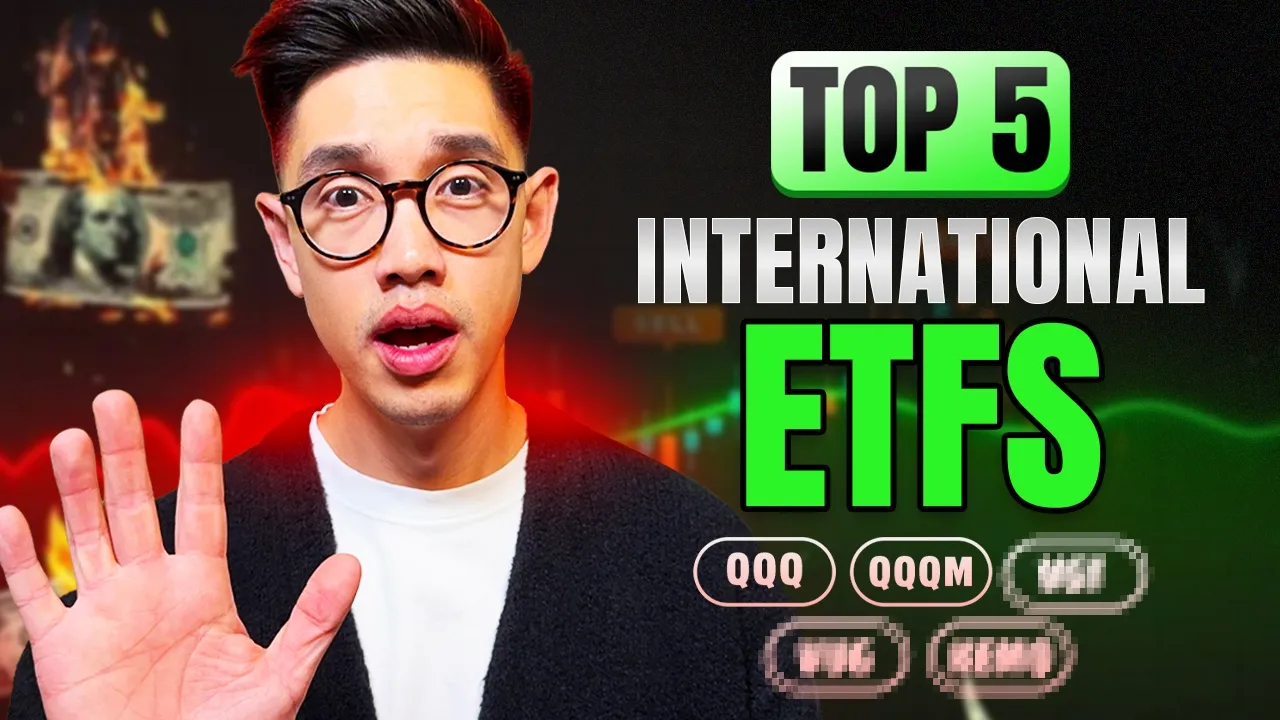
When we talk about investing, the conversation almost always revolves around the United States. We often talk about the S&P 500, the Nasdaq 100, or the total US market funds, and for good reason. The US dominates the global stock market. Right now, roughly 60% of the world's market value comes from companies listed in America, while the remaining 40% is spread across the rest of the world. So, if the global market were a pizza, about six extra cheese pepperoni slices would come from companies listed here at home, while the remaining four slices would represent businesses abroad. Now, of course, I love a classic pepperoni pizza, but after six slices, you might start wondering what the rest of the menu looks like. So, in this video, we're going to explore that other 40%. We'll look at how international ETFs can add value to your portfolio, walk through five of the most widely used options, and I'll end it by sharing my thoughts on this. So, why should anyone invest outside the United States? I'll use an example to illustrate this. Imagine you're a 40-year-old business owner running an established surf board brand known for its custom boards that are sold across the country. While everyone says you're easygoing, building a business has made you pretty tough when it comes to money. This meant you started investing as soon as you could, sending part of every good sales season straight into your brokerage account. Right after graduating, you built a diversified portfolio with ETFs like SPYM, maybe some QQQM, and let's just say SCHD, which has now grown to roughly $750,000. This puts you in a very comfortable spot, but let's say AI enthusiasm suddenly cools down because the major players report disappointing results, making investors question how profitable the tech really is. This has a big impact on your investments, since companies like Microsoft and maybe Nvidia are major players in your ETFs. Within 6 months, the value of your portfolio, maybe we'll say it drops from $750,000 to $650,000. But then you tell yourself, "Hey, it's fine. Markets go through cycles." Running a business has taught you to not panic every time things slow down. But then let's just say that your portfolio takes another hit. New regulations on pharmaceutical pricing put pressure on large healthcare companies, reducing profits across the sector. Since healthcare also represents a significant portion of broad US indexes, your portfolio dips further to $590,000. And yeah, that's a pretty significant swing in a relatively short time period, especially for someone who believed they were well diversified. The S&P 500 holds hundreds of companies, but they all operate under the same regulatory system, the same currency, and the same economic policy environment. Sticking exclusively to the United States market means you're exposed to US-specific risks. And if rising interest rates pressure high-growth stocks, or fiscal policy shifts unexpectedly, or the dollar weaken sharply, then yeah, you could see even more volatility. This would be like building your entire surfboard business around a single beach instead of expanding along the whole coastline. If a storm hits, or the waves disappear for the season, then your whole business would dry up overnight. While the US market is one of the strongest, it's still a single economic system. If you had included an international ETF, maybe like VXUS, in your portfolio, then it would have helped offset some of these sudden changes in the US market. For example, if European financial stocks grew from higher interest rates, or commodity-heavy markets like Australia and Canada saw gains from rising energy and materials prices, those gains abroad could have softened the losses at home. While this wouldn't completely shield you from local downturns, it could have kept your portfolio closer to maybe $620,000, rather than falling all the way to $590,000. Again, this is all hypothetical, but in a nutshell, international ETFs can help smooth out region-specific risks, helping you stay balanced instead of wiping out and scrambling to fix your portfolio. Now, let's have a look at five different international ETFs. First, there's the Vanguard FTSE Developed Markets ETF, which trades under the ticker VEA. It launched all the way back in 2007, when American investors were becoming curious about investing beyond the US, particularly in developed markets across Europe and Asia. Like the other international ETFs we'll look at today, VEA is not actively managed. It follows a predefined index. To understand this, we need to go back all the way to 2003. This is when FTSE, the index business connected to the Financial Times and the London Stock Exchange, introduced something called the Global Equity Index Series, or GEIS. This created a single framework for organizing stock markets around the world. It allowed investors to see how different parts of the world were performing, and gave fund providers a blueprint they could build investment products around. The system began with broad global indexes that tracked companies from dozens of countries, including Japan, the United Kingdom, Germany, and Australia. Over time, more specific versions were created. Some that concentrated only on developed countries, others that focused on emerging markets, and even more specific versions that narrowed in on certain regions, or excluded the United States altogether. One of these, known as the FTSE Developed All Cap ex-US Index, say that three times fast, tracks developed countries outside the United States. And this is the index that Vanguard chose for VEA to follow. Over the last 5 years, it's grown by just over around 40%, which is respectable. And it does so while keeping fees low and paying a steady dividend. I'd say that this makes a good fit for investors who want exposure to established international markets without taking on the added volatility that come from emerging economies. Next, let's take a look at the Schwab International Equity ETF, or SCHF. And just like VEA, it also tracks one of the GEIS indexes. In this case, it follows the FTSE Developed ex-US Index, which also focuses on developed economies outside the United States. Now, the main difference is that SCHF tracks large and mid-size companies, while VEA also includes smaller companies. For example, SCHF and VEA may include large companies like, you know, Nestlé, which is based in Switzerland, as well as mid-size companies like Nintendo, which is listed in, of course, Japan. But only VEA would also include smaller publicly traded businesses such as Greggs, a well-known bakery chain based in the United Kingdom, or Brunello Cucinelli, I hope I'm saying that right, an Italian fashion company that started as a small family business and is now publicly traded in Italy. Just keep in mind that since VEA tracks an index, companies will still get added and removed from different categories each time it's reassessed. And some might even get removed altogether as new companies get added. SCHF is the only international ETF we're looking at today that doesn't invest in small-cap companies. This means that it focuses only on larger, more established businesses, which can make it slightly more stable during market downturns. However, of course, the downside is that it may miss out on some of the higher growth potential that goes hand in hand with smaller companies. On top of this, SCHF also has a very low expense ratio sitting at just 0.03%. And over the last 5 years, it has grown by just over 42%, which is very similar to VEA. Overall, I have to say that despite the market cap difference, the outcome between VEA and SCHF isn't super different. They have similar expense ratios, similar dividend yields, and very comparable long-term growth. Third, let's take a look at the Vanguard Total International Stock ETF, or VXUS. Now, this is where it gets a little bit more interesting, because VXUS tracks the FTSE Global All Cap ex-US Index, which, unlike the previous two ETFs, includes both developed and emerging markets. Now, as you may already know, emerging markets are countries whose economies are still growing and becoming more established. This includes places like China, India, Brazil, and South Africa. They often have faster economic growth than developed countries, but they also tend to be more on the volatile side. Political uncertainty, currency swings, and less mature financial systems can all lead to bigger ups and downs. So, the theory is that if you're investing in an ETF that includes emerging markets, you can expect a little bit more movement in your portfolio. However, over much of the past around 17 years or so, emerging markets have generally lagged behind developed markets. A big reason for this is that developed markets were driven by strong technology growth and more stable economic conditions. This helps explain why VXUS has only grown by around 30% or so over the last 5 years, roughly 10% less than both VEA and SCHF. But, as we know, investment cycles don't last forever. In 2025, actually, emerging markets outperform developed markets for the first time since around 2017, which might suggest that the gap between the two is starting to narrow again. Of course, this doesn't guarantee anything going forward, but it does suggest that there may be value in choosing an international ETF that includes emerging markets. I'd say VXUS is great for investors who want one ETF that captures the entire international market, from mature economies like Japan and the UK to faster-growing regions like Indonesia and Thailand. Next, let's take a look at the iShares Core MSCI Total International Stock ETF, or IXUS, next. Now, unlike the previous three, which tracked indexes run by FTSE Russell, IXUS tracks an index that's run by MSCI, or Morgan Stanley Capital International. This means while the overall idea is similar, you know, broad exposure to international markets, the exact countries included, how they're classified, and how the companies are weighted can differ slightly from the FTSE-based funds. So, for example, MSCI classifies South Korea as an emerging market, While FTSE considers it as a developed market. This small difference alone can slightly change how much of the fund is allocated to emerging economies. The two indexes also differ slightly in how much weights they assign to certain countries. For example, China, India, and Taiwan make up somewhat of a larger portion of the FTSE emerging market index than they do in the MSCI's version. Which means that the overall country exposure can look a little bit different depending on which index the ETF follows. In general, MSCI tends to take a slightly more conservative approach to classifying markets, while FTSE is sometimes quicker to upgrade countries to develop status. Now, going back to IXUS, it follows the MSCI ACWI ex USA investable market index. Just like VXUS, this includes both developed and emerging markets outside the United States. If you look at its five-year growth, you'll see that it has performed nearly identically to VXUS, growing by roughly 30% over this period. Otherwise, IXUS is very similar to the other funds we've covered so far. It's expense ratio sits at 0.07%, which is slightly higher than VEA and SCHF, but still considered low by industry standards. And again, my standard is it's got to be under 0.50% and maybe around closer to 0.10%. It also pays a dividend yield of around 3%, keeping it in line with broader international ETFs. Now, I'd say that this could be a good option for investors who prefer the MSCI framework or who are already using other maybe iShares ETFs and want to keep everything under one provider. Now, let's take a look at another MSCI option called the iShares Core MSCI EAFE ETF or IEFA. I know there are a lot of letters here, but again, this is just a ticker symbol. Unlike IXUS, this one does not include emerging markets. It focuses only on developed countries in Europe, Australasia, and the Far East, which is where the acronym EAFE comes from. In other words, IEFA is MSCI's developed markets only version. It gives you exposure to countries like Japan, the United Kingdom, France, Germany, and Australia, but excludes both the United States and emerging economies like China, India, or Brazil. What makes it stand out is that it sits somewhere between SCHF and VEA in structure, while using MSCI instead of FTSE as its index provider. Something we haven't looked at so far and it's worth bringing to your attention is the tax side of owning an international ETF like IEFA. You see, when you invest in international stocks, there are two main taxes to be aware of. First is the foreign withholding tax. Many countries automatically withhold a portion of dividends before they're paid to the fund. You don't see this deduction directly, it happens at the source. However, in a regular taxable brokerage account, you can usually claim a foreign tax credit on your US tax return to offset some or all of this. Second, international ETFs often pay qualified dividends just like US ETFs, but the percentages can vary slightly depending on the countries involved. In practice, the tax treatment is usually similar to what you'd experience with a broad US equity ETF. So, while international ETFs do introduce an extra layer of tax complexity, it's generally manageable, especially in a standard brokerage accounts where the foreign tax credit applies. Going back to IEFA, if you invested $30,000, you'd earn roughly $1,000 per year in dividends based on its current yield. On this amount, you'd likely pay around $150 in federal dividend taxes, assuming that it's a typical 15% rate. Because IEFA holds companies based overseas, some foreign taxes are withheld before those dividends even reach the fund. In a taxable brokerage account, you may be able to claim a foreign tax credit to offset part of this, often somewhere in the range of $100 to $200 per year on a $30,000 investment, depending on how much was withheld. This means that in many cases, the foreign taxes you paid can largely be credited back against your US tax bill. Now, these taxes and subsequent credits aren't unique to IEFA. They apply to all international ETFs. So, it's good to be aware of this before you start investing in international ETFs. If I had to give IEFA an assessment, I'd say it's a clean developed markets only option, but in practical terms, it's very similar to SCHF and VEA, just built on MSCI's framework instead of FTSE's. Now, as you may have picked up by now, I'm somewhat lukewarm about international ETFs. They do offer diversification benefits just like what we discussed earlier in the video. But over the last decade in particularly, they've generally underperformed compared to the US market. If we compare the five-year growth of the international ETFs we covered, which averaged around 35% to US-based ETFs, there is a noticeable difference. During the same period, SPYM grew by over 75% and QQQM by more than 90%. So, from a purely performance standpoint, sticking with US equities has delivered stronger returns in recent years. That said, international markets did outperform in 2025. Whether that marks the beginning of a longer shift, we don't know yet. So, while I'm still a sucker for the classic pepperoni pizza, if this does turn into a more sustained trend and I decide to add international exposure, I'd probably choose VXUS. It's the most complete version of the category, covering both developed and emerging markets in one fund. And if you're going to diversify globally, you might as well own the entire opportunity set rather than trying to predict which region will outperform next. If you decide to invest in international ETFs, just make sure that you understand what you're buying. Look at the countries involved, whether emerging markets are included, and how it fits into your broader portfolio. Again, I summarize all of my favorite ETFs in my $1 million investing road map if you're someone who's more of a visual learner. If you're interested, you can download it below. It's 100% free and I will see you in the next video here.
Comentários 0
Entre para participar da discussão.
EntrarAinda não há comentários. Seja o primeiro a compartilhar sua opinião!