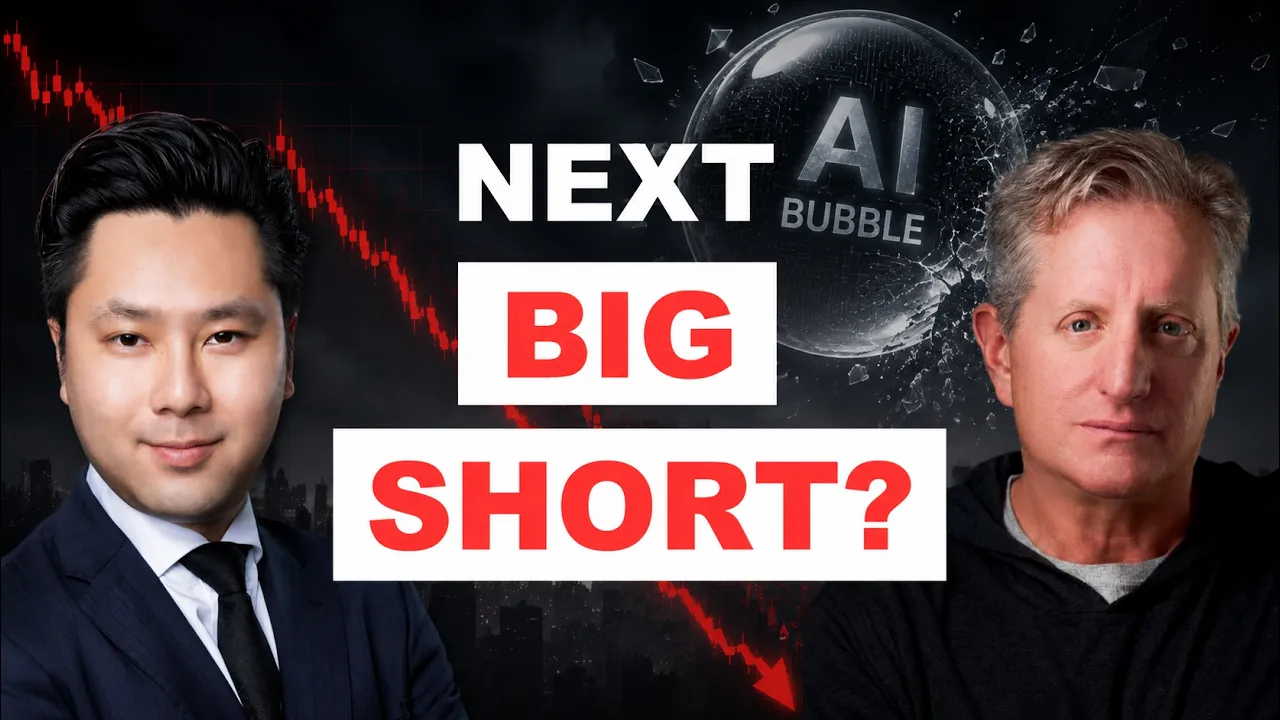
Market Bubble Trigger: 'Immediate Recession' Once This Happens Says Big Short's Steve Eisman

- Retorno do vídeo
- —
- Chamadas
- 2
- Compra / Venda
- 2 0
- Publicado
Recomendações
Entrada é o preço de fechamento do ativo na data de publicação. Atual é o último fechamento registrado.
-
Entrada $217,55 28 ago 2026Atual $217,55 28 ago 2026Resultado +$0,00
I am still long Nvidia and several other tech stocks. I'm less long cuz I've gotten nervous, but um I am not short.
-
Entrada $134,98 28 ago 2026Atual $134,98 28 ago 2026Resultado +$0,00
you could buy the KBWP, which is the property casualty insurance index ETF.
Transcrição Completa
If tomorrow open AI failed, the US economy, I think, would go into an immediate recession and the market would have a massive correction. I think it's a little nerve-wracking that um the entire US economy is dependent upon two companies that lose billions. I think the whole tech space sells off. Our next guest is Steve Eisman, host of his own show on YouTube called The Real Eisman Playbook. Check it out. It's a great show featuring great interviews with financial experts. Steve was made famous by Michael Lewis's book, The Big Short, and subsequently the Hollywood blockbuster of the same name, where Steve Carell played Steve Eisman's character. >> Hey, there's a bubble. >> How do you know? >> Trust me. Call Venet by 50 millions in swaps on the NBS. What do we got? Gabaldi 4 triple B. >> Mark, you sure? >> Yeah. Yeah. It's time to call [ __ ] >> [ __ ] on what? >> Every [ __ ] thing. In the book and in the movie, they changed the name to Mark Bomb. You'll recall that Mark Bomb or Steve Eisman ran Frontp Point Partners back during the financial crisis. They were on the right side of the subprime mortgage crisis. Frontpoint Partners's position doubled from $700 million to $ 1.5 billion from being right during the financial crisis of 2008. And now Steve is going to tell us about the number one risk he's watching in markets today. Hint, it's in the tech sector. Right now there's a trade on couch for which of the following firms, Open AI or Anthropic, will IPO first? There's a 93% chance that it's going to be anthropic. And once these companies IPO, there's going to be some very key financial data that we're going to be watching for for indicators of where this tech bubble is headed. That's according to Steve. This is a very, very important episode for anybody exposed to the tech sector, which is all of us if we're in the S&P 500. This video is brought to you by Koshi and sponsored by Koshi. And it's the largest prediction market in the United States. Unlike a sports book, you're trading peer-to-peer on real world events from economic data to political outcomes. And the price moves based on public opinion, not a house. Go to the link in the description down below or scan the QR code here and use my code lin to get this special offer which is that new traders who use my code can get $25 when you trade $25. Koshi is CFTC approved and available in all 50 states including California and Texas. And on the Open AI versus anthropic trade, if you believe that Open AI will actually IPO first and you put $50 down on that particular trade, your payout could be $316 if you're actually right. Well, Steve's going to give us his opinion. Welcome to the show, Steve. It's a great honor to host you. I followed your work for quite some time. Thanks for being here. >> Thank you for having me. >> I know you've been asked this a million times, but uh it's your first time here. And before we talk about markets, I have to ask you when um the the movie The Big Short, the Hollywood blockbuster was based in the book, they named change the name to Mark Bomb, but it was really your character uh was in there. Uh you were in there featured. Um what was your initial impression seeing you being portrayed by Steve Carell? Did he do a good job, do you think? >> Um I thought he I mean this is sort of shocking in that he we only met once. We met for breakfast uh at a diner near my my home called Three Guys and he wore a Boston Red Sox hat so that nobody would know who he was. We spoke for about an hour. I took him home then to meet my family and that was really the last time I had a substantive conversation with Steve Carell and yet somehow his portrayal of me was quite accurate. >> Wow. Um, if you had to, let's say, testify to Congress right now, they were to ask you about the current financial conditions and whether or not there is some hidden crisis that is looming. What would you say today if you had to? >> Well, I don't think it's hidden. You know, the the if you look at US GDP growth this year, it's going to be up around 2%. Uh, half of it is from AI capex. That's public information. I'm not, you know, it's not like I discovered the Rosetta Stone. That that is simple simply public information. And you know, Nvidia just reported, as you mentioned, revenue was up more than 100%. However, 70% of its accounts receivable was from five companies. which of those companies, we don't know who they are, but we could we could all pretty much guess a bunch of them. >> The way I sort of see the entire AI story is that Nvidia sells chips to hyperscalers 70% of hyperscaler AI revenue is from anthropic and open AI and that equates to about 25 to 35% of their cloud revenue. If you look at just Oracle, um 50% of its $600 billion backlog is just from open AI. So in a sense, the way I think about this is the entire AI ecosystem food chain is dependent upon the future health and success of anthropic and open AI. That's and and by the way that also means that the US economy hinges upon the the the health and future success of anthropic and open AI. I think it's a little nerve-wracking that um the entire US economy is dependent upon two companies that lose billions and I would say between the two Open AI is the weak sister. It's pretty much uh baked into um at least prediction markets. Let me show you this that Anthropic is going to IPO at some point. This is will open AI or anthropic IPO first. 93% anthropic open in your show the real isman playbook. You've talked about how once these companies do go public, we'll have real data >> to base a lot of our decisions on. What are some of the real data that you're anticipating or looking forward to? Well, what I'm really looking forward to is I'm pretty sure that Anthropic's revenue story will be good through June. And that's because sometime around late June, July, token maxing, which is where people were just spending whatever they they had no sensitivity to spending. They just spent money like crazy on tokens. token maxing ended and now people are a lot more self-conscious. So I actually think the third and fourth quarters are going to be much more interesting for Anthropic and Open AI than the first half of the year. And I'm hoping to get some clarity on anthropic when they put out their S1. Whether they'll give it or not, I don't know. If we do see evidence that B2B sales start slowing down, what does that mean for first of semiconductors which already sold off in July and then to the rest of the tech space? >> I think the whole tech space sells off. >> Yeah. Was that sell off? Was that did that already happen? Was that the July selloff you talk we're talking about? >> That was that was like the preview. >> Okay. Right. But but we we have to have conclusive evidence that the bubble is popping. And so the finan the key financial metrics that you would evaluate because the word bubble is hotly debated. It's up to academic debate. We have we have to look at what to make the conclusion that this bubble is popping growth is slowing. If you had to name narrow down to two or three financial variables, what would they be or metrics? I >> I think it would be the revenue growth for the second half of this year. >> Right. And with respect to open AI um you know as as I recall if you look at the June quarter results that have come out um I think Anthropics revenue growth revenue was like 11 a.5 billion >> and it was upund over a 100% versus the March quarter. Open AAI which like I said is the problem child had around 600 6.5 billion in revenue and it was up only 18% versus the March quarter. Worse its costs went to 12.5 billion up 3 billion in 3 months. So simple math, um, OpenAI's revenue in 3 months was up a billion dollars sequentially and its costs were up three billion sequentially. That's not the right direction. >> Can we make the argument that profitability doesn't matter very much for these companies that we're talking about? Take a look at Tesla for example. For most of its history, it wasn't profitable. stocks still went up because the investors believed that there was a bigger picture beyond just short-term profitability. >> Well, look, I think eventually profitability matters, but near-term these stocks don't care, which is why I'm talking about revenue growth slowing, >> okay, >> is is is the more important metric >> if it happens. >> If the if the Treasury were successful in backs stopping the selloff of bonds, if they're successful in capping the long end of the yield from yield curve from going up, >> that's that's that's not going to happen. It's a It's a joke. >> No, they >> Treasury has what $4 billion that they're gonna that they're going to buy Treasury with with. It's not even a basis point. It's It's a It's silly. >> It's the Well, people do agree with you, Steve, but they also say it's the signaling that matters. Do you agree? >> No, I don't think it matters. But if if your signal is that you're going to spend $4 billion, who cares? If they but if they were to say if Scott Besson were to say we have the Treasury we have the Treasury general account at our disposal. It's got a bill. It's got a trillion. >> He's not going to spend a trillion. He's not going to spend a trillion dollars. I look like a [ __ ] >> Okay. All right. So, you're not convinced that 5% is the cap for the 10 year? >> I have absolutely no idea what the cap in the 10 year is. I I have no idea one way or the other. I I I never make predictions about interest rates. I think it's just >> no one can predict interest rates, >> but I think the idea that Treasury should spend a trillion dollars to try and cap long-term rates is abs is absurd. >> Yeah, >> we already saw this. The Fed did this with quantitative easing to try and do the same thing. It had absolutely zero impact on the US economy. The only impact it had was causing stock prices to go up. >> Right. Um, and this goes back to your research. Like you said, most of these hyperscalers, 70% of hyperscaler AI revenue and half of Oracle's $600 billion backlog traces to two companies that lose billions of dollars and are relying at this point on raising capital for their survival. Can we make the assumption then uh Steve that as long as interest rates stay low and capital remains available that this this train continues to run? >> No, I think that if if >> first of all open AI I think is in trouble. I I think the revenue growth is obviously slowed dramatically. It better start accelerating soon and um if what I was talking before about token maxing, I think it's going to be harder for these guys to raise capital. >> I could be wrong, but that's what I think. >> Um yeah, Nvidia just announced a $500 billion uh third party capital facility with the likes of KKR, Apollo, Blackstone, Black. That's it's not not exactly. >> No, >> it's not. No, it apparently what happened was they were they were working on the transaction. This is according to Bloomberg. >> Yeah. >> And and it was taking a long time and so Jensen went out and basically just announced it anyway. >> And even though there's it's like a memorandum of sort of quiet understanding. I mean they may get it done but right now there is no 500 billion dollars. Mhm. Okay. And so if the average consumer, let's say the average person were to see you at a dinner party and say, "Well, look, I'm not investing in the stock market. I know very little about capital markets, but it sounds to me like the entire economy is propped up by a couple companies that may or may not even remain profitable going forward." Would that be a true statement, you think, Steve? >> I think it's that's 100% accurate. And so how do we prepare ourselves financially in this kind of environment when so much concentration in the stock market has become a major risk for not just capital markets and investors alike but for the entire growth of the economy. >> I think it's very very difficult. Um and part of the problem is that you know people have made a lot of money and I'm not just talking about institutions I'm talking about individuals as well. Uh-huh. >> They have tremendous unrealized gains. And so, you know, let's say you owned, let's say you bought Nvidia really well. I'm just using as a hypothetical. And you've made many, many times your money >> and now you're nervous. If you sell your Nvidia, you're going to pay 35% plus in capital gains taxes. That is painful. Um, I don't have a great answer for people, you know, who who for people who have embedded gains. You know, I I, you know, I could I could tell you certain ETFs that you could buy that would be, you know, lower risk, like you could buy the KBWP, which is the property casualty insurance index ETF. um just as just as one example but you know the problem is people have such embedded gains that I don't think most people are going to sell and so I think it's a very difficult question >> let me present to you another long-term trend Steve uh allow me to share my screen here and I want to show you the debt and deficit situation of the United States this is the federal debt as a percentage of GDP now this Congressional Budget Office is projecting that this this number as a percentage of GDP is going continue to rise and in fact may at some point surpass the World War II high if not already. Now I'm going to flip over to see the deficit. It's the same story with the deficit. It's gotten wider. It's going to continue to get wider. If this trend were to continue, if projections made by the CBO are correct, what's the long-term investment play here? Let me just first say that you know all other things being equal it'd be better if we had a smaller deficit. >> Yeah. >> Um I am not of the view that you know US economy is going to crash and burn anytime soon because of the deficit. Um, you know, I remember in the 90s Pete Peterson was uh moaning and groaning about the deficit and you know, people who have who make the argument that, you know, the deficit is too big, the dollar will lose its reserve currency status, you know, cats and dogs will lie down together, it'll be Armageddon. um have been making that argument for 40 years. And you know, when you make an argument for 40 years and you've been wrong for 40 years, probably you should ask yourself like okay why hasn't what I predicted happened? And I think the answer to that question is that for better or worse, the US Treasury market is the most liquid bond market in the world. And because of that, the financial system of planet earth uses treasuries. So for example, there I think the repo market is like a three trillion dollar market. This is for those of your viewers who don't know, the repo market is where banks lend to one another overnight. That's $3 trillion. It's all T bills. No, nothing else. So, you know, the United States has the luxury, for better or worse, of mounting deficits as long as treasuries are the financial system of the world. And the only way that treasuries will not be the financial system of the world is if some alternative shows up. You know, it's not going to be Chinese bonds, it's not going to be Bitcoin, it's not going to be European bonds. So until then, hey, don't worry about the deficit all that much. That that is now that doesn't mean that interest rates couldn't go higher. >> Yeah. >> You know, and I think part of the reason why the interest rates have gone higher is that um AI debt levels keep go, you know, the amount of debt being raised by AI is sort of crowding out everything else. Um, so yeah, rates could go higher, which would hurt the housing market. It would hurt the economy, but the calamity that uh some people like to pontificate about, I don't think is realistic. >> Why why aren't we seriously considering an alternative to US treasuries? You mentioned it's not going to be. >> What What is What is there? >> There is no alternative. I mean, let's say okay >> I'll ask you name something that you think could be an alternative. I don't know, but I think Ray Dalio, >> you know what? You know why? You know, Yeah. Ray Dalia has been talking about this nonsense for the last 20 years. >> Okay. >> So, you know, I kind of get sick of it, but there is no alternative to treasuries because there's to for there to be an alternative, you need to be as big and as liquid. >> And there's there's nothing. Look, if if there was an alternative, then the stuff that Ray Dalia was complaining about and and and bemoning would be a much bigger risk. But until then, I think it's academic. The market in recent weeks, I'm talking about since the beginning of August and more particularly August 19th, has taken a turn for the positive. Bitcoin's finally reawakening as is most of cryptos. gold has gone up from $4,000 to $4,700 um on the back of what people believe is Treasury intervention which we already talked about and you're skeptical of. Do you think this is the start of a new uptrend or is this overreaction to what the Treasury is signaling which we discussed earlier? >> I have no I have literally no idea. You know, I don't I just don't like to predict markets. I just like like I said, I think the big risk to the market which is huge >> is anthropic and open AI. But that risk could be if it if I'm right it could materialize a year from now. >> Yeah. >> So and and and as you know timing in market timing is everything. >> Michael Bur actually is also shorting u bidding against Nvidia and shorting the chip sector. Would you go to short? >> I I am not I am not doing that by the way just so you understand. I am I am still long Nvidia and several other tech stocks. I'm less long cuz I've gotten nervous, but um I am not short. >> Would you be considered would you consider hedging against your long positions given these mounting risks? >> I might. I I might. It's possible. >> And when we talk about hedges, what what what kind of what kind of um hedging do you believe in? >> I'd rather keep that to myself for now. >> All right. maybe for the next book. Steve, besides the AI sector, um are there any other changes you think fundamentally speaking when it comes to investment themes that you've observed over the last year, especially since the Iran war, has that changed your thesis on anything, by the way, besides AI? >> I I don't think the Iran war has real long-term implications for the US economy. I mean, it has long-term implications for the United States, but um the economy, I think, is as of now is fine. I mean, we do have a K-shaped economy. The bottom of the K is is struggling. There's no question about that. But, uh, as long as, um, AI capex keeps powering higher, the economy in the market probably goes higher. It's all it's all one trade. this K-shaped economy. Um, is it fair to say that the stock market needs to be propped up or else everything falls apart? And I think this is probably one of the main reasons why the Treasury is intervening ahead of the midterm elections is one of the arguments that people are making because if the wealth effects takes hold, Steve, then the top of the K that supports spending, they're going to stop spending. Are you concerned about this? I I think that's fair. But I I again if tomorrow >> Yeah. >> and I'm not making this prediction, but I'm just saying if tomorrow >> Open AI failed, >> Mhm. >> the US economy, I think, would go into an immediate recession and the market would have a massive correction. Um, I don't think that Treasury propping up rights or whatever has any impact on that one way or another. Open AI will succeed or fail because it'll succeed or fail. It has absolutely nothing to do with treasury. If it succeeds, then the, you know, the AI trade continues. And if it fails, it won't. I think it's really just that simple. You've also talked about this with other media. CNBC, you went on CNBC. You said the Chinese open-end models, open weight models are much cheaper. If they start really taking a lot of market share, and it sounds like from what I'm hearing that they're starting to, you could have a big price war. Why is that not being reflected in consumer demand right now in the US? You think? >> What do you mean by consumer demand? >> Why aren't we using Chinese models right now at at scale? >> Well, I'm hearing that people are starting. takes time but uh you know if if that does happen there would be a price war. >> Mhm. Okay. Um you run a very successful YouTube show. I mentioned this before uh this real Steve Eisman playbook. What are some of the themes that your guests have been talking to you about and some of their concerns? >> Um some of the stuff that we've already spoken about. >> Yeah. >> Um we've had on I'll talk about some interesting guests. We had on um a guest Wolf Gang Munchchow who wrote a book called um Kaput, The End of the German Economic Miracle. >> Mhm. >> And he was on pretty recently. We were basically talking about why why is it that Europe doesn't grow? It just doesn't grow. Um, and he had some very interesting things to talk about, but basically regulation in Europe basically kills the tech sector in Europe. And so, you know, Germany, France, all these countries, they just they literally don't grow. Then we had another guest on in June. Mhm. >> Um, you know, Meta just settled this lawsuit which was which was um a California lawsuit which was about the their algorithms and we had on a a guest uh law professor Ben Zaperski basically talking about the the legal theories behind all these lawsuits. It was fascinating. >> Mhm. >> Um I had on a great guest. This was a wonderful guest. I was looking for something um that would kind of celebrate the you know the 250th anniversary of the United States and I found a great book called um it was capitalism an economic history of the United States and it had been written by Alan Greenspan and a gentleman named Adrien Wooldridge and um obviously I couldn't interview Alan Greenspan but I interviewed Adrian and that was um that was fascinating. It was really um it was very illuminating. So that's that's kind of some of the stuff that we have on this. I would say the podcast is very eclectic. We we do a lot of sellside analysts. We do authors. We do economists. Um you get a real education I think from our our podcast. >> Yeah, it's a great show. You've been talking about situational awareness recently since it blew up. Some people have commented that directionally he's right. It's just a matter of bad risk management. Do you agree? >> Totally. >> Um I gave an example in one of my weekly raps where I said, "Imagine it's like 1905." >> Uhhuh. >> And you have a thesis that automobiles are going to conquer the world and going to put all the carriage companies in bankruptcy. That's your thesis. So let's imagine you could do this. you you buy every auto and auto parts company that's public. I I have no idea if any of them were public back then, but let's imagine that they were. And you short every horse carriage company. What you've done is one trade. It's the same thing. You know, it's not your your it's not that your longs and your shorts are not independent of one another. They move exactly in unison. If your longs go up, your shorts go down. and and we all know obviously that that thesis would over the long term prove to be 100% correct. The problem for situational awareness is they had that trade on which was long basically hardware and short uh software, >> you know, but as as going back to my example, imagine if there's a terrible car accident that gets tremendous amount of press and for a period of time you're the trade reverses because people start to worry about automobiles because they think maybe they're not safe. >> Yeah. >> Now, unfortunately, if you're levered 4 to one, you get put out of business really quickly. That's what happened to him. >> Okay, that makes sense. I've got a few more questions to wrap up the show. See, it's been great talking to you. Um, >> do you think the world, the financial world in particular, has fundamentally learned their lessons from the 2008 financial crisis? the world has changed in the last 15 16 years. >> Well, the thing that I would just point out is that um the banks post DoddFrank were forced to deliver enormously. >> So that the leverage today is like half of what it was. >> Um so I I I don't worry about the banks these days. you know, they may have exposure to private credit, but you know, given how much capital they have, I just don't think it's a systemic issue. So, is that a lesson learned or was it rammed down their throats? Probably a combination of the two. But, um, the bank banking system in the United States, I don't think has ever been this safe in anyone's lifetime. >> I'll show you another chart. Um, this is just headline CPI. Where I'm going with this, Steve, is that you'll recall following the 2008 financial crisis, we had CPI averaging between 1 to 2%. Um, there was a bit of a peak in 2011, it came back down. There was a whole decade where people didn't have to worry about the inflation of consumer products as much as they have to today. And I've been talking to some of the economists on my show, and this is a relatively recent phenomenon when you compare to the last 20 years. I'm not talking about the late '7s or early 80s, but the fact that we have to worry about rising consumer prices to this extent is a relatively new theme. Does that change your investment thesis at all? >> I don't know if it look it means I think the area that's been really really hurt is housing >> and it's it's and it's a lot of hidden costs. It's um it's the cost of taxes. It's the cost of property and casualty insurance. It's the cost of utilities. I think because of that inflation, there's a whole swath of Americans who have been completely priced out of the housing market. Leaving aside the price of the house just to bear the annual costs are beyond are beyond their means. And um I mean that impacts housing related stocks but I don't think it really impacts much beyond that. >> My final question, what would trigger you to start doing the same kind of research you did in 2006 2007 which is to dig into different jurisdictions. I think back then you were looking particularly at California and Florida for subprime mortgage data and basically formulate a thesis that the housing market was in trouble. In other words, redo the work that you did. um what do >> there's no subprime really mortgages so you can't that data is sort of gone >> um if there was a correction in the housing market I think it would just be a normal correction I don't think it would be calamitous so that's not where I focus my attention these days >> excellent I mentioned your show Steve where else can we follow you >> uh we're on Substack >> um so Just so if we do so everybody knows we do two three things. We do a interview that goes out on Monday on YouTube and we do a market rap which goes out Friday after the close and on Wednesday on Substack for premium subscribers we do an additional interview or master class. I'm going to be doing a master class that I'll put out in a couple of weeks about how to analyze banks. >> Very cool. Well, thank you very much Steve. I appreciate your work and uh >> it was a great um it was a great time for me to study your work actually as I grew up in the financial sector um when I was starting off in my career. So really appreciate the opportunity to speak with you today and thank you for speaking to my audience. >> Thank you >> and thank you for watching. Don't forget to like and subscribe. Please follow Steve in the links down below and do use my code lin when you sign up to Koshi. Remember, new users who use my code lin l i n can get $25 when you trade $25 for the first time. Link down below or scan the QR code here to get started.
Comentários 0
Entre para participar da discussão.
EntrarAinda não há comentários. Seja o primeiro a compartilhar sua opinião!