this gives you an opportunity to add into these positions or especially if you don't have any exposure right now.
Contexto
Speaking of weakness, Micron, the last 24 hours have been a head scratcher. ... I think this gives you an opportunity to add into these positions or especially if you don't have any exposure right now.
this gives you an opportunity to add into these positions or especially if you don't have any exposure right now.
Contexto
Speaking of weakness, Micron, the last 24 hours have been a head scratcher. ... I think this gives you an opportunity to add into these positions or especially if you don't have any exposure right now.
this gives you an opportunity to add into these positions or especially if you don't have any exposure right now.
Contexto
Speaking of weakness, Micron, the last 24 hours have been a head scratcher. ... I think this gives you an opportunity to add into these positions or especially if you don't have any exposure right now.
if push comes to shove, I don't think you need to go any further than Nvidia.
Transcrição Completa
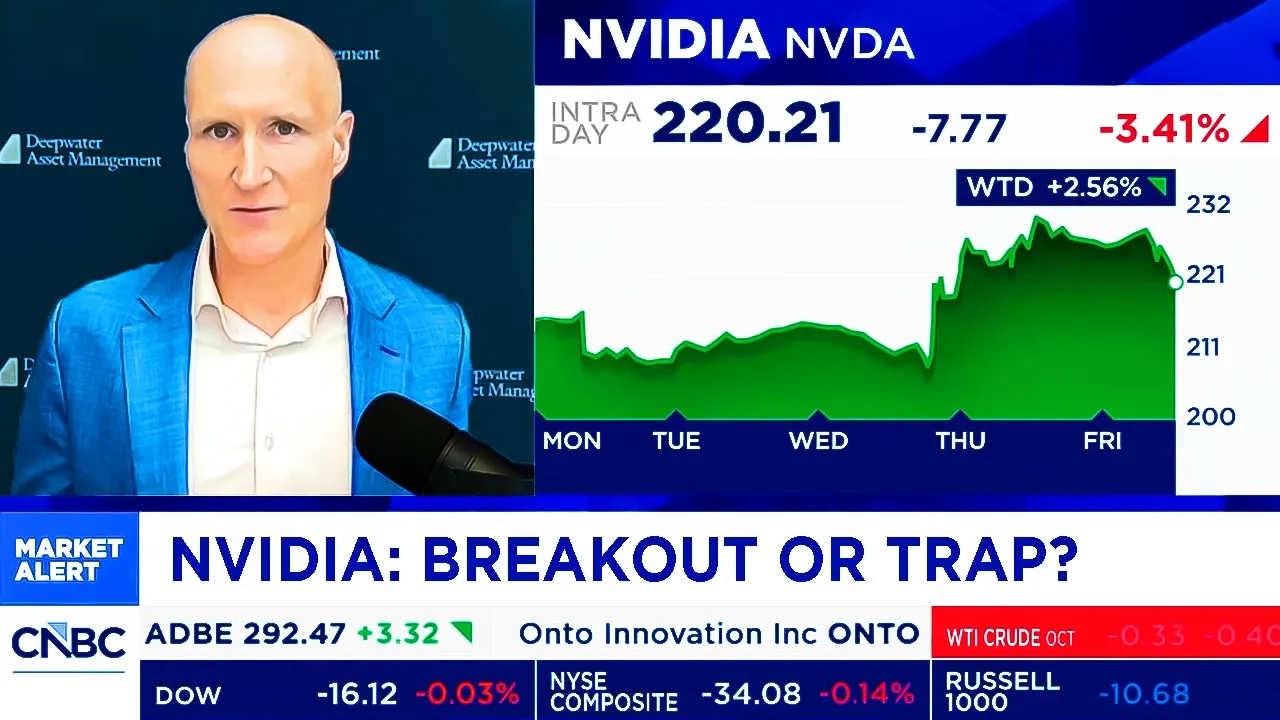
Nvidia adding $442 billion in market value just yesterday, marking the second largest one-day gain by any stock in history. Gene Monstra of Dean Water Asset Management joins us now for more. Gan, welcome to the program. For years, we used to talk about Apple and Apple getting bigger and bigger and people used to talk about deceleration and it just felt like in the last few months we were doing the same thing with Nvidia. What was your reaction to that outlook from that company? Well, I appreciate the Apple analogy, John. Actually, it's something that I've been thinking about more recently, that growth that Apple had. And just to put into perspective what's happened with Nvidia over the past few years and looking for towards next year, calendar 22, Nvidia did 27 billion in revenue. Calendar 27, so 5 years later, they'll likely do more than 700 billion. It's probably going to be 750 in revenue. So, 27 to 750. The reason why I say that and in the comp relative to Apple is that what's happened with Nvidia has been breathtaking even relative to the iconic tech moves that we've seen. And so the key takeaway here is less about what we've seen from 22 to 26. It's more about what we're going to see from 27 to 30. to get to your your point here. It's been well documented here about the the numbers, the guidance, the plus 70% revenue growth rate versus the street at plus 45%. That's for calendar 27. That was kind of the eye openener from from a couple nights ago. I expect that next year calendar 27 will probably grow at 90%. Uh that means that the growth rate in calendar 27 will be about the same as it is in calendar 26, 90%. And I think uh at the core of what's going on here, if we just look at the business, forget about the big picture with AI, but just if we look at Nvidia's business, at the core of what's going on is that the customers simply just can't get enough capacity to do inference. And that is what is driving these numbers up. And ultimately, I still believe we're probably in the third inning of this buildout. Sounds hard to kind of wrap my head around that. I still think we're very early. Gene, I really struggle with that, but that's the way things are heading. Gene, when you look at this company, one unique part of the way they operate is they look to foster and create their own demand by helping to build out the AI ecosystem elsewhere. What would you point to as a unique feature of that? Well, I think from uh you know the demand side, it's just the speed of their chips that ultimately is what is driving all this and that's what's allowing them to have this incredible pricing uh leverage kind of next year probably 20 30% potential pricing increase on some of their products and I think that's the piece John that gets missed in this conversation is that ultimately uh consumers or their customers really need these chips more than uh any other custom silicon. And so I think that's a big key takeaway here is that uh they basically have the best stuff in town. >> What then do you make of some of the other moves they've been making recently, Gene? Maybe lost in the news flow of that huge gain in earnings they had yesterday was the fact that they bought Hugging Face, a big platform for open- source modeling and discussion. They have their own open source that they're working on too. Gene, what exactly is Nvidia doing there? So this is a important dynamic in terms of how Nvidia sees the progression of models. And so what hugging face is is for those who are more technical, it's effectively the github of AI development. For those less technical, it's a library of uh open-source AI models that people who are developing AI can basically pull thousands, hundreds of thousands of models and put them plug and play them into uh the development. And so that's what this is the big picture here, Danny, is this is the theme around open source. And this is something that Jensen's been very supportive of. But there's a story underneath the surface that I think is more important to what the headlines are, which is hugging faces uh progressing Nvidia into the open source world. What's most important here is that uh Nvidia is doing uh is basically building out is doing the inverse of what their customers are doing to them. So just stick with me for a second here. If you look at customers like Meta and Google um they are building their own custom silicon effectively they want to compete or they want to have alternatives to Nvidia. What Nvidia is doing here with hugging face, what they did last week with poolside, a small acquisition, uh is essentially they're building um the these their own models in the event that their customers, their current key customers start to do more their custom silicon, they have an advantage to focus more on the models themselves and make money from the models themselves. It's just a fascinating dynamic. As tightly as these companies, the mega caps and Nvidia hold their hands, Nvidia's also uh getting some diversification in case those customers start to do their own custom silicon. >> Well, there was also in the earnings out some some other hedging just looking to other customers besides the hyperscalers looking to sovereign AI as well as to enterprise. Gan, does that seem like a growing at least the pace of growth fast enough versus their historical customers to kind of alleviate some of the concerns over concentration risk? >> So the customer concentration actually the top two declined in terms of total percentage of revenue went from 38% in the April quarter to around 30%. And the reason is SpaceX basically came out of nowhere. It was a a couple percentage of total revenue in the April quarter. It's probably about 5% in the in the July quarter. So they are getting some diversification within that. But to your point is the script is flipping in terms of where they're getting their growth from. If we're looking at for next year, those hyperscalers are expected to grow revenue just over 50%. If you look at the non-hyperscalers, the sovereign like you mentioned, they're expected to grow around 85%. So um why that's important is that what investors struggle with here when we started and talked about this breathtaking increase in in in numbers it's less about the law of large numbers there Google's a similar size business the issue is this the slope of the deceleration of revenue and as the nonhyperscalers grow that gets investors more comfortable that that decline from 90% next year to maybe 50% in calendar 28 uh won't be as sharp and so I think that this customer diversific ification. This script flipping in terms of focus more on non-hyperscalers is an important piece that allows investors to sleep just a little bit better at night knowing that that growth curve isn't going to be as sharply declining as maybe something today. >> Uh let's get to Nvidia this morning after the blowout quarter that we got earlier in the week did spark that chip rally. Company added, get this, 442 billion in market cap yesterday. That's the second largest one-day gain behind remember that Microsoft day where they added 450. Today, Jim, it's about Marll. A lot of chatter about it being a bridesmaid in the wake of the Nvidia number. >> Matt Murphy guy got the kind. Yeah, it was a tough moment for him. I think some degree the CEO of Marvel because he's very common regular guy and suddenly the next trillion dollars. But it's from it's from Jensen and Jensen's got more gravitas than anybody. I don't know. Well, look, I I look at what happened in that conference call where you the company reports, all right, and it's just a flatout report and doesn't give you the co crest uh guide up of 70%, people just slamming, this is we were speaking at Nvidia, slamming it down, right? Uh and then at the the third sentence in the actual conference call, she talks about the much much radically better uh revenue growth and then you get the stock up to 519 and I mean 219. Now, here's the problem with this thing. this stock didn't get to the top. So there's going to be somebody David who says, you know, 219, 228, 232 didn't take out the the top. Didn't take out the top. So therefore, you know, David, what they're going to be saying, >> double top, >> double top. >> Double secret probation top or just a double top? >> I actually heard that. Marvel is a very expensive stock. Unless everything works, it's a cheap that was like Nvidia. If they can do the number, you're you're 10 times 20 28. Yeah, look at the gain for the year 165. In memory, Jim, we did get from SK Heinik yesterday that the shortage they think will last through the end of 2030. >> Cosby was down last night. I was surprised. I thought that that shortage comment and that's echoes what uh Sanja told me when we at Micron. Uh but I guess people kind of are are that's kind of factored in. Uh I know that it's not factor in. If you're buying DAM, you're always kind of hopeful that maybe there'll be a price break, but it doesn't look like it. There continues to be a ton of news around data centers and sort of the social economic push back to the push back now from some unions. >> Oh my, I was thinking that if you were pro data center, you could always say to your constituency, look, I'm anti-data center, but you know, the electrical workers like the data center, so I'm in neutral or maybe even pro data center. What what's the metric then that you're watching for that would would tell you the data center risk outweighs the safe haven that these big names provide or the growth opportunity that the big names provide? What's the metric that you're watching for that would tell you to get out? >> I mean, it's never one thing, Contesta. I wish it was that simple, but watching semis is a good place to start because they've been obviously at the tip of the sphere, right? They're up over 60% this year. um you you got that I I still don't like the fact they gave this guidance but Nvidia gave that guidance of 70% growth in you know their revenues for next year I think well anyway but that I think it's going to be difficult for them to get there and to believe their customers who are obviously double ordering I think you know there's a lot of risk that introduced but in the near term we're obviously seeing demand outstrip supply but But I think watching semis and within that watching memory is which is arguably the most tight of all the sectors that's a good place to start in terms of going all right is it even safe to hide out in the big you know data center infrastructure names. Yeah, I mean, yeah, clearly the the shortage forecast out of SKH Highix this week going into 2030, but I'm curious why why why you didn't like the Nvidia guide? Why if there if if customers are implying 100, what was wrong with guiding 70? >> Well, let me bring you back in time. So, the most valuable company in the world in 2000 said, "Hey, we think we can grow revenue sustainably at 30 to 50%." And then two years later they had negative revenue growth for two consecutive fiscal years. And that's Cisco. They were the Nvidia of its day. Semiconductors is the most cyclical sector within all of technology. And when you go into massive shortage and Nvidia makes the best chips on the planet. The customers all want these chips. Do you think they're placing orders just for what they want? They're placing double orders. No question in my mind. And so, yeah, it may look like much like for Cisco, yeah, the demand is 30 to 50%. But, you know, it's what I would tell you is I have no doubt in my mind there's double ordering. Nvidia may think that demand is at 100%. But it's at 100% because there's double orders in there. And so, I'd much rather have them do what they've been doing through their entire history, which is they guide one quarter ahead and they go from there. And so that's I mean I own it. I own six of the seven Magnificent 7. I don't own Tesla, but I own Nvidia. I thought the numbers would be good. I thought the guidance would be good. And quite honestly, the part I hated is when they guide it to 70% >> for the full year. Yeah. Yeah. That was that was a new wrinkle getting getting an annual guide. Uh we'll see if how well they can carry that. Uh Dan, it's going to get interesting. But then on the flip side, you get this amazing earnings from Nvidia. I mean, it couldn't have been better. You look at this and you talk about them beating on the top line, beating on the bottom line. I mean, that was a given. But if you look at this thing a little bit more deeply, you can't like understate it. The revenues doubled to 96 billion. The data center revenue was 89 billion and they led for the next quarter at $ 108 billion. I mean, that's incredible. So, on one hand, you have in the the higher rates becoming a little bit of a stickier for longer problem, possibly a rate hike, but the earnings are are very very powerful. So, I think that the market can support higher yields as long as the earnings come in and that is a way better scenario to see markets at all-time highs because earnings are doing it as opposed to us hoping and wishing for rate cuts and and that not coming to fruition. So, at this point, I think the Fed holds and we see a rate hike in December. >> Kevin, if it's not Nvidia, because Nvidia is its own thing. We we know the story now. We kind of see the projections that they've laid out for us. Are there chip stocks that are not named Nvidia and Marll that you think offer compelling value at these levels? >> Well, we do own in our growth portfolio AMD, we own Intel. I I mean, we have a diversified portfolio there, but I mean, if push comes to shove, I don't think you need to go any further than Nvidia. I mean, after you look at this earnings report last quarter, I mean, 2028 numbers, they're probably trading at like 15 forward. I realize that's 2028, but this thing just keeps getting cheaper and cheaper. Now, someday the party ends. All the notes earlier that we discussed 100%. This party doesn't last forever, but I don't see the end coming anytime soon. So, I if if I'm looking at a name, I still want to stick there and stick with best of breed. >> All right. >> Speaking of weakness, Micron, the last 24 hours have been a head scratcher. >> Yeah. >> Yeah. I I think it's the same thing. uh AMD, Micron, Marvel, you know, kind of all these stocks in this space in particular, particularly with Nvidia. Um I think just again we're consolidating that big move we had previously. Retail investors are still sitting out right now. We haven't I think that's going to change, but I think we've got to get through this next month or so. Some some more kind of weakness here, but I think this gives you an opportunity to add into these positions or especially if you don't have any exposure right now. >> A lot of room to run. So I want to get your thoughts then because um ultimately we know earnings are the mother's milk of these rallies and Nvidia had a huge week uh and so did software. You added to Nvidia and Micron this week. Uh what what was the motivation there? >> I mean we just thought the ear well first of all the setup was really good uh in terms of uh Nvidia being down seven out of eight or something uh days before the report. uh the valuation. We added Nvidia uh and Micron to our value portfolios as well as Amazon and two years ago Google. These are companies that are are trading like uh value stocks and so we added it. I rarely go in ahead of earnings but we did it worked out pretty well. The memory um trade right now is is just being driven by the short-term investors and so we want to be contra them uh just as we did during the previous six months with software. you know, we were adding to Microsoft and Service Now, uh, among other names because we thought that those names would be survivors. So, that's what your viewers should be doing is moving contra to the ALOS and the short-term hedge fund traders. >> All right, I hope you're all doing well today and staying calm in this market. Friday was a mixed day in a market with some notable red action in AI hardware, stocks related to data center buildout, and also small caps. We did get some news stories that I'm going to address in a moment that likely weighed on AI hardware, but the main event on Friday was the speech from Fed chair Kevin Worsh. I'm not going to recap everything Worsh said, but his speech is the main reason for the declines we saw in stocks Friday morning. Worsh emphasized that the Fed is committed to bringing inflation under control, saying that the Fed quote must be sure underlying inflation is clearly and quickly approaching our target. Otherwise, we got stuff to do. Worsh's comments caused traders to increase their bets on future Fed rate hikes, yields moved higher, and many small cap and momentum names traded lower. Worsh also spoke at length during his speech about AI, token economics, the Frontier AI lab's revenue run rates growing more than 500% year-over-year, and more. I'm not going to recap everything War said about AI, but I would essentially summarize it as him saying that the Fed is watching this stuff closely and that there are still questions regarding where everything will land and the full impact AI will have on the labor market and the economy. Those comments and the implied uncertainty regarding AI's future impact on the economy likely put some additional pressure on AI hardware and data center adjacent stocks Friday morning. Now, let's cover some Nvidia news and I'll cover memory news after that. The Wall Street Journal reported that Nvidia has paused parts of its new AI cloud revenue sharing program that was launched back in July. But I noticed some industry professionals online saying they spoke with Nvidia and Nvidia denied the report. CNBC's Christina Parts and Eveos also said that Nvidia denied the pause by saying, quote, "The new business model we introduced in July that opens up compute access to the fast growing AI ecosystem is still in place and continues to evolve due to high demand." As a reminder, these deals are meant for earlystage neoclouds that need help getting things up and running because they lack the capital needed to do so. In those situations, instead of Nvidia simply investing in the Neocloud, Nvidia agrees to share in the cloud revenues as well. When Nvidia introduced the new business model in July, they named Sharon AI and Firm Technologies as the first companies that will be part of the initiative. Look, I understand the circular financing concerns. The reality is that this will be a very small portion of Nvidia's future revenue and they are helping some early stage companies get things off the ground since those companies lack the capital and investment grade ratings necessary for the initial stages of their buildouts. When the hyperscalers were in the early stages of their buildouts, they already had wellestablished businesses they could use to fund the initial stages of their cloud buildouts. Today, these smaller companies do not have that, but they do see the opportunity that's ahead. Nvidia is helping them work through the initial stages of their buildouts so they can get started. I don't see a problem with that. Again, we're talking about a very small portion of Nvidia's future revenue. On Friday, the information published a story claiming that the Commerce Department is working on a slim down replacement for the Biden era AI diffusion rule. According to the report, a major objective is to close the remote access loophole that allows Chinese AI firms to access Nvidia GPUs remotely when those GPUs are located in clouds outside of China. I need to provide a disclaimer and say that this has repeatedly been an unreliable source regarding Nvidia China rumors in the past, and I have no idea if this story is true or not. I'm just bringing it to your attention so that you're aware of it. Now, my honest thoughts are that the US should be very careful on this topic because preventing developers in China from accessing Nvidia GPUs abroad could have unintended consequences. We know that Nvidia GPUs are not allowed to be sold in China in large quantities at the moment. We also know that there are export restrictions on advanced lithography systems as well as on certain components, but now we're specifically talking about whether AI developers in China can rent GPUs that are located in clouds outside of China. Keep in mind that about half of the world's AI developers currently live in China. The platforms that developers choose to build on are the platforms that will win. We saw with Microsoft, we saw it with Apple, and now we're seeing it again with Nvidia. Now, if you cut off half of the world's AI developers from building on Nvidia's platform, those developers will be forced to build on a different platform. If that happens, the US could unintentionally speed up the growth of a separate ecosystem in China built on technology from Huawei, Cambercon, and others. If you speed up the development of that ecosystem, then you also speed up the eventual export of that ecosystem beyond China into various markets around the globe. That would of course be negative for Nvidia, but would also be negative long-term for the US from strategic perspective. Put simply, it is in the United States strategic best interest that developers in China continue building on the American technology stack, even though those GPUs are located in clouds outside of China. If you cut off their access to Nvidia GPUs, while Chinese regulators simultaneously limit the number of NVIDIA GPUs that can be shipped in a China, then those developers will be forced to build on a different platform in a separate ecosystem. And again, we're talking about half the world's AI developers, which is nothing to sneeze at. that separate ecosystem and the Chinese technology stack could potentially compete with the American technology stack at some point in future years and take market share in various countries around the globe. That would be bad for the US from a long-term strategic perspective. Also, a quick heads up, President Trump and President Xia of China are expected to meet on September 24th, and the president has said that AI will be one of the topics of discussion during that meeting. That meeting has implications for Nvidia's short-term price action. So, keep that in mind. Now, let's cover some memory news. In recent videos, I've mentioned Nvidia NVHBM, which is essentially custom HBM for XPUs. This is an expansion of Nvidia's NVLink Fusion, which allows custom accelerators to be used in Nvidia systems. And now it's being reported that Samsung has secured an early position as a key supply partner for NVHBM, and that Samsung is developing an 8 layer version of HBM4E, which is shorter than the 12 layer and 16 layer version Samsung had originally prepared. It's also reported that Nvidia set a speed of 17 to 18 Gbits per second per pin for Samsung, which is about 20% higher than the 14.4 Gbits per second per pin of Samsung's initial HBM4E samples. With all of the talk about custom accelerators from the hyperscalers, OpenAI, an Enthropic, and so on, we need to remember that Nvidia innovates across the entire stack. We also need to remember that with Envy Link Fusion, companies can integrate their custom accelerators with Nvidia systems and remain customers within the Nvidia ecosystem. Additionally, the world is already compute constrained, which means there's already enough room for multiple chip makers to succeed, and the total addressable market is growing an extraordinarily strong clip. On top of that, now is not the time for Nvidia investors to worry about market share. In other news, China CXMT posted their first earnings release after going public, showing first half revenue up more than 870% from a year ago and a surge in net profit. CXMT sees the global shortage of DRAM persisting in the second half of 2026. CXMT also said in a filing that it has shipped samples of its LPDDR6 to customers that may have spooked some market participants who are concerned about CXMT's innovation progress and worry that CXMT may eventually flood the market with cheap memory that challenges the big 3's pricing power. It's important to remember that CXMT can't fully satisfy all of the demand in China, let alone the rest of the globe, as there is simply not enough supply. Not that long ago, Reuters reported that CXMT was charging some customers more than Samsung and SKH Highix. They would not be charging higher prices if there was a surplus of supply. It's also being reported that Bank of America sees the memory shortage getting even tighter. They expect DRAM and NANS spot prices to rise another 10 to 20% in September. And they see a scenario in which DRAM industry revenue growth is greater than 80% in 2027 if current pricing momentum persists. The report says Samsung indicated 2027 supply fulfillment remains only around 50 to 60% while SKH indicated it has little interest in expanding commodity D RAM/nam production because HBM is consuming capacity. Also a quick heads up we get South Korean export data for the month of August on September 1st that is directly relevant to memory stocks as Samsung and SKHix are both based in South Korea. That export data should give us some insight into memory pricing during the month of August. Now, in case you've missed recent videos, I'm once again going to recap Nvidia earnings. Keep in mind that when I post a video on YouTube, the vast majority of my subscribers do not see it. And so, I'm going to recap Nvidia earnings again in case anyone's missed recent videos. Nvidia reported revenue of $96.2 billion versus $92.3 billion expected. Data center revenue was $89 billion versus $86.3 billion expected. Adjusted EPS was $222 versus $29 expected. and Q2 gross margin was in line with expectations at 75%. Something that I think initially spooked market participants when the report came out was that Nvidia's free cash flow decreased notably during the quarter to $21.3 billion which is down from $48.5 billion last quarter. This appears to be due to a decrease in cash flow from operating activities which Nvidia CFO addressed in her commentary. Cash flow from operating activities was $ 24.1 billion versus $50.3 billion a quarter ago and a sequential decrease was driven by higher working capital adjustments and cash taxes. It's worth mentioning that Nvidia previously indicated that cash taxes would rise materially in Q2. Also, Nvidia had a significant increase in accounts receivable during the quarter, resulting in a roughly $22.35 billion negative adjustment to operating cash flow. That was by far the largest working capital drain on free cash flow during the quarter. In other words, the increase in receivables reflects revenue that had been recognized, but where the corresponding cash had not yet been collected by the end of the quarter, creating a significant temporary drag on operating cash flow. That has to do with timing. It's not anything to be concerned about. And as for next quarter, Nvidia guided revenue at $18 billion versus $ 104.2 billion expected. And Q3 gross margin is expected to be 74% versus 75% expected. We later learned on the earnings call that the slight miss on next quarter gross margin is due to higher memory prices. That slight miss is likely why the stock initially traded lower when the earnings report was released. Also, in Nvidia CFO commentary, we got this table showing Nvidia's future commitments. This is very helpful and I'm very glad that Nvidia provided this table given all the talk about circular financing that we've heard in recent weeks. I've probably heard the phrase circular financing hundreds of times over the past month. As you can see from this table, the vast majority of Nvidia's commitments are for supply and capacity so they can produce more product and grow revenues. Nvidia's investments in cloud service agreements are relatively small compared to Nvidia's commitments with suppliers. In other words, the claim that Nvidia is quote unquote funding its own growth is in denial of the actual numbers. To put it another way, Nvidia supplier commitments are substantially greater than their investments and cloud contracts. Meaning the overwhelming majority of Nvidia's demand is not being funded by their own investments. Not even close. The circular financing fears are largely overblown and the talking points are getting stale. Now, let's cover the Nvidia earnings call. Let me start by saying that this was one of the better earnings calls from Nvidia in some time. Analysts asked some great questions and both Jensen and Colette were very direct and to the point with their answers. This was a very good call in my opinion and now but to rapidfire important points from the earnings call. Nvidia CFO started the earnings call by saying quote, "We expect to grow revenue by approximately 70% in fiscal 2028. That is much better than analyst consensus of roughly 44% revenue growth in fiscal 2028." And that is a supply constrained outlook. In other words, growth would be even greater if Nvidia wasn't supply constrained. Later in the call, Jensen said that Nvidia's demand is far greater than 70%, but 70% is what Nvidia has high confidence that they can deliver given the supply constraints, but they will continue to work on that. Later in the call, Jensen said, quote, "We have more supply than 70%. Our demand is much higher than that." So, in other words, revenue growth should exceed 70% in fiscal 2028. But, of course, Nvidia is conservative in the guidance that they provide. And so they're just saying 70%, even though they expect growth to exceed 70%. I can't stress this enough. Going into this report, consensus was roughly 44% revenue growth in fiscal 28. And Nvidia just told us they expect 70% revenue growth in fiscal 2028. And Jensen's comments on the call indicate that growth will actually be greater than 70%. That piece of news is what caused the stock to start trading higher during the earnings call. Nvidia also announced an expansion of its partnership with AWS. AWS is deploying an additional 2 million GPUs starting this quarter through the second quarter of fiscal 2029. Nvidia's non-hyperscaler data center revenue increased 138% year-over-year to 40.3 billion and Nvidia CFO said that non-hyperscaler customers will represent roughly half of Nvidia's data center business. Later on, Jensen reiterated that Nvidia's non-hypers scale customer segment will likely be larger than Nvidia's hypers scale customer segment. That's positive on the topic of customer concentration as Nvidia is working to reduce its dependency on hyperscalers. That said, Nvidia is still growing tremendously among the hyperscalers which have about $2 trillion worth of backlogs. According to Nvidia, Nvidia still sees about $20 billion in server CPU revenue this year and expects CPU revenue to more than double in fiscal 2028. Nvidia expects to ship rock 3 LPX in volume later this quarter. And on the topic of the Frontier Labs, leadership said Nvidia has invested nearly $50 billion in Frontier Labs. And with Nvidia's recently announced $500 billion dollar partnership with financeers, the Frontier Labs will be able to build and assess AI infrastructure funded by long-term institutional capital at relatively attractive rates. Demand is not the problem. The Frontier Labs have incredible demand and they need more compute to serve that demand. NVIDIA CFO said the Frontier Labs customer traction and usage are skyrocketing and Nvidia believes the Frontier Labs will become the largest technology companies in history. Yes, the largest technology companies in history. Nvidia CFO reminded us that Nvidia plans to return 50% or more of free cash flow to shareholders and she said that Nvidia has returned 60% of free cash flow to shareholders year to date. Regarding gross margins and rising memory prices, Nvidia CFO said, quote, "We are experiencing extreme pricing conditions in memory. The magnitude of the price increase has exceeded our prior expectations and are headed even higher into next year. As a result, we are resetting expectations today for Q3. We expect gap and non-GAAP gross margins to be 74%. We expect margins to bottom in Q4 in the 71 to 72% range before settling at 72 to 73% in fiscal year 28. As executed, price increases take effect in Q1. So that update on gross margins moving lower is not great for Nvidia, but it does bode well for the memory makers. Nvidia is directly attributing the expected decline in gross margins to higher memory prices. It's also worth noting that Colette essentially confirmed that price increases will take effect in Q1, which is something that was recently reported by Bloomberg. Bloomberg reported server makers were raising prices for servers containing Nvidia GPUs by more than 15% due mainly to higher memory prices. Colette didn't give us a specific amount for the price increases in Q1, but she essentially confirmed that price increases are coming due to higher memory prices. Jensen was asked about OpenAI's new Jalapeno chip and Jensen said that Nvidia is doing something very different. He said that custom XBUS are being developed that are inference specific chips for one cloud or one service. Whereas Nvidia is building an entire AI factory platform that can be used in any cloud and spans the entire AI life cycle. Nvidia CFO emphasized that a large part of Nvidia's commitments are supply commitments that are necessary to produce product. You can see in this table from Nvidia's CFO commentary that the vast majority of Nvidia's commitments are for supply and capacity, not for investments in other companies or cloud agreements. Those commitments are relatively small compared to Nvidia's commitments to secure supply so that they can produce product and grow revenue. In other words, the talking point that Nvidia is funding its own growth completely misses the point. Nvidia's investments and cloud service agreements are much less than their supply and capacity commitments. The talking point that Nvidia is funding its own growth does not add up. The vast vast majority of Nvidia's demand is not being funded by Nvidia's investments or cloud contracts. Those that repeatedly use the talking point that Nvidia is funding its own growth are in denial of the actual numbers. And on the topic of Nvidia's exposure related to its guarantees, they've essentially provided a $ 105 billion credit back stop to the data center campus in Ohio in partnership with SB Energy. And their land power and shell guarantees for AI clouds are only $3.5 billion. That's a total of 108.5 billion. As for the $15 billion guarantee, Nvidia's guarantee obligations are capped at a total of $15 billion and become effective in phases as certain conditions are met. Nvidia's guarantee exposure declines as Open AI fulfills lease payments. The circular financing fears are largely overblown. When asked about things like AGI and recursive self-improvement, Jensen said that demand is going to inflect further. It's worth noting that Nvidia's growth is already accelerating, and Jensen expects demand to inflect even further. Overall, this was a solid earnings report with a very positive earnings call. One of the better earnings calls from Nvidia in some time in my opinion. The biggest piece of news as it relates to the stock is that Nvidia expects revenue growth of 70% in fiscal 2028, which is far greater than consensus expectations of 44% prior to this earnings report. And again, Jensen's comments on the call seem to indicate that Nvidia will likely grow revenue more than 70% in fiscal 2028, but Nvidia is conservative in the guidance they provide, and so they just guide it at 70%. Nvidia usually doesn't guide beyond one quarter, so that is also a notable change. Nvidia's expectation that gross margin will decline due to higher memory pricing is not great, but in the eyes of market participants, that appears to be more than offset by Nvidia's much better than expected fiscal 2028 revenue guide. So overall, these were solid results and a very positive earnings call. Looking ahead, Jensen is scheduled to speak at the Goldman Sachs Communicopia and Technology Conference on September 10th. And then Jensen is scheduled to speak again at GTC Berlin on October 21st. Now, in case you're new to the channel, I want to make sure that you have at least a basic understanding of the underlying long-term thesis. So, let's cover that. Now, I don't know what's going to happen in the short term, but from a long-term perspective, I am very confident that Nvidia will be worth much more in future years than it is today. When Jensen was on the Lex Freedman podcast not that long ago, he was very seriously raising the possibility of Nvidia becoming a $3 trillion revenue company in the near future. If that happens in the coming years, then it is very plausible that Nvidia could one day be worth tens of trillions of dollars in market cap. That might sound crazy, but that's what Jensen is implying when he raises the possibility of Nvidia becoming a $3 trillion revenue company. I guess the question at that point is what multiple the street will be willing to give Nvidia. I don't know the answer to that question, but I truly do think that Nvidia will be worth much more in future years than it is today based purely on the fundamental growth of the business. Based on everything I'm seeing, the world is still computed and I expect that to continue at least through the first half of calendar 2028. In a computed environment, developers will use whatever viable compute they can get their hands on. Today, there are no GPUs that are sitting dark due to a lack of demand. Like there was fiber sitting dark due to a lack of demand at the height of the dotcom bubble. Back then, companies were laying fiber in the hopes that use cases and demand would eventually show up. Today, we are seeing the complete opposite. As I've said many times, when market participants compare this AI revolution to the do-com bubble, they ignore the fact that the internet is already here this time. This means that mass adoption of the technology and new use case development at scale are immediately possible. We don't have to wait years for it to show up. It's already here. The world is compute constrained which means there is not enough supply to satisfy demand. New capacity is utilized as soon as it comes online. The hyperscalers are monetizing capacity as soon as it comes online. Each of the hyperscalers spoke about being supply constrained on their most recent earnings calls. Additionally, many of the clouds are building out into contracted demand. They're not blindly building in the hopes that demand will eventually show up. No, they're building out because they have signed contracts and in some cases significant prepayments from their paying customers. This AI revolution is fundamentally different from the dotcom bubble and 2026 will be a pivotal year for the AI industry thanks to the rapid adoption of agentic AI and the proliferation of agentic systems in the world's leading enterprises. The leading AI labs revenues are surging right now. Agentic coding and the implementation of agentic systems in large enterprises are new use cases that are increasing inference demand significantly that subsequently is increasing compute demand. The rapid adoption of Agenic AI is why we're seeing an inflection in inference demand. It's why we're seeing the leading AI labs revenues surge. I wish both Anthropic and Open AI were public so the public could see the ramp in their revenues. I think the leading labs surging revenues may be the initial proof point that grabs market participants attention and causes them to realize that there will be a clear ROI on AI infrastructure. I think the leading labs surging revenues will also help assure investors of the longevity of Nvidia's growth since these labs revenues are directly tied to compute. If they had more compute, they would have greater revenues. It really is that simple. Demand is not the problem. The problem is a lack of supply to meet the demand. As I've said previously, I expect the world to be compute constrained at least through the first half of 2028, possibly longer. And so regardless of what happens in the short term, it's important for long-term investors to remain focused on the fundamentals, maintain a long-term perspective, and remember that we are only in the early stages of Agenic systems being adopted at scale. This will increase compute demand significantly, and after that, the next surge in compute demand will likely be fueled by physical AI. We're no longer talking about digital agents performing digital tasks. With physical AI, we're talking about physical AI agents performing physical tasks in the real world. NVIDIA CFO has called physical AI quote, "A multi-trillion dollar opportunity and the next leg of growth for Nvidia. This industry will fundamentally transform society and Nvidia has positioned themselves to benefit massively. NVIDIA sells the hardware for the data centers where the models are trained. They offer omniverse where the models are taught and tested. And Nvidia also sells the hardware that allows ondevice real-time inference through Nvidia AGX, allowing robots to have intelligent interactions with the real world even when they are not connected to a data center. Notice that Nvidia is taking a holistic platform approach to physical AI and they're embedding themselves as the underlying foundation supporting all of it. Over 3 million developers are already building on the Nvidia robotic stack and this is not getting enough attention. As for production ramps, Blackwell Ultra has ramped and remains in high demand. Vera Rubin is rolling out to customers. Nvidia Gro 3 LPX is in full production. Later on, we're expecting the launch of Reuben Ultra in 2027 and Fineman after that in 2028. We have a clear data center product roadmap stretching into 2028. And Jensen believes that AI infrastructure spending will reach three to 4 trillion annually by the end of the decade. That means Jensen is expecting growing AI demand and an expanding total addressable market underpinning all of this. I don't think we are anywhere near any type of bubble bursting type of event. With all of this in mind, I seriously think that Nvidia still has plenty of runway ahead of it. And I think this company will be worth substantially more in future years than it is today. At least that's my view of the situation. A quick note before I wrap up. All of the compilations on this channel are edited by Finn Vid with original structure and commentary. Occasionally the same edits appear elsewhere on YouTube. If you're looking for the original version, it's always here on this channel. Thanks for watching Finn Vid. I appreciate your support. Remember to stay calm in this market. Remember to maintain a long-term perspective and do not make any hasty or irrational decisions. With all of that being said, I hope you all have a great rest of the day and I'm curious to hear your thoughts about Nvidia in the comments below. Please leave a like on this video so more people will see it. And while you're down there, please consider subscribing. It's free and you can always change your mind. Thanks for watching and hopefully I'll see you in the next

Comentários 0
Entre para participar da discussão.
EntrarAinda não há comentários. Seja o primeiro a compartilhar sua opinião!