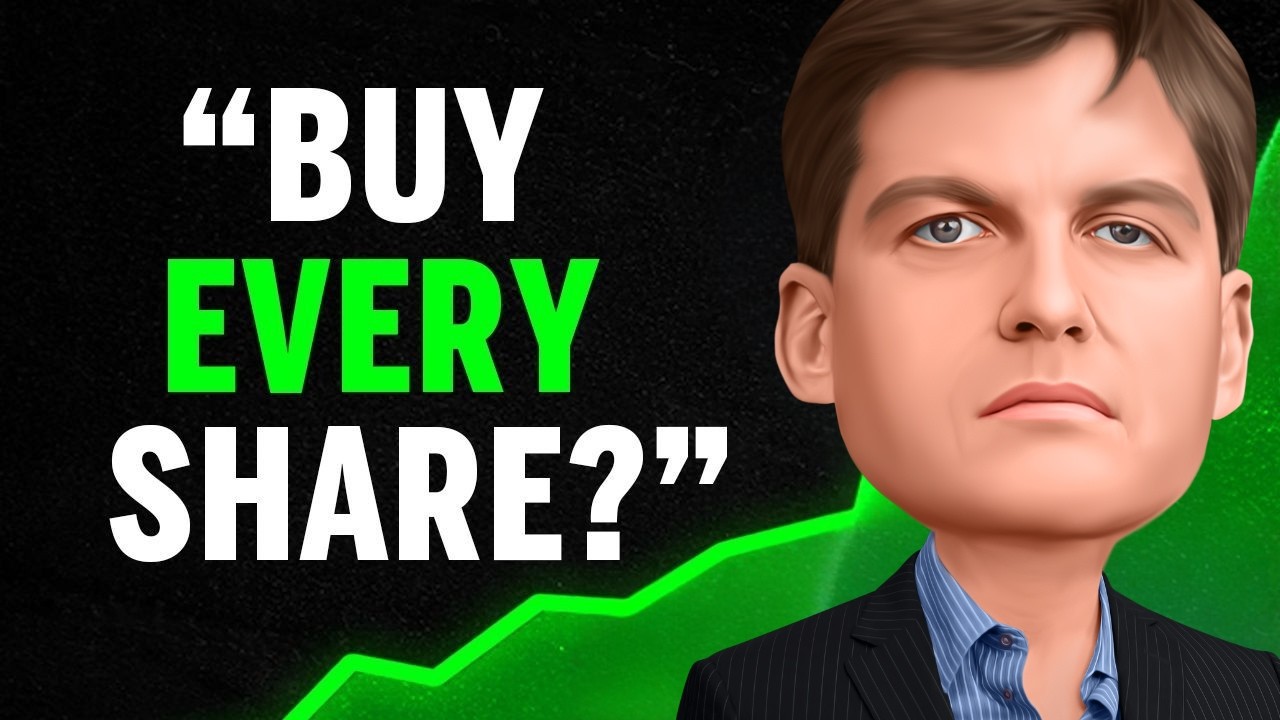
Every Stock Michael Burry is Buying Right Now! (5 New Buys)

- Retorno do vídeo
- +10,66%
- Chamadas
- 6
- Compra / Venda
- 4 2
- Publicado
Recomendações
Entrada é o preço de fechamento do ativo na data de publicação. Atual é o último fechamento registrado.
-
Entrada $407,77 12 mai 2026Atual $488,87 25 ago 2026Resultado +$81,10
Microsoft, it's a new position in a beaten down mega cap software leader.
-
Entrada $45,44 12 mai 2026Atual $61,55 21 ago 2026Resultado +$16,11
PayPal, another new position, dedicating a piece of his portfolio to the payment sector, which has gotten absolutely crushed.
-
Entrada $240,83 12 mai 2026Atual $276,27 24 ago 2026Resultado +$35,44
Adobe, he has increased his existing holdings despite the stock falling significantly.
-
Entrada $581,09 12 mai 2026Atual $563,49 21 ago 2026Resultado −$17,60
MSCI, which he's also increased his holdings,
Contexto “MSCI, which he's also increased his holdings, and Salesforce, which is a target for a future edition.”
-
Entrada $22,37 12 mai 2026Atual $18,04 24 ago 2026Resultado +$4,33
He recently exited after the whole GameStop is buying eBay.
-
Entrada $171,31 12 mai 2026Atual $209,06 24 ago 2026Resultado −$37,75
But the next one I have puts on Salesforce CRM.
Transcrição Completa
Michael Bur just updated his portfolio and he's making five very specific bets right now. These are not random picks. Nothing Bur does ever is. This is the man who predicted the 2008 financial crisis when almost nobody else saw it coming. In fact, his writings about it were what led other people to go invest and piggyback off his investment. He has an amazing track record of success and a process behind it. What people don't realize is before he called the great financial crisis, he was an amazing stock picker with an amazing track record. And today I want to show you what he's buying, why it matters, and then we're going to run the numbers ourselves to see, do we agree with Bur here. So, let me show you the full list first, and then I want to give you a quick refresher on who Michael Bur is. Because if you're newer to investing, you need to understand why people pay attention when this man makes a move. Microsoft, it's a new position in a beaten down mega cap software leader. PayPal, another new position, dedicating a piece of his portfolio to the payment sector, which has gotten absolutely crushed. Adobe, he has increased his existing holdings despite the stock falling significantly. MSCI, which he's also increased his holdings, and Salesforce, which is a target for a future edition. He has not bought Salesforce yet, but it's the top of his list. Five moves all beaten up. Bur is clearly betting the market has punished these businesses far more than the fundamental deserves. Now 30 seconds on who this man is because it does matter. So Michael Bur is the founder of Zion Asset Management. He became a legend for one specific call in the mid 2000 when virtually every bank and analyst was saying that the housing market was fine. Bur studied the actual data and concluded it was going to collapse. He heavily bet against it. In 2008, when the housing market did crash and nearly took the entire financial system down, Bur made over $700 million for his investors. His story became the movie The Big Short and he ended up being played by Christian Bale. Now, I am not telling you to copy Bur. I will never tell you to copy anybody. Do not buy a stock just because he's buying it or because anyone is, including Warren Buffett or myself. What I want you to understand is the process they use to get there. looking at actual numbers before you spend a single dollar investing. That is what changes your approach to investing from speculation. So guys, let's get into it. I'm excited to see if Bur's moves actually make sense based on our process. And guys, I also want to make note Bur was buying GameStop far before the hype happened. He recently exited after the whole GameStop is buying eBay. And if you guys haven't seen this, the most incredible interaction on CNBC that could ever have occurred between Sorcin and Cohen, I cannot stop watching this thing. I've watched this so many times and I cringe every time. >> People are going to ask, "How does the math math for you?" uh given the price tag, $56 billion, given the market cap of GameStop, uh which is a fraction of that, I I know you have this $20 billion um financing letter for from TD, but sort of walk us through how how you could get to that price and how it would work. >> It's on our website. It's half uh cash, half stock. I >> I I hear you. I understand that. I'm I'm just trying to understand where the the rest of the money would come from. >> It's half cash, half stock. >> That math doesn't get you to the price that you're offering. So, >> that's a pretty straightforward question. I don't get it. Like, where's the rest of the money coming from? >> I I don't understand your question. We're offering half cash, half stock, and we have the ability to issue stock in order to get the deal done. >> I It's like I'm like literally I got the sent to me yesterday. I'm like, is this a joke? I thought the same thing. I'm like, is this AI? No. Is it legitimate? Becky quick even like this is very straightforward. I love that she said that. So guys, first up, Microsoft. Microsoft makes the software that runs offices around the world. Microsoft Word, Excel, Teams, Outlook. It runs Azure, one of the biggest cloud computing platforms on Earth, which is also a major AI infrastructure platform. And it owns LinkedIn, Xbox, and has deep partnerships with OpenAI, the company behind Chat GPT. I think their best acquisition ever was LinkedIn. To be able to see all those cringey posts on LinkedIn and old Paul used to go on LinkedIn. They used to call me LinkedIn Paul and I'd go in there on these random posts and just say I and they're absolutely unbelievable. But isn't there a great Instagram account that talks about like LinkedIn posts. It's absolutely awesome. But anyways, Michael Bur has called Microsoft a beaten down mega cap software business. They are down significantly from their highs. investors are worried about the80 billion dollars being spent on AI infrastructure and when it'll pay off. I want to remind everybody the thought of people being worried about Microsoft was unheard of not very long ago. The thought about all these companies that's what has to happen for prices to really sell off. So let's pull up Microsoft in our software and let's take a quick gander at the metrics here. So it is a $3 trillion business. That is the actual price of the company, not the ticker price. The ticker price is merely the market cap divided by how many shares they have outstanding. It can be manipulated very easily. That is the price. Revenue 318 billion. You can see right here their free cash flow is a lot lower than net income. If it wasn't Microsoft, I would be very concerned about this. But we understand when they invest a lot in capital expenditures through AI, that's hitting their free cash flow, not hitting their net income. If you don't understand that, don't worry. It'll make sense as you watch more videos. It's not as over it's it's overwhelming and I understand that. It will get easier. Next, dividend yield. Adorable.84%, but it does eat up 26 billion of their money. They've got good returns on capital, 19% a year for the last five years. Down a little bit recently, great balance sheet. Look at this growth rate, guys. Their growth rate in the last three, five, and 10 years is actually getting faster. How is that? Look at their profit margin. 10-year profit margin 34%. 5year 36.7. One year 39%. Their profit margin is getting better and better and they're selling for nine and a half times sales. The reason we talk about that is as we pull up other software businesses, price to sales ratio is a great way to compare and see like, hey, why is this one selling for 10 times sales, the other one selling for four, another one selling for 85 like Palunteer? So, let's pull up their eight pillars. What I thought it was going to be, six checks, two X's, and the two X's are their valuation metrics. Does that mean it's overpriced? No. Guys, if I told you right now that Microsoft is going to double its profit every year for the next 20, you would pay this in two seconds and you'd be dumb not to. The question is, can Microsoft do that? What do they have to grow to have a valuation this high? 45 times 5-year free cash flow, 34 times 5-year net income. There's got to be a lot more growth there. And it's harder on big companies. Doesn't mean the company's bad. Just means that people are still excited about it. So, you look at this going, what's Bur seeing that we don't see? Because these are high numbers, but he sees something. Next, we go to analyst estimates. Well, guys, look at this. Analysts expect 24 and a half, 14 and a half, 17 and a half, 22, 16.5% earnings per share growth almost doubling in the next four years, guys. For a company Microsoft size to double its earnings per share is an incredible feat in four years. That's amazing. Let's look at their revenue growth according to analysts. 17 1.5, 15 and 1/2, 16 1/2, 17, 14. Another huge I mean this is big numbers for a company this large guys this is a aircraft carrier to turn to to make movements takes a lot of work and this thing is just humming along humming and I want to remind everybody a mere 14 years ago a tech CEO m said to me that I was stupid for buying Microsoft because it was a dead company just remember that now I've gone over quite a few things here today so far and it feels overwhelming you are not alone I want Repeat that till I'm blue in the face. It is overwhelming for all of us at some point. The question I have for you is, do you want to get better? If you want to get better, I made a very, very simple key metrics PDF. What it does is it gives you all these key metrics absolutely free. Click the link below in the description or on our first pin comment. Click the link, sign up. It will send you this PDF absolutely free. It'll explain all of these key metrics to you, how they're calculated, and what they mean. That way you and I can speak the same language and as you watch more and more videos you can refer to it and I assure you absolutely that if you do that you will become a better investor. Now we have story a little bit of story we have a little bit of numbers. What I always tell people do is go right to your stock analyzer tool put in some assumptions. See if you should even spend more time. Let's see if Bur's even based on our assumptions if we're even in the running with Bur. So let me pull up the last time I did Microsoft. Okay, I did a 10-year analysis. I did seven, nine, and 11% revenue growth. A lot lower than analysts think, but what if AI isn't the hype it has always been, and it doesn't grow as much as they think? I I don't want to invest on all the best scenarios. Profit margin, free cash flow margin. I made them the same because over long periods of time, they will be the same. 34, 37, and 40. Now, what PE and price to free cash flow should I assign to Microsoft 10 years from now? Guys, here's what I always tell people to make good to do this. The market average is 15 or 16, but you assign higher multiples for great companies, lower multiples for bad ones. Would you consider Microsoft a good company or a bad company? I consider it good. High returns on capital, good growth rate, great balance sheet, a good moat. So, I'm giving it 20, 23, and 26 times earnings. That's a lot, guys. But again, this is a premium business. And then finally, no margin of safety, 9% desired return. Again, this is not what I want to pay for the company. This is merely what's it worth? What's the intrinsic value? But you got to have margin of safety in there. And that's very simple. If you have our software already, all you do is instead of making 9%, put whatever return you want higher. But if you only want 9%, my question to you is why are you even buying stocks? Go buy a lowcost ETF. Don't no reason to have the stress. So, if you're here to buy individual stocks, give yourself a higher return. So, I hit the analyze button. The stock's currently at 411. I have a low price of 360, high price of 702, middle price of 506. But keep in mind, guys, we don't know exactly when Bur bought. It hit 355 recently, which would have been below our lowest number. So, I don't necessarily disagree with Bur. And the other thing is Bur might think that the revenue growth is higher than what I think, which would make it pretty decent value play. Guys, stock number two, PayPal. Guys, PayPal is the button you click at checkout when you shop online. They also own Venmo. They process over a trillion dollar in payments every year across more than 200 markets. The stock is down over 80% from its all-time highs. And the pandemic inflated the valuation. growth normalized and the stock plummeted, but the free cash flow is real. The user base is enormous and management has been buying back stock at historically low valuations. Bur is putting three and a half% of his portfolio here. So, let's see what the numbers say. Well, guys, they just reported earnings and they fell 10%. But it was mostly because they didn't guide for much higher than people expected. They beat on revenue, they beat on profit. Is this an opportunity? Well, Bur seems to think so. And guys, so do I. I own PayPal. Again, don't buy a company just because I own it. But it's a 43.7 billion dollar business that generated 5.5 billion in cash flow last year and 5.3 billion a year for the last 5 years with good returns on capital. I'm looking at this going okay okay, this is um this is something very interesting. Profit margins getting better, gross margins getting better, all these things are getting better. And I look at this go. And by the way, a very unique metric that we just added to the site PE to growth ratio. It's under one. That means you're getting far more value for the growth. It just takes the PE divided by the growth level. That's incredible. Now, there's a lot of competition, but Venmo is up 14% year-over-year in terms of the transactions that are done there. And I believe PayPal is a very, very safe source for people to buy. Whenever I'm buying something from a place that I'm like, "Okay, I want to make sure I have assurances." I do PayPal because I don't want to get on the phone with Visa and contest something and all that stuff, I want to go to PayPal where they're going to have my back. Especially when I'm buying from overseas markets. So, let's check out the eight pillars. Is it an eight pillar thriller? It absolutely is. All eight check marks, guys. They bought back 21% of their shares in the last five years. That's incredible. Well, they're selling for seven and a half times free cash flow. this is the time they should be buying back shares. I don't know why they're paying a dividend. Granted, it's only 130 million, but that's really not necessary. Just, you know, it is what it is. But I look at this going, just buy back shares. Buy back a ton of shares. Even if the business only grows five or six% a year, if you buy back shares this cheap, your investors are going to make a crapload of money. This is a prime example. All the all the stocks that are beaten down are a prime example why I teach on YouTube because people like to follow the price and say a stock is bad because it's down, a stock is good because it's up. No, that is not true. It could be true, but in all likelihood, news follows the stock price. And I want to remind everybody of that. Like Microsoft 14 years ago, I was like, but revenue and profit keep increasing double digits every year. How is it a dead company? How can you say something is dead or dying? Even when it comes to one of the companies we're going to talk about shortly that Bur bought, I had a great value investor friend of mine who says, "Well, clearly the business is worse." And I'm like, "Okay, it's worse because it's not growing 15% a year, it's growing 12% a year." Like, let's understand what worse means. But these are the emotional things that happen out there that I want to make sure people understand. So, let's go to the analyst estimates for PayPal. Not a lot of growth here. We have $5.87 87 cents in profit growing to 783 according to analysts but that's a long ways away 3 years from now and revenue growth not huge 2 and a half 4 and a half 5 11 12 11.6 six. So, growing revenue growth, but again, we don't know if it's going to happen or not. We have no idea what the future holds. But our job is to go to stock analyzer tool, put in reasonable assumptions, and see if it's worth the time. So, I'm going to go to stock analyzer. I'm going to pull up PayPal. So, guys, I made some pretty conservative assumptions on PayPal. 10-year analysis. First off, guys, look at this increasing return on capital increasing. I did two, four, and six% revenue growth for 10 years. That's pretty low, guys. That's way lower than analysts expect. Way lower profit margin and free cash flow. Now, guys, the thing about PayPal is their free cash flow historically is much higher. But recently, this last year, it was a lot closer within 1% of each other. I did 14, 16, and 18%. And then what PE would I put in this company 10 years from now? Now, guys, I put 13, 15, and 17 because of how competitive fintech is. And it's it's not really have a big moat. So I'm looking at PayPal going, "Oh, there's a huge moat here." It has high returns on capital, but not a lot of growth potential. So I'm actually going to change this just slightly to 13, 17, and 21 because if they're able to really capitalize on things, then I look at that going, it could be a premium company. But right now, I'm okay with this and I put my 9% desired return. You've ever laid awake at night wondering whether your investments are going to be okay and you have enough for the future? That feeling comes from one place. It's fear of the unknown. You don't really know why you own what you own. Everything Money built software that fixes that completely. The stock analyzer tool shows you the right price to pay for a stock based on the assumptions that you put in. The eight pillars analyze the fundamentals of the business. And when you use both together, every decision you make has real reason behind it. That anxious feeling goes away. When the market drops, you're not panicking. You're actually excited because you know what you own and you know what it's worth and you know you paid the right price. So, if the price gets better, you're going to be even more excited. That's what it feels like to sleep well at night. This works whether you've been investing for 20 years or you're just getting started. The process is the same either way. So, start your 7-day trial for just $7. Click the link in the description and get full access right now. Now, I hit the analyze button. The stock's currently at $46. This is why I'm interested. I have a low price of between 60 and 65, 135 to 150, 90 to 100 in the middle. Big potential here. 21% if my middle assumptions occur above. 20% returns on my money. So, okay guys, we're going to go through the last three stocks very quickly. And if you want, pause the video and take a look at my assumptions. Please do that. So, the one stock I was talking about, Adobe, clearly a stock that's the company's not as great, but it's still growing well. It is beaten down. all-time high of 700, now at 255. So, let's pull go pull up Adobe the last time I did it in our software, guys. Very low assumptions here, being conservative. The only thing I want to point out is I did 36 and 9% revenue growth. Everything else, you can take a pause and look, hit the analyze button, guys. I have a low price of 260 to 375, high price of 630 to 840, middle price of 400 to 550. same potential returns as PayPal with 6% revenue growth for 10 years. 6%. That's it. Next one. MSCI. Now, I'm not going to lie to you guys. I don't think I've really looked at this very much in the past. Um all-time high of 679. They're currently at 581. Okay, this is interesting. It's selling for 30 times free cash flow, 30 times earnings. I'm surprised he actually likes this one a lot, but let's go check out why. Yeah. And look at their um this is interesting. Let's see if I've done it in the past. I've never done this stock. >> That's okay. Now, guys, I look at this. Look at their earnings per share growth according to analyst. Big- time growth. 13 13 12% revenue growth. High single digits. Okay. So, let's go make some assumptions now in stock analyzers. I've never done this company before. I'm going to be a little more conservative. Let's call it 3, 7, and 11%. Actually, let's call it 4, seven, and 10. Profit margin and free cash flow margin. Um, the profit's actually lower than free cash flow, which I like. So, I'm going to go uh 40 43 46 for both of these. Now, that's something that's very important I want you guys to understand. By the way, high high returns on capital, but you got to remember when free cash flow is higher than net income, that's it's harder to manipulate free cash flow than net income. So, I like seeing that. So PE, let's go 16, 20, and 24. High returns on capital, great margins, and my 9% desired return. Hit the analyze button. Stocks at 580. I don't see what Bur sees. He has 300. I have 300 in the low side, 720 in the high side, 471 in the middle. Unless he's making very different assumptions than me, I don't see the allure here. But the next one I have puts on Salesforce CRM. Another company has been beaten up because people think that AI is going to ruin it. But here's what's interesting about CRM. Let's take a look at my assumptions in the past. 5 7 12 10% revenue growth. 2530 and 35 because just like Adobe free cash flow is much higher than net income. 14 18 and 22 on the earnings multiple. And then my 9% return. I hit the analyze button. The stock's currently at 187. This is why I'm interested. I have that low price of 190, high price of 520, middle price of 320. I think there's a lot of interest there for that. Now guys, five stocks, most of them beaten up. Bur is betting the fear has gone further than the fundamentals deserve. Remember, great investing is rarely seen as comfortable. Discomfort often creates the mispricings that have allowed value investors to outperform the market for over a century. So know what you own, know what it's worth, never buy based on hype, not even hype about what Michael Bur is doing. So if you want to see three stocks that we analyze with potential multibagger upside right now, these are stocks that can go up multiple times, click your screen for our breakdown of each one and why they might look like opportunities right now. The results are very fascinating. Thank you for your time.
Comentários 0
Entre para participar da discussão.
EntrarAinda não há comentários. Seja o primeiro a compartilhar sua opinião!