…growth basis is a very good deal here. I also like AVGO Broadcom. That is one of the stocks besides Nvidia probably has the most products that go into a data center. Okay, so this is core to that AI buildout theme, AI infrastructure theme. And I think you pick up shares here of AVGO, Nvidia. You could look at Micron Technology a little bit here. I think it is it's obviously looks very cheap here, but there are some real risks that that uh that that memory chip cyclicality continues and that prices come down very quickly for th…
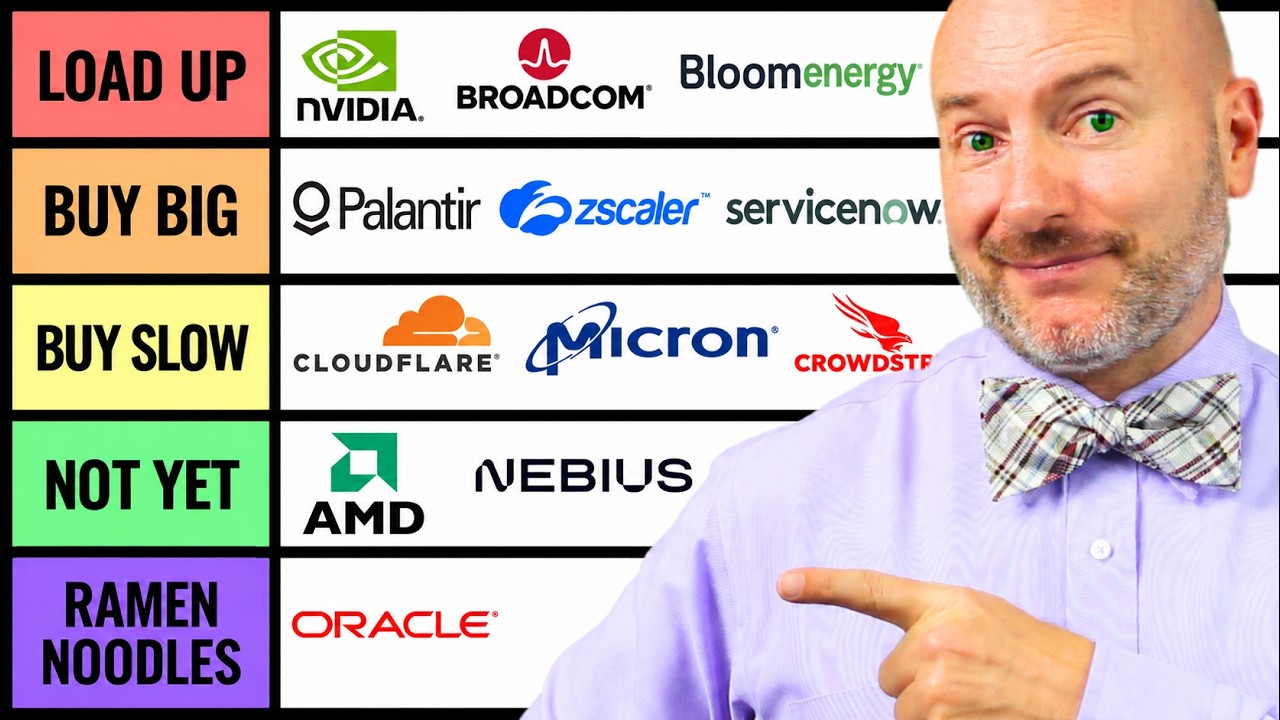
And I think you pick up shares here of AVGO, Nvidia.
Contexto extraído por IA
I also like AVGO Broadcom. That is one of the stocks besides Nvidia probably has the most products that go into a data center. Okay, so this is core to that AI buildout theme, AI infrastructure theme. And I think you pick up shares here of AVGO, Nvidia. You could look at Micron Technology a little bit here.
…isk than appears here in Micron Technology. But here we can look at some of these other ones. Nvidia the second cheapest on the list or second least expensive I should say on the list here.48 48 times price to earnings adjusted for growth. Folks, I think now is the time you start buying Nvidia. It is really lagged, has really built up value in there. We saw where it's leading in in uh revenue growth. It's leading in profitability and point48 times on a price to earnings adjusted for growth basis is a very good deal here. I also l…
Folks, I think now is the time you start buying Nvidia.
Contexto extraído por IA
Nvidia the second cheapest on the list or second least expensive I should say on the list here.48 48 times price to earnings adjusted for growth. Folks, I think now is the time you start buying Nvidia. It is really lagged, has really built up value in there. We saw where it's leading in in uh revenue growth.
Transcrição Completa
This chart of the largest nine stocks tells you everything you need to know about the stock market right now. And it's not all good. Hey bow tie nation. Joseph Hog with your weekly stock market update. This week showing you why that chart reveals the stocks you need to be buying. Not those stocks because the largest stocks won't be the best returns, but how they point to seven others that I'm buying right now. I'm going to walk you through the five core segments of the AI universe. 29 top stocks in infrastructure, cloud software, cyber security, and power to show you the only seven that I'm buying right now. Stick around though because I'll also show you why the market is in for an October surprise. Why the good vibes that drove stocks higher last week was the ultimate head fake. Now, back to that chart of the nine largest companies because it's not their size that makes them unique and points to the stocks that you need to be buying. It is their total domination of the stock market this year. In this table of these nine companies, we see their weight in the S&P 500, how heavily the overall stock market index concentrates each stock here. For example, if you had $100 invested in that broader market, the S&P 500 index of 500 US stocks, more than $8 of that would be in Nvidia alone and $7 in shares of Apple. In fact, a full $39 of your $100 investment would be in just these nine stocks with the remaining $61 spread across $491 stocks in the market. But now what is an an even bigger deal here is when you take those weights multiplied by the stock's return this year, you get how much these nine giants have added to the overall stock market. I've done that on the right here. For example, taking that 8.4% weight of Nvidia in the stock market times its 23% return this year, adding a full 2% to the return on the entire S&P 500 index. Doing that, we get 1.6% from Apple, just under half a percent from Microsoft, and8% from the combined Alphabet shares. Then giant additions from returns on Micron and AMD this year. All adding up to 13.5% return added to the stock market from just these nine stocks. But then here something weird happens when you look at the total return on all 500 stocks. The year-to- date return on the S&P 500 index. The stock market is only up 13% for the year. Nation. That means these nine companies alone account for pretty much all the return on stocks this year with the remaining 491 stocks either losing money or just not budging enough to make a dent in the market. So when you see something like this, you got to ask yourself, what's the story here? What is driving the market? And it's not that they're the largest companies in the world. It's that they are all integrated into that boom in artificial intelligence. Every one of these companies is seeing its stock price rise in that growth of AI and nation. This points to the fact of this market. At this point in the bull market, AI is the only game in town and you need to be investing in it. Now, it's not going to last forever. In fact, I highlighted it a few weeks ago when I think it's going to come tumbling down and I'm going to link to that video in the description below. But for right now, if you do not have money in AI stocks, you're not going to be getting the best returns in the market. Now, that doesn't necessarily mean that you just buy these biggest nine stocks or the basket of AI stocks like the AI and technology fund, the ticker AIQ, which holds 88 stocks in this theme. this late in the bull market, you have got to start being picky, especially with some of these stocks trading at ridiculously expensive prices. So, I want to guide you through the five most important segments of AI from infrastructure to software and power. Show you the seven stocks that I'd be buying right now. Now, we're going to start off with the software stocks here. One of the best opportunities in the market. I think we've got a lot of these other themes, the infrastructure, the power that have continued to go up. We do see some real weakness in the software stocks over the last uh over the last year just on the idea that AI will replace a lot of what they do. But what we're actually seeing if you are picky in these, you can find ones that are actually going to benefit from the AI theme. I'm going to talk about that. Here we have Service Now, ticker N, Snowflake, SN, Palunteer Technologies, PLTR, Data Dog, DDoG, Apploven, A Cloudflare, ticker NE. I'm going to walk through why I think two of these in particular really benefit from the AI trade and how to invest. And if we look here at the chart, starting with the one-year chart, we do see that big sell-off from October, November of last year into really what was April. The big sell-off here down as much as 4550% for some of these as investors feared that AI was going to replace the software created by these companies. basically anybody any enterprise customer who's going to be able to just vibe code their software their own software from AI and uh and be able to replace what these companies do. But then we have started to see the kind really these pull apart and this is when the market speaks volume folks. If you look at the chart you can see what the market is saying where it sees the relative strength and which stocks are going to do better when they start pulling apart like this. You can see they trade all pretty closely together here in the uh as they were going down and and that's just those macro themes, those big picture themes pulling everyone down together. But then you start to see the winners come out. You see data dog up 82% over the last year. Cloudflare up 55% and Snowflake up 41%. Down on the bottom here, Apploven down 60% still for the year. Service Now ticker, one of my favorites. I'm going to talk about that down 26% still and a real opportunity. And then Palunteer Technologies really going nowhere. And again, where I'm going to be focusing here is the convergence of software and AI. Not where the AI is going to destroy software demand as those doomsayers fear, but where AI is creating demand for some of these. We see here Cloudflare reports a 1700% increase in daily requests across the internet from AI agents. And that means this year, for the first time ever, more than half the internet traffic was not human. It was from AI. Here I want to scroll down and compare growth in revenue and earnings for these companies. See which ones are really growing. See which ones are participating in what I call the agentic orchestration theme. Okay, this is where some of these companies are going to act as a middleman between the AI agents. Okay, between the companies running their agents for the business and the models themselves, OpenAI's GPT, Anthropic with its mythos and other models as well as Alibaba and Quinn models going to be standing in between these to really get the most out of those agents. Okay, saying that hey this agent should use this model and this agent should use this other model to really get the most efficiency and so companies aren't spending their entire AI budget in one month. Okay, that is going to be the power created by AI for a lot of these companies working working in between the agents and the models to really get that efficiency and that effectiveness. We haven't seen that yet but we will start to see that in some of these particularly service now we see here 22% revenue growth over the last year 20% expected. I believe that is a little bit lower because of some of the legacy software it still has as products here. I think that increases here over the next couple of years as we start to see that revenue from the orchestration theme build up in that. But this is why we see that negative 26% return over the last year still for service now that it is still trading on that a little bit lower growth there. See some of these other ones 30% revenue growth for Service Now 62% for Palunteer. Of course you pay for it. We're going to look at uh we're going to look at valuation here in a minute, but valuation on Palunteer still very high because of that 62% growth. You want that 62% growth, you're going to have to pay for it. Data dog 26%. Apploving 30%. Cloudflare 30% there. Cloudflare another one of the companies that I think will really benefit from this agent orchestration theme. I think that 30% growth is very good. But here all of these very good 30% plus revenue growth expected over the next year. This does not look like an industry in decay, an industry where AI is replacing the software that they create. I want to scroll back up to valuation area because you know even a great company can be a bad investment at the wrong price. So I want to compare these on a PEG basis. Okay, we're going to compare these on these this PEG non-GAAP forward basis. Okay, so what this is, this is the price to earnings. Okay, so that core measure of how expensive a stock is. What is the price of the stock? What are investors paying for every dollar in earnings created by the company? that core valuation. Of course, with that price to earnings, you got to adjust it for growth because I would much rather pay a higher PE ratio more more money for every earnings if those earnings are growing so quickly like we have with Palenter growing 62% revenue growth growing you know almost 100% plus sometimes on earnings growth. I would pay more for that company than a stock growing revenue or growing earnings at a slower pace. Okay, so you do see these PE ratios here. We want to adjust that for growth to see who is really trading uh less expensively. Here we do see service now trading for just 1.3 times price to uh price to earnings adjusted for growth. That is the second least expensive there next to app ticker a just.5 times. Now a probably a little bit more exposed to that software destruction theme in AI. I would be worried about apploving there. You really need to dig into that company's software. how easily it is going to be replaced by AI before you start investing. I think you can pick up shares here on a rebound play. But I'm really looking at Service Now here, ticker N at 1.3 times. You've got Palunteer at just almost two times price to earnings adjusted for growth. That is the third least expensive. So Palunteer is actually a relatively cheap stock here compared to others in its uh in its industry there in that software segment there. 5.5 times for Cloudflare. I do still like Cloudflare, but it is getting a little expensive at this point, okay, on just the uh the runup in the stock this year. So, I would be focused more on Service Now, ticker N, and maybe even Palunteer, ticker PLTR in this group. I've still got five more stocks to highlight, but also that warning for October that you cannot afford to miss. Now, the best way to protect your money when this kind of thing does happen is through options investing, and it's helped others in the community book some very strong returns. George made over $26,000 buying the $30 calls on SMCI, a 315% return in just two weeks. Justin made a 380% return on a call option strategy in one week. And then there's longtime bow tie brother Chad generated over $10,000 in income this month across five stocks from Amazon to Alibaba and Nvidia. To help you get started, I'm relaunching our ultimate options course. Over three hours of video. I start you with the basics, then walk you through 29 option strategies, when to use each, and how to set it up, including a real world example with shares of Tesla. The course also comes with a one-of-a-kind strategy finder to help you find the right option strategy and an options calculator to show you exactly what to expect. And right now, I'm relaunching that course at a 38% discount. Save $150 off. You're going to get all the basics you need to get started, the strategy finder to make sure you're using the best strategy, the options calculator to show you exactly how much you can make, walkthroughs on all 29 strategies, and a 14-day money back guarantee. Now, that $150 launch discount is only available with a coupon code in the link I'll leave in the description below. So, look for that link or just scan the QR code here. I also want to look at infrastructure stocks here, the backbone, really the hardware on which all of this AI is going to run, the chips, the networking, the architecture, all of this. So I've got Nvidia Corporation ticker NVDA. AMD took advanced micro devices. Broadcom to ticker AVGO. Micron Technologies ticker MU. Taiwan Semiconductor ticker TSM. ARM Holdings ticker ARM. Marll Technology MRVL. And Arista Networks ticker A&E. We come down here to the one-year chart. We can again see that kind of bifurcation in the market. Some stocks up, some stocks down. But really where the market is telling us that these best uh these best opportunities are and the most competitive companies in the space. Okay, we do have some difference in uh in product types here. Obviously Micron is memory chips. Uh you've got AMD CPUs, Nvidia GPUs, Marll is more uh accelerator chips along with AVGO and then TSM is really the manufacturing of these. So it's not exactly apples to apples uh situation here, but they are all all in that AI infrastructure hardware space. MU up 485% over the last year. Easy returns might be out of that right now. Investors uh took their last their last earnings report last week with with a grain of salt. It really didn't drive the stock up much on really what was actually a very strong earnings report. AMD also up 273% over the last year. Marvel Technologies 215%. really like that one on its competition with AVGO in that accelerator chip space. ARM up 102%. Taiwan Semiconductor really the only name in the only game in town for actual manufacturer of those chips. Understand folks, most of these chip makers, the uh the Nvidas, the AMD, the ABGOs's out there, they don't manufacture their own chips. They just they just have the the architecture. They they create the knowledge behind those chips. But then TSM is the one that actually manufactures probably about 90 95% of all these chips put out by those AI producers there. Nvidia itself only up 24% over the last year might be coming into value territory on that one. And ABGO, one of my favorites here, up 5% over the last year. So again, I want to scroll down and look at growth here. I want to compare these across growth. See which ones are growing revenue. Here we got Nvidia still expected to grow revenue 73% over the next year. that tops out uh AMD's revenue growth of 50%. AVGO also expected to grow revenue at 50%. MU ticker Micron Technologies expected to still grow revenue at 100% still double its revenue growth even after the last couple of years. Explosive growth on that one. Taiwan Semiconductor a little bit slower growth there as it uh really just has that that manufacturing capacity. ARM 27%, Maravell 46% and Arista Networks 32%. I think Arista Networks is a little bit uh a little bit forgotten stock here. It's one of the big one of the key players in the networking space. One of the core bottlenecks in that AI infrastructure theme really where are our bottlenecks in the supply chain. First it was with GPUs and Nvidia and then it w it was with uh memory chips like I Micron. Now we're really seeing a bottleneck a shortage of supply for that networking uh hardware and software. We see that here in AET ticker A&E or Oristrista Network's A&E. And what I also want to look at here is profitability because I think it speaks volumes about these stocks. You really you can really tell a lot about a company from its profitability. Here we can look at the gross profit margin which is the the money left over after paying suppliers after paying some manufacturer. We can look at the EBITN margin which is your core operating margin. Okay, this is after all those operating expenses are paid. says after all the uh the suppliers the um after all of the the manufacturing everything is paid basically so this is your core operating cost this tells you a lot about a company folks and what I'm talking about here so you look at something like an Nvidia 66% EBIT do margin okay it has 66% of its revenue left over after paying all those costs here we look at AMD only 23% left over so why is that why are these both chip makers both semiconductor makers but Nvidia has so much more left over after paying in those costs. And I'll tell you, it's a core competitive advantage of Nvidia. And that's because Nvidia's chips are in such high demand, are so high quality, are so high performance compared to AMD that it can charge pretty much whatever price it wants. Okay, you've got 75% gross profit margin. That is really speaks to the price that Nvidia is able to get out of its chips and the uh the power it has over suppliers. Okay, it is the largest largest buyer for a lot of its suppliers which means it can buy at bulk and buy those get lower costs for its suppliers charge higher prices from its customers and that really feeds into the profitability here. AMD no slouch in profitability as well as those stock returns but it just cannot cannot compete with Nvidia. So I think that 23% return on Nvidia over the last year I think it's just building up value in that stock and I think that's one we we need to look at. But then we see that same picture in some of these other ones. Micron Technology took her MU 81% EBA margin. And again folks, it is in that supply shortage for memory chips. It is right now it is right now over capacity. It sold its capacity production capacity years out to its uh to its buyers and it's basically just raising its price to whatever price it wants to get out of its memory chips and people are paying it. Okay, the these are these are products that you need in an AI data center. There is a shortage of them. So Micron is raising the prices and has an 81% Ebidot margin. This is what you need to look at folks to see the real strength in a company compared to others in its industry or or in its segment. Okay, 81% EBID margin for Micron, 71% at TSM. Really, it is the only game in town for manufacturing. Like we said, 71% Ebidom margin. So you really want to look at operating margins here. Compare those and see what you're getting out of these stocks. Finally, putting all these together, we're going to go back up to valuation here again. We're going to look at the PEG non-GAAP ratio here. So, price to earnings adjusted for that growth. Here we see some of the best deals here. Micron at 03. Micron has always been inexpensive because folks typically uh memory chips are very cyclical, extremely cyclical. You get these these giant bursts of demand for memory chips. Uh these the companies like Micron, like SanDisk, they they boost their production capacity. So they they create more production capacity and and really boost the supply of these chips when those prices are high. But then that supply or that shortage comes out. The the demand comes down for those memory chips and prices just crater. Okay. So you get these these very much ups and downs cycles for memory chips. And investors just don't believe that that's over. investors. What investors are telling me here with just a 03 times price to earnings adjusted for growth ratio. Investors are telling me that they don't feel like the that cyclicality is over in memory chips and they feel like a reckoning is coming for this uh for these memory chip makers like Micron that have zoomed 500% over the last year. So a little bit more risk than appears here in Micron Technology. But here we can look at some of these other ones. Nvidia the second cheapest on the list or second least expensive I should say on the list here.48 48 times price to earnings adjusted for growth. Folks, I think now is the time you start buying Nvidia. It is really lagged, has really built up value in there. We saw where it's leading in in uh revenue growth. It's leading in profitability and point48 times on a price to earnings adjusted for growth basis is a very good deal here. I also like AVGO Broadcom. That is one of the stocks besides Nvidia probably has the most products that go into a data center. Okay, so this is core to that AI buildout theme, AI infrastructure theme. And I think you pick up shares here of AVGO, Nvidia. You could look at Micron Technology a little bit here. I think it is it's obviously looks very cheap here, but there are some real risks that that uh that that memory chip cyclicality continues and that prices come down very quickly for that stock. And here, you knew we couldn't forget the cyber security names. My favorite theme in this, my favorite long-term theme because even as we see those cycles in spending for a lot of these infrastructure names, a lot of the chips, a lot of things like that, you will not see cyclicality in the cyber security names because this is one the one line item of a tech budget that cannot be cut. Okay, you cut this part of a tech budget for cyber security uh defenses and somebody hacks your company. Okay, so you cannot cut down you cannot cut this budget out of your out of your tech uh tech spending for a company. Here we've got Palo Alto Networks, ticker PAW, Crowdstrike Holdings, CRWD, Zcaler, ticker ZS, Octa, OKTA, Fortnet, ticker FT&, and Cloudflare ticker NE. Now, Cloudflare really sitting in the middle here. Not really a pure play cyber security company. It did start as a cyber security company but has moved much more into uh the uh the networking and and the internet services and infrastructure space. But I include it here because it did start as a as a software or as a cyber security theme. Looking here over the last year, you can see here again like those other uh segments, it did they did track all very closely together here in that sell-off from October into April of this year. really that big picture fear that AI was going to replace these names really hitting all of those equally but then we've started to see some pull out all right some pull pull forward octa up 122% crowdstrike up 117% Fortnite 109% Palo Alto Networks 92% all four of those up double your money over the last year cloudflare up 55% zcaler really the lagard here really interesting at negative 36% so the market is speaking here folks you got to listen to it and you got to kind of kind of question what you're thinking on some of these stocks when the market speaks so clearly that that Zcaler probably the weakest cyber security company here if there is a company that is going to be replaced by AI then it would be Zcaler I think right here but against that we know there is no end to the news on how AI is really increasing that attack surface for hackers and driving booming demand for these cyber security companies here a new report from zcaler showed that ransomware data theft was up 275% over the last year stealing almost 900 terabytes of data with the average ransom reaching a $432,000 on an attack. And again, we've been writing this theme all year with the five cyber security stocks in my portfolio now up an average 116%. In fact, all but Zcaler have doubled since we started buying. Crowdstrike here up 137%, Fortnet 107%. Octa up almost 120% here. Zcaler, even the lagard down or up 46%. Palo Alto Networks beating them all up 169%. So, you know, I'm buying all five of those. I'm not trying to pick the absolute winner. I'm just getting in on this whole cyber security wave, but we do want to compare these, see which ones to to add right now because these are getting very expensive on that runup, almost double over the last year. We can see here revenue growth for the group. Palo Alto up 20% or expected up 20% for the next year. Crowd Strike expected 23% revenue growth over the next year. Zcaler really interesting here. The market has said that it doesn't like Zcaler. It thinks it is the most at risk to AI replacement but still expected to post 20% revenue growth over the next year. So there is there is an opportunity there a gap to be exploited. Octa just 10% on its fairly small uh part of the market that identity access management part of the cyber security market. Fortnite a little bit slower 15% and Cloudflare that 30% revenue growth. So we do see a little bit slower revenue growth than we saw in some of those other the infrastructure names. Still very respectable revenue growth for a company here. And again these are these aren't the kind kind of companies that grow all just one year. These are the kind of companies these cyber security companies are be going to grow grow for five or 10 years from now as we see cyber security demand just increase from AI. On valuation here we're going to compare on that PEG non-GAAT forward basis. So the uh the price divided by the earnings expected over the next year and that adjusted for that earnings growth. We do see here very expensive stocks. Okay, we saw some real deals in some of those other infrastructure names compared to this but Palo Alto trading at five times on a PEG basis. Crowdstrike really Crowdstrike dominates this uh segment with its Falcon software uh platform. Really the best cyber security you can get out there but trading for 7.3 times on that PEG ratio. So you are paying for that growth, you are paying for that market domination. Zcaler just two times really the least expensive by far of the group and why I do own shares here. Why I would take a second look at Zcaler just on its on its valuation as well as still very respectable revenue growth there expected. Octa 3.5 times uh price to earnings to growth, Fortnite 3.1 and Cloudflare 5.5. So within these I think PaloAlto and Crowdstrike now getting too expensive to to be adding shares. Okay, I'm going to hold on. I think cyber security demand and the revenues continue to grow for these, but still just getting very expensive compared to some of the AI stocks that we've seen. I do like Zcaler here for a new pickup two times on a price to earnings to growth adjusted ratio as well as that very uh very good revenue growth expected. Fortnite 3.1 times probably the second least expensive here. So, I would be picking up shares of Fortnite and Zcaler really on that broader cyber security theme. Now, I want to look at these NeoCloud stocks. Okay, these so these companies building these data centers for lease out to the models for uh OpenAI as well as Anthropic. Not that I'm buying these, but because a lot of you out there are asking for me to compare these. We've got Oracle Corporation ticker OCL, Nebus Group, NBIS, Cororeweave, ticker CRWV, and Iron Limited. IN coming over from uh Bitcoin mining, cryptocurrency mining, going where the money is in this AI data center buildout. all of these companies building out those data centers to lease out later. Now, we see over the last year, again, like some of those other other uh segments, we do see them pulling apart and the market really speaking to where it thinks the returns or where it thinks the competitive advantage is in these companies. Okay, Nebius still up 92% over the last year. While you've got negative uh while you've got losses in the rest of these, Iron down 11%, Core down 35%, Oracle down 50%. Okay folks, this is where the market is saying that if AI breaks, this is where it's going to happen. Okay, if the revenue for u you know this AI theme is just not there. If the users, if the customers, if the enterprise users just don't plow enough revenue to justify all of this spending that we're seeing, this is where you're going to see it first. And this is why a lot of these stocks are down over the last year. And we saw that in what was the biggest news over the last few weeks, Oracle's forced measure on a giant 2.4 4 gawatt New Mexico data center being built for Open AI. This site is way behind schedule and Oracle is saying it shouldn't have to make those lease payments starting in 2028 if that data center isn't ready. It's one of the first cracks in the AI trade here, folks. The bottleneck, the roadblocks to data center and that infrastructure building. So definitely something we want to keep watching. Now that doesn't mean you completely ignore these companies because I think they are still growing. We're going to look at growth here and we'll look at valuation to see if there are any really good uh good deals coming. But we do see Nebia still expected to grow its revenue 371% over the next year. We don't have an analyst forecast for core wave but we see it grew 115% over the last year. Iron 142% revenue growth expect expected. So still some very strong revenue growth. If you do believe that that AI infrastructure the buildout theme is going to continue might be some good valuations might be some good opportunity to pick up shares of these some some of these that have fallen over the last year. Oracle, the only one that I would say definitely avoid. Revenue growth only expected up 32% over the next year. It is still being held back by some of that legacy software uh products that it sells and we're really not participating quite as much in this uh in this AI buildout. But then let's go up to valuation here and see what we're paying for these companies. We can't use the uh the price to earnings because most of these are still negative earnings. So we don't have a price toearnings ratio. We will use the price to sales here and adjusted for that growth. we see the a much different picture than what we see here. Here we see Oracle at the the least expensive of the group just 5.7 times sales. But because those sales are growing so slowly compared to these other ones, these are actually the the price to sales adjusted for growth becomes a much different picture. Okay, even 46 times price to sales for Nebius, which is extremely expensive, very expensive stock there adjusted for that growth, it's closer to about nine times price to sales. still not the cheapest but uh much more attractive on that price to sales adjusted for growth. With Core Weaver, we have about six times price to sales adjusted or price to sales uh ratio and then iron 18 times price to sales uh growth price to sales ratio here, folks. So, not quite the uh not quite the the value that I would expect, you know, given that these are down over the last year. Not quite the value where I would start picking up names here. I would look at Nebius. I think it has the best uh buildout buildout theme going for it. I think Oracle probably the weakest of the group as you saw from those stock prices. So I would still wait a little bit on these. I think they are really the first stocks to shake out if the AI theme uh explodes or implodes and uh and starts losing money. So I would probably go with some of the other segments we're talking about here in infrastructure, cyber security. We're going to talk about AI power next. And that power generation really one of the biggest bottlenecks, one of the biggest supply shortages here in this whole AI theme. the whole AI buildout theme because they cannot they just cannot get that legacy power generation the utilities out to these data centers fast enough. That's because you see in a chart here it can take between 3 to 5 years to build out a data center but it can take up to 10 years to really get that power generation capacity the uh the old legacy power generation from the utilities the lines the transmission all the way out to a data center. So what we're seeing here is these other these alternative sources being built out this bloom energy ticker be verive holdings VRT monolithic power systems ticker MPWR being able to colllocate uh power generation directly at the data centers okay being able to to to position a power generation source right next to the data centers really doing well. We're also going to look at Coherent Corporation to Kario HR and Quant Services PWR. And looking at the stock chart on these, we can see over the last year, like the other ones, they did trade very closely together for most of the year. Then started pulling apart, but not quite to the extent that we've seen it with some of the other ones. Uh Bloom Energy still up 215% over the last year. More than three times your money on that one. 182% for Coherent. PWR up 57%. diverted 52% and MPWR monolithic power up 46% over the last year. In this theme though, besides the news of the delays at Oracle's New Mexico data center, Texas has also put a freeze on new permits pending a grid audit which has hit that AI stocks broadly. It's largely a political move ahead of the midterm. So after November, we could see a lot of these decisions reversed and a lot of these stocks rebound. Against that though, power producers like Bloom Energy here have been aggressive at adding capacity and those tech upgrades. Bloom advanced its 800volt DC native architecture last month and and bought another 158,000 foot facility to ramp up production of its own products on strong demand. And we're going to see that growth as we compare it across these companies. We can see Bloom Energy here at ticker be expected to grow revenue at 66% this year. That follows 90% growth last year. Verdive 31% expected coherent at 36%. power PWR PWR quant services at 24% and monolith monolithic power expected to grow revenue by 33%. So you really see the competitive advantage uh Bloom Energy has really probably the best at colllocating that power generation at a data center and quickly as quick as 90 days uh Bloom Energy can get power colloccated to a data center. So really benefiting from that really growing uh faster than its peers here. comparing the valuation across these. We don't have a uh PEG non-GAAP for all these. We don't have a PEG uh price to earnings non-GAAP for Bloom Energy. So, we can use the the GAP numbers there. Of course, GAP generally accepted accounting principles just a uh the the formal accounting principles that these companies have to have to uh report on their financial statements and then non-GAAP is basically adjusted for reality here. So, we can use a combination of these. It's not apples to apples, but we can use it here. uh Bloom Energy trading for 044 times on that price toearnings adjusted basis. So very inexpensive even considering that 66% sales growth and a faster uh faster earnings growth there.51 times for Verdive. We've got two times for uh PWR 68 times for Coherent and 1.5 times for MPWR. So really the uh the least expensive here, Bloom Energy. I would definitely be picking up more shares of Bloom Energy as we see those data center growth come back after the midterm elections after we see that that come kind of fall to the wayside as a political uh pressure here on the AI theme and as we see Bloom Energy continue to grow its revenue. Now before you get too by happy though, one piece of news last week proves we could be in for a bumpy October before these stocks take off again. It happened Wednesday when the PCE measure of inflation came in lower than expected with with inflation at 3.4% from last year on a dip in oil prices during August. That drove stocks in the S&P 500 up nearly a percent after the news on that idea that that lower inflation means the Fed won't have to increase interest rates quite as fast as expected. And in fact, the odds of a rate increase when the Fed meets on the 28th of this month plunged. The market was pricing in 64% odds of a rate increase last week. Now, after that inflation report and that weak jobs report, the odds are just 20% of a rate increase. But then here, folks, one look at the price of oil in September, and you see why a rude awakening is coming when those inflation numbers come out later this month. The price of oil came down in August after a big jump in July, and that contributed to that lower inflation report that we saw last week. But then look at the jump in the prices through September, sending oil up nearly to the year's high past $100 a barrel. Now, yes, energy prices bounce up and down a lot. And the Fed tries to look past that with a core inflation number. But the market is still very much a two-year-old child that reacts to those big headline numbers. And that inflation number is going to jump when we see the consumer price index, that's the CPI report published on the 14th of this month and then confirmed when we see the PCE report on on inflation drops on the 29th of the month. Now, in itself, I don't think this is going to be enough to crash the stock market, but it will slow it down and could cause that typical 3 to 5% dip in stocks. When that CPI number hits on the 14th, it's going to spook the market and raise odds of a Fed rate hike later this month. That doesn't mean you sell all your stocks, but it does mean being ready and not being allin and holding some cash aside to buy on that dip. And if you want more ideas on stocks to buy, YouTube thinks you're going to like this video on the right next. So click through and see if it's

Comentários 0
Entre para participar da discussão.
EntrarAinda não há comentários. Seja o primeiro a compartilhar sua opinião!