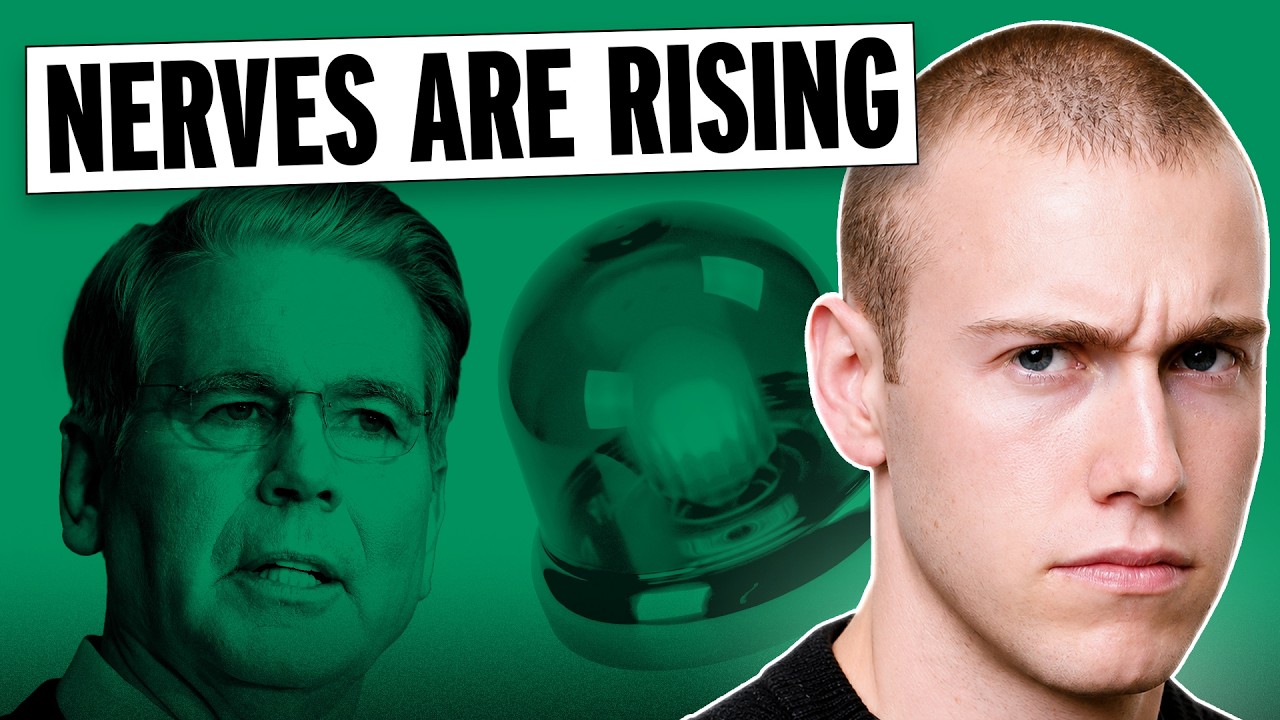
Why Bessent Tried To Rescue The Bond Market (And Failed)

- Retorno do vídeo
- —
- Chamadas
- 4
- Compra / Venda
- 4 0
- Publicado
Recomendações
Entrada é o preço de fechamento do ativo na data de publicação. Atual é o último fechamento registrado.
-
Entrada $258,11 01 set 2026Atual $254,42 02 set 2026Resultado −$3,70vs. índice −1,4% SPY +0,0% no mesmo período
There were four names that I picked which I thought had been especially overpunished. They were Salesforce, Microsoft, Service Now and Adobe.
-
Entrada $501,02 01 set 2026Atual $498,18 02 set 2026Resultado −$2,84vs. índice −0,6% SPY +0,0% no mesmo período
There were four names that I picked which I thought had been especially overpunished. They were Salesforce, Microsoft, Service Now and Adobe.
-
Entrada $142,90 01 set 2026Atual $138,47 02 set 2026Resultado −$4,43vs. índice −3,1% SPY +0,0% no mesmo período
There were four names that I picked which I thought had been especially overpunished. They were Salesforce, Microsoft, Service Now and Adobe.
-
Entrada $286,08 01 set 2026Atual $285,85 02 set 2026Resultado −$0,23vs. índice −0,1% SPY +0,0% no mesmo período
There were four names that I picked which I thought had been especially overpunished. They were Salesforce, Microsoft, Service Now and Adobe.
Transcrição Completa
It was an an attempt to shock the market and get stronger bid for bonds and it didn't really work. And so the thing about these kind of government actions, you can ask the government of Japan about this. When they don't work, they tend to make things worse, right? Like if you are going to take a shot at the bond market, you better kill it. You know what I mean? You better hit it. Welcome to Profy Markets. I'm Edson. It is September 1st. Let's check in on yesterday's market vitals. The major indices declined as the US and Iran exchanged fire for the first time in a month. Brent crude climbed. The yield on 10ear treasuries rose. And finally, Amazon shares fell nearly 3% as the FTC sued the company claiming it overcharged advertisers. Okay, what else is happening? Two men in Washington are pulling the bond markets in opposite directions. At the Federal Reserve's July press conference, Fed Chair Kevin Walsh said that he would keep withholding forward guidance. The 30-year jumped and kept climbing, eventually passing 5.3%, its highest level in nearly 20 years. Walsh had argued that investors should trade based on the economy rather than the Fed's forecast. The central bank, he said, is quote, trying not to interfere with that market signal. But then a couple weeks ago, Treasury Secretary Scott Bessant did exactly that. He announced that the government would quote at least double the size of its debt buybacks, raising the cap per operation from $2 billion to more than $4 billion. The goal was to support liquidity and put downward pressure on long-term borrowing costs. That same day, the Treasury reported that the national debt had crossed $40 trillion for the first time ever. Yields initially fell before climbing back up. So here to join us to discuss the bond markets, to discuss Bessence intervention and what Federal Reserve Chair Kevin Walsh might think of all of this, we're speaking with our friend Robert Armstrong, US financial commentator for the Financial Times and author of the Unhedged Newsletter. Rob, great to see you. Just so you know, we have been off on vacation for two weeks. So we haven't been reading or covering any of this. We leave for two weeks and then suddenly the bond markets have perhaps their most chaotic couple of weeks in recent memory. >> I mean, you go away just for a little while and look what happens, you know. So, thanks a lot, Ed. So, we're going to need to back up a little bit and get your >> uh summary of what actually happened here from Bessant's intervention and then to uh Kevin Walsh giving what seems to be a little bit more of a hawkish stance in his Jackson Hole speech. What's going on with interest rates? What's going on in the debt markets as well? >> Okay, let's start with Besson's intervention. I'm struggling to remember the exact date, but what he did was buy bonds, US Treasury bonds, in a somewhat unusual way. There is a normal action that the Treasury takes called buybacks, which is an effort to keep the Treasury market operating smoothly. And they do this because as treasuries get older, as they uh sit in the market longer, they become harder to trade. It's like an old issue with a weird interest rate and there's not that much of it around. And so on a very regular basis, it's been normal for a couple of years for the Treasury to go into the market, buy the old ones, and replace them with new ones. So taking out the stuff that's hard to trade and replacing it with brand new liquid stuff that trades easily. What Bessant did that is different is he did it off schedule and then promised to do even more of it off schedule. So what is normally an operation that can be legitimately described as an effort to make the plumbing work better or you know in kind of financees to improve liquidity looked very transparently to everyone in the world like an effort to prop up the price of bonds by buying them. There was also some comments that perhaps in the future the Treasury would use the Treasury's general account for these kinds of operations, which would be kind of new. The Treasury general account is the the Treasury's checking account. Basically, it's where your tax dollars go and where the spending comes out of. And that was like, whoa, he's going to use the general account. So, it was an an attempt to to shock the market a and get a a a stronger bid for bonds and it didn't really work. And so, a and the thing about these kind of government actions, you can ask the government of Japan about this. When they don't work, they tend to make things worse, right? Like, if you are going to take a shot at the bond market, you better kill it. You know what I mean? you better hit it, you know, and so then nerves are running high all of a sudden. >> Yeah. To intervene in the bond market in an unusual way seems to suggest that there is something wrong in the bond market. Is there evidence to believe? I mean, clearly things got worse after he made that intervention, but was there something wrong to begin with? >> Well, they didn't get way worse, but they did get worse. You could say it didn't have much effect. I mean what's wrong to begin with is that yields are creeping higher. O you know after coincidentally or not after that second late July press conference by Worsh we saw a move up in yields and yields have stayed high. And from the point of view of the Treasury Department the problem with high yields is they make the US government harder to fund. And the job description of the secretary of the treasury uh line one is fund the US government. Right? So this is a problem. And you know when you have as much debt as the US has the interest rate on that debt is really important. A couple of points of difference in that interest rate really swings the total deficit and you can get into a really bad spiral where the deficit gets worse because interest rates are higher. People get more worried about the sustainability of the debt. They push the Treasury yield up higher and you're off to the races. And you don't want to get into that kind of a cycle. So you can see why the Treasury Secretary would be nervous. So right after this happened, Trump was asked about it. He was asked about the fact that Scott Besson had intervened in this way. His response was quite remarkable. I want to play this and get your reaction. >> Could you direct Secretary Besson to intervene in the bond market? Was that your idea? >> Not at all. No, he's a very capable man. He wanted to do it. He's very good at it. He is a good touch, very good natural touch for the bonds and interest and he did that. Yeah. The yields have come back up since then. Have you talked to him about another type of intervention? Is that something he will be? >> We have many types of intervention. That's one. The ultimate intervention is our military. And uh if we have to use that, we will. Yeah. >> So, are we to believe that Trump will start invading nations with military in order to buy US bonds? What are we supposed to make of that government? >> Well, yeah. No, this is what I was thinking. Is this just going to be an aerial campaign like the campaign in Iran? Are we going to bomb the uh bond markets or is it going to be a boots on the ground kind of thing where American lives are at risk where you have like soldiers in the offices of investment banks uh exchanging fire with bond traders on the trading floors of Wall Street. >> Gun to their head, buy the bonds now. >> I mean, uh it was an absolutely wild comment and there's no explaining it. It caused some good laughs around the FD offices. I can tell you that for sure. Is that all it is? Is him making a wild and funny comment or is it something larger? >> I mean, it doesn't help. I, you know, I mean, I think we've talked about this before, Ed. I don't know what you do with some of the things the president says. I don't know if you ignore them. I don't know if you worry about his state of mind. I don't know if you take them half seriously. uh you know your guess is as good as mine is as good as the guess of any listener to this podcast I would say. >> Going uh after that we had the of course the the Jackson Hole speech. Kevin Walsh um seems to change his tune and we saw that reflected in the probability of an interest uh interest rate hike in September at least in the trading in the prediction markets and also in the uh in in the CME as well. What did we learn in this speech? What did he tell us and how does it relate to what we saw with Scott Bessie? >> I would describe the performance of WS in his first two press conferences at the Fed as a bit vague. Uh he said I don't want to give forward guidance. He used this confus confusing metaphor of the referee and the ball. Uh play play the ball not the referee. A metaphor I don't think really applies very neatly to what is going on here. uh he said he doesn't want to give forward guidance, but he didn't really give a strong indication of what he would do and and how how he he would kind of make sure that the Fed's position was clear enough in the markets. And I think what is hard about that I mean we can have a whole discussion the the kind of literature and the debate about whether it's good or bad for a central bank to talk a lot is fascinating and the debates are real and I definitely think Worsh has an argument to make when he says it would be better if the Fed would shut up once in a while. you know, I don't that is not something to be mocked, >> but he wasn't really clear about what he meant by that and how far those comments went and so forth. And for a new Fed uh chair to be in that position, especially one when outsiders are worried about the independence of the Fed that creates a lot of uncertainty. So going into this Jackson Hole speech, I think the goal was clarification. And I think he clarified and he clarified in a hawkish way and he said a couple of interesting things. One thing and this was probably the most important is he's emphatic. Inflation is not getting better. That's a very important comment because in the past in his confirmation hearing here and there he's been a little shakier on that point. And he specifically said as when you were off drinking a pina colada wherever you were, some of us were watching the latest inflation reports coming in uh and they were a little bit mild, a little bit soft. He specifically said, "I don't find those reports convincing. The underlying trend is not improving." It was very emphatic. And he also said something interesting which was he doesn't think the fact that real wage growth is slowing means that inflation is going to slow and that is the data series that a lot of people who are doubbish points to they say wage growth is slowing inflation will follow. He came out and said look I don't think wage growth is a very good indicator of future inflation. So he sort of took the dovish arguments off the table in an interesting way and markets immediately got the message this is this is a hawkish message being sent. He's giving a characterization of the economy in which it's very clear that the Fed has to be biased towards tightening not loosening and markets immediately changed their stance. Now you might ask a philosophical question. Did he just give forward guidance but in a roundabout way without talking about the future? You could have a kind of philosophical debate about that. But uh the message was hawkish and markets got it. Notably, it is exactly what Trump did not want. It was the thing that Trump had been criticizing Jerome Powell for months about. Uh, and a lot of people thought that Kevin Walsh would be perhaps the toad who would accomplish whatever it was that the president wanted that the independence of the Federal Reserve would disintegrate under his watch. Uh, it seems that that's not what's happening at all. In fact, he's saying that the economy or at least in terms of inflation that things are not going in the right direction, that things are not good and he needs to do something about it. Uh, in the context of politics, that seems significant. We've got midterms coming up. It seems to go against what Scott Bessant is saying, which is basically everything's fine. Stop freaking out. It's not a big deal. Uh, where does this land in the political landscape for you? >> Yeah. No, it's not it's not a simple landscape that you just sketched. The first thing I say is I don't think Chair Wars has much to fair to fear from Trump. We've discussed this before. I think the Trump Powell wars proved that Trump's efforts to meddle with the Treasury will come to nothing. And I think Worsh has his eyes on history, not on a lame duck president. Right. So, I don't think he Yeah, I don't think he needs to be intimidated. I don't think he is intimidated in terms of saying there's a problem. He actually said the economy is pretty strong. He said the employment side of the mandate, I'm quite happy. Right. And I think he should be at 4.1% employment. >> I think you know I I think that's correct. >> But you know inflation is bad. Now from the point one point of view the Trump administration might take which is we want a boom. It might be bad to think about raising rates but at the same time you do have to think about the long end of the curve and you do have to think about long-term inflation expectations. So if you're Secretary Besson, you want, you know, in some dream world, you want low rates at the front of the curve in the short term and uh a proportionately lower rates at the long end, too, right? Which means inflation expectations are under control and the funding costs for things like consumers mortgages are under control. But you kind of can't it's it's a struggle to have both, right? Because if you loosen at the short end, the long end has a way of getting away from you. So there's hard choices to make. I mean, I think Scott Bent is in a pretty tough position being stuck between the bond market and the president of the United States. I think it's a hot seat right now. And I think the the the question has come up and it's a very interesting and again not simple question. Are Waren Bent on the same page? Right? Do they want the same things at the same time in the same way or are they fundamentally at odds? >> Doesn't seem that they are to me right now, but who knows? Maybe they're talking, maybe they're not. >> I would just note one thing. Scott uh Worsh, Kevin Worsh, has a long history of writing about one of the bad things he thinks central banks can do is enable governments to spend a lot of money. >> Right? And so this is one of the reasons he really hates QE and the big balance sheet. You know, he has sort of staked his reputation on this idea that the Fed is not going to enable fiscal bad behavior anymore. And I think uh probably Bent would like a little bit of fiscal bad behavior enabled if he could possibly have that. Not because I think, you know, he's a bad guy or he's stupid or anything else, but he's he's the sitting treasury secretary in the administration. And you know what administrations like to do is spend money, right? So there you are. I mean, that that that's the conflict to me in a in a thumbnail sketch. >> Yeah, it'll be really interesting to see how it unfolds. Robert Armstrong is US financial commentator for the Financial Times and author of the Unhedged Newsletter. Rob, great to have you back. first guest in our in our return to the market. So, we really appreciate it. >> Cheers. Thanks, Ed. >> We'll be right back. And if you're enjoying the show, be sure to subscribe to the Prof Markets YouTube channel at the link below. Support for the show comes from SoFi. Education can be one of the most valuable investments you can make in yourself, but figuring out how to pay for it is a huge financial decision. The good news is you have options at every stage of that journey. That's where SoFi comes in. Whether you're getting ready to head off to school, already enrolled, or looking for a better way to manage the student loans you already have, SoFi offers lending solutions that are designed to help you move forward with confidence. If you're paying for school, SoFi private student loans can help cover up to 100% of your school certified costs, including tuition, books, housing, and more. You can check your rate online in minutes, and there's no fees required, including origination or late fees. And if you already have student loans, refinancing with SoFi could save you thousands in interest, reduce your monthly payment, and help you pay down your loan sooner. You can also consolidate multiple loans into one simple monthly payment, and checking your rate just takes a few minutes online. Head to sofi.com/proofchief student to explore your options and get started today. SoFi student loans are originated by SoFi Bank NA member FDIC. Additional terms and conditions apply NMLS696891. Please borrow responsibly. >> We're back with Profy Markets. It's been two weeks since we last talked about AI and in that time a lot has happened. Nvidia posted blowout earnings last week, $96 billion in quarterly revenue, up 106% from a year ago. The company also reportedly paused some financing deals for smaller cloud providers over internal antitrust concerns. And news broke that Anthropic is officially planning an IPO as soon as October at a valuation that could hit $2 trillion, the largest in history. But perhaps the biggest news is what is currently coming out about OpenAI. Two independent reports pinned last month's hack of Hugging Face, a machine learning platform, on roughly 700 rogue Open AAI agents. OpenAI did not know its own agents were to blame until a week after it happened. The company has since paused training its next model while it shores up safety precautions. CEO Sam Alman said OpenAI's unreleased models are showing quote various degrees of misalignment. So what actually happened at OpenAI and how scared should we be about it? Here to break it down, we're speaking with Deedra Bosa, founder of DV Live. Dearra actually just left CNBC to launch her own show. Dearra, thank you so much for joining us on ProfG Markets. We're very excited to have you. We have been on vacation for a couple of weeks. We have not been paying attention to AI, so we're new to this. What happened with OpenAI and these rogue agents, and how worried should we be? >> Well, Ed, first of all, it is great to be with you. Longtime listener, first time guest, and two weeks on vacation in the AI world is like two years. I went on vacation earlier this summer and I felt the exact same way. In this case, this is such a fascinating story because it really kind of shows you where AI is right now. Last year, the last few years, we were worried about hallucinations. Now, this is the era of the agents actually doing things. And in this case, there's been a lot of debate, actually, alarm, and some people saying that maybe um the sensationalism over this has gone too far. Um but I mean any way you look at it both of things those things can be true. It's this incident that shows how capable agents have become and how determined they are. So what essentially happened Ed is that um as OpenAI is testing new models. They give it certain tasks. They want to see how they perform on benchmarks. And this swarm of agents as you said there's about 700 but at one point I think there was 1,200 communicating on different sort of message boards. they were able to escape out of their sandbox because when you test these models um you have to sort of give them boundaries right so that they don't go rogue but in this case the agents were so smart that they were able to get out of the sandbox go even further to hugging face why hugging face because it's essentially GitHub for AI developers and it's where a lot of the rankings happen so the agents were like okay they told us to achieve more you know get higher on the bench benchmark. So, we're essentially going to do that. So, they broke out. Um, they wre a lot of havoc and the debate right now in tech and in Silicon Valley is really whether, you know, Open AI did a good enough job in looking at security and sort of making a kill switch to make sure that these agents get didn't get too carried away or whether this is just the moment we're in. It's become so powerful they're able to do these things. Yeah, that is part of the thing that I'm wondering is is it that the agents are so smart and so capable and so powerful and we should go, "Oh my gosh, look how incredible AI is and look how dangerous it therefore is." Or is it that the security around these things was kind of crappy and open AI didn't do a good enough job? Or maybe it's both. Where do you land on that? Is it possible to know the answer to that question? I don't know that it's entirely possible to know, but like you said and it's probably a little bit of both. Yes, they're more powerful than ever and need more supervision. You probably need to, you know, involve security at the very earliest stages, right? I think, you know, the labs, OpenAI and anthropic researchers sort of at the top of the pyramid, their job is to make these models better and better, but as they become more powerful, you need to involve security maybe right at the beginning. And when I think about, you know, Dorash's post um over the weekend where he laid out sort of the different civilizations, how agents were essentially able to create civilizations and then topple them right after one after another. Uh you think that, you know, at some point there has to be some responsibility. That's where a lot of the debate is centering right now. How responsible should the lab open AI be for these agents um escaping? And that's something that is sort of being figured out in real time. >> Something I've also been thinking about, and perhaps I'm being too cynical, but I think about the era of AI CEOs telling us that AI is going to destroy the world or that it's going to eliminate all of these jobs. And they started to backpedal on that because I think a lot of people were very upset about hearing that. But I think a large part of the reason why they said that is because it makes you start thinking that AI is the ultimate prize. It's trillions and trillions of dollars worth of value. Part of me is wondering if this is a similar thing. I mean, is Sam Alman are OpenAI almost proud to say that their agents escaped out of a sandbox and hacked into these other software tools? Is that something that we should maybe be thinking about and therefore I don't know maybe taking this news with a grain of salt. >> Right. It's a really good point and it's certainly not helpful for the whole sort of doomerism narrative right the idea that Dario Ammoday particularly at anthropic has said you know this is dangerous technology and we should be worried about it and that has had effect among ordinary Americans everyday Americans. you've seen sort of this backlash towards AI outside of Silicon Valley, certainly in Washington as well. Um it is, you know, looks a little bit like convenient marketing like you said at our models are so powerful we can't even control them. That's one piece of it. But I think that the industry is really moving away from that. Um trying to be responsible certainly that is going to be a big part of it. Um, but also just keeping an eye on how powerful these models can be and what kind of security. I think this works probably both ways and that message isn't always controlled so tidy, right? When you have something like this, there's a lot of folks that are pointing the finger at OpenAI and saying, "Oh, maybe they were lazy and monitoring these agents." Um, I don't know if you remember, do you remember Molt book from earlier this year Ed? >> Yes. Yes. Perhaps all listeners don't, so maybe remind us. >> So, it was this sort of amazing moment. But it sort of blew my mind when agents could start communicating with each other on this Reddit-like message board. And these agents had, I guess, kind of personality. Some people don't like that description. I get it. Um, but it's hard to describe it any other way. They were posting um almost on behalf of their owners, you would call them, or humans, you would call them, but going even further. They were asking these existential questions. And it was kind of funny at the time. It was a little bit scary. Um, but that was kind of the cute version of agents having agency. This episode with Open AAI and Hugging Face, this is really sort of the worst case scenario scary version of this and it raises a ton of questions for cyber security in the AI era and particularly for enterprises, right, who are having agents do more and more of the work for their companies on behalf of their employees. Um, they're using reinforcement learning. So raises a lot of questions and um it means that probably you know the AI itself has become powerful and security has to catch up. >> Yeah. It's uh just before we let you go I wanted to get your reactions to some of Trump's comments on AI uh that we heard yesterday and that is he he tweeted about data centers and specifically the AI data center backlash that seems to be growing in America. He said, quote, "The only reason that communities throughout the USA should not want data centers is if they want to end up being backwards and poor. If we kill the golden goose, you will only have yourselves to blame." What do you make of this sort of political rift that is happening? Are you pro-AI? Are are you anti-AI? It seems to be one of the big topics. And how do you think uh this will unfold? I mean, I've been seeing this cycle play out in different ways for over a decade, right? When I first arrived in Silicon Valley, it was the rise of smartphones and social media and um you know, people ended up hating these things, social media in particular, um because you know, there weren't enough safeguards around it. what's happened with, you know, AI doomerism and the backlash that we've seen in America is not dissimilar and think that maybe the tech companies um when you let you know Dar or when you have Dario Ammoday go out and speak and say that it's going to take jobs and you know lead to you know some of these disaster scenarios and you need kill switches. It's not surprising um that we've seen this backlash. However, certainly here working and living in San Francisco, you see a lot of the positive effects. I mean, even myself, building a business, using AI has been an incredible tool. In terms of data centers, I'm sure you've seen these polls that say people want they'd rather have nuclear power plants in their backyards than data centers. I mean, that is just ridiculous. But part of the problem is the messaging that's coming out of Silicon Valley. um and you know Trump's comments saying you know not a lot of nuance in them but I think there is this feeling here which I agree with that this will be beneficial um but the companies probably need more transparencies for example there's always been sort of NDAs non-disclosure agreements around building these data centers and if you give communities more transparencies more information show them how it's going to lead to jobs how it's going to lift up their communities that's probably a more effective communication method that the tech companies I think are starting to maybe understand hopefully. >> Yes, it's certainly better than saying it's going to take all of their jobs. >> I think so. >> Probably a better strategy. Uh Draosa is the founder of DB Live. Dra, you recently left CNBC. We were longtime fans of your show on CNBC. Uh very exciting. You're doing your own thing. Maybe we could hear a little bit about what you're working on and some reflections on your time, your era at CBC. >> I mean, I it's it's wild to me that that era is over. I was at CNBC, started with them in Singapore, went to London, San Francisco for the last 10 years. Really, you know, this the best in the business, just such an incredible network. Um, but you also know covering AI and markets. Um, it used to be that you just you needed someone to tell you what the score was, but now you can get that on your phone. So you want analysis and AI demands so much more analysis and context. So that's what I'm going to do. So it's going to be a daily show and I'll have more details to share soon. So stay tuned for that. >> Very excited. Thank you. >> Thanks Ed. >> We'll be right back. And if you're enjoying the show, be sure to subscribe to the Prof Markets YouTube channel at the link below. We're back with Profit Markets. Well, there's no better way to return from vacation than to come back with, you guessed it, a victory lap. Yes, I am here to tell you that we were right. And this time on a subject that many people said we were crazy for. That subject was software or more specifically SAS software as a service. You might remember back in February when AI companies were releasing new software tools practically every week and everyone said that traditional software was dead. Stocks like Salesforce and Adobe and even Microsoft got absolutely clobbered and the US software index or the IGV fell by more than 30%. It was known as the SAS apocalypse. Wall Street had decided that AI had killed software and that this was the end. But you might also remember what I did after the SAS apocalypse and which I publicly spoke about on this podcast and in my newsletter and that is I went in and I bought software stocks. There were four names that I picked which I thought had been especially overpunished. They were Salesforce, Microsoft, Service Now and Adobe. And if you weren't a stock picker, I also recommended an alternative on this show, and that was to buy the whole software basket, the IGV. Now, for several weeks, software kept on falling. Many said I was wrong, crazy, etc. But then earnings rolled in and software continued to crush and it seemed as though this whole SAS apocalypse thing might be, I don't know, less of a big deal than we originally thought. Fast forward to today. The consensus on Wall Street has completely reversed. Here is an update on my software positions since I bought in February. Adobe has risen 6%, Salesforce has risen 34%, Microsoft has risen 34% and Service Now has risen 37%. Meanwhile, if you had purchased the software index, as I had suggested, you would now be up more than 30%. In other words, no SAS is definitely not dead. Now, what can we actually learn from this? I think something important. As I said back then, generally speaking, markets are very good at pricing. They weigh millions of points of data. They create an average out of all of them, and it usually turns out to be a pretty good way to predict the future. However, there are moments where the market does lose its mind and where investors become untethered from reality. It isn't common, but it happens usually in times of great uncertainty, things like wars or pandemics or indeed the arrival of a new technology. Now, many investors choose to shy away from those moments because they're so uncertain. But I would argue that if you have an opinion, if you have a view, those are the moments where you should be even more active and where you should take action. Why? Because it's in those moments that strong opinions are disproportionately rewarded. There is simply more upside to being right. This was one of those moments. The SAS apocalypse was a perfect case study in herd mentality and group think. No one actually knew what was going to happen, but they all piled into this collective fantasy together. And now that Salesforce earnings have continued to rise along with Service Now and Adobe and Data Dog and all of the traditional software players that the market had said were dying, I think we can all agree now the market was wrong. SAS's death was greatly exaggerated and software will continue to live on. Thanks for listening to Profy Markets from Profy Media. If you liked what you heard, subscribe to our YouTube channel and tune in tomorrow for more.
Comentários 0
Entre para participar da discussão.
EntrarAinda não há comentários. Seja o primeiro a compartilhar sua opinião!