Dell tonight, I think Dell's going to be pretty good. I love those guys.
Contexto
Dell tonight, I think Dell's going to be pretty good. I love those guys. They uh they're they're basically the way uh they're helping Jensen play in the enterprise.
Contexto
Ben Rits the head of tech research at Malas has a buy rating on Nvidia price target went up with earnings last week.
Transcrição Completa
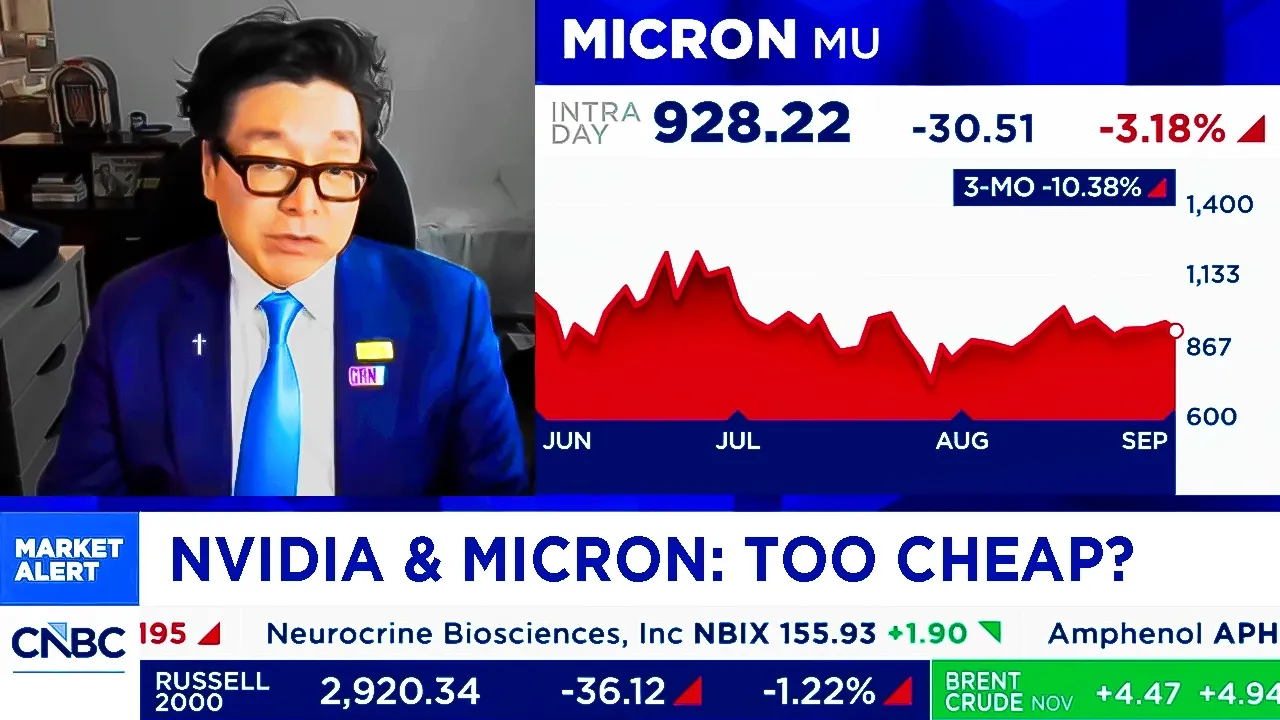
I'm gonna talk about the anthropic deal with Nvidia because it is another Why is that making you upset? >> Because it's anthropic got paid by Nvidia to go by Nvidia and that's why Nvidia >> only 30 it's only $35 billion or so ultimately that will result obviously it's a drop in the bucket. Well, that is where we are and of course we're going to see more like it and uh you know maybe some differentiation on the same theme which is essentially Nvidia providing a credit rep to some extent you could argue for anthropic which doesn't have the balance sheet to go do all this stuff itself but is ultimately the leaser of all the comput capacity. >> You ever heard of compute as an asset? >> Yes. >> Did you listen to that Nvidia call where there's basically companies that are coining money? So listen, if you want to lend somebody money so they can coin money and then pay you back some, you know what? What is that? That's okay. They've been doing that since it's a wonderful life. I >> think they call it balance sheet as a service, right? That's the new phrase. >> That is exactly what So APOCALYPSE >> I SAW PRICE TARGET RAISING DOLBY. >> SORRY. >> I'm going to just explain the structure of the deal itself. You're going to have to try to just not speak for maybe 10 seconds. All right. Oh, I got to talk. Hut8ate is developing the ising [laughter] the data center. That's it. I'm out of time already. Go. How about 15 more? Hate's developing the the data center. They're essentially the landlord. The chips are obviously going to be Nvidia. Um, you got Lambda in the middle there. They're actually putting all the servers in the racks, buying the chips, but Lambda is backed by Nvidia as well. Then you have anthropics sitting there and saying we will buy all the compute capacity that you can give us and that's what we're dealing with here. The numbers are enormous. I do wonder whether one day Jim you won't see Nvidia just say what are we doing? Why not just buy a data center company or a few and buy a power company and a few and just do all this ourselves? >> Well I mean why not have others do it? >> They won't have 75% margins anymore. Why? >> No. Cuz you see Nvidia makes things that should be that are to be sold. That's what they do. Why doesn't Ford buy every single Ford 150? Just buy them all and tell Phil Labau what a bang up month we had because you don't do that. [snorts] It's a company that makes things and then sells them and it finances some of them. >> Yes. But at the end of it is at the end of this chain are the companies that are paying anthropic for its models that they are using to try to gain efficiencies and potentially fire employees and everything else and save a lot of money. That's where the revenue comes from and then it all goes up the back up the chain. So why not just take over the chain? >> Well, because if you listen to Jensen, he'll talk about say Elon Musk buying chips and then like leasing them to these guys for so much money that it was like one of the coups of SpaceX. It was great. It was a reason to buy SpaceX. Notice SpaceX bottomed >> without a doubt. The fact that SpaceX became a so-called hyperscaler almost. >> Yes. Exactly. um instead of just using its own compute capacity for its own LLM and Grock was a huge gamecher for them in terms of the revenues coming in for the company and conceivably over time as well. Not to mention how much he's going to continue to build and his commitments to Nvidia to buy as many chips as he has and now he's moving into M trying to manufacture his own blades for gas turbines. >> You saw that that >> which by the way that hurt how met yesterday. >> How how I met my mother is going to be down bad big today. >> Was no it was down yesterday. >> Is it? Yeah, I think it will because this was >> I want to know what's going on with Micron because yet again it's moving down 2% >> 935 a share. So there are reports that the labor unions in Taiwan where most of the memory is produced could strike over their bonuses. They want to get paid more and they're reportedly demanding that Micron pay out more of its operating profit and do so quarterly instead of annually. Can you imagine if thousands of these unionized memory workers work uh walk off the factory floor? >> That would be serious. >> I mean, poor Apple and everybody else that buys their chips. >> Yeah, that's right. >> And signed a $ 35 billion deal with Nvidia back cloud provider Lambda. As part of the deal, Nvidia is going to provide them chips. Of course, it will hold the lease for the data center in Texas. Our next guest believes that tech giant well it's stock at least poised to break out for real this time even despite concerns around the overall AI ecosystem. Let's bring in Ben Rits the head of tech research at Malas has a buy rating on Nvidia price target went up with earnings last week. I think you raised a little bit to 420 now. All right. Stocks kind of almost back to where it basically is prior to earnings. I think maybe checked exactly if it's a percent or two higher. Uh Ben, what gives you the confidence that there is going to be a catalyst that moves this thing substantially higher from here? >> Well, the catalyst is my mom's birthday. She's turning 80. So, I got to say happy birthday to Bobby. >> She's the best. And uh that's going to bring good luck to Nvidia, I think. So, let me let me get to Nvidia. So, look, I think they accomplished a lot on that call. I think that they d-risisk margins for the next six quarters. No other semis or hardware company can really say that and they have the buying power to do such a thing. So gross margins are what need to stabilize in semis for a stock to work as you know. So that was pretty good. But what I really like about what Nvidia is doing is they're they're in this moment that's a little bit like Apple when Apple stopped working. It got to 12 times earnings and they had to figure out what to do with their cash ward and they had to figure out how to communicate their strategy for the next leg. And what I think they are going to do at NVIDIA is promote this open model strategy. Even though they're working with Anthropic and OpenAI who they want to thrive, I think that the promoting an ecosystem that gives away open and openweight models that run best on their stack is a brilliant strategy. It's a razor and blade strategy that kind of they can only do. So what will happen in my opinion is Jensen's going to promote these open models, open weights and it's going to explode with physical AI because we're going to need a lot of custom models for that and for the enterprise and that is a way to promote their stack, their software and their infrastructure. So you give away the models to get the blade. However, the other brilliant aspect of that David is that Anthropic and OpenAI are going to go crazy investing because they have to stay ahead of open models and stay on the frontier. So they create this flywheel and uh I think people are going to figure it out over time. And >> what's going to what is going to make them figure it out? I mean you can say it but right now it doesn't seem to be having >> well I mean look with Apple it took a long time for people to figure out services. Now we all look back and go oh Luca said it and the stock went straight up. It's actually oh contr my fair you know it did not work right away. People are like ah screw you know stupid. And uh what you got to do is what Jensen sees right now is the singularity is going to happen in the future. That's and he sees a something that you know like a Michael Bur can't see and he's got to stick to it and keep rinsing and repeating this and eventually people will go oh the residual values are longer than we think. Oh, we are going to consume tokens like oil. Tokens are the oil. And what he should be doing right now is something we were talking about off air is that I think they need to get together with the industry and social, you know, out socialist the socialists. And what I mean is they got to get together as a group and they got to say we have to get this world ready for UBI and the data center backlash right now. What they need to do is get together as an industry and say, "Hey, look, whether it's 5%, 10%, we give back to communities. This is how much we have to lower power bills." And they should all get together and talk about the benefits, which are being lost on a lot of people right now. And they need to get on it. And the benefits are there. If you do the work in my opinion, >> yeah, >> there's a lot of benefits for AI. But there may be, as I said earlier in the last hour, the the opposition to data centers may not really be, as we keep seeing it, around the environment or water or electricity usage. It may simply be fear of AI itself. >> Well, that's true. But if if people find out they get a lot of free stuff such as lower power bills and giving back to the community and then maybe even some AI training, they're going to change their mind really fast. People are digging free stuff. Even some of the capitalists kind of like that aspect. And I think they all should get together and out socialize the socialists and get ahead of this because if Elon's right now even a flavor of Elon Elon's talking about UBI and >> we should say universal basic income is what you're talking about when you say UBI. >> Yeah. Basically giving people back free stuff. Yes. And >> well the increase in revenues and margin is going to be so enormous conceivably. He said 20 to 30 trillion added to the world economy that profits are going to go through the roof. But of course the question is whether people will still have jobs, >> right? And so somebody needs to lay out like this is like Saudi Arabia, but instead of oil, we have tokens >> and you know, you're going to get you're going to get back this if you live in a community that has a data center, your property taxes are going to go to zero or lower. Your power bills are going to go lower because we're going to build behind the meter. And they got to lay it out for people. I mean, cuz the funny part is the capitalists could say, "Look at all this free stuff." And uh and then the socialists will be like, "Wow, you know, I can't compete with that. I can't even fund it." You know, >> I I mean, the only problem is that has not been the experience to date. I mean, there are states like Georgia that it's actually cost them tax revenue to bring these data centers in. >> Well, look, I I think that we're going to get to a point I'm of the view that the these tokens are becoming like the oil. And when you've seen things in the Middle East and how they live there and how they give back to the communities, uh you you know I wouldn't say Saudi Arabia is the model. We have to make it, you know, we have to make it American. >> Uh but >> No, but then you're talking about a realignment of our economic system. >> Not exactly something that happens easily. not happens easily, but if we lay the groundwork um based on maybe it needs to come from Elon and all his buddies, but it needs to be laid out laid out clearly and it the vision among these guys if you got them all is a little clearer than it's coming out of Ben Ritz here. I mean, it's, you know, they feel like we're on the path towards a singularity and there's going to be a boom in these tokens and the consumption and, you know, the smartest guy we have is Elon and he sees something. Now, he's often wrong in timing right in trend. >> Agreed. >> And, um, you know, I think we ought to get on it as an industry and make it a capitalist version of uh, this before. >> This is a much longer conversation. While we have you, just to end here though, back to the stock market, not Nvidia, but Broadcom, cuz we're going to get earnings. People sometimes, I think, forget it's a $1.7 trillion market value higher than Metas, for example. What are your expectations for those numbers and what they're going to mean? >> I think the quarter uh and you even the next few quarters mean nothing. I think that the stock is trading probably at a singledigit multiple on the 28 numbers and Hawk needs to say our share with Google is rock solid. it goes even past 2031 and they have to lay out the AI gigawatts that they're going to serve through 2028, maybe even beyond so that people see the long-term earnings power is growing and growing huge. And I think that he needs to do a gigawatt walk sort of uh help people with the long-term growth rate and then the stock can work. But I think it's super cheap. I think you should not underestimate Hawk Tan and he had a bad conference call [clears throat] 90 days ago. Chances of them having two in a row, I think, are slim, but we'll see. And Dell tonight, I think Dell's going to be pretty good. I love those guys. They uh they're they're basically the way uh they're helping Jensen play in the enterprise. >> Beautiful. >> Do you feel like there is maybe collusion or price, untransparency, intransparency, lack of transparency in the memory chip market for computers? So, I haven't seen anything specifically, but just so that your readers understand, I I build my own computer at home. It's fun to do. It's a fun thing I get to do with my brother and we were going to build a new one and RAM looked okay and we said great well you know we can buy his now and then a couple months later I looked again and the price of RAM for people like me had exploded. I haven't seen any evidence of collusion I think that there's an intense need for RAM for other applications other than mine and I just want to make sure that those markets remain competitive and it that's part of my >> because when I hear the FTC chair say wow SHOCKED AT THE PRICE jump I should have probably followed up on that at the time. Look, price jumps happen when there's an influx in demand. That's okay. That isn't necessarily evidence of collusion or price fixing. But it's important to me as a regulator and enforcer of the antitrust laws that our markets remain competitive particularly for inputs for AI and for consumer end use applications like mine. >> All right. So remember Friday Kevin WH at Jackson Hole, he said he talked about the growth rate of AI tokens and how central it is to the nation's economic future, including obviously central bank policy. Earlier today, my next guest uh posted that demand for intelligence is infinite, right? It will never stop growing. Therefore, the surge in token demand will never slow down. See this chart? That's the way it's going to look. I want to bring in Kyle Reed, head, co-owner of Milk Road. Kyle, you know, I I want to start with the basics because, you know, we keep talking about tokens and yet I don't think the vast majority I would venture 90% of people don't really understand what they are. But obviously if the chairman of the Federal Reserve gives his first and most important speech and he's talking about tokens, they must matter. >> Yeah. Tokens are are the currency for intelligence essentially. Uh you can kind of think of like a human when you use your brain, you're using energy. That's the same thing as what you're using for tokens when you're using artificial intelligence. And I think there is infinite demand for artificial intelligence because it's starting to replace uh labor in in various many different forms. Uh, and I think we're seeing ROI in many companies that are using it. I think we saw forget who it was who put out the study, but basically three times the amount of revenue for companies that are using AI versus that are not in terms of new revenue. And so, um, I think the demand for this only uh, continues to accelerate. You know, we started using tokens from chat. Now we're getting into the agentic use of tokens and that's way more than humans do. They use about 10 to 100 to sometimes even a thousand times more tokens. Uh and then we'll get into robotics who also use tokens whether that's robo taxis, humanoid robots and so I just think the token usage meaning the the amount we're using intelligence is only going to continue to accelerate. >> Is it a good way to measure then the the AI success and potential like you know of course you still have a lot of people out there saying this is a bubble and and it's going to fail. >> Yeah, look I mean I think the best thing you can do is look at ROI. You can look at earnings of companies that are using it and right now it's very clear that the ones that are using it are seeing incredible growth. Whether that's, you know, SAS companies like Salesforce and Service Now, uh whether it's the things you're about to see in the robo taxi world with uh with Tesla and Whimo, um or or or many different areas. I think uh to me it's if we're using this stuff and it's making us more profitable, making us better products, um that's really what you want to see. And that's the productivity. You know, if you see what Bennis Bessant has been talking about or or the Fed, you know, they want to grow their way out of this debt. And the only way you can do that is productivity, which is either get more humans to be more productive. that's not happening. And so then it's get AI or technology to be more productive. And I think AI is going to be the way that we do that. I don't know if we'll succeed at at growing our way out of debt, but I do know our only hope right now is AI. And so we just need to continue to use this stuff more and more. And that's the best productivity we're going to see. >> So Drew, what exactly in your mind is the state of that DRAM memory trade overall right now? And is it something that investors can still buy into or feel like they need to wait for a real flush out? Look, I think you're starting to see a lot of stabilization in the price action of of late, which is healthy because we've had a really aggressive sentiment reset for a lot of high beta trades, not just memory. And then when you think about the state fundamentally, I would say it's actually better than it was at the peak before. We still have contract prices moving higher. Estimates I would say for compute looking out to 2030. Uh, and the revenue there, you're looking 3x where we are now. So, fundamentally, setup's better. We've had a pullback and stabilization. It's a good time to put some money to work in secular themes. >> Is there something that investors should be more wary of given the dynamic not just in the US players but increasingly so with some of the external players across the Pacific, especially in South Korea. There's a fear maybe that over capacity in the coming years could be an issue. These many of these stocks still trade at very small relative price toearnings multiples compared with other semiconductor stocks. They're wondering if it's justified or not. >> So let's get away from the [snorts] pees a little bit. It gets a bit messy because we've had such a big move in the E. When you look at what the group is really pricing in, you're looking at earnings estimates or I I would say embedded growth expectations that are about 30% for the next 5 years annualized. So compounding when you look at the street estimates, the fundamental side of it, we think we can hit 35 plus%. So the valuation, forget the PE, when we think about the DCF, it actually makes a lot of sense right here. I would think about the trade that way and then the multiples will really just follow suit as long as we can hit those long run growth estimates. >> I mean, broadly, Drew, what does that mean for a seasonally September one not off to a great start for a tricky month here? >> It's it's a really good time to add to these on pullbacks. At the end of the day, as long as long run estimates for earnings keep moving higher, which they have for the Korean names, for the US names big and small, as long as they keep pushing higher, that fundamental setup is supportive for a longer term kind of bull market, especially in the growth trades. It's not these cyclical concerns around rates, which you definitely had to argue at the beginning of the show, that are going to hurt the earnings estimates here. I think it's a really good place to hide out especially if you want to buy some risk. >> Now thematically Roundhill is known for for deploying thematic ETFs. DRAM is a theme within semiconductors. From a strategist standpoint, is it the real theme that's going to have the most upside or are there other themes that you're tracking right now that could be poised for some outperformance relative to what you're seeing even from a DRAM? I would say the general theme outside of just memory is going to be bottlenecks in the AI supply chain. So you see that in Neocloud, you can see that in Photonix, you can see that in a few different places, but the key to buying the bottlenecks is knowing that end demand is still there. I think Nvidia commentary last week was huge. They basically told you, "Yeah, we know these bottlenecks exist. It kind of hurts how much we can deliver, but it's still there. It's not killing demand." So, as long as demand for an end theme is still strong, you can buy the bottlenecks where there's pricing power. >> We've talked a lot and every time I think you've been on recently, this data center issue which is now bubbled up to the to the point of feels like a boil or on the verge of a pretty steady boil. What's the impact of that on the broader market, do you think, as September begins? Yeah, it's a real issue because as as we talked about, it's resonating with voters and we're seeing Republican governors siding with that in and supporting moratoriums. Um, I just think the AI industry needs to do a better job of explaining the benefits and I think that's I think they've gotten the message. It is creating jobs and it's creating benefits for users and of course it's strategically important for the US. So I think that this is definitely headline issues even into the midterms. But once that's behind us, I think the AI sort of return on investment story is what's important. Those stocks will rebound. >> Does it does it change anything about the near-term trajectory for the AI trade? You know, there's a difference obviously between how people feel about this issue and how investors should react >> based on how the people feel. >> Yeah. It feels like the trade itself has been impacted by all of the negative headlines and the polling and the rhetoric that's been out there. Is do you think so? >> Yeah, it definitely has. And I think we have to keep in mind three things. One is of course a lot of people have made money in AI stocks. So they're going to be involved with a trade, [snorts] but there's going to be churning between bottlenecks and semis and memory and downstream ideas. I think we're going to witness churning. And of course the third is as long as this is out there, multiples can't really expand. So it does sort of put a cap on it for now. >> So I think that it's unlikely that investors are suddenly going to find religion uh about all of the different things that could go wrong where you just had an earnings period that confirmed that the AI party is still rolling and you had Jensen Wong come out less than a week ago and tell us we've got visibility into 2028 and the growth numbers are still very strong. So I think that realistically this is a temporary pause. But wasn't the tell in all of that that the market didn't react like you would have thought in Nvidia knocks the cover off the ball. Jensen Wong guides 70% revenue growth into 28 longer than they've ever gone before. And what have the stocks done since? Not much. >> Yeah, but you've heard me say that Nvidia's good news is good news for everybody else and less so for them, right? as the biggest company in the world at $5 trillion. It takes a ton for them to be able to move a 1 percentage point at any given moment. But you look at the shares of like an Amazon, for example, or a Microsoft, for example, or an Apple. All of these companies after uh Q2 earnings reports have done extremely well, especially the days right after the earnings print. So, I just think that it's unlikely that suddenly we're going to stop caring about that narrative and really focus on the things that we've been actively ignoring for the for the better part of a year now. >> What do you think? >> Uh I mean, I'm going to agree cuz I think Nvidia's multiple is capt. >> I do agree with Malcolm. Yeah. Uh because uh Nvidia's multiple has been sort of stuck uh in the high 20s in the low high teens, low 20s. >> Wasn't it like the lowest level in like seven years going into going into the print? Yeah, >> I mean it was stuck in a good place. >> That's right. And to me, it's a sentiment barometer that investors can't be that a bullion about AI until, you know, Nvidia follows like a Cisco path and rerates to a multiple of the S&P. And I think that we're still quite a ways from that. >> You you think it deserves a higher multiple. >> Yes. Because they have a recurring revenue business. Uh their dominance in a sector and >> based on a lot of assumptions, right? the the the recurring revenue. >> Uh it yes, in some ways, Scott, because the future is still uncertain, but actually we can say five years ago, we were uncertain about the future of AI and they were they were dominant back then. So to me, they have a they're not getting rewarded for their ability to navigate this AI trade so successfully and really being central to that future and and then at some point they'll be traded like an N of one company and have a high multiple. >> I want to bring it in. But in the semis, what I do right now, you mentioned things that are down 30, 40, 50%. I'm looking at names that are holding up the best. A name like Micron, I'm watching very closely because if the semis turn, I want to own the strength because that'll usually uh turn up first. So, something like that. But the problem is we've got some deep deep drops in here, deep corrections. And it's not just semis, the whole artificial intelligence trade, whether it's the energy, the construction, the data centers, they're also in deep downtrends. And I just would rather wait, be a little late, not too early, because you never know where the bottom is. And again, it's been really rough going for those two areas. >> Well, yeah, but you know, you look at Nvidia and Nvidia and this anthropic deal, $35 billion cloud computing deal with Lambda. Both of those are Nvidia backed. There is always that question about the circularity trade, but when we talked to Jensen Wong last week right here on the claim and countdown, he was saying that there is an actual thinking behind funding those neoclouds because well, listen to how he put it. >> Primarily, most of it is going to be around a couple of AI labs. And the reason for that is because obviously these are extraordinary companies going through an extraordinary time. Their businesses are turning a corner. They're inflecting and becoming quite profitable and what they need is compute, but they don't have the balance sheet to go secure the loans. They don't have the they're not investment grade yet. They're they're neither of them public yet. And so they don't have the ability to secure lowcost capital and therefore because we understand exactly what's going on with their business because we know compute is vital to their growth. Um and also because you know these companies are in the on the way of becoming public companies. This is really a perfect time for us to help them with their flywheel. And there we backs stop them. >> Gary, we got to run, but really quickly, you don't think that he might look like a real genius in the future for having helped out get these neoclouds that don't quite have the credit rating to get the loans to expand AI. >> Uh, the best way I can put it, he better be right. you know, there's now almost $2 trillion of offbalance sheet debt and 1.5 of on the balance sheet. That's a heck of a lot of debt uh betting on the future and and Vidy has really become something of a bank uh to a lot of these companies. So, I'm rooting for him because if the other happens uh there could be big big trouble. So, fingers crossed he is right. And look, so far he's one of the greatest success stories of the last 20 30 years and let's hope that continues. I'm all for it. Anthropic inked a $ 35 billion contract with an Nvidia backed NeoCloud play Lambda. Nvidia owns the lease to the center. The complex is being developed by former Bitcoin miner Hut 8. Nvidia's backing Hut 8's activities too. Why does Nvidia have to make all these investments in back stops? Because the companies involved just couldn't go to a JP Morgan or Bank of America and ask for multi-billion dollar loans. They wouldn't get them. Many of the companies Nvidia backs are not investment grade. Nvidia is effectively serving as the banker for these kinds of companies. I like that Nvidia knows this business better than anybody else. They know the chips retain their value. Worst case scenario, they repossess the GPUs, maybe even the for the same price they sold them. No bank could think like that, though. So, Nvidia's become the banker for the AI data center buildout. Now, the one thing I don't like is that no matter how vicifously I defend these deals, and I keep doing so, I know it's falling on deaf ears. The more complex these deals are and this anthropic the lambda the hut eight arrangement is real complicated and mind-numbing the less Nvidia is going to get credit for it. As much as I believe in Jensen Wong's strategy, I know that the market's not going to be happy with it. Instead, Wall Street wants Nvidia to take its money and come in with the biggest buyback in history. Something to rival what now former CEO Tim Cook did at Apple where he shrank the share cap by about 44%. See, Apple realized there was no better investment out there than Apple. Right now, I believe there's no better investment for Nvidia than Nvidia. It's not like Nvidia doesn't have a buyback. It's been buying about $20 billion worth of stock a quarter and $99 billion remaining on share repurchase authorization at least at the end of the quarter. But that's the last quarter. But that's not a lot of money when you're dealing with a $5 trillion company that's practically printing money. Let me give you the cadence of why a much bigger buyback is needed. On October 28th of last year, when Jensen Monk spoke at GTCDC, he said, quote, I think we're probably the first technology company in history to have visibility into a half a trillion dollars of cumulative Blackwell and early ramps of Reuben through 2026. End quote. Nvidia stock gained 5% that day, climbing from around 191 to 2011. On March 16th, 2026 at regular GTC, Jenna said, quote, "I'm here to tell you that right now where I stand, a few short months after GTC DC, I see through 2027 at least 1 trillion dollars." End quote. The stock gained 1.6% that day, moving from 180 to 183. Last Wednesday, August 26, after the market close, CFO Colette Crest said revenues would be up 70% in fiscal year 2028, which is 2027 if you go by the normal calendar. And Nvidia would be on track to grow 100% if not for supply constraints. Stock rallied 8.7% in response last Thursday. Since then, it's given back more than half that gain. Overall, from the close on October 28th to today, Nvidia stock is up 8.2%. The S&P 500's up 10.7%. Yes, Nvidia's underperformed despite that gigantic unheard of leap in sales. Here we have a company that's dramatically ratcheted up revenue expectations for next year and its stock has barely moved. I think it's radically cheap. Whatever Nvidia is doing simply isn't being rewarded by Wall Street, just like Apple rarely used to get credit for its greatness. Apple took matters into its own hand with that gargantuan buyback and it worked worked like a charm. Now look, there are reasons why Nvidia is getting no respect. Maybe it's because they're lending to dicey outfits. Maybe they're just popping up companies that shouldn't exist. Although I personally, again, think that's dead wrong. In my view, Nvidia is simply extending credit against merchandise that can and does retain value. I think it's absurd that Nvidia has an amazing order book and huge profitability. Yet, it trades at just 23 times this year's earning estimate and a much lower P on the soldout years. So, if I were Jensen, here's what I'd do. I'd quintuple quintuple the buyback authorization. Quintuple it. Announce a monster half trillion dollar buyback. Repurchase a tenth of the company in a fairly aggressive fashion every day. Clockwork. Get bigger on the down days. Take advantage of the selling. Reload when finished if the balance sheet allows it. Why not? Company's not getting any credit for its current strategies, which is wrong and creates the buying opportunity. And I think they could afford the level of buyback without scaling back their investments. I think they want a higher stock if they want it. Here's what happens. You pretty much need to do it my way. Even as it is a prosaic by road enterprise. My plan is not an indictment of the company. It's an indictment of the market. Wall Street is not valuing Nvidia correctly. That's why they should do like Apple, which also is valued incorrectly, and repurchase a spectacular amount of stock. Because I think from Nvidia's perspective, there's nothing more valuable in this market than Nvidia. Mean it, show it, do it. It might be the best investment this amazing company's ever made. All right, I hope you're all doing well today and staying calm in this market. Tuesday was a rough day throughout much of the market as tensions rose notably in the Middle East, sending both oil and yields higher as stocks traded lower. Overnight it was reported that Anthropic assigned a $35 billion compute deal with NVIDIA backed Lambda. NVIDIA holds the lease on the data center and the data center is being developed by HUD 88. Anthropic will use roughly 350 megawatts of capacity at the facility to run NVIDIA infrastructure for Claude. You may remember back in July the Financial Times published a piece about Nvidia and HUT 8 that I mentioned on this channel. I thought the headline of that story was somewhat sensationalized given the actual details of the article. The text of that article indicated that Nvidia would pay less than $2 billion per year spread out over many years. That's nothing for Nvidia. Anyway, the data center campus mentioned in that FT story back in July is the same data center campus involved in today's news regarding anthropic hut 8 lambda and Nvidia. Also on Nvidia's earnings call last week after talking about OpenAI, CFO Colette Crest said, quote, "For another Frontier AI lab, we will provide selective credit enhancement for nearly 2 GW of compute. That other AI lab is almost certainly anthropic." And so it appears that today's news may be part of that selective credit enhancement that Colette spoke about. Nvidia is the entity holding the underlying long-term lease with HUD 8. That investment grade Nvidia lease makes the project much easier for HUT 8 and its lenders to finance. And then Lambda provides the Nvidia compute to Anthropic. So this roughly 350 megawatt project may be part of the 2 gawatt that Colette mentioned on the earnings call. I want to remind you of something else Colette said on the earnings call about the frontier model companies when she said quote we are going through a major computing platform shift. The creation of one of the most important technologies in human history and these are once in a generation companies. Their technology leadership is proven and their customer traction and usage are skyrocketing. We expect them to become the largest technology companies in history. Bear that in mind whenever you see headlines about Nvidia lending its creditworthiness to help open AAI and Anthropic secure the capacity they need. These two companies do not have the investment grade credit ratings to secure the financing they need. That's where Nvidia can step in to help. And importantly, there's very strong in demand from customer sovereigns and enterprises for the products and services offered by both OpenAI and Anthropic. But they need compute in order to serve that demand. This is not a situation of propping up demand. It's a situation of helping these companies secure the capacity they need in order to serve the demand they're seeing from their customers. Given the strong demand they're seeing, if they had more compute, they would have greater revenues. It really is that simple. The circular financing fears are largely overblown and they miss the point entirely. We know that the Frontier Labs revenues are surging and according to Jensen, they're now generating profitable tokens. With each new generation architecture from Nvidia, token costs will come down. And as token costs come down, I expect we will gradually see the frontier model company's margins improve. They just need some help initially so they can get the capacity they need in order to serve demand. Also, the fears about the frontier model companies being able to meet their spending commitments are largely overblown as well. The $500 billion in independent thirdparty capital that Nvidia recently announced with six of Wall Street's largest financiers is mainly to provide access to capital for the Frontier Labs so they can secure the capacity they need at attractive rates. Now is not the time to worry about their spending commitments. Also, as a brief side note, as I said in last night's video, keep an eye on cyber security as another major use case for AI moving forward that will increase inference demand significantly because we're talking about an agentic workload running continuously. So essentially 247 inference demand that will increase compute demand significantly and the frontier model companies will benefit as well. And I don't see that demand decreasing over time. I actually see it increasing over time as threats become more numerous and complex. Speaking of cyber security, today Crowdstrike announced Crowdstrike Safe Mind, a family of purpose-built security models and harnesses from the Crowdstrike Super Intelligence Lab. Crowdstrike builds the models using Nvidious Nematron open models in collaboration with Nvidia. As token costs come down, token generation and usage will increase. We learned that very clearly based on what Open Router shared this past week. As I explained in yesterday's video, as token costs come down and usage increases, valuable new use cases will be unlocked. As valuable new use cases are unlocked, inference demand will increase significantly. As we saw earlier this year with a coding, greater inference demand ultimately leads to greater compute demand. This is not the same as oil during the shale revolution. There are substantially more use cases for AI than there are for oil. You cannot unlock many new use cases by means of producing more oil. However, there are many new use cases that can be unlocked by lowering token costs and increasing token generation and some of those use cases are very valuable. There's a fundamental reason why Nvidia is driving token costs lower with each new generation architecture as well as with software optimizations of older generation hardware. Nvidia stands to benefit enormously as a result of lower token costs. In other news, SoftBanks SB Energy has filed to go public in the US. You may remember that SB Energy is developing the Ohio site where Open AI will be the tenant. Nvidia is providing a credit back stop for that site in order to enable more favorable financing. SB Energy's IPO prospect has revealed that Nvidia has committed to invest $1.5 billion in a private placement at the IPO price. Look, $ 1.5 billion is not much for Nvidia and Nvidia sees that SB Energy has a lot of business ahead of them. Call what you will, but Nvidia will likely see a good return on that investment over the long term. In other news, Anthropic just announced Claude Fable 5.1 and Mythos 5.1, which show promising results. The AI race is alive and well. As I've said before, with the advance of open models, you better believe that Open AI and Anthropic are motivated to innovate even faster. They likely already have multiple models that they haven't released to the public yet in order to avoid raising concern in Washington. Additionally, I think there will always be demand for leading frontier level intelligence, even as open models become increasingly available. I think we're always going to see demand at the frontier for the most demanding use cases. In other news, it's reported that Micron's Taiwan unions are moving toward a possible strike. It's been reported that 80% of surveyed members supported strike action. They reportedly want an additional fiscal 2026 payment and starting in fiscal 2027, a bonus system distributing 15% of operating profit. Taiwan is Micron's largest manufacturing base and produces both DRAM and HBM. So, this is very important to watch as it relates to Micron. It's important to mention that there is no strike yet at the time I'm making this video. Negotiations and legal procedures must happen first. Micron says that this year's performance bonus will be the highest in company history. In other news, Dell reported another very strong quarter with revenue up 58% year-over-year. Adjusted EPS up 203% year-over-year. Fullyear fiscal 2027 revenue guidance of $92 billion, which is up 69% year-over-year. And full year fiscal 2027 adjusted EPS guidance of $25.50, 50 cents, which is up 181% year-over-year. AI optimized servers revenue was up 100% year-over-year, while traditional servers and networking revenue was up 122% year-over-year. During the quarter, Dell booked a record $60.9 billion in AI server orders, and Dell exited the quarter with a record $95 billion backlog. So, put simply, AI server backlog is growing much faster than revenue. That reaffirms the thesis that there is still plenty of runway ahead and we are not at peak spending. On the earnings call, leadership said its pipeline grew sequentially and remains multiples of the backlog. They also said demand outstrips supply and demand for traditional servers was actually greater than Dell's reported results because Dell was supply constrained. Overall, Dell's earnings report and earnings call were very positive for hardware companies like Nvidia, Micron, SKH, and so on. Looking ahead, Jensen is scheduled to speak at the Goldman Sachs, Communicopia, and Technology Conference on September 10th. Then we have Micron earnings on September 30th. And then Jensen is scheduled to speak again at GTC Berlin on October 21st. Now, in case you're new to the channel, I want to make sure that you have at least a basic understanding of the underlying long-term thesis. So, let's cover that. Now, I don't know what's going to happen in the short term, but from a long-term perspective, I am very confident that Nvidia will be worth much more in future years than it is today. When Jensen was on the Lex Freedman podcast not that long ago, he was very seriously raising the possibility of Nvidia becoming a $3 trillion revenue company in the near future. If that happens in the coming years, then it is very plausible that Nvidia could one day be worth tens of trillions of dollars in market cap. That might sound crazy, but that's what Jensen is implying when he raises the possibility of Nvidia becoming a $3 trillion revenue company. I guess the question at that point is what multiple the street will be willing to give Nvidia. I don't know the answer to that question, but I truly do think that Nvidia will be worth much more in future years than it is today based purely on the fundamental growth of the business. Based on everything I'm seeing, the world is still computed and I expect that to continue at least through the first half of calendar 2028. In a computed environment, developers will use whatever viable compute they can get their hands on. Today, there are no GPUs that are sitting dark due to a lack of demand. Like there was fiber sitting dark due to a lack of demand at the height of the dotcom bubble. Back then, companies were laying fiber in the hopes that use cases and demand would eventually show up. Today, we are seeing the complete opposite. As I've said many times, when market participants compare this AI revolution to the dot bubble, they ignore the fact that the internet is already here this time. This means that mass adoption of the technology and new use case development at scale are immediately possible. We don't have to wait years for it to show up. It's already here. The world is compute constrained which means there is not enough supply to satisfy demand. New capacity is utilized as soon as it comes online. The hyperscalers are monetizing capacity as soon as it comes online. Each of the hyperscalers spoke about being supply constrained on their most recent earnings calls. Additionally, many of the clouds are building out into contracted demand. They're not blindly building in the hopes that demand will eventually show up. No, they're building out because they have signed contracts and in some cases significant prepayments from their paying customers. This AI revolution is fundamentally different from the do-com bubble and 2026 will be a pivotal year for the AI industry thanks to the rapid adoption of agentic AI and the proliferation of agentic systems in the world's leading enterprises. The leading AI labs revenues are surging right now. Agentic coding and the implementation of agentic systems in large enterprises are new use cases that are increasing inference demand significantly that subsequently is increasing compute demand. The rapid adoption of agentic AI is why we're seeing an inflection in inference demand. It's why we're seeing the leading AI labs revenues surge. I wish both Anthropic and Open AI were public so the public could see the ramp in their revenues. I think the leading labs surging revenues may be the initial proof point that grabs market participants attention and causes them to realize that there will be a clear ROI on AI infrastructure. I think the leading labs surging revenues will also help assure investors of the longevity of Nvidia's growth since these labs revenues are directly tied to compute. If they had more compute, they would have greater revenues. It really is that simple. Demand is not the problem. The problem is a lack of supply to meet the demand. As I've said previously, I expect the world to be compute constrained at least through the first half of 2028, possibly longer. And so regardless of what happens in the short term, it's important for long-term investors to remain focused on the fundamentals, maintain a long-term perspective, and remember that we are only in the early stages of aic systems being adopted at scale. This will increase compute demand significantly, and after that, the next surge in compute demand will likely be fueled by physical AI. We're no longer talking about digital agents performing digital tasks. With physical AI, we're talking about physical AI agents performing physical tasks in the real world. NVIDIA CFO has called physical AI, quote, a multi- trillion dollar opportunity and the next leg of growth for NVIDIA. This industry will fundamentally transform society and Nvidia has positioned themselves to benefit massively. NVIDIA sells the hardware for the data centers where the models are trained. They offer omniverse where the models are taught and tested. And Nvidia also sells the hardware that allows ondevice real-time inference through NVIDIA AGX, allowing robots to have intelligent interactions with the real world, even when they are not connected to a data center. Notice that Nvidia is taking a holistic platform approach to physical AI and they're embedding themselves as the underlying foundation supporting all of it. Over 3 million developers are already building on the Nvidia robotic stack, and this is not getting enough attention. As for production ramps, Blackwell Ultra has ramped and remains in high demand. Vera Rubin is rolling out to customers. Nvidia Gro 3 LPX is in full production. Later on, we're expecting the launch of Reuben Ultra in 2027 and Fineman after that in 2028. We have a clear data center product roadmap stretching into 2028. And Jensen believes that AI infrastructure spending will reach three to 4 trillion annually by the end of the decade. That means Jensen is expecting growing AI demand and an expanding total addressable market underpinning all of this. I don't think we are anywhere near any type of bubble bursting type of event. With all of this in mind, I seriously think that Nvidia still has plenty of runway ahead of it, and I think this company will be worth substantially more in future years than it is today. At least that's my view of the situation. Quick note before I wrap up, all of the compilations on this channel are edited by Finn Vid with original structure and commentary. Occasionally, the same edits appear elsewhere on YouTube. If you're looking for the original version, it's always here on this channel. Thanks for watching, Finn Vid. I appreciate your support. Remember to stay calm in this market. Remember to maintain a long-term perspective and do not make any hasty or irrational decisions. With all of that being said, I hope you all have a great rest of the day and I'm curious to hear your thoughts about Nvidia in the comments below. Please leave a like on this video so more people will see it. And while you're down there, please consider subscribing. It's free and you can always change your mind. Thanks for watching and hopefully I'll see you in the next

Comentários 0
Entre para participar da discussão.
EntrarAinda não há comentários. Seja o primeiro a compartilhar sua opinião!