
- Retorno do vídeo
- -1,97%
- Chamadas
- 2
- Compra / Venda
- 2 0
- Publicado
Recomendações
Entrada é o preço de fechamento do ativo na data de publicação. Atual é o último fechamento registrado.
-
Entrada $18,51 03 set 2026Atual $18,15 04 set 2026Resultado −$0,37vs. índice −1,6% SPY −0,4% no mesmo período
those are the real buying opportunities.
Contexto I think if there's those types of opportunities where we even fall below $17 a share where it is today, those are the real buying opportunities.
-
Entrada $18,51 03 set 2026Atual $18,15 04 set 2026Resultado −$0,37vs. índice −1,6% SPY −0,4% no mesmo período
Scotia Bank initiated coverage on SoFi Technologies putting an outperformance on this stock in a $25 price target.
Contexto SoFi is up 4.3% here today as Scotia Bank initiated coverage on SoFi Technologies putting an outperformance on this stock in a $25 price target.
Transcrição Completa
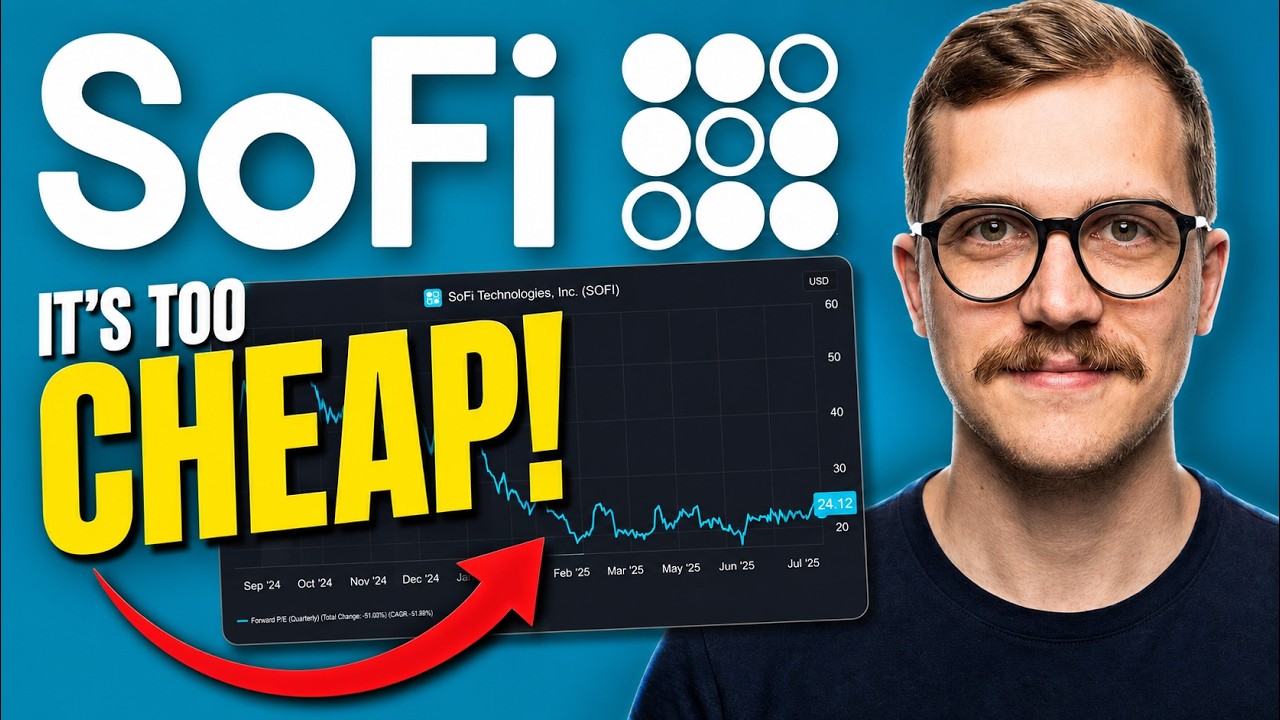
SoFi is up 4.3% here today as Scotia Bank initiated coverage on SoFi Technologies putting an outperformance on this stock in a $25 price target. Scotia Bank said that SoFi's Q2 earnings report indicated a broader financial platform with fast member growth, deeper product penetration, a scaled deposit base, and improving fee revenue. The analyst told investors that the loan platform business adds another important layer by allowing SoFi to monetize originations and underwriting without every loan on the balance sheet. It believes that the company's member growth, deposit funding, and capital light revenue will support estimates above consensus over time. Currently, and I was actually just looking at this, aside from the $25 report that we ended up seeing for SoFi, they did also come in at extremely cheap valuations. And I want to put together this is a very small presentation. I want to build on this later on, but how cheap SoFi is is getting potentially too cheap to ignore. If you end up taking a look at their forward price to earnings, this is based on Wall Street's numbers, but I'll talk about how accurate Wall Street's numbers are here in a minute, but we're looking at around 23 times forward PE. Comparatively to where we were before, just in this this is a one-year time frame that we're looking at, we were sitting as high as 50-60 times forward price to earnings ratios. But the growth rate has been extremely high at over 100% growth rates, and so that rate not only as the stock ends up falling over time, but also as earnings continue to keep up, that forward price to earnings fall extremely quickly. But the real report comes in through guidance. That's how we get forward price to earnings. That's how we get potential mid-term outlooks as well. And what we see from this mid-term outlook is that they want to hold up a 30% revenue compounded annual growth rate between 2025 and 2028 bringing up total revenue to $7.9 billion dollars revenue. On an adjusted earnings per share base, we're looking at anywhere between a dollar and two cents if you're looking at a 38% compounded annual growth rate and 112. That would put the medium of those two numbers at $1.07. If you were to assume that midpoint, $1.07, that's a 40% compounded annual growth rate on their earnings for the next three years, which is a very, very common way to look at a PEG ratio as a three-year PEG. On a 23 times forward P/E, SoFi's PEG ratio is currently sitting at 0.58 times. I ended up going back because many people don't look at this metric anymore, at least it's not as common as just purely P/E ratios, but it was Peter Lynch's favorite metric. This is a combination of both price to earnings and the growth ratio, or price to earnings growth. What his rule was was that if he said, "If you were to end up looking at the company's P/E ratio equal to its growth rate, it would put up a PEG ratio of one times." That would be a fairly valued company. Anything under one times would be significantly undervalued, and anything over one times could potentially sign that it might be a little bit pricey. But, that could also be that maybe the investors are believing that it's going to grow faster than what Wall Street currently has it pegged out to be, right? So, look at a company like Palantir, for example. Their PEG ratio is higher than one, but also Wall Street believes that they're going to compound at 40% where a lot of their investors believe they're going to compound at somewhere closer to probably 80 or 90%. So, that's why it can hold up a higher than one times PEG. SoFi's ratio is essentially saying that investors are believing the opposite, that SoFi will not be able to grow at the rate in which they've been growing. But, let's take a look closer at Wall Street's estimates because for the longest time Wall Street has been extremely cruel, I find, or a little bit too conservative to SoFi, but now they're actually doing a pretty good job. Adjusted net revenue sees this company going all the way out to 7.9-ish billion dollars. That's SoFi's own estimate. Wall Street has it at 7.43, missing roughly a little over 450 million dollars worth of growth. So, this is they're actually expecting a lower amount of growth, but that's not what Wall Street is reporting on. The main part at the end, because SoFi can dilute to try to drive growth, one of the things that's super important is the adjusted earnings per share, which is expected to come in at a dollar seven. So, that's inclusive of dilution. Wall Street has their consensus at the exact same level of as what SoFi is expecting. So, they're actually pretty aligned with SoFi's guidance based on consensus GAAP EPS, not adjusted. So, this could even look potentially better. Just running some quick math here, assuming that we have the same amount of outstanding shares today, it doesn't matter if it's up or down three years from now because the EPS would adjust to the amount of outstanding shares. So, I'm just doing the math on the shares that are outstanding today. We're looking at roughly 1.4 billion dollars of net income that's shared between both Wall Street and SoFi. They both agree with this. But, SoFi believes that they're going to come in at higher amounts of revenue bringing on an 18% margin, where Wall Street believes that they're going to have less revenue, so actually indicating a 19.5% net income margin. So, it's pretty interesting to compare these companies and to see how cheap that the valuation truly is knowing that for the most part, not only is this company been able to bring on their numbers and actually surprise to the upside. I can actually prove this here. Look, take a look at the history of this company over the last few years. We have surprised on revenue every single quarter. So, Wall Street is probably low on those numbers, and then we've never missed on EPS. Now, net income has always beat Wall Street expectations, but there's sometimes where they say we're going to come in at one cent and we do come in at one cent even though we've had more net income than they expected, but also potentially some dilution. For the majority of the time we end up beating either in high double digits as high as 100% or 50% or 37% 25% beats on EPS growth throughout history. It's my belief that Wall Street's estimates over the next 3 years are actually going to come in conservatively and that we are going to beat SoFi's own midterm guidance of growing by 40% compounded annual growth rates as incremental margins have been consistently higher than the net income margins are today. Meaning all of the new revenue has higher margins than the revenue of before. So as we stack on new customers and new product lines, those are beneficial to SoFi's practice. By the way, midterm guidance does not include any of the total businesses that were not included whenever they wrote that guidance. So you're looking at things like SoFi USD, SoFi big business banking, small business banking, or business credit cards, or any of the things that they are likely to expand in over the next 3 years are not inclusive of their guidance. As Chris Lapointe, the CFO of SoFi has said, "We're only guiding to the things that we know we will be doing today." So they're likely to even come in and beat that, but it just goes back to the actual point of their PEG ratio is at less than 0.6 times today's forward PE. That's the part that surprised me even though PEs are usually beat almost every single time, revenues beat every single quarter that SoFi has been in since being a public company, and yet the Wall Street investors and even retail continues to not bet on this company. I get that there's a souring macro, but inclusive of this guidance is also going into two rate hikes this year. They are baking in a level of conservatism while still not adjusting their rate at which they want to invest in SoFi. There's been even cheaper rates of SoFi's potential forward PE. We saw recently that after earnings this company fell to roughly $14 a share. I think if there's those types of opportunities where we even fall below $17 a share where it is today, those are the real buying opportunities. If you could potentially pick up this company under a PEG ratio of 0.5, there's such a level of margin of safety there for the long-term investors that if you do believe that they're going to continue to compound earnings and tangible book value is going to grow alongside that revenue growth, which they also called for, that I really don't see how this company ends up falling apart unless they start losing market share, but all of the statistics that we end up seeing like unaided brand awareness and the amount of member growth is exceeding their past expectations. So, member growth is doing extremely well, unaided brand awareness, market share across every single product that SoFi has ever entered. So, I don't see a way that you can confidently call for a bear case on this company right now other than just a debt crisis, but for the most part they hold their own loans on their books and the default rates of those loans have been better than ever. So, I'm very, very confident in SoFi right now and Scotiabank's new upgrade of $25, while I do like it, it's probably even higher than that considering we're only 0.6 PEG.
Comentários 0
Entre para participar da discussão.
EntrarAinda não há comentários. Seja o primeiro a compartilhar sua opinião!