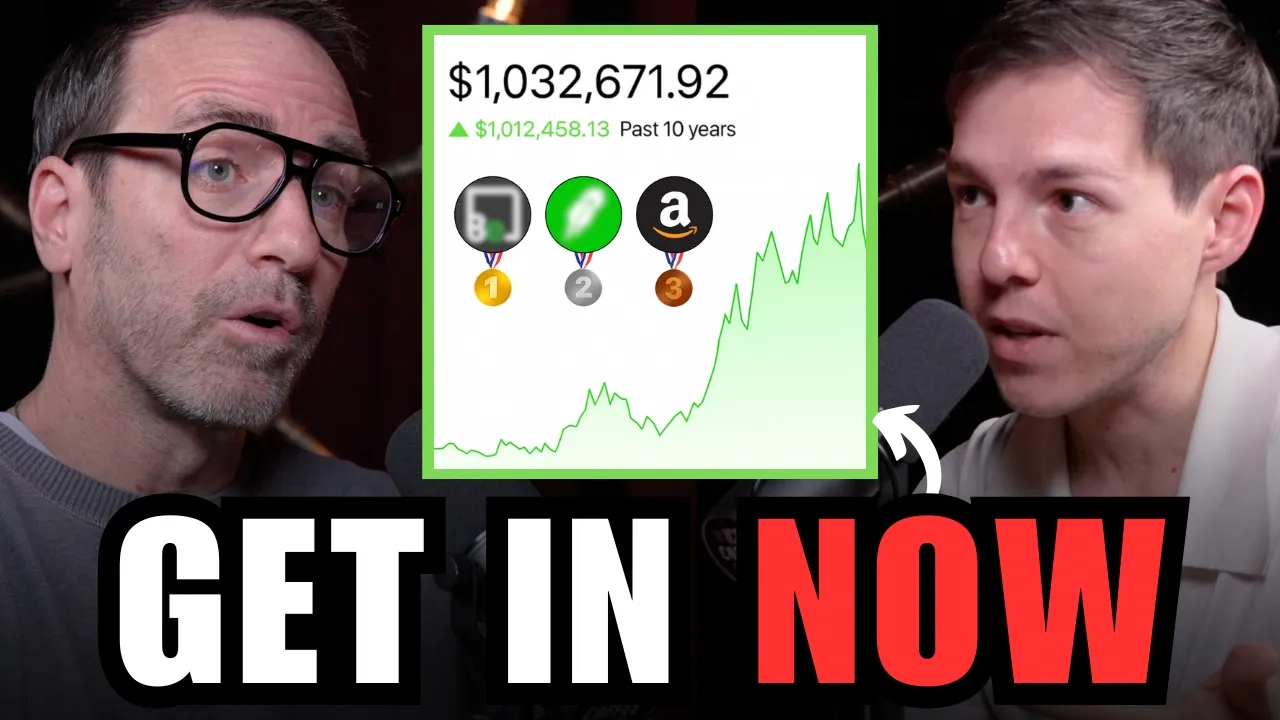
3 Stocks Chris Camillo Is MASSIVELY Bullish On (Explained)

- Retorno do vídeo
- +7,71%
- Chamadas
- 3
- Compra / Venda
- 2 1
- Publicado
Recomendações
Entrada é o preço de fechamento do ativo na data de publicação. Atual é o último fechamento registrado.
-
Entrada $165,42 19 nov 2025Atual $175,89 24 ago 2026Resultado −$10,47
I exited almost all my Palunteer
Contexto “Listen, I exited almost all my Palunteer, you know, over the course of this summer on a case-by case basis.”
-
Entrada $222,69 19 nov 2025Atual $262,07 24 ago 2026Resultado +$39,38
If it drops I'll just buy more.
Contexto “So like I don't care what happens in the next few weeks to few months with Amazon. If it drops I'll just buy more.”
-
Entrada $186,52 19 nov 2025Atual $208,48 24 ago 2026Resultado +$21,96
throwing my money in Nvidia calls
Contexto “So, I wasn't just randomly throwing my money in Nvidia calls that week.”
Transcrição Completa
Could you make a case that Palunteer is overvalued? Absolutely. You can you can definitely make a case. Listen, I exited almost all my Palunteer, you know, over the course of this summer on a case-by case basis. You can make Yeah, they could be overvalued. But the stocks that I'm invested in, I don't think are overvalued. So, I'm not concerned, right? Like, you know what I'm focused on? I'm focused on companies like Amazon. I'm focused on companies like Bloom Energy that I think are beautifully positioned to be one of the primary power suppliers for data centers around the world and compute over the next 5 to 8 years. I'm not super concerned with the companies I'm invested in. >> Who do you think are going to be the biggest winners and losers in the AI race? >> Well, it's early and we don't fully know that yet. So, I think one of the big issues is as investors, we're always trying to answer all the questions. We're always trying to figure out everything all the time at the same time. And that's just we're just not capable of doing that. To be a great investor, you just have to figure out one or two things. So, if you can find one or two companies that you have conviction in, that's all that really matters. you know, for most of the last year, the companies I had conviction in were companies like Robin Hood, Palunteer, uh, and Nvidia, right? So, as you know, I had levered positions in Nvidia every week for like 14 weeks in a row, uh, during during the recovery after the tariffs. You know, going forward, I still have conviction in Nvidia. I absolutely now have less conviction in Palunteer because the world knows what I knew about Palunteer a year ago. Uh the world now finally knows what I knew about Robin Hood a year ago, right? Uh I do think Robin Hood still has legs uh to continue to surprise people the next two to five years. So I'm still on Robin Hood. But when we think about this kind of next phase of the cycle, um there are 60 or 70 AI companies and I don't have opinions on most of them. Okay? like there's no way for me to get strong conviction around dozens and dozens of companies. I feel really good about Amazon, okay? I feel really good about Bloom Energy. I still feel really good about Nvidia. Um, you know, why do I feel good about Amazon? Long term, it's really simple. Regardless of who the big winners are in the early stages of AI, who are ultimate who's ultimately one of the biggest winners, right? Ultimately, it's hard to make a case that Amazon isn't one of the biggest winners long-term from this massive cycle of intelligence and automation and robotics. They spent 20 years building out an obscene amount of infrastructure around the world, making investments that no other company would ever even consider making. That didn't make any sense because you're making these investments in a very low margin business because everything that Amazon does on the consumer side, basically the world's largest retailer of stuff to humans, is extremely low margin. Why is it low margin? Because it takes hundreds and hundreds of thousands of expensive humans to basically move these products from one place to another. The systems are extremely expensive, right? And so now that we've developed this intelligence and you know you know the other half of my world is like this concept of us having an infinite labor machine over the next few decades once embodied AI comes to fruition which is robots which is inevitable. It just we can debate the timelines but it's inevitable. Amazon's the biggest winner. Yeah. >> So like I don't care what happens in the next few weeks to few months with Amazon. If it drops I'll just buy more. >> Yeah. Amazon's been incredible. I went to Home Depot the other night to find an extension cord. I wanted to find a 15 ft extension cord outdoors. And I went to Home Depot and I looked at the prices and then went to Amazon. And then I realized I could buy the same thing at Amazon for half the price and it would arrive the next morning between like 6 and 8:00 a.m. That's insane. So, I just went and bought it on Amazon instead. The other thing that's interesting with Amazon is their movies that you could watch and their shows that you could watch on Amazon which are incred like Beast Games was through Amazon. And so them getting in that media side too I think is incredible. Not a lot of people think about that. >> It's fun but it's not what I really care about. What I really care about is the the the infrastructure play that Amazon has invested in over the last couple decades that once they're able to properly, you know, kind of tweak the efficiencies in that infrastructure with automation and robotics, which is inevitable. I think Amazon is going to be unstoppable. meaning like I don't think you'll be able to compete with Amazon in terms of your ability to get a product from here to there. >> What about the growth possibility though? Amazon is already such a massive company that if they doubled they would be the largest company and if they doubled like you it would be hard I feel like to make a substantial return on Amazon. >> Not when you use leverage, right? So if you're if you're using >> if they go up 10% you have like weekly calls on it then you can >> Yeah. Yeah. Yeah. I mean it doesn't have to be weekly calls, right? I mean it could be monthly calls. Um it could be just investing on leverage. Like that's what I do. So I take big swings when I have high conviction in in in in a thesis. >> So I'm curious, what does your portfolio then look like right now? You had Dave, the other host of Dumb Money Live, say that your portfolio is just insanity. And I'm curious, you know, like what are the main stocks that you're super bullish on and and the swings that you see? >> Listen, I I'm going to stay super bullish on Robin Hood for a long time. I don't see that position changing anytime soon. Uh I'm still bullish on Nvidia, but I'm not levered like I used to be. That was insane. what I was doing with Nvidia a few months ago >> was actually what were you doing actually kept me up at night. I mean I I I had >> I had 10% of my portfolio le uh invested in weekly Nvidia options every single week. Sometimes 15% of my entire liquid net worth in options that if it just moves a dollar the wrong direction it in the next few days it's disappears. But I had pretty good conviction that every week it was going to move in the right direction. And except for like I don't know maybe one of those weeks, maybe two, I I hit it every week. >> How is that not gambling? >> Gambling. It's not gambling. It's the opposite of gambling. Every single one of those trades was based on a thesis that was deeply researched, right? So it was the, "Hey, uh, I see who's flying over to the UAE next week. I know they have these meetings. I know exactly what those meetings are going to be about. Like it's not hard to like anticipate what the news flow is going to be once they arrive in the UAE, once they have those conversations, once they talk about the data centers, once the news starts to put together the pieces about who's going to be the biggest beneficiary. Oh my gosh, now we have this thing called sovereign AI and all the stuff that Jensen was talking about is actually becoming real. I mean, every week there was a different story. So, I wasn't just randomly throwing my money in Nvidia calls that week. I had a thesis related to a very specific piece of of of information that I felt was going to get dispersed right that week and for the most part it did and it worked. So the way that you kind of balance out your finances is very interesting. You have your trading account that you try to build up to a certain amount like low eight figures and then from that point you take a chunk out at the end of the year put it in the foundation. And so what would happen then if your primary trading account you were wrong on some of these things? Like how would you build that back up? Like do you because I don't think you necessarily have like an active source of income. >> I do have active sources. I remember I have a few restaurants. >> True. Yeah. >> Um volatile source of income. >> But you were just you were you were lamenting recently I think on X about how hard it is to be successful in the restaurant. >> It's the hardest. It's the worst. We we are successful but we're an anomaly. Uh, I do have another business, as you guys know, Collecticon, which is the largest, uh, you know, Pokemon trade show in the world. And that's actually an obscene cash flowing business, and I love it. So, no, I I I do have income, but for the most part, you're right. Like, I generate as much I as I can from my trading account and then I take a big chunk of it and put it in my foundation every year. And I have gotten a little aggress. Listen, Dave has known me since I was 13, right? and he's seen me go through these cycles and I've gotten in some very squirrely situations in the past where he's had to lend me money. So um >> he's had to lend you money. >> Oh, yeah. Yeah. >> How did that conversation go about? >> I mean, we were we were younger and it wasn't a lot of money, but yeah. I mean, I >> just a few hundred,000 last week. I I had listen I I don't know if I told you guys this before, but you know when I post college uh you know I I had taken cash advances off of every single credit card that I had like five or six credit cards cash advances. I used those cash advances to buy options and one stock that went bad and I I went broke. I lost every dollar to my name and I was in debt. >> How old were you? >> Early 20s. >> And how did you get out of that? How much debt did you have? >> I didn't get out of it. It was horrible. I I was I was had no money. My I was living in LA. My apartment cost $525 a month. My car was broke down. I was selling cars at the time. Literally selling cars at uh Santa Monica BMW I believe at the time. And uh I was just completely broke. And then unfortunately I didn't have health insurance and I got sick. I got something called Graves disease which is a thyroid disorder. And uh I had to move home to Texas. Uh my parents took care of me and once I got better, I just started building my way. But it took a few years. >> Took a few years. >> Yeah. Took a few years >> from one bad stock. >> Yeah. >> How much stock was it? How much debt did you >> um It was It was >> It was It was the most incredibly bad stock to ever be invested in. It was a stock that ended up having some kind of fraud and they delisted it while I had my options. So they they didn't delist it. Excuse me. They froze the stock while they were investigating uh the whole thing, the SEC, and because the stock was frozen while I was holding my options, my options just expired worthless. >> What did you learn then from from that experience? >> Risk management is important. Yeah, it it is important. I was a kid. I I always tell people like that's when you want to make mistakes. The only way you will ever learn these lessons is losing real money. So, I encourage everyone when they're young just to actually do stuff, to invest with their own money. Because if you do blow up your account, you are going to learn that lesson. You want to learn that lesson when you're really young and you're investing thousands of dollars and not millions of dollars and you don't have a family, right? And you like that's when you want to do it. Uh but yeah, I was in debt for many years. My credit ruined. Um you know, when I met my wife, uh I was deep in debt. I had no money. Like it was it was it was bad. But you come out of it. >> But how did you have the faith to then go back into the market and do it again? >> What else you going to do? Right? Like like I learned my lesson. But like my lesson was I had too much concentration and I didn't really at the time I wasn't investing properly. I wasn't investing the right way. I was investing because a guy I knew a guy that knew a guy that said, "Hey, this is a sure thing." First of all, as we know, there is no such thing as a sure thing. But more important than that is you have to do your own homework. And that's what I that's what now you know why I preach. I I don't just say that to say that. Like I say it because I really mean it. When people try to like copy my trades or people ask me for my exact trades, I generally don't release them anymore because I truthfully do not want to instill that type of behavior. Steal my ideas, but do your own research and actually make your own decisions because these are really important decisions. You don't want like I don't want to blow up your account, right? Like that's on you, not on me. So, I'll share an idea with you, but you got to go do your homework. I got to say when we met Vlad from Robin Hood completely changed my opinion of the company. Like I was a fan of Robin Hood and I have been for a long time. But meeting Vlad and seeing him face to face and seeing his excitement about the company and how passionate he is. >> He was open to ideas which I thought is the most important thing. You need to be able to pivot and hear out other people and listen to the right ideas and ignore the bad ones. And we were like Graham was feeding him some excellent ideas and he was like totally interested. and he's like, "Yeah, like we're we kind of working towards that." And >> yeah, but it made me really think that Robin Hood, I think, has what it takes to compete with the big people like Schwab, which I think a lot of people tend to compare them to in terms of account balance size and number of accounts and average account, you know, things like this. Seeing Vlad and even going to Hood Summit in Las Vegas, we got invited. Incredible. And you meet the people there that like you know you see Tesla super fans where they're like all Elon I I met those people but for Robin Hood like a totally different segment of the market where people are so excited about Vlad and Robin Hood and I think he's one of the few people where after meeting him I was convinced on the company and we've met other people uh big investors where immediately after meeting them like all right listen I I lost all faith. I will say Michael Sailor was pretty convincing too. >> Yes, Michael Sailor was the only other one that when Bitcoin was uh 48 $50,000 when we filmed with him afterwards I'm like you know what Jack what he says makes a lot of sense. >> No comment on Michael Sailor. But I will say this uh that was the best interview Vlad has ever done. I I I watch that and he's come a long way. He used to be terrible at giving interviews. >> Oh, he was excellent. Yeah. >> Yeah. I that that was great. Listen, the the Robin Hood's my number one position. It became my number one position this last year. It grew into becoming my number one position, Eclipse Amazon. And my thesis has always been really simple. We have a hundredish trillion dollars that will get transferred over the next 30 35 years uh to the younger generation through inheritance and other means. And that a big chunk of that money is going to Robin Hood. And and beyond that I have a second thesis on Robin Hood which is uh Vlad manages that company like a startup. There are very few companies in the world of that size where the founder CEO is quite honestly has the balls to to to still manage it like a startup and to take big risk and to break through walls and to ask for forgiveness as opposed to asking for permission. And Elon is one of those guys. He gets credit for being one of those guys. Vad does not get credit for also being one of those guys. So, anytime I see a company like that with the capability of dominating a sector and literally like like like killing a sector and stealing all the business, you match that with a CEO like that, like it's game over. Here's the other thing is that he agreed to come on our podcast, which I think I think it's dumb not to come on a podcast, especially like a finance podcast. And we we reach out to a lot of people and we either get a lot of nos or just never hear back from people that should be doing podcasts. And we would I think we'd be doing him a favor by doing a podcast. And Vlad was excited about doing it. And walking into his office, it's it's not like a corporate, you know, headquart looked like a house. >> It also was surprisingly not extravagant. >> No, >> I was expecting we were going to walk into some sort of like crazy huge headquarters, the classic Google thing with the slides and, you know, free food everywhere, buffets, and this and that. It really looked like they were running relatively lean for how productive their company is, which I also think is a a positive indicator. >> And this is going to be another big one. their 2 and a half% crypto match right now. They just brought it back. I don't know if it's if it's targeted, uh, but they had a 2% match when Bitcoin was at 120. Then they increased it, which I thought was really clever to 2.5%. But Bitcoin is now $100,000. So technically, it's not costing them that much more, but it looks on paper that you're getting 2.5% on a lower amount though. But it looks like 2 and 12% for whatever you bring into the platform. They're going to bring in a lot of money to Robin Hood. >> The thing that Vlad and Robin Hood does is they play the long game. They are playing the long game. They are in this for the next 20 to 30 years to be the biggest financial company on earth. I have absolute confidence that they will be unless something really crazy happens. Um, listen, I opened up a Robin Hood account. Uh, well, I've had an account for a long time, but I I put meaningful money into my Robin Hood account for the first time this year, which was shocking cuz like I'm just that's not something I ever thought I would do. Um, I'm old school, but it was because of the match. >> Um, it it was it was the extra little thing that said, you know what, I'm going to go ahead and do this because it was that extra incentive that got me to pull the trigger. And listen, once you're in that ecosystem, they do a really good job. Uh I, by the way, I love I mean the fact that you can, you know, prediction markets on your brokerage. >> Oh man, don't get me startled on that. >> It it it it's it's huge though because you got to realize it's not about even how big of a market that can be. Um it's about the fact that you can do everything through one app, right? That prediction market is great and it's awful because now every sports game I watch or go to. I'm I don't want to say I'm betting. I am placing a hedged position on Robin Hood in real time. >> That's what they they want you. It's not It's not gambling. How are you? >> It's like you're hedging a position. It's definitely gambling. >> That is by That is not hedge. >> It's speculation. >> There we I'm speculating on Robin Hood, but what's funny is that I could watch like I went to a hockey game the other day and I'm watching the hockey game at the same time as I'm watching my Robin Hood account because I bet on the Las Vegas Golden Knights and when one team scores like you see the odds change within like two seconds it's already priced in. >> How much did you bet? >> Uh $100 and I lost it all. >> But you had fun. I had a great time and I also bet on the uh oh this was bad. I put money on Cuomo in New York because I thought it would be a closer race and he was priced when I bought in at like seven cents and I knew he was probably going to lose but I thought there's I thought that was underpriced. I thought it should be more of like he should be a 15 to 20 cent bet and that lost. I just tell the maturity that that was that's a fair thesis that you know that's my favorite type of investing is when you see an asymmetric riskreward. Um investors like the way our brains work. We're not really capable of computing that. And those opportunities are out there all the time. It's like okay yeah it probably won't happen but there's likely a 2x better chance of it happening than how it's priced currently. So you have to take that even if you're likely to lose. You have to you have to size it appropriately, but you do it enough and you will win. >> But here's the one thing that I think is worth looking out for with Robin Hood is that their fees on the prediction markets are so massive. It almost makes it not worth it to go through Robin Hood. But the thing is it's it's so easy. Like it saves me from having to drive down to Red Rock and place a bet when I could just do it on my phone in like two seconds. But but the spread between the bid and the ask and the the Robin Hood fee you pay adds up to like 10 to 15% a buy and then 10 to 15% a sell if you sell it before it matures. >> Okay. So they're I think they're looking at the long tail of customers who want to engage in that type of prediction market as opposed to the professional gambler, right, that really cares that much. For people like me, I don't care. Like if I want to bet on a game, I I don't care if I can get a 5% better margin going to MGM, which I can't even do in Texas anyway, right? But even if I could, like I said, it's just easy and they make it easy and fun. I can go on there and place a bet like 5x quicker than I could on a gambling app. It's just easier. Um, and I think a lot of people don't want to have a gambling app. They don't want to have money inside of a gambling app. That's just not part of who they are. And I think Robin Hood is going to end up with millions and millions of people casually betting on sports, casually betting on various things. And that I think that's fine for them. >> Do you know, this might be too nuanced of a question, how it's going to be taxed because they recently passed that law that says you could only write off 90% of your gambling losses. >> I don't know if this is going to be counted as gambling and if it is, okay, it's going to be a hedged a hedged investment. >> I don't think it will be.
Comentários 0
Entre para participar da discussão.
EntrarAinda não há comentários. Seja o primeiro a compartilhar sua opinião!