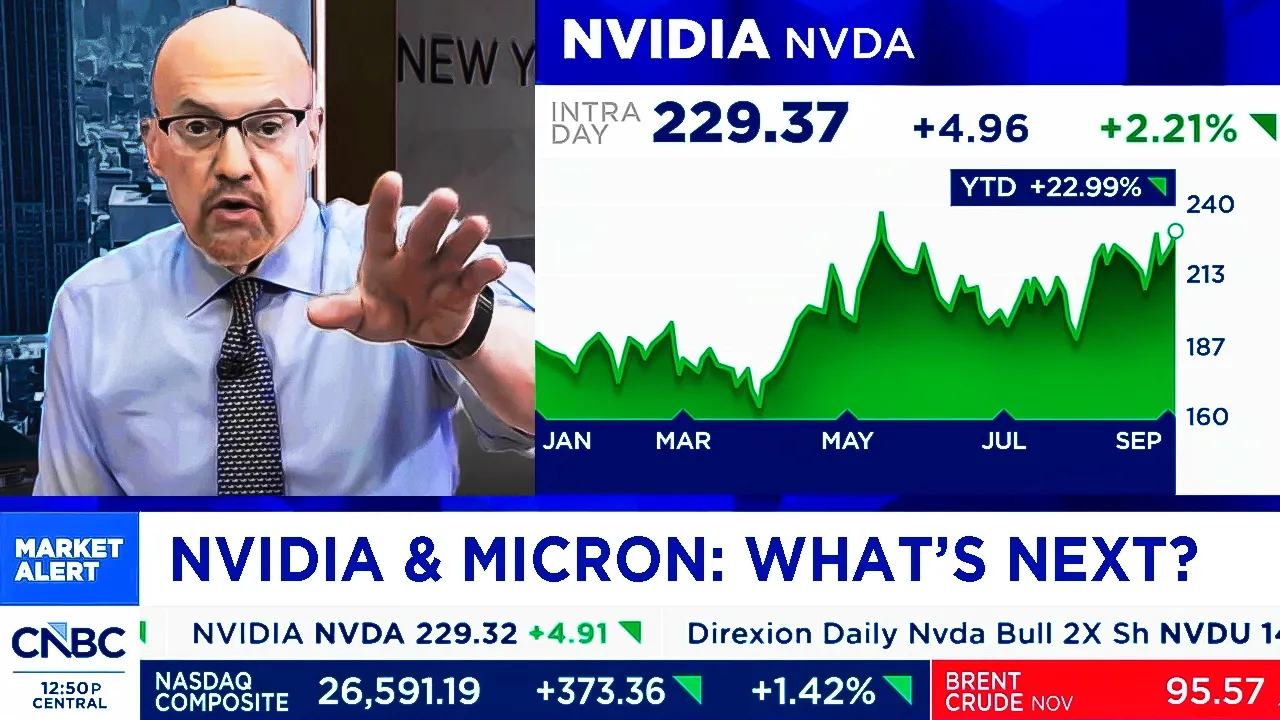
The News Today On NVIDIA Stock, Micron Stock, OpenAI, NVIDIA Hugging Face Deal - NVDA Update

- Retorno do vídeo
- —
- Chamadas
- 2
- Compra / Venda
- 2 0
- Publicado
Recomendações
Entrada é o preço de fechamento do ativo na data de publicação. Atual é o último fechamento registrado.
-
Entrada $228,45 03 set 2026Atual $228,45 03 set 2026Resultado +$0,00vs. índice +0,0% SPY +0,0% no mesmo período
Nvidia, you have a strong buy on that.
Contexto “All right. Nvidia, you have a strong buy on that. It is coming on like gang busters.”
-
Entrada $228,45 03 set 2026Atual $228,45 03 set 2026Resultado +$0,00vs. índice +0,0% SPY +0,0% no mesmo período
it makes sense to to rotate some of your money back into Nvidia from some of the high-f flyers out there.
Contexto “...it makes sense to to rotate some of your money back into Nvidia from some of the high-f flyers out there.”
Transcrição Completa
Let's begin though with Nvidia confirming that it has agreed to acquire Hugging Face. This is Jensen Wong with Becky last hour making the case for the deal on Squawkbox. Our fundamental goal is just to make sure that AI advances as quickly as possible. And it's really really important right now as the open models are really accelerating that we make sure that we provide hugging face the platform to continue to scale and for the the resource for them to scale and extend uh the open model uh ecosystem and community. Jim looks to close first half of next year and the the coincidence of this announcement and Broadcom and that whole mess of custom versus open really getting interesting. >> Well, look, I think that that Jensen and Colette Crest CFO have really been pushing people to understand this and have been you someone like me, I I was I candidly more of a novice to it and they walked me through it and emphasized look you know you really got to be open. The Chinese are doing very very well. We have to blunt them, have it so that we have the best even though they have good relationship with John but just saying listen we need our own open that we didn't know about hugging face at the time but I applaud this and I think what people have to do is say if AMD were announced they were buying hugging face if Broadcom announced they were bugging hugging face buying hugging face we would send a video dumping so you got to think of it like that it's a little asymmetrical but I was really glad that they got it because if there was a bidding war and they lost to someone else people would be saying wow they've lost their touch in the open and they're really just they they don't have it. They don't and you need open. You've got to have open. >> Do you think it's about defending yourself from customer demand that softens as others do the custom work? >> Okay. So, I've been thinking about that. I was thinking, what would Jetson say if if I said, "Oh, it's just defensive." You have to say it's offensive and defensive. They have a lot of customers and they really have a great brand. And the defense is they got to be sure that nobody else catches them when it comes to to open. I continue to be amazed of what Nvidia does. I think that they're incredible. Yes, I did what they have a trillion dollar buyback. I'm not going to I'm going to reiterate that. But there's just a there's an amazing grace to this man. I mean, here Jensen was at the crowd story conference and he was fantastic with George Kurts. His quarter was really good. Uh much better than I think people realize. Uh this was another move that is really smart and I just feel like the stock is stalled and I think it's stalled because there are sellers everywhere. It needs to mop up the selling which is what Apple did. They mopped it up. Now I see that I mean I was thinking oh my god is there is there an economist curse like there was at one point like a >> great not great usually historically. >> Oh I know. I didn't want to see that you know and what is sorcerers apprentice there but I I like look I just think it's just another thing that was well explained by him. about why you need it. And I do think that open is good. And I think that he wants to he wants everyone to be on Nvidia and this is just another 12.9 billion advance that makes it so it's more likely that they're going to be on Nvidia, >> right? Doesn't it put um doesn't it put Broadcom on some notice? Um I mean and what about Neoclouds? How do they compete with the the sorcerer of silicon as as the economist puts it? He's got great for neoc. He buys all the neo he has a stake in a lot of the neoclass. You know, look, I I want to I got to go hard on this broadcast. I thought that this I know that the next quarter is not going to be good, but I do think the AI revenue double again in fiscal year 2028 to 230 billion was the jaw drop uh jawdrop statement. Remember, he did up next year to 15 billion. But this is one I was talking to Ben Stodto and and and to Jeff Marx who work with me. This is now anthropic. It's anthropic or bust. So they can do it whatever he wants to do with hugging fist. They need anthropic to have a blockbuster uh IPO and that I don't know. I mean we I think there's a lot I was with someone last night who actually I think does know and said that Anthropic can put up any number it want once. They make so much money they could actually say they're making a profit. that could put money back into growth. If we don't get that, then there's a whole thing. Everything that we're talking about could just be horrendous. >> Yes, that will that that's the ongoing concern, Jim, that it is a that it is a Jenga tower of sorts. >> I agree with you. Um, but I also think that Anthropic is great, but you know, you keep me anthropic like people whisper. Do you know that that uh all their customers only one there's like one customer that you keep hearing that there's 99% and it's always anthropic. It's always anthropic and anthropic is by far it in a in a in a market of stocks it's the most important stock and it doesn't even trade. >> Yeah. >> Patrick, does this deal make sense to you? >> Uh it does on a couple vectors. So first of all, just to to put this in in context, Nvidia just bought the place where developers decide which model to run, right? So it's distribution but could also serve AI workloads versus hugging faces spaces. And I say think topline it's about accelerating open source growth with which I think is a TAM play but it's also a hedge right I mean a neocloud's uh hedge the hyperscalers and I think hugging face hedges the closed labs building their own chips >> so if you are a closed lab if you're an open AI or an anthropic and you read the news of of today's deal what do you think about that >> so I think everybody has embraced the idea of coopetition uh all of the uh uh leading uh closed labs are are not only using uh uh non- Nvidia GPUs with AMD but also creating their own uh accelerators. So it's not one big happy family but everybody is relying on each other right now and there's so much compute uh required and the rate of change uh is so big uh everybody can grow and while I wouldn't normally say this I think everybody can be winners here. So then you know in terms of the economics here what is the hugging face business model and is there any kind of economic benefit for Nvidia or is it more as you outlined earlier just that the stack and the flywheel effect that Nvidia gets from having that in house and making sure as uh Jensen Wong was saying that it's in good hands. >> Yeah. Right now it looks like an 86x multiple. Uh they've got 150 million uh ARR. Compare that to Microsoft paid $7.5 billion dollars uh for for GitHub. So we like to call those a strategic premium which is so high uh that um um there has to be some uh combined multiple uh value from it. And I think even even Clem from Hugging Face admitted to to keep it open, to keep it independent and growing. Uh these guys needed funding that they likely couldn't get from a VC. >> Yeah, it's interesting that you bring up Microsoft GitHub. I think it was BA yesterday argued that it kind of is like a Trojan horse in that sense where it first appears as just free software but once it's inside it kind of drives all kinds of demand for networking and compute. Does that metaphor make sense to you? >> Oh 100%. And in fact, if if uh Hugging Face wanted to go allin, uh they can replicate uh what GitHub does, which means the first place that developers stop, combine that with the second place uh which is uh which is currently hugging face and then could even serve models and serve compute on hugging faces spaces. So you could essentially uh pull together uh your own hyperscaler uh sorry your own uh lab capabilities plus hyperska capabilities even though that's not what the companies are talking about yet. >> Yeah. It's not too often you have a firm hacked or at least attacked by agents and then bought for billions of dollars a few weeks later. Was the was the attack seen as a vulnerability or any reflected any shortcomings of of the of the firm itself? >> Yeah. So related to this, I mean uh the short answer is no. Uh I I see this see these as a completely separate uh hugging face just happened to be a a a I wouldn't call it it's not an easy target because they're they have got good security. Uh but when you put the forces of an unknown unknown model that attacked it uh and in the way that it did uh it it did uh it did if nothing else it raised the spectre and the risk of overall AI security. I don't think uh them getting attacked has anything to do with the acquisition today as if you know they need more money or more funding to have better security >> because I want to ask you about Nvidia as well which is one of your biggest holdings if not the biggest holding. They did the hugging face deal today. We're going to have a lot more about that later on. Um, but here's Jensen Wong talking about the importance of this deal on Squawkbox earlier. Our fundamental goal is just to make sure that AI advances as quickly as possible. And it's really really important right now as the open models are really accelerating that we make sure that we provide hugging face the platform to continue to scale and for the the resource for them to scale and extend uh the open model uh ecosystem and community. >> What do you think this deal is all about? >> Yeah, I think it's about uh I think it's about scale. I think it's about defense and I think it's about Nvidia protecting uh its dominant position, the open-source business at HuggingFace. It's the, you know, it's the de facto open source repository leader. There's 3 million plus models on on their uh on their network. There's 200,000 enterprise customers. Uh you're talking about 18 million AI builders on the hug and face model. So Nvidia has been very clear about not being perpetually uh beholdened to just the hyperscalers capex. You know, we talked about that a lot for the last couple years. They want more enterprise. They want more sovereign wealth. They want more government. They want more open open source. And open source place uh to make an acquisition like Hugging Face makes perfect sense to us. You want to be uh in control and in command of that type of business. That's still a business. Let's not forget Openface is a open open-source software is still a business model. Uh it's just it's just crowdsourced. So there's there's risks. We saw those risks exploited in the summer. Uh it strikes me that Nvidia with more resources as a partner and then now as an owner will allow that to be better managed from a security standpoint and certainly better monetized over time. >> It's done great this year up 20% even as you mentioned some of the other hardware names or some shares of Nvidia are popping 2 and a half% this afternoon. This after the news today they will buy hugging face for 12.9 billion. Our next guest says the deal could be a gamecher as it will be quote acquiring the front door through which a meaningful share of AI innovation is discovered, shared and deployed. BFA security senior semi- analyst VC Arya joins us now. You are you're listen VC, this is a big deal. I I don't even know where to start because there's all of the drama around hugging face with the open AI attack which was more about what these AI bots are capable of. Now, here comes Nvidia almost kind of turning itself into a competitor of some of its biggest customers, >> right? Uh, good afternoon, Kelly. I think what's happening is that this is essentially a 13 billion statement from Nvidia that it is all in on AI. I mean, we kind of knew it, but this I think kind of reinforces the message that they really want to influence, encourage, you know, help accelerate the adoption all the way from data center uh to the software stack. And uh what I think they have made clear is that uh there is going to be a big uh room for open-source models because the open source community is what will help to accelerate the adoption of AI. In certain cases, it'll help to lower the cost of AI and its adoption by uh enterprises. So I think this is a very important uh strategic view and if they are able to uh complete this deal it effectively gives them control of the town square in which a number of developers are coming and interacting and oh by the way when they're developing those models it helps give Nvidia an upper hand in understanding where the technology is going and it can also shape how it silicon is developed alongside. So I I I think it's a very important and strategic announcement that they are making. you know, it's it's protective in some ways because if you are OpenAI, if you're Anthropic, if you're Google, if you're any of the large language models, for lack of a better word, Nvidia is a major cost for you. Major cost setter. So, of course, they're all trying Google has its TPU. They're all trying to build out their own, you know, take that that profit margin back from Nvidia. And here comes Nvidia saying, "Well, we're going to make sure that if you do that, that we're going to be the one that all the open- source models effectively can kind of run off of 3 million plus open source models." So, yeah. and Meta obviously doing the open source thing as well. So now we have to talk about and do you think we're we're getting you know too far ahead of this conversation? It's still a small acquisition, but you know, 3 years from now, is it going to be in I'm sorry, Anthropic versus OpenAI versus kind of the NVIDIA ecosystem maybe versus a meta? I don't know. >> Right. No, it it's a fair point, but if one believes, right, there was some public discussion recently about anthropic suggesting that the addressable market for AI over a long period of time could be in the order of tens of trillions of dollars. I think I I saw the $30 trillion number. This year we will be less than a trillion. So the point is we are in such early stages of AI adoption by consumers and enterprises and and governments and around the world that I think it is too early to try and pick a winners and losers. You're right that different parts of the ecosystem are trying to maximize their competitive positioning. You know hyperscalers are working with Nvidia. You know a few days ago when Nvidia reported they announced that Amazon is buying 2 million more of their Vera Ruven chips. At the same time, Amazon is developing its own custom chips, right? Same situation at Google. So, I I take your point, but I think it's too early to try and proclaim who are going to be winners and losers because we are very early in that adoption curve. But I I I I do uh believe that part of what Nvidia is also doing is helping create an ecosystem that is away from the incumbents because, you know, sometimes the incumbents don't move as quickly, right? They have constraints, you know, they have, you know, prior baggage. They have a lot of constraints in in many ways. But this new emerging uh set of companies uh that are the frontier labs that are the open that's the open-source community right that are the neo clouds they can move much much faster and quicker and accelerate that adoption. So that's the part of the ecosystem which doesn't have the balance sheet to support itself and I think that's the part of the ecosystem Nvidia is really uh trying to encourage significantly but I don't think it's an eitheror. I think they're working closely with with both sides. Final question. You know, you're you're positive on Broadcom. Obviously, it's selling off a little bit today. You're neutral on momentum, which is continues to kind of underperform. What what you know, the memory names have been soft. What is going on in the AI ecosystem and in the AI trade right now? >> Sure. I think the first half of the year, Kelly, what we saw were was the momentum part of semis, right? The socks index was up 100% in the first half of the year and there was a dash into names that were the bottleneck and areas of constraints that was memory that was CPU right that was optics that was uh wafers and we saw the traditionally large mega cap name struggle at that time right Nvidia struggled you know Broadcom struggled in Q3 we have seen a big rotation away from those bottleneck names and these mega caps have started to do relatively better I think Nvidia's the best performer in the socks index so far in Q3. I think as we come out of uh this kind of summer volatility and we come out in Q4 and Q1 that are historically the two best quarters to own semis I think you might actually see a good mix of of the two where investors want to own where the value is you know Nvidia is basically trading at a mid- teens PE for 60 to 70% earning growth you know Broadcom very compelling uh valuation um right so I think it's going to be a mix of owning certain names that are in those constraint areas but then also balancing them with certain names that I think have that uh value aspect to their uh to the stock. All right. >> All right. Nvidia, you have a strong buy on that. It is coming on like gang busters. All of a sudden, people falling in love with the stock again. >> And it's it's it's more valuation than anything. I mean, clearly they gave that 27 guidance was absolutely phenomenal. Um you got the good visibility there. They they announced the hug you got the hugging phase deal in there right now. So you kind of see how they are evolving the ecosystem and how the entrenched they are across that entire AI ecosystem. So, I think when you kind of look at the valuation at this point in time, it makes sense to to rotate some of your money back into Nvidia from some of the high-f flyers out there. And again, that's what you're seeing from the the overall chip trade. And at 1011 times our 28 estimate and the free cash flow potential there, I think some of the concerns out in the market, whether it be financial issues or what have you, um, probably overblown, you're probably going to see new highs. Let the audience know you. >> Then there's Hugging Face, which Nvidia just announced it bought today for $13 billion. Hugging face is the open-source openweight model that 18 million people are using it. You know that Sam and and do you look at Nvidia purchasing that cuz the analysts look at it as sort of a defensive move let let us make sure that we aren't too dependent on anthropic or open AI. Do you look at it as a threat and were you looking at perhaps purchasing Hugging Face? >> I was happy to see Nvidia purchase Hugging Face. I know the hugging face team and I think very highly of them and I think Nvidia will be a good home. We think that open source is an important part of the ecosystem and we think there are people that want control of their own models and we think there's innovation that will come from open models in a way that we're quite excited about. Um we want to be the best cost performance at every level. So we have our model uh called GPT 5.6 uh Luna, a smaller less expensive model. you could reasonably assume we'll do something in the GPT6 family too. Uh that outperforms any open source model we're aware of at a cost uh you know cost per task basis. I do agree with Alex Karp that the token maxing thing is very dumb and what people should care about is how much money they have to spend to get a a piece of work done. And one thing we're very proud of with Astra is how token efficient it is. Um, even though the cost per token is higher, the amount of work you can get done uh, for a given budget of dollars uh is better than I think we've ever had for a frontier model before and I think that customers are going to be very happy with what they can get for the price. >> Nvidia is making another big move deeper into the AI ecosystem, agreeing to buy hugging face for roughly 13 billion. For more, we're bringing in Daniel Newman, Futurum CEO. Dan, it is great to see you. Let's get into this. Nvidia dropping 13 billion on hugging face. Break this down for us, Dan. In simple terms, what exactly is Nvidia buying here, Dan? And why now? >> Look, we all see what's going on in the market. There's been a call for more open weight, open-source intelligence. There's two massive labs and then of course you have Google and Meta but there's hundreds of u millions 500 million in fact models that are being developed that are open source open weight by firms that are building vertical intelligence world models and Nvidia has been very bullish on this. We are in an era right now where the cost of intelligence this isn't just about tokens anymore or how many tokens can be generated. This is about how much does it cost to get a correct outcome from your AI and Nvidia wants to be in front of this access to more developers, access to more enterprises. And if you think about the size of this price tag versus the investment portfolio and the balance sheet that Nvidia has, it's a small price to pay for, I don't know, 200,000 enterprises and 18 million developers that are now going to be at their disposal and part of the NVIDIA ecosystem. >> Yeah. So bigger picture Dan is a way to think about this simply is this Jensen Wong basically saying hey we're not just selling chips here you know this isn't just picks and shovels we want to we want to own an ever bigger piece of just that entire AI ecosystem. >> Yeah of course that's very fair Josh Jensen has been doing this for a long time. People that understand Nvidia's business understand that it's been a long time since it's been a chip company. It's gone from me a chip company chips softwares models frameworks, systems and now they are going to own a bigger part of that distribution layer and that distribution of models where decisions are being made on what kind of model is being applied to what kind of problem. We know agents for instance and different agents require different models running on different infrastructure to deliver value to customers. And this by the way is the battle in the boardroom right now. companies had this era of token maxing. How much AI can we use? And very quickly they realized running the latest clawed models and the and the latest open AI models which by the way are great and they will certainly win a good portion of the economics. But companies are also realizing for many tasks you can apply a more efficient model to serve that task. We've actually built a pinnacle a benchmark called pinnacle Josh that looks at this exact thing. And we've found that things like running a model on prem can be six times more costefficient than running them through the API in the cloud. And we've also found that certain tasks can be run on open source models for a a fraction a tenth the fifth a half of the price of using these frontier models. Nvidia is capitalizing on this because they benefit no matter which model because in many cases it's going to be running on Nvidia infrastructure. Another so wrinkle to consider I guess Dan is you know open AAI is you know an Nvidia customer right so does open AI does Sam Alman now look at this headline with hugging face and does he look at Nvidia and say okay you are you are increasingly a rival >> well I I think all of this has some what we'd call coopetition right um you could also say Jensen is hedging open- source openweight models because open AI is going to build its own silicon with the jalapeno chip in partnership with Broadcom So, I think there's a little bit of hedging going on all around, but I don't think the number one reason to do this is hedging. I think what we're seeing is open router data showing us that demand for paid tokens doubled in a month. It's up 25 times year to date. The goal is to bring the cost of intelligence, meaning that correct outcome cost down as much as possible because what we're seeing is Jeban's paradox, right? Exponential growth of token demand. So all of these things together, Jensen's playing all sides. I have no doubt in my mind that OpenAI, Enthropic, Google will continue to use uh Nvidia. You could see that in their forecast last week. But all of them are hedging on infrastructure in some ways. And of course, Jensen wants to be the infrastructure partner and be part of the development of models that can democratize intelligence and make it more affordable at scale. So, if I'm an Nvidia investor, Dan, and I'm listening to this, I mean, listen, it's a $5.5 trillion company. Do I look at this hugging face move as, you know, this is something that could financially move the needle, or no, this is this is more of a a strategic play? >> I think it's both. I don't think you can directly correlate the 150 million or so in revenue and say that this is going to drive immediate returns. But if you're looking from the outside, Nvidia is building that platform, right? That top bottom platform, the infrastructure, the systems, the frameworks, the models. And of course, now you add hundreds of thousands of enterprises, tens of millions of developers running hundreds of millions of models that are increasingly being developed to solve specific problems and better economics than the frontiers. So I think it's an and I think the natural uh you know kind of narrative in the market is always that everything is zero sum. If someone builds their own chip it means it's going to replace Nvidia. If uh Nvidia starts working with hugging face it means they're going to create a rift with open AI. And I think that's really only the case when it's Sam Alman and Elon Musk. I think otherwise we are seeing what I call an era of abundance. the demand is is going parabolic and that we need intelligence across the continuum of lower cost all the way to the highest end premium frontier intelligence or what I think Greg Brockman just referred to as as the AGI they launched with the GPT6 today. >> You know some viewers Dan they may only know hugging face because they're like oh yeah that that's the one uh that open AAI models hacked. Do do you think I mean is there any connection to this news this acquisition Dan or No, that's a it's a separate story. >> I listened to their uh CEO this morning in an interview and you know he did talk about how that instance potentially drove their need to you know expand and raise capital and get access to more greater intelligence that they could use to potentially combat a situation like that. Obviously, you know, the disclosures on any cyber attack can be somewhat limited, but I would say that the desire for hugging face to more deeply partner with someone a company with the resources of Nvidia with clearly driven by understanding that with greater resources, this open way open model ecosystem could continue to scale at a much faster rate. And no doubt that while I mean there could be some regulatory concern here, I don't think this is a slam dunk. I think that they picked the best partner to enter this race with and I no doubt we've heard from Jensen he sees the open ecosystem as critical for the long-term success of AI >> next. I know Nvidia is up 22% for the year but and that would be a lot for every other company BUT NOT FOR NVIDIA. THIS IS Nvidia for heaven's sake. I'm going to do my fantasy thing next week. You know we do that thing here. I'm not trying to figure which player Nvidia should be but I am leaning right now toward uh toward Gibbs. Anyway, Nvidia bought Hugging Face today. I know it sounds like a foreign version of Kleenex, but it's a king of open source AI. I think it's a brilliant move and it'll put to rest all the nonsense that Nvidia's technology is only good at training, not inference. It's foundational. I'm throwing that word around all day today because it makes me look really smart. But what matters is that Nvidia sells it less than 15 times next year. I'm going to say that again. Less than 15 times next year. If it announces tomorrow that it's going to buy back a half a trillion dollars of its own stock and manage that buyback aggressively like I would if I were in charge of it not on autopilot it is. But when the stock drops from these ridiculous dips in there they're buying stock grows up 50%. I am not Hey, look. I nailed the Dell for 100 points. Give me some credit here. I think this thing goes up 50% if I manage to buy back or someone like me like an AI version of me. >> All right. I hope you're all doing well today and staying calm in this market. Today was overall a positive day throughout much of the market after the Feds. Waller said he would support holding rates steady at the September meeting if price pressures continue to ease and he indicated that we're finally seeing some signs of disinflation in recent data. Those comments came as market participants are debating whether or not we will get a rate hike at the September or December meetings. Waller's comments helped lift stocks across the board on Thursday. I'll cover Nvidia's acquisition of hugging face in a moment, but first let me cover some other important news stories that we got on Thursday. On Thursday, OpenAI announced GPT 6 Astra saying quote anything you can do on a computer Astra can do for you. The model shows very impressive results on benchmark. It appears that the roll out will take a few days based on comments from OpenAI employees that I've seen online. This comes just 2 days after Anthropic announced Claude Fable 5.1 and Mythos 5.1. And it comes just one day after Meta announced the release of Muse Spark 1.3. The AI race is alive and well. In other news, it's been reported that Micron plans to double its HBM production capacity compared to the previous year, aiming to strengthen its supply for the latest 12 layer HBM4 in an attempt to increase market share. It's important to note that 12 layer HBM4 is being used in Nvidia's Vera Rubin, which is ramping right now. According to industry sources, Micron plans to add up to 60,000 wafers per month to its HBM production capacity by the end of this year. The addition of 60,000 wafers per month would exceed Micron's HBM production level of roughly 40 to 50,000 wafers per month last year. By the end of this year, Micron will have secured HBM production capacity of roughly 100,000 wafers per month, according to the report. This news is notable for Micron because SKH Highix and Samsung's HBM production capacities are notably greater than Micron's. I don't think this additional capacity is anywhere near enough to threaten the memory makers pricing power. And so overall, I think this development is positive for Micron. And now, in case you missed the video I posted earlier today, let's cover today's big Nvidia news. Nvidia announced today that they have agreed to acquire Hugging Face for roughly 12.93 billion. The two companies will scale Hugging Face's platform, strengthen its infrastructure, and expand access to AI for developers and institutions worldwide. Hugging Face is arguably the primary platform developers use to discover, build, fine-tune, and deploy AI models, especially open- source and openweight models. According to Nvidia's press release today, more than 18 million developers, researchers, and creators use Hugging Phase to share more than 3 million models, 500,000 data sets, and 1 million applications. More than 200,000 companies use the platform to discover, evaluate, customize, and deploy AI. Nvidia also says that Hugging Face will remain an open platform for the entire AI ecosystem. NVIDIA compute will not be required to build on or deploy through hugging face. Now, let's consider some of the implications of this deal. We know that Nvidia wants to be the leader in open-source as they have indicated repeatedly over the past year. And now, by acquiring hugging face, Nvidia is moving further up the stack and will own what is arguably the primary platform for open- source and openweight AI. You could think of hugging face as basically being the GitHub of open- source AI models. This should also strengthen NVIDIA's CUDA mode because it should make deploying open- source models on Nvidia's infrastructure even more seamless. In other words, it will strengthen Nvidia's position as being the default platform for open models. As I mentioned in last night's video, this is very interesting from strategic perspective because while major hyperscalers are trying to diversify their chip supply away from Nvidia by moving down the stack and developing their own custom accelerators, Nvidia is vertically integrating in the opposite direction. moving up the stack into models and developer tooling and strengthening their mo there. As I've said before, now is not the time for Nvidia investors to worry about market share. That said, I understand that the narrative among some market participants over the past year has been that Nvidia's market share will erode as hyperscalers develop their own custom AS6. I disagree with that narrative in some respects, but again, notice what this hugging face acquisition does from strategic perspective regarding Nvidia's mode. Nvidia is moving further up the stack and strengthening their mode at the model, distribution, and application layers. So from a strategic perspective, this acquisition helps Nvidia strengthen their position beyond just the chip and infrastructure layers of the AI stack. One potential risk to this acquisition is that it might encourage the development of alternatives, especially from Nvidia's competitors, because up to this point, Hugging Face has been viewed as relatively neutral and open. That said, Nvidia has committed to keep the platform open. We'll see what the future holds, but I think it's in Nvidia's best interest to keep the platform open, and I think they're likely to do so because whether you're generating tokens for an open model or a closed source frontier model, you still need the infrastructure necessary to generate the tokens. That's where Nvidia comes in. And so, open- source and openweight AI is fantastic for Nvidia as it drives greater consumption throughout the ecosystem, which ultimately results in greater compute demand. This is a big reason why Nvidia is so determined to develop open models that drive the entire industry forward. In fact, even before this acquisition was announced, Nvidia was already the largest contributor of open models and data to hugging face. Again, open models are fantastic for Nvidia. In addition to driving greater usage throughout the ecosystem, open models are also extremely important for sovereign customers who are developing their own AI. Nvidia CFO told us on Nvidia's recent earnings call that Nvidia's sovereign AI business, primarily through the regional clouds, grew 35% sequentially and more than tripled year-over-year in Q2. Sovereign AI revenue is included in Nvidia's non-hyperscaler ACIE customer segment. That customer segment is growing very strong with revenue up 138% year-over-year in Q2. Again, open source and openweight AI is very important for sovereign customers. Additionally, as Jensen explained in his CNBC interview Thursday morning, open models are incredibly important for cyber security. As I've said in recent videos, pay attention to cyber security as another major use case for agentic AI that drives a considerable amount of token demand moving forward. Because with cyber security, we're talking about agentic systems running continuously. Meaning, we're talking about a workload that drives 247 inference demand that is going to drive a considerable amount of token demand moving forward. And I don't see that demand decreasing over time. I actually see it increasing over time as threats become more numerous and complex. Again, open models are incredibly important for cyber security. Overall, I think Nvidia acquiring Hugging Face makes a lot of sense from a strategic perspective. Also, as a brief side note, while open models could potentially put some pressure on the margins of Frontier model companies, I think there will always be demand for leading edge frontier intelligence. I think there's room for both open and closed models to succeed simultaneously. Now, I just outlined some of the reasons why open models are important for Nvidia, but before I move on, I want to mention one more thing that is very important. Nvidia has made it very clear over the past year that they want to be the leader in open-source AI. This should lead to a very advantageous position for Nvidia in the future and it should drive greater consumption throughout the ecosystem which will result in greater compute demand. But here's what I want you to notice before we move on. In order for all of this to work, Nvidia needs a lot of capacity to train and serve their own models. That requires a lot of compute capacity. And notice this, Nvidia designs their products, but they do not manufacture those products. And so if Nvidia needs a lot of capacity to develop open models, it makes a lot of sense for Nvidia to simply rent that capacity from other companies. That way, Nvidia gets the capacity they need without having to deal with the additional risk and headaches of securing land and power, data center construction, dealing with local governments, and so on. Nvidia can just let other companies deal with those headaches while Nvidia simply rents the compute capacity they need for their own internal workloads. That is not circular financing. It's simply good strategy and business on Nvidia's part. Keep all of this in mind the next time you see an article in the press accusing Nvidia of circular financing because they're renting Nvidia infrastructure from one of their customers. Again, Nvidia does not manufacture their products. If they need a lot of compute for their own workloads, which they do, then it makes a lot of sense for Nvidia to simply rent that capacity from other companies. Looking ahead, Jensen is scheduled to speak at the Goldman Sachs Communicopia and Technology Conference on September 10th. Then we have Micron earnings on September 30th. And then Jensen is scheduled to speak again at GTC Berlin on October 21st. Now, in case you're new to the channel, I want to make sure that you have at least a basic understanding of the underlying long-term thesis. So, let's cover that. Now, I don't know what's going to happen in the short term, but from a long-term perspective, I am very confident that Nvidia will be worth much more in future years than it is today. When Jensen was on the Lex Freedman podcast not that long ago, he was very seriously raising the possibility of Nvidia becoming a $3 trillion revenue company in the near future. If that happens in the coming years, then it is very plausible that Nvidia could one day be worth tens of trillions of dollars in market cap. That might sound crazy, but that's what Jensen is implying when he raises the possibility of Nvidia becoming a $3 trillion revenue company. I guess the question at that point is what multiple the street will be willing to give Nvidia. I don't know the answer to that question, but I truly do think that Nvidia will be worth much more in future years than it is today based purely on the fundamental growth of the business. Based on everything I'm seeing, the world is still computed and I expect that to continue at least through the first half of calendar 2028. In a computed environment, developers will use whatever viable compute they can get their hands on. Today, there are no GPUs that are sitting dark due to a lack of demand like there was fiber sitting dark due to a lack of demand at the height of the.com bubble. Back then, companies were laying fiber in the hopes that use cases and demand would eventually show up. Today, we are seeing the complete opposite. As I've said many times, when market participants compare this AI revolution to the dot bubble, they ignore the fact that the internet is already here this time. This means that mass adoption of the technology and new use case development at scale are immediately possible. We don't have to wait years for it to show up. It's already here. The world is compute constrained which means there is not enough supply to satisfy demand. New capacity is utilized as soon as it comes online. The hyperscalers are monetizing capacity as soon as it comes online. Each of the hyperscalers spoke about being supply constrained on their most recent earnings calls. Additionally, many of the clouds are building out into contracted demand. They're not blindly building in the hopes that demand will eventually show up. No, they're building out because they have signed contracts and in some cases significant prepayments from their paying customers. This AI revolution is fundamentally different from the dotcom bubble and 2026 will be a pivotal year for the AI industry. Thanks to the rapid adoption of Agentic AI and the proliferation of agentic systems in the world's leading enterprises, the leading AI labs revenues are surging right now. Agentic coding and the implementation of Agentic systems in large enterprises are new use cases that are increasing inference demand significantly that subsequently is increasing compute demand. The rapid adoption of Agentic AI is why we're seeing an inflection in inference demand. It's why we're seeing the leading AI labs revenues surge. I wish both Anthropic and Open AI were public so the public could see the ramp in their revenues. I think the leading labs surging revenues may be the initial proof point that grabs market participants attention and causes them to realize that there will be a clear ROI on AI infrastructure. I think the leading labs surging revenues will also help assure investors of the longevity of Nvidia's growth since these labs revenues are directly tied to compute. If they had more compute, they would have greater revenues. It really is that simple. Demand is not the problem. The problem is a lack of supply to meet the demand. As I've said previously, I expect the world to be compute constrained at least through the first half of 2028, possibly longer. And so, regardless of what happens in the short term, it's important for long-term investors to remain focused on the fundamentals, maintain a long-term perspective, and remember that we are only in the early stages of aic systems being adopted at scale. This will increase compute demand significantly, and after that, the next surge in compute demand will likely be fueled by physical AI. We're no longer talking about digital agents performing digital tasks. With physical AI, we're talking about physical AI agents performing physical tasks in the real world. NVIDIA CFO has called physical AI quote a multi- trillion dollar opportunity and the next leg of growth for NVIDIA. This industry will fundamentally transform society and NVIDIA has positioned themselves to benefit massively. NVIDIA sells the hardware for the data centers where the models are trained. They offer omniverse where the models are taught and tested. And Nvidia also sells the hardware that allows ondevice real-time inference through NVIDIA AGX, allowing robots to have intelligent interactions with the real world, even when they are not connected to a data center. Notice that NVIDIA is taking a holistic platform approach to physical AI, and they're embedding themselves as the underlying foundation supporting all of it. Over 3 million developers are already building on the Nvidia robotic stack, and this is not getting enough attention. As for production ramps, Blackwell Ultra has ramped and remains in high demand. Vera Rubin is rolling out to customers. Nvidia Gro 3 LPX is in full production. Later on, we're expecting the launch of Reuben Ultra in 2027 and Fineman after that in 2028. We have a clear data center product roadmap stretching into 2028. And Jensen believes that AI infrastructure spending will reach three to 4 trillion annually by the end of the decade. That means Jensen is expecting growing AI demand and an expanding total addressable market underpinning all of this. I don't think we are anywhere near any type of bubble bursting type of event. With all of this in mind, I seriously think that Nvidia still has plenty of runway ahead of it. And I think this company will be worth substantially more in future years than it is today. At least that's my view of the situation. Quick note before I wrap up. All of the compilations on this channel are edited by Finn Vid with original structure and commentary. Occasionally, the same edits appear elsewhere on YouTube. If you're looking for the original version, it's always here on this channel. Thanks for watching Finn Vid. I appreciate your support. Remember to stay calm in this market. Remember to maintain a long-term perspective and do not make any hasty or irrational decisions. With all of that being said, I hope you all have a great rest of the day. And I'm curious to hear your thoughts about Nvidia in the comments below. Please leave a like on this video so more people will see it. And while you're down there, please consider subscribing. It's free and you can always change your mind. Thanks for watching and hopefully I'll see you in the next
Comentários 0
Entre para participar da discussão.
EntrarAinda não há comentários. Seja o primeiro a compartilhar sua opinião!