you've been bullish on Nvidia for some time. You still like it.
Contexto
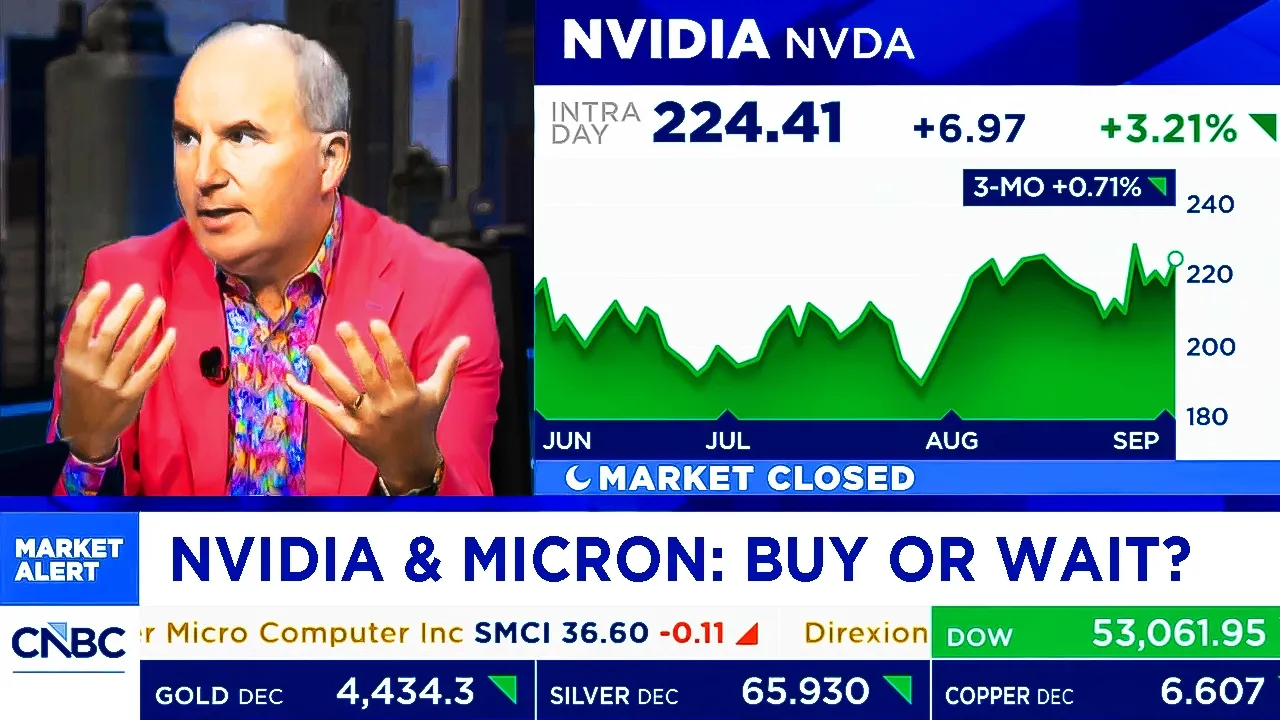
I want to bring in Caruso Insights, their president, Matt Caruso. Matt, ... you've been bullish on Nvidia for some time. You still like it. ... Why now after really being somewhat of a disappointment for so long?
your buy area on this SMH you say around 500 could be a good entry point.
Contexto
"You're looking at this and you your buy area on this SMH you say around 500 could be a good entry point."
Transcrição Completa
and the Invida CEO Jensen Wong will meet today to continue the talks in Asheville, North Carolina. VC Harrier covers semiconductors for Bank of America and he joins us now for more. VC, welcome to the program. At a time when public opinion is leaning quite heavily against what's happening with this buildout. It's interesting to see these leaders get a seat at the table down at the G20. How will they keep that support from these leaders? >> Uh good morning, John. Um I I think you're right that uh you know recently we have heard of uh some public backlash against the buildout of uh data centers and I think it's important to to recognize uh that but at the same time I I would uh treat that as more the exception rather than uh the norm. you know yesterday or actually in the last two days Taiwan Semiconductor uh presented at Semicon in Taiwan and they suggested that over the next several years uh we could see an incremental 30 to 40 gawatt equivalent of IT capacity or AI capacity being deployed uh globally right every gigawatt if one uh uses equipment from uh Nvidia is close to 30 to40 billion um right of uh demand for semiconductors so I think that the long-term outlook is is very clear But as we head towards uh the midterm elections, right, as as we we pass through some of these uh you know, geopolitical issues in the near term, some of that backlash uh could come and uh create more volatility in the sector. But I think the the key point is that the long-term demand outlook for semiconductors is exceptionally strong. >> We've been debating potential constraints now since this started, whether it would be energy, whether it would be capital, whether it would be the politics. what potential constraints do you see on the horizon as a headwind to this buildout? >> Sure. So, John, one way to think about this is that constraints are not always a bad thing. Um, right, and in some ways they are helping to prevent a lot of the overbuild. Imagine if everything was free and available, right? We would probably be building out a lot and then the complaint would be we have overbuilt. So to some extent I think having constraints in the system creates a lot more discipline and and you mentioned the constraints they are uh financial constraints uh there are operational constraints the availability of land power shell uh within semiconductors they are the constraints around uh enough memory chips uh substrates uh wafers uh lasers uh power chips so you name it there are 10 different areas of of constraints but the interesting thing is that the industry is planning um right with the great deal of uh uh you know uh creative creativeness around this uh and that is why you know what we have seen is that at the start of this year people thought that cloud spending this year would be about 650 billion it will actually be close to 800 billion and then people also thought that next year cloud spending would be about 800 and now what you know the trend is for it to be close to 1.3 trillion so I think the industry has found creative uh ways around managing around these constraints. But my point to you is that uh constraints are not always a bad thing. I I think they help to inject a lot of uh discipline in the industry as well. >> Are you worried about prices getting cut though on semiconductors and margins getting compressed? >> No. Uh I think that if there is any uh compression it is in margins for sure but that is mainly because of the supply issues Lisa that we just uh discussed that you know the price of certain input uh components uh memory wafers lasers are getting more expensive. So that is showing up as uh pricing power for certain kinds of companies. The memory companies the optical companies uh the uh foundaries it's showing up as great pricing power for them. the analog companies I mean their margins are close to all-time highs but uh companies who are involved in the hardware layer and uh the upstream uh the downstream compute layer you know they are having to bear uh some of these margins but even look Nvidia reported recently um you know their gross margins used to be 75 and even with all this inflation next year their gross margins would be 71 to 72% and more importantly if the growth projections are right next year at this time Nvidia could be doing 2 billion ion dollar in sales every weekday and generating a billion of free cash flow every weekday. That that's pretty powerful. >> Those numbers are just ridiculous. VC. Thank you, sir. Forbear there of Bank of America. A constructive view on the chips trade. If you had to pick a problem, if I had to choose one, I'd rather have a supply problem as one of those companies than a demand problem obviously and that's the problem they have right now. >> Yeah. Focus on Nvidia. They could reportedly seal the 14 billion deal to acquire artificial intelligence startup Hugging Face. They could seal it this week. This transaction could include a billion dollar retention package for hugging face employees. Billion dollars. Staying on Nvidia, Edward Lawrence just spoke to Jensen Hong. He laid out what he thinks should be the rules of the road for AI. Watch. >> Right now, the technology is in its formative stages. And the um the advice uh that I would have is is um uh to regulate practical and actual harm and not uh uh regulate theoretical and hypothetical harm. And the reason for that is of course the technology is still advancing. We want to make sure that the technology advances in a safe way and and the the more advanced it is the safer and more practical it could be, more useful it could be. Uh we will bring you more updates from the G20 Innovation Summit as we get them. >> And of course, Nvidia, now Nvidia at number 10 is huge, right? In fact, Jensen Wong has been so busy. He's at this year's G20. By the way, we got to give props to the administration. They allow private companies a very unique opportunity to go to the G20 and speak to world leaders. This is a very influential stage and Jensen has delivered big time. Of course, his plan is to educate everyone on the importance of the AI revolution. >> This token is a mathematical outcome of a lot of computation. And this token represents intelligence and in a lot of in a lot of the same ways. If you go back a hundred years, couple hundred years, uh the world discovered this new idea called energy and you monetize it, uh dollars per kilowatt hours. Today it's dollars per million tokens. It's the same idea. >> It's the same same same idea. More and more people seem to be getting it. I want to bring in Caruso Insights, their president, Matt Caruso. Matt, >> you've been bullish on Nvidia for some time. You still like it. It's it's actually what you you're calling your bullish outlier because it is standing out from the crowd. Why now after really being somewhat of a disappointment for so long? I think the market tone has shifted dramatically as well and Nvidia blew away expectations. Their growth is phenomenal. People are looking for more that safe, very high growth name and Nvidia really nails it. They are not only they the leader but they're expanding their lead and so we're seeing that also in price action. That resilience to the general sector weakness is a big standout that's under accumulation. >> You think Jensen now is starting to really get through the folks? I mean he's he's at the G20 saying every country must have it. That means every you know that means every business must have it. At some point I think most people are interacting with it to a degree. Uh but from a business model point of view it's starting to kick click that hey maybe this is still early stage. >> I think it's early stage and in fact if you look at the way valuations are people are pricing this as if they don't believe it'll sustain but I think we're at a dramatic shift in how compute will be consumed. So if we continue this trajectory as Jensen has pointed out the stock is plenty of upside even given its market cap. Let's talk about the other semis because in Nvidia's traded outside of the semiconductors if it's down sometimes the rest are up and vice versa. We hear that the buying was trickling down to some of the older names some of the different niches out there. You're looking at this and you your buy area on this SMH you say around 500 could be a good entry point. >> Yeah, the the underlying fundamentals are so strong. Obviously, the the advance was incredible and that takes time to digest and ironically people always want to chase strength, but when you're in this digestion phase, it's best looking for some weakness to put on exposure instead of chasing upside and getting turned over in the summer chop. >> So, this pullback that we're seeing right now, this is not necessarily an indictment on semis. They're saying, "Hey, look at the runup. You have to consolidate that, but don't use this as an indictment on the on on semiconductors." >> Every cycle, just as in March, people were concerned about other issues. They didn't want to focus on where the growth was. Now there's new issues with the bond market and so they're throwing this out as well. This sets up another great opportunity just as people again lose uh focus. >> I want to talk about semis because you do cover a swath of hardware and semiconductors. Uh they're trying to come to life here overall what's changing uh you know the the sort of narrative now we know there was this point where software up semi down semi up software down kind of thing but it feels like something more is going on right now. >> I'd say beware of narrative following stocks. The momentum in semis broke sometime earlier this uh a few weeks a couple of months ago. A lot of it because of situational awareness and Korean retail traders and things like that. The actual demand for semis has increased very significantly. For Nvidia to come out last week and say we have at least 70% revenue growth next year, that's the first time they've given specific guidance a year out. Then you have Dell last night raising their guidance tremendously saying they're going to double their server revenue that the actual fundamentals for these companies is improving. Now momentum in trading is important but the fundamentals here are far more important and if you believe that AI will continue to gain market share in terms of enterprise technology spend which we do semis are some of the best place to be and you have these companies like Nvidia and Broadcom right >> trading in the mid teens on earnings you have Micron still trading at six or seven times earnings that's as your as your earlier guest said that implies that the cap IC cycle is almost over, which there's no indication that that's the case. >> Just take Anthropic and Nvidia. It it's very clear Jensen Wong has ambitions to be more than just a guy who sells chips. Um, and we're seeing that with the uh the reports about this hugging face deal. I get the same sense that Anthropic wants to be more than just an LLM model. What do you think those companies can become if this AI buildout is uh as solid and relentless as it seems to be? Gosh, you know, I think they can they can both spread their wings and I think every company the opportunity for a lot of different companies is is very broad today. Um, you know, what I think most of the market isn't really appreciating about Nvidia is they are moving down the market, right? They're moving into the infrastructure and the model layer with Neimotron um which will allow them to basically be the provider of not only the software that you interact with and the intelligence layer but also the the GPUs that um that provide that intelligence and it's a very powerful business model for them as they start to you know get into the open model kind of realm right and support their own chips with the intelligence layer. Um I think it's a very very interesting pivot if they decide to really focus on that. I mean philanthropic I think you know it's very clear that they're getting into enterprise. >> Yeah. >> And you know I I do it wouldn't surprise me if they decided to buy a oldw world software company >> right. um in order just to get the distribution for >> for their own product and modernize the entire ecosystem. So um I know that's a little farfetched but >> but I do think that their their opportunity and enterprise is massive. Um they're getting into life sciences, they're getting into, you know, drug discovery tools, big big markets. And so and and I I think that's why when when people are questioning, oh at two trillion, how much more value is there on the table? Well, when you're effectively coming in and rewriting entire sectors, um, the opportunity set is big. >> All right, let's dig into AI and this moment that we're in, Dan. I mean, I'm just wondering what the biggest thing you think that investors are getting wrong right now about this trade. >> I think it's the scale and scope of just how big this is going to be. Look, Sam, I mean, I mean, you have to for four to five trillion that's going to be spent in the next few years is the multiplier. For every dollar spent on capex, there's a four, five, $6 multiplier on that across the rest of tech. I think it's you're starting to now see some of that come to fruit and I think you've seen in the latest earning season but I think that is something where investors have been kind of missing in terms of just the scale and scope across infrastructure across software across energy. I think that's what you I think maybe investors have missed in the AI revolution >> and Nvidia obviously playing such a big part in this and I understand uh with respect to your research license where you stand on certain stocks but let's just use that as for instance a lynch pin to talk about the broader industry particularly because of the performance this year Dan I mean it's not the sort of parabolic pass that we're used to with a name like Nvidia the narrative this year has been one of valuation compression and consolidated growth It's still stable. I mean, the fundamentals still look good. What are your expectations then, you know, moving forward for the broader AI trade given what we've seen in that particular name? Yeah, look, I think first of it all starts with chips and as much as there's been focus in terms of memory chips and Cosby and what we see in Korea, look, Nvidia, they've been the epicenter of AI, you know, relative to what we see in terms of there's really one chip in the world that's fueling AI revolution, right? I think Nvidia and Jensen has the best I think viewpoint in terms of what demand looks like. and we said from our last Asia trip demand and supply is 13 to1 terms of demand and supply >> so I think as that plays out in terms of the broader trade and there's always a debate is it chips is it infrastructure is it hypers scale is it software it's it's a combination of all of them when you all start to put it together in terms of where it's headed >> you have spent so much time in Asia you go there often you and I have spent time in Asia together over the years. I'm just wondering do you think that Jensen will be able to sell his chips to China at some point? >> That's look that that's a big risk because not necessarily just to Nvidia, but I think overall if Jensen and Nvidia are not able to sell into China, it's China that strengthens. Huawei strengthens. And that's why I think when you think about what's happened to Beltway, there's such this quagmire going on in terms of what's happened in terms of the China market because I think in the tech industry and it's my view, they understand that by not selling it to China that hurts US names because it makes China that much stronger and it's an arms race between US and China and I think that that's like a very important point where we are today. Meanwhile, Nvidia shares ending up about 3% higher today. Our Jim Kramer on Squawk on the street. He made a very big call on what Jensen should do right now with a big chunk of Nvidia's money. >> I called for a half a trillion dollar buyback >> out of Nvidia. >> Yes, it needs that. >> You've been talking about this Luca like >> they got to go Apple. It's the first time I put a number on it. Half a trillion. >> So almost 10% of the of the market cap. >> Oh yeah, they have to. I mean, remember Apple bought back 44%. I'm just starting with this buyback. I think it's so much better than giving it to Nibbius. >> So, should Nvidia buy back a half a trillion dollars of its own stock, Dan? >> Um, I mean, it should if they maybe pull back on some of the investments that they're making in the ecosystem. I mean, I think at these sorts of levels um and this valuation, it might make a lot of sense to kind of shrink that uh share count. And for Apple, it really did serve as a tailwind. They I think they bought back maybe threearters of a trillion dollars since they um announced that uh going back to 2012 when uh Tim Cook took over and so they've also paid back at least a quarter of a trillion dollars um in dividends. Obviously Nvidia pays a dividend but you know like I guess you got to ask the question are there better uses of their cash right now and especially you're getting to a point where there's a lot of um I don't know I mean there's a lot of questioning a lot of these circular deals are getting a bit more complicated as it goes and I would almost kind of get it out there. you don't actually have to start buying back the stock. you can announce that sort of stock buyback and you can kind of be um I don't know a little opportunistic if you will because at some point if you look at the rest of the space so stocks does not trade well a lot of these stocks do not trade particularly well you can make the same argument despite Nvidia making a new high today just look at that chart it's been going sideways for months and months so um to have that in the kitty and ready to go that makes some sense and you know Jensen seems pretty optimistic about their road map here so again maybe that is a good use of capital and Jim's right 10% of the share account um that would easily buoy this stock in difficult times. >> You know, his whole point was that there's nothing more valuable in the market than Nvidia, so why not buy back your own shares? You agree with that thesis that this is the best way to put their money to work. >> I think it's not a bad way to put their money to work. It's I don't think it's a, you know, that large of a what does he want to do? $500 billion. >> That seems pretty large. It's more than the cash that they have. They do have incredible cash flow. Over the next two or three years, they could probably afford that. But it's not all or none, right? But they do have, I think, currently maybe an $80 billion buyback in place, which seems small. Is it a hundred now? That's sort of maybe adorable compared to what [laughter] what what Jim wants, but it could be somewhere in between. I think they deserve to have uh the street say, "All right, you've you've been good stewards of your capital." So, continue to do that if the way you think is not buybacks and something else. >> Okay. >> I sort of say, "All right, they've earned that." >> Adorable. Or you want to do adorable? You like adorable? I mean I listen half a trillion dollars. We've seen companies buy more than 10% of their stock back and that is or 10% of their market cap back. That's exactly what the math is as David just sort of pointed out in the clip. So I don't think it's ridiculous. I don't think they have the balance sheet for it currently. I don't think but obviously I'm sure they could raise money pretty easily. What I'll say is this. We talk about how cheap Nvidia is all the time. It does not trade at a market multiple. Some of their peers to the extent that you think they have peers trades at twice the multiple. So they could easily come out and say we don't think the market's rewarding us for our growth and yeah we're going to do an aggressive stock buyback here. The market would absolutely fall in love with that. However, to Karen's point, you know, are there better ways? They've been great stewards of capital so far. So we'll see. High growth companies get higher multiples than lower growth companies. But there are anomalies. For example, what the heck is Nvidia doing with a with such a low price earnings multiple despite the phenomenal growth? WAS IT 14 TIMES NEXT YEARS? COME ON. The answer is that there are many money managers who believe Invidious numbers are peaking because of this circular reasoning stuff we keep hearing about. Others think it's because of a pause in spending uh because of political opposition to the data center. Therefore, the critics believe Nvidia is making all these investments in its customers just to keep the balls in the air continue by continue to uh make money by paying its customers who then pay Nvidia back. This process is called circular financing. It's considered a real sign of danger because we saw these kinds of transactions in the leadup to the dotcom collapse. I vehemently disagree. Nvidia's Jensen Wong knows that the companies using his chips are starting to make a ton of money, so why not back them up? This is something I asked Dell's CFO last night. He confirmed that right here on this show. Companies are relying on Nvidia's equipment and they're making fortunes. We're finally at the moment where customers are beginning to clean up from this technology. That's why Dell's up so much. They told you that they're very good at supply chain management. Some of that supply chain management is about getting enough Nvidia because those chips are in short supply. Dell's multiple low because people didn't believe they could make as much money with Nvidia's wares. Last night we found out and look what happened. So the bottom line when you I know it's complicated, but I had to try it. When you put it all together, you realize there's no revulsion to the data center or the AI stocks or even momentum players. It's just that when bond yields go up, money managers dump their expensive stocks and swap into the cheaper ones with lower pees, priced to earnings multiples. As it happens, many of the data center players have high multiples. But the ones that don't, like Dell, they're doing just fine. >> All right, I hope you're all doing well today and staying calm in this market. Today was overall a positive day in a market at the index level, but slightly mixed beneath the surface as the situation in the Middle East continues. Tuesday night, Bloomberg reported that Nvidia is in advanced talks to acquire Hugging Face for 12.9 billion plus a $1 billion retention package for Hugging Face employees, bringing the total to roughly $14 billion. According to Bloomberg, a final agreement has not been reached, and the timing or details could still change. If this deal were to happen, it would have interesting implications for Nvidia. We know that Nvidia wants to be the leader in open source. If this deal happens, Nvidia will be moving further up the stack and control what is arguably the primary platform developers use to discover, build, fine-tune, and deploy AI models, especially open- source and openweight models. It would help strengthen NVIDIA's CUDA mode, as it would make deploying open- source models on Nvidia's infrastructure even more seamless and further cement NVIDIA as being the default platform for open models. From a strategic perspective, I find this very interesting considering that major hyperscalers are trying to diversify their chip supply away from Nvidia by developing their own custom accelerators. And by acquiring hugging face, Nvidia would be vertically integrating in the opposite direction, moving up the stack into models and developer tooling and strengthening their mode there. I guess one potential risk to this acquisition is that it might encourage the development of alternatives. Hugging face has been viewed as relatively neutral and open. Some developers and especially Nvidia's competitors might become slightly concerned if Nvidia were to own the platform. It's also possible that this deal could draw some regulatory scrutiny which would not be ideal for Nvidia. Overall, I think this deal could make a lot of sense for Nvidia from strategic perspective. At the time of making this video, we do not yet have confirmation of a deal. In other news, JP Morgan analyst Harllinser met with Nvidius, vice president of investor relations and strategic finance to discuss Nvidia's outlook. Nvidia said they provided their fiscal 2028 outlook of 70% revenue growth due to stronger visibility into next year and a meaningful gap between street expectations and internal projections. As a reminder, Nvidia's fiscal 2028 is mostly in calendar 2027. It begins in late January. I've heard some people incorrectly assume that Nvidia guided to 70% revenue growth in calendar 2028, but it's fiscal 2028, not calendar 2028. Anyway, Nvidia said training versus inference revenues was roughly 50/50 around 18 months ago, but Nvidia expressed confidence that inference is now larger and continuing to grow as a percentage of the business. That's important because more inference ultimately means that Nvidia's customers are monetizing AI more than they were previously. Also, I'm sure many of you remember the many incorrect takes last year claiming that Nvidia was losing ground in inference. As I said repeatedly on this channel, Nvidia systems are actually the best on the market for inference with the lowest total cost of ownership. It's also important to remember that Nvidia's platform is fungeible. So while companies will use the leading edge accelerators for training new models, those same accelerators can later be transitioned to inference workloads, meaning they're useful for longer and have a longer useful life. That's positive for Nvidia's customers. Importantly, and this may be a big reason why Nvidia traded higher on Wednesday. Nvidia indicated to JP Morgan that without supply constraints, Nvidia's business could potentially more than double year-over-year. That indicates that demand is even stronger than what Jensen and Colette implied on the earnings call last week. Another reason why Nvidia traded higher on Wednesday is likely Dell earnings. As I mentioned in last night's video, Dell reported another very strong quarter. I'm not going to go over all the details, but revenue was up 58% year-over-year. Adjusted EPS was up 203% year-over-year and Dell indicated that their backlog is growing much faster than their revenue, meaning there is plenty of runway ahead and we are not at peak spending. That's positive for Nvidia. Dell also spoke about being supply constrained and they indicated that memory is the main bottleneck. Also on Wednesday, Jensen Hang spoke at the G20 Innovation Ministerial and urged world leaders to build their own AI infrastructure so that they don't get left behind. On Nvidia's recent earnings call, CFO Colette Crest said that Nvidia's sovereign AI business, primarily through the regional clouds, grew 35% sequentially and more than tripled year-over-year in Q2. Sovereign AI revenue is included in Nvidia's non-hyperscaler, ACIE customer segment. That customer segment is growing very strong with revenue up 138% year-over-year in Q2. In other news, it's being reported that Nvidia is investing in Mistral's three billion euro funding round. We don't know how much Nvidia will invest. We also got Broadcom earnings Wednesday after market close. I'll just briefly cover some of the main points. Broadcom slightly beat consensus on both the top and bottom lines. Revenue was up 86% year-over-year. AI semiconductor revenue came in at 16.7 billion, which is up 221% year-over-year. And Broadcom expects Q4 AI semiconductor revenue to accelerate to $21.7 billion, which will be a 236% year-over-year increase. Broadcom guided Q4 total revenue at $34.8 billion, which is slightly less than consensus. Now, what really helped Broadcom and After Hours were CEO Hawkan's comments on the earnings call when he said that Broadcom has secured the supply for AI semiconductor revenue in fiscal 2027 to be approximately $115 billion. That would be a double from this year. He said Broadcom's demand exceeds this outlook. Hawk then said that Broadcom expects the trajectory of growth to continue in 2028 and they have line of sight for fiscal 2028 AI semiconductor revenue of $230 billion. So they expect AI semiconductor revenue to double in fiscal 2027 and then to double again in fiscal 2028. That outlook and the fact that Broadcom expects their growth trajectory to continue in 2028. That is the key detail from Broadcom's earnings in my opinion. Broadcom's outlook and Dell earnings both reaffirm the thesis that there is still plenty of runway ahead and we are not a peak spending. As I've said so many times on this channel, this is not zero sum. The world is already compute constrained, which means there's already enough room for multiple chip makers to succeed. And the total addressable market is growing at an extraordinarily strong clip. On top of that, as long as the world is compute constrained, almost all viable compute that is produced will be sold. This is not zero sum and now is not the time for Nvidia investors to worry about market share. Now, let's cover a couple pieces of memory news. SK Group's chairman raised the possibility of building a new memory plant in Japan between SKH Heinix and Kioa. He also said that data center memory supply is currently 20 to 30% sure demand and that SK's existing expansion in South Korea is not enough to meet that demand. In other news, Micron discussed a new architecture at Semicon Taiwan that it says could provide more than 10 times current HBM bandwidth while consuming substantially less energy per bit. This appears to be more exploratory rather than a near-term commercial product. Micron is also reportedly exploring near GPU NAND. The concept would place high endurance NAND extremely close to the accelerator potentially on the package or board, creating a new memory tier that sits between HBM/DRAMM and conventional SSD storage. The idea is aimed primarily at large model inference. This comes as SanDisk and SKH have been pursuing a related high bandwidth flash concept. This could potentially be important longer term as a new highv value use case for NAND. Looking ahead, Jensen is scheduled to speak at the Goldman Sachs Communicopia and Technology Conference on September 10th. Then we have Micron earnings on September 30th. And then Jensen is scheduled to speak again at GTC Berlin on October 21st. Now, in case you're new to the channel, I want to make sure that you have at least a basic understanding of the underlying long-term thesis. So, let's cover that. Now, I don't know what's going to happen in the short term, but from a long-term perspective, I am very confident that Nvidia will be worth much more in future years than it is today. When Jensen was on the Lex Freedman podcast not that long ago, he was very seriously raising the possibility of Nvidia becoming a $3 trillion revenue company in the near future. If that happens in the coming years, then it is very plausible that Nvidia could one day be worth tens of trillions of dollars in market cap. That might sound crazy, but that's what Jensen is implying when he raises the possibility of Nvidia becoming a $3 trillion revenue company. I guess the question at that point is what multiple the street will be willing to give Nvidia. I don't know the answer to that question, but I truly do think that Nvidia will be worth much more in future years than it is today based purely on the fundamental growth of the business. Based on everything I'm seeing, the world is still computed, and I expect that to continue at least through the first half of calendar 2028. In a computed environment, developers will use whatever viable compute they can get their hands on. Today, there are no GPUs that are sitting dark due to a lack of demand, like there was fiber sitting dark due to a lack of demand at the height of the.com bubble. Back then, companies were laying fiber in the hopes that use cases and demand would eventually show up. Today, we are seeing the complete opposite. As I've said many times, when market participants compare this AI revolution to the dotcom bubble, they ignore the fact that the internet is already here this time. This means that mass adoption of the technology and new use case development at scale are immediately possible. We don't have to wait years for it to show up. It's already here. The world is compute constrained, which means there is not enough supply to satisfy demand. New capacity is utilized as soon as it comes online. The hyperscalers are monetizing capacity as soon as it comes online. Each of the hyperscalers spoke about being supply constrained on their most recent earnings calls. Additionally, many of the clouds are [clears throat] building out into contracted demand. They're not blindly building in the hopes that demand will eventually show up. No, they're building out because they have signed contracts and in some cases significant prepayments from their paying customers. This AI revolution is fundamentally different from the do-com bubble. And 2026 will be a pivotal year for the AI industry thanks to the rapid adoption of Agentic AI and the proliferation of Agentic systems in the world's leading enterprises. The leading AI labs revenues are surging right now. Agent coding and the implementation of Agentic systems in large enterprises are new use cases that are increasing inference demand significantly that subsequently is increasing compute demand. The rapid adoption of Agentic AI is why we're seeing an inflection in inference demand. It's why we're seeing the leading AI labs revenue surge. I wish both Anthropic and Open AI were public so the public could see the ramp in their revenues. I think the leading labs surging revenues may be the initial proof point that grabs market participants attention and causes them to realize that there will be a clear ROI on AI infrastructure. I think the leading labs surging revenues will also help assure investors of the longevity of Nvidia's growth since these labs revenues are directly tied to compute. If they had more compute, they would have greater revenues. It really is that simple. Demand is not the problem. The problem is a lack of supply to meet the demand. As I've said previously, I expect the world to be compute constrained at least through the first half of 2028, possibly longer. And so regardless of what happens in the short term, it's important for long-term investors to remain focused on the fundamentals. Maintain a long-term perspective and remember that we are only in the early stages of aenic systems being adopted at scale. This will increase compute demand significantly. And after that, the next surge in compute demand will likely be fueled by physical AI. We're no longer talking about digital agents performing digital tasks. With physical AI, we're talking about physical AI agents performing physical tasks in the real world. NVIDIA CFO has called physical AI quote a multi- trillion dollar opportunity and the next leg of growth for NVIDIA. This industry will fundamentally transform society and NVIDIA has positioned themselves to benefit massively. NVIDIA sells the hardware for the data centers where the models are trained. They offer omniverse where the models are taught and tested. And Nvidia also sells the hardware that allows ondevice real-time inference through NVIDIA AGX, allowing robots to have intelligent interactions with the real world, even when they are not connected to a data center. Notice that Nvidia is taking a holistic platform approach to physical AI, and they're embedding themselves as the underlying foundation supporting all of it. Over 3 million developers are already building on the Nvidia robotic stack, and this is not getting enough attention. As for production ramps, Blackwell Ultra has ramped and remains in high demand. Vera Rubin is rolling out to customers. Nvidia Gro 3 LPX is in full production. Later on, we're expecting the launch of Reuben Ultra in 2027 and Fineman after that in 2028. We have a clear data center product roadmap stretching into 2028. And Jensen believes that AI infrastructure spending will reach three to 4 trillion annually by the end of the decade. That means Jensen is expecting growing AI demand and an expanding total addressable market underpinning all of this. I don't think we are anywhere near any type of bubble bursting type of event. With all of this in mind, I seriously think that Nvidia still has plenty of runway ahead of it. And I think this company will be worth substantially more in future years than it is today. At least that's my view of the situation. Quick note before I wrap up. All of the compilations on this channel are edited by Finn Vid with original structure and commentary. Occasionally the same edits appear elsewhere on YouTube. If you're looking for the original version, it's always here on this channel. Thanks for watching Finnvid. I appreciate your support. Remember to stay calm in this market. Remember to maintain a long-term perspective and do not make any hasty or irrational decisions. With all of that being said, I hope you all have a great rest of the day. And I'm curious to hear your thoughts about Nvidia in the comments below. Please leave a like on this video so more people will see it. And while you're down there, please consider subscribing. It's free and you can always change your mind. Thanks for watching and hopefully I'll see you in the next

Comentários 0
Entre para participar da discussão.
EntrarAinda não há comentários. Seja o primeiro a compartilhar sua opinião!