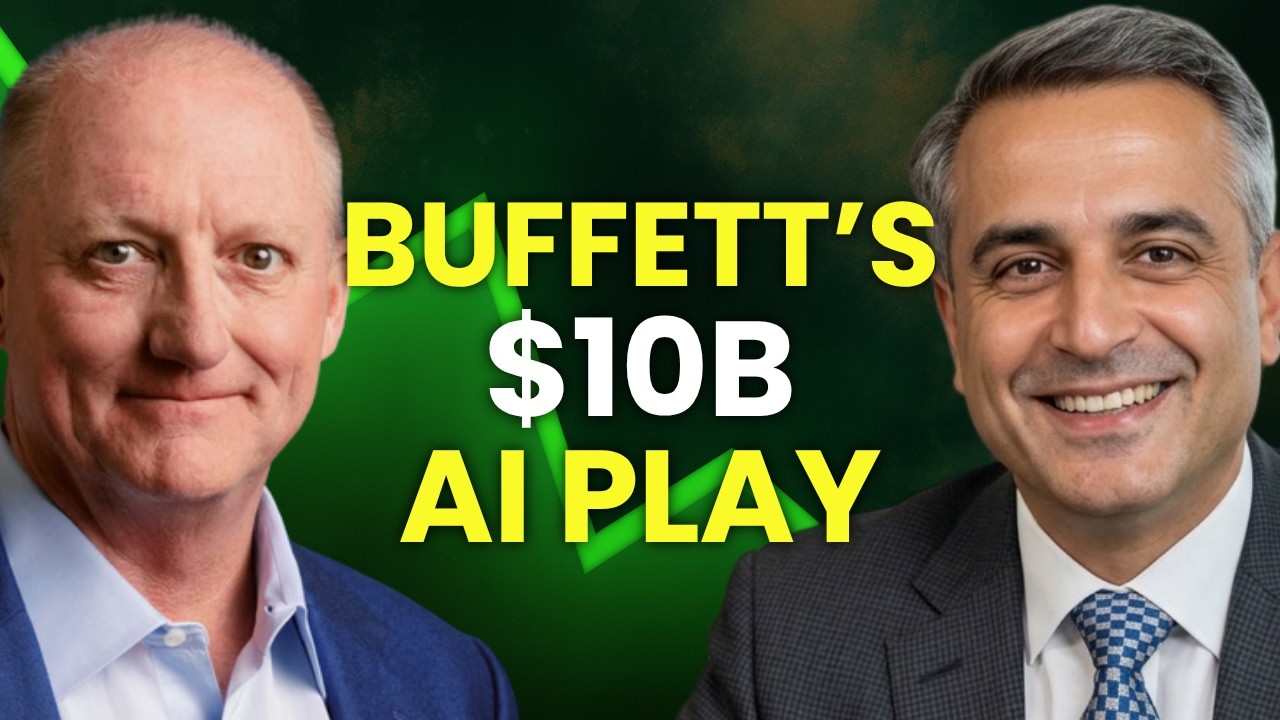
Greg Abel Reveals How Berkshire Hathaway Is Cornering The AI Energy Market

- Retorno do vídeo
- —
- Chamadas
- 2
- Compra / Venda
- 2 0
- Publicado
Recomendações
Entrada é o preço de fechamento do ativo na data de publicação. Atual é o último fechamento registrado.
-
Entrada $342,48 03 set 2026Atual $342,48 03 set 2026Resultado +$0,00vs. índice +0,0% SPY +0,0% no mesmo período
Warren initiated that probably close to 15 months ago or a little bit more. And So, we initiated the the the initial purchases in Alphabet.
-
Entrada $342,48 03 set 2026Atual $342,48 03 set 2026Resultado +$0,00vs. índice +0,0% SPY +0,0% no mesmo período
We have a significant opportunity to invest in continued invest in Google, but in a in a with a significant block.
Contexto I called Warren and I said, "We have a significant opportunity to invest in continued invest in Google, but in a in a with a significant block."
Transcrição Completa
Berkshire Hathaway's quiet $10 billion block purchase of Alphabet stock reveals a massive coordinated pivot toward the infrastructure powering artificial intelligence. Speaking on CNBC in early September 2026, Berkshire CEO Greg Abel detailed this transaction and explained how the conglomerate is positioning its energy business for the AI boom. By the end of this video, you will understand the exact mechanics of Berkshire's Google trade and how its utility business plans to corner the critical energy market that AI requires. Let's hear Greg Abel on CNBC. And after that, I'll give you my own reaction breakdown to what he said. >> Greg, we we spoke with Warren Buffett back in July right here on CNBC and talked to him about a lot of things, but one of the interesting things he brought up was the Berkshire portfolio. Obviously, you're running things. He said that you're the decision maker, but that you all talk frequently, almost daily. And that the position that was initiated in Alphabet, he said was his. I just wonder if you could talk a little bit about your relationship with Warren, how you all are doing, and how you're managing that portfolio at this point, the stock portfolio for Berkshire. >> Yeah, great. Well, a great example of it is Warren turned 96 on Sunday. So, before I left to come to Tokyo, stopped in, had a had a great celebration with Warren as he as he turned 96 with his family and and friends. So, we had a a very nice afternoon. After that, flew here to Tokyo. And and and Warren absolutely loves the the Japanese investments in the companies we've uh invested in. So, it's I could tell it wasn't easy for Warren that off I went to Tokyo, but yeah, we have a great working relationship in that we discuss a variety of things on a regular basis. So, we would have some discussions even on Sunday about our our Japanese investments. And I talked to him earlier this morning just to give him an update on on how each of the meetings went and how the companies are performing. But it's a it's a very much a just a a dialogue we've always had. We love talking business. We love talking about what we're seeing across our our portfolio. And you're absolutely right. relative to the Alphabet position. Warren initiated that probably close to 15 months ago or a little bit more. And So, we initiated the the the initial purchases in Alphabet. We continued or he continued and we discussed it then and continued to discuss it. initiated a variety of purchases. And then I want to say in late May I received a call on a Sunday morning to see if we wanted to particip- participate in their upcoming equity offering. Uh really no terms or amount were set. And I said, "Well, I'd get back to him right away." And very much consistent with how we manage Berkshire, but also how we the governance around it. I called Warren and I said, "We have a significant opportunity to invest in continued invest in Google, but in a in a with a significant block." Discuss the size. They hadn't set the size, but recommended that we consider 10 billion. And Warren Warren and I discussed the size. We discussed the size of discount. And I'd recommended 6 and 1/2% discount. And we were comfortable with that. And we went back to them and and highlighted we would be interested in a a block on those terms. And then ultimately consummated the transaction. >> Why do you like Alphabet? >> I think from the just from a real high level, obviously we don't discuss the underlying specifics of any of the concepts in in in around any of our equity investments, but the one thing that is unique with Alphabet, I guess we do see this across other businesses, but number one, obviously uh we all are seeing and feeling the impact of AI. So, we knew it was going to have a significant impact on on America and and and businesses. We have a lot of visibility from within our companies as to how we're using AI, what type of benefits it's delivering, so that brought uh incremental interest. And then uh we saw Google as a significant player. Now, there's a lot more to Google than what I just said and why we like it, but those were the fundamental reasons as to why we uh took a serious look at uh at Google and now have uh um a significant investment in it. >> Well, let me ask you a little more about AI and the data center build-out that's taking place. You're somebody who spent decades working in infrastructure building at Kiewit and and and also at Berkshire Energy. So, you understand one of the key um places that's seen as a a limiting factor for AI build-out and that's energy. Where are we right now in turn of the terms of that data center build-out? Where do you see opportunities um specifically for Berkshire? >> Yeah. So, it's really interesting as they continue to announce all the data centers and data center sites. I've sort of always had a strong view that energy would be the constraint. I and and there'd be energy, we can produce the energy. It's do we have a How long it would take to get the sites prepared and and being in a position they could serve the data centers. And I continue to see that as a big constraint. We'll come to one of the other challenges. So, um And and but we do still see it as a significant opportunity for Berkshire and Berkshire Hathaway Energy in that uh for example, if you look at Iowa, where we have a number of data centers, uh I want to say last year approximately 8% of our load came from data centers. And we see incremental load coming on, both customers requesting it and and what we can serve. But we've really operated to some pretty basic principles right from the from the get-go. And we've shared that with each of the hyperscalers. We've And it's really policy we've we've discussed with our state, our governors, and and our regulators. And we highlighted we are interesting we are interested in serving these hyperscalers. One, if there was no impact to the uh the rates of our other customers. And in fact, we've pretty much taken the approach there has to be a net benefit to our customers. The communities have to understand the impact on on water. And that has become much more manageable as they uh uh uh address that and use you know, the technologies that are available to minimize water use. And then And then lastly, the the communities have to be open to having the the the data center in their community. We have we we we we very much believe in the fact that you have to be a a welcomed member of the community. Now, that's a decision the data center has to make, but we we can uh encourage them to seriously evaluate where their reaction from the communities. And I know you've had many discussions around it. There is a lot more pushback in the communities across the US. We have not had any specific site rejected to date. We're continuing to move forward on the on the various sites we have under construction. And our sites would be the energy infrastructure, not the data center site. But it has to be done on the terms and conditions I I just highlighted. >> The CNBC host opened the discussion by pressing Abel on his operational relationship with Warren Buffett, specifically pointing out that while Buffett has publicly designated Abel as the primary decision-maker for Berkshire's sprawling operations, Buffett himself initiated the recent position in Alphabet. This created a fascinating tension. Who is actually running the show when it comes to Berkshire's massive equity portfolio? Abel responded by painting a picture of an incredibly close, highly collaborative partnership. He noted that they maintain a continuous, almost daily dialogue about business operations and portfolio performance. To illustrate this, Abel shared that just before flying to Tokyo for a series of corporate meetings, he stopped by Omaha to celebrate Buffett's 96th birthday on Sunday, August 30, 2026. Even during a casual family birthday celebration, the two men spent the afternoon discussing Berkshire's Japanese investments. This detail underscores that the intellectual partnership between the legendary investor and his successor remains as active as ever. When the host asked for specific details on how the Alphabet position was built, Abel revealed a fascinating timeline that shows exactly how Berkshire operates behind closed doors. Buffett initiated the first purchases of Alphabet stock roughly 15 months prior to the interview, which places the start of the position around June 2025. The two executives discussed the investment as it grew, but the real inflection point occurred in late May 2026. Abel recalled receiving a phone call on a Sunday morning inquiring whether Berkshire would be interested in participating in an upcoming private equity offering from Alphabet. At that moment, no specific terms or dollar amounts had been established. Abel immediately called Buffett to discuss the opportunity. Recognizing the scale of the offering, Abel recommended that Berkshire propose a massive $10 billion block purchase. Furthermore, he suggested demanding a 6 and 1/2% discount on the shares. Buffett agreed and Berkshire went back to Alphabet with those terms, ultimately closing the transaction. My take on this is that it reveals a level of institutional agility that simply does not exist anywhere else in the financial world. Usually, a $10 billion corporate transaction requires weeks of investment committee meetings, risk assessments, and bureaucratic sign-offs. Yet Abel and Buffett were able to evaluate, structure, and green-light a massive tech investment over the course of a single Sunday morning. This tells us two things. First, the transition of power at Berkshire is incredibly smooth. There is no friction or power struggle between Abel and Buffett. Second, it highlights Berkshire's massive competitive advantage as a preferred liquidity provider. When a trillion-dollar technology company like Alphabet wants to raise capital quickly and quietly, they do not just go to Wall Street. They go to Berkshire Hathaway because they know Abel and Buffett can commit billions of dollars instantly without disrupting the public markets. If that surprised you as much as it surprised me, let me know with a like and subscribe to the channel. This behind-the-scenes look at Berkshire's investment process naturally prompted the CNBC host to ask why the firm decided to take such a significant stake in Google. For decades, Buffett famously avoided major technology investments, arguing that they fell outside his circle of competence because their long-term competitive advantages were too difficult to predict. Abel answered this challenge by outlining a highly practical, modern investment thesis. While he declined to discuss the specific valuation models or internal numbers, he explained that the decision was rooted in the undeniable reality of the artificial intelligence revolution. Abel pointed out that Berkshire has a unique structural advantage that most institutional investors can only dream of, a massive empire of wholly-owned operating businesses across infrastructure logistics manufacturing, and retail. This diversified footprint gives Berkshire incredible real-time visibility into how AI is actually being used in the real economy. By observing their own companies, Abel and Buffett could see firsthand what kind of productivity gains, cost savings, and operational benefits AI technologies were delivering. This empirical ground-level data gave them the confidence that AI would have a profound, lasting impact on American business, and it led them to identify Google as a premier, highly significant player in the space. From an analytical perspective, this is a brilliant adaptation of Berkshire's traditional value investing philosophy. Historically, Buffett evaluated companies by looking at physical moats like brand loyalty, distribution networks, or proprietary technology. What Abel is describing here is a way of evaluating technological moats through the lens of Berkshire's own industrial and consumer businesses. If Berkshire's railroad or utility companies are seeing massive efficiency gains from Google's enterprise AI tools, that is a far more reliable indicator of a durable competitive advantage than any speculative Wall Street growth projection. However, I think there is a deeper, more strategic layer to this play. While Berkshire is investing billions into Alphabet's equity, they are simultaneously positioning themselves to solve the single greatest physical bottleneck that Alphabet and its tech rivals face in the AI race. The massive, insatiable demand for electricity. Before we continue, here's a short message from our sponsor of this video Narratora. >> Nobody wants to manually turn this massive annual report into a presentation. So, watch this. I'm going to transform it into a professional presentation outline in under 5 minutes. I upload the report to Narratora. Narratora analyzes the source and recommends the appropriate workflow. I select presentation outline, choose my settings, and generate. And there it is, a slide-by-slide presentation with talking points and suggested visuals built from the original report. No complicated prompting, just a few clicks. This is Narratara, generative content automation. Turn your sources into finished content at narratara.com. >> This connection became the central focus of the next segment of the interview as the host shifted the conversation away from the stock market and toward the physical world of infrastructure. Given Abel's decades of experience building massive power plants and transmission lines at Peter Kiewit Sons and Berkshire Hathaway Energy, the host pressed him on the current state of the global data center buildout and where the limiting factors actually lie. Abel's response was blunt and highly illuminating. While many technology analysts focus on the supply of advanced semiconductors or the speed of fiber optic networks, Abel has long held the view that energy will be the ultimate constraint on the expansion of artificial intelligence. He clarified that the bottleneck is not necessarily our ability to generate electricity, rather the real challenge is the sheer amount of time it takes to prepare sites, build transmission infrastructure, and physically connect these massive data centers to the grid. To put the scale of this demand into perspective, Abel shared a striking metric from Berkshire's utility operations in Iowa. He noted that in 2025, data centers accounted for approximately 8% of Berkshire Hathaway Energy's total electricity load in the state. Looking ahead, the company is seeing a massive wave of incremental demand as tech companies plead for more power to support their next-generation AI facilities. What I find most compelling about Abel's take on the energy bottleneck is how it contrasts with the typical Silicon Valley narrative. Tech executives often talk about AI data centers as if they exist in the cloud, completely detached from physical constraints. But Abel's operational perspective forces us to look at the harsh physical reality. A modern AI data center can require as much power as a medium-size city. Building the high-voltage transmission lines and substations needed to deliver that power can take 5 to 10 years, largely due to regulatory hurdles, supply chain delays for heavy electrical equipment, and local grid capacity limits. This means that the tech companies with the deepest pockets cannot simply buy their way out of the energy constraint. They are entirely dependent on regulated utilities like Berkshire Hathaway Energy to build the physical pathways for their electricity. As the conversation deepened, the host pushed Abel on how Berkshire is managing the complicated political and environmental dynamics of this massive infrastructure buildout. Serving these tech giants requires billions of dollars in capital expenditure, which can often strain local grids and create tension with existing residential and commercial utility customers. Abel explained that Berkshire has established a set of strict, non-negotiable guiding principles that they communicate directly to every tech company looking to build a data center in their territory. First and foremost, Abel stated that Berkshire will only agree to serve these massive facilities if doing so has absolutely zero negative impact on the electricity rates of their existing customers. In fact, Berkshire's policy is that there must be a clear, demonstrable net benefit to the local community and existing ratepayers. Furthermore, Abel emphasized that local communities must be fully aware of and comfortable with the environmental impacts of these facilities, particularly regarding water usage for cooling. He noted that while modern technology has made water minimization much more manageable, the ultimate decision to host a data center rests with the community itself. Abel remarked that while there is growing public pushback against data centers across the United States, Berkshire has not had a single infrastructure site rejected to date because they strictly adhere to this community-first approach. Where I land on this is that Berkshire's conservative, highly disciplined approach to utility management is actually their greatest competitive advantage in the AI infrastructure race. Many publicly traded utilities are rushing to build out capacity as quickly as possible to boost their short-term earnings, often shifting the financial risks onto local ratepayers. By contrast, Berkshire is using its massive balance sheet and private ownership model to protect local communities while demanding favorable terms from the tech giants. By insisting that hyperscalers pay their fair share and provide a net benefit to the grid, Berkshire ensures that its energy business remains highly profitable and politically secure over the long term. This disciplined boundary setting is exactly what protects Berkshire from the regulatory backlash that is beginning to hit other utilities across the country. The host then asked Abel to clarify the exact nature of Berkshire's role in these projects, wanting to know if Berkshire is actually building the data centers themselves or simply providing the underlying utility connection. Abel clarified that Berkshire's focus is strictly on the energy infrastructure, the substations, transmission lines, and power generation assets, rather than the physical data center buildings. He re-emphasized that this infrastructure development will only proceed under the strict terms and conditions they have laid out regarding community consent and ratepayer protection. This distinction is critical because it highlights Berkshire's classic tollbooth business model. Berkshire has no interest in taking on the operational risks of running data centers, nor do they want to speculate on which specific AI software will win the market. Instead, they want to own the essential infrastructure that every single AI company must use. Whether Google, Microsoft, or Amazon wins the AI race, they all have to pay Berkshire Hathaway Energy for the electricity and transmission lines required to run their models. It is a highly defensive, incredibly lucrative way to play the AI boom without taking on the technological obsolescence risk of the underlying hardware. As the interview drew to a close, the conversation returned to the broader strategic picture of Berkshire Hathaway under Abel's leadership. By connecting the dots between the massive equity investment in Alphabet and the rapid expansion of Berkshire's energy grid, Abel demonstrated a cohesive, highly integrated vision for the conglomerate's future. My final takeaway from this discussion is that Greg Abel is proving to be the perfect operational steward for Berkshire's next chapter. While he may not possess Warren Buffett's folksy public persona, he possesses a deep, highly sophisticated understanding of industrial infrastructure and capital allocation. Under his watch, Berkshire is not merely reacting to the artificial intelligence revolution, they are actively shaping the physical landscape that makes it possible. By combining Buffett's opportunistic equity investing with Abel's disciplined operational execution, Berkshire Hathaway is quietly positioning itself as the ultimate infrastructure backbone of the digital age. This disciplined approach ensures that Berkshire remains insulated from the volatility of tech markets while securing a reliable long-term stream of revenue from the essential utilities powering the AI revolution. It is a master class in risk management that prioritizes durability over short-term growth. When you look at the company's trajectory under Abel, the message is clear. They are playing a different game entirely. While the rest of the market chases the next breakthrough, Berkshire is busy building the grid that every winner will eventually have to plug into. That is the true quiet genius of their strategy, and it is a reminder that in the race to build the future, the most reliable way to win is often by owning the ground that everyone else has to walk on. Keep your eyes on their energy spending over the next few quarters, because that is where the real story of this company's evolution is being written. I appreciate you watching. Give the video a like, subscribe to the channel, and send it to someone working through the same question. See you next time.
Comentários 0
Entre para participar da discussão.
EntrarAinda não há comentários. Seja o primeiro a compartilhar sua opinião!