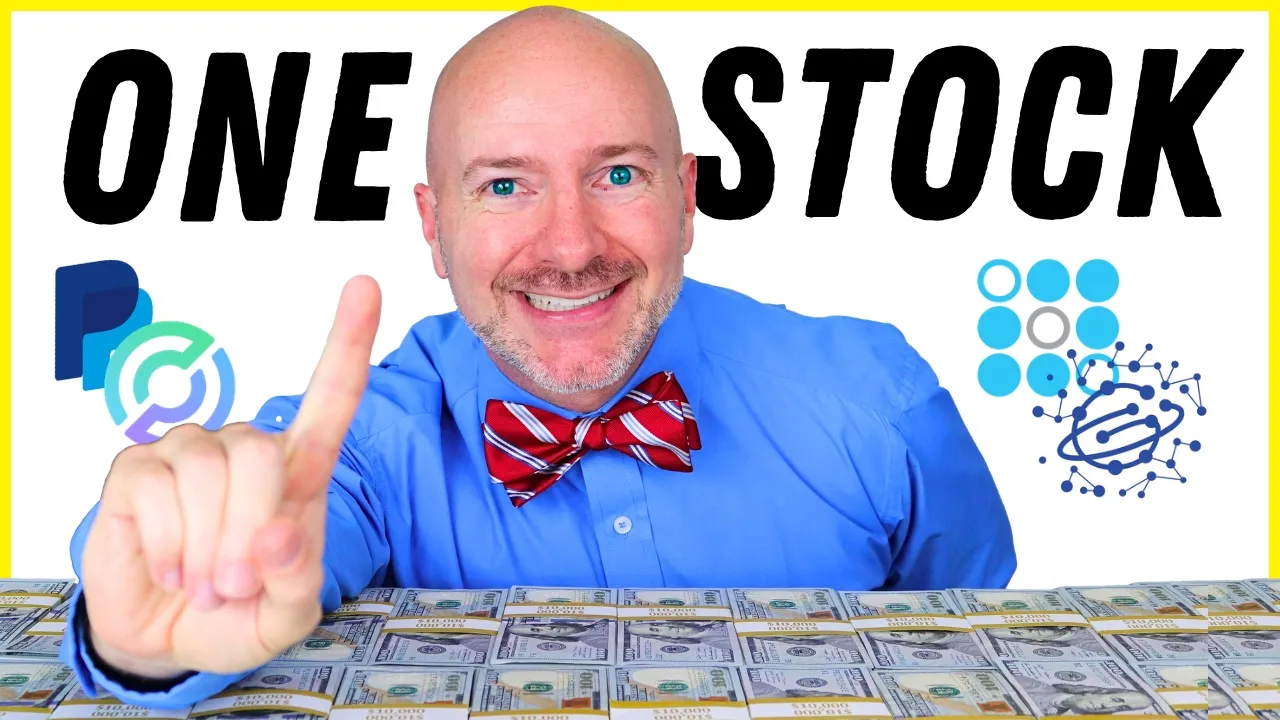
I think I would prefer SoFi and PayPal right now. PayPal a little bit more near-term, upside on possibly a a heightened bid by that private equity company, maybe raising their bid to $62 or $65.
Contexto
“I think I would prefer SoFi and PayPal right now. PayPal a little bit more near-term, upside on possibly a a heightened bid by that private equity company...”
the one stock I'd be buying right now on this theme, SoFi Technologies, ticker SOFI.
Transcrição Completa
Washington is pushing crypto hard and the real reason has nothing to do with Trump or Bitcoin. The government desperately needs stable coins to keep it out of bankruptcy. A $400 billion reason to push crypto forward. Nobody sees this coming, but it is going to be the biggest trend over the next few years and I found five stocks positioned to win including one that I'm buying right now. Nation, most investors think they know why Washington suddenly loves crypto. Trump owns crypto, his family has crypto businesses and his administration has made turning America the crypto capital of the world a priority. But there is another reason that could be far more important to the government and almost nobody is talking about this. The fact is the United States desperately needs stable coins, a form of cryptocurrency to save it from bankruptcy. This is why the Genius Act was so important, stable coin regulation that actually received significant bipartisan support. About the only thing in Washington that the government can agree on these days. The Senate vote 68 to 30 for final passage. And buried inside those rules is something extremely valuable for the government's financial health. Nation, stable coins are digital money that keeps their value against the US dollar. They do this by taking every dollar you use to buy a stable coin and putting that into safer investments like US Treasuries and money market funds. Now the investment value doesn't jump around and it earns an interest income for the stable coin company. Now traditional banks basically do the same thing, right? They're taking your savings deposits, investing that into loans that they make or other safe investments. But whereas a bank typically only buys about 8 cents worth of government treasury bonds for every dollar in those deposits, stable coins buy much much more. A part of that is that under the Genius Act, every dollar of stable coins has to be backed one for one by qualifying reserves. Now those reserves can include some cash and other investments but critically, they can also include treasury securities, those treasury bonds along with the qualifying repo and money market funds and similar assets. Now, you see this in a snapshot of stablecoin issuer Tether's investments. More than 63% of that $156 billion in Tether is invested in US Treasury bills. In other words, as stablecoins grow, they potentially create an enormous new structural buyer for Treasury bills. And Treasury Secretary Bessant hasn't exactly hidden the importance of this. When the Genius Act became law, he specifically said that stablecoins would lead to a surge in demand for US Treasuries and has talked up the potential for more than 3.7 trillion in a stablecoin market. And this is where the math becomes enormous and saves the government's ass to the tune of hundreds of billions of dollars. The stablecoin market is only around $300 billion right now, but projections have a potential market of a $4 trillion. The Wall Street Journal estimates growth on that scale could create roughly $2.7 trillion in additional Treasury demand. And to put that number in perspective, Treasury's own borrowing committee says that based on current coupon auction sizes and the privately held bill supply, primary dealers project a $1.5 trillion funding shortfall in fiscal 2027. [clears throat] Folks, the US government needs to find someone to buy another $1.5 trillion in its bonds or interest rates are going to skyrocket even more. So, here suddenly the government's enthusiasm for stablecoins starts looking a lot less mysterious. Now, we can't just say that $2.7 trillion in stablecoin buying is going to lead to lower rates by by an exact amount, but we do know how much Treasury buying has pushed rates down in the past. A 2023 Federal Reserve simulation modeled a $2.7 trillion increase in Treasury holdings and produced roughly an 80 basis point reduction. That's about 0.8% in the 10-year Treasury rate. After the financial crisis, Fed research estimated its asset purchase programs collectively reduced the 10-year Treasury rate by roughly 80 to 120 basis points. That's about as much as 1.2% lower interest rates. A 1% lower interest rates might not seem like that much, but consider the scale of this and you see why this is going to happen. Even if Congress doesn't pass the Clarity Act for that crypto regulation, the SEC is preparing its own changes and and stablecoins are going to be pushed through. And that's because with the government now owing over $40 trillion, every 1% point reduction in interest rates paid on those treasuries represents roughly $400 billion a year in lower interest expense. That's not a forecast for $400 billion in immediate savings, but it does show you how just a tiny decrease in rates brought on by this massive Treasury buying is worth a lot of attention in Washington. This is going to be the biggest news on Wall Street over the next few years and I found five stocks to watch including one I'm loading up on. I'm going to highlight the stocks in that group next, but first I want to thank today's sponsor Gamma in helping me put together a presentation for an upcoming video. Now I'm working on an update for AI infrastructure stocks, the bull bear case and especially the the supply shortages that have sent some of those stocks to the moon. Here I wanted to try building the presentation in Gamma, but only had a rough idea. So I went to generate here, give it just a couple of sentences explaining what I wanted, but honestly was expecting to have to just build this out on all the content myself. Instead, Gamma took that idea and built out the five slides I wanted, pulled together the major points, organized the comparisons, and gave me a really solid starting point including referenced information sources. I did not expect Gamma could do that. Now I'm still going to go through, add my own analysis including some other stocks, customize everything for the video, maybe change the formatting here, but instead of just starting with a blank page I've already got a professional-looking presentation that I can build on. And that's what impressed me most about Gamma. It combines the power of AI with your own ideas and information to to make building a great presentation super easy. Look for the link below or just scan the QR code here and can out Gamma and start designing today. Back to that list of stocks though, and first I'm going to look at the positioning for each of these stocks in this theme, how they benefit, then we're going to compare them all side-by-side in a head-to-head to see which one to buy right now. And first up here, SoFi Technologies, ticker SOFI, might be the sleeper stock in this theme. Though there is another one that has the clearer upside. SoFi is a digital financial services company, a bank offering savings, lending, investing, credit cards, and crypto all online. Now here, it's also uniquely positioned as the first stablecoin issuer with a national bank charter, connecting it into traditional finance like no other on the list. That means nearly 15 million SoFi members can already buy, sell, and hold that SoFi USD stablecoin on the app. SoFi plans to integrate its stablecoin utility through its ecosystem, potentially combining that blockchain payments with checking, savings, investing, and other financial products. That existing distribution is the competitive advantage here. SoFi doesn't need to find millions of crypto users from scratch. It can introduce those stablecoins to customers already using its platform. Here, Galaxy Digital, ticker GLXY, gives investors a different way to play this theme because it doesn't need one particular stablecoin to win. Galaxy is more of a digital assets and platform provider. So providing crypto trading, lending, asset management, custody, and other financial services here. If you think of SoFi as more like a digital consumer bank, Galaxy would be more like Goldman Sachs. So here, think about what happens as stablecoins potentially grow into a trillion-dollar-plus asset class. Institutions aren't necessarily going to be leaving hundreds of billions of digital dollars just sitting idle in wild wallets. So think about what happens here as stablecoins potentially grow into a trillion-dollar-plus asset class. Institutions aren't necessarily going to be just leaving hundreds of billions of digital dollars sitting idle in wallets. They're going to use them as trading collateral, lending against them, deploying them in tokenized assets and DeFi, and then moving between counterparties and blockchains. A Galaxy can provide the infrastructure and the services around all those activities, and that makes Galaxy a picks and shovels play on that stablecoin adoption. Circle needs USDC to win. PayPal needs PYUSD to gain adoption. Galaxy can potentially benefit whether the incremental trillions of dollars flows into any of these, any other regulated stablecoin, or several of them. PayPal here, PYPL is more like SoFi and could be a near-term opportunity after the company rejected a $60 offer from private equity last week. Shares sank back down and are 25% lower on the news after that news, but there is still a lot to like here even without the stablecoin growth theme. PayPal is global digital payments connecting consumers and merchants through its wallet for payments, money transfers, and e-commerce. And the company has struggled under competition lately, but still has a massive scale with a lot of value here. PayPal processes over $2 trillion each year in payments on on 440 million active accounts. Bigger than that the reason for that buyout offer in the first place, PayPal's first-mover advantage in the stablecoin market. The company has expanded its PYUSD coin to 70 global markets integrating it into PayPal wallet and seen over 200% growth last year. Transitioning to stablecoins for payments means PayPal can cut out some of the costs of the most expensive and inefficient parts of the existing payment system, especially international and cross-border transfers. That could help management deliver on a $1.5 billion cost-savings program in its recent restructuring and and leverage that slower revenue growth into much stronger earnings growth. Coinbase, ticker COIN, could be the second strongest beneficiary of the stablecoin theme. Coin is the crypto financial platform and exchange at $46 billion market cap, though competition is heating up. Its benefits from the stablecoins goes beyond just allowing investors to buy and sell this though. That's because Coinbase helped establish USDC, one of the largest stablecoins, with Circle in 2018, when that arrangement was restructured in 2023, Coinbase received a minority equity stake in Circle. So, Coin gets some of that income from Circle as USDC usage takes off. Basically, the trillions of dollars that Circle could invest in Treasuries to back its USDC stablecoin is going to generate interest income, part of which will go back to Coinbase. But, the most obvious winner here, though not necessarily the best investment on fundamentals, which we'll dive into next, is Circle Internet Group, to grow CRCL, which issues the USDC stablecoin and about 74 billion dollars coins in circulation. That makes it second only to Tether at a $183 billion market cap and more than 10 times larger than the next largest stablecoin. And USDC circulation was up 19% over the year to the last quarter. And remember, every new dollar in stablecoins is invested in Treasuries or other assets to earn that interest return. Management continues to target about 40% compound annual growth in circulation. With what we know about the stablecoin push by the government, that could turn out to be much faster. So, we know the players in this, we know the beneficiaries. Now, I want to rank each one by fundamentals, see who has the strongest growth, the best profitability, and more importantly, the best valuation for the one stock I want to buy right now. So, I've set up this comparison: SoFi Technologies, ticker SOFI; Galaxy Digital, GLXY; PayPal, PYPL; Coinbase Global, COIN; and Circle, CRCL. And we can see the year-to-date and the one-year chart here. Now, most of these, they are going to follow that the Bitcoin and Ether prices, right? Cryptocurrency prices, because they are integrated into the the cryptocurrency ecosystem. What you will see here, though, SoFi and PayPal, much much less correlated with those prices. So, those are bank banking business digital payments businesses that don't necessarily follow crypto up or down quite as much as some of these others. Obviously, Galaxy, Coinbase, and Circle much more much more integrated into cryptocurrency and they're going to follow that up and down. Over the last year here, we do see Galaxy down 2.5% PayPal down 22% Circle 26% SoFi down 28% we just started buying back into that one a couple of months ago. Coinbase down 41% this is all on that that huge drop in the cryptocurrency prices but on this theme of stablecoin growth, I think these go much higher. Digging into the fundamentals here, we first look at growth. Look at the revenue growth on these. First, we start with SoFi growth revenue growth year-over-year is 40% expected to 33% higher over this next year. Galaxy up 24% over the last year expected 245% over the forward year. That might be a little bit inflated there. I don't expect Galaxy to actually grow its revenues 245% could see though 200% or more on that so I have a feeling we're going to pay for that in valuation. So, we'll come back to that. PayPal and Coin really the slow growers of the group. Now, these are basically just digital banks a digital financial services payments. Coinbase is just the the banking platform really therefore cryptocurrency. Just a 4% growth expected and 1% growth expected there for Coinbase 4% for PayPal. Now, on Circle we don't have a forward estimates but we do have that rear looking estimate 37% revenue growth last year for Circle. Obviously, management again expecting that 40% cumulative annual annualized growth in revenue over the next few years. So, if we take that forward, that puts it right on par with SoFi as far as growth. Galaxy obviously the standout winner here in growth. PayPal and Coinbase lagging pretty badly against these others on on growth. Just as important as that growth though is profitability. How they turn that revenue growth into profitability into net income for investors. We're going to look at the net income margin here and we see a big differences between these stocks. We see 15% net income margin for SoFi, pretty good, about a equal to PayPal. So, both of those and Circle here, 15%, which is is kind of surprising for a for its business model, okay? So, basically Circle is just taking the money that people put into that buy USDC with, taking that money and investing in super safe investments like US Treasuries that that right now are only paying about 4 to 5% other money market funds, things like that. So, you wouldn't expect a lot of a lot of margin on this type of business, but they're able to leverage that up to 15% net income profitability. Very impressive there for Circle. PayPal and SoFi pretty strong there actually kind of surprising for the pain that these stocks have have taken over the last year. You know, PayPal in particular is down towards multi-year lows and still producing 15% income margin though. Galaxy and Coinbase kind of surprising here with negative income margin. So, basically unprofitable, especially with the the profit margins at some of these. Now, what is interesting here with Galaxy and Coinbase and does mean you have to look into the financial statements a little bit harder. A lot of this difference here in between the operating margin or that EBITDA margin and the net income margin, those final earnings, is mark-to-market security. So, both of these companies own and hold Bitcoin, Ether, other cryptocurrencies on their balance sheets as investments as reserves. When those fluctuate, these companies have to mark those values to market okay? Basically, those all those reserves, all the Bitcoin and the Ether and the cryptocurrencies held by Galaxy and by Coinbase a year ago were held were worth one thing. Now, they are worth much less. So, they had to mark those to market, really update the balance sheet value of those that flows through to the income statement in that mark-to-market and and that's why why have have this negative uh negative profitability on these. So, very much accounting nerd talk here that I I'm sure, but uh but you really got to understand that when you're kind of comparing these these profitability metrics across each other. But, I do like the profitability here on SoFi, on PayPal, and on Circle. They're uh they're among the five groups. But, then this all has to come to valuation, right? Because even a good company can be a bad investment at the wrong price. So, we're going to use the price to earnings to compare these. Price to earnings for this fiscal this first fiscal year, so current price to earnings. This uh forward price to earnings would be FY2. We're going to go on both of those since we don't have all price to earnings for all of these here. But, uh we see SoFi trading right now at about 28 times price earnings. So, basically that means you're you have to pay to buy this stock, you have to pay $28 for every dollar in reported earnings for this company. Okay, that's the measure of valuation. How expensive is it to buy every dollar in in earnings when you buy a share? 28 times for SoFi there. We don't have one for Galaxy, but we do see forward negative 73 because it's unprofitable, extremely expensive. Again, remember I said you were going to have to pay for that 245% growth in revenue expected for Galaxy. And here we see that very expensive on price to earnings basis there. PayPal just at 9.7. That's where I think the opportunity is in PayPal, especially after they they turned down this offer for $60 a share, and why and the shares came back down to the lower 50s. I think very good valuation here for PayPal. Coinbase don't have you know, near-term price to earnings, but we do have for next year 64 times. 64 times price to earnings on next year's next year's expected earnings. So, again, very high. Circle 73 times price to earnings. So, here we see clearly the the least the least expensive is PayPal here in this group. SoFi also relatively inexpensive, although it is fairly expensive uh, against other stocks that you might look at. 28 times price to earnings, Circle 73 times price to earnings. Now, as far as this theme and the one stock I would buy, I think I would prefer SoFi and PayPal right now. PayPal a little bit more near-term, uh, upside on possibly a a heightened bid by that private equity company, maybe raising their bid to $62 or $65. I think that would bring a lot of investors back to PayPal, but I don't think it really even needs that bid to, uh, to to provide returns for investors here, okay? They've still got a great payments business. This move to stablecoins is going to cut costs a lot for the company and that's going to translate into faster earnings growth. So, I think PayPal a good deal right here right here. SoFi, I own those shares. I've been buying it after the drop over the last couple of months. I like that up to at least up to $20 and above there. On this theme of stablecoin, uh, stablecoin integration and growth, I think you have to be taking a chance on Circle here as well. So, CRCL, maybe pick up a few shares there, but the one stock I'd be buying right now on this theme, SoFi SoFi Technologies, ticker SOFI. Check out Gamma and create a presentation you won't believe with the link in the description below. Don't forget to join the Let's Talk Money community by tapping that subscribe button and clicking the bell notification.

Comentários 0
Entre para participar da discussão.
EntrarAinda não há comentários. Seja o primeiro a compartilhar sua opinião!