
- Retorno do vídeo
- +3,34%
- Chamadas
- 2
- Compra / Venda
- 2 0
- Publicado
Recomendações
Entrada é o preço de fechamento do ativo na data de publicação. Atual é o último fechamento registrado.
-
Entrada $73,00 24 mai 2026Atual $72,23 21 ago 2026Resultado −$0,77
and a bond ETF maybe like BND or AG
Contexto From there, you can split the remaining 90% between maybe a treasury ETF like SGV or BIL and a bond ETF maybe like BND or AG.
-
Entrada $19,45 24 mai 2026Atual $20,96 24 ago 2026Resultado +$1,51
and a bond ETF maybe like BND or AG
Contexto From there, you can split the remaining 90% between maybe a treasury ETF like SGV or BIL and a bond ETF maybe like BND or AG.
Transcrição Completa
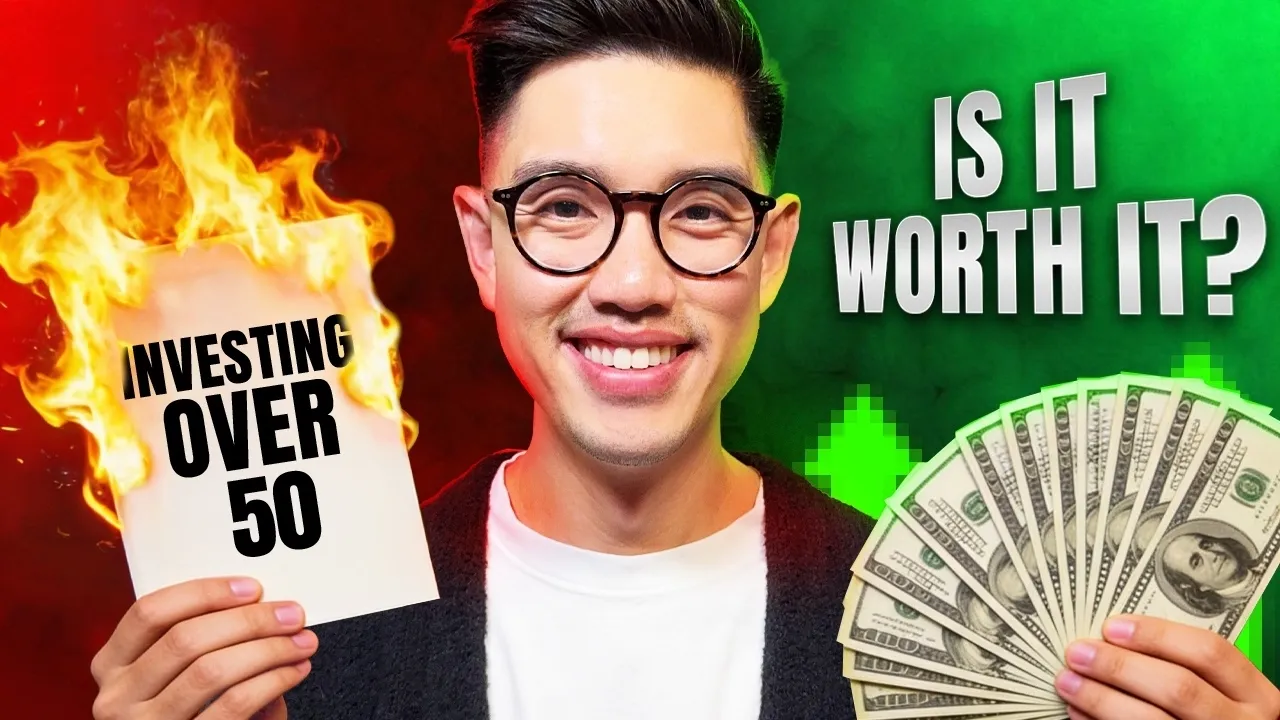
What's the one thing you'll always hear about investing? For me, it's that you need to start as early as possible. And while that's true, it can also create a lot of pressure. Before I started investing, it made me feel like I was already behind. And even now, I still have moments where I wish I started much earlier. When you see the headlines like investing for teens or how to build wealth before you hit 20, it can feel like you're the last guest arriving at a party after everyone's already eaten and the music's already been turned off. And I've seen this concern come up again and again. People say things like, "I know something is better than nothing, but at my age, is it even worth it?" So, in this video, I want to tackle this question headon. First, we'll look at why people think it's too late and why this isn't necessarily true. Then, I'll walk you through two portfolio approaches for people over 50, depending on whether you're starting from scratch or already have some savings behind you. So, let's begin with that one piece of advice that keeps coming up. Start as early as possible. So, do you remember that analogy with the grain of rice and the chessboard? My uncle actually told me about this when I went back to Taiwan when I was a kid. And this is an analogy that has stuck with me ever since. So, basically, you can picture a chessboard. Altogether, it has 64 squares. There are eight across and eight down. Now, if you place one grain of rice on the first square and then double the number of grains on each new square, how much rice would you have by the time you reach the end of the board? By the end of the first row, you would have 128 grains of rice. Nowhere near a typical serving about 3,000 grains or half a cup cooked. So, by the time you reach the end of the board, do you think you'd finally have enough to make a proper meal, maybe even put together a bowl of fried rice for your whole family. I remember sitting there listening to my uncle tell this story. He actually pulled out a chessboard and we started placing grains on each square. But, as younger me quickly learned, we didn't have nearly enough rice at home to get very far. As it turns out, the final square alone contains over 9 quintilion grains of rice. That's a nine followed by 18 zeros. And in total, the entire chessboard would require about 18 quintilion cranes, which is enough rice to feed hundreds of millions of people for years. Now, this is a great demonstration of exponential growth. If you think of that first row as your start to investing, it looks like nothing is really happening. But by the time you reach the later squares, the growth becomes overwhelming. Of course, the further along the board you get, the more you benefit from that growth. But what if you only make it to the end of the second row? I know it's not the full chest board, but it's still about 32,000 grains of rice. Enough for multiple meals, which is definitely a worthwhile outcome compared to sitting with just one grain forever. So, to put this into context, let's look at a real example. Let's say my uncle, who was already in his 50s back then, made a pact with younger me that we would both start investing on the same day. We agreed that no matter what, we would each invest $500 per month into a broad-based ETF earning around 10% annually. Since, of course, my horizon was longer, I might have 50 years of investing ahead of me, which would grow to around $1.3 million. My uncle, on the other hand, might only have 10 years before retirement. So, his investment would only grow to about $103,000. Now, you might look at that number and think, "Well, that's kind of depressing." But I completely disagree. What's actually depressing is keeping that $500 in a checking account because you're convinced that it's too late to start investing. If my uncle did that for 10 years, he'd end up with about $60,000 and he would have missed out on roughly $40,000 of growth. Now, that $40,000 might not sound life-changing at first, but when you put it into context, it can go a lot further than you think. He could rent an apartment in a coastal town in southern Spain for a year, picking up fresh bread and seafood from local markets, and settling into a sun soaked routine. Or he can finally lean into something that he's always enjoyed, like a premium golf club membership, upgraded clubs, and regular trips to courses in Arizona or Florida. Or of course, he could invest it back into his home, building a small pool, a deck, and maybe a proper backyard grill setup. And that's assuming he stops after 10 years. Maybe he's in great health. Maybe he enjoys his work. And maybe he decides to keep going for another 10 or even 15 years. Now, he could be looking at something closer to $200,000 to $350,000. Enough to turn a single good year into a few great ones with better locations, more flexibility, and far less compromise. But my point here is simply that even if you only have 10 years left to invest, that's still a worthwhile pursuit and in my opinion a lot better than doing nothing at all. Now, if this sounds like something that you like to do, you can download my $1 million investing road map, which walks you through different ETF options and allocation ideas to help you build something that fits your goals and risk tolerance. It's completely free and a resource that I made for you regardless of what phase you are in your life. If you're interested, feel free to download it down below. Now, in my experience, people in their 50s who want to start investing fall into one of two groups. First is someone who is starting from scratch. And this happens more often than people think. Life gets busy. You focus on your career, your family, and the next immediate responsibility in front of you. And investing just never quite becomes a priority. Before you know it, you're in your 50s and instead of a portfolio, you've got a bit of savings and not much else backing you up. And first of all, that's okay. For a lot of people, investing just wasn't front of mind. Other things needed their time and energy. So, if this sounds like you and you're ready to start today, that's amazing. Welcome aboard. Your first priority is going to be building a proper emergency fund. And of course, the easiest way to do this is to open a high yield savings account. If your income is stable, aim for at least 3 months worth of living expenses. And if you freelance or you feel like your role could be at risk due to restructuring or downsizing, aim for closer to 6 months. or if you need more liquid cash because of your age and situation, you can always increase this based on what you need in the near future. The most important thing here is that you have this money in a high yield account, not in some sort of savings account that gives you only 01% interest. Now, once you have this in place, you can start investing now because you don't have a 401k or a large asset base to fall back on. For me, I would lean towards a more conservative strategy. You'll often hear people say that if you're starting late, you should take more risk to catch up. Personally, I think that's terrible advice. If you're already behind, risking what you do have makes even less sense, especially since markets can drop at any time. So, instead, I focus on more stable investments, maybe like with money market funds, treasury bills, or bonds. You can access all of these through a standard brokerage account like maybe with Fidelity or Charles Schwab. When you open your brokerage account and transfer money into it, this cash will automatically land in your default account. If you're using Fidelity, this default account will typically get swept into a money market fund called SP AXX. If you're using another brokerage like Schwab, just make sure that your cash is set to also automatically sweep into a money market fund. So, let's say that you have $500 to invest each month. If this money lands into your money market fund, it might earn about 3 to 4% annually, which is of course significantly higher than a typical checking account. For me personally, I like to keep around 5 to 10% of my cash in a money market fund. Why? Well, it's because it gives me a lot more flexibility. I can easily withdraw if I need the cash and I can easily invest it if I see a good opportunity. From there, you can split the remaining 90% between maybe a treasury ETF like SGV or BIL and a bond ETF maybe like BND or AG. These are broadly diversified lowcost funds and they usually have very low expense ratios of around 0.04%. In terms of returns, treasury focused funds tend to track short-term interest rates, so around 4.5%. Broad bond funds tend to average around 3.5% over time. Now, if you follow this approach for 10 years, you'd invest $60,000 in total, which would grow to roughly $74,200. That's $14,200 in profit just from starting to invest. As you can see, this won't make you a millionaire, but it can give you financial stability and some extra cash to help you later in life. Whether that's a twoe trip to Thailand or just keeping the lights on, it's money that you want to have. Now, let's say that you already have a 401k and an emergency fund in place. You could also follow the more conservative approach we just discussed, sticking with money market funds, bonds, and treasuries. or you could take on a bit more risk and start investing in ETFs. Since you already have a safety net, you can take on a little bit more risk if, of course, you feel comfortable doing so. The goal here is to grow your money, not put yourself in a position where you could lose a large portion of it. Now, if you have something like $100,000 or maybe even $500,000 sitting in just a regular savings account and you just realize that inflation is slowly eating away at it, then this is where the growth focused portfolio makes a little bit more sense. So, if it were me, I would stay away from high-risk assets at this age. So, for example, I would stay away from cryptocurrencies, meme stocks, penny stocks, and even IPOs. I know social media likes to talk about them and share stories about how some kid made like a gazillion dollars from some sort of penny stock. But in the end, there are way more people who lose money, and a lot of these high-risisk stocks is pretty much just gambling your money. Instead, because I'm at this age, I look at broadbased ETFs, things like the S&P 500 through SPYM or VO, an international ETF like VXUS, or a diversified focus ETF like maybe SCHD, VYM or SPYD. I know I talk a lot about high growth ETFs like QQQM and VUG. However, at this age, I would be just a little bit more on the cautious side since these growth and tech companies are relatively way more volatile. Just like before, I would keep around five or maybe 10% in cash just sitting in a money market fund. And then I would split the remaining 90% across a few of these ETFs or whatever it is that I would be comfortable with. If I were in this position right now, I'd probably split 90% equally across SPYM and SHD. The former will give you broad exposure to the overall US market, while the latter adds a steady stream of dividend income on top of that. Now, if you invested $500,000 today using this kind of structure, and the market delivered an average return of around 10% per year, then after 10 years, you'd be looking at roughly $1.27 million. That's a gain about $770,000 without adding another scent. Now, of course, markets never move in a straight line. Some years will be better and some will of course be worse. But over long periods, this is the kind of growth that you might experience. Or if you may want to invest for a longer horizon, say for 20 years instead, your capital can grow towards $3.4 million with average returns. And again, this is you not adding another penny into your portfolio. So, if you're like a lot of the people that my teamman and I talk to and you have a large sum of money and you know that you want to grow it for at least 10 to 20 years, you might as well put some of that money that you're comfortable with towards investing rather than letting it be eaten away by inflation. Now, obviously, I'm not in your shoes and I don't know the full picture of your financial situation. So, don't just take my word for it because of course this isn't financial advice. You want to make sure that you do your own research, think things through, and make sure that you're comfortable with the decisions that you're making. Again, I put together my $1 million investing road map to help you get a better handle on the basics of investing. I also have a lot of portfolio allocation ideas if you want to see how you can structure your investments. Everything's down below if you're interested. And if you find it helpful, you can watch this video
Comentários 0
Entre para participar da discussão.
EntrarAinda não há comentários. Seja o primeiro a compartilhar sua opinião!