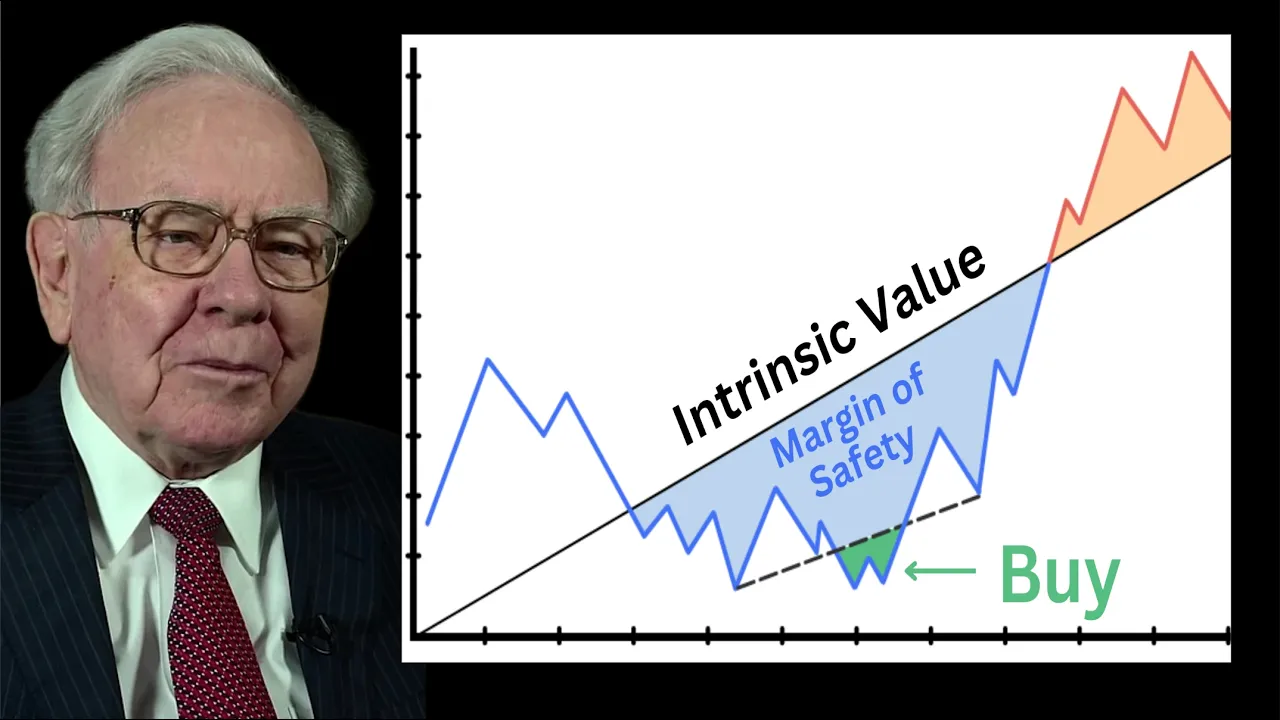
Warren Buffett: How To Calculate Intrinsic Value

- Retorno do vídeo
- -0,42%
- Chamadas
- 2
- Compra / Venda
- 2 0
- Publicado
Recomendações
Entrada é o preço de fechamento do ativo na data de publicação. Atual é o último fechamento registrado.
-
Entrada $88,07 05 set 2026Atual $88,36 08 set 2026Resultado +$0,29vs. índice +0,9% SPY −0,5% no mesmo período
Citar esta recomendação Ver vídeo original * †
Contexto da transcrição original
…ash flow was going to grow about 6% per year over the next 10 years. That means the fair value of Coca-Cola's stock today is $65.75, an exact precise number. And what this tells us is that while the stock is trading at about $89 per share, Coca-Cola is overvalued according to my model. And I would simply have to wait for Coca-Cola's price to fall below what my model shows before it would be an attractive buy. Now, discounted cash flow calculators can be very simple to use, or they can be very complex. In fact, some investors even choose to do bear, bull, and base modeling, and they weigh the probability differently according to what they think …
Coca-Cola is overvalued according to my model. And I would simply have to wait for Coca-Cola's price to fall below what my model shows before it would be an attractive buy.
-
Entrada $319,97 05 set 2026Atual $316,22 08 set 2026Resultado −$3,75vs. índice −0,6% SPY −0,5% no mesmo período
Citar esta recomendação Ver vídeo original * †
Contexto da transcrição original
…er the last 3 years the growth rate has slowed to just about 2% and the earnings have slowed to about 4% That to me means that Apple has become a low growth business and I don't think it makes sense to pay a high premium to own this stock. So, while I think Apple is very clearly a high quality business, I wouldn't be interested in buying Apple stock on its own until it got into the cheap level, which would be about $240 per share as of the end of 2026. Thanks so much for watching. I'll see you in the next video.
So, while I think Apple is very clearly a high quality business, I wouldn't be interested in buying Apple stock on its own until it got into the cheap level, which would be about $240 per share as of the end of 2026.
Transcrição Completa
How does Warren Buffett calculate the intrinsic value of a stock? Well, if you follow his writings, he actually told us a few decades ago that it's simply a matter of discounting the value of a company's future cash flow to a present rate. But, something interesting happened in 1996 when Charlie Munger called him out on stage at a Berkshire Hathaway annual meeting saying that he'd never seen Buffett actually do a DCF calculation. So, if he doesn't do DCF calculations, how does he figure out if a company is a buy? Well, I analyzed Buffett's portfolio and trading history and in this video I'll explain the super simple five-step method that Buffett uses to know when exactly it's time to buy a stock and I think you'll be surprised at just how easy it is. Now, Buffett's first step in his five-step process is to simply eliminate companies that are hard to predict. Now, we know this is true because a few decades ago he told us that they stick with businesses whose profit picture seems reasonably predictable. And if you look at the companies that are in his portfolio today, you will see a lot of businesses that have highly predictable futures like American Express, Coca-Cola, and Google. Now, if you've ever seen this famous photo of him working at his desk, you will see that there's actually a too hard pile that he has right on his desk. And I think the very first criteria that he uses if a business future isn't predictable, he files it away as too hard and moves on to the next idea. Now, the second filter that Buffett uses is to only value companies that are in the capital return phase of their life cycle. See, if we pull up that quote from 1996 where he talks about discounted value, what most people miss from this quote is the second part of the sentence which talks about the cash that can be pulled out of a business during its remaining life. Now, that to me is a critical clue to look at because what it means is that Buffett only invests certain phases of the business growth cycle. Now, if you're unfamiliar with this visual, it's critically important to understand this concept before you try to value any businesses. See, there are five distinct phases that every public company on Earth is in its life, and knowing which phase it's in is a critical step before you can value it properly. Now, if you're unfamiliar, phase one is called the startup phase, and this is when companies are losing tons of money, have very little revenue, and they're extremely high risk. So, in 2026, this includes companies like Rocket Lab, Lucid, and IonQ. Now, companies graduate to phase two when their revenue starts to take off and their losses actually start to decline. Yes, they're still losing money. The losses are shrinking over time as they become more established. So, this includes companies like DraftKings, Rivian, and SoundHound AI. Phase three is when profits finally start to appear because revenue is growing faster than the company's costs. However, the company is not yet fully optimized for profits, so it's not returning capital to shareholders yet. So, in 2026, companies like Amazon, Spotify, and Tesla are very clearly in phase three, the operating leverage phase. Now, phase four is when Buffett starts to pay attention. This is when a company is making so much cash and it's fully optimized for profits, and it actually can start to hand some of that cash back to the shareholders. And this is where cash cow businesses like Apple, Nvidia, and Costco live. Now, the final stage is called phase five, and this is when a business is starting to lose ground. Its revenue is actually starting to decline for a couple of years, and this is when businesses start to shrink, and they actually go into turnaround mode. Some companies that are in turnaround mode today are like Target or Altria. And sometimes these businesses turn, and they can turn out to be fabulous investments, or sometimes companies can't turn because there's something structural wrong with their industry, and they are heading towards bankruptcy. Now, if there's one visual from this entire video that I want you to put in your head, it is this one, because it is absolutely essential to understand how Buffett thinks about valuation. And what I mean is if you take a look at every single holding in Berkshire Hathaway's portfolio, and you analyze what phase it's in, it becomes crystal clear what phase Buffett likes to look at. For example, let's analyze what phase American Express is in right now. I built this tool that does the analysis for us, and what it shows us is that American Express is in phase four, the capital return phase. Now, let's take a look at Coca-Cola, and we can see that Coca-Cola is also in phase four, the capital return phase. Finally, I'll do one more company called Kraft Heinz Group, which has been a trouble investment for Buffett, and we can actually see that Kraft Heinz is actually in phase five, the decline phase. By the way, if you want to do that same phase analysis on any company in your portfolio, just visit the link you see on your screen, or click the link in the video description, enter a ticker, and the tool will tell you what phase the company is in. Now, I did that analysis on every stock in Berkshire Hathaway's portfolio as of the midway through 2026, and what I found was it has zero exposure to companies in phases one, two, or three. In fact, 74% of the companies in Berkshire Hathaway's portfolio are in phase four, the capital return phase, and 26% are in phase five, which is the phase that he focused on intensely when he started his career. And that's why I'm so confident that Buffett uses the capital return filter before he makes any sort of valuation decision. Now, the third filter that he uses after he's done that is to simply do multiple analysis on the business in order to value it. Now, that might surprise you because again, he talks up the value of using discounted cash flow calculators for years. Now, if you're unfamiliar with what he means by that, discount counting just simply means that a dollar today is worth more than a dollar at some point in the future. For example, a $100 today is clearly worth $100, but how much is that same $100 worth five years from now? Well, because we have to account for the waiting that has to be done, we have to discount that future $100 in order to get a present value today. So, at a 10% discount rate, $100 five years from now is only worth $62 today. And that same $100 10 years from now is only worth $39 today. Now, the way that some investors put that concept into practice when they're trying to value businesses is to use tools such as discounted cash flow calculators in order to estimate the fair value of a stock today. For example, let's do a discounted cash flow analysis on a company like Coca-Cola, one of Buffett's holdings. Now, there are numerous ways to do discounted cash flow methods, but the most popular way is to do what's called a terminal value method. And what this does is it lets you input a terminal growth rate, discount rate, and then we simply enter the rate that we expect free cash flow to grow over the next 10 years. So, let's say I thought Coca-Cola's free cash flow was going to grow about 6% per year over the next 10 years. That means the fair value of Coca-Cola's stock today is $65.75, an exact precise number. And what this tells us is that while the stock is trading at about $89 per share, Coca-Cola is overvalued according to my model. And I would simply have to wait for Coca-Cola's price to fall below what my model shows before it would be an attractive buy. Now, discounted cash flow calculators can be very simple to use, or they can be very complex. In fact, some investors even choose to do bear, bull, and base modeling, and they weigh the probability differently according to what they think is likely to happen. And by changing these toggles, you can get the exact projected price of a stock both today and into the future, and use that against the current price to simply determine if it's a buy, sell, or hold. Now, that's how DCF models work in theory, but the biggest knock that I have against them is the fact that they give investors a false sense of precision. You can have the intrinsic value of a stock today basically be any number you want it to be simply by changing the inputs that you put into the calculator. And I think that is the reason why Charlie Munger called out Buffett saying he doesn't actually do them. Not only are they complicated, but they give you a false sense of precision. Now, if you watch that clip, Buffett actually later admits that yes, that's true. And he said, "If it doesn't just scream out at you, it's too close to call." Meaning, if the valuation isn't incredibly obvious in the first place that it's attractive, why do a DCF model making it too close to call? So, it's not that Buffett can't do DCFs, it's that he doesn't need to do them. He instead uses very simple valuation methods such as multiple analysis. Now, if you need a quick primer on multiple analysis, what this means is that we take the price or the value of a business and we compare it to a financial metric that the company has. Now, the most famous multiple out there is of course the price to earnings ratio, which compares the market cap of the business to the profit of the business or the net income to the business. You can do the same multiple analysis with lots of profit metrics. For example, you can divide the price of the business by operating income to get the price to operating income or price to EBIT ratio. You can also get the price to gross profit ratio or the price to sales ratio. And there are literally dozens of metrics that you can look at. Now, one mistake that I see investors make when they're trying to do multiple analysis is they don't relate the multiple analysis back to the business growth cycle. See, a key thing that I learned from studying people like Buffett is the correct multiple to use changes depending on what phase of the business growth cycle you are in. Buffett likes to stick to companies that are in phase four and five, and one reason he does that is these businesses tend to be easier to value. That's because the price to earnings ratio works because these businesses are fully optimized and therefore you can use net income in the denominator of the equation. But what about companies that are in phases one, two, or three? These companies are most likely not optimized for profit. And that's why if you ever look at these companies price to earnings ratios, you get a false positive because these companies are not fully optimized for profit yet. And that's why if you're going to look at a company that's in say phase three, you probably can't use the price to earnings ratio. And instead you have to go higher up on the income statement to find a number that's fully optimized. And that's why you can use price to EBT, price to EBIT, price to gross profit, or price to sales to figure out its valuation. For companies that are in phase two, you have to stick to the top end of the income statement. You have to use price to gross profit or price to sales. And when you're in the startup phase, you almost exclusively have to use price to sales because the company has no other profit metric to report. Okay, now that I hope I have you convinced that Buffett uses multiple analysis, that brings us to the next step in the process, which is to simply compare the company's correct multiple to its own trading history. And this can tell Buffett if a stock is cheap or expensive. Now, as I already laid out, Buffett exclusively stays on the right side of the business growth cycle phase, and he focuses companies that are buying back stock or paying a dividend. So, let me show you how this would work on a company that Buffett has owned for years, Coca-Cola. Now, this tool shows me the price to earnings ratio that Coca-Cola has traded at over the last 5 years. And what it does is it averages out the number so we can see the {quote} {unquote} fair value of Coca-Cola over that time. Then we put very simple bands above and below the number to indicate when Coca-Cola is either wildly above or below the average valuation that it's traded at. Now, the price to earnings ratio works on a company like Coca-Cola because it's very clearly in stage four of the business growth cycle. And when using this, it becomes incredibly obvious when Coca-Cola is cheap and expensive. The company was very clearly cheap in October of 2025, and it was obviously very expensive in September of 2024. And by simply using the company's own trading history, we can get a very clear sense of when the stock is cheap or expensive. As of the middle of 2026, Coca-Cola stock would be cheap somewhere around $82 per share, and it would start to get expensive somewhere around $91 per share. I really think it is that simple. Now, while that does make it very easy to figure out when a stock is cheap or expensive, there's one extra step that you need to understand, and this is something that trips everybody up about using multiple analysis. And that is you have just the multiple to account for the qualities of the business. See, some companies can trade at very high multiples and be cheap, and other companies can trade at very low multiples and be expensive. And that highly depends on what the market thinks about the qualities of that business. Now, as a general rule, there are things that can happened that can cause a stock to deserve a higher multiple than average, and there are things that can happen that cause a stock to deserve a lower multiple than average. Now, one of those things is the nature of the company's revenue. See, when a company's revenue is recurring in nature or highly predictable or recession-proof, the market sniffs that out and awards the company a higher than average multiple. And the inverse is also true. When a company's revenue is non-recurring in nature or it's unpredictable or it's highly cyclical, the market sniffs that out, too, and permanently awards a lower multiple to that business. Another factor that goes into this is the company's growth and growth prospects. So, if a company has above-average growth potential, the market tends to reward that with a much higher PE ratio or a much higher multiple. And the inverse is also true. And when a company has low growth potential, the market punishes that with a lower than average multiple. And this is where the art of valuation comes in. As a general statement, the more predictable and the higher quality the revenue and the higher the growth, the more you should be willing to pay for a stock, and the inverse is also true. If a company has very low-quality revenue and very low growth potential, its valuation should be much lower than average. Now that we know the full five-step process, let's take a company like Apple, a former Buffett holding, through this checklist and process to figure out when it would be a good buy. The first question to ask is is Apple's revenue predictable? Well, if you pull up a long-term revenue chart of Apple, you see that its revenue has gone up into the right for a couple of decades now. That makes this company's revenue highly predictable. So, we get the check there. Next question asked is what phase of the business growth cycle is Apple in and specifically is it in the capital return phase? Well, if we put Apple into the tool that I built, it's very clear that yes, Apple is in the capital return phase. Since we know it's in the capital return phase, it's safe to do multiple analysis on Apple. Now, when I pull up Apple, the PE ratio is highlighted because the company is fully optimized for profit and therefore the price to earnings ratio works. We can see that as of September of 2026, Apple stock is quite expensive today trading at 37 times earnings. Whereas back in 2022, the company's stock was only about 21 times earning making it very cheap. And we can actually go one step further by looking at different multiples from the income statement and cash flow statement and even in the balance sheet to confirm that Apple stock is quite expensive today. The final step is to think through the quality of Apple's business and to figure out if we need to adjust the numbers up or down. Well, when I think about Apple's business, I think its revenue is highly predictable. However, the company's growth rate has slowed down in recent years as the business has matured. In fact, when I analyze Apple's growth potential, while it has grown at about 6% revenue rate over the last 10 years, over the last 3 years the growth rate has slowed to just about 2% and the earnings have slowed to about 4% That to me means that Apple has become a low growth business and I don't think it makes sense to pay a high premium to own this stock. So, while I think Apple is very clearly a high quality business, I wouldn't be interested in buying Apple stock on its own until it got into the cheap level, which would be about $240 per share as of the end of 2026. Thanks so much for watching. I'll see you in the next video.
Comentários 0
Entre para participar da discussão.
EntrarAinda não há comentários. Seja o primeiro a compartilhar sua opinião!