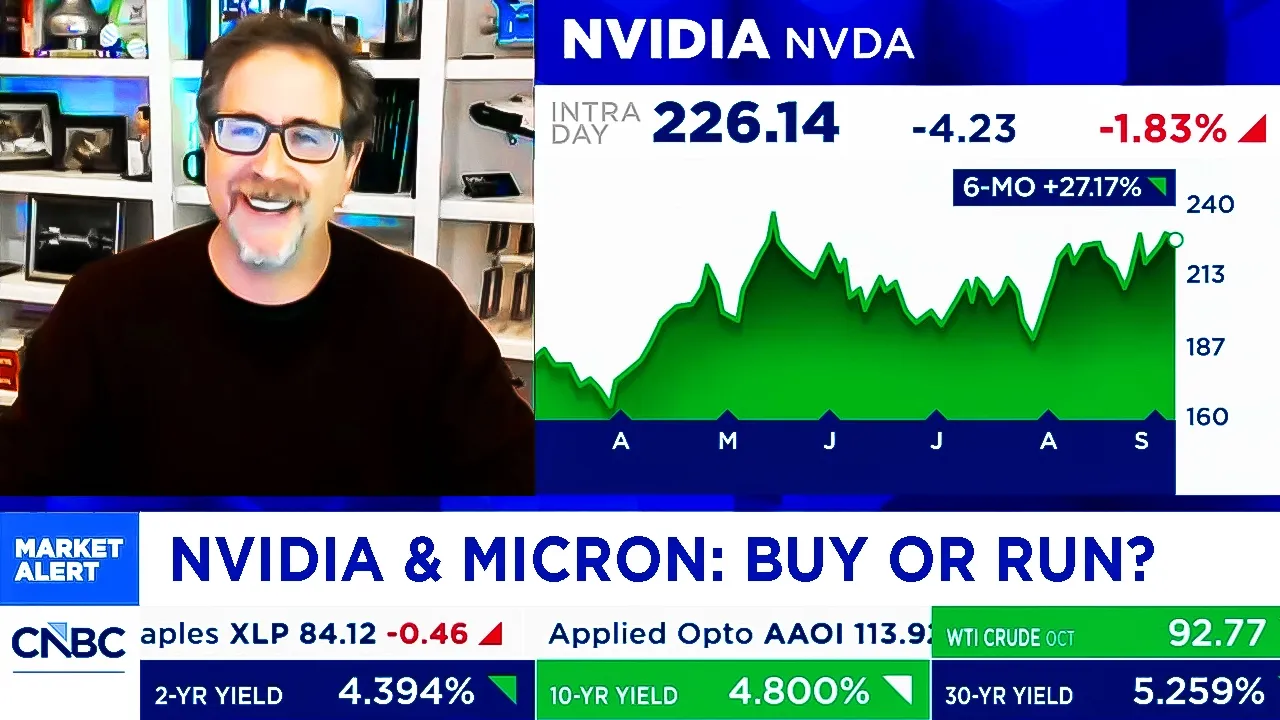
…t company. uh their peak EPS is not expected for two more fiscal years. So you can see how very good for them but continually a big problem for the industry. And believe it or not, even though I sound redundant, even though I sound boring, I buy Nvidia both hands every time it dips below 200. I continue to like some of the memory names. And don't forget with Micron that you also have now trading as an ADR SKH Highix. And if you'd rather go with an ETF, I much prefer BRAM. So I still think semis and hardware and we're since we'r…
I buy Nvidia both hands every time it dips below 200.
…d that many market participants are worried about additional supply coming online that would threaten memory makers pricing power due to the historical cyclicality of the memory business. As I've said before, based on what I can see today, I think it's reasonable to be bullish on memory makers like Micron and SKH through 2027, possibly longer depending on what happens. I think that this current moment is likely to last longer than the typical memory cycles of the past. We've heard from so many companies over the past couple months about how they're memory constrained. Nvidia probably has some of the best…
I think it's reasonable to be bullish on memory makers like Micron and SKH through 2027, possibly longer depending on what happens.
Contexto extraído por IA
“As I've said before, based on what I can see today, I think it's reasonable to be bullish on memory makers like Micron and SKH through 2027, possibly longer depending on what happens.”
…ot be expected within the relevant time frame. I'm just providing a range of what I think is reasonable based on what I could see right now and that may change. I could always be wrong and nothing is guaranteed. But regardless of all that, I continue to be bullish on iron and I expect to be bullish through 2027. Now, let's cover some memory news. It's been reported that KB Securities estimates that Samsung and SKH memory inventories have fallen below 10 days and 2027 may be the tightest memory market on record. KB also forecasts that in 2027 DRAM …
I continue to be bullish on iron and I expect to be bullish through 2027.
Transcrição Completa
The memory itself is something we've talked an awful lot about. Um, look, these prices are higher. There's more demand for it. And just in reading some stories over the weekend and and and around this entire issue, you know, we like to blame AI, but a lot of these problems started well before the data centers. And by the way, the RAM that's used in the in the phones is is different than the RAM that's used in the data centers to begin with. How how do you kind of see all of this? How do you see it playing out? What's it mean in terms of prices? And then margins too. >> Well, even though uh Micron SKX and Samsung, the big three aligopolis in memory have been getting much more focus whether you're an industry buyer or an analyst following the stocks on their applications for AI data centers. There's obviously even in consumer electronics like the iPhone a real demand for memory. And before he stepped down and retired, Tim Cook talked about this. And even a company with the heft of an apple uh has to pay more. Cost of goods sold, goods sold goes up, gross margins go down, and it's a real problem. And I don't think that we're going to see much relief in the memory uh market for years. If you take a look at U Micron, for example, I follow that company. uh their peak EPS is not expected for two more fiscal years. So you can see how very good for them but continually a big problem for the industry. And believe it or not, even though I sound redundant, even though I sound boring, I buy Nvidia both hands every time it dips below 200. I continue to like some of the memory names. And don't forget with Micron that you also have now trading as an ADR SKH Highix. And if you'd rather go with an ETF, I much prefer BRAM. So I still think semis and hardware and we're since we're talking about semis this morning uh focused on continued AI data center development because I actually think that spending is going to go fast and furious into 2030. And so I much prefer there than any applications having to do with consumer electronics at least at this point. You described Samsung, SKH Highix and Micron as an oligopoly. It makes sense. They have about 90% of the market share, right? >> Is there anything that ever disrupts that igopoly? Is there any regulator who can get involved? Any nation that can get involved or do you think that's a pretty safe place for all three of those companies to be um to be seen? >> I think it'll be a safe place at least for the next several years. But you do see I don't think it's regulatory. I think it just comes from competition. Whenever you have such a fast growth and such high margins, you're going to invite competition. And we do have some competitors coming on the scene uh particularly out of China. And you will have more and more applications that will try to avoid buying uh high bandwidth memory DRAMs from the big three and try to go another way. maybe uh more explosive uh growth from SRAMs because SRAMs are more plentiful versus DRAMs controlled by those three companies I mentioned. >> The AI build now becoming an increasingly difficult political issue across the US as local opposition ramps up the big effort to block new data centers. Gallura of DA Davidson writes, "As data center push back grows, the land power and shell constraints are likely to grow too, and it's an important factor for more longerterm AI chip demand." Gil joins us now for more. Gil, welcome. Is this becoming a headwind already to growth? >> I think what it's doing is that it's managing the cycle. It's actually preventing the investment from getting out of control. I think a good data point we got was from Jensen Wong that said that he expects to grow 70% next year but demand would actually justify far better growth far higher growth. Let's say he could have doubled next year and the re that gap is the limits on data center construction. It's the push back at the local and national level. Not to mention all the bottlenecks around it. So because we're afraid of of the data center development, we're actually slowing down the rate that otherwise this would have grown, Anthropic is willing to pay 25 million a gawatt right now because they're generating more than 50 million a gawatt. So that means they buy far more compute if it was available. But because of all of the constraints, because of the bubble talk, we're actually not building data centers as fast as the demand would justify. So, Gil, do you see it as a welcome regulator to make sure there isn't a sloppy build out? >> Yes. I think that we the good way to prevent a bubble from happening is by talking about a bubble. And everybody these days wants to predict a bubble. Everybody wants to be the next Michael Bur from the big short, including Michael Bur. And and that's helping create higher CDS rates. It's creating more more a tempered market for lending. and it's creating this push back. So, yes, it's helping manage the cycle, which should extend the cycle, which is a good thing. It should prevent it from going too fast right now, but maybe extend the cycle so we have a little bit of a healthier buildout with more thoughtful approach to it. Let's not forget part of what Let me restate what the president said in a little bit of a nicer way. What he's saying is, look, if somebody wants to build a $50 billion data center in your backyard, your choices aren't yes or no. Your choice is to go to to the to the builder of the data center and say, "Hey, you know what? If you're willing to spend that much, build me a new school, repave all my roads, and and you're and no tax breaks, and please install clean energy to fuel that data center so there's no noise and pollution." That's the real choice. And I think municipalities and localities are starting to realize that. So again, it's slowing the build out of the data center in a good way, in a way that could build better, cleaner, less uh uh less polluting data centers, extending the cycle. >> Uh when Jensen buys Hugging Face and people yawn, it's 13 billion. Maybe paid too much. But if Broadcom bought Hugging Face, people would say, "Wow, I mean, let's pay 400. We're going to stop Jensen." There's a big double standard. anybody who wants to say I could come out here and I say you know what I think this whole thing's got to stop Carl you know it's got to stop and and let me tell you what I know I know I have seen things like you wouldn't believe and it's got to stop and maybe people say you know Kramer's like he's really tired >> yeah well I'll tell you what got some attention Jim over the weekend was this Times piece about open source corporate America getting addicted to open source like at AT&T where in May open source was 20% of their usage it's now 40 it's going to be Well, I mean it's exciting and it's cool and people fool around with it. >> Jensen said it could read Moby Dick in a second. I didn't ask it about I said I asked him I said well how fast read Moby Dick and he said one second. I said that was funny and he goes yeah laughing on the inside. >> Oh my Jensen's I wish people knew how fabulous he is. And then maybe that's why I'm somewhat taken. You know, I'm thinking about the same thing about how powerful they are and I am saying that the people on the side of this are some of the greatest people I've ever met and it makes it very difficult for me to be critical about this. >> Yes, I understand. I >> mean I if I see something that is not necessarily uh correct about Nvidia, I I'll get something within 15 minutes and it will tell me what I how I could you know what have been a more accurate. I was usually it's I was in artful. They don't say listen you I know what the hell I'm talking about to some degree but you have to understand that this is a company which watches the show by the way watches everything I do I think it watches everything and it just very on point for you to be smarter most of the things they send me are that I think of a better way to say it or you need to learn this so why don't you read this blog if every company was Nvidia we would have a much more accurate meaning >> and why do you think they're not it too much work I mean is Is it is it too much trouble? >> That's an interesting question. I think >> wrangle the financial press. >> Well, the maybe it is. You know, it's the same people the whole way. When the company was was 200 billion, it's the same people. I I just think that Jensen is like I remember Jensen first told me about these things. He said, you know, I put I put every conference call through it and just, you know, and sometimes it is uh too long didn't read. But they're the only company I've ever seen in investor relations that basically says, I want you to be better about my company. GE G's done that. But people have to recognize at home what happens is that you're watching TV and you're getting on your phone. You're getting, you know, Jim, it would have been you would have been better had you said it this. Yeah. Okay. It would have been better. And and then you have to reassess and say, well, you know what? I thought I did a good jobortive. I think we've just gone through a consolidation phase in these names, Scott. You know, whether it's Alphabet, whether it's Nvidia in particular, which out of the seven is the one that I look to most for leadership. Now, I realize it's down today. It did start the morning up. It's within a hair's breath of an all-time high. I think it's very likely that it takes that out. And once it does, we're going to be talking about that. It's not going to look back and go down from an all-time high. It's likely to go further higher on around roughly 19 times forward earnings. We know what they said two weeks ago about revenue growth rate in the coming year, 70%, which by the way is supply constraint. So, it could be higher if things uh on the supply chain become a little bit unstuck. Uh, all this is not to say that the other stocks don't have something going for them. We've talked about Microsoft a lot. Very forgiving valuation and most importantly, Joe, maybe you'll back me up on this. The sentiment is coming back to Microsoft. This was a stock under $400 just a few months ago and people were looking at it actually tossing it into the heap of the SAS names and thinking that it might somehow become disenfranchised. I think that will be looked back as folly. The point being is each of these names has their own idiosyncratic reasons for going higher and the valuations give support before >> Kelly will CFO of OpenAI Sarah Frier just took the main stage here at that Goldman conference communicia that you mentioned the line I will say was out the door. There were two overflow rooms. So clearly the bankers here clamoring to get a sense of what the CFO of OpenAI is talking about ahead of their upcoming IPO. This company of course was filed confidentially to go public. A couple headlines. Frier said that while the company is growing at a nice clip, the enterprise business, as she described it, has been quote on a tear. She also talked about some of the revenue growth. She said overall ARR grew 20% month over month. This was just from Jul from June, excuse me, June to July. And then while the enterprise business overall compared it to the overall business said that was up 32% month overmonth, that did confir confirm some of our reporting from earlier this summer about an employee. Alahan. She talked about value and cost and the overall ROI picture as companies grapple with token cost. She said that she's trying to really highlight that to enterprise customers. Said there's been an industry shift to price per outcome versus price per token. So overall the price discussion really shifting here and then talked about building a moat said there is more competition of course from cheaper open source models. Said that those will have a place but then what creates a durable moat is this ability. She said for OpenAI to have a holistic approach from compute to application layers to enterprise. And then finally, Kelly highlighted the consumer business now has 1 billion weekly active users. And then the ads business said that was the fastest business internally to grow to a $1 billion run rate. And finally, the final final, Kelly, they're going to keep leaning in on compute, she said, and inference uh with their chips business. They will continue to self-build their own data centers as well. and clearly still spending on compute. >> Incredible to see. And Sam Lesson had warned us about this and we were all I was ready to declare it's over. anthropic one you know I and and boy what a shift the past week has made in their direction especially oh my gosh it's now but >> I don't know if you saw this morning Kelly they said a research note ton of bullish notes on Astro over the weekend but this morning Mel has said open AI is so back and I think you blink and the the race changes you know who's in front and who is kind of coming from behind but Sarah Frier saying they took arrows a couple years ago for overspending on compute that was a criticism she said That's the reason why Astra is succeeding is because they have spent so much but really also tried to frame it as revenue per GPU said they're trying to grow revenue while still spending >> 100,000 is that what they said GPUs reach I just wanted to mention K the chat GPT has actually been down intermittently over the past couple of hours we saw this last week did did she give any indication of why that is this happening because of demand >> she did not mention that we've seen some rolling outages you mentioned last week with chat at GPT being down. We saw similar instances with Claude, which I'm not sure if today we're seeing the same. Outlook was down last week. She didn't mention it. Also didn't explicitly mention an IPO. I think they were uh this was obviously a Goldman conference. It was Eric Sheridan was interviewing her. The the subtext was that there's an IPO, but it never came up explicitly. She didn't mention the outages. I did just see that, Kelly. We don't know exactly why. And you you are tending to see more of this. It could be demand. It could be a lack of compute. I mean, that's been one of the criticisms with some of these outages is they just don't have enough compute to serve demand. >> A new generation of artificial intelligence may have just arrived. Open AAI is calling Astra its most powerful model yet. And Nvidia is once again at the center of the compute buildout. CEO Jensen Juan writing on X that Astra was trained on more than 100,000 Grace Blackwell GPUs with another 400,000 coming online next. So, we've gone from ChatGpt, which seemed impressive at the time, to Astra in just four years. The AI arms race is accelerating and the investment stakes are rising with it. Here to discuss is Stacy Rasg, senior semi- analyst at Bernstein. Stacy, it's great to see you. Um, and and as we just talked about in the news update, OpenAI just revealed that a 10,000 AI agent swarm solved a thing called the Navier Stokes problem. Thank you. Can you explain in lay terms what it means that a swarm of 10,000 agents solved this problem? What what does that mean? And they talk to each other. They'll say, "Okay, I got to step forward like this. Now you go do that." How this it's crazy. I >> I I mean, look, you've had, you know, thousands of mathematicians working on that problem for for quite a while as well. So, I mean, maybe think about it like that. You've got individual agents that are all working on pieces of that problem, talking to each other, reviewing, going back and forth, and looks like they did solve it. This is one of the This is the Navier Stokes problem. This is one of the uh I think seven millennial prizes. The only other one that's been solved was the point card conjecture um several years back. Uh so, he solved it. He's a janitor, but he was a smart janitor. He could probably solve it in the hallway. Baby, baby. >> My question, Stacy, is what happens when this compute power is put to nefarious uses? First of all, what happens? As to quote a friend of mine who was an early guy in all this, he's much smarter about this than I am. He says to me, what happens when we can't turn off the bots? I'm like, if you're asking the question, then I'm going to take some notice. >> Yeah. I mean, these are you start to worry about like building Skynet, I guess, and that's like I I don't know. I'd like to believe that we can always turn off the box if we have to. Um, but I mean the these are questions that I think the industry is is is wrestling with right now. This whole idea of guard rails and and so on and and and so forth as the capabilities of these models um increases and and you can see it's been increasing by leaps and bounds over the last several years. And think about this like we've only as to your to your Jensen quote we're only into this like three or four years. Like this is still pretty early like if you think about where this where this could go and and the progress they've made just in that in that amount short amount of time is pretty remarkable. So, how do you run this through the Stacy Razgon balance sheet or or meaning stock selection, you know, screener? Um, because we see and it it seems to me, but but you would know more than I that Open AAI ecosystem stocks have been rising since Astra was announced. Um, can you talk about that? What does it mean for Nvidia in particular, which up 6% last week? >> Yeah, I I mean, seems to me it means more compute, right? Just more and this has been the story the whole way along, right? Right. I mean, there's been a lot of like, you know, angst about who's winning or losing in this kind of environment. And I I've said this probably on the show before, but my general view has been is is the opportunity big or is it not? And if it's big, I actually think there's room for for plenty of folks to to thrive. And I mean, that's what we're seeing. You've got Nvidia thriving and Broadcom and I mean even guys like Marll and MediaTek and AMD and I mean even Qualcomm you you talked about Qualcomm a little bit earlier you know they've got a data center story which I mean even for for them is is is potentially siz everybody's doing fine and everything that we're seeing I think from these models I mean it just it comes down to more compute more more GPUs more accelerators more CPUs more memory >> but but Stacy a lot of the we we highlighted this top of the show a lot the NASDAQ 100 peaked out in mid June And now maybe it hits another peak. I'm not saying it's permanently peaked, but it's been 3 months since we made a new high in the NASDAQ. I know you're shaking your head, but for a lot of traders and investors, they got used to making new money, new highs every week. >> Is the money already made? >> I look, I I'll put the the trading stuff aside. I mean, I'll take a look at the socks, for example. So, you're you're right. It's down a lot off the peak. That being said, the stocks index, which which for those that may not know, this is an index of of semiconductor stocks, it's still up almost 70% year-to date, right? And so, you know, clearly if we gotten there monotonically, everybody would be super happy. That that never happens. Like you you always overshoot and undershoot, but we're up a ton year to date. Um, and by the it's all earnings like earn forward earnings expectations are up more than 100%. Multiples are actually down year to date. um the fundamentals, you put the stocks aside for a bit, the fundamentals have been doing nothing but getting better for for these kinds of reasons. And I think that the the sector itself has still had a remarkable year, one of one of the strongest years probably in in memory. Certainly one of the strongest that I've seen in a long time. And and again, if you think about where we are in the cycle, it doesn't feel like this cycle is coming to an end anytime soon. And so, you know, the stocks on any given day are always going to do whatever they're going to do, but like o over, you know, as we kind of go forward, fundamentals are getting better, not worse. >> Yeah. No, I take your point. It's just more and more and more of everything at this point. Stacy, thank you very much, Stacey Rasg. >> What you've seen over the last few quarters has been a real acceleration in their business. They've they've seen their overall business catch up. The acceleration of the growth has been meaningful, and now they're looking for all the compute they can get. And that's been kind of the theme here has been that nobody has enough compute. So I had a number of of of inquiries today. You know, is this a sign of strength for Qualcomm? Is it a weakness for AWS? What's going on? And the thing is it's it's strength across the board. It's that Amazon and AWS simply cannot build enough compute. It cannot buy enough Nvidia, buy enough AMD, and build enough of its own chips. And now they're looking for new, highly capable partners. And that's where Qualcomm showed up at the right time. So it's really a situation of and in many cases the market wants it to be or they want it to be oh this means less Nvidia. Oh this means less graviton tranium. We actually see it as all aggregate. The forecast continues to grow so rapidly for the amount of capex and the amount of AI compute required that it's a bit of an all hands on deck. Qualcomm with its provenence and pedigree and low power, the acquisitions it's been able to to make is very complementaryary to what Amazon is trying to do. And of course, Amazon's trying to ramp up compute quickly to meet its, you know, several hundred billion in backlog that sits uh that sits in its cloud business today. >> Key position in fantasy, what you want are the equivalent of compounders, stocks that can consistently grow and grow and grow over time. basically want a running back like Nvidia, the other stock on my own it don't trade it list. Now in the past I've called Nvidia wide receiver for your portfolio. More of a rapid growth name but at this point it's matured enough to be a running back. That said Nvidia is still on track to put up 70% revenue growth next year. Don't worry about today's action. It was just crazy down. For the NFL analog, I like probably the best player in the game, Jamir Gibbs. the thrilling running back for the Detroit Lions who can stack up yards and touchdowns both by running the ball and catching passes. He's the complete package. Just like Nvidia's advanced computing platforms, which combine chips, networking equipment, and software, both Gibbs and Invid are known for their speed. But overall, this is a comparison all about quality. Just as Nvidia should be one of the first stocks someone buys when starting a uh to build a portfolio, Gibbs is going to be one of the first few players taken in any fantasy draft. Put it this way. I have the eighth pick in my league's draft and there's no way I'm going to be able to get Gibbs. I'm lucky if I get Cam Scataba. >> But let's talk about the one that may be and I've discussed with you offline. When someone says you're the next trillion dollar company and your company IN THE DOLLAR BET $219, what do you do? And I'm talking about Jensen anointing you because it had to be a surprise. And holy cow. I mean, you could argue it's a it's a it's a target on your back or you could say I'm going to live up to that man. Where are we? >> Right. Yeah. So, at Comp Computex in June, I gave a keynote presentation, my first one, and Jensen was one of the guest speakers I had. And we were talking at that time about how in the in the AI cycle, we've had the compute wave, right, which was all the GPU XPU companies. That was a huge ramp 2, three years ago. It's still going. Then we had the memory cycle. And then what I was talking about was the connectivity wave, right? Which is now all the connectivity required to connect all the memory and the compute together. And then Jensen came on stage and um you know I think backed up that vision and and and certainly had a had a high high hopes for the company. Look, I would say this um we're driving the company uh to you know levels that I probably couldn't have imagined 10 years when I became CEO. >> Uh but the the future is very exciting and and investor asked me the same thing recently. Hey, you know, you're how do you get from here to there, right? >> Which is like say four times the valuation increase uh roughly four or five times. And I said, look, when I became CEO in 2016, our valuation, our market cap is up like almost 40x >> since that time. So, look, we got another four to go and it's not easy. And um you know, that's I think there's an aspirational number out there for sure. We're just focused on driving the business, right? creating the value for the shareholders along the way. And uh I'm I'm very excited about this October 6 to give our kind of new 5-year marker, four to five year marker of where we can go. >> All right, I hope you're all doing well today and staying calm in this market. Tuesday was a red day throughout much of the market as oil moved higher and market participants await key inflation data this week. We get PPI on Thursday and then CPI on Friday. And this is all happening as market participants debate whether or not we will get a rate hike either in September or December. The next FOMC rate decision and press conference are scheduled for September 16th. We also get a summary of economic projections at this meeting. I want to cover three things in this video. First, I'll cover some Nvidia and OpenAI news. Then I'll cover Iron and provide an update on my thoughts there, and then I'll cover some memory news after that. By far the biggest news over the weekend as it relates to compute demand was the community's response to OpenAI's GPT 6 Astra. Nvidia's Jensen Hong posted on X over the weekend saying that GPT6 Astra was trained on more than 100,000 Nvidia Grace Blackwell GPUs. Jensen wrote, quote, "AGI has arrived. 400,000 GPUs coming online next." Keep in mind that whenever we see the deployment of a new Frontier model, showing a significant leap in capability that is a major driver of additional compute demand. Not just compute to train more capable models, but also compute to serve the current frontier model. And with the deployment of more capable models, we should also see the unlock of new use cases, which also drives additional compute demand. And as if Astra was enough, OpenAI posted online Tuesday saying they used an internal model that is significantly more capable than GPT 6 Astra to solve the Navier Stokes problem, which has remained unsolved for roughly 90 years. For investors, the more important takeaway is that OpenAI is saying that they have a much more capable model internally that they have not yet released to the public. And in a paper published on Tuesday, OpenAI shared this chart showing the performance of GPT6 Astra and their internal model on a curated set of open math problems. This is very positive for investors in hardware companies like Nvidia, Micron, SK, Heinix, and so on. The X-axis is test time compute and the Y-axis is pass rate. So the percentage of math problems the model successfully solves. I want you to notice a few things from this chart. First, we can clearly see that more test time compute results in greater performance from both models. Secondly, if you look very closely at the x-axis, you'll notice that it's logarithmic, meaning moving equal distances to the right represents multiplicative increases in compute, not small linear increases. And thirdly, I want you to notice that the internal model continues to scale strongly with added compute. Test time compute scaling continues to produce performance gains for this model on this benchmark. And that suggests that scaling laws likely remain intact if scaling laws remain intact. That is positive for companies like Nvidia because in simple terms, it means that the more compute you use, the more capable the models will become. That's positive for the entire AI hardware supply chain. In other news, on Tuesday, Meta announced Muse, a personal AI agent that gets things done across every part of life. Shopping emails, calendars, health, and fitness and so much more. Muse is a personalized agent meant to tackle any task it's given. Muse can integrate with existing apps as well as create new apps if needed. Considering that Meta has billions of users across their platforms, if Muse turns out to be a success, this could mark an important moment in the adoption of Agentic AI among consumers. In other news, the Financial Times is reporting that bankers are pushing rating agencies toward investment grade credit ratings for anthropic and open AI ahead of those companies IPOs. This is especially relevant to Nvidia as they are essentially providing a guarantee worth up to 105 billion for the data center campus being developed by SB Energy in Ohio where OpenAI is expected to be the tenant. Nvidia also said on their recent earnings call that for another Frontier AI lab, they will provide selective credit enhancement for nearly 2 gawatts of compute. They didn't mention that lab by name, but it's almost certainly anthropic. And so this piece of news from the FT about bankers pushing rating agencies for investment grade credit ratings for OpenAI and Anthropic has major implications for Nvidia. In fact, for that Ohio site I mentioned, Nvidia's support agreement can reach $ 105 billion. But one termination condition is Open AI obtaining a satisfactory credit rating. meaning if OpenAI were to obtain a satisfactory credit rating that could reduce Nvidia's contingent guarantee exposure. Market participants would likely view that as being very positive for Nvidia. In other news, iron was recently featured in a piece by the Financial Times. Iron said AI compute supply may struggle to ever fully catch demand. Iron also said they could spend as much as $30 billion by mid 2027, which lines up with what we learned from Iron's recent earnings call. As a reminder, Iron told us that they expect 25 to30 billion of capex in 2027. Iron expects that capital requirement to be met through existing cash and committed GPU financing/prepayments of $14 billion, an additional $8 billion of GPU financing/c customer prepayments, and then the residual requirement is expected to be met through data center financing, operating cash flows, and corporate debt and equity. And so, yes, we may see more dilution under Iron's $6 billion ATM program, and possibly more corporate level issuance. That said, I expect that issuance to be a relatively small portion of the total capex number. Iron is prioritizing other methods of securing capital before resorting fully to debt and equity issuance. It's also important to consider that as of Iron's most recent earnings call, 100% of their data centers were unencumbered. Meaning, while Iron has already been borrowing against its GPUs, Iron has not yet borrowed against its data center assets. And keep in mind that the Horizon 1 data center is now operational in Horizon's 2 through four are expected to come online before year end. Iron can borrow against those assets. I expect Iron will be able to meet their 2027 capex requirements. On Tuesday, Iron announced that its 2 gigawatt Sweetwater hub, which includes both Sweetwater One and Sweetwater 2, has been conditionally included in the aircot batch zero process as base load. The substation at Iron Sweetwater 1 was energized earlier this year, and construction of 300 megawatts of data center capacity continues with delivery targeted for Q4 2027. Iron also said, quote, "Additional large-scale projects within Iron's broader development pipeline have also been included in batch zero. Iron will include these projects in its announced development portfolio following the execution of the relevant grid connection agreements. This press release is the main reason why iron traded higher on Tuesday due to the mounting public backlash against data centers. Leadership in Texas has recently become more strict regarding which data center projects they will allow to connect to the grid. Because of that, some market participants were concerned about Iron's Sweetwater sites in Texas. And then on Tuesday, not only did Iron say that Sweetwater is included in batch zero as base load, but they also indicated that they have additional Texas-based projects that have yet to be announced. And those projects are also included in batch zero. All of that is positive. I continue to be bullish on Iron and I'm optimistic about early 2027 as we should see revenue ramp notably over that time. And we have multiple catalysts to look forward to with Horizons 2 through four expected to be delivered to Microsoft before year end. Iron also signed a contract with an unnamed Frontier Lab. that Frontier Lab might be anthropic and perhaps they didn't name Anthropic due to the ongoing IPO process. I don't know. We'll see. But finding out the name of the Frontier Lab could potentially serve as a catalyst. In case you missed my coverage of Iron's earnings, I updated my expected price range to the range of 90 to $120 per share sometime in the first half of calendar 2027. I lowered the bottom end of the range because I need to start accounting for the time gap in between when iron reaches an ARR milestone and when that ARR milestone fully translates into reported revenues. I also expect to narrow the expected price range further as iron issues additional shares under the ATM program. So bear that in mind. Nothing is guaranteed. I'm just sharing a general range that I think is reasonable and I expect to adjust that range over time as needed depending on what happens. There are also multiple assumptions baked into the price range I gave. The price range assumes that there isn't a market down. It assumes that the world remains compute constrained. It assumes that iron meets their ARR targets on time. And it assumes that there is no major dilution beyond Iron's $6 billion ATM program. If any of those assumptions do not hold, then that changes things materially and the price range should not be expected within the relevant time frame. I'm just providing a range of what I think is reasonable based on what I could see right now and that may change. I could always be wrong and nothing is guaranteed. But regardless of all that, I continue to be bullish on iron and I expect to be bullish through 2027. Now, let's cover some memory news. It's been reported that KB Securities estimates that Samsung and SKH memory inventories have fallen below 10 days and 2027 may be the tightest memory market on record. KB also forecasts that in 2027 DRAM and NAN bit demand growth could exceed bit supply growth. On that note, Trendforce published a piece Monday saying that DRAM industry revenue rose 59.5% quarter-over-arter in the second quarter as supply expansion continues to lag demand growth. Trendforce pointed out that Samsung posted the strongest quarter-quarter bit shipment growth as they moved early into mass production of HBM for which is used in Nvidia's Vera Rubin platform. SKH Highix experienced growth in its average selling price that was relatively limited since HBM accounts for the highest proportion of SK's total bit shipments and Micron prioritized higher price server DRAM in its product Mix amid capacity constraints. Micron's market share rose slightly to 23.3% versus 22.4% in the previous quarter. Something else that got a lot of attention over the long weekend were rumors that Nvidia is shifting Ruben Ultra toward 8 high HBM versus 12 high. There have been so many rumors about memory content per Ruben Ultra GPU over the past couple months. It's important to consider that if the rumors are true, it is not automatically bad news from memory makers. This is something I've mentioned repeatedly over the past month. We know that Nvidia is supply constrained based on what leadership said on the most recent earnings call. And after the earnings call, Nvidia indicated that they could grow revenue more than 100% year-over-year if it were not for supply constraints. If memory is the limiting factor and Nvidia were to reduce the amount of HBM content per GPU, then Nvidia could sell more GPUs in total. If that were to happen, then we could end up with a situation in which total HBM revenues and total bit shipments actually increase rather than decrease. Additionally, Nvidia going with 8 high HBM versus 12 high would result in better yields. That would be positive for memory makers. And so, don't assume that less memory per GPU automatically means less demand for memory or lesser total HBM revenues because it's not that simple. In other news, China's CXMT has officially announced mass production of LPDDR6 and said it is open to working with global customers. That news may have weighed on Micron Tuesday as Micron's LPDDR product portfolio currently tops out at LPDDR5X. It's also important to consider the context around this news. Not that long ago, it was reported that Apple was lobbying the administration to allow them to purchase Chinese memory, while Micron was simultaneously lobbying the White House to prevent Apple from purchasing Chinese memory, arguing that it would threaten domestic memory manufacturing in the US. It's important to note that Apple has tested CXMT's DRAM for iPhones and MacBooks, but there is still no confirmed agreement at the time I'm making this video. With all of that context in mind, CXMT's progress and willingness to work with global customers likely weighed on Micron Stock Tuesday. Something else that likely weighed on Micron was a report from the FT about China's push into DUV lithography systems. In that piece, the FT writes, quote, Memory Maker CXMT and YMTC have both stocked up enough DUVs from ASML to cover their expansion plans over the next 3 years. according to a person with knowledge of the matter. Keep in mind that many market participants are worried about additional supply coming online that would threaten memory makers pricing power due to the historical cyclicality of the memory business. As I've said before, based on what I can see today, I think it's reasonable to be bullish on memory makers like Micron and SKH through 2027, possibly longer depending on what happens. I think that this current moment is likely to last longer than the typical memory cycles of the past. We've heard from so many companies over the past couple months about how they're memory constrained. Nvidia probably has some of the best supply chain management of any company on Earth. And so if Nvidia is supply constrained and taking a slight hit on gross margins due to higher memory prices, then we're probably unlikely to see memory prices crash anytime soon. It's also worth mentioning that Nvidia told Morgan Stanley not that long ago that they expect the memory shortage to persist for several years. If Nvidia thinks the shortage will persist for several years, then it's probably going to persist for at least several years. Looking ahead, Jensen is scheduled to speak at the Goldman Sachs Communicopia and Technology Conference on Thursday, September 10th, starting at 11:50 a.m. Eastern, 8:50 a.m. Pacific. Nvidia CFO, Colette Crest, spoke at this event in 2025, and Jensen spoke at the event in 2024. Both times, the stock reacted very positively. Now, I'm not saying that's guaranteed to happen this time because, of course, I don't know what the future holds and anything could happen. That said, this event is for the financial community and it has historically had an impact on Nvidia's short-term price action. Additionally, whatever Jensen says at the event will have implications for the entire AI ecosystem and those company stocks. So, pay attention to this event on Thursday. Then we have Micron earnings on September 30th. And then Jensen is scheduled to speak again at GTC Berlin on October 21st. Now, in case you're new to the channel, I want to make sure that you have at least a basic understanding of the underlying long-term thesis. So, let's cover that. Now, I don't know what's going to happen in the short term, but from a long-term perspective, I am very confident that Nvidia will be worth much more in future years than it is today. When Jensen was on the Lex Freedman podcast not that long ago, he was very seriously raising the possibility of Nvidia becoming a $3 trillion revenue company in the near future. If that happens in the coming years, then it is very plausible that Nvidia could one day be worth tens of trillions of dollars in market cap. That might sound crazy, but that's what Jensen is implying when he raises the possibility of Nvidia becoming a $3 trillion revenue company. I guess the question at that point is what multiple the street will be willing to give Nvidia. I don't know the answer to that question, but I truly do think that Nvidia will be worth much more in future years than it is today based purely on the fundamental growth of the business. Based on everything I'm seeing, the world is still computed, and I expect that to continue at least through the first half of calendar 2028. In a computed environment, developers will use whatever viable compute they can get their hands on. Today, there are no GPUs that are sitting dark due to a lack of demand. Like there was fiber sitting dark due to a lack of demand at the height of the dotcom bubble. Back then, companies were laying fiber in the hopes that use cases and demand would eventually show up. Today, we are seeing the complete opposite. As I've said many times, when market participants compare this AI revolution to the do-com bubble, they ignore the fact that the internet is already here this time. This means that mass adoption of the technology and new use case development at scale are immediately possible. We don't have to wait years for it to show up. It's already here. The world is compute constrained, which means there is not enough supply to satisfy demand. New capacity is utilized as soon as it comes online. The hyperscalers are monetizing capacity as soon as it comes online. Each of the hyperscalers spoke about being supply constrained on their most recent earnings calls. Additionally, many of the clouds are building out into contracted demand. They're not blindly building in the hopes that demand will eventually show up. No, they're building out because they have signed contracts and in some cases significant prepayments from their paying customers. This AI revolution is fundamentally different from the dotcom bubble. And 2026 will be a pivotal year for the AI industry thanks to the rapid adoption of Agentic AI and the proliferation of Agentic systems in the world's leading enterprises. The leading AI labs revenues are surging right now. Agent coding and the implementation of Agentic systems in large enterprises are new use cases that are increasing inference demand significantly. That subsequently is increasing compute demand. The rapid adoption of Agentic AI is why we're seeing an inflection in inference demand. It's why we're seeing the leading AI labs revenue surge. I wish both Anthropic and Open AI were public so the public could see the ramp in their revenues. I think the leading labs surging revenues may be the initial proof point that grabs market participants attention and causes them to realize that there will be a clear ROI on AI infrastructure. I think the leading labs surging revenues will also help assure investors of the longevity of Nvidia's growth since these labs revenues are directly tied to compute. If they had more compute, they would have greater revenues. It really is that simple. Demand is not the problem. The problem is a lack of supply to meet the demand. As I've said previously, I expect the world to be compute constrained at least through the first half of 2028, possibly longer. And so, regardless of what happens in the short term, it's important for long-term investors to remain focused on the fundamentals, maintain a long-term perspective, and remember that we are only in the early stages of aic systems being adopted at scale. This will increase compute demand significantly, and after that, the next surge in compute demand will likely be fueled by physical AI. We're no longer talking about digital agents performing digital tasks. With physical AI, we're talking about physical AI agents performing physical tasks in the real world. NVIDIA CFO has called physical AI quote a multi-t trillion dollar opportunity and the next leg of growth for NVIDIA. This industry will fundamentally transform society and Nvidia has positioned themselves to benefit massively. Nvidia sells the hardware for the data centers where the models are trained. They offer omniverse where the models are taught and tested. And NVIDIA also sells the hardware that allows ondevice real-time inference through NVIDIA AGX, allowing robots to have intelligent interactions with the real world, even when they are not connected to a data center. Notice that NVIDIA is taking a holistic platform approach to physical AI, and they're embedding themselves as the underlying foundation supporting all of it. Over 3 million developers are already building on the NVIDIA robotic stack, and this is not getting enough attention. As for production ramps, Blackwell Ultra has ramped and remains in high demand. Vera Rubin is rolling out to customers. Nvidia Gro 3 LPX is in full production. Later on, we're expecting the launch of Reuben Ultra in 2027 and finement after that in 2028. We have a clear data center product roadmap stretching into 2028. And Jensen believes that AI infrastructure spinning will reach 3 to4 trillion annually by the end of the decade. That means Jensen is expecting growing AI demand and an expanding total addressable market underpinning all of this. I don't think we are anywhere near any type of bubble bursting type of event. With all of this in mind, I seriously think that Nvidia still has plenty of runway ahead of it. And I think this company will be worth substantially more in future years than it is today. At least that's my view of the situation. Quick note before I wrap up. All of the compilations on this channel are edited by Finn Vid with original structure and commentary. Occasionally the same edits appear elsewhere on YouTube. If you're looking for the original version, it's always here on this channel. Thanks for watching Finn Vid. I appreciate your support. Remember to stay calm in this market. Remember to maintain a long-term perspective and do not make any hasty or irrational decisions. With all of that being said, I hope you all have a great rest of the day. And I'm curious to hear your thoughts about Nvidia in the comments below. Please leave a like on this video so more people will see it. And while you're down there, please consider subscribing. It's free and you can always change your mind. Thanks for watching and hopefully I'll see you in the next

Comentários 0
Entre para participar da discussão.
EntrarAinda não há comentários. Seja o primeiro a compartilhar sua opinião!