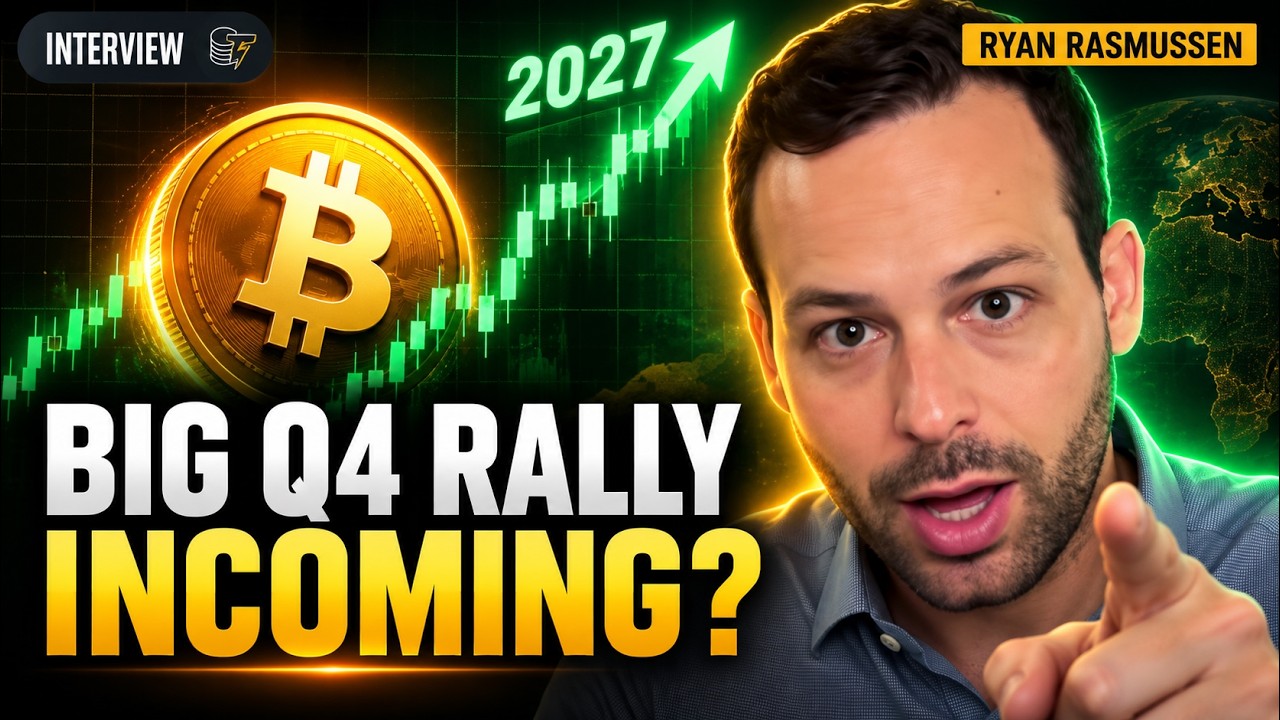
Where’s the Bitcoin Rally? Why Bitwise Still Believes It’s Coming

- Retorno do vídeo
- -0,19%
- Chamadas
- 3
- Compra / Venda
- 3 0
- Publicado
Recomendações
Entrada é o preço de fechamento do ativo na data de publicação. Atual é o último fechamento registrado.
-
Entrada $78.282,00 09 set 2026Atual $78.135,00 10 set 2026Resultado −$147,00vs. índice — BTC é o próprio índice de referência — não há excesso a medir
most investors should hold anywhere from 2 to 6% Bitcoin in their portfolios
-
Entrada $78.282,00 09 set 2026Atual $78.135,00 10 set 2026Resultado −$147,00vs. índice — BTC é o próprio índice de referência — não há excesso a medir
So I think the institutional capital is going to flow into Bitcoin.
-
Entrada $78.282,00 09 set 2026Atual $78.135,00 10 set 2026Resultado −$147,00vs. índice — BTC é o próprio índice de referência — não há excesso a medir
Bitcoin is going to be above 1 million per coin in 2030.
Contexto extraído por IA "I think Bitcoin is going to be above 1 million per coin in 2030."
Transcrição Completa
At the end of 2025,
you made a few predictions for
2026. One of them from
bitwise, was that Bitcoin was
going to reach a new all time
high in 2026, and that the four
year cycle will be broken. So far,
the the four year cycle has
been playing out pretty much
regularly, and Bitcoin is still
down 40%, roughly 40%
from its previous all time high. So do
you still stand by your prediction? Yes, it's a good
question. Look, I think what's
important to remember is that we
just saw a near 30% jump in Bitcoin
prices in a very short period of
time. So this is a heavily
momentum driven and highly reflexive
asset and asset class. We only need
another 10% or so to turn positive. Year to date we've
seen enormous acceleration in ETF
flows. We've seen ongoing
purchases by Treasury companies. And from where we
sit at bitwise, the investors were
speaking to are really excited about
where we're at in terms of
developments, catalysts and
fundamentals. And so I do think
that we could reach a new all time high
this year. I definitely think
we're going to end the year positive,
which would break that four year cycle
of three up years and one down year. Of course,
this year is supposed to be a
down year based on that cycle. New all
time highs is a little bit harder of
a reach. But I do think with the
continued momentum, strong Q4 that we
typically see and a little bit of the
macro uncertainty settling, we could
certainly shoot to new all time highs
in 2026. We'll continue in a
moment. But first, I want to tell you
about a product from our partner. Every year exchanges
get hacked, wallets get drained
and keys get stolen. Engrave zero is
built to make that impossible. No USB,
no Bluetooth, no WiFi. Every transaction is
signed offline and verified by QR code. It's the only wallet
certified EL7. The highest security
rating of financial device can hold four
layers of tamper protection.
Biometric access. Nothing gets in. Back up your key on
graphene steel. Fireproof built to
outlast disasters. Track your portfolio
in the liquid app. Your keys never
leave the device. Engrave. Own your
crypto. And now let's get
back to the conversation. I
still want to touch on another
prediction that you made last year. So it was about
ETFs. Basically, you were
saying that 2026 was going to be like an
amazing year for crypto ETFs,
that ETFs will sort of absorb over Are
100% of the new supplies of,
uh, of Bitcoin, but also
other cryptocurrencies. We are seeing that
there is still a net outflows at this
moment from the point of view of
Bitcoin ETFs. And it's at least $1
billion net outflows. We saw a huge
outflows in May June. I think now
it's recovering a bit. What happened
during the year that you didn't expect
from the point of view of the ETF inflows and
outflows? Yeah it's a good
question. So I think heading
into 2026, if you remember we
made these predictions at the
end of November. So we were right
after the October 10th flash crash. A bunch of liquidity
left the ecosystem. And from there we
entered this prolonged crypto
winter. And I think the
summer really was kind of the the
depths of that crypto winter. We
believe we bottomed. We think price is,
you know, clearly recovered
from the 60 K range for Bitcoin for for
lower for many other alts. And what we've
seen is a reversal in Bitcoin ETFs
going from outflows in the summer to
several billion of inflows so far in in
August and September. The thing
that we weren't expecting, I think
that was difficult to forecast was the
rise in macroeconomic
uncertainty and geopolitical
conflict this year, which has affected
all macro assets. It's inflected. It's
it's affected oil prices and inflation
prints, which in turns
change the likelihood of rates
from cuts to hikes, which going into
this year, the expectation by
the market was that we would see several
rate cuts. Right now, there's a
slightly higher than a coin toss
probability that rates get raised at
the next FOMC meeting, or at least
this year. So I think there was
some macro factors and geopolitical
factors that played a role this year in
terms of investor appetite for risk on
assets. The other thing that
we didn't necessarily
forecast, but certainly played
out was this broad capital rotation
that we saw across investors out of
crypto, out of other asset
classes, and into AI and the
equities market. The space X
IPO is a great example of that.
When we were speaking with
investors around the time of the space X
IPO, they mentioned that
they were selling assets to raise
capital to get exposure to space X, because clients were
asking for it because they wanted
exposure to it. It was going to get
added to the Nasdaq and become part of
the benchmark. So they need to have
some exposure. Otherwise they're
short space X, but it was such a
massive IPO that the capital pull from
other asset classes, including crypto,
but also including things like gold
drove prices lower. I think you saw the
sell off in gold happen around the
same time as the sell off in Bitcoin
and crypto assets, midsummer, and
that's not super surprising given we
knew that capital was rotating. Look,
the momentum in the equities market is
certainly still there. But it
started to stall out. And while I
don't think equities are going to be poor
performing over the next 6 to 12 months, I do think they'll
underperform crypto assets as investors
start to reposition themselves in across
the asset class spectrum. We know
investors we were speaking with back
then weren't saying they were exiting
crypto forever, just like they're
not exiting gold or other asset classes
forever. It was a rotation. And like all
rotations, it comes back
around. And most investors
we speak to today are thinking about
if right now is the right time to
reenter the market, if they've missed
the bottom, which, you know,
around 60 K would have been much more
favorable entry point than around 80
K. So I think that
means is that investors are paying
attention and will see capital rotate
back in. A lot of that will
manifest itself in ETF flows. I wanted to touch on
what you just said regarding the battle
for attention. So for sure in 2026, as you also
mentioned in a recent interview,
crypto has sort of lost the battle for
attention from from investors. What I
wanted to ask you is what is happening or
what should happen to regain the
attention of investors? Or maybe
that's already happening, I
don't know. Yeah, it looks
Giovanni. I think all the
things are happening right now. One thing
for certain that needed to happen is
that you needed to see equities stop
having these blow off, momentous rises
that they had in the first half of the
year. And I think that's certainly
happened. Optimism around the
non-stop up. Only a trade has
faded a bit. Equities have
stalled out. I know a lot of
investors worry about the September
seasonality of equities in. A lot of the
investment committees were on.
Other folks that we speak to are very
aware that September is historically a
down month for equities. And so I
think what investors are doing is taking
a step back from the market. They're
surveying all the potential
investments they can make, all the
different asset classes and crypto
looks attractive relative to other
asset classes. Right now,
it's been trading down while
everything else is trading near all
time highs. So I do think that's
part of the battle for attention. The
other things that are happening to
gain investor attention are things
like massive momentum in
tokenization. It seems like every
other day we're seeing a major
headline around some new all time high in
tokenized stocks on Solana or some other
network. We're seeing tons of
financial institutions start
tokenizing funds or explore
tokenization. We're getting the
clarity from the SEC around how to
tokenize asset. What does it mean
from a regulatory perspective. So I
think that's positive. You also
have the stablecoin momentum behind us,
which, you know,
started when the Genius act passed
last year and was signed into law. But
now there's been this long lag
between when it was passed and when it
actually goes into effect. Now the
stablecoin, uh, which regulates
payment stablecoins, goes into effect in
early 2027. But right now we're
in that final rulemaking period
for agencies that then tell banks and
other large businesses how to
engage with regulated payment
stablecoins. So I think that's
another thing that's turning in crypto's
direction. And it gets a lot of
attention from Wall Street and
mainstream finance, because stablecoins
not only are such a big deal in D.C. right now,
when people talk about the Clarity
Act and what's hung it up, but because
businesses know that stablecoins are set
to disrupt their typical payment
flows and transaction
processes if they don't adapt them. So I think you have
tokenization. I think you have
stablecoins. You also have the
debasement trade, which has reared its
head again in August with gold and
Bitcoin performing strongly at the same
time that the US crossed $40 trillion
in debt for the first time,
and all of a sudden you're seeing
headlines and every talking head across
any financial media outlet, talking
about the runaway debt and the
inability for the US to, you know,
move beyond this and what happens in
those times. Investors turn to
hard assets like gold and like
Bitcoin. So I think we have a
few things that are actually turning in
the right direction already and have
already turned investor attention,
we believe will follow. And I think
that will drive a lot of capital back
into the crypto space. Now, I was talking
to an expert not too long ago who was
basically saying, I wonder when
Bitcoin will go back outperforming
indexes, because if Bitcoin
won't become again
this uh, highly
performative asset that is able to
outperform indexes, then investors would
start asking themselves, why
should they take on the additional risk
of Bitcoin when if you look at the
performance in the last five years,
you see that in terms of
performance, Bitcoin has has
underperformed the S&P 500 in the last
five years at least. So I'm not sure
whether the wealth managers you are
talking to or some other clients are
also expressing the same concerns
regarding this. But what are your
thoughts on that issue? Yeah. Well,
I think look, investors who have
been paying attention to crypto
or just getting into crypto are
definitely aware that Bitcoin has
been one of the best performing major
assets for the past decade. And of
course, there's been periods between then
where Bitcoin's underperformed or
outperformed the S&P 500 or the Nasdaq or
other indexes they may track. But over
the long term, Bitcoin's
outperformed all of them. And I think
what you see today is that investors
have a lot more access to Bitcoin
through things like ETFs. A lot of
wealth management platforms and the
large RIAs and Wirehouses now allow
their advisors and wealth managers to
access Bitcoin in client accounts. So that changes the
narrative a little bit, because we have
all this capital that we set as
rotated out of crypto, or maybe
been sidelined from crypto because they
haven't had the access to it. But
they know that over the long term,
Bitcoin has outperformed these
other indexes that they track against. And when momentum
turns in Bitcoin's favor, I think we're
well positioned for a lot of those
investors to make those allocations. I
think you saw that with the several
billion of inflows, not only into
Bitcoin, but into other majors like
Solana, XRP and Ethereum. And so when we talk
about Bitcoin's performance at
bitwise, we take a very long
term oriented view. And that's because
most of the investors we face
off with traditional financial advisors,
RIAs and wealth managers, these are
long term oriented investors. They
typically don't try to trade in and out
of a bunch of assets throughout the year. They take positions
once they have conviction and they
hold them for the long term. And I
think that's what we're going to see
here. As the price
continues to stabilize, around
80,000 and moves higher. And so,
yes, it underperformed
over a short period, but it's
outperformed over the long term. And
many of the new investors coming
into Bitcoin aren't day traders. They're
long term investors who are positioning
their portfolios and their client
portfolios for the next decade, not the
next six months. What are the
macroeconomic catalysts that could
drive Bitcoin price higher in the next
couple of months? Well, certainly an
end to the conflict in Iran would help
because you would see oil prices reset
at lower levels, which would reduce
inflation fears, which would reduce
the likelihood of rate cuts that the
market is pricing in right now,
and give the fed some room to
breathe. So I do think the conflict
in Iran just dragging on longer
than most people expected plays a
role, but with an end
potentially in sight, because we
don't think that the Trump administration
wants us to drag on much longer. I think
that's a positive macro catalyst if
and when it does come. The other
thing that's been playing a role
somewhat is this will they won't they
on the tariffs front, right. Like
tariffs increase costs which
therefore increase inflation
expectations have the same knock on
effect on rates. So those are two
things that have really played a role
this year in terms of macro headwinds
that we've been facing. But I do think that
what we saw was that Warsh is still not
showing his hand in terms of what the
FOMC is going to do. We saw Bessant start
to intervene, first with the yen,
then saying he's intervening with the
long end of the bond market. I think
that's a sign that the US doesn't want
rates to go much higher. And that's a
very powerful force. And what we've
historically seen is Bitcoin performs
well in low rate environments as
investors go and look out along the
risk spectrum for higher yield
returns. So if we see the
macro environment settle, if we
actually don't see rate hikes and we
see rates stay flat or come down,
we see bonds start to normalize back to
to normal levels. And if we see an end
to this conflict in the Middle East,
I think those are macroeconomic wins
that turn in crypto's favor and
in Bitcoin's favor in Q4. I would like to know
your price prediction for
Bitcoin for 2030. Ah, I love this
question because as I mentioned, we
love to think about things long
term. My view is that
Bitcoin is going to be above 1 million
per coin in 2030. I think there's a
bunch of factors driving it higher.
But if you zoom out, the things that I
think are most important is that
we're expanding access for
institutional investors to
Bitcoin. They now can access
Bitcoin in ETFs in client accounts
across almost every major wealth
management platform. But what's important
to remember is just because they get
access doesn't mean that they allocate
right away. One interesting
anecdote from our time at bitwise is
that historically, it's taken about
eight meetings from an advisor engaging
with us to actually allocating to a
Bitcoin fund. And those meetings
don't happen every week for eight
weeks. They typically happen
once a quarter or so over the span of two
years. So running that
back, if most of these advisors are
just getting access to Bitcoin this
year, it stands that they
likely won't allocate towards the
end of this year or maybe the middle of
next year. And I think that
capital, once it starts
coming into the into the ecosystems will
stay. And a lot of
advisors start with 1% and then ladder
up from there to 2% or 5%. So I think
institutional capital coming into
the Bitcoin space is going to drive the
price higher. I think continued
regulatory clarity, not just for
Bitcoin, but for the entire industry. We have regulated
payment stablecoin legislation with the
Genius Act going into effect later
this year. We're going to churn
through the uncertainty about
the Clarity Act and get rules either
from Congress or from the SEC and
CFTC around regulation. That's going to be a
positive. That allows
investors to feel better about making
allocations. And you have this
continue rising concern around
debasement of traditional fiat
currencies. And it's something
that is going to continue to push
investors into hard assets over the next
decade through 2030 and beyond. And when
they look at hard assets that have the
ability to hedge against fiat
debasement, Bitcoin and gold are
really the two out there that we see
benefiting the most. And the thing is,
is the gold market is massive. The
Bitcoin market is tiny. It's like 1%
of the gold market or 2% of the gold
market. And we think the
store of value or hard asset market is
going to grow over time, much larger
than it is today. It's grown over the
past decade at like a 10% kegger. We think that will
continue into the future. And we think
that Bitcoin's share of that market will
grow. So Bitcoin's share
of a growing market will increase. And I
think debasement will be a big part
of that. Lastly, I would just
add that we continue to see so
much investor interest in things
like model portfolios, which is
a set and forget method that a lot of
wealth management platforms use. And
we've seen everyone from Charles Schwab
to fidelity to everyone in between
talk about how most investors should
hold anywhere from 2 to 6% Bitcoin in
their portfolios, depending on their
risk preferences. And a lot of these
platforms are starting to add
Bitcoin to their model portfolio. So
I think the institutional
capital is going to flow into Bitcoin. I think concerns
about debasement is going to flow assets
into things like Bitcoin and gold. And as Bitcoin
continues to reduce its volatility and
as as its correlation to
equities continues to trend back to
where it historically has
because it's been high recently,
I think those things will all drive
investors to adding Bitcoin to their
portfolios alongside gold and as part of
their typical portfolio
allocation. Thanks again for
joining us and hope to see you soon on
our show. Amazing. Thank you
Giovanni. Great to be here and hope to
do it again soon.
Comentários 0
Entre para participar da discussão.
EntrarAinda não há comentários. Seja o primeiro a compartilhar sua opinião!