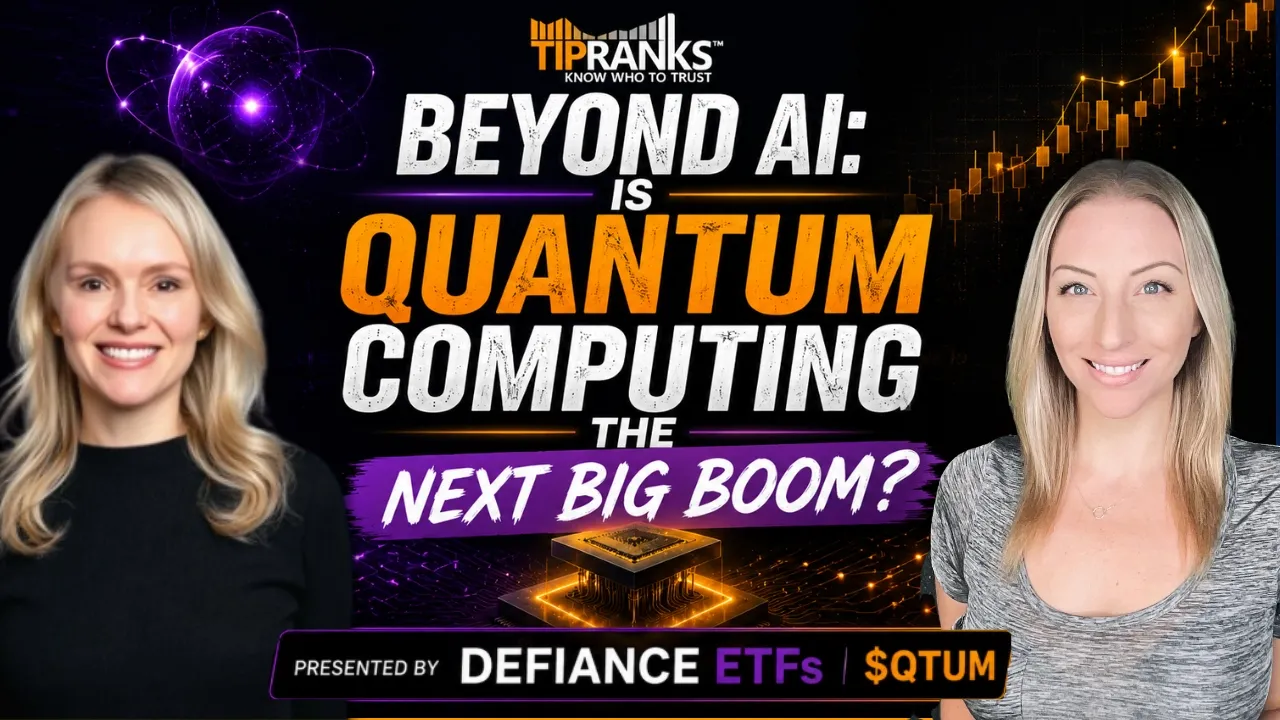
Could Quantum Computing Be Bigger Than AI? | Defiance ETFs

- Retorno do vídeo
- -10,31%
- Chamadas
- 1
- Compra / Venda
- 1 0
- Publicado
Recomendações
Entrada é o preço de fechamento do ativo na data de publicação. Atual é o último fechamento registrado.
-
Entrada $167,76 03 jun 2026Atual $147,40 24 ago 2026Resultado −$20,36
And so I think that a quantum ETF is a great way to go.
Contexto “ETFs give you that, you know, you it gives you diversification, it gives you broad exposure to a particular theme. … And so I think that a quantum ETF is a great way to go.”
Transcrição Completa
Hey everyone, it is Julie here with TipRanks and I once again have the pleasure of being joined by Sylvia Jablonski, the Chief Investment Officer at Defiance ETFs. Now, Defiance ETFs is an innovative ETF issuer in the space and today we get to dive into an exciting ETF focused on quantum computing, which is a very hot spot in the investment world right now. So, Sylvia, thank you so much for joining me today. >> Hi Julie, thank you for having me. Glad to be here again. >> Of course. Now, today we are looking at the Defiance Quantum ETF under the ticker QTUM. This was launched back in 2018. So, this is actually a long time before quantum computing became a really mainstream investment theme. So, what is the core thesis behind the ETF and why did Defiance decide that this was a space worth building a fund around so early? >> Um yeah, great question. So, so the Quantum ETF essentially gives investors access to stocks in the quantum ecosystem, right? And so that could be pure play quantum stocks, that could be um companies like an IBM or Honeywell that do a lot of R&D in quantum, they they are building quantum computers within their um umbrella businesses that they run. And so, it's, you know, it's also the materials, the chips, the picks and shovels that go into the quantum computers working and processing and things like this. So, it's really exposure to the entire quantum ecosystem. So, quantum and machine learning. Um and what I would say is that this very much represents an is akin to the AI trade, right? And so, if you see, you know, what happened with AI over the last couple of years, like we're we're just on kind of day one of that potentially happening with quantum. It's the next gen of of computing, supercomputing, and you know, where AI will potentially go. >> And you guys created this like eight years ago though, so quite ahead of the trend. So, what drew you to that so long ago? >> Well, it was created before people knew what quantum computing was, right? And it's it's really a testament to our founder having the vision that the next generation of of computing would look something like supercomputing. It would look something like AI. It would look something like machine learning. And that's essentially where the puck is going. And you know, if you kind of think about like the superlative or you know, where this could land, I mean, quantum computers essentially can do things in parallel, right? They can do the use of qubits. You have you know, you have kind of these two stages. You have zeros and ones. And a regular computer does those things kind of like one thing at a time. Whereas as a quantum computer can do these things in parallel. And what a traditional computer can can do, you know, pales in comparison. So, a quantum computer, for example, can do a task that a traditional computer can't do for a thousand years in a couple of of minutes in some cases. When we get to the fruition of the technology, you know, working and and advancing and maturing, I I I think like a great analogy is if say you're locked out of your apartment and I mean, I guess this doesn't happen so much anymore. But you have like a super that has like 50 keys, right? And you have to go if they're not labeled, you go one by one by one until you see which one works, right? That's a traditional computer. The quantum computer would be like all 50 at once, right? It it understands and and can do all of those things at once so you get in right away. You know, kind of a simplification, but it's it's really, you know, kind of like the ultimate ultimate landing of supercomputing and AI. >> I love that description of with the keys. That's actually a great visual there. Now, when people think of a quantum ETF, they might be expecting more, you know, pure play quantum companies. But this ETF does have names like AMD, ARM, Micron, Intel. How do you decide which companies belong in this portfolio? >> So, the reason that we like this ETF and why I think a lot of our investors like this ETF is you have exposure to the pure play quantum names, right? That's that's very much, you know, the the the core and and and part of the thesis of this ETF. But it's like anything else, right? I mean it's the larger companies are are and the well-known companies are also the ones that are just investing massively in quantum computing, right? You have Nvidia, I mean they have large-scale quantum investments. Um you have, you know, we mentioned IBM, we mentioned Honeywell before. Um you know, Google's involved. I mean what's great about this ETF is you have exposure to the small cap pure play quantum companies, but you also have the balance of these large companies that have massive balance sheets. They're going to be huge players in quantum. Maybe they take over some of the quantum companies, you know, maybe they don't. But what happens is on the days where you have these market corrections, our ETF tends to do really well because um the higher beta stocks could could pull back with the market, but the larger stocks serve as a ballast and and really give you that diversification and protection within the fund kind of organically because of the types of quality companies that they are. But the idea is that these companies are all critical to the buildout of quantum computing. So you have the picks and shovels like the chip companies as you mentioned, right? Um you have you have data centers, you have um you know, large hyperscalers um adopting quantum within cloud types of resources. you have the darlings, right? The IonQs, the D-Waves um of the world. And so it's all very well represented in this fund. >> Now you mentioned of course that AI has been this big theme over the last couple years here. So how does quantum computing fit into this picture? >> You know, it's it's all kind of with within the realm of of the same ecosystem. So so quantum computing can can help, you know, um data and data discovery and data parsing and analysis happen more quickly and more efficiently that leads to more accurate um you know AI systems processing and and machine learning being done more accurately and and being done quicker. But when you think about like what quantum computers can do, you know, they can they can help with drug discovery. They can you know, run the data for thousands or you know, hundreds and thousands of trials at the same time and give a result versus you know, right now if AI is running on a traditional computer, you're kind of doing one thing at a time. It can help with financial modeling, you know, banks better managing their balance sheets and their risk assessments. It can help with cryptography. It can help with defense. It it can help with you know, kind of kinds of um you know, nameless amounts of of of tasks here and I think that's why it's you know, that's why it's just so widely observed right now by investors cuz if you think about you know, even cybersecurity and things like this, um you kind of need that next generation of supercomputing to have AI work in its most efficient form. So it's all part of the same thing really. I mean, I've just heard I I heard somebody this morning say that quantum computing is just the next evolution of of AI and I think that there's some truth to that. >> Yeah, it sounds like the possibilities are endless there with that list. Now, when we look at the ETF itself, in the past year it is up over 80% and has delivered over 469% since its inception. What do you think the big drivers behind that performance have been? >> Well, again, I think it's a a well-built fund, right? I think you're you're getting access to the top performers in the quantum space and you're also getting access to the entire machine learning and AI ecosystem and and those stocks are very much the ones that have been performing um you know, particularly since '22 and particularly since the chat GPT moment. So I think that the fund is structured quite well and it gives you access to like the most important names in the current and next generation of supercomputing, quantum computing, AI and machine learning. >> Now, when we talk with investors, are there any kind of misconceptions or misunderstandings about investing in quantum computing or a fund like this that you think they should understand? >> I think you know, I think when we talk to investors a lot of it is just talking about, you know, what the possibilities are with quantum computers and they talk about early stage and you know, if there's any questions are around like is it too early? Like are we, you know, it is is the news kind of not here yet? Is it too soon? But look what happened with AI, right? So I think when we think about quantum computing, it's it's not too early. It's it's kind of just right. But the you know, the idea for these types of disruptive technologies is you hold these for the long term, right? These are meant to be, you know, in a portfolio, part of your your tech allocation, you know, your whatever it might be your your AI play or semiconductors or tech allocation, very much a complement or or a great, you know, pure number one player in in a portfolio for that space. Um and so yeah, the idea is that it won't happen overnight, but if you know, if you're kind of in it from the beginning you can participate in the upside there. So again, we just think that this is potentially the next AI, right? The next um AI insight that people are going to be looking at. >> Absolutely. And then for investors that, you know, want to get into this quantum space, why might an ETF approach uh a better approach versus trying to pick a clear winner? >> So ETFs are great for this. This is actually the beauty of ETFs and what they're best designed for in my opinion. Thematics are or I think hands down where you want to go, right? When you when you're thinking about when you're a novice investor, you know, you want exposure to a space, but um you don't know so much about all of the companies who are players and who who will be around and who won't, who's pre-earnings, who's post-earnings. ETFs give you that, you know, you it gives you diversification, it gives you broad exposure to a particular theme. And if there's one stock that isn't doing well, you know, again you have the balance of the quality stocks within it. And so I think that a quantum ETF is a great way to go. You know, let us pick the quantum stocks um for you if you think it's a if it's a good fit for your portfolio, you'll get exposure to all of them, right? Versus versus just one that might not perform or um could underperform. And then there are new plays coming into the market. We just heard about the Quantinuum IPO that um is, you know, very popular right now and in the news around quantum computing. So, these ETFs also end up picking up names like that once they go public um oftentimes based on on, you know, their kind of rules and methodology. So, it's a great way to stay at the forefront of quantum computing um and having, you know, kind of someone else that the issuer index provider do the work for you. >> That is the beautiful thing with ETFs, they Now, the quantum space has been growing a ton already, but what kind of potential and future do we see there? >> Well, we're, you know, somewhere around 1 to 2 billion right now and we're thinking that that's going to be 10 to 20 billion by 2035. And so, you know, you have this massive um massive compound annual growth opportunity here. You know, even if it's even if it's a third of that, you're you're going to see a lot of potentially going to see a lot of growth in that space. And so, I think that, you know, over the next decade or so, we're going to see massive amounts of economic impact from the growth of quantum computing. >> That is very exciting. All right. Well, I appreciate your insights on this ETF. For all of our viewers, if you're wanting to learn more, you can head on over to Defiance ETFs and see it over there or check out our TipRanks ETF Center. Of course, these videos are never a suggestion to buy or any stock or ETFs. So, always do your own research and due diligence. Sylvia, thank you so much for joining me again today. >> Thank you for having me. >> We'll chat with you again soon.
Comentários 0
Entre para participar da discussão.
EntrarAinda não há comentários. Seja o primeiro a compartilhar sua opinião!