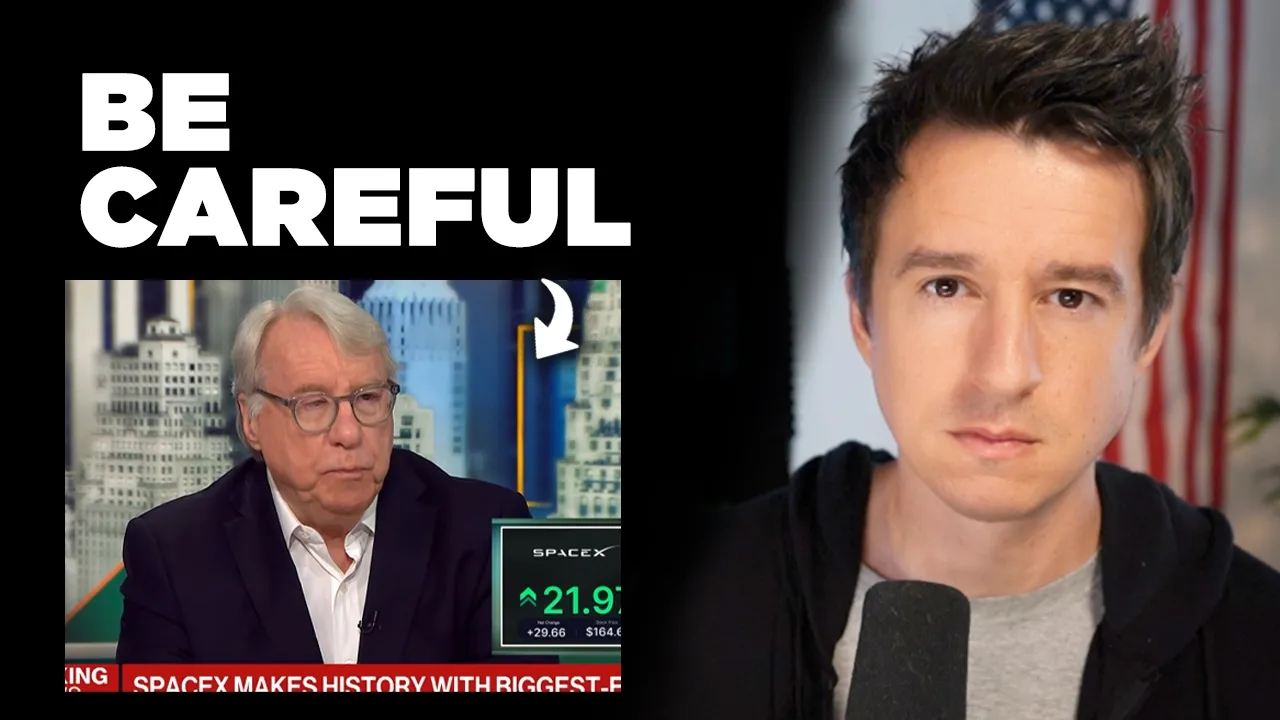
Investing Legend Warns About This Market

- Retorno do vídeo
- +5,56%
- Chamadas
- 2
- Compra / Venda
- 2 0
- Publicado
Recomendações
Entrada é o preço de fechamento do ativo na data de publicação. Atual é o último fechamento registrado.
-
Entrada $167,54 15 jun 2026Atual $200,12 27 ago 2026Resultado +$32,58
I've continued to buy more into Texas Roadhouse.
Contexto Instead, I've continued to buy more into Texas Roadhouse. This is a company that I already own.
-
Entrada $1.892,66 15 jun 2026Atual $1.725,33 28 ago 2026Resultado −$167,33
This stock is going to 2,000.
Contexto We have ASML. ASML that's up another 1.76%. And ASML is at almost $1,900 per share. This stock is going to 2,000.
Transcrição Completa
Today on the Jezel Carlson show, the market is racing upwards. It is blindingly green. Basically, every company except for some consumer staples and energy. Everything else seems to be going up. We have all the big tech companies, all the digital platforms, those ones are racing up today. And we know the reason why. There is apparently a new peace deal that we struck with Iran. We have JD Vance, vice president, going on to CNBC explaining the details of the deal. And investors are of course excited about this. It means that the straight of Hermuz is open. It means that we can focus on brighter days ahead instead of this constant conflict. Or at least that's the idea. Now, of course, we have to look at how long it will actually take to be recovered. How long until we get back to our normal flow of oil as before. We'll be looking over those details. And we have a lot of other news that's happened just recently. For example, SpaceX just IPOed. It made Elon Musk a trillionaire. That made a lot of people very happy and very rich. At the same time, it made some other people very upset. We have The Verge calling Elon Musk a killer. That's a a real headline. We have other people like Jim Chanos going over the valuation of SpaceX, saying that it's over 100 times price to sales. It's trading at a hundred times its revenue. We also have Elon Musk addressing those concerns, saying that he believes that SpaceX will have a trillion dollars in revenue by 2030. That would be more revenue than Amazon has today. We'll be looking at how realistic that is. And of course, we have the fail of the week, which in this case is Anthropic. Anthropic had their flagship model shut down by the US government. This was a self-inflicted wound by Anthropic. We'll be going over all the details in today's episode. So, we have a ton to get to in this episode. Let's go ahead and jump in. Now, as we look at what's going on today, we can see that the market is moving up big time. When we look at some of the top stocks, these are some of them that are in my portfolio, like Amazon, one of my top holdings, is up 3.27% 27% today, up to $246 per share. Huge move by Amazon. This one really lifts up the portfolio. We also have Google. Google's up 3.15% today. It was on a bit of a downtrend. It was coming off of the 400s down to like 350. Now it's back to 369. Microsoft is up 2.73% today. So big move by Microsoft. We have Uber up 6.52%. Uber and Door Dash are both moving up big time. Door Dash is moving up even more 11.63%. Both of these companies are phenomenal. The stock price is down, but we're seeing some strong momentum upwards now. I think that this will continue for these companies. We have S&P Global, another huge holding in my portfolio, up 2.44% today. This one continues to move upwards. And we have ASML. ASML that's up another 1.76%. And ASML is at almost $1,900 per share. This stock is going to 2,000. This is incredible to see what's going on with ASML. And of course, we can't forget about Duolingo. This one has had momentum as well. It's up to 130, up another 5% on the day. Now, I have to give an additional shout out to ASML because we have the portfolio here pushing up near all-time highs. And if we look at the top position, this is the most valuable position in my portfolio in the passive income fund. We have ASML just at the top barely. It's actually at $9 more than Mastercard. So this one's barely the largest holding in the passive income portfolio. This will bounce around between ASML and Mastercard. Now having said that, if you were to add together both my Google positions, the one in the passive income portfolio at 133,000 and then I have another portfolio, the Story Fund, where I have even more Google, almost another 90,000 of it. Most of it's in gains on this one. It's up 400%. If you add those together, Google is still my largest position by far, even above ASML. In fact, when we look at both portfolios together, this is what it looks like. We still have Google at the top here, 15.5%. We have Amazon in second place at 12% and then we have ASML third. But still notably, ASML is climbing up by itself. I have not bought this company for some time. I loaded up on ASML below $700 per share and I've just held it. I haven't sold any. And this company is doing all the work by itself, which I like to see. Now, ASML is over $100,000 in the green with a cost basis of $62,000. So, that one has been amazing and the future remains bright for it. Now, when I look overall in my portfolio, I've put so much money into these large AI companies, digital tech platforms, financial network companies. I bought so much of companies like Google, of companies like Meta. I've put $170,000 into this one. I loaded up on Mastercard as well. I think Mastercard's doing great. Amazon as well is another one that I put a ton of money into and I think these positions are going to do great. But I've been looking for other companies, ones that are not AI related, ones that aren't even techreated. I've been doing research on lots of them. For example, I just recently did an over hourong deep dive into Casey's. This is a convenience store. A lot of investors don't even know about Casey's because it's basically only popular in the Midwest and Iowa in particular, but it looks like a run-of-the-mill gas station, a convenience store. In reality, the stock has crushed both the S&P 500 and the QQQ. It's done better than almost any major tech index, and it does that by combining a convenience store with restaurant-like margins. They are the fifth biggest seller of pizza in the country. They continue to grow like crazy. They're expanding and doing acquisitions and buildouts at the same time. They're taking over small town America, which of course there are tens of thousands of convenience stores. They're consolidating the entire industry. Casey's has experienced rapid growth, enormous market beating performance. And the way that they got there was by selling pizzas. They are just simply selling good pizzas at a gas station. It's a novel concept. Usually, you look at gas station food as being inferior to restaurant food, but they have entire kitchens in their convenience stores. They sell highquality pizzas. Many people believe that they're better than many of the mainstream pizza joints. So Casey's can sell them, undercut their competition, gain huge market share, and now they're expanding into other food categories, specifically chicken. They believe that they can have as big of a chicken business as they have pizza. That makes the company incredibly profitable. So it's an interesting company, and if you want to look at it more, again, you can watch the entire exclusive that we just released on Qualum. But when I was looking at the company, the only thing that's held me back from buying it is the valuation. Casey's has raised up to a higher multiple, so I'm holding off for now. Instead, I've continued to buy more into Texas Roadhouse. This is a company that I already own. I am a deeply in the green on this one. It has been one of the most successful investments I've made. I bought Texas Roadhouse back around the co time period where nobody wanted to own restaurants. And Texas Roadhouse has continually gained market share. Texas Roadhouse continues to show excellent operations. It's a company that's remained profitable even with record high beef prices. Texas Roadhouse has actually benefited from record high beef prices because they're stronger than their competition. It makes it so other companies can't compete as well on a price point as they have. So, the stock price has held up even despite this problem with beef prices being high. And I like what I see with it. So, even though I own quite a bit of the company, I'm starting to build back up this position to make Texas Roadhouse a little bit higher weighted. And I want to get it to around a 5% weighted position in my overall portfolio. Now, when we look at what's driving this incredible performance today, why all these stocks are going up, of course, it's optimism with this new deal being reached, and we can take a look at what JD Vance, the vice president, says about this deal. Here's the vice president on CNBC just this morning trying to explain to investors and people what this deal actually means. What this agreement does is say to the Iranians that you don't have access to the money to rebuild that nuclear program, but if you're willing to give up that program longterm, if you're willing to accept the inspections and verification regime that's necessary to give us the confidence you're never going to have a nuclear weapon, then we want you to be a prosperous country and we will reinvite you into the community of nations. And that's fundamentally the two-step process, the choice the Iranians have to make. Do they want access to the world economy? If so, they're going to have to give up the long-term nuclear ambition. If they don't want access to the world economy, and they don't give up that ambition, they're never going to have the resources to rebuild it from where it is today. So, it's a big win for the American people. And I think the Iranians fundamentally have a good choice here in front of them, whether to be a normal country or whether to be a country that continues to be to pursue a nuclear weapon, which they now have no capacity to do. So there you have his messaging. Of course, this comes from the administration. The actual agreement is still being negotiated on. They just have a framework for negotiating it now, and it's going to end up being incredibly complex with a ton of nuance, and we can't possibly go through all of it in this episode. But regardless, what investors are looking at today is that it's at least headed in the right direction. And in terms of inflation or oil prices or even the opening of the straight of Hermuz, this type of stuff is going to take some time. It'll take some time to work its way back into the economy. They mentioned that the backlog of stranded vessels and the need for crew changes and the rest means the realistic return to normal shipping patterns is weeks if not months away. So granted with anything this big there's going to be caveats and nuance and specifics in the deal that people will inevitably argue about over and over again and that's normal but this news is unmistakably overwhelmingly positive for the market. If we actually have a resolution here, if we have the straight of hermuz start to gain more ships every day, more of them passing through, that is overall great for the global economy. It's good for oil prices within the United States and especially in Europe. If it starts to open up more regularly, inflation, which has been ticking up a bit, will start heading back down. If inflation goes down, that will impact positively many of the companies that we hold. So I view this as overall an optimistic development, one where we can have the worst over with the war in Iran, where we can move in a positive direction going forward. Now, of course, while all this is going on, we also have the SpaceX IPO, which made Elon Musk the world's first trillionaire. We have the news here. He is officially on paper a trillionaire. To put this simply, Jeff Bezos, who has a couple hundred billion dollars himself in net worth, he is closer to your net worth than he is to Elon Musk's. Like you two, Jeff Jeff Bezos and you are are more similar to each other in net worth, like if you were to group them together, than he is with Elon Musk's. That's how that's how rich Elon Musk is on paper with a trillion dollars. It is actually incomprehensible how much money this is. You don't understand it even though you think you may. So I have a brokerage account. I have 1.5 million in it. I would just need to multiply that by like 800 to 900 times to become a billionaire, which of course is not likely. I don't foresee that happening anytime soon. But that wouldn't even make you close to becoming a trillionaire. You would have to a,000 times your net worth again after a thousand times and get to get to a billion. A trillion dollars is literally a thousand billions. It's numbers that we have difficulty comprehending. And when this is happening, especially at a time where there's a lot of wealth inequality, lots of people struggling financially, it highlights all these social problems. Immediately after uh Elon Musk became a trillionaire, you have most of the socialist governors saying that they want to take a piece of the pie. They want to take 5% of his wealth and so on and so forth. We also have articles like the Verge saying that the world's first trillionaire is a killer. They don't use the word murderer because of probably liability reasons, but instead they call him not ironically a killer. Now, I understand the frustration with looking at Elon Musk and seeing the insane amount of wealth. And you may think that doesn't seem fair. How can he have so much wealth while so many people have so little? But I believe people view this wealth as though Elon Musk just has a piggy bank with a trillion dollars in it. And that's just not how this works. If more people understood that this is paper net worth based on valuation multiples of a company that is not liquid cash for him, I think it would make it a little bit easier to understand. SpaceX is trading at $178 per share. Uh when we look at this, the multiples obviously are a little wonky right now. They just don't make sense. And that's part part of the reason why is we only have a couple quarters of data in Qualrram anyway. As this company continues to go quarter after quarter, we'll get better data here. But regardless, when we look at some of the multiples, SpaceX doesn't make any money. It is not profitable. It barely makes any revenue as well based on the size of the company. It's going to do around 30 to40 billion in revenue. That's not a lot for a company that's trading at a $2.29 trillion market cap. When we have the next two quarters, that'll bring it to around 110 times revenue. And I think this comes down to just a simple disagreement over investment philosophies. I believe that there's a huge group of investors in the market today that do not care about fundamentals. They don't care about revenue. They don't care about earnings. They don't care about even growth rates or if a company's growing at all. They simply care about hype, about excitement, about being involved in the latest thing. It's the same group of investors that were bullish on Bitcoin. Bitcoin doesn't create anything. It doesn't really solve any problems. It's not used as global commerce. It's not any better than Mastercard or Visa's network. in transacting or doing anything similar. It's not even good for privacy. Bitcoin literally has almost no advantages over a traditional payment system and it has many disadvantages. But investors flock to it. They they love Bitcoin and those investors wanted to be involved in something and something different, something excited. You can plug in whatever motivations you believed, but the fundamentals were not a motivation. And I see much of that attitude entering the stock market today. investors are leaving crypto and going into the latest and greatest in the stock market. Whether that be Tesla, now it's SpaceX is the new exciting thing. And when you look at the fundamentals, it doesn't really matter. Whether or not SpaceX actually does well, I don't believe really matters. Whether or not the revenue grows, I don't think really matters to investors. Because if it doesn't grow next quarter, it might grow the one after that. If it doesn't grow the quarter after that, it might grow the quarter after that. As long as there is some carrot on a stick that's always two quarters or 3/4 out, there's always a thesis for the company to sustain an incredibly high valuation, 100 times multiples. We see it for companies like Tesla. Tesla's not sustained quite the multiple of SpaceX. There's more priced in for this company and there's more risk in SpaceX than Tesla, but it's the same principle nonetheless. Investors are willing to pay for stories and narratives. And if those stories and narratives do not come true, they're willing to just wait and continue paying hoping that they'll come true on a delayed timeline. We've seen the same pattern repeatedly with Tesla, and I believe we're going to see the same thing with SpaceX. The first clue that we're already on that track is a recent tweet by Elon Musk. He recently said that, and this is real, you can check his timeline. This is on X. He says, "I think SpaceX might be able to reach approximately $1 trillion revenue in 2030. A trillion dollars by 2030." To put that in perspective, last year SpaceX did $18.7 billion in revenue. Now, they have some new revenue streams. Uh they have the compute deals that they're doing with like Google and other companies. That's generating some revenue, at least temporarily, and it probably will for a couple years. But that's a big leap from where we are today to a trillion dollars. To put that in perspective, that is a 54 times increase in revenue since last year. That's as if SpaceX was going to increase revenue by 120% every year for five consecutive years. That's the reverse DCF of it. Now, it's not impossible. Technically, it could happen because anything could happen. And that's the bull case here. Anything can happen. And we have a CEO that consistently says big grandiose promises like this most recent one. And notice that Elon Musk tweeted this out publicly. This wasn't something that was leaked in an internal memo or a board meeting. He didn't just say this to some close confidants about his future personal thoughts on the company. No, he didn't say it privately because he didn't want it to be private. He wanted people to know about how big SpaceX is going to be. He wants them to know that it's going to be a trillion dollar revenue company, the biggest company in the world by far. And because if people know, they're more likely to buy the stock. When they're more likely to buy the stock, they support these incredibly high valuations. And Elon Musk's net worth continues to rise as he is a massive owner of these companies. If the trillion dollar revenue mark by 2030 doesn't happen, which it's almost certainly not going to, then Elon Musk can say, "Well, I'm always a bit optimistic. I always shoot for the stars." Right? That's the big defense. Whenever he says something that's outrageous, people write it off and scoff at it as just Elon Musk being Elon Musk. He always shoots high and at least look at what he's done before. He's he's accomplished great things. So, there's always a defense for it, even when these goals don't materialize. After, of course, Elon Musk makes these big grandiose promises, these big claims of where his target is, saying that he thinks SpaceX will get to a trillion by 2030. We have people like Ahmed saying, "If you're right about that, then SpaceX is pretty cheap." Paying $2.3 trillion for a company that did 15 billion in revenue last year. That's not expensive because based on what Elon Musk is saying, it sounds pretty cheap. So all of this continues on. The incredibly high valuations, the super high net worth of Elon Musk, most of his wealth being in these stocks that are trading at insanely high multiples, all of it continues on in the future. And we have skeptics, people like Jim Chenos, that continually and repeatedly warn against investing in these type of situations. And here he is doing so again. And one of the things that I think SpaceX is ushering in in 2026 is massive equity issuance. And and historically, without a doubt, in the 20th and 21st century, anytime you have seen massive IPOs and secondaries relative to the size of the market or the economy, investors generally have been advised to to be a little more cautious or or reduce their risk. So the 1999 2000 um 2021 for the first half of that year u during the meme stock and spack craze. We are now going to break records in 2026 for IPOs and secondaries. Um and SpaceX of course is the granddaddy kicking it all off in a big way. But we're going to see OpenAI and Anthropic and probably some others. his stern warning that all these companies are issuing equity and we have all these massive IPOs I think should be listened to. And it's not just SpaceX. We also have Anthropic and OpenAI gearing up to do massive IPOs. This will cash out to many investors willing to buy these shares at any price. And again, you'll notice the common pattern here. The fundamentals are thrown to the wayside while investors focus on what's the most exciting trade in the market. There's many people that are on different sides of this, but when we look at it, it's the continued story of exuberance. The investors that have seen this before continue to warn against it, saying that this is what happens every time there's trouble in the market. And he's not saying to become scared or sell out of all your holdings. But Jim Chainos is saying to proceed with caution, to be careful when the market gets into this level of exuberance that we're seeing today. In fact, some analysts are now saying the XAI is actually becoming worth less and less as they're expanding into a lower margin, more commoditized business, which is the Neocloud. XAI seems to be suddenly changing its business model from developing models like Grock to basically becoming an Ed Lllo Neocloud. The entire valuation rests on XAI's progress. The Neocloud strategy is a commodity business that is valued far lower on the public markets. A neocloud is exactly what XAI has done with their contract with Google. Basically, they bought a big landfill. They filled a whole facility full of GPUs and they're leasing it out. So, it's GPUs as a service. That is a NeoCloud. Now, that's different than what Google Cloud or AWS does. AWS has thousands of developer tools and have been built over years to be able to run and manage organizations and companies on it. All of these tools are extensively built out. They're using database management, storage, compliance, security, on and on and on. That is not a neocloud business. What AWS is doing is building out full IT infrastructure on their cloud. What SpaceX is now doing with most of their revenue growth has been Neocloud growth. And Jim Chenos highlights this as a potential problem that the business quality is actually going to lower right as they're getting this extremely high valuation. And instead they basically did a 180 pivot and said we are going to lease out our capacity to anthropic and Google and that's the neocloud model right that's you're an equipment lesser and that is a much lower valued business in the marketplace than being a model company or a hyperscaler and we've been following data centers for a long long time and basically you're it's a finance business right you're you're you're buying the chips from Nvidia somebody else and then you're leasing them out to anthrop ropic or what it's a rate of return business. It's not a super high-tech business. Yet 22 plus trillion of the 29 12 trillion of of SpaceX TAM in their perspectus was based on that business. >> Now we finally get to the point of all of this, which is how much value in these stocks relies solely on Elon Musk's name being attached to them, the Elon premium. The Elon premium has been substantial over time, but now it's it's at record highs. This is a a premium for an individual, a key man in a company that I don't believe we've ever seen before. >> And now you have another Elon Hopes and Dreams company with an even bigger valuation. Um, and and so does that does that double double the value or does it basically say, "Okay, well, I'm going to pick one." Um, because neither of them, let's face it, are are being valued on their operations. SpaceX is, I believe, depending on what I heard in the green room, is probably now at about 110 times revenues. And and just history tells us you just never really make much money buying equities at over a 100 times revenues. History says that you don't make money buying companies at 100 times revenue. But that's history, and you can't look at history to judge the future. This is all new. That's almost inevitably what people's thoughts are. And maybe they're right. Maybe this time it is all new. SpaceX will get to a trillion dollars of revenue and the stock will end up being cheap at this price point. We'll have to wait and see. Now, moving on, we finally get to the fail of the week, which in this case is Anthropic and more specifically, Daario. Daario, if you recall, is the one that started Anthropic. He founded the company. And he's one of the biggest AI leaders that's caused panic and anxiety and a lot of grief to many people over the advent of AI. We know that AI has an incredibly low approval rating by basically everyone now, including new graduates, because they've been told repeatedly by people like Daario in the industry, uh, experts that it's going to cause job disruption. We also have many government officials using this rhetoric as an excuse to try to control, regulate, and seize artificial intelligence and anything that comes from it. It's caused an entire bit of chaos. And again, the poster child for all of this is Daario. He is the primary one behind this type of rhetoric. Well, recently it seems like this has come back to bite them. Anthropic recently released their newest model, their flagship, their most powerful model that people were giving overwhelmingly good reviews. It was on the benchmarks. This is the most powerful benchmark. And then suddenly without any type of notice, it was pulled from the market. If we look at the timeline of events, it says here that Anthropic unveiled Fable 5 and Mythos 5 on Tuesday, just days after it received the export control directive from the government. The company worked with the government agencies to test the models ahead of the release and receive approval to deploy them. The government then called Anthroic on 1 p.m. on Friday and instructed the company to disable Fable 5 and Mythos 5 because of an unspecified national security threat. Anthropic in a statement on Friday said that it believes that this new concern that the government has around the potential narrow and non-universal jailbreak where users could bypass a security guardrail and ask Fable 5 to read specific code bases and fix any software flaws. They say that we disagree that the findings of this narrow potential jailbreak could be cause for recalling a commercially model a commercial model deployed to hundreds of millions of people. Anthropic said, "If this standard was applied across the industry, we believe it would essentially halt all new model deployments for all Frontier model providers." Now, everything Anthropic is saying here is probably true. It probably shouldn't be pulled because of some small exploit, some jailbreak way to get around this model for a small amount of time. And that would normally be how the company's treated. But Anthropic themselves are the ones that made everybody scared of this AI model. They're the ones that pounded the table. They sounded the alarms. They said that this model could take over the world. It could hack major companies like it's having keys to the launch missiles if it's in the wrong hands. That's how they describe their models. They scare everyone. But then when the government says, "Hey, you have a way to jailbreak this model. There's exploits in it, so we're going to shut it down until you fix that." They go, "No, no, no. That's not a big deal. It's really not that scary." Uh, now that it's a commercially available product, like these small little exploits in it, those aren't big deals. Totally no big deal at all, Daario. You can't have it both ways. You can't constantly scare everyone, talk about how dangerous your models are, sound the alarms over and over again and talk about security and safety and responsibility. But then when you have flaws in your own models, allowing people to jailbreak them, you say, "How dare you shut down our models, government? How dare you do that?" Anthropic has 100% brought this upon themselves. And for that, they are the fail of the week. That's all for this episode. Hope you enjoyed. See you in the next
Comentários 0
Entre para participar da discussão.
EntrarAinda não há comentários. Seja o primeiro a compartilhar sua opinião!