…ut relying on the target. And we also have news the split adjusted trading is expected on November 20th. Each share becomes eight and the price divides by eight where more importantly the total value of your holding that stays the same. So sandisk it makes my higher risk buy list. I like the valuation opportunity but I want a position size that allows for earnings volatility. I'm not going to give it first place simply because the multiple is the lowest. Now ASML it gives us a different comparison here. of the attr…
sandisk it makes my higher risk buy list
Contexto extraído por IA
Now the data center growth gives us a reason to consider that possibility but I don't want to take the steepest part of this chart and just assume the conditions continue indefinitely. That's really where the risk sits for SanDisk. And don't read these distant earnings decline as a firm consensus coverage. As we highlighted earlier, it drops substantially further out. The near year is pretty much 27, 28, and 29. They have many more analysts behind them. And you can see very bullish in terms of Wall Street in their forecast. Their average analyst target is roughly double today's price. It adds to the interest, but leaves the sustainability question unanswered. I want the cash flow case to work without relying on the target. And we also have news the split adjusted trading is expected on November 20th. Each share becomes eight and the price divides by eight where more importantly the total value of your holding that stays the same. So sandisk it makes my higher risk buy list. I like the valuation opportunity but I want a position size that allows for earnings volatility. I'm not going to give it first place simply because the multiple is the lowest.
…nings path it just ends up proving to be too optimistic. If spending slows, orders move out or customers become more cautious. the apparently low future multiple it won't provide the protection that currently it seems to be offering for me Nvidia makes the buy candidate list the business has grown into much more of his valuation whether it deserves first place it depends on how much growth the other stocks require for the upside we're about to see which brings us to Palanteer this is an important comparison be…
Nvidia makes the buy candidate list
Contexto extraído por IA
Now the main risk for Nvidia is that this earnings path it just ends up proving to be too optimistic. If spending slows, orders move out or customers become more cautious. the apparently low future multiple it won't provide the protection that currently it seems to be offering for me Nvidia makes the buy candidate list the business has grown into much more of his valuation whether it deserves first place it depends on how much growth the other stocks require for the upside we're about to see which brings us to Palanteer this is an important comparison because the operating performance is excellent but an excellent quarter and attractive entry price they're two separate things as the valuation is going to
Transcrição Completa
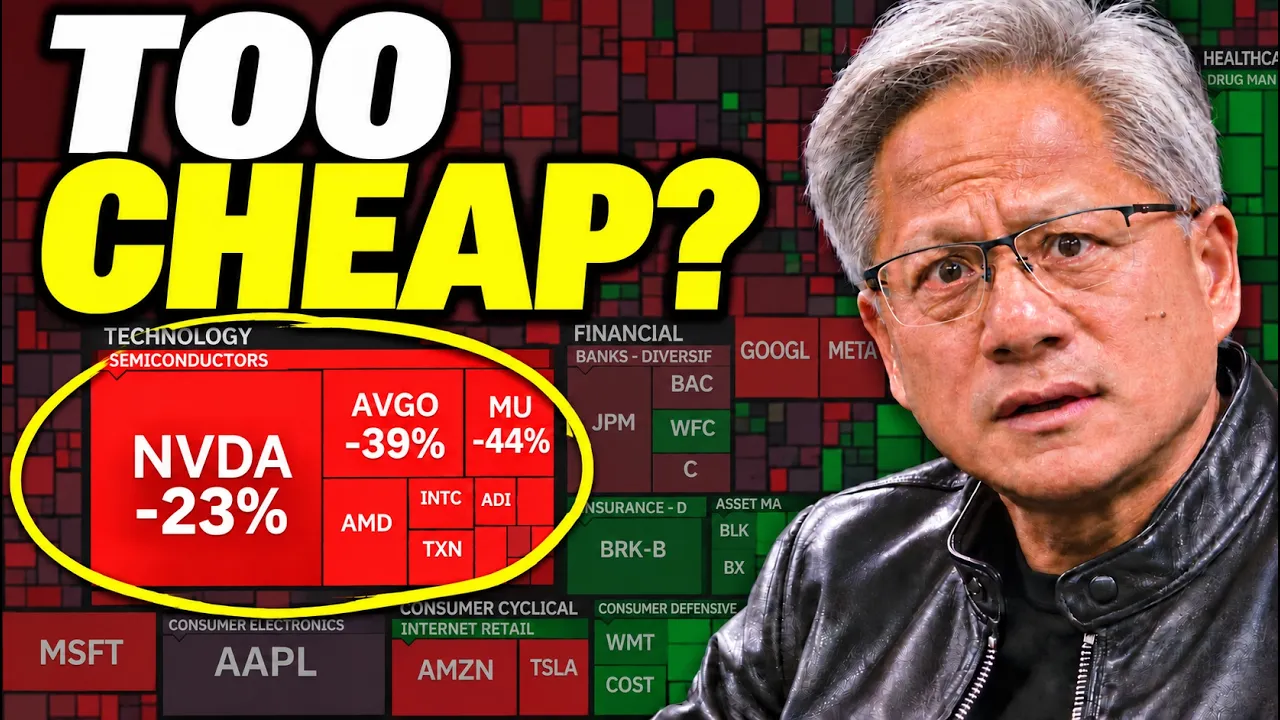
Look at this. In the last few days, Microsoft and Amazon, they've been flying. But Nvidia and Micron are falling. If you own these AI stocks, yesterday probably felt very different from the market rally that everyone was talking about. And this also goes beyond one bad day. Some of these companies from their highs, they've lost a third of their value or even more. The question now is whether the lower prices actually make these AI companies worth buying today. I mean, we've got one of them that trades at less than five times next year's estimated earnings. That looks ridiculously cheap, but there's a reason I won't automatically put it above Nvidia, and we're going to work through that. And another business that's growing incredibly quickly, yet my valuation still comes out below the share price. So, today I'm comparing eight stocks, then ranking where I put fresh money and where I'd wait. And let's kick things off with Nvidia. It was trading at $200 the close of yesterday. In the early session, we can see it's below sitting at $197. But the earnings forecast, they're much stronger than they were a few years ago. It changes what we're paying today. I mean, look, year to date, they're up 7%. Over the last year, they're now flat, which is incredible to say for such a company that over the last 5 and 10 years has been doing very, very well. I mean, it's even heading towards 52-E lows. And we can see a double strong buy both from Wall Street and Quant. Seek Alpha though they do believe a buy but definitely on the weaker side where Nvidia's revenue per day has gone from roughly $200 million. We're talking October 2023 to more than a billion in the latest quarter. It helps explain my interest in Nvidia. The business has grown substantially while we're seeing quite a significant pullback in the share price. Same thing when we look at the operating income that's increased as well. Now, solid bars, they are the historical figures. Hatch bars, they are forecast, but you can see the projections. They're only expected to increase at a continued rapid rate. And for the year ending January 2027, analysts are expecting earnings around $930 per share. Following year, January 28, that sits just shy of $16. It's why the earnings years matter so much here. At today's price, Nvidia is trading at a forward valuation of 16.7. Just look at their 5year average that sits at 35. It's also the cheapest Nvidia's been valued in the last 5 years and probably even further before. And if you want to see the blue tunnel from Simply Save Dividends highlighting the fair value, while the share price, we can see it's significantly lower than the bottom end. That's an indication of a potential severe undervaluation signal. I mean, it's as close to zero as it is in fact the bottom end, which is around $400. just telling you how much of an opportunity there could potentially be. Now, one thing I'll say as we will look at these consensus earnings across the different stocks today is bear in mind the further down you go there is a lot less coverage. I would really only take comfort in at least the next three years where we can see quite a significant number of analysts. Now, my DCF model which does follow analyst targets from 2027 to 2030 assumes $150 billion of free cash flow. Now, to be honest, I'm being quite conservative here. Analysts do project for Nvidia, at least for 2027, to be higher than this figure, 250 billion. That's where they see free cash flow in 2030 where we have a a 9% discount rate followed by growth of 15%. Bear in mind, most recent year, 59%, the 10-year KGA, that's 59% on an annual basis, 5year even higher. And it brings us a value today. $255, 28% upside implied with a margin of safety sitting at 22%. Attractive definitely, but it also depends on that cash generation. For example, if we're to look at the bare case here reducing to 10%, we get a value of $26. Now, that's not too dissimilar from today's price, but also factor in the 10% here still uses the free cash flow assumptions all the way to 2030. So lowercase still assumes substantial business growth. Now Wall Street their average price target is does sit higher $327. I just treat this as another opinion. It doesn't replace checking whether the business can generate the cash needed to justify today's price. Now the main risk for Nvidia is that this earnings path it just ends up proving to be too optimistic. If spending slows, orders move out or customers become more cautious. the apparently low future multiple it won't provide the protection that currently it seems to be offering for me Nvidia makes the buy candidate list the business has grown into much more of his valuation whether it deserves first place it depends on how much growth the other stocks require for the upside we're about to see which brings us to Palanteer this is an important comparison because the operating performance is excellent but an excellent quarter and attractive entry price they're two separate things as the valuation is going to Now, not only were they down yesterday 2%, they're now sitting around $167. Also down 2 3% in the early session. Year to date, down 3.4%. Over the last year, down 10%. If you've been a long-term shelder, well, still very, very strong performance. And it's trading around the midpoint of the 52-bit range. Very weak buy rating from Seek Alpha with a more respectable buy from Wall Street. And just in that latest quarter, revenue was around $2.3 billion split between commercial customers and government. And look at the profit flowing through the business. This is very different from a company growing sales while also losing money. I mean, their operating profit that's moved above a billion dollars for the quarter. So when people say Palanteer's valuation is high, that shouldn't be confused with saying the underlying business is performing badly. It clearly isn't. where when we move to the net dollar retention, it's another strong part of the story. At 165%, existing customers are spending substantially more. It's valuable because growth isn't relying entirely on finding new customers. And look, we can also see commercial revenue becoming a bigger part of the mix. It gives Palunteer another route to growth alongside government work rather than leaving the whole investment case tied to just one customer group. And the cash flow, that's real. The trading figure here has reached over $4 billion. It's a major improvement. The next question is how much of that future improvement the share price today already assumes. And the nearer earnings estimate that's around $1.70 then expected December 27 to be around $2.50. We're paying roughly on 26 numbers a forward P over 100 times or around 6970 based on 2027 numbers. That's a very different starting point from Nvidia Palunteer. They may deliver fantastic growth and still produce a disappointing investment return. If investors eventually decide they want to pay a lower multiple for the earnings today and my model as per analyst targets for 26 starts with $5 billion of free cash flow, then it assumes 25% on the middle basis. I don't think anyone can call that a pessimistic assumption. It already gives Palanteer considerable credit although fair play to them. three and 5year Kag looking very strong. Free cash flow was up 82% in just the most recent year. But even with that growth, the result is $155 and that's below today's price of $167 indicating no margin of safety. Still a premium of 8%. So the selloff is improved the valuation, but it hasn't automatically created a margin of safety today. And you can look at this sensitivity table. It explains the disagreement. 20% growth while a much lower value 30% growth while 212. So just a relatively small change in sustained growth for pounder it makes a very large difference. Now analysts they're a lot more optimistic. Average price target $218 implying 27% upside is possible but to buy today personally I need enough confidence in the growth to accept the valuation that I'm actually paying. Now, for me, for Palanteer, I'd wait for a better entry or stronger evidence supporting a higher valuation. That's my view on fresh money. Simply holding an existing position is a different decision from choosing this over today's alternatives. And before the next stock, we also need to deal with this split in the market. Because if the biggest AI customers are rising while their suppliers fall, investors are clearly questioning something beyond yesterday's earnings. We've got one explanation and that is tighter restrictions on new data centers could help companies with capacity already in place. Their existing infrastructure it becomes more valuable while suppliers face uncertainty over how quickly the next projects proceed. This would explain why buyers and suppliers can move in opposite directions. Steve Wise makes that argument in this CNBC discussion. Listen to what he's saying about spending because it affects the forecast that we're valuing today. market is seeing the Democratic victory as forced control on capbacks. So in other words, they won't be able to spend what they committed to spending if there's a moratorium for any period of time on new data centers, particularly in Texas where 30% of all projects are. So and if you look at this exactly what the market's telling you, it's not telling you all clear. It's telling you that we want to go back into those companies because they will be what they used to be, not what they are now. Which is why you've got Nvidia down, which is why you've got Taiwan Semi down, which is why you've got all the providers in the supply chain taking on gas today and the hyperscalers, which buy from that supply chain doing well. That's his interpretation of the market reaction. Now, compare it with actual spending. These four companies spent more than $200 billion on property and equipment in just the last quarter. The investment already happening is very substantial. The uncertainty that's over future spending and the timing of new capacity. I wouldn't turn an election result into a guaranteed collapse in AI demand. But I also wouldn't assume that every planned project proceeds unchanged. Now look, there's also broader rotation as well. Through the end of October, equal weight was ahead of the standard S&P 500. Investors have been finding opportunities outside the largest technology companies. Meanwhile, we can see the NASDAQ's forward earnings multiple near its lowest level in 4 years. It's a lower price relative to expected earnings, but it also doesn't tell us whether every earnings forecast is really reliable. And then we've got semiconductors. They also trade at a discount to the wider market. For us, the job is checking which companies can sustain their profits because a low multiple on temporary earnings that can be misleading. And SanDisk is where that question becomes particularly interesting. The stock has fallen more than half from its high yet the earnings multiple looks exceptionally low. Let's see what has to hold up for that to matter. I mean, it was down 8% yesterday in the morning session. I mean, it's already down around 6%. Now look, year to date, it's done phenomenally, up more than 300% over the last year, up more than 400. But this was a company trading not that long ago, above $2,300. We still get a strong buy from Quant. Wall Street pretty much at that 4 and a half for a strong buy. Seek Alpha also a buy, but weaker than the other two. Data Center revenue that's increased dramatically. The latest bar, October 26, that's at $4.8 billion, up around 3 billion from the previous quarter. It helps explain why the earnings forecast, they've just risen so sharply. And the forward earnings multiple, well, that's sitting at 4 and a half. The other valuation measures, they're all so low as well. I can see why that catches people's attention, especially after such a large fall in the share price. And the margins we can see here, 85%, that's the gross margin. When they're this high, I want to understand how much pricing strength the valuation assumes will ultimately last for the company. I mean, look, analysts, they're expecting earnings of roughly $228, then $287. If these estimates are delivered, today's price looks very low relative to the profits that are being forecasted. Now, look, the price chart that we have is a useful reminder though that Sandex is still substantially higher this year despite falling so far from its peak. A last draw down. Honestly, it doesn't mean we're back at the starting point. Now, my model assumes 18 billion of annual free cash flow for 2027. Analysts, they actually forecast it significantly higher. So, I would say it's conservative in relation to what they're predicting doesn't mean what they're predicting is actually accurate. And then I've used the lower rate here sitting at 0%. So, keeping it flat over the longer term. That's the ongoing assumption. But the level of cash flow, that's what matters here. Now, that gives a value of $1,700, indicating 72% upside, a margin of safety of 42%. Now, it's important to reiterate the qualification here. The forecast of $18 billion, it starts well above the historical value of 9.3 billion. So, zero subsequent growth, it still assumes a much stronger level of profits and cash generation, which is ultimately expected to be sustainable for many years. Now the data center growth gives us a reason to consider that possibility but I don't want to take the steepest part of this chart and just assume the conditions continue indefinitely. That's really where the risk sits for SanDisk. And don't read these distant earnings decline as a firm consensus coverage. As we highlighted earlier, it drops substantially further out. The near year is pretty much 27, 28, and 29. They have many more analysts behind them. And you can see very bullish in terms of Wall Street in their forecast. Their average analyst target is roughly double today's price. It adds to the interest, but leaves the sustainability question unanswered. I want the cash flow case to work without relying on the target. And we also have news the split adjusted trading is expected on November 20th. Each share becomes eight and the price divides by eight where more importantly the total value of your holding that stays the same. So sandisk it makes my higher risk buy list. I like the valuation opportunity but I want a position size that allows for earnings volatility. I'm not going to give it first place simply because the multiple is the lowest. Now ASML it gives us a different comparison here. of the attraction is the quality of the business and its role in manufacturing advanced chips. The question is whether the pullback has created enough room in the valuation. I mean it was down 4% yesterday already down over 2% just in the morning. Now it's already up year to date 40% over the last 5 years up around 76. Not too bad around the midpoint of the 52- week range with just one strong buy. That's from Wall Street seeing Alpha much weaker in terms of the buy rating. And the latest quarter shows sales of roughly 11.7 billion euros and a strong gross margin. Next part that's guidance. So obviously we need to distinguish what ASML's delivered from what management is expecting. And one thing I talk a lot about ASML is the service revenue. I like that as the installed base grows, ASML earns money supporting and upgrading those machines. It gives us another part of the business to consider alongside sales of new equipment and revenue increasing over time forecast estimated further growth. But they still depend in terms of the forecasted bars on customers investment plans. Even a very strong competitive position. It doesn't remove the timing of the spending cycle. Now earnings estimate they rise from $4642 to $63 and then to 86. That's significant expected growth. But we need to check how much the share price already gives ASML credit for delivering today. And we've got the chart here. ASML is below the historical forward multiple 22.8 against 32.2. In fact, nearly as cheap as the lows we saw in mid 2022. Useful context, yes, but a cheaper multiple than its own average is never enough on its own. Not in isolation. The cash flow valuation still needs to support the purchase. Now, I've used 15% annual free cash flow growth, 9% discount rate, again, consistent, 3% terminal growth, also consistent. That gives us a value of $1,543. Now, we're talking 4% upside margin of safety, yes, but fairly trivial, around 4%. So, this looks close to fair value than a heavily discounted opportunity. If we look at the sensitivity going to around 10% value falls around $1,100 at 20% $2,100 it tells me the business need to live a strong growth to make today's price particularly attractive and the share count FSML it's moved down over time as well helpful for remaining shareholders but a roughly 10% reduction over the period it's supportive rather than reason to ignore the purchase price now Wall Street they do see considerably more upside than my central model. I can understand the optimism. I just don't want to adopt the optimistic valuation automatically because I like the company and the share price has fallen. ASML, it goes on my weight list at this price. I want a larger discount or evidence supporting a stronger cash flow forecast. Is a business I'd like to own at the right valuation. Micron, well, it offers more apparent upside, but brings us back to the earning cycle question. After a large pullback, the multiple looks very low. We need to look at what's happened to the profits behind it. Year to date, still up 179%. That's after the 7% drop we saw today. Today, at least in the early session, doesn't look like it's going to have a great day. Down over 5% over the last year and last 5 years, done incredibly well. Up a,000% in fact, trading midpoint of the 52- week range. Quite some way from all-time highs at $1,255. Double strong by Wall Street Quant seeking Alpha with a weaker buy. and revenue that's accelerated enormously. The latest quarter is above $54 billion changes the scale of the business. It also explains why the old earnings numbers, they're not as useful on their own. And not only revenue, but net income that's increased sharply as well. So the lower earnings multiple reflects both a falling share price and much higher profits. That combination can create value provided the higher profits prove sufficiently durable. And for Micron, this is the chart I wouldn't skip. Gross margins have moved from deeply negative to exceptionally high. So Micron's demonstrated both sides of the cycle. We shouldn't value it using only the strongest end. And you've got analysts. They're forecasting here $177 of earnings in the near year with further growth after that. At the current price, the earnings in the short term, well, they're sitting below five. You've also got longer contracts supporting the argument for more durable earnings. They can improve visibility compared with selling at short-term prices. But the pricing terms matter and contracts alone won't eliminate the earning cycle. We've also got the forward multiple below Micron's historical average looks attractive. But remember, when earnings are usually strong, the multiple can look cheapest before profits weaken. The margin history, that's why I'm careful. And you can also see on the blue tunnel, like we saw with Nvidia, massive, massive disconnect from the share price today. and even just the bottom end. Now, my model starts with $75 billion of free cash flow, assuming 5% growth. We've gone for the low one today. Growth rate does look modest, but again, remember, sustaining the high starting level of cash generation, that's the bigger assumption, gives us a value of $1,300, indicating 63% upside, margin of safety of 39%. potentially very very large upside but the cash flow assumptions they do deserve more scrutiny than the headline number even on a 0% basis if we just plug that in today so no growth over longer term it gives us a value of $941 indicating upside still margin of safety coming in at 16% holding a peak level flat though that can also remain an optimistic assumption the real test is how far cash generation could fall if margins normalize the history shows why want the stress test the downside it isn't captured just by reducing a positive growth rate slightly and the analyst target higher again I wouldn't use that again as a reason to buy the stronger argument is whether the current price leaves enough room for a less exceptional earnings environment than today Micron it makes my buy list with more earning cycle risk than the multiple loan suggests I'd be interested in building gradually I'd also avoid treating Micron Sandis as completely independent bets on the AI buildout Marvel that adds adds another complication. The stock has fallen dramatically. But there's also a major acquisition to assess. So, we need to separate the opportunity in the existing business from what the combined company might become. Year to date, they're up 88%. Bear in mind this one not long ago it was trading around $330 where we see in fact strong buy from Wall Street. Pretty much on the cusp of a hold from Seek Alpha down 7% yesterday, down 5% so far today. And the proposed momentum combination is a huge part of the story. The announced enterprise value was around $115 billion. It's an all stock transaction. So the consideration changes with Marvel share price. And look this chart very important. Lmentum shareholders would receive 4 and a half Marvel shares for each share they own. So the value of the offer it moves as the buyer shares move. And there are also two revenue streams to consider here. Bringing them together could expand the business. But we simply can't add the revenues and assume every dollar immediately creates more value for each existing shareholder. I mean the new shares issued, they're part of what shareholders pay for the acquisition. A larger combined business needs to generate enough additional cash to justify that larger share count. That's the calculation that I care about. Now analysts, they're expecting earnings around $422 and then 734 by Jan 2028. substantial growth, but these forecasts need a consistent basis before we use them to value the eventual combined company. At around $160, that's roughly 22 times the second earnings estimate, but the acquisition changes what shareholders own. So, I wouldn't apply that multiple blindly to the future combined business. And we can see the forecasted bars. It shows the scale of growth investors are considering. I'd want to check the timing and assumptions behind both companies figures, then bring those together with the cash cost and the share issuance. And we've also got the scenario table showing how much the outcome depends on future performance. Integration, margins, and growth can all change the result. A deal being large doesn't make automatically good, automatically bad. Now, analysts, they see like with most stocks today, in fact, significant amount of upside, but the range very, very wide. Understandable given how much is changing. I'd want a valuation. I can follow through to the combined cash flows per share. For now though, Marvel is a watch list stock for me. I'm not comfortable putting a confident combined company price target on it by applying the old share count to a much larger future business. Now, that could change as the numbers become clearer, but today we have other candidates where the relationship between the business cash generation and valuation is easier to assess. I don't need to force a purchase here. And TSM is one of those candidates. It's fallen around 19% from its high. The opportunity less dramatic on the price chart but the nearer earnings valuation it gives us a strong comparison. It was down over 2% yesterday. We can see down around 3% this morning. Year to date still very strong over the last 5 years very strong up 236%. Although now on a pullback midpoint of 52- week range all-time highs $487 double strong buy quant much weaker buy from seeking Alpha where earnings are expected to rise from $17.50 to $23 and then almost $30 by 2028. It gives us a clearer growth path to compare with the price we're paying. And at around today's price while the forward earnings is sitting just below $18 is considerably less demanding than Palanteer. Although obviously they're very different businesses with different risks. And we also see the undervaluation signal from the blue tunnel. Very rare to see for TSM. In fact, to note it, you'd have to go back to around 2025 than 2023. And when we look at their margins, it shows substantial improvement over the longer period. The latest quarter is down slightly. So I wouldn't describe margins here. They're not rising every single quarter, but they're still at a very strong level. And both revenue and profit forecasts, they both show considerable growth. Again, they're estimates, but it helps explain the investment case for TSM. Obviously, they need to be earned rather than treated as something that's already been executed. And you can see that same strength when we look at the growth table is not a case where the share price has fallen because every operating measure is deteriorating. The disagreement is over future growth and the valuation. Now, my model starting with 47 billion of free cash flow, then assuming 20% growth moving forward. That's strong over a long period. So we just need to be comfortable with that requirement before we consider buying. Gives us a value $490 implying 27% upside margin of safety around 21%. If we then look at the sensitivity reducing that to 15% value falls to 358. So the base case does require sustained growth is an attractive candidate but the current price already assumes continued success. Now analyst target higher $587. But as always, I'd rather work from my own assumptions accepting a more cautious valuation than buy simply because the consensus target looks very appealing. Now, Taiwan risk also needs to be part of the decision spreadsheet. It can never capture that with one number. It affects the return I require and the size of the position that I'd be comfortable holding. TSM definitely makes my buy candid group. I prefer the valuation cushion here to ASML Central case, but I'm not going to describe TSM as risk-f free simply because it manufactures chips for several successful companies rather than just one. And then we move to Broadcom, the final stock and a serious contender. The share price has fallen substantially while the earnings estimates still point to very strong growth. Let's check how much optimism my valuation already includes. Down 2% yesterday, down more than two we can see today. Year-to- date negative -6 over the last five though up nearly 500% yet trading around 52- week lows or at least in that direction. Double strong buy wall street quant four out of five buy from seek alpha and analysts are expecting earnings to rise from around $12 a share to $19.50 then above $30. That growth is why the valuation changes so much depending on which year we use. And if you're looking on 2027 numbers, well, we can see they're trading below 19. They're on 5year average that sits at 24. So a potential undervaluation signal for which we also notice that when we look at the blue tunnel, look at the last 10 years. Last time it traded in such an undervalued signal. Well, very rare. I mean, you'd have to look really in detail. Potentially a small one around the COVID drop. And if we look at management's AI revenue outlook, very ambitious, we can see showing roughly $58 billion, then 115 billion, then 230. Obviously, they're an outlook, but definitely very impressive if they can execute. And then we've got the growth table reflecting that optimism across revenue and earnings. Gives us a reason to investigate the sell-off, but I still want the valuation to leave room for growth coming in below the strongest expectations. And my model again from analyst expectations kicking off at $48 billion then assuming 20% growth now substantially above the historical figure for 2025 at 27 billion. The valuation is already giving Broadcom credit for strong execution. Then it gives us a value of $516% implied upside margin of safety 38% one of the largest valuation gaps in the comparison today. lower case that matters at 15% 368 still doubledigit upside and for Broadcom their leverage trend that's improved as well helpful when assessing the balance sheet obviously I'd still look beyond one ratio because the financing demands of the wider AI buildout they can affect customers as well as suppliers where this chart is showing us rising credit protection costs across parts of the AI trade doesn't mean a default is inevitable but it does show investors asking for more compensation for risk alongside the weak in share price for Broadcom. What I do is check whether this revenue outlook turns into cash on the expected timetable. Strong demand is valuable, but the funding and delivery of that demand, they matter when we're valuing years of future growth. And Wall Street, their average target, $527, close to my estimate. Interesting, but again, I'd still judge the investment by the assumptions. Two similar targets. They don't make either one of them certain. Brocom then makes my stronger buy candid group. I like the potential return while accepting the model's strong growth assumption. Now, let's put all eight in order. The largest upside is not going to decide first place. And eight for fresh money is Palanteer. The operating performance is excellent, but my optimistic growth assumptions still don't produce a discount at today's price. I'd wait for the valuation to give me more room. In seventh is Marvel. There's an interesting opportunity, but the proposed combination makes the valuation harder to assess. I want a consistent view of the combined cash flows and the share count before committing fresh money. In sixth place, ASML is a business I rate highly, but the central valuation it's too close to the current price for a strong buy conclusion. A better entry that would change the decision. Fifth, that would be SanDisk. The potential upside is substantial and the lower multiple deserves attention. I'd approach it as a higher purchase because the result depends heavily on sustaining a much stronger cash flow level. Fourth place, Micron. There's a significant valuation opportunity with the same need to stress test the earning cycle. I'd consider building gradually while keeping the combined exposure to memory stocks at a sensible level. Third, TSM. I like the earnings valuation and the potential return while allowing for the growth already expected. Taiwan risk is the reason I wouldn't treat the spreadsheets margin of safety as the whole decision. Second place, Brocom. The model gives me an attractive potential return but requires strong growth. I'd build a position allowing for a slower outcome rather than assume the highest forecasts are guaranteed. And in first place, Nvidia doesn't have the largest headline upside. I prefer the balance between its earnings valuation and the growth being delivered. For fresh money across these eight, that's my first place to look. I'd be gradually and keep checking the earnings path rather than buy a full position immediately. If the business develops differently, the valuation needs to change with it. I wouldn't keep defending an old target. Yesterday's market split gives us a reason to review these stocks, not a reason to buy all of them. Some prices now look interesting, others still leave me asking for better terms before adding fresh money. Now, let me know which of the eight today you'd put first and what you need to see before buying. If you enjoyed the episode, smash the like button, hit the subscribe and bell so you're aware of future episodes. You can also click on the pin comment where you can read our weekly articles, sign up, deliver them fresh to your inbox. We cover severely undervalued stocks as well as what's going on in the market. You can click below and read now. More importantly though, have a great day. I'll see you all on the next

Comentários 0
Entre para participar da discussão.
EntrarAinda não há comentários. Seja o primeiro a compartilhar sua opinião!