…D UP GETTING CLOBBERED. THOSE EARNINGS WERE FABULOUS. GOT CLOBBERED IN FABULOUS EARNINGS. The only stocks that rallied of any size, the ones that work in a serious recession where costs come down, but the consumer still has money to spend. Food, drug, think Proctor and Gamble. Wow. Market leader. Colgate. That's not the kind of leadership you want though. You buy those stocks. We think the economy is in big trouble. Is it? Which brings me to the bottom line. If you have a market that can change the stripes usually every day, becomes very hard to have what? Conviction. You just want to throw things away and go ho…
Food, drug, think Proctor and Gamble. Wow. Market leader. Colgate. That's not the kind of leadership you want though. You buy those stocks.
Contexto extraído por IA
The only stocks that rallied of any size, the ones that work in a serious recession where costs come down, but the consumer still has money to spend. Food, drug, think Proctor and Gamble. Wow. Market leader. Colgate. That's not the kind of leadership you want though. You buy those stocks. We think the economy is in big trouble. Is it?
…D UP GETTING CLOBBERED. THOSE EARNINGS WERE FABULOUS. GOT CLOBBERED IN FABULOUS EARNINGS. The only stocks that rallied of any size, the ones that work in a serious recession where costs come down, but the consumer still has money to spend. Food, drug, think Proctor and Gamble. Wow. Market leader. Colgate. That's not the kind of leadership you want though. You buy those stocks. We think the economy is in big trouble. Is it? Which brings me to the bottom line. If you have a market that can change the stripes usually every day, becomes very hard to have what? Conviction. You just want to throw things away and go ho…
Food, drug, think Proctor and Gamble. Wow. Market leader. Colgate. That's not the kind of leadership you want though. You buy those stocks.
Contexto extraído por IA
The only stocks that rallied of any size, the ones that work in a serious recession where costs come down, but the consumer still has money to spend. Food, drug, think Proctor and Gamble. Wow. Market leader. Colgate. That's not the kind of leadership you want though. You buy those stocks. We think the economy is in big trouble. Is it?
Transcrição Completa
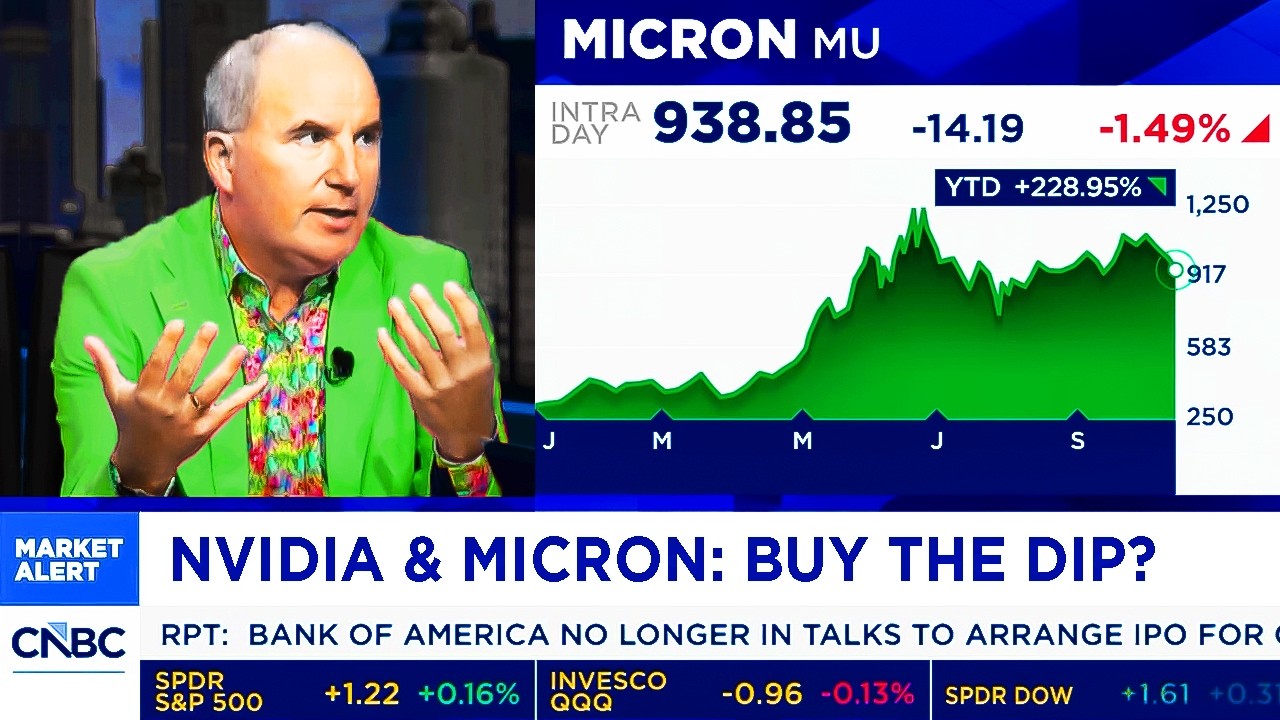
Nvidia is investing billions to build out AI operations in Europe. CEO Jensen Hang addressed reporters in Paris about the European push. >> This is the beginning the beginning of uh AI in Europe. In the last year alone, we have invested $8 billion in European startups and in the next week I'm going to announce another two more billion dollars. And so we're we've invested tremendously in just about every single layer of the AI infrastructure here uh in Europe. And so the next layer above that is investments. These are going to be the the uh the superstar companies of the next generation. What about speculative bubble on high? Are you frightened about it? >> Today demand is far greater than supply and the reason for that is because we're in the beginning of this new industrial buildout. And so we need to build AI infrastructure around around the world. And so demand is much much greater than supply. Someday of course the two will come into balance. Now whether it's 5 years from now or 7 10 years from now which is kind of the the duration of a new technology buildout except this one requires a lot of factories and requires energy and construction and so there are many natural limiters that keeps the industry from building too fast. Um but eventually uh it surely will happen that demand and supply will come come into balance but you're not going to see that in the next several years. >> That was Nvidia CEO Jensen Huang speaking in Paris. And joining us now is DA Davidson head of technology research Gil Laura. Gil based on those comments and everything else that we've seen investment wise from Jensen over the last number of years. Is he singlehandedly ensuring that the AI party keeps going? He has a very big role in it. Nvidia has a very big role because they have so much resources and they're really in the middle of the in the eye of the storm. So what they're doing is they're finding the places where the ecosystem needs to become more robust and they're investing there whether it's it's fiber or new clouds or optical capacity or in this case more geographic diversity for the model companies. Nvidia is finding ways to invest in those places to make the ecosystem more robust and they're really in a position to do that because uh because everybody needs their chips and because they have the capital to do so. But it's it's not that they're driving the wave. What's driving the wave is is AI model consumption. It's companies and consumers buying more uh paying more to use models for uh work and uh and personal lives and uh and and he's just making sure that that capacity is available because ultimately if the capacity is available more GPUs will be sold and obviously the companies he's investing in are more likely to buy Nvidia GPUs than they are competitor GPUs. >> Sure. And also the bonus would be if he actually made a return on those investments. I mean Masayoshi son made a business model of it right and it worked out in some cases extraordinarily well for him. How do you value Nvidia with that included so you know returns on potential investments? >> So the investments they've made have mostly gone up. Uh but that's still in Nvidia's case a relatively small part of their valuation. So we're not sure that we need to give them separate credit for that. What's far more important is that they have been successful in creating this ecosystem. Let's not forget that started in 2017 when he delivered the first GPU to Sam Alman at OpenAI. So he's been doing it for a while and the return on investment is more uh the the more GPU sold than it is markups on those positions. Nvidia's valuation right now is is very pedestrian. They are trading at a discount to the market in spite of the fact that they guided us that even next year right now they're growing almost double. Even next year they're going to grow 70%. So the market is skeptical of Nvidia's growth. That's why you you see Jensen with a little bit of a chip on his shoulder. Uh but if they continue to deliver the market eventually, we'll give them credit that as he is saying the the cycle is now looks like it'll be a 3 to five year cycle at least. He's saying a 5 to 10 year cycle, but based on what everybody else is saying, including ASML this morning, the cycle is likely to continue through 2030 based on what we know now. Yeah, I mean it's funny. It almost feels like Nvidia, you know, right in the middle of the maelstrom is the one company that markets are actually valuing maybe appropriately, right? This selloff that we've been seeing in memory stocks, is it a healthy thing? For example, >> yeah, so the market is of two minds right now. You have Nvidia, Broadcom trading at a slight discount to the market. Memory stocks like Micron and SK Highix trading at a third of the market multiple maybe five or six times earnings while at the same time the market is still giving very high valuations to other parts of the semicmplex the semicap the optical complex most of the other semi and optical stocks are trading like the cycle is going to go through 2030 it's just really those four companies Nvidia Broadcom Micron and SKH that are trading like the cycle is already over. So the market's a little bit of two minds right now. It's the same cycle. If all those other semioptical companies do well, so will these companies, which is probably where the opportunity lies right now. >> Yeah. Gil, what did you think when ASML said it would investigate the possibility of upping its capacity more? It seemed like a responsible comment to me in the sense that maybe they're not sure if this does continue and they've already said they're going to expand capacity and maybe it wouldn't be wise to spend potential shareholder returns right on more capacity if it's not going to be necessary. >> Jensen mentioned that there's governing factors to the growth. ASML is probably the most important one because almost all the most advanced chips are made on ASML UV machines and ASML throughout the last couple of years has really stayed very cautious and very conservative. They keep telling us that they know they can sell a lot more machines, but they're not going to do it because they don't want a bubble to form. They are one of the most important governing factor because there's nobody else that can make those machines. What they actually said this morning was, you know what, we are now so sure we cannot deliver the supply to our customers in 2027 and 2028. So, we're starting to think about expanding capacity because we're starting to get orders well into 2029 and 2030. That's actually very positive and it's consistent with what everybody else in the ecosystem has said. Yeah. other semicap companies, other semic companies, the hyperscalers and the model companies. So all we're hearing from the companies is very positive outlooks, very good visibility, but the market is very jittery right now and every negative data point is what the market is clinging to. >> Well, here's one Gil. You told the Professor G the Prop G podcast that Cororey stock could literally go to zero. Investors could lose everything on this stock. Is that true of all of the neoclouds or is coreweave a particular case? >> The topic here is leverage, right? So what's important to note is even if I am optimistic about the cycle and about the use of of AI, that doesn't mean there's not bad behavior out there and borrowing at very high interest rates in order to build data centers that are increasingly commoditized outside of the hyperscalers may not end up being a good investment. And if Cororeweave is boring at 9% and the best return they can get off of that is a 5% return, it doesn't matter how how much they scale. They're destroying value at every turn. And that's especially true for the type of NeoCloud that funds their entire investment based on debt. So there the more leverage we use to build data centers, the more risk we're bringing into the system. I don't know if you saw the FT report that Corby is actually chasing insurer capital now as well and it's looking for cheaper ways to continue funding this spending. It wants better ratings to open it to more investors. >> That's because they've run out of the ability to borrow even at 9%. That is a very concerning factor. And again, I think that's the broader topic here is that um the the buildout as long as it's governed at a good rate and we're using cash flow to invest in it and we understand that it's speculative, it's one thing. But if if if we're going to continue to chase capital 9% and above, that capital will stop being available at some point. But again, back to what Jensen has said, that is a governing factor. Yeah, >> we are not inflating a bubble as quickly as we could be because the capital markets are going to regulate that and we're not going to continue to lend at these rates. There's a finite amount of risk capital that's available to lend to build out data centers and hopefully that keeps the growth at rates that can sustain through 2030 which again is the best outcome for all this ecosystem. >> We now want to bring in Yorkville Ives Dan Ives to talk more about some of the pressure that we're seeing in technology today. Dan, always good to see you. >> Great to see you, Frank. Thanks. >> All right, you just came out with a note saying there's some some jitters about the AI buildout. I mean, we're certainly seeing in names like Cororeweave and also Oracle, a name that you cover. Um, break it down. Is this just about higher yields because the yields aren't as high as they were just a few weeks ago. Why today are we seeing this kind of pressure? Yeah, I mean clearly core weave being sort of the poster chop what we're seeing in terms of nervousness but Frank I think it just comes down to the worries like our yield is that going to constrict the data center buildout are you seeing cracks in the armor and I can tell you I'm here in Korea from a memory perspective it's accelerating I mean significantly where I don't even think we have equilibrium demand to supply till late 2028 early 2029 so I just think this is a white knuckle moment market way overreacting and I think we're going to get through earning season and that's going to be the calming force because what you're going to see from the hyperscalers and ultimately the chip players and the demand you just cannot ultimately deny. >> All right, so spell this one out for us Dan. You're saying the hyperscalers are going to kind of answer some of the questions that people have about the AI buildout. What are you expecting from these reports? Is it simply just beats on cloud? >> Yeah, Frank, I think it's a put this as pieces of a puzzle. If memory stocks and what we're seeing from a chip perspective demand 13 to1 hyperscalers we think we've seen a 30 to 40% acceleration sequentially in terms of deals and as that comes out especially Microsoft you with Amazon Google that's just another piece of the puzzle that then will be answered further with the palunteer the snowflake the use cases because it just goes to our point we're less than 5% through terms of companies going down the AI strategic path And I get the nervousness in yields and what we've seen with core and you know and what the debt market's telling you. We assume 5 10% of the data center don't get built. You then still have a thousand data centers getting built and that capbacks wave. I think that's really going to be the driving force and why you continue to be super bullish here in these names. >> All right, I want to talk about the Mac 7 specifically Apple very close to an all-time high $5 trillion market cap. That's certainly a bright spot in this market. How critical are the Mag 7 to maintaining this bull market that we just celebrated a 4-year anniversary for? >> Their hearts and lungs. I mean, I think big tech ultimately is flexing the muscles again, not just on hyperscape, but we see from Nvidia and others. But when it comes to Apple, it's a good example. I think we've seen with Meta as well, the golden install base, and they could be late to the AI party, but they are going to be a toll collector on the consumer AI revolution. And I think that's really what Turnis is going after. And I think investors are recognizing. I think when you look at Meta and Apple in particular, you can't count them out because the install base is at the epicenter just like what Meta is doing with Muse. I think these are both names that are going to significantly outperform over the next 6 12 months. >> So you're talking a lot about the sentiment right now. You you believe at least the fundamentals are very different than the sentiment at least today. You know, sometimes you see a knee-jerk reaction in the markets after a hotter than expected print that leads people to believe that the Fed might hike once, maybe twice. But I also want to go back to some of the action in the market. If you look at ASML, uh they put out guidance. They have orders all the way through 2030, and you didn't see a positive response there. Also, we're going to have a guest coming up later. He believes some of the action in memory stocks is tied to short selling. So, there are people in the market that don't have confidence in chips, and I think chips are kind of a leading indicator. So, I mean, if you disagree, please tell me. But why do you think so many people are betting against chips and this this critical part of this AI buildout right now? >> Yeah, look, great points, Frank. And I think so many have been skeptical in this AI revolution build out the last 3 years. Now, that's maybe accelerating here, but it comes down to we're here in Korea. I see it front and center what the memory players are seeing. Demand is accelerating a point that you never even could curve your arms around relative to demand. But it needs to be ultimately earnings and demand as that comes through. You can't deny that. And I think a lot of these stocks are disconnected in a way where the fundamentals are accelerating and the multiples are ultimately retracting. And I think they're trading like cyclicality. Investors are snake bitten. But that creates opportunities from memory, from SK and others, the chip, Nvidia, and what we're seeing on the hyperscalers. These are buying opportunities, not the time to wave the white flag. >> You know, Dan, it's so funny you mentioned that. So you're in Korea, huge retail investor culture there. Here in the US, it feels like the retail investors cooled off a bit. Is this a dip that you think retail can buy and maybe potentially change some of the momentum in the market that we've been seeing. >> I think this is going to these are the moments these white knuckle moments is where you buy the winners and you buy the stocks. I could go back to the fictional SAS apocalypse, the circular financing concerns, and then you look what's happening with software and such. That's the opportunity right now for memory chips and what we're seeing even when you core weave nebus and others we will sit here two months from now three months from now going to year and looking this was an opportunity not the time to panic >> but I really think within tech frank this goes back to where Dan is right now is is in South Korea because the Cosby has been weak since last week and I think the Cosby's down and the memory names are down about 12% over the past five or six days you now have the Cosby under the 200 day moving average which is very heavily memory constrained and we continue to see this spill over when the cost being the memory names in South Korea sell off our names start to sell off and then couple that with rates inflation and midterms and we're just in this this type of market right here but I do think this is going to be an opportunity to add to those names because as you and Dan were talking about the hyperscalers the cloud growth which is huge parts of Google Microsoft and Azure Those are looking to be growing at 55 to 56% over the next two quarters. Those are big numbers that we're going to continue to see. And so I do think that's going to be a really stabilizing factor within tech specifically within the hyperscalers cloud growth. >> But it is safe to say that the free fall in core, yes, NeoCloud is freaking people out. It's a big company, a lot of debt. It's a data center operator with so much debt, some of which has now become distress debt, that it's dragging down the whole group and maybe the entire market. It's so ugly. Corweave CEO Michael Intrader says his employee told his employees that he blames the stocks more than 15% decline on the market acting irrationally. Hold it just a second. Good to know. But markets can stay irrational for longer than you can stay solvent. Not reassuring. Won't tech earnings save us? They have in the past. Nevertheless, ASML, the gigantic Dutch semiconductor capital equipment maker, reported a terrific quarter this morning. Talked about rising demand, much better than expected. When I got up this morning, the European stock was up a couple of points. I thought it might counter still one more day bad day for the Korean the Cosby, the Korean index that I've been talking about nightly SKHIX, the lynch pin of AI Harbor was down about five when it came out. I thought ASML might be able to counteract it. Wrong. Instead, SKH fell another four. So ASML reversed and ENDED UP GETTING CLOBBERED. THOSE EARNINGS WERE FABULOUS. GOT CLOBBERED IN FABULOUS EARNINGS. The only stocks that rallied of any size, the ones that work in a serious recession where costs come down, but the consumer still has money to spend. Food, drug, think Proctor and Gamble. Wow. Market leader. Colgate. That's not the kind of leadership you want though. You buy those stocks. We think the economy is in big trouble. Is it? Which brings me to the bottom line. If you have a market that can change the stripes usually every day, becomes very hard to have what? Conviction. You just want to throw things away and go home. That's happened time and again since the do peak in 2000. Throw them away and go home. If you do though, let me ask you something. Will you be able to buy them back in time for those 10 glorious days of the year when all the gains are made? I don't think so. I say stay in the game. What? Sometimes it's as simple as thinking about what people will pay for a given stock and what they won't pay for because it's too expensive or the prospects aren't even as bright as most investors think. You can see this most dramatically in the stocks in the technology sector which is the largest segment in the S&P 500. Specifically, I'm talking about the contrast between hardware and software and the price journeys multiples we will pay for them. The thesis for more than a year was simple. AI represents a new industrial revolution. So we're going to pay more for the stocks that help that revolution along and pay less for the stocks that are standing around doing nothing. That's why we went wild with memory place and seagate. They're essential for the data center. We decided to raise the price earnings multiple for stocks like Micron which is chronically low valuation stock. Remember in how to make money in any market I explained the importance of the PE multiple which isn't talked about enough. And my people will pay more for one stock than another. Oh, we were paying more for Dell because you needed Dell servers to integrate Nvidia hardware into your organization. And we recognized that a stock like AMD deserved a premium multiple because it had both GPUs and CPUs which would be beating hearts of AI and Aentic AI respectively. And that's how Dell could go from 110 in January to 595 at its highs last month. That's how AMD could go from $188 in March to 658 by last week. Now we're finding that maybe these moves were too big too fast. While hardware was roaring, Wall Street decided that enterprise software would be turned to roadkill under the wheels of Claude and Chatt. Who needed Viva Systems which had the leading software platform for critical trials when it was doomed to be displaced by Claude, right? So a $300 stock it's cut in half. Same thing happened to service now. Everyone assumed it would be rendered obsolete, but GBT. The stock goes from 193 to 81. Nothing was rougher to watch than Salesforce with a per seat business model that seemed to ignore AI. So that stock finishes last year at $264. Then it goes all the way down to the 160s 6 months later and we just covered workday. Stock went from 247 to 110 6 months. But that whole dynamic disappeared and has switched ever since the summer. We decided suddenly that we were paying too much for that hardware and too little for that software. So, we begun to savage the semis like SK Highness, the largest memory chip company which dominates the Korean exchange and is now coming to dominate our own since it listener. The earnings aren't being crushed. In fact, semidor capital equipment maker ASML reported fantastic last night. Yet, it stock was down slam. The memory chip companies are all raising estimates, but we're paying less for those estimates. The PE multiples are being crushed. PE compression explains this move. not earnings in the enterprise software companies from work data sales force service. Now they've become more involved in AI with a heavy endorsement from the likes of open AI and anthropic itself. Now we're willing to pay much more for their earnings. No analysts have raised numbers for these enterprise software companies at least not yet. So the question is do you need to sell the hardware? Can you still buy the enterprise software stocks? Have the semis with their ever rising prices peaked? Is Dell really done? I think we're seeing a reset and one that simply can't be gamed. I'm going over my chest holdings tonight and looking where there could be more rounds of multiple contraction and multiple expansion. My take too early to call bottom and hardware moves are too violent. But in the end, you will need the hardware to build data centers. All this stuff remains in short supply. The enterprise software companies, they can keep going higher because their stocks never should have been so low in the first place. They want to enjoy the multiple expansion after a year when we expected these companies to be destroyed by AI. It never came to pass. And with the changes they're making, it never will. All right, I hope you're all doing well today and staying calm in this market. Wednesday was a rough day in the market and especially for tech due to multiple reasons. We got a hotter than expected CPI print Wednesday morning as market participants worry about potential future Fed rate hikes. We got strong earnings from ASML Wednesday morning with very positive guidance and forward-looking commentary. ASML once again raised its 2026 guidance. Management expects its planned equipment production capacity to be insufficient to meet customer demand through 2028, and customers are discussing orders for 2029 and 2030. All of that bodess well for AI demand and the continuation of the AI buildout. But ASML's earnings and commentary were overshadowed by other events in the market. What really spooked the market on Wednesday was Core Weeav's bond situation. I'll be straight forward with you in saying that this situation is not good. And at the same time, I do think that many people are leaving out important context when discussing the situation online. So, let's talk about it. Core's unsecured bonds maturing in 2032 traded below 80 cents on the dollar, which is commonly considered to be a warning threshold for distressed debt. Yield surged. Corw's 9.625% 625% bonds due in 2032 are now yielding over 15% versus roughly 13.4% earlier this month. That is indicative of a significant deterioration in credit market sentiment. Again, this is not good and it has implications beyond just coreweave. But now, let's talk about some important context that I think many people are missing. Importantly, yields above 15% do not mean that Coreave is suddenly paying 15% interest on all its existing debt. Core's fixed coupon bonds continue carrying their contractual interest rates, but those elevated yields suggest that investors would demand substantially more compensation to lend Coreweave additional money on comparable unsecured terms. I'll also mention that Core's 2031 unsecure bonds are also yielding roughly 15%. Now, the 2031 bonds and the 2032 bonds that are getting a lot of attention collectively represent about 10% of Core Weave estimated outstanding debt. That's nothing to sneeze at, but it is important to keep things in perspective. It's also important to mention that there's a big difference between distressed bond pricing and evidence that a company cannot meet its upcoming obligations. Many are pointing to Core Weeav's very large backlog, which is important to keep in mind. That said, it's also important to consider that in order to capitalize on that backlog, Core Weave needs to fund its buildout, and it is primarily funding its buildout through debt at this point. Now, my honest opinion is that this is not a good situation. And at the same time, I do think this will be resolved. Some of you may remember me talking about Coreeave in the past when I've spoken about iron. While I have nothing against Coreeave, I said repeatedly in past videos that I prefer iron because of their vertical integration and because their debt situation is very different from Core Weeaves. That said, that does not mean that I'm bearish on Core Weave. I actually think Core Weeave has a lot of growth ahead of it despite the nervousness we're seeing in the market. You also have to consider the importance of Core Weeave to Nvidia both from a customer diversification standpoint and also given Nvidia's investments in core. very seriously doubt that Nvidia would allow Core Weeave to falter and so it's worth considering the possibility of Nvidia stepping in as a last resort if necessary. The core situation is also important for the broader ecosystem as it has implications for those companies access to capital, an environment where access to capital becomes tighter. It's especially important to be selective in the companies that we choose to own. Put simply, I'm personally not invested in core and the company's debt situation is a big reason for that. At the same time, I'm not bearish on Core Weeave and I think they have a lot of growth ahead of them. I expect this situation will eventually be resolved. I noticed the FT published a story about Coreeave wanting to tap capital managed by insurance companies. If Coree could obtain investment grade ratings on more of its secured financing, insurance companies could provide substantially cheaper capital than investors are currently demanding for unsecured bonds. Coreweee is also reportedly examining Nvidia's $500 billion financing initiative that Jensen Hong announced alongside six of Wall Street's top financeers back in August. And so again, I get the concerns and this situation is not ideal. And at the same time, although I don't own a position in Corweave, I do think some of the concerns are slightly overblown. I expect that the situation will eventually be resolved. In other news, the FT published a story Wednesday evening saying that Anthropic's revenue reached $16.8 billion in Q3, which is up roughly 46% sequentially. Anthropic reportedly told investors it achieved an 11% operating margin and was cash flow positive during Q3. Anthropic reportedly generated about $1.70 in revenue for every dollar it spent on compute. If we were to annualize Q3 revenue, that would be approximately $67 billion. But that is not the same as Anthropic September exit revenue run rate. Many AI stocks traded lower during after hours Wednesday evening after the FT story was published. That's likely because Anthropics reported Q3 revenue growth of 46% sequentially is a deceleration from Q2's sequential revenue growth of 143%. A quarter-over-arter deceleration in revenue growth ahead of a $2 trillion IPO as access to capital is getting tighter. That's not an ideal setup in the short term, which is likely why we saw a negative reaction to the news Wednesday evening. That said, it is important to keep the proper context in mind. Anthropics reported quarterly revenue is more than 3.5x what it was just two quarters ago. So, I get the negative short-term sentiment due to the expected timing of Anthropic's upcoming IPO. But at the same time, let's not miss the forest for the trees here. Right now, the market is very nervous with elevated yields, higher oil prices, the upcoming election, access to capital getting tighter, worries about Anthropic's upcoming IPO, and so forth. Because of that nervousness, recent news stories plagued by inaccurate media framing, such as the OpenAI revenue story, the CXM news that was overstated without proper context, Broadcom CEO Hawkan's recent comments about investors that were blatantly taken out of context by multiple media outlets. All of those stories have exacerbated the downward price action on a nervous tape ahead of an important election. During these moments, it's important to slow down, keep the long-term picture in view, and not miss the forest for the trees. This too shall pass. In the meantime, we as investors can be selective in the companies we choose to own. Focus on high-quality companies with improving fundamentals and add to positions in great companies in a responsible manner during a time of weakness. I'm not a financial adviser and I'm not telling you what to do. I'm just sharing some news, my opinions, and some thoughts that I think may be helpful to consider. With the proper mindset of a long-term investor, it's possible to actually look forward to selloffs as potential buying opportunities rather than dreading sell-offs and panicking when they happen. Unfortunately, sell-offs are inevitable in the market. But sell-offs are not the time to panic. As I often say, remember to stay calm in this market. Remember to maintain a long-term perspective and do not make any hasty or irrational decisions. This is not the time to panic. This is the time to determine which companies we want to own moving forward and to determine what the right strategy is in light of the opportunities before us. Proper position sizing is extremely important. It is usually not a good idea to go all in on a stock all at one time. You don't have to buy an entire position all at one time, and you don't have to exit an entire position all at one time. It's also important to not own a position in any one company or sector that is so large that it causes you to get scared and make irrational decisions during sell-offs. Sell-offs are inevitable. If you need help with your unique situation, consider reaching out to a certified financial professional who can help you with your unique circumstance. Looking ahead, Jensen Hong is scheduled to deliver a GTC keynote at GTC Berlin on Wednesday, October 21st, starting at 11:00 a.m. Central European Summer Time. For those of us in the US, that's October 21st starting at 5:00 a.m. Eastern, 2:00 a.m. Pacific. Now, in case you're new to the channel, I want to make sure that you have at least a basic understanding of the underlying long-term thesis. So, let's cover that now. I don't know what's going to happen in the short term, but from a long-term perspective, I am very confident that Nvidia will be worth much more in future years than it is today. When Jensen was on the Lex Freedman podcast not that long ago, he was very seriously raising the possibility of Nvidia becoming a $3 trillion revenue company in the near future. If that happens in the coming years, then it is very plausible that Nvidia could one day be worth tens of trillions of dollars in market cap. That might sound crazy, but that's what Jensen is implying when he raises the possibility of Nvidia becoming a $3 trillion revenue company. I guess the question at that point is what multiple the street will be willing to give Nvidia. I don't know the answer to that question, but I truly do think that Nvidia will be worth much more in future years than it is today based purely on the fundamental growth of the business. Based on everything I'm seeing, the world is still computed and I expect that to continue at least through calendar 2028. In a computed environment, developers will use whatever viable compute they can get their hands on. Today, there are no GPUs that are sitting dark due to a lack of demand. Like there was fiber sitting dark due to a lack of demand at the height of the dotcom bubble. Back then, companies were laying fiber in the hopes that use cases and demand would eventually show up. Today, we are seeing the complete opposite. As I've said many times, when market participants compare this AI revolution to the dot bubble, they ignore the fact that the internet is already here this time. This means that mass adoption of the technology and new use case development at scale are immediately possible. We don't have to wait years for it to show up. It's already here. The world is compute constrained which means there is not enough supply to satisfy demand. New capacity is utilized as soon as it comes online. The hyperscalers are monetizing capacity as soon as it comes online. Each of the hyperscalers spoke about being supply constrained on their most recent earnings calls. Additionally, many of the clouds are building out into contracted demand. They're not blindly building in the hopes that demand will eventually show up. No, they're building out because they have signed contracts and in some cases significant prepayments from their paying customers. This AI revolution is fundamentally different from the dotcom bubble and 2026 will be a pivotal year for the AI industry thanks to the rapid adoption of agentic AI and the proliferation of agentic systems in the world's leading enterprises. The leading AI labs revenues are surging right now. Agentic coding and the implementation of agentic systems in large enterprises are new use cases that are increasing inference demand significantly that subsequently is increasing compute demand. The rapid adoption of agentic AI is why we're seeing an inflection in inference demand. It's why we're seeing the leading AI labs revenues surge. I wish both Anthropic and Open AI were public so the public could see the ramp in their revenues. I think the leading labs surging revenues may be the initial proof point that grabs market participants attention and causes them to realize that there will be a clear ROI on AI infrastructure. I think the leading labs surging revenues will also help assure investors of the longevity of Nvidia's growth since these labs revenues are directly tied to compute. If they had more compute, they would have greater revenues. It really is that simple. Demand is not the problem. The problem is a lack of supply to meet the demand. As I've said previously, I expect the world to be compute constrained at least through calendar 2028, possibly longer. And so, regardless of what happens in the short term, it's important for long-term investors to remain focused on the fundamentals, maintain a long-term perspective, and remember that we are only in the early stages of aic systems being adopted at scale. This will increase compute demand significantly, and after that, the next surge in compute demand will likely be fueled by physical AI. We're no longer talking about digital agents performing digital tasks. With physical AI, we're talking about physical AI agents performing physical tasks in the real world. NVIDIA CFO has called physical AI quote a multi- trillion dollar opportunity and the next leg of growth for NVIDIA. This industry will fundamentally transform society and NVIDIA has positioned themselves to benefit massively. NVIDIA sells the hardware for the data centers where the models are trained. They offer omniverse where the models are taught and tested. And Nvidia also sells the hardware that allows ondevice real-time inference through NVIDIA AGX, allowing robots to have intelligent interactions with the real world, even when they are not connected to a data center. Notice that NVIDIA is taking a holistic platform approach to physical AI, and they're embedding themselves as the underlying foundation supporting all of it. Over 3 million developers are already building on the NVIDIA robotic stack, and this is not getting enough attention. As for production ramps, Blackwell Ultra has ramped and remains in high demand. Vera Rubin is rolling out to customers. Nvidia Gro 3 LPX is in full production. Later on, we're expecting the launch of Reuben Ultra in 2027 and Fineman after that in 2028. We have a clear data center product roadmap stretching into 2028. And Jensen believes that AI infrastructure spending will reach three to 4 trillion annually by the end of the decade. That means Jensen is expecting growing AI demand and an expanding total addressable market underpinning all of this. I don't think we are anywhere near any type of bubble bursting type of event. With all of this in mind, I seriously think that Nvidia still has plenty of runway ahead of it. And I think this company will be worth substantially more in future years than it is today. At least that's my view of the situation. Quick note before I wrap up. All of the compilations on this channel are edited by Finn Vid with original structure and commentary. Occasionally, the same edits appear elsewhere on YouTube. If you're looking for the original version, it's always here on this channel. Thanks for watching Finn Vid. I appreciate your support. Remember to stay calm in this market. Remember to maintain a long-term perspective and do not make any hasty or irrational decisions. With all of that being said, I hope you all have a great rest of the day. And I'm curious to hear your thoughts about Nvidia in the comments below. Please leave a like on this video so more people will see it. And while you're down there, please consider subscribing. It's free and you can always change your mind. Thanks for watching and hopefully I'll see you in the next

Comentários 0
Entre para participar da discussão.
EntrarAinda não há comentários. Seja o primeiro a compartilhar sua opinião!