…he last three years. And the forecast for next year is 75% growth of free cash. So fast forward 3 years, 5 years. If you think it can be even 20 25% kagger in that window, you're talking about trillions of dollars of market cap. So you you you can still buy Nvidia. it it may not feel uh fun because you wish you'd bought it earlier, but I think a lot of investors are saying, "Look, this is still the number one name, doing the most with the free cash flow, generating a lot of revenue. There's a reason why they're $5.5 trillion market cap." >> Well, I I just think about, you know, Buffett, some of those great I they would never trim a position. [clears throat] I mean, they they would certainly change it, maybe rightize it over the years, but they tended to just let these thin…
you can still buy Nvidia. it it may not feel uh fun because you wish you'd bought it earlier, but I think a lot of investors are saying, "Look, this is still the number one name, doing the most with the free cash flow, generating a lot of revenue. There's a reason why they're $5.5 trillion market cap.
Contexto extraído por IA
Yeah, that's really the question of free cash flow, hence the buyback, right? If you believe that they can continue to grow free cash, they've done that something like 190% for the last three years. And the forecast for next year is 75% growth of free cash. So fast forward 3 years, 5 years. If you think it can be even 20 25% kagger in that window, you're talking about trillions of dollars of market cap. So you you you can still buy Nvidia. it it may not feel uh fun because you wish you'd bought it earlier, but I think a lot of investors are saying, "Look, this is still the number one name, doing the most with the free cash flow, generating a lot of revenue. There's a reason why they're $5.5 trillion market cap."
…ned it earlier, but gross margins have been derisked to 72 73%. I think I was nervous that actually they were going to be under pressure more, but I don't think I don't obviously that's not the case. So, it shows confidence, good news, and I like to buy the stock with the company. >> What do you think it means for the stock itself? When we have conversations about Apple, for example, and I said on halftime, they outappled Apple because they had the biggest buyback and now obviously takes that place. But does it put …
I like to buy the stock with the company.
Contexto extraído por IA
They have 13 different contracts with 13 different companies. They can do both. >> I do cuz I think they're going to do about 300 billion in free cash flow next year. So they can do all of these investments in all these other companies. That gives me more confidence in something like a Synopsis or Marll because they're investing 2 billion in each of those companies along with others. So there's that. They get to grow by themselves. They have a whole product cycle set coming. And I think I mentioned it earlier, but gross margins have been derisked to 72 73%. I think I was nervous that actually they were going to be under pressure more, but I don't think I don't obviously that's not the case. So, it shows confidence, good news, and I like to buy the stock with the company.
Transcrição Completa
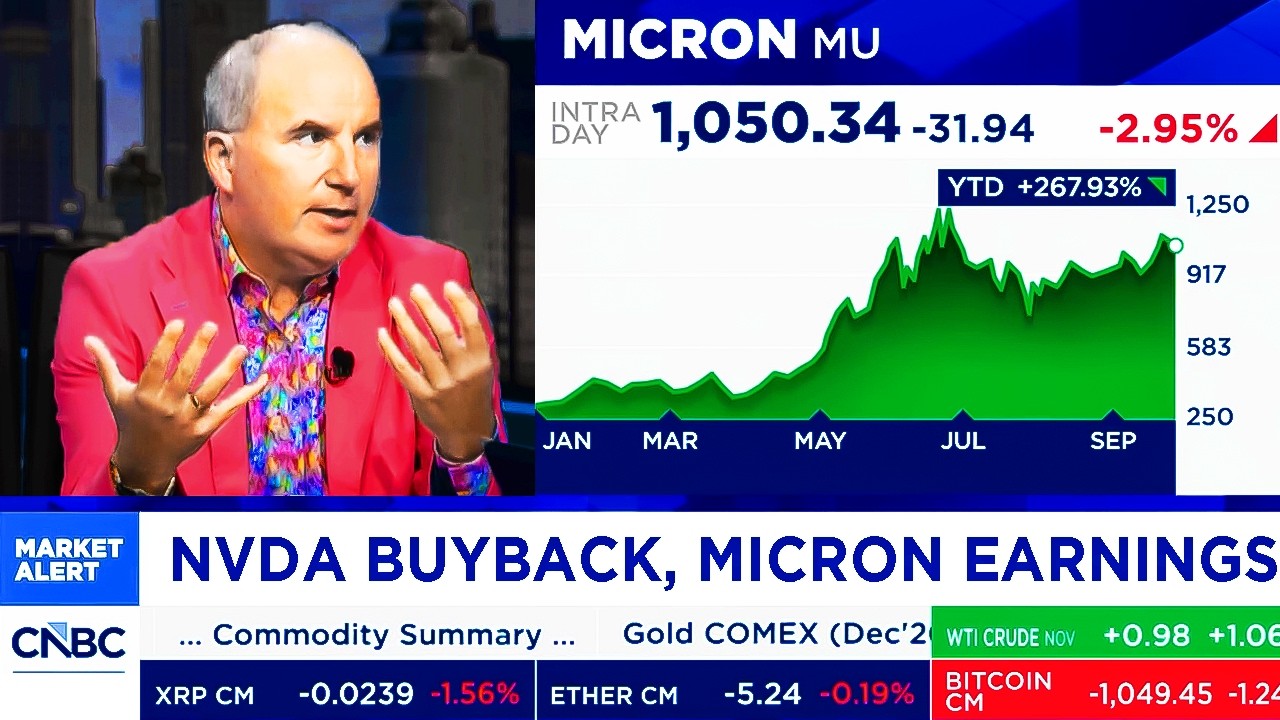
You got to tell me about Micron because they report Wednesday after the bell and you think it's a pivotal uh uh report. >> I do. I think we're going to see 300 350% growth. I people don't realize it but the chips and the memory that they make. They require 10 times that kind of memory in a robot than they do in say an automated car. So this is going to accelerate on a level that I don't think people are prepared for. >> But isn't that already priced into the stock which is extremely uh expensive, isn't it? >> It is. But I don't think it's even remotely priced in. I think this stock in the next couple years is going to double and then some. >> Yeah. Tell it's like an Nvidia. >> Yes, very much so. And isn't it interesting? Yes, Nvidia is the adult in the room now. And I think Micron is going to be in the same position. >> Well, we'll see. >> And to talk some Nvidia, which continues to be the largest position. Um, what could this new line of business represent? And and how does it defend them in a way? >> Yeah, I think it's uh it's good it's good conscience right here. I think you're going to see a little bit of security across the board from hardware, from software, from services, all through the AI stack. It's good to see Nvidia trying to lead the way. There's no question that the um I think some of the concerns around some of these these frontier models getting out of their sandbox has got AI investors spooked. So, the first thing you need to see is the leader step up and that's what I think Nvidia is doing today. Exactly how it works, we're going to have to find out, right? I I I haven't seen any details yet. So, we'll see if it does, but I think it's that's how you do security in AI. It can't just be uh one player. It's got to be all the players, hardware software etc. >> Do you think about Kathy Wood who was on on last week and you know notoriously when Tesla was her biggest position, she would always trim it back to 10%. And do you trim back your Nvidia position or do you just let it ride? >> No, we do. We do. So, in in the focus growth strategy that Silventages, 5% active is largest we can ever be. So, anytime we get to 5% above the the index weight now, the index weight of Nvidia is 15%. So you're never going to see us beyond 20%. But the reality is 2023, 2024, 2025 when this was a new story and new ideas and hyperrowth that was surprising everybody. Sure, we'd let it run up 400, 500 basis points active. Nowadays, it's closer to 200 300 basis points. >> Yeah. I just, you know, it's one of the great wealth generating opportunities of the past few years. And so it's just interesting question. What do you do now? Right? It's easy to write the story in hindsight, but what do the next couple of years look like? Yeah, that's really the question of free cash flow, hence the buyback, right? If you believe that they can continue to grow free cash, they've done that something like 190% for the last three years. And the forecast for next year is 75% growth of free cash. So fast forward 3 years, 5 years. If you think it can be even 20 25% kagger in that window, you're talking about trillions of dollars of market cap. So you you you can still buy Nvidia. it it may not feel uh fun because you wish you'd bought it earlier, but I think a lot of investors are saying, "Look, this is still the number one name, doing the most with the free cash flow, generating a lot of revenue. There's a reason why they're $5.5 trillion market cap." >> Well, I I just think about, you know, Buffett, some of those great I they would never trim a position. [clears throat] I mean, they they would certainly change it, maybe rightize it over the years, but they tended to just let these things ride. >> Yeah. I can't do that. [laughter] >> Yeah. >> No, I think our investors expect uh diligence when it comes to risk control. We know that trees don't grow to the sky to use the old adage. So you you've got to be smart about taking profits when it makes sense. You'll you'll see us do that with all the stocks we own in the portfolio. Multiple sectors, multiple trimming. >> So that kind of out of the way, you know, and it is a fascinating story today, obviously, and it's it's nice to see what they're doing to try to keep this whole AI trade going because they know the regulatory crackdown that could be coming if we keep hearing about these incidents put puts the whole thing at risk, right? Um so possibly an important move in that direction. What about the 10-year? What about Treasury yields? [laughter] Does it matter? >> Not to Nvidia. No. I mean, they're if they're buying back this many shares, uh you you know that there's no issue with cash. Them going to the market um with with with debt. Uh them going to the market really sort of in that obtuse way of investing in their u in in some of their customers as well as their suppliers. They can do whatever they want with their cash flow. The cost of debt to Nvidia is is insignificant. >> Who does it matter to? >> Uh banks, all the financials, right? all the all the interest rate sensitive folks. >> I thought of you immediately. >> I did because I remember these conversations we had right before earnings trying to anticipate what they might announce, whether they would announce a huge buyback. They did not. They announced a big one, >> but today is like the bazooka buyback. It is. >> You told me at the the time you didn't want a big buyback. >> No, I I I'm not going to want a big buyback. Who's going to complain about it? >> I wanted to see growth. I wanted to see revenue growth accelerate and guidance actually last quarter did from 45% to 70% by fiscal 2028. The buyback today is great. It's 4% of their market cap and I like the fact that they have a timeline by the end of fiscal 28. So I think that's really good news. It shows confidence and I'm okay with them doing the buyback but I like the growth. >> Well, and I like the margin. If I recall our conversation, you you said you would rather have Nvidia reinvest the money and continue to spend to grow >> not lean so heavily into a shareholder return. >> But they are >> Is that fair? Now just hold on hold on hold on just tell me cuz I remember this conversation. Is that fair? >> I do too. But they are spending right to grow. They have 13 different contracts with 13 different companies. They can do both. >> I do cuz I think they're going to do about 300 billion in free cash flow next year. So they can do all of these investments in all these other companies. That gives me more confidence in something like a Synopsis or Marll because they're investing 2 billion in each of those companies along with others. So there's that. They get to grow by themselves. They have a whole product cycle set coming. And I think I mentioned it earlier, but gross margins have been derisked to 72 73%. I think I was nervous that actually they were going to be under pressure more, but I don't think I don't obviously that's not the case. So, it shows confidence, good news, and I like to buy the stock with the company. >> What do you think it means for the stock itself? When we have conversations about Apple, for example, and I said on halftime, they outappled Apple because they had the biggest buyback and now obviously takes that place. But does it put a floor under the stock in some respects that if growth slows, they still have a big big buyback to point to to entice an investor base? >> 100%. And if you think about all the numbers they gave us in terms of the guide, you're looking at something like $22 a share in earnings power. That puts this at 13 times estimates. And you just heard SEMA say the long-term average is 36 times. So this company is cheaper. And when I bought it in over the summer, I said to you then, "This stock is cheaper than Hershey's, the multiple." And that's crazy given the growth that you're getting for this company. >> Sure. But when we had this conversation initially and you pointed to Apple having their big buyback, it [snorts] was almost as if you were making somewhat of a point that you do a big buyback like this when your growth is slowing. This is not that case, right? >> Not in any way. >> But you did make that point. Yes, I did because it was true. I mean, growth was slowing at Apple and they offset it by this huge buyback, which was good news, too. But the growth slowing was disturbing to me given the multiple that it trades at. This now is trading at 13 times. They're buying back stock. They're going to see 70% growth in revenues. So, they're doing it all and yet the stock hasn't done anything. This stock is up 21% year-to date, and the socks is up 76% year-to date. That to me does not make any sense when numbers are going higher. >> The analog 2 to Apple is the the issue is the the valuation of that stock for you now >> for sure. >> It's like 36 times >> it is expensive for the growth that you're getting uh and services which is a big margin driver for Apple actually slowed in the last two quarters. We don't want to see slowing because I think that that's going to have implications to margins as well. >> All right, let's bring in Dan Ies. He's a Yorkville Ives partner, senior managing director and analyst. It's good to have you on cuz I I wanted to get your your take as well. I mean your your initial reaction when you saw the number was what >> I think it was a genius move because if you go back to their last earnings I mean that was a blowout quarter and when you look at the buyback I think that's exactly what investors want to see cuz it's this tugof-war between investments a lot of stuff Stephanie talked about and the buyback but it's taken a page out of the Apple playbook and I think they're smart shows further confidence and at the end of the Today they are in the early days like we've said by third inning of this AI revolution and there's only one chip in the world fueling it and that's Nvidia. >> Can you can you speak to the balance of reinvesting versus giving money back to shareholders that they obviously think that they can do both. Steph is the shareholder sitting here as well agrees. >> Yeah. And I think they showed it like Scott they came off a quarter if you go back and the quarter was sort of a shrug to shoulders. Maybe they don't do the buyback, but like we talk about from our Asia checks, demand to supply is 13 to1. So I mean right now it's Nvidia's world that everyone else is paying rent and I think they're in a position where you do the buyback, continue to ultimately do these investments and they are just in such a massive position of strength and I think investors continue to underestimate the scale and scope in terms of numbers going out the next one, two years just way way way underestimate. I think where Nvidia is going to ultimately be. >> What about the other news of the day? The I guess if you want to characterize it as the the agent safety platform. >> I think that's look it's Jensen not just it's not just talking the talk, it's walking the walk because it goes back to all the safety issues. The Dario essay need to slow it down. And I think Jensen came out right away and saying that's not the right strategy. You have to have guard rails around it. And now they're actually putting action right there. But you don't slow it down because no one like no one's going to slow down in the US because everyone understands and Jensen more than anyone else. If US slows down, China's going to accelerate and they win. You put safety guards, you don't go 55 miles an hour in a right lane just for no reason. >> Do you have Steph a reaction to that? That other news that I just asked Dan Ives about? >> I was very positive on it. I mean, it's monitoring everything. It's exactly what we were hoping we were going to get from last week's President Trump and she meeting. We didn't get a lot of detail, but I'm sure it was discussed. And I think it's a super home run for the company that they're getting in front of this. This is absolutely on the on the top of everyone's minds right now is safety. >> It's funny when you look at the cyber related names. >> They're they're up significantly on on this news. What do you make of that reaction? >> Well, they're partnering with them. Crowd Strike and Palo Alto were actually named as well as many other companies. So, I like that they're diversifying throughout a lot of different parts of software to get this product up and out the door f in a very fast fashion. >> Dan, what about the the overall mega cap trade itself, which is back clearly uh in a big way. Maybe not so much today. Nvidia is getting a nice move, but certainly lately it's outpaced the rest of the market. Well, I think it's about the hyperscalers are going to lead it because we see acceleration 25 30% of acceleration of AI deal flow sequentially. So the large caps right now they will flex their muscles and I think you're going to see just massive earnings from not just Microsoft when you look at Alphabet Amazon and others then look at Meta right I mean Meta shot across the bow what they did today in terms of you know trying to get talent from but also just showing that like Muse now they're when you look at the resources that these big tech companies are showing they're not going to be in the background anymore and I think this is an arms race plan now and investors recognize We are going to go into just a massively strong earning season as we go into October. >> Yeah. How about this Meta run? I know it's given back four plus% today, but the run recently has been extraordinary. >> Investors were counting out Zuck and Meta yet again, right? I mean, like we've said, like New York City Cap was bearish on Meta. When you go back to that earnings, they were in look, I think part of it, they were spending money like a 1980s Rockstar and everyone thought they were just spending to spend. Now you look amused. Look what happened. So this is really I think it's a gamecher for AI. It's a gamecher for Meta and it also now they start to monetize that three and a half billion user base. Look at just like Apple they could be late but when you have an install base like that they they're continue to dominate. I think investors continue to underestimate Meta and Apple when it comes to the AI trade. >> I want the world to know that we're this industry has the technology. it has the maturity, has the responsibility to do it right, and we will do it right. And so, so that's number one. I think we're going through um the largest infrastructure buildout in human history. And uh we're we're we're we have the benefit of being a very uh central part of that. We're generating a lot of cash. We're going to generate a lot of cash in the coming years. And um uh you know, every single year as we generate more cash, uh we'd like to be able to return it back to the shareholders. Nvidia's valuation has dropped to a decade low of less than 17 in terms of forward PE on potential concerns that it may not be able to maintain the speed of its profit growth. Joining us now is Millius Research, head of technology research. Ben writes us. Ben, uh, good to see you. Um, I mean, obviously a lot of folks expected that you get a nice bump, uh, in a share buyback. The company's due to make a trillion dollars in free cash flow, I think, over the next three fiscal years. So, this is a good chunk of it coming back, a $235 billion now total buyback authorization. Does that change the picture from an investor perspective? >> No, not really. I I think that it was a signal cuz they're seeing a lot of investors this week. So, they wanted to say, "Hey, look, we're going to be buying at least 40 bill a quarter for the next six quarters, and you can count on us to be buying our stock." You know, there's been a lot of criticism around potential circularity, them investing in other stocks rather than their own. So, this is a good way to kind of get on the road and say we're confident in what we're doing. Um, I think it can get a lot bigger than what they're saying, too, in terms of the buyback long term. >> Do we need though to rethink um Nvidia, maybe this is what the valuation is reflecting, Ben, because you know, Mike cited an interesting stat. It's an eyepopping stat actually when it comes to Nvidia's projected growth. Um, but according to their investment slides, they're they're right now an investor in 13 public companies, 229 privates, and they say the ROI for those entities is three times the amount they put in. Should we discount Nvidia for that, or should we add some kind of premium if they're this amazing investor? Well, I think the thing with Nvidia, look, is uh if you're benchmarking against the Russell 1000, it it's really hard to be overweight this name if you're a long only uh and the dynamics of a company this large getting larger is tough there. I think there's a lot to Nvidia's multiple just in terms of its size and these folks being able to buy incremental shares. I mean, if you get over 15% of your portfolio as a manager, uh, I mean, that that just gets you a lot of, uh, uh, let's just say nervousness and whatnot, and the company deserves to be higher given its growth rate. I think buying back stock in a bigger and bigger way is going to really help it solve that problem and get a better valuation. >> Yeah. Uh, I mean, obviously, it won't hurt. Although I I I would note that the the 235 billion is like 4% of market cap. You know, when Apple announced 100 billion in 2018, it was like 11 or 12% of its market cap. So, uh you know, again, it doesn't hurt. They have more than enough to to make it happen. But the fundamentals, Ben, obviously, you know, Jensen Wong is out there wanting to kind of preserve this idea that we should be kind of going all out, building as fast as as we can. there's no reason to slow down. But if we can do it more safely using in part uh its own platform in terms of guard rails, all the better. Um is this a real uh I guess change in how these these models might behave or is it just a gesture? >> Well, I think that Jensen, you know, has a lot of great points here. He's he's kind of saying, you know, look, uh you shouldn't put out a product if it doesn't work right and if it's a risk. And we have laws in this country that are enforcable. So I I think what's really great about what Nvidia did today is they talked about Open Shell. They had talked about a product like this when Open Claw came out. Now it's really coming of age. And then Sentry where they can shut down agents that are misbehaving. And somebody needs to take the leadership here. And I think not only is Nvidia going to do it, but all the cyber companies that pop today and uh you know hopefully all these guys can make us have a safe environment. I really think what Nvidia is doing is pretty neat with regard to how it gives away software which is kind of like a razor and then it sells the blade in its infrastructure stack. And it's doing that with open models too. By proliferating open models, you actually create a more secure environment because open models can help defend you against rogue agents and AI systems. So, uh, Nvidia's really put a lot of this industry, if not the whole industry on its back and trying to lift it forward. And, you know, no one better to do it than Jensen. I mean, you guys saw his energy, uh, this morning and, uh, I know that, uh, he's frustrated probably about the valuation, but uh, you know, I want to see this. I want I think they could buy back a lot more stock like a hundred bill a quarter in two years. So that that that really is a much bigger portion of their market cap that could really help this thing. >> Yeah. Is Gene Monster, managing partner of Deep Water Asset Management. Gan, always good to speak with you. I mean, it is amazing that Jensen always seems to have a solution to the problem. Companies can't get financing or backing and Nvidia gives them the money. Um, Nvidia wants to make sure its partners have access to capital. They put together a consortium. They want to see AI guard rails without government intervention and they come out with Open Shell and and Sentry. Um, is this just how good Nvidia is? >> I think it speaks to the position they're in. In part, the first things that you mentioned are evidence that they've grown their business. There's a 25 billionyear run rate business four years ago. They'll do 700 billion next year. That affords them the ability to finance some of their customers. What's happened today with this open agent safety effectively is them leveraging their hardware piece to do something that is novel and the novel uh equation I bet they used AI to help solve this is essentially how do you promote accelerated AI adoption while keeping agents from going rogue and the novel piece is they have a software piece to it and they have a hardware piece. Now I think this is kind of a test to Nvidia doing the right thing here is that the hardware part of it. This is basically a chip that sits between the data center and Ruben and Vera Rubin. If they get a 100% attach rate to that so this is full adoption of every Vera Rubin that's sold they sell some of this hardware to to enable this new platform the safety platform that would add about 1% to their overall business. So it's fractional, but where they benefit is less about that direct revenue. But if in fact this does help ease some of the concerns around safety and if uh the government can get behind this, the White House can get behind this and really promote that Nvidia is doing something on the safety problem that can lower some of the tension around companies continuing to invest in this and can kind of do that acceleration that Jensen was talking about on Squawkbox. And so Melissa, I think they are in a unique position. They're capitalizing on that position and I think the market today was responding to the share buyback essentially that's lowering the shares outstanding by about 3%. It didn't fully capture that today in the move but that was but the significance of this new platform if in fact they're able to get it to work and get it fully adopted. I think this could really unlock what has been a a huge headwind for the AI story over the past few weeks. So Gan, I'm sitting in Dan's seat, so I'll play the role of Dan briefly and ask you if you were to type into one of these agents, why does Nvidia trade at a discount to the broad a significant discount to the broad market? What like that, what answer would you get? Because it does. And given the metrics, it should not, >> right? Well, I mean, it trades at a discount because that huge number going from 25 billion in revenue a few years ago to 700 billion. That's the law of large numbers. It's just really hard for investors to get comfortable that that's going to continue. What that downward slope of growth rate, that's the reason why it trades at that compressed multiple. But my sense is that this company will continue to surprise over the next several years. Um, you know, we talked about the platform today. We think about the size of the AI brain. Remember that guidance that they gave back at the end of August, 70% growth for calendar 27. The street was looking for 40% when they gave that guidance initially. I think that really speaks to the issue here to your point is the law of large numbers. I think what you're going to see is the significance of what's happening not only on the hardware side but on the infant side as I think as humans it's hard to fully comprehend how long this is going to go. I think it's going to go much longer. And even though the multiple of Nvidia will probably continue to go down, I think the stock will continue to rise. Hey Jean, because I'm sitting in Karen's chair, um I'm gonna ask you a question that's that's probably built around value and valuation different than guys. Um and and because I'm Tim, I I think Apple has been a buy for a long time. Mostly because I I think there's an element about their capital markets dynamic that's made them a safe play for a lot of big institutions and and the early phase of Apple giving a lot of money back. all that same free and in a relative on a relative market cap perspective, Apple was as free cash flow generative as Nvidia is here. But phase one of that for Apple where they really stepped into the buybacks and and the capital markets dynamics, they issued long debt at low rates. Um the market rewarded them and it wasn't just later on when Apple just looked like it was, you know, kind of going sideways and not a lot of growth there and so what about a div that the yield wasn't so great. Bringing this back in, isn't this reason enough to rerate Nvidia? Um, not because people own it for the div, but because it becomes a slightly different type of an investment for bigger institutions. >> Well, I don't know if it would generate a rerating. When I think about a rerating, I think like a narrative change. I think what happened to Google a year and a half ago, what's happened to Apple over the past year? The stocks up 35%. I think the NASDAQ's up like 18% over that period. That to me is a rerating. But to your point is I do think that this speaks to how aggressive they want to be at returning uh capital lowering that share account. They did 85 billion back in May and now this is 150 billion. You put those two together, you're talking about lowering the shares outstanding by 4%. So these are like base hits. So I do think that that is uh that that is noteworthy, but there there still has to tackle that challenge of the law of large numbers. All right, I hope you're all doing well today and staying calm in this market. Monday was a red day throughout much of the market as we saw both oil and yields move higher. Oil moved slightly lower intraday on a headline regarding the conflict in the Middle East. But even after the move lower, oil was still up on the day. Higher oil and elevated yields continue to worry market participants as it relates to inflation and future Fed rate hikes. On Monday, Nvidia announced that its board of directors has authorized a $150 billion increase to the share repurchase program, raising the total program to $235 billion. This marks the largest share repurchase authorization increase in history. Not just for Nvidia, but the largest in all of history. Nvidia says they expect to execute the total remaining program through fiscal 2028. Nvidia's fiscal 2028 begins in late January of calendar 2027. Also on Monday, Nvidia launched the open agent safety platform consisting of Nvidia Open Shell open source software and the Nvidia century reference system design that enables full stack governance and control across software and the hardware compute and robotic systems that run agents. Nvidia's Open Shell provides a secure runtime boundary that traces all actions and enforces policy as agents run on Nvidia Vera CPUs. Open Shell is open source and so it can be extended to work with thirdparty compute platforms including those from ARM and Intel. Nvidia Sentry adds an outof-band watchdog that runs on Nvidia Bluefield for DPUs to continuously monitor agent behavior. Sentry can quarantine agents that attempt to move outside their boundaries in milliseconds. And Nvidia is being joined by industry leaders from across the AI ecosystem to strengthen AI safety for every industry across the full stack of infrastructure software models and robotics including anthropic Microsoft Palunteer Crowdstrike, Dell Figure, HPE Hugging Face, JP Morgan, PaloAlto Networks, Perplexity, SAP, Salesforce, Service Now, SpaceX AI, and many others. This is very important given all of the recent concerns about AI safety. Nvidia is in a position to bring the ecosystem together and get just about everyone in the industry to collaborate on this topic. With all of the recent concerns about AI safety and reports about certain incidents, it's important to consider the human-caused faults that led to many of those incidents happening. Hopefully, this initiative from NVIDIA will help avoid many of those problems moving forward. And hopefully, the industry can gradually repair the damage that's been done to the public perception of AI and the subsequent public push back to data center construction. It's also worth mentioning that moving forward, cyber security will be a major driver of compute demand. Because we're talking about agentic workloads that run continuously driving 24/7 inference demand. I don't see that demand decreasing over time. I actually see increasing as threats become more numerous and complex. Nvidia will benefit from the increase in token demand driven by cyber security workloads. And again, even if the frontier model companies pace the development of frontier models as they've suggested, which I seriously question by the way, I do not expect that have any meaningfully negative impact on total AI infrastructure spending. We would likely see the frontier model companies direct incremental compute capacity toward inference workloads rather than training. Plus, you would still have growing usage and inference demand, enterprise deployments, sovereigns, cyber security, and so on. None of that is going away even if the frontier companies follow through with what they've suggested. Additionally, frontier model makers will need a very substantial amount of compute for testing if they follow through with what they've suggested. We're talking about many billions of dollars worth of additional compute. So again, I don't expect the calls to pace the frontier to have any meaningfully negative impact on total AI infrastructure spending. Over the weekend, the information published a story saying China signaled it may allow Bite Dance, Alibaba, and others to buy Nvidia RTX Pro 5500 chips. The information claims that Chinese regulators asked companies including Bite Dance and Alibaba how many chips they want and how they plan to use them and told some companies that Beijing intends to approve purchases. It's important to mention that we're talking about a Blackwell generation workstation GPU, not B200 or GB 200 class data center GPUs. I also need to provide a disclaimer and say that this has repeatedly been an unreliable source on Nvidia China rumors in the past. And so I don't know if this story is true or not. I'm just bringing it to your attention so that you're aware of it. The story claims that Bite Dance alone is considering roughly 1 million chips and Nvidia is targeting roughly 500,000 units per quarter into China starting in late December. If that is true, then we could potentially be looking at annualized China revenue in the double-digit billion dollar range. Most analysts are not factoring any China revenue into their models, and so any China revenue could represent upside for Nvidia. Also, the US government's 25% cut of Nvidia's China sales is not applicable to this specific chip under the current rules. So, if Nvidia is allowed to sell these in China, it should not have a meaningfully negative impact on gross margin. Again, I don't know if this story is true or not. I'm just mentioning it so that you're aware of it. On Monday, we got a slew of positive updates from many Wall Street firms ahead of Micron earnings this Wednesday with some raising their price targets and others reiterating their bullish price targets. Micron is scheduled to report earnings this Wednesday after market close and the expectations are high. Last I checked, consensus expectations for the quarter are revenue of $51.4 billion, adjusted EPS of $31.73, and non-GAAP gross margin of 86.2%. As for next quarter guidance, consensus expectations are revenue of $56.7 billion, adjusted EPS of $35.25, and non-GAAP gross margin of 87.5%. Those numbers could change before Micron reports, but that's what the consensus expectation was the last time I checked. Market participants will also be listening for updates on things like HBM4, HBM4E, Capex, and Micron's capital return plans. As a reminder, Micron should be able to conduct typical share repurchases starting this December. I'm sure we'll get an update on Micron strategic customer agreements or SCAs for short. Micron CEO said in an interview last month that Micron has signed more SCAS since the company's last earnings call. It's important to remember that these SCAs are take or pay and they are typically for 5 years. I understand the skepticism surrounding these agreements given what we've seen from long-term agreements or LTAs in past memory cycles. It's important to understand that Micron's seas are fundamentally different both in duration and contract terms compared to the typical LTAs of past memory cycles. Put simply, the main question market participants have heading into this earnings report is how long Micron and the other memory makers pricing power can last. This is because the memory business has been cyclical for decades. And so there are many people who have been on Wall Street for multiple decades and throughout the entirety of their careers, memory has been cyclical. With that context in mind, we understand that that fear of memory prices rolling over is the main reason why Micron trades at such a steep discount to the broader market. Last I checked, consensus is that conventional DRAM pricing will peak sometime in the second half of 2027. And the consensus is that NAN prices will peak slightly earlier sometime around mid 2027. On Micron's last earnings call, leadership said they expect supply demand conditions for both DRAM and NAN to remain tight beyond calendar 2027. Now, if Micron is able to convince market participants that memory prices will remain elevated through most of calendar 2028, then we could see a positive reaction in the stock. But again, that's if Micron is able to convince market participants. The reason Micron trades at such a low multiple is psychological. Market participants have witnessed the cyclicality of the memory business for decades and so they are very skeptical about how long memory makers pricing can last. And so how Micron trades following earnings really comes down to whether or not they can change market participants minds on how long the pricing power can last. As I've said before, I think this current moment is fundamentally different from the typical memory cycles of the past. And I think this current moment is likely to last longer than the memory cycles of the past. We know Micron will report very strong results. That said, it really comes down to their forward-looking outlook and whether or not they can convince the market that memory prices will remain higher for longer. We will see what happens. Keep in mind that one of the Micron Taiwan labor unions is scheduled to hold a strike authorization vote October 1st through October 3rd and then voting is scheduled at a second location from October 4th through October 6th. So, we could possibly get the results of that vote sometime around October 6th or 7th. If a strike is declared, that would most likely have a negative impact on the stock. So, be prepared for that just in case. I expect leadership to be asked about this situation on the earnings call Wednesday. Looking ahead, we will likely get Samsung's preliminary earnings guidance sometime in early October. And then Jensen Huang is scheduled to deliver a GTC keynote at GTC Berlin on October 21st. Now, in case you're new to the channel, I want to make sure that you have at least a basic understanding of the underlying long-term thesis. So, let's cover that. Now, I don't know what's going to happen in the short term, but from a long-term perspective, I am very confident that Nvidia will be worth much more in future years than it is today. When Jensen was on the Lex Freedman podcast not that long ago, he was very seriously raising the possibility of Nvidia becoming a $3 trillion revenue company in the near future. If that happens in the coming years, then it is very plausible that Nvidia could one day be worth tens of trillions of dollars in market cap. That might sound crazy, but that's what Jensen is implying when he raises the possibility of Nvidia becoming a $3 trillion revenue company. I guess the question at that point is what multiple the street will be willing to give Nvidia. I don't know the answer to that question, but I truly do think that Nvidia will be worth much more in future years than it is today based purely on the fundamental growth of the business. Based on everything I'm seeing, the world is still computed, and I expect that to continue at least through calendar 2028. In a computed environment, developers will use whatever viable compute they can get their hands on. Today, there are no GPUs that are sitting dark due to a lack of demand, like there was fiber sitting dark due to a lack of demand at the height of the.com bubble. Back then, companies were laying fiber in the hopes that use cases and demand would eventually show up. Today, we are seeing the complete opposite. As I've said many times, when market participants compare this AI revolution to the do-com bubble, they ignore the fact that the internet is already here this time. This means that mass adoption of the technology and new use case development at scale are immediately possible. We don't have to wait years for it to show up. It's already here. The world is compute constrained, which means there is not enough supply to satisfy demand. New capacity is utilized as soon as it comes online. The hyperscalers are monetizing capacity as soon as it comes online. Each of the hyperscalers spoke about being supply constrained on their most recent earnings calls. Additionally, many of the clouds are building out into contracted demand. They're not blindly building in the hopes that demand will eventually show up. No, they're building out because they have signed contracts and in some cases significant prepayments from their paying customers. This AI revolution is fundamentally different from the dotcom bubble. And 2026 will be a pivotal year for the AI industry thanks to the rapid adoption of Agentic AI and the proliferation of agentic systems in the world's leading enterprises. The leading AI labs revenues are surging right now. Agent coding and the implementation of agentic systems in large enterprises are new use cases that are increasing inference demand significantly that subsequently is increasing compute demand. The rapid adoption of agentic AI is why we're seeing an inflection in inference demand. It's why we're seeing the leading AI labs revenue surge. I wish both Anthropic and Open AI were public so the public could see the ramp in their revenues. I think the leading labs surging revenues may be the initial proof point that grabs market participants attention and causes them to realize that there will be a clear ROI on AI infrastructure. I think the leading labs surging revenues will also help assure investors of the longevity of Nvidia's growth since these labs revenues are directly tied to compute. If they had more compute, they would have greater revenues. It really is that simple. Demand is not the problem. The problem is a lack of supply to meet the demand. As I've said previously, I expect the world to be compute constrained at least through calendar 2028, possibly longer. And so regardless of what happens in the short term, it's important for long-term investors to remain focused on the fundamentals, maintain a long-term perspective, and remember that we are only in the early stages of aic systems being adopted at scale. This will increase compute demand significantly, and after that, the next surge in compute demand will likely be fueled by physical AI. We're no longer talking about digital agents performing digital tasks. With physical AI, we're talking about physical AI agents performing physical tasks in the real world. NVIDIA CFO has called physical AI quote a multi-t trillion dollar opportunity and the next leg of growth for Nvidia. This industry will fundamentally transform society and Nvidia has positioned themselves to benefit massively. Nvidia sells the hardware for the data centers where the models are trained. They offer omniverse where the models are taught and tested. And NVIDIA also sells the hardware that allows ondevice real-time inference through NVIDIA AGX, allowing robots to have intelligent interactions with the real world, even when they are not connected to a data center. Notice that Nvidia is taking a holistic platform approach to physical AI, and they're embedding themselves as the underlying foundation supporting all of it. Over 3 million developers are already building on the Nvidia robotic stack, and this is not getting enough attention. As for production ramps, Blackwell Ultra has ramped and remains in high demand. Vera Rubin is rolling out to customers. Nvidia Gro 3 LPX is in full production. Later on, we're expecting the launch of Reuben Ultra in 2027 and Fineman after that in 2028. We have a clear data center product roadmap stretching into 2028. And Jensen believes that AI infrastructure spinning will reach 3 to4 trillion annually by the end of the decade. That means Jensen is expecting growing AI demand and an expanding total addressable market underpinning all of this. I don't think we are anywhere near any type of bubble bursting type of event. With all of this in mind, I seriously think that Nvidia still has plenty of runway ahead of it. And I think this company will be worth substantially more in future years than it is today. At least that's my view of the situation. Quick note before I wrap up. All of the compilations on this channel are edited by Finn Vid with original structure and commentary. Occasionally, the same edits appear elsewhere on YouTube. If you're looking for the original version, it's always here on this channel. Thanks for watching, Finn Vid. I appreciate your support. Remember to stay calm in this market. Remember to maintain a long-term perspective and do not make any hasty or irrational decisions. With all of that being said, I hope you all have a great rest of the day. And I'm curious to hear your thoughts about Nvidia in the comments below. Please leave a like on this video so more people will see it. And while you're down there, please consider subscribing. It's free and you can always change your mind. Thanks for watching and hopefully I'll see you in the next

Comentários 0
Entre para participar da discussão.
EntrarAinda não há comentários. Seja o primeiro a compartilhar sua opinião!