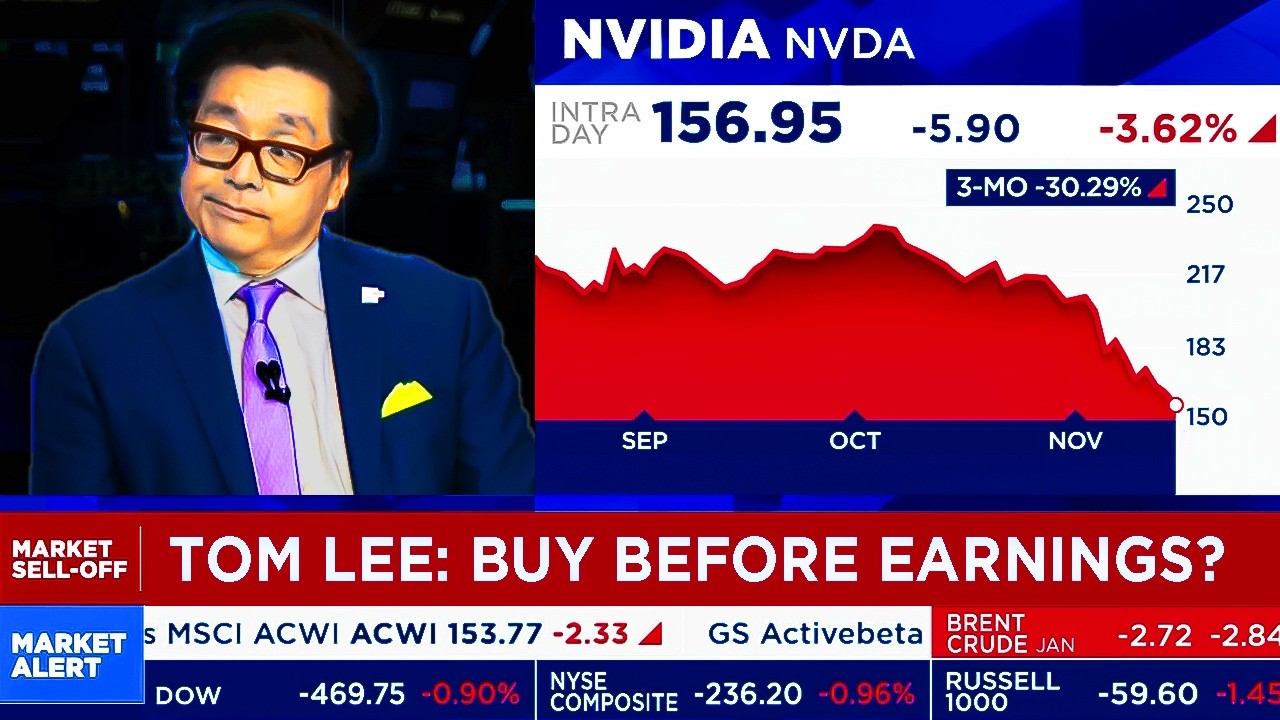
Jensen Huang is reportedly discussing a comeback as CEO. His supporters are lobbying for his return. If he did come back, would you buy more stock? >> Well, I'd buy more stock even if he didn't come back, but I'd probably buy even more more stock if he did, if that makes sense. Stuart, >> and video reports after the bell tomorrow. Do the numbers matter at all right now? >> You know, I don't think they do. I think that Nvidia I think the biggest thing is that they might not offer guidance. Everybody's going to be …
Well, I'd buy more stock even if he didn't come back, but I'd probably buy even more more stock if he did, if that makes sense.
Contexto extraído por IA
Jensen Huang is reportedly discussing a comeback as CEO. His supporters are lobbying for his return. If he did come back, would you buy more stock? >> Well, I'd buy more stock even if he didn't come back, but I'd probably buy even more more stock if he did, if that makes sense. Stuart, >> and video reports after the bell tomorrow.
… they've only spent 19 billion this year. So we think that will get restarted once the blackout period has ended and you will see a floor under this stock and some appreciation. Would that be a buy signal for you to add to the position? >> Yeah, we are. We will be adding to the position. The question is how much and when. We've had clients call in and instead of asking us for to tax loss harvest, they've actually asked us to buy more. >> Yeah, I'm not surprised. >> I do want to talk about your company obviously, but I firs…
Yeah, we are. We will be adding to the position.
Contexto extraído por IA
Would that be a buy signal for you to add to the position? >> Yeah, we are. We will be adding to the position. The question is how much and when. We've had clients call in and instead of asking us for to tax loss harvest, they've actually asked us to buy more.
Transcrição Completa
Jensen Huang is reportedly discussing a comeback as CEO. His supporters are lobbying for his return. If he did come back, would you buy more stock? >> Well, I'd buy more stock even if he didn't come back, but I'd probably buy even more more stock if he did, if that makes sense. Stuart, >> and video reports after the bell tomorrow. Do the numbers matter at all right now? >> You know, I don't think they do. I think that Nvidia I think the biggest thing is that they might not offer guidance. Everybody's going to be looking at this and saying, "Well, how does it impact China?" I think 8 to 10% of their sales are at risk. But through 2728, you're talking about 70% growth that they've already, you know, planned for. So to me, this is a company that's on an even footing. It's about the story. Now, >> now there's so many directions we can go with Nvidia. When they report tomorrow, what's the one thing you're focused on? >> It's a tough one because it's such a short notice, right, for and there's so many things they can't say. Um, I I think a lot of folks want to know about this those GPUs in Hong Kong, $16 billion worth, you know, by the way, did you add those? Were they part of your revenue number? Uh, and if so, where did they end up going, you know, so we want clues as to what what's going on, you know, because, you know, it's a Jensen story, but it might be an Nvidia uh story as well, you know, in terms of management and the board. We know a lot of pressure coming on the board. So there's a lot of questions that can be a answered. Uh they came out pretty quickly when this whole thing erupt started to erupt saying they were pretty confident uh about you know not being spied on. I want to hear them reiterate that confidence now that they've had some time to look into this. So uh you know all eyes on Nvidia and and how much confidence do they have in guidance if they give any guidance at all? That's going to be really important because to your point, people are saying if you base fundamentals, if you base the valuation on current guidance, the stock is extraordinarily cheap. But if guidance changes, then maybe this rerating is warranted. >> Do you think they get away with not giving guidance? >> D. Yeah, of course. I mean, we've seen companies use the weather for not giving guidance. You can definitely use this for not giving guidance. Car Charles, I want to bring it back to you in terms of discipline. Market selling off going into Nvidia's earnings report. Seems like this happens every time since GPT launched. the stock selling off. What's the discipline you advise for investors going into reports like this that >> might you don't have to pick the bottom? Uh, you know, I think as an investor, you should be really getting excited. I don't think the AI trade is over. I think the hyperscalers are going to spend 1.4 trillion next year and then 1.7 trillion. If you add Oracle, two trillion in 2028. I've seen some numbers over the weekend on on on just for instance the chips and Morgan Stanley just updated their research over the weekend. This is not over by any means. It it is the future. These companies are going to invest and that money goes somewhere and maybe Nvidia doesn't get the lion share like they did in the past. So that means other opportunities and right now everything is selling off and everything is not in bad shape. >> Yeah. >> Mike, I'm hear hearing from one source that Nvidia's board is not considering bringing Jensen Wong back as CEO. Again, that's according to a source familiar. I'm told the board right now is focused on the investigation at hand and is not in discussions to bring Jensen Wong back as CEO. That is despite growing calls online and this petition uh and that support that is being built around Jensen Wong. Again, I'm being told that the board is not considering bringing him back. Mike, >> fascinating. Sema, thank you very much. Let's bring in our halftime committee, Joe Teranova, Jenny Harrington, and Jim Leenthal. Joe and Jim both own Nvidia. Welcome to you all. We heard what Brad Gersonner had to say, what Sema had to say, and uh I did mention that Nvidia was trading off through the interview. Joe, um you know, Gersonner, it was not a stridened call that Jensen Wong must be reinstated. It was much more nuanced in a sense of look, let's take a beat and consider all options. Um which would include him perhaps coming back. But there's the question of who's going to lead the company and then the question of the company's relative strategic position given that all that's gone on and and the market is doing a rethink of really the size of its ultimate opportunity it seems. >> Yeah. And I think the question is is who is who is the market you know who who is who is addressing uh Nvidia and where it's currently pricing and I still believe it's in the hands of a lot of quantitative models which are just exacerbating the downside. The fundamental analysis on Nvidia is really complicated right now. You could look at the valuation and we all acknowledge it's incredibly cheap, but does the market care about that? Because look at the other side of that. The most expensive mag 7 is where the capital is actually flowing towards and that being Apple. So it continues to be an incredibly complicated story. At some point, like all stocks in the history of complicated stories in the market, it'll find a bottom. Tomorrow night, we'll get the opportunity to hear from Colette Crest, who I am more than confident is a very thoughtful um leader of the company. She's been the CFO since 2013. She certainly knows the numbers pretty well, but it doesn't really remove the complexity. And I think that's the biggest challenge. Do we know the answer to the fact? Have in fact the Chinese been delivered any of the advanced AI chips? We don't have an answer to that. Just no clarity. And I think that's what really the dominant headline is. >> And Jim, um, we will get the numbers tomorrow. We'll get, you know, whatever guidance they're they're they're comfortable giving. They'll also be allowed to buy back stock after they report earnings. That's probably not insignificant given where the stock is and their buying power. But I guess almost no matter how you slice it, whether it was illicit, you know, trafficking of trips into China or not, the the the demand pool is now narrower, right? In other words, if the government is saying we can't have these, you know, clouds in Southeast Asia that Chinese buyers use to access the the Nvidia compute, all the rest of it, it just seems whatever you thought it was a month ago, it might be smaller now. And now it's a question of has the market recognized that in the valuation, >> right? So if you're a long shareholder as I am and Joe, I agree with you that the quants are having a field day here. But let's talk about the fundamental question of how bad could this be for the earnings picture at Nvidia. Let's take the worst worst case, Mike. I mean, that's always a good thing to do if you're long the stock and it's going down like this. What is the worst case? Let's use the higher number of the range of how much sales go to China including indirect illicit sales that has been estimated up to 20%. Okay, next year we're projecting uh almost 700 billion in sales for Nvidia. Let's say 20% of that 140 billion. Let's take a really ridiculous analysis here and say that 100% of that profit. It's not, right? But let's just say 140 billion uh comes off of earnings. Net income next year was going to be about 450 billion. Now it's 310 billion. That's a lot of money, guys. It's a lot of money. Um, and what I'm saying in this is that a stock that's down as much as it is, has lost over $1.5 trillion, is now pricing in a worst case that seems to me far worse than any worst case I can really realistically come up with. >> It's it's down like $2 trillion, Jenny. Yeah. >> Yeah. So, I I consider myself not a current shareholder, but a potential future shareholder, but a lot rides on that. And so first I think we need to acknowledge that that like Jensen made a horrible professional decision, right? So it's not just personal and in that he incinerated over a trillion dollars and he incinerated all of his credibility. So I'm not sure it's that the market cares or doesn't care about the current valuation. And I don't think it's really Jim just about the current earnings and using your worst case scenario because what he also did was he's saying he's he said you know he said there are 70% earnings over the head. Okay, who knows right? You have no credibility left. you've sacrificed all this like for your own moments of personal pleasure. Disgusting. Um, not that I'm judgmental, but I am. And I am on a professional level because you don't do that when the credibility of your firm that supports 50,000 employees is on the line. I would never do that. And I have 10 people's professional lives on on the line for me. But the other thing that he's risked is the entire ecosystem. And if you look at that circularity of financing chart that goes around on Twitter a lot and out there, you see the tentacles of circular of circular financing everywhere. What happens if those start to retract, which I think they are. How does the ecosystem get impacted? So, I think there's a much longer time horizon before we know what earnings really are going to be and what things really look like in this. Now, if we get to that point and they've got a great new CEO, which I think there's a very good chance of, and we have proper visibility to earnings next year, then that's a place where we should enter because there is no there is no contesting that there's 42 or 49,000 whatever it is employees who are super talented and they're excellent at operations and supply chain and technology. Like, there's amazing people there and they have the best technology. So, I think there's a chance that we invest in one day. But Mike, if you don't mind, I want to say one other thing. At Gilman Hill, we have something that we called the GE parable. And for years back in like 2013, I would say, "Oh, if GE ever gets to 13, I'm going to buy it because then it'll have a 5% dividend yield." And my partner Greg would always say, "If G is ever at 13, you're not going to want to buy it." And so I'm sitting here in this moment saying like, I think I'm going to want to buy Nvidia one day. >> And I hear Greg in my head saying, "Ah, you may not. You may not. If it gets to the price you want to pay, you may not." >> I mean, that's that's often the way, right? Right. I mean, it's because things actually surf. >> Is that the general feeling though? Aren't most people that don't own Nvidia, aren't they looking at this as a potential opportunity down the road? It's just ultimately when you want to step in. >> I don't I don't know. I mean, I have a client right now who's overexposed. I have tons of clients who are overexposed outside of Gilman Hill. And the reason being it's overexposed to what? >> To Nvidia shares. >> Yeah. But what I'm saying is if you do not own Nvidia. >> Okay. But I would have thought they'd say, "Hey, if I sell it now, my capital gain bill is so high. I don't want to." instead position. >> I would just say you know what you just said is very rational about things can get worse than what I was putting forth as the worst case scenario. I think in moments like this just like on the upside the negativity can go a little too far >> for sure which may be the opportunity >> which may be the opportunity. So without without trying to gussy this up too much, I would say there's a couple of things that I've just lightly pushed back on your worst case than my worst case. One, as Brad Gersonner aptly pointed out, the next six quarters really are baked in. I mean, if you're going to cancel your Nvidia chips in the next six quarters and you're building a data center, you're never going to get them back. I mean, the company is going to remember that and hold you against hold it against you. The second thing I would say from a sentiment point of view because sentiment does matter here if my worst case is not worse enough you know anthropic coming public assuming it does this week is a shot in the arm for the AI trade it's 60 to80 billion of new capital that comes in where's that new capital going most likely a large portion of it is to the chip system whether it's Nvidia Broadcom or whomever but more than anything it shows at six times overs subscribed that there is a lot of appetite ite still for this trade. >> I is the best in the business. We've got York for livives Dan Ies and Funstrat head of research Tom Lee who is also of course a CNBC contributor. Guys, we really appreciate you coming in coming on. The market needs to hear from you on a day like today. And I understand you've each got your views on Nvidia and Jensen. We'll get to that in a second. First off though, um Tom Lee, can we start sort of macro? People are wondering, and it's a good question. Does any crack in the AI story bring the entire market down? I know you've been bullish. Do you remain so? Uh, I do remain bullish and I think your question you'reing is important. If there is something that would take the AI trade down, like force it to hit a wall, it would be bad for the stock market and the economy. But if someone asked me, are the events of the past two weeks, whether it's Nvidia or the blue tsunami, going to cause AI to hit a wall, my answer would be no. So to me, I think that there is a market de-risking and adjusting and dealing with headlines and and emotions and of course margin selling. But structurally, to me, the entire AI story is intact. >> Why is that not the case with Nvidia? And let's remove Jensen Wong if we can. Okay? And I know that's hard to do. Um, and Dan, we'll get you in a second on this because I know you got your views as well. If Nvidia is the quote central bank of AI, and if AI is driving most of the big stocks in the market, why wouldn't all this change >> affect the macro environment? >> Uh, well, just two reasons. One is, you know, capital is dynamic. So um Nvidia is not the independent driver of AI innovation even if it plays a really important structural role. So if uh if Nvidia becomes less central you know is it anthropic and the capital they raised and their ability to continue to raise money or is it SpaceX there's going to be a new sort of uh capital flow and the second is precedent. I mean if we look back at every innovation wave if a single founder was removed it didn't change personal computing the internet development media I mean none of these are really affected by a single person >> I don't know sometimes I think they are you know I I I take your point but I mean even the think about Intel right in the in the ch the ups and downs they went through with leadership over the years or Apple you know they they can have a a trillion dollars worth of impact Dan like you're saying >> do but do you think long run we look back on this and go yeah why were we so concerned about whether Jensen Wong stay stayed or what the company ended up they they studied the ship and they were fine >> yeah let's just call like it is like Jensen is the most important person not just in US tech but the global tech and you could argue the economy so Nvidia losing Jensen we've said it's worth a trillion dollars to the valuation and the reality is it's a dream scenario for China because he was the gating factor between China and the US but Nvidia They're 2 to three years ahead of the nearest competition. They're 2 to three years ahead of China. That is not stopping the 3 to four trillion that's going to be spent. That's not moving the needle either. So my whole point is what's happening here is like it has been a you know gut-wrenching week for investors in tech. It's been a black eye moment for Jen's a black eye moment for Nvidia. But the reality is like the for the first time in 30 years the US is ahead of China when it comes to tech. And that is not changing and that will continue to fuel this AI revolution. >> What gives you the confidence that's not changing without him? I mean because only because he's the one who got us to that point. Like people often talk about these companies like someone woke up one day and made a decision. Let's let's have Leading Edge AI chips and lead the world. No, it was a video game chipmaker. They were making GPUs like he you have to anticipate these shifts. Notice a you have 50 direct reports. Why? So that the company can remain flexible and respond urgently to changing market dynamics. That's where jump in here Tom. That's where I just wonder I mean, >> how do you keep that lead? >> Yeah. Um, so I spent the first half of my career following the mobile and internet industry. I was a tech analyst at Ker and the Solomon and JP Morgan and in the in the wireless data revolution. It started with research in motion and blackberries and then the mantle shifted to Nokia and Nokia was at one point the biggest company in the world. >> But then Nokia misststepped and if someone said that, oh well the mobile data revolution's over, then Apple came in and stepped in. So to me, the AI story is a multi-prong story. >> But you're making investors nervous if you're likening Nvidia to Nokia to Nokia. Yeah. Or Blackberry. >> Although the markets did rally after those companies lost their leadership in the market. >> So those stocks were hurt, but the exponential growth. It was an S-curve industry for 30 years. >> And I think that Tom's I think what's just important here is that no one will deny and we've talked about it like Jensen out in Nvidia. It's a different Nvidia going forward. It's not the same without him. But the reality is that their chips, the technology, and the strategy, that's not changing. Now, look, part of the issue is just the the political the China issue board. It's all the things that we've talked about. But I just think when I look at video, it's worth 225 per share without Jensen >> and and it was worth he thought more with him. But actually, speaking of which, of the board and everything else going on, let's turn to Simma Modi, who has the latest on Nvidia and any possible succession plans. Simma, you were saying earlier, uh, maybe it's time to rethink those. >> Yeah. Well, Kelly, in an interview with Scott Wapner today, Alimter Capitals Brad Gersonner spoke out for the first time since pending a letter to Nvidia's board asking the board to take their time in making a decision on leadership. >> He's an exceptionally visionary leader. He built built the company over 30 years and the minimum he deserves is to have a full hearing by the board. And if the board concludes based on the full hearing that he's not the guy to take it forward, so be it. Give that answer to shareholders. >> Him being Jensen Wong. Gersonner went on to say while he thinks highly of interim CEO Klet Crest, he doesn't think she has raised her hand to run Nvidia on a permanent basis. Now, yesterday, Treasury Secretary Scott Besson calling for a dramatic shakeup at Nvidia, urging the board to look externally for a new CEO. Separately, we've been told by a source that Nvidia's board is not considering bringing Jensen Wong back as CEO. And no discussions have taken place on this topic. And that the focus right now guys is on the independent investigation being run by federal prosecutor Jun Kim of Wtel Lipton Rosen and Cats who has been brought in to examine whether former CEO Jensen Wong was a target of Chinese intelligence and if company secrets were dulged. What we'll also be telling Kelly and Brian is how executives address leadership on the earnings call tomorrow night. >> Sean, thank you. We appreciate it. Sim Modies, we turn back uh for some reaction to our panel here. Um Tom, what do you think? Um well I I think I agree with Brad's statement that uh the removal of Jensen seemed very hasty. I think that some of the allegations are public allegations that now there seems to be some backtracking and in fact Sema's last point about now the investigation is involved is is focused on revealing company secrets whereas over the weekend there was talk well Nvidia is selling chips to Singapore. The reason I I I doubt there was shenanigans financially is the CFO is being made interim CEO. The CFO should be the one that would be blamed if there were financial shenanigans. So to me, I think the scope of this continues to narrow and I think maybe it was a hasty inappropriate removal. >> So let's let's focus in on that term financial shenanigans because I think this is paramount to the stock in the near term. On one hand, Dan Ies, we can make the argument that Nvidia's valuation is now below that of say Coca-Cola or some of the other boring companies that don't have very much growth. In fact, if you look at the PE or price of sales or some of these other metrics, Nvidia's valuation is below some quote slower growth companies. But that also assumes that the market believes the E in earnings. Tomorrow night, we're going to get earnings out of Nvidia. We're either going to get consecutive consistent guidance, everything's fine, or they could change it. Do you believe the E in earnings is solid for Nvidia? >> Because if it is, the valuation is solid and you could make the case that the stock is undervalued. >> I think the E is way underestimated even if you took out China, Hong Kong, any sort of loophole revenue because demand and supply is still what 13 to1 for Nvidia chips. So even if all that came in the US right now, if Tom and I want to order Nvidia, we were building an AI infrastructure. We couldn't get those probably for a year and a half. >> The book is sold out. >> It's sold out through 20. >> Here's my Let me I'm sorry to jump in. Here's my concern. If tomorrow night we hear Colette Crest, interim CEO to your point CFO saying, "Well, there's some sales that we just can't identify and they may have gone to channels China that were not legal and we're going to back those out." Is that number big enough to materially damage the E? Because even if that's 10 to 15%. the E you you have double to triple that amount of revenue that's essentially in backlog for the next year and a half. So my whole view is that the E is not being overestim it's actually being underestimated relative to the one chip in the world fueling AI and it's part of why we're in this situation with the China and is because of them. >> Yeah. I mean, just to add to Dan's point, you know, now people are trying to spin the narrative as if Nvidia was channel stuffing. Dan's point is there's no channel stuffing. I mean, look at every component of today AI. Even memory is expensive. Sam Alman suggesting that we need to turn in spare RAM on our computers. Things are very tight. >> But that I I think it was this piece from the New York Times this morning that was raising, we talked about this with Alex Kowitz last hour, this idea of excess chips. Do either of you buy that idea that perhaps you know the supply demand situation is the opposite of what we were told and there you know there's some you know this would be the most shocking thing to come of anything that could happen with the Nvidia story Dan and you're shaking your head >> we're in Asia four times a year you see it Taiwan Korea AC around China demand to supply is ma there's no overordering stuff in the channel and I think right now we're going through a massive sort of nervous period you got to separate the facts I >> and yeah like for instance tomorrow Dan and I could start a company called compute co and if there were exis chips we would take every one of those and we wouldn't have a problem financing it >> exactly right >> and you you're happy with the valuation of the compute >> yes and the more importantly I think that headlines and stock fundamentals like look at what happened with United Healthcare when it really came under pressure and the stock rebounded and things didn't change as much as people think they had a group CEO murdered. They had a CEO that was pushed out because they had to restate their entire guidance, a Dow component, and the stock is up solidly since then. To your point, very quickly, um, because I know people are going to be yelling at us to just ask this basic question, Tom, what do they do now? What do our listeners and viewers and fund strat clients, what do they do now? Do they do anything? Do they add to their positions? They sell? I'm I'm going to say I know nobody's having fun. It's been turbulent and in fact I think people might even be losing hope, but they need to take a look at the bigger picture. We've experienced this six times since 2019. These waterfall declines are always V-shaped recoveries. If there's a V-shaped recovery, we are at the bottom of the V right now. >> You what what are you seeing that makes you think that? >> Um >> we all hope you're right, by the way. >> Yes. I think last week felt like a structural bottom like a real liquidation funds derisking just like October08 >> which got us to 148 on Nvidia last week by the way 156. >> That's right. And then this week we have a liquidity event absorbing 90 billion or more of money new money for the anthropic IPO. Once that clears it's going to people are going to flip the view and say wow there's still hundred billion dollars of willing money to buy an IPO that has a stack >> because everything is I know we got to go. Everything's getting whacked today. Do you feel like there's there's maybe some hedge funds that didn't quite have the right situational awareness >> and they and you're see >> and if they're all overloaded into one thing then those those hedge funds >> Yeah. There's career risk as you're saying >> like say why am I >> taking risk off >> and as you know I that's not fundamental that's for selling plus we have free margin needing to be raised in front of an anthrop. >> It's a wash out moment. You buy tech this is not the time to throw in the white towel. Both of you think that V-shaped bottom was last week for for every decline since 2019 has a V-shaped recovery. >> This is a Can I can we term it now? This is a cut me moment, >> right? >> You think it's over, >> but it's just the beginning. We'll see. So, Nancy, you've been a staunch defender of Nvidia. Of course, there's so many questions as we head into the earnings tomorrow, but I want to start with the Bank of Jensen. Everyone's saying it's been a dumb move. It was a risky it's too risky. They should stop it. Maybe we'll hear that from the new CEO. What do you think? >> Yeah, I think you're right on, Charles. That was a perfect analogy. I mean, I learned early days from Dr. Arthur Arthur Laugher. This is how the economy works. Um, I borrow money from you and spend it on someone else and and it keeps going. Velocity of money. So, uh, unless there was some nefarious activity, uh, I think that the the playbook has worked very well and we may see a pullback. Uh I I I'm reading the same reports you are, but I'm skeptical until we hear directly from the board and directly from Colette Crest tomorrow. So we'll see. I mean, we're waiting on earnings because we think that will reignite the share buyback program. They announced 230 billion and they've only spent 19 billion this year. So we think that will get restarted once the blackout period has ended and you will see a floor under this stock and some appreciation. Would that be a buy signal for you to add to the position? >> Yeah, we are. We will be adding to the position. The question is how much and when. We've had clients call in and instead of asking us for to tax loss harvest, they've actually asked us to buy more. >> Yeah, I'm not surprised. >> I do want to talk about your company obviously, but I first want to get your reaction to the story that everybody is obviously talking about here, and that is Jensen Wong's departure from Nvidia. because you did post on X talking about quote his personal generosity with time and advice for founders like you. What kind of advice did he give you? >> Jensen is all about relentlessness, grit and determination. Uh more than even advice as a founder, he was a demanding perplexity user. So most of the time he would tell me what part of the product can improve. And our users reflect his spirit, constantly wanting to make more with less. And he's all about like always finding the next edge, not being satisfied with the status quo. And uh most of my time was just spent talking about open weight models, multimodel orchestration, how to make the product more accurate, which is all about, you know, perplexities, what what perplexity stands for. >> People are talking about Jensen Wong as being arguably the biggest cheerleader for open source. Um, and given what you just said, what does it mean having that voice not on the field so to speak right now? >> It means that like the ecosystem and the alliance that he helped build, the foundations have been set for others to take on the beton and like carry it forward. And um, you know, we announced perplexity frontier research >> just today >> today. And uh the reason is we don't just want there to be one company doing open source. Nvidia wants there to be a lot of people doing open source. That's what Jensen wants. Uh that's what uh we want to do as well. And we're going to open source all the models we train for multi- aent orchestration continual learning systems and uh help make the ecosystem really work and American open weight models need to exist. Uh an emotron is making good progress. Muse is pretty good. Muse Glimmer, Muse Spark. So we need to continue to cultivate that ecosystem, build around it and uh make America great in open source. >> Can you confirm on the record as to whether Nvidia is an investor in Perplexity? >> Nvidia is an investor in Perplexity. Yes. >> Okay. And the reports were that you guys have been in active talks with Nvidia either leading or joining another round which could value you at $30 billion. What can you tell us about that? I'd rather not talk about our funding. >> Okay. >> We're making great business progress. That's what I'm pretty excited about. >> If he is no longer the CEO of of Nvidia, would it impact either your ability to do that or you have other relationships with them? You just announced a new product recently. >> Yes. So, we we have a lot of things going on with Nvidia. Uh our relationship with them is not like other companies looking to you know help fund their startup. We work with them on Neatron. We're part of their coalition program. one of the founding members. We contributed to Neatron 3i. We're going to work together with them on Neatron 4. We've been working with them on local AI on portable. >> Well, that's the portable computer that you talked about recently. Tell us more about that. >> So, people are getting worried about uh owning a a secure and sovereign AI. Uh because there's a lot of news you constantly read about agents going rogue. U security and trust is what gets people to be more comfortable with agents especially uh by regulated institutions. sovereign wealth institutions and so on. Uh we found a lot of interest in that from our financial institution uh users. So uh we've been working together with lot of different uh silicon partners on bringing a version of perplexity computer that runs fully locally in a in an isolated environment including your you know your own laptops or uh separate hardware like DGX or RTX Spark. And so that's the work we've been working together with them. But it can go I guess the best way to describe it is it can go up and down into the cloud but also locally. Why why is that better for safety and security? >> Because you have full control. >> Safety is all about control. So whatever data you don't want a frontier lab to look at. You don't want an uh you don't want another case of like the Navier Stokes equation incidents where uh people are worried oh like it doesn't matter if the company says we don't actually directly look at the data but we put it in our post training mix. What matters is like do you have the ability to like completely block access to any model on the cloud for some data that you really care about you if your IP relies on it or your your customers trust you to safeguard their data. So you don't want to put that into a Frontier Labs uh you know training data. >> All right. I hope you're all doing well today and staying calm in this market. Monday was a rough day throughout the market and it was an especially rough day for tech stocks for multiple reasons. I noticed some well-known voices reigned in their bullish outlooks for the AI buildout. We have Nvidia earnings this Tuesday which is making some market participants nervous. We got some news that weighed on Nvidia that I'll share a moment. And plus, we're expecting Anthropic to go public later this week. If investors want to buy Anthropic shares, they have to sell something else first in order to raise the capital. All of those factors weighed on tech stocks Monday. Over the weekend, there were calls online for the board to bring back Jensen as CEO, especially after the FT published a story claiming that Jensen was discussing a potential comeback as CEO. On Monday, CNBC reported, according to a source, that the board is not considering bringing Jensen back as CEO. As I said numerous times last week, if the New York Times story about the second alleged affair with a direct report at Nvidia is true, then I think it is highly unlikely that Jensen will return as CEO. Additionally, if Jensen misled the board, as some have alleged, then that also would indicate that Jensen is unlikely to return as CEO. I know some people online have floated the idea of removing the board and electing new directors who would reinstate Jensen as CEO. While that is technically a possibility, I view this option as being extremely unlikely. According to Nvidia bylaws, shareholders that have held continuously for at least one year and represent at least 15% of voting power can request a special meeting of shareholders. That alone is a difficult threshold to meet. And even if that threshold were met, the next step would be to vote out the existing directors without cause. That would require twothirds of voting power to vote in favor of removing directors without cause. Getting to that threshold would almost certainly require major institutional investors getting involved and voting in favor of ousting directors without cause. I do not see that happening at all. Now, I will mention that all members of the board are up for reelection in 2027. And so, there's a potential scenario in which shareholders could lead a campaign for new directors who would support reinstating Jensen. That is a possibility, but by that point, there's a good chance that Nvidia will already have selected a new CEO. As I said last week, if the reports about the second alleged affair are true, then I think it is highly unlikely that Jensen will return as CEO. It's technically possible, but it is not my base case for what I'm expecting. If new information becomes available in the future, things could change, but that's not what I'm currently expecting. Even without Jensen, Nvidia's road map over the next couple years is largely already set in motion, and I expect the team at Nvidia will likely be able to successfully execute upon that road map. The main fundamental questions have to do with new leadership in the out years, the long-term vision and direction of the product roadmap that remains unclear at the moment, but for the next couple years, the road map is largely already set in motion, and I expect Nvidia will likely execute successfully. Now, let's cover some news. On Monday, the Commerce Department announced an interim final rule addressing Chinese company's ability to access restricted US AI chips through data centers located outside China. As a reminder, up to this point, while advanced GPUs were not allowed to be shipped to China, Chinese developers were still allowed to access advanced NVIDIA GPUs remotely by renting them from clouds outside of China. And now, these new restrictions target both the diversion of physical chips as well as remote access to advanced computing infrastructure. New licensing requirements affect chips exported to Singapore Malaysia Thailand Indonesia, and Brazil. So, this new rule is aimed at limiting Chinese developers ability to access advanced chips remotely. And companies in the affected countries must now apply for US export licenses for advanced chips. This news weighed on Nvidia stock as well as other AI infrastructure stocks on Monday as market participants are wondering how much of Nvidia's revenue comes from Southeast Asia. That will likely be an important topic of discussion on this week's earnings call. In other news, Nvidia announced Reuben HPC, which is a new GPU in the NVIDIA Ver Rubin platform designed to accelerate simulation and data processing for science, engineering, and analytics workflows. Reuben HPC will accelerate simulations, shortening the path from exploration to scientific discovery, and industrial design. The Ruben HPC GPU features more than 50,000 CUDA cores as well as a sparse data acceleration capability that keeps those cores fed with data and accelerates GPU toGPU connectivity with seventh generation Nvidia link interconnect technology. Reuben HPC is expected to be available in 2028. Looking ahead, we have Nvidia earnings on Tuesday, November 17th after market close. Last I checked, consensus expectations are for Q3 revenue of $18.7 billion. Q3 adjusted EPS of $247. In August, management guided Q3 gross margin at 74%. As for the Q4 outlook, consensus expectations are for Q4 revenue guidance of $124.8 billion. And back in August, leadership said they expect Q4 gross margin of 71 to 72%. Keep in mind that the consensus expectations that I shared could change, but those were the numbers the last time I checked. As for this specific earnings call, the main focus will be on the future of company leadership and potential succession plans. At the very least, market participants want leadership to reiterate their expectation to grow revenue at 70% in fiscal 2028 or possibly even raise their outlook. It would also be helpful if leadership would announce an increase to the share repurchase authorization. Last we heard, that amount was $235 billion in Nvidia said it expects to execute the buyback through fiscal 2028, which ends in January of 2028. I think another topic of discussion on the earnings call will be the company's investments, guarantees, and other forms of support for companies throughout the ecosystem, and what that may look like moving forward. Recent reports have indicated that Jensen and Colette disagreed on some of those topics in the past. And so, it'll be interesting to hear what Colette has to say about Nvidia's financial support of other companies as interim CEO. Put simply, I expect Nvidia to report strong results and guidance, but I think market participants focus will revolve around leadership and potential succession plans that will take priority over quarterly results and guidance in the eyes of market participants. I'll try to cover Nvidia earnings the night of November 17th. So, be on the lookout for that video either Tuesday night or early Wednesday morning. This will be a very important earnings call and then one day after earnings. We're expecting an all hands meeting at Nvidia on November 18th. We may get more details about the future of company leadership following that meeting. Long-term, I do think Nvidia will be fine with or without Jensen, and I expect the company will get through this challenging situation. That said, over the short to medium-term, uncertainties regarding the future of company leadership will be an overhang on the stock until we get more conclusive answers. Now, in case you're new to the channel, I want to make sure that you have at least a basic understanding of the underlying long-term thesis. So, let's cover that. Now, I don't know what's going to happen in the short term, but from a long-term perspective, I am very confident that Nvidia will be worth much more in future years than it is today based purely on the fundamental growth of the business. Based on everything I'm seeing, the world is still compute constrained, and I expect that to continue at least through calendar 2028. In a computed environment, developers will use whatever viable compute they can get their hands on. Today, there are no GPUs that are sitting dark due to a lack of demand. Like there was fiber sitting dark due to a lack of demand at the height of the.com bubble. Back then, companies were laying fiber in the hopes that use cases and demand would eventually show up. Today, we are seeing the complete opposite. As I've said many times, when market participants compare this AI revolution to the do-com bubble, they ignore the fact that the internet is already here this time. This means that mass adoption of the technology and new use case development at scale are immediately possible. We don't have to wait years for it to show up. It's already here. The world is compute constrained, which means there is not enough supply to satisfy demand. New capacity is utilized as soon as it comes online. The hyperscalers are monetizing capacity as soon as it comes online. Each of the hyperscalers spoke about being supply constrained on their most recent earnings calls. Additionally, many of the clouds are building out into contracted demand. They're not blindly building in the hopes that demand will eventually show up. No, they're building out because they have signed contracts and in some cases significant prepayments from their paying customers. This AI revolution is fundamentally different from the dotcom bubble. And 2026 will be a pivotal year for the AI industry thanks to the rapid adoption of Agentic AI and the proliferation of agentic systems in the world's leading enterprises. The leading AI labs revenues are surging right now. Agentic coding and the implementation of agentic systems in large enterprises are new use cases that are increasing inference demand significantly that subsequently is increasing compute demand. The rapid adoption of agentic AI is why we're seeing an inflection in inference demand. It's why we're seeing the leading AI labs revenues surge. I wish both anthropic and open AI were public so the public could see the ramp in their revenues. I think the leading labs surging revenues may be the initial proof point that grabs market participants attention and causes them to realize that there will be a clear ROI on AI infrastructure. I think the leading labs surging revenues will also help assure investors of the longevity of Nvidia's growth since these labs revenues are directly tied to compute. If they had more compute, they would have greater revenues. It really is that simple. Demand is not the problem. The problem is a lack of supply to meet the demand. As I've said previously, I expect the world to be computed at least through calendar 2028, possibly longer. And so regardless of what happens in the short term, it's important for long-term investors to remain focused on the fundamentals, maintain a long-term perspective, and remember that we are only in the early stages of agenic systems being adopted at scale. This will increase compute demand significantly. And after that, the next surge in compute demand will likely be fueled by physical AI. We're no longer talking about digital agents performing digital tasks. With physical AI, we're talking about physical AI agents performing physical tasks in the real world. NVIDIA CFO has called physical AI quote a multi-t trillion dollar opportunity and the next leg of growth for NVIDIA. This industry will fundamentally transform society and Nvidia has positioned themselves to benefit massively. Nvidia sells the hardware for the data centers where the models are trained. They offer omniverse where the models are taught and tested and Nvidia also sells the hardware that allows ondevice real-time inference through Nvidia AGX allowing robots to have intelligent interactions with the real world even when they are not connected to a data center. Notice that Nvidia is taking a holistic platform approach to physical AI and they're embedding themselves as the underlying foundation supporting all of it. Over 3 million developers are already building on the Nvidia robotic stack and this is not getting enough attention. As for production ramps, Blackwell Ultra has ramped and remains in high demand. Vera Rubin is rolling out to customers. Nvidia Gro 3 LPX is in full production. Later on, we're expecting the launch of Reuben Ultra in 2027 and Fineman after that in 2028. We have a clear data center product roadmap stretching into 2028. I don't think we are anywhere near any type of bubble bursting type of event. With all of this in mind, I seriously think that Nvidia still has plenty of runway ahead of it. And I think this company will be worth substantially more in future years than it is today. At least that's my view of the situation. A quick note before I wrap up. All of the compilations on this channel are edited by Finn Vid with original structure and commentary. Occasionally, the same edits appear elsewhere on YouTube. If you're looking for the original version, it's always here on this channel. Thanks for watching, Finn Vid. I appreciate your support. Remember to stay calm in this market. Remember to maintain a long-term perspective and do not make any hasty or irrational decisions. With all of that being said, I hope you all have a great rest of the day and I'm curious to hear your thoughts about Nvidia in the comments below. Please leave a like on this video so more people will see it. And while you're down there, please consider subscribing. It's free and you can always change your mind. Thanks for watching and hopefully I'll see you in the next

Comentários 0
Entre para participar da discussão.
EntrarAinda não há comentários. Seja o primeiro a compartilhar sua opinião!