…mates are going to be too low for calendar 27, calendar 28. And so I think that ultimately it's just hard for us to wrap our heads around a $5.7 trillion market cap continuing to have measurable upside. I I would put this in the context to I think Nvidia is a great company to own. It's a great way to own. If you believe that we're still early AI, that's one to own. I don't think it necessarily will have kind of some of the same level of upside that maybe like a SpaceX potentially could have given just its two trillionish market cap. I mean the kind of the incremental piece the incremental upside is p…
I think Nvidia is a great company to own. It's a great way to own. If you believe that we're still early AI, that's one to own.
Contexto extraído por IA
I mean, definitionally it is if you believe in the estimates. I just built the case that the estimates are going to be too low for calendar 27, calendar 28. And so I think that ultimately it's just hard for us to wrap our heads around a $5.7 trillion market cap continuing to have measurable upside. I I would put this in the context to I think Nvidia is a great company to own. It's a great way to own. If you believe that we're still early AI, that's one to own. I don't think it necessarily will have kind of some of the same level of upside that maybe like a SpaceX potentially could have given just its two trillionish market cap.
Transcrição Completa
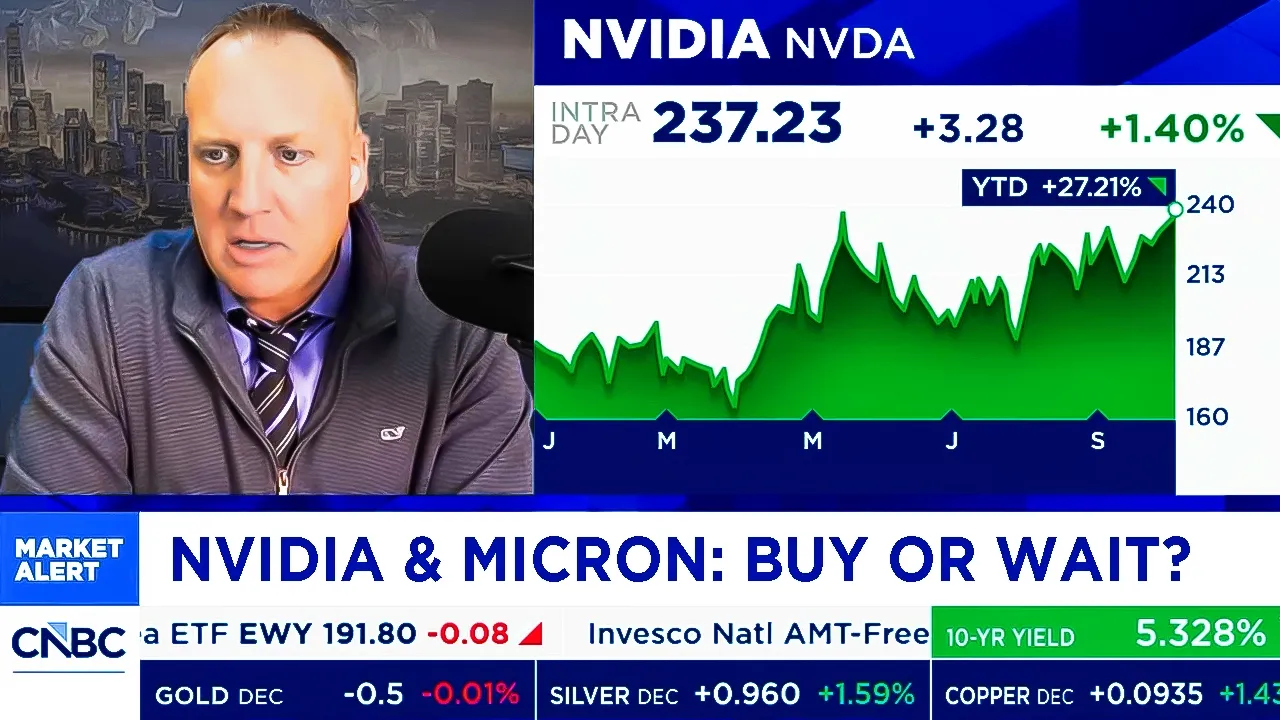
Nvidia did if we're talking about Nvidia and I think that's what we should focus on that is the market leader at this point right >> uh indeed Joe and when it comes to Nvidia it's probably the easiest way just to own the broader AI trade of course the multiple Nvidia has been quickly uh compressing over the past year as this wall of worry about what the growth rates are going to be in 2027 and 2028 uh we had that breathtaking speaking guidance that they gave, this is back at the end of August, they guided calendar 27 revenue up 70%. Now, some of that was from price increases because of memory costs, but if you back that out, it basically suggests that their underlying core business, which is a barometer for the size of the AI brain is going to be up 60% in calendar 27 over 26. Now, as of this morning, if we look at the fact set estimates for hyperscaler growth for next year, it's at 32%. So, there's a still a very wide gap in terms of at least where the the sell side is at relative to what Nvidia is saying about the the size of this buildout. But, I want to put a piece of context to why Nvidia can keep moving higher here is that at the end of the day, the question comes down to what is that growth rate kind of a few years out. And if we look at what's happening with these personalized bots that have kind of captured our attention over the past few weeks, this would be of course rockbot or muse or dots from open AAI. The amount of tokens that they take is about 10 to 15 times more than what generative AI is. And the reason why I point that out is that as these bots go from really nent use today, sub 1% to effectively everyone will have these bots, it builds a case that that brain of AI, that piece that Nvidia powers needs to grow substantially for longer than I think many investors believe. the uh we had I guess it was Jeremy Seagull, Jean talking about how uh because the market is up X certain markets are up X um and earnings are up Y that the the market doesn't even keep up with the we the earnings gains which indicates at least some type of of multiple contraction maybe because of higher rates. Um but it it is it is interesting that some of these stocks would you say Nvidia is less overvalued than it used to be even at a new high? I mean, definitionally it is if you believe in the estimates. I just built the case that the estimates are going to be too low for calendar 27, calendar 28. And so I think that ultimately it's just hard for us to wrap our heads around a $5.7 trillion market cap continuing to have measurable upside. I I would put this in the context to I think Nvidia is a great company to own. It's a great way to own. If you believe that we're still early AI, that's one to own. I don't think it necessarily will have kind of some of the same level of upside that maybe like a SpaceX potentially could have given just its two trillionish market cap. I mean the kind of the incremental piece the incremental upside is probably with those um smaller um uh a couple trillion dollar market cap companies. But uh I I think at the the core here comes down to this question about growth too. And I just want to stress one other point is that there is this anxiety around the market too that effectively that as improvements happen with GPUs and model that the amount of power that's going to be needed power being compute power to drive inference is going to decline. Therefore, that's negative for Nvidia's business. And I believe that the power of the GPU, the significance of the GPU will remain intact for the next uh several years, five years, which should bode well for again what's going to happen with Nvidia's estimates. And uh one last piece here, Joe, when we think about back to last Tuesday when President Trump talked about super intelligence, and this was generally a branding concept, but it is important relative to what's going on with Nvidia. Super intelligence. The branding piece is to make people feel better about what's going on with artificial intelligence. But there is the concept of super intelligence and that's when the machine can think abstractly beyond what humans can understand. They would give us insights that we simply wouldn't challenge. When that happens, if that happens, there's a debate whether we actually reach super intelligence, but the amount of inference needed will go through the roof, even higher than what we've talked about here. So when you put all this together, a very simple question. Do you believe that there's a path of super intelligence? If there is, then you really need to continue to own the AI trade and Nvidia is going to be a big beneficiary. >> Yeah. Yeah. You're going to need that. That that's something that we're not used to thinking about. I think, Gan, that that it could really just be early in the buildout based on on what we're talking about here and we could be totally underestimating things. >> I think the question mark for all of us, Nancy, is how long this is going to last. >> No, you're right, Cheryl. That that is the the big question. Um but what if you you can look recently at Micron's earnings and what they're telling you is that demand is sort of accounted for through 2030 and they can't meet demand for memory chips. So if you use that as a bellweather, I think what you can assume is that uh and that that this will continue for for 5 years uh to seven years and we heard that as well from a study done by Goldman Sachs where they they are argue we're going to spend 7.5 trillion dollar on AI infrastructure spend uh from 2026 to 2031. So that that gives you some confidence. Both may be wrong, but directionally I think they're right. And that's that's what investors need to pay attention to. Micron trading at five times 28 earnings. Uh Nvidia trading at 15 times fiscal year 28 earnings. These are companies that are generating ridiculously high levels of earnings growth. And so I I think they are the safe place to be um rather than some of the more speculative names that investors are talking about. interesting because you know when you're always looking for opportunity you are going for those smaller names and you're saying stick with the big players and and and that's what uh the performance is telling us uh right now I want >> let's begin with Nvidia's record run and a potential 6 trillion valuation now Jensen Wong's net worth surpassing 200 billion that's according to Forbes Jim we talked last week about pushing through like a like a tush push through 230 >> well I like that I mean I think kind of the things that happened were were there was an Ezra Klein interview that I actually think is somewhat seminal the people who like Jensen are saying, you know, he's got it under control. He's the adult in the room and they've got uh I I think that they've got a lot of the worries uh the existential worries cured. Yeah, there are some people who say, you know what, he's become so close to Trump, it's really amazing. Uh but what has mattered, I think, is is that we finally don't care about China. We're so thrilled about all the orders that he has, Jensen has, that we stop thinking if without China, what's going to happen? David, when you're away, there's the tugof-war. tugof-war, tugof-war, but Nvidia breaking out is a seminal situation because six trillion in the end pretty major. >> Yeah. I mean, you hit two different things there which I think is interesting. One is obviously the operation of the business talking about how successful it's been and whether even they get any China orders, how much that matters. The other thing you just said is that the existential crisis has been cured >> for him. No, he the people who like him are saying the existential crisis. >> I see. cuz I listened to that same interview and I found some of his answers less than compelling. >> Okay, so that's where I wanted to go for a second because this was the first time I felt there were people on both sides. I have very informed people who said to me your friend Jensen I mean enough as soon as you hear that you know it's he's being very gling it. He's got this idea that we're fine. Uh what seemed to matter to Wall Street what that carried weight on Wall Street. I don't know if it carries weight say into the elections where I think that I think that the data center is a disaster. >> There's two separate there really are two separate arguments being had. One is about >> better than I say it. >> One is about Nvidia and its ability to continue to execute on the opportunity and around whether really it is circular financing or how much it's a risk and how much its business is going to grow and obviously you know you have great insight into that. Then the other is the one that we talk about at this desk as well which is this raging debate Carl about what the advance of this technology is going to mean for society and Wong spent a lot of this interview you're referring to which was a couple of weeks ago now >> it resonates >> talking about that um Bill Gates obviously also then responding in a very different way >> on Ezra line as well >> on the same good for Ezra about this idea that Jensen raised simply saying liability is enough to curb bad behavior. And I'm paraphrasing here and that companies will do the right thing and should not release products that are unsafe. And I wonder what I've been living in. He and I are similar ages, but we've been living in different worlds, I guess. >> Yeah, that's true. It's funny. I've got I have some friends who are in the insurance business and they're literally saying, "Okay, so will Chub do it? Do you really want Liberty Mutual?" So, how about the Someone said that, "Do you really want Liberty Mutual?" I said, "Look, I I am not close enough." Companies are always thinking about the greater good and not necessarily their shareholders. Right? >> You know, we've missed your cynicism. We've been going at this level. We forgot to go in the scrum. Welcome back. >> Thank you. 40 years of covering business. Maybe it made me I didn't wasn't born cynical. >> No. And I wasn't born yesterday. I think that this is about the midterm elections. >> I think that this has become maybe the most hated force in America. >> Well, they're a month away. Do you think it will have a real impact on the ability to build data centers in this country andor should we just I mean SpaceX stock took off again? I mean maybe orbital data centers are coming sooner than we think. >> Well, I think that they will. I think that that's part of the theme of Adam Adam Jonas. No, I'm just saying Carl, look, I I I the midterm election, something that that surprises me is that the the staunch nature of how whoever can identify with anti-data center does boost their numbers. Uh, but I do think that in the end there'll be a couple states don't seem to mind. But I think that it's going to be a radical defeat for the for the data center because they forgot and for every dollar that's going into Nvidia chips, you're talking about 70, 80, 90, $100 of throughput coming back at them. >> We got some uh young millionaires coming up, don't we? >> Yes, we do. And next generation millionaires being printed right now. >> All right. Nvidia, it's been on a great run recently. Uh, when is it going to hit a market cap of $6 trillion? I know it's close. Well, it is. It's very, very close. It's only about 6% from here. And excuse me for looking at my notes, but I think I looked right before I came on the air. We got 13% probability hit $6 trillion this week, 50% by the end of the month, 70% by December 18th. But I think the more interesting proposition, Stuart, is when does it get to 7 trillion, and nobody's talking about that. That's only 25% higher. Definitely within the next couple years, in my humble opinion. You think it's definitely going to be 7 trillion soon? >> No question about it. No question about >> because you have unlimited faith in Nvidia. >> I don't know about unlimited faith, but I look at as a professional investor and say, what is this company going to do? Who's going to take it? Where are the products going to go? They're already talking about a trillion dollars in sales through 2027. So, you know, oneif of what the company is worth today. Dan on chips. Um, is Invidia the tip of the spear to getting the socks back to all-time highs? Uh, I see Western Dig today and Seagate trying to undo some of the damage from last week. >> Yeah, I mean, I like Nvidia quite a lot between now and earnings because, you know, they were marketing in New York City last week. They sounded great. picked up a few incremental data points where they think they can gain share at hyperscalers this next year because their view is hey if we've got all these data center moratoriums and push back on power hey we we have the best token per watt out there and that's what people are going to be focused on if power is a gating item you look at it and say wow it's trading at a 16 multiple on 70% revenue growth for calendar 27 which is you know a market multiple you go this is this is amazing And so it's all about risk versus reward and can you get in front of stuff before it starts to move because the overall market I got some real concerns with that. Like cash is one of my favorite positions right now because of bond yields spiking and at a certain point either the bond market's wrong or the stock market is wrong. And so for me I'm trying to be very selective even though I do like some names underneath this. And for me, Nvidia is great valuation for terrific growth. And as you said, Carl, it is the tip of the spear for the AI trade and for the market in general. >> This is why all roads lately, Josh, have led back to, as we said at the outset, the mega caps. Nvidia first record high since May. The market cap 5.7 trillion. Um, Melius upgrades Microsoft today to a buy. You've got positive notes on Amazon. You got positive notes on Apple and I don't see why anybody thinks that any of that's going to change anytime soon. >> That's right. Last week I said Nvidia about to break out is the most important chart in the market. Um I think uh today proves it. Look, you're in a you're in a situation now where you have to make one of two bets. either the mega caps are going to take us all the way into the end of the year with the participation of the S&P 493 and they will eventually find their lows, exhaust themselves of sellers and those stocks will come back or um the other bullish scenario is that doesn't happen but it but it won't matter because Apple is in a product cycle, one of the biggest stocks of the world. Um, and we could talk about consumer discretionary, which is a nonsense category. It's a madeup sector where they just throw things they don't know what else to do with. Um, we can talk about those stocks that are mostly tiny with a few exceptions. Um, but the truth is if Apple is in a product cycle and making highs. Um, and now you have Nvidia after consolidating for God knows how long starting to make new highs and you've got earnings revisions going higher for those two names. Microsoft is in some sort of a stasis. Meta has gotten its groove back. They've gotten the narrative back. They're getting multiple expansion on top of a new earnings growth story. Um, those are the stocks that really matter for like how does the S&P finish the year? And I know there's a lot of people that are like, well, it shouldn't be that way. I'm sorry. I don't control I don't control that. Deserves got nothing to do with it. We We could have a 20% plus S&P year on the back of Apple, Nvidia, Meta, Microsoft acting better. That seems to be what's playing out. and and and you know, there's no asterisks in this game. If you're managing money and you're trying to deliver returns to shareholders, um no nobody wants to hear about um the asterisks. It's it's what was the what was the result right now. I I don't think this market could handle 7% 10ear, but that's not what it is right now. It's five and change percent. That was the average absolute rate of of the 10-year throughout the 1990s, a decade in which I think we would all agree stocks did pretty well. And so, absent some sort of bizarre spike that catches everybody offg guard, we can live with this. We can survive. You do have to be more specific with what else you're buying away from Nvidia. Stephanie's right. Joe is right. I agree. >> Mr. Josh Brown, what's your final trade? >> I don't think Nvidia is done going up. Oh okay. >> All right. I hope you're all doing well today and staying calm in this market. Monday was an interesting day in the market. It was a mostly positive day even as yields and oil remained elevated with longerdated yields reaching multi-deade highs. On Monday, Nvidia's largest AI server manufacturing partner Foxcon reported September revenue up 25.7% month- over-month and up 38.4% year-over-year. Focusing on July, August, and September. Foxcon's quarterly revenue increased about 47% year-over-year. That bodess well for Nvidia. It's very encouraging to see Nvidia making new highs recently. It's kind of crazy to think because I went back and looked at some videos I posted a couple years ago. And I found this video that I posted on October 2nd, 2024, so almost 2 years ago to the day. You can see what Nvidia share price was at the time. Listen to what I said in that video 2 years ago. Right now, the market is focused on Nvidia's upcoming product cycles, especially the Blackwell platform. In the immediate term, anything could happen. But from a long-term perspective, I am bullish on the future of Nvidia, and I think this company could very well double over the next two years given Nvidia's current growth trajectory and upcoming product cycles. Again, you can see what Nvidia's share price was at the time of that video. And you can see where the stock is today. Funnily enough, I posted that video on October 2nd, 2024. This past Friday, October 2nd, 2026, so 2 years later to the day, Nvidia made a new all-time high that was 18 cents away from being an exact double from when I posted that video exactly 2 years prior. I was not expecting it to be that close. Sometimes I get things wrong and I do not know what the future holds. So bear that in mind. That said, it's encouraging to see the stock making new all-time highs. What's even more interesting is that while the stock has doubled over the past 2 years, the business itself has much more than doubled over that same time frame. Nvidia's multiple has compressed notably since the time of that clip I showed you. I continue to think that Nvidia is undervalued given the fundamental growth of the business that's ahead. And I still think that many people are underestimating how long this buildout will last. As I've said many times in these videos, I expect the world to be compute constrained at least through calendar 2028. That is what I have high confidence in at this current moment based on what I could see today, but my honest opinion is that the world is likely to be compute constrained for longer than that and I will most likely extend that forecast out further at some point in the future as we gradually gain more information. As a reminder, last week Morgan Stanley reinstated Nvidia as its top semiconductor pick after meeting with Jensen Hong and CFO Colette Crest. Morgan Stanley pointed out that Nvidia's 70% revenue guide for fiscal 2028 is too conservative. I very much agree with that. As I mentioned after Nvidia's earnings call in August, Jensen's comments on the call clearly implied that Nvidia actually expects to grow revenue more than 70% in fiscal 2028, but they just guided conservatively at 70%. Also remember that Nvidia's fiscal 2028 begins in late January and it's mostly within calendar 2027. This is an important week for memory makers and I'll explain why in a moment. But first, let me cover the memory news. DG Times reported Monday that AI server demand is tightening LPDDR 5X supply for PCs and smartphones. Data center demand has continued expanding throughout 2026 and is expected to remain strong in 2027, reducing availability for PCs and smartphones. In other news, Trend Force published a piece saying that DRAM is very tight with a roughly 20we lead time versus a lead time of roughly 8 weeks under balanced conditions. They also say that DRAM shortages are limiting some NAND suppliers ability to support enterprise SSD solutions. In other words, even where NAND itself may be available, associated DRAM requirements can become the bottleneck for the finished SSD. Now, this is a very important week for memory makers for multiple reasons. This week, we should get Samsung's preliminary earnings guidance that will almost certainly have an impact on the stocks of other memory makers like Micron and SKH Heinix. As I've said before, I do think there are fundamental differences between this current moment and the typical memory cycles of the past. And I think this current moment will last longer than the typical cycles of the past. That said, the memory business has been cyclical for decades. You have to understand that there are some people who have been in the market for decades and throughout the entirety of their multi-deade careers, they've witnessed the cyclicality of the memory business. Because of that, some of them are entirely unwilling to consider the idea that this current moment could possibly be different from the memory cycles of the past. Just last week, I heard someone saying on one of the financial networks that Micron's earnings report last week marks the top of the memory cycle. This individual said that even though Micron leadership said that memory and storage supply demand conditions will be tighter in calendar 2028 than in 2026, new clean room capacity ramping in 2028 will not be enough to change that. And Micron guided Q1 gross margin at 86.25% and told us that that would be the floor for gross margin and they expect higher gross margin for the balance of 2027. To say that Micron's earnings report last week is the top of the memory cycle is to say that Micron leadership are lying. I do not think that is the case, but that's exactly what I mean. There are some people who have been on Wall Street for decades and they're not even willing to consider the fundamental differences between this current moment and the memory cycles of the past. With that context in mind, when Samsung releases their preliminary earnings guidance this week, even if the results are spectacular, you're going to have some market participants who assume that the cycle is peaking because the results are so good. And on the other hand, if Samsung releases results and there's even a slight disappointment relative to expectations, you're going to see some market participants assume that the peak of the cycle is behind us and that the cycle is starting to roll over. It's unfortunate, but that's the lose-lose situation we're dealing with in the short term as it relates to market sentiment and memory makers earnings. Last quarter, Samsung released preliminary earnings guidance showing operating profit up more than 1,800% year-over-year. And even with those fantastic results, the stock traded lower because of the phenomenon I just mentioned. Now, I will say one thing that is very different this time around is leverage. There is substantially, and I mean substantially, less leverage in these names compared to the situation we had in early July. For context, in early July, there was substantial trading activity in 16 single stock leverage products related to Samsung and SKH Heinix. But now, trading activity in those same 16 single stock leverage products is down more than 90% compared to the peak in trading activity back in early June. That is partially due to a major regulatory change that happened in South Korea that went into effect in late July. There's no doubt in my mind that those leverage products had an effect on how Samsung traded in early July when the stock traded down heavily even after the company released fantastic results. And again, trading activity in those 16 leverage products connected to Samsung and SKH Heinix is down more than 90% compared to the peak in early June. And so there's substantially less leverage in the system now compared to back then, which is a positive. Something else happening this week is that a strike authorization vote is underway among one of Micron's Taiwan labor unions. Voting ran from October 1st through October 3rd, and now voting is happening at a second location from October 4th through October 6th. And so we could potentially get the results of that vote very soon. In order for a strike to be authorized, it must be approved by more than half of union members. Taiwan is Micron's main manufacturing hub, and so we do need to watch this situation just in case. If a strike is announced, that would most likely have a negative short-term impact on the stock. And if a strike is not approved, that could be perceived as a short-term positive for the stock. Even if a strike is announced, I expect this situation will eventually be resolved. I do want to provide an important caveat about when we'll get the results of the vote. Today, I noticed a source saying that the results of the strike vote will be announced on October 19th. I don't know if that is correct or not, but I'm mentioning it just in case. I thought we would get an announcement of the strike vote results shortly after the vote concludes, but this source is saying it will be announced on October 19th. I don't know if that is correct or not. So, while I'm not sure what specific day we will get the results, it appears that the results should be announced sometime this month. Looking ahead, we should get Samsung's preliminary earnings guidance this week and then Jensen Hang is scheduled to deliver a GTC keynote at GTC Berlin on October 21st. Now, in case you're new to the channel, I want to make sure that you have at least a basic understanding of the underlying long-term thesis. So, let's cover that. Now, I don't know what's going to happen in the short term, but from a long-term perspective, I am very confident that Nvidia will be worth much more in future years than it is today. When Jensen was on the Lex Freedman podcast not that long ago, he was very seriously raising the possibility of Nvidia becoming a $3 trillion revenue company in the near future. If that happens in the coming years, then it is very plausible that Nvidia could one day be worth tens of trillions of dollars in market cap. That might sound crazy, but that's what Jensen is implying when he raises the possibility of Nvidia becoming a $3 trillion revenue company. I guess the question at that point is what multiple the street will be willing to give Nvidia. I don't know the answer to that question, but I truly do think that Nvidia will be worth much more in future years than it is today based purely on the fundamental growth of the business. Based on everything I'm seeing, the world is still computed and I expect that to continue at least through calendar 2028. In a computed environment, developers will use whatever viable compute they can get their hands on. Today, there are no GPUs that are sitting dark due to a lack of demand. Like there was fiber sitting dark due to a lack of demand at the height of the.com bubble. Back then, companies were laying fiber in the hopes that use cases and demand would eventually show up. Today, we are seeing the complete opposite. As I've said many times, when market participants compare this AI revolution to the do-com bubble, they ignore the fact that the internet is already here this time. This means that mass adoption of the technology and new use case development at scale are immediately possible. We don't have to wait years for it to show up. It's already here. The world is compute constrained, which means there is not enough supply to satisfy demand. New capacity is utilized as soon as it comes online. The hyperscalers are monetizing capacity as soon as it comes online. Each of the hyperscalers spoke about being supply constrained on their most recent earnings calls. Additionally, many of the clouds are building out into contracted demand. They're not blindly building in the hopes that demand will eventually show up. No, they're building out because they have signed contracts and in some cases significant prepayments from their paying customers. This AI revolution is fundamentally different from the dotcom bubble. And 2026 will be a pivotal year for the AI industry thanks to the rapid adoption of Agentic AI and the proliferation of agentic systems in the world's leading enterprises. The leading AI labs revenues are surging right now. Agentic coding and the implementation of Agentic systems in large enterprises are new use cases that are increasing inference demand significantly that subsequently is increasing compute demand. The rapid adoption of agentic AI is why we're seeing an inflection in inference demand. It's why we're seeing the leading AI labs revenue surge. I wish both Anthropic and Open AI were public so the public could see the ramp in their revenues. I think the leading labs surging revenues may be the initial proof point that grabs market participants attention and causes them to realize that there will be a clear ROI on AI infrastructure. I think the leading labs surging revenues will also help assure investors of the longevity of Nvidia's growth since these labs revenues are directly tied to compute. If they had more compute, they would have greater revenues. It really is that simple. Demand is not the problem. The problem is a lack of supply to meet the demand. As I've said previously, I expect the world to be compute constrained at least through calendar 2028, possibly longer. And so, regardless of what happens in the short term, it's important for long-term investors to remain focused on the fundamentals, maintain a long-term perspective, and remember that we are only in the early stages of aic systems being adopted at scale. This will increase compute demand significantly, and after that, the next surge in compute demand will likely be fueled by physical AI. We're no longer talking about digital agents performing digital tasks. With physical AI, we're talking about physical AI agents performing physical tasks in the real world. NVIDIA CFO has called physical AI quote a multi-t trillion dollar opportunity and the next leg of growth for Nvidia. This industry will fundamentally transform society and NVIDIA has positioned themselves to benefit massively. NVIDIA sells the hardware for the data centers where the models are trained. They offer omniverse where the models are taught and tested. And NVIDIA also sells the hardware that allows ondevice real-time inference through NVIDIA AGX, allowing robots to have intelligent interactions with the real world, even when they are not connected to a data center. Notice that Nvidia is taking a holistic platform approach to physical AI, and they're embedding themselves as the underlying foundation supporting all of it. Over 3 million developers are already building on the Nvidia robotic stack, and this is not getting enough attention. As for production ramps, Blackwell Ultra has ramped and remains in high demand. Vera Rubin is rolling out to customers. Nvidia Gro 3 LPX is in full production. Later on, we're expecting the launch of Ruben Ultra in 2027 and Fineman after that in 2028. We have a clear data center product roadmap stretching into 2028. And Jensen believes that AI infrastructure spinning will reach three to 4 trillion annually by the end of the decade. That means Jensen is expecting growing AI demand and an expanding total addressable market underpinning all of this. I don't think we are anywhere near any type of bubble bursting type of event. With all of this in mind, I seriously think that Nvidia still has plenty of runway ahead of it, and I think this company will be worth substantially more in future years than it is today. At least that's my view of the situation. Quick note before I wrap up, all of the compilations on this channel are edited by Finn Vid with original structure and commentary. Occasionally, the same edits appear elsewhere on YouTube. If you're looking for the original version, it's always here on this channel. Thanks for watching, Finn Vid. I appreciate your support. Remember to stay calm in this market. Remember to maintain a long-term perspective and do not make any hasty or irrational decisions. With all of that being said, I hope you all have a great rest of the day and I'm curious to hear your thoughts about Nvidia in the comments below. Please leave a like on this video so more people will see it. And while you're down there, please consider subscribing. It's free and you can always change your mind. Thanks for watching and hopefully I'll see you in the next

Comentários 0
Entre para participar da discussão.
EntrarAinda não há comentários. Seja o primeiro a compartilhar sua opinião!