…depends partly on a higher starting cash flow forecast. First, Home Depot is my choice of the three at these prices. The dividend is covered, the multiple has come down, and the housing slowdown has created a possible recovery opportunity. This is a measured buy, not a claim that Home Depot must return to $350. At 6% growth, the model offers little upside. At 8%, it offers considerably more. The range is the real investment decision. For a pure income portfolio, you may reasonably choose Pepsi instead. For a defensive brand you intend to hold for…
This is a measured buy, not a claim that Home Depot must return to $350.
Contexto extraído por IA
First, Home Depot is my choice of the three at these prices. The dividend is covered, the multiple has come down, and the housing slowdown has created a possible recovery opportunity. This is a measured buy, not a claim that Home Depot must return to $350. At 6% growth, the model offers little upside. At 8%, it offers considerably more.
…ecovery required. A market making new winners can leave good businesses behind. Sometimes that is the opportunity. Sometimes the lower price is simply the market recognizing slower growth. The numbers decide which story is more convincing. At this price analysis, I would buy Home Depot first, keep Pepsi high on the watch list, and wait for more evidence or a better price in McDonald's. Now, tell me which one you would buy. The 4.6% yield at Pepsi, the global franchise at McDonald's, or Home Depot ahead of a possible housing recovery. And what assumptions would change your answer? Don't forget as always to sign up to the …
At this price analysis, I would buy Home Depot first, keep Pepsi high on the watch list, and wait for more evidence or a better price in McDonald's.
Contexto extraído por IA
My ranking today is based on today's prices against the recovery required. A market making new winners can leave good businesses behind. Sometimes that is the opportunity. Sometimes the lower price is simply the market recognizing slower growth. The numbers decide which story is more convincing. At this price analysis, I would buy Home Depot first, keep Pepsi high on the watch list, and wait for more evidence or a better price in McDonald's. Now, tell me which one you would buy.
Transcrição Completa
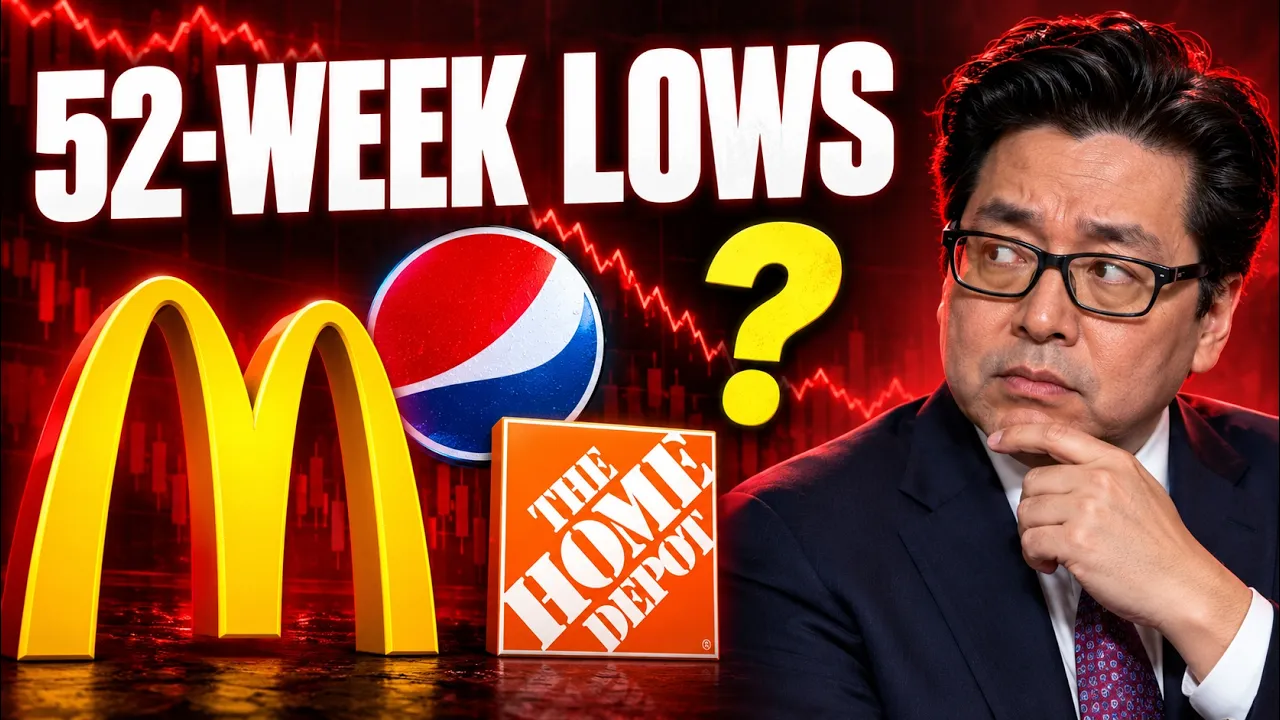
The stock market is up this year. Nvidia, Apple, and parts of technology have pulled higher, but look away from those names and a very different market appears. We've got Home Depot, Pepsico, and McDonald's, which are all trading near their 52-week lows. These aren't obscure companies waiting to prove their business models. They're three of the most familiar businesses in America. Now, take a look at McDonald's. It's fallen more than 22% this year. Investors have just been given a new long-term growth plan. Yet, their shares, they've continued to slide. We've got Pepsico. That's yielding 4.6%, a figure that would once have seemed unlikely for this stock. But, a high yield is only attractive if the cash flow supporting it ultimately holds up. And then we've got Home Depot, which is approaching its own 52-week low. Its customers are still spending, but the housing market, that's yet to provide the recovery that many investors expected. And honestly, the wider backdrop matters here. The S&P 500, that's gained around 12 and 1/2% while the 10-year Treasury yield, that's climbed by about a full percentage point this year. And we've got some fresh data today. The final September consumer sentiment came in at just 48.1. That's a picture of households that are worried about prices and their financial outlook. All while in the background, we have the stock index which continues to climb higher. And this gap is the point of today's video. A rising index does not mean every consumer business is enjoying a healthy environment. Nor does a falling share price automatically give us a bargain. So, what I'm doing in today's episode is I'm putting these three stocks through the same test. What has actually gone wrong? What the business can realistically earn? What the dividend costs? And how much improvement the current price already assumes? With Pepsi, their problem is whether it can persuade customers to buy more rather than relying on higher prices. McDonald's must win more visits while helping franchisees fund a major overhaul. And then Home Depot, well, they need a housing and project cycle that eventually improves. The question is which of those recoveries offers investors the best reward for the risk that they take on today? And by the end of the episode, I'll rank all three from worst to best and tell you the one that I would choose at these prices. The answer is not simply the stock with the largest decline. And before the individual companies, listen to how Tom Lee frames the effect of high yields. It explains why being more demanding about growth and balance sheets, even for household name stocks. >> I think both perspectives make sense. You know, yields have risen to a level that are competing with stocks. We're trying still I think the market's still trying to decipher why yields are higher. I mean, I think there's multiple reasons. But I think what's kind of lost in the conversation is two things. Number one is uh where will rates be in 6 months because where will inflation be? And second, I think rising yields make competition better for stronger companies. Meaning, there are going to be some companies that actually become more attractive as yields rise. >> That does not tell us to buy every strong company. It tells us to ask whether its strength is already priced in. All three have recognized brands, their cash flows and future expectations, they differ considerably. And you can see the consumer businesses now account for a much smaller share of the index than what we've seen historically. That may create opportunity, but I want evidence at the company level before calling this a buying moment. So, I'm going to start with the stock whose sell-off ultimately looks most dramatic. And then we're going to end up seeing whether a large dividend or a possible housing recovery offers a strong investment case. And kicking off with McDonald's, which trades at $236, very close to its 52-week low at 234. And we can see a double buy rating from Seeking Alpha Wall Street. Although not that strong, both of them around four out of five. And year-to-date, it has crashed down 23% while the S&P 500 is up more than 13% over the same comparison over the last year. Well, it's still down 22% over the last five, still down. Over the last 10, you would have though doubled your money, but you can in fact see this one did peak. We're talking in fact this year $341. And when we talk about the performance, it's not been great. The disappointment extends beyond this year. If we look at the five-year price return, well, it's actually negative while the index, both S&P 500 and the QQQ, they've advanced sharply. Now, bear in mind the chart here excludes reinvesting those dividends, but it captures how far the expectations have changed. And what makes the food interesting is that earnings, they haven't collapsed alongside the stock. Trailing earnings, we can see around $12.31 per share, while the share price has been going in the opposite direction. And then if we talk about the multiple, well, that's compressed around 18 times forward earnings, near the bottom of the 10-year range. So, the first question is, has the market become too pessimistic? And when we take a look at the data from Simply Safe Dividends, again, forward PE sitting around 18, their five-year sitting at 24. And on the other side, the yield sitting pretty much at the highest in at least the last five years, 3.3% versus a five-year of 2.3. We're still looking at Simply Safe Dividends. Looking at the blue tone in fact, which highlights intrinsic fair price, we can see there's a disconnect which only is getting larger and larger since around May-June. This indicates a potential undervaluation signal. Zoom out last 5-10 years. Metrics, while not as fast as we'd like, they are moving in the right direction. One thing to note though, this company over the last 10 years has given investors not many chances, but the odd chance here and there to buy it in an undervalued level. Is this what we're seeing today? Because look, even with analysts giving it around a four out of five buy rating, they're expecting this one to climb to $300 over the next year. Implied around 27% upside from today. You can see the more bearish analysts at $250, that's actually higher than where the share sit today. The more bullish extreme going up to 390. Where remember, the scale of the company is extraordinary. They've got more than 46,000 restaurants worldwide. Nearly 95% they're operated by independent local owners, which gives the company a different economic model from a typical restaurant chain. And the model helps explain operating margins above 45% as we can see here. In fact, on a trailing basis, brand property interest and franchise economics, they produce substantial profit from the revenue that McDonald's reports. And not only very impressive margins, but we're seeing efficiencies. The margins improved over many years. This is a real strength and is why dismissing McDonald's as a broken company before the shares fell, that would be a mistake. Because look, analysts they still expect around $12.90 earnings per share this year. They're expecting that to climb to around $13.87 by 2027. That is growth, although it is hardly the sort of explosive recovery the share price chart might make you imagine. And in their most recent quarter, Q2, well we can see EPS that beat expectations, 338 332. Trivial beat, but nonetheless up by 2%. Revenue that narrowly missed the estimate, but both earnings and revenue they improved on a year-on-year basis. So, the results alone don't really explain the subsequent investor day reaction. The harder question here is customer traffic. McDonald's CEO has said the company should plan for developed market industry traffic to remain largely flat with on top of that elevated inflation persisting. This is the clearest explanation directly from management for why a cheap-looking multiple needs scrutiny. Listen to what the CEO says the company expects from its operating environment. >> And one of the things I've talked to our team about is we need to stop talking about that being a different difficult environment and just say that is the environment because I think as we look out forward, we're not expecting things to change. We're not expecting that the industry all of a sudden is going to go to having, you know, robust traffic growth. We think that's going to be largely flat. We do think inflation's going to be with us for, you know, unfortunately, I think many more years at an elevated level. >> That is why a lower PE may be justified for a while. McDonald's has to gain customers from competitors, sell customers more often, or improve efficiency. It cannot simply assume a rising industry will do all the work. Where they answer, it includes chicken and beverages. Management wants to gain 1.5 percentage points of global share in each category by 2030 while maintaining its position in beef. Now, these are targets. They're not realized sales. Where there's also proposed advertising business built around the company's digital reach, it's an interesting potential margin opportunity, but I wouldn't assign it a large value before really the earnings become measurable. And the central investor day announcement was around 8 and 1/2 billion support for franchisees through 2036 including around 5 billion through 2030. It includes rent relief and capital support for modernization and technology. And ultimately, the spending could make restaurants faster and more profitable over time. McDonald's estimates substantial restaurant efficiency benefits, but investors have to wait to see the return while accounting for the support being provided. Now, I'd be careful with the claim that this proves the franchise system is falling. It doesn't. It does show that getting better results will take investment from McDonald's as well as the operators. And one thing that's important here is the balance sheet capacity. Net debt to EBITDA, we can see is at 3.18 times on the trailing measure with a projected 3.05. That is manageable, but is less comfortable than Pepsi's figure, which we're going to move on to next. And we can see the dividend is going to say score of 77, and September's increase was 3.8%. Incoming investors are being paid more today because the share price has fallen. Yet, the projected free cash flow payout is 69%. I'm not going to call the dividend endangered. I am saying a 3.3% yield should not be mistaken from limited room to raise it rapidly. And the trailing free cash flow, that's around 7.8 billion. It's improved, but it's not tracked the share price decline in a way that makes every valuation assumption conservative. Now, here is the test for McDonald's. We can see here free cash flow 2025 came in at 7.2 billion. We've used what the market expects from analysts at 8.3 billion in 2026, and then assuming 9% annual growth. Now, under these assumptions, the fair value comes to $246. That's roughly 4% above the market price, where the reversed DCF says 8.5% growth is already priced in. Now, the blended value, that is much higher, $296, but it also includes a multiple valuation here, as well as a dividend discount model. Now, this is all worth considering if you were to use a blended rate, well, you would in fact get a margin of safety around 20%. And the returns towards the old peak could produce strong returns. yet that requires investors to award McDonald's a rich multiple while traffic is weak and the investment program is still being proved. Now, on top of that, bear in mind there's also changing eating habits and weight loss drugs. They're another risk to monitor. Now, I'm not going to claim they explain the entire sell-off. Pricing, value perception, franchise economics, and traffic, they're far more immediate questions. So, McDonald's is probably third ranked for me today. I admire the business and can see why long-term shareholder might add gradually. At this price, I want more cash flow upside before calling it the best of these three. And then in second place, we move to PepsiCo trading at $128, $129. Pretty much as we can see here at 52-week lows. Where we just get one buy rating, very weak at that, from Seeking Alpha, 3.7 out of five. Wall Street giving it a hold. And the shares, they're down 10% year-to-date. Over the last year, down eight. Over the last five, down 16. Over the last 10, not really great, especially factoring in inflation. I'd probably say real terms, if you didn't reinvest the PepsiCo dividends, you'd have a negative return. And this is precisely the sort of stock dividend investors start watching closely. Familiar products, decades of distribution, and a yield that's moved well above its normal range. Now, the 4.6 yield that we're seeing today, the highest it's ever offered in at least the last five years, is significantly above the five year sitting at three. The forward PE also the lowest in a long time, below 15. Five year average sitting at 21. We're on the blue tunnel, similar to McDonald's, we're getting an undervaluation signal. Although the underlying metrics on this one has actually been declining over the last year. Zoom out to the last 10 years, looks like it really much peaked mid-2024. Since then, we're in a decline. But also, like we saw from MCD, this one very rarely to be in a severely undervalued signal prior to 2024. We'd have to go to the Covid drop than 2018. Now, the yield itself we can see here is close to the lower end on the normalized earnings charts 10-year range. So, if you only look at the multiple and the yield, well, Pepsi might actually appear to be the obvious winner today. And look, there is genuine business strength. Pepsi has a large snacks business, a beverage business, and substantial operations outside North America. The second quarter, well, we can see they reported revenue of 24 billion, up 6% year over year. And quarterly revenue beat the estimate, although core EPS $2.20 came in slightly under $2.21, but neither result alone explains why investors have marked the shares so heavily. Year over year, they are up, but we're talking around the mid single digit range. Well, Pepsi is actually one of those companies that earn strong margins relative to the sector. 54% gross margin, we can see above the sector of 35. In terms of other margins, let's look at the EBIT, for example, 16 above sector nine. And bottom line net income 11 cent versus the average at four. But profitability is not the principal problem. The problem for this company is the mix of growth. For several years, higher prices did much of the work, while company-wide organic volumes fell. Consumers, they're eventually pushing back when snacks and drinks feel too expensive, and it's why this story matters about Doritos. Pepsi could lift revenue by raising prices for a long time. The risk is that it loses purchase occasions or shelf space if customers stop accepting them. The important distinction is between a brand that can charge more and a brand that can charge any price. A strong brand still has to offer customers a reason to keep choosing it, and their recent company data is mixed. North American convenient food volume was flat in the second quarter, while North American beverage volume fell 4%. International businesses helped the overall picture, and there's also been some progress. North American convenient food volume improved on a year-to-date basis. That matters, but I need to see several quarters of the company of durable volume recovery before treating the problem here resolved. And don't forget the consumer backdrop complicates the recovery. When household budgets are squeezed, a familiar brand may keep its position but lose frequency, package size, or some of its pricing power. Where perhaps you'd have poorly planned selected price increases after earlier cuts. The spokesperson said the new prices would remain below where they were before those cuts. The result for volumes remains to be seen. And then throw in a few analyst downgrades. The recent downgrades and reduced targets reflect the concerns about North America and affordability. I'd use the headlines to explain sentiment but not as an independent estimate of intrinsic value. Now consensus expects $8.56 of EPS in 2026, rising to $8.95 by '27. Pepsi itself continues to guide 2 to 4% organic revenue growth and 4 to 6% core constant currency EPS growth this year. Now these are respectable figures for mature staples company, but they also show why the valuation needs to stand on realistic growth rather than the assumption that the old multiple must automatically return. Now the income case is the best of the three. We can see Simply Safe dividend scoring in an 80 safe score, an A+ credit rating with the most recent increase this year being 4%. But here's the qualification. Dividends consumed around 85% of trailing free cash flow with 77% projected for the next 12 months. It limits how fast the payout can grow without better cash generation. And net debt EBITDA is around 2.07 projected to fall to 1.98. The balance sheet is stronger than McDonald's on this measure, and it gives Pepsi time to work on the volumes. Where we can see revenues grown over the decade, but annual free cash flow, that's been much less smooth. And Wall Street, they forecast on $153 over the next year, 19% projected upside. And you can see solely on the DCF model, we've used 6%. Now, that is above the 5-year CAGR and 10-year CAGR. Most recent year was 9%. It gives a value of $145 above the market price of $129, around 13% growth with a reverse DCF highlighting 4.4% subsequent growth priced in. Now, if you want to look at the blended rate, we get to $171. It's a plausible optimistic reference, but I personally anchor the decision closer to what we can see from the cash flow case. So, Pepsi is my second choice. For someone primarily seeking current income, I can understand preferring it. For the strongest total return opportunity, I still need more confidence that volumes and cash conversion returning. Now, before we move into stock one, Home Depot, I want to let you know that minutes ago I've released my latest weekly article screening 217 dividend stocks. You can click on the pinned comment below to sign up, read that article, as well as all these others straight away. Drop one every single week. We uncover severely undervalued stocks, as well as a brief update of the market overall. Now, jumping into Home Depot, trading $293 pretty much at 52-week lows. Now, we get one buy rating, Seeking Alpha with a hold, Wall Street four out of five. Whereas, down 15% year-to-date, over the last year down 28, over last five down 14, over last 10, I believe the best one from the three today up 128%. And with it being down 15% year-to-date, the latest quarter, it was actually better than what analysts were expecting. Now, compare the company like we've done with the other two against the S&P and the QQQ. There's a sharp split from the index, but Home Depot's problem is easier to state than Pepsi's. When homeowners aren't moving and borrowing is expensive, many large projects can wait. And the shares, well, they've also disappointed over 5 years on a price return basis. It creates a potential opportunity if the business is temporarily weak, rather than permanently less valuable. And we can see in their most recent earnings, where they reported sales of 47.9 billion, EPS $4.92, we can note a double beat with reported comparable sales growing 1.7% including 1.3% in the US. And that is the positive case. Customers are still shopping, smaller projects are continuing, and Home Depot's business is producing results despite an unfavorable housing environment. And this first short clip puts the comparable sales improvement into plain English is worth hearing before we turn to what management expects for the remainder of the year. >> Same-store sales though, 1.7%, the best in a couple of years. That was really driven, you know, Canada was strong, Mexico was strong, but the US even put up a 1.3%. Um, and it seemed like, you know, some of their spring assortment did very well. Big ticket items, think grills, patio furniture, gardening items. It seems that they did pretty well in the quarter. >> That sounds promising, but one strong spring quarter is not the same as a full housing recovery. We need to compare those results with what Home Depot is willing to forecast. And you can see transactions have been under pressure over several years. Inflation can lift the sales figure even when fewer people are coming through the tills or taking on major renovations. Management has described a customer doing necessary work while postponing bigger discretionary projects. That is why Home Depot can produce a decent quarter and still sound cautious. Replacement part of repair or a modest garden purchase cannot substitute indefinitely for a full renovation. The large project customer is where an improving housing market can make a meaningful difference. And margins, well, we can see they're showing some pressure. Trailing EBIT, we're getting around 12%. That's below the 5-year of 14%. It leaves room for improvement, but it also shows the slowdown has got real cost. And tariff cost and consumer affordability, they add to the challenge. Home Depot received tariff-related refunds that helped recent profitability. So, I'm not going to extrapolate that benefit indefinitely. And the company also reaffirmed its full-year guidance around flat to 2% comparable sales growth with adjusted EPS expect to be roughly flat top to 4%. That is a cautious outlook after the Q2 beat. The analyst in this second clip makes a distinction I care about. Good reported results today, but no assumed rebound in housing during the second half. >> I will say though, looking at that reaffirmed guidance, it looks like there's a lot of uncertainty heading into the back half cuz it sort of implies more of a slowdown in the that top-line growth as we get into the second half. Meaning, they're not definitely not expecting any rebound in the housing market, and maybe continued pressure on consumers. >> That is a reasonable way to forecast. It also means investors buying Home Depot today and not paying for a management promised near-term boom. The upside case depends on a later improvement. And Home Depot is much more than a bet on next quarter's DIY traffic. It's distribution network, stores, and professional customer relationships, they're difficult for a smaller competitor reproduce. It's investing in speed and service for those customers. The pro market is a large opportunity, although an addressable market figure should never be confused with revenue Home Depot's already secured. The professional side has stayed active while the DIY customer helped the recent quarter. Both are important and neither removes the effect of slow housing turnover on larger projects. Here is the potential catalyst. People cannot postpone moving, remodeling, or replacing major parts of a home forever. Timing is uncertain, which is why we want the valuation to work without an immediate rebound. At roughly 19 times forward earnings, Home Depot trades below its five-year average of 22.5. Its 3.2% yield is also above the five-year of 2.5, both indicating potential undervaluation. For which the blue tunnel also gives us the same conclusion, sitting just below the bottom end. We saw this a little bit in May, but zooming out to last 5-10 years, you can see the last time we actually got a severely undervalued signal was around mid-2022. The dividend safety score is also 80 safe with an A credit rating. The latest dividend increase was just 1.3%, which reflects the slow near-term growth rather than a rapid income growth story. And you can see the forecast free cash flow payout is about 60% compared with Pepsi's 77% projected payout. That gives Home Depot more dividend coverage. Even though Pepsi currently offers the higher yield, and Home Depot's net debt to EBITDA is around 2.2. The balance sheet is not free of obligations, but it's not the main obstacle to waiting for demand to improve. And consensus they're expecting around $15 of EPS for the fiscal year ending Jan 27, and then rising to $16 for Jan 28. That's modest growth consistent with a business waiting for a better housing cycle. Now, the growth rating is weak because near-term estimates are weak. That is exactly why I test the investment on cash flow rather than assume a return to the old PE. And the DCF that we're using, well, you can see 2025 they reported 16.3 billion free cash flow. Analysts are actually expecting a drop to 14.5 billion 2026. So, this starting point builds in some deterioration. It's still a forecast. Cash flows move around substantially in the past years as we can see. In fact, so So, not going to present any single growth rate here as certainty. This scenario range, in my opinion, it matters more than just one fair value figure. And using the middle rate, 8% annual growth, where we get to $350, that's around 20% upside from the current price today. If we see this slow down to 6%, well, it drops to 297, not too dissimilar from the price today. With the model telling us that right now priced in is 5.8% growth with the important qualification here being that the 8% sustained free cash flow growth is more optimistic than the near-term EPS outlook. Although it's in line with their 10-year CAGR, I'm buying the possibility of a recovery, not declaring that the base case return here is guaranteed. And a modest growth recovery plus some P/E improvement could produce attractive returns. Neither has to arrive tomorrow, and neither should be assumed solely because Home Depot once traded at a higher multiple. This is why Home Depot edges out the others for me. The business is still profitable through a difficult cycle. Dividend coverage is reasonable, and the share price leaves a clearer recovery path to test. If housing remains frozen for years, my ranking could be wrong. I would watch comparable transactions, large project demand, margins without temporary tariff benefits, and the cash flow that funds the dividend. So, here's my ranking. Third, McDonald's. Its brand and margins are outstanding, but a model assuming 9% cash flow growth gives only around 4% upside. Where if you were to use, in fact, the blended rate, it increases to 20%. The new program may make restaurants more productive, yet it requires support for franchisees and time to prove the return. For me, the sell-off alone is not a sufficient margin of safety. In second, PepsiCo at 15 times earnings and a 4.6% yield is the most interesting stock here for an investor prioritizing income today. But I want to see volume recovery translate into cash. Its projected free cash flow power is still elevated, and the DCF's attractive value, it depends partly on a higher starting cash flow forecast. First, Home Depot is my choice of the three at these prices. The dividend is covered, the multiple has come down, and the housing slowdown has created a possible recovery opportunity. This is a measured buy, not a claim that Home Depot must return to $350. At 6% growth, the model offers little upside. At 8%, it offers considerably more. The range is the real investment decision. For a pure income portfolio, you may reasonably choose Pepsi instead. For a defensive brand you intend to hold for decades, you may favor McDonald's. My ranking today is based on today's prices against the recovery required. A market making new winners can leave good businesses behind. Sometimes that is the opportunity. Sometimes the lower price is simply the market recognizing slower growth. The numbers decide which story is more convincing. At this price analysis, I would buy Home Depot first, keep Pepsi high on the watch list, and wait for more evidence or a better price in McDonald's. Now, tell me which one you would buy. The 4.6% yield at Pepsi, the global franchise at McDonald's, or Home Depot ahead of a possible housing recovery. And what assumptions would change your answer? Don't forget as always to sign up to the weekly news, and grab that latest copy that we released today. As we said, one every single week. More importantly though, have a great day. I'll see you all on the next one.

Comentários 0
Entre para participar da discussão.
EntrarAinda não há comentários. Seja o primeiro a compartilhar sua opinião!