The News On NVIDIA Stock, Micron, Anthropic, OpenAI - NVDA Update

- Retorno do vídeo
- —
- Chamadas
- 1
- Compra / Venda
- 1 0
- Publicado
Recomendações
Entrada é o preço de fechamento do ativo na data de publicação. Atual é o último fechamento registrado.
-
Entrada $212,17 15 set 2026Atual $212,17 15 set 2026Resultado +$0,00vs. índice −0,5% SPY +0,5% no mesmo período
Citar esta recomendação Ver trecho original (24s) *
Contexto da transcrição original
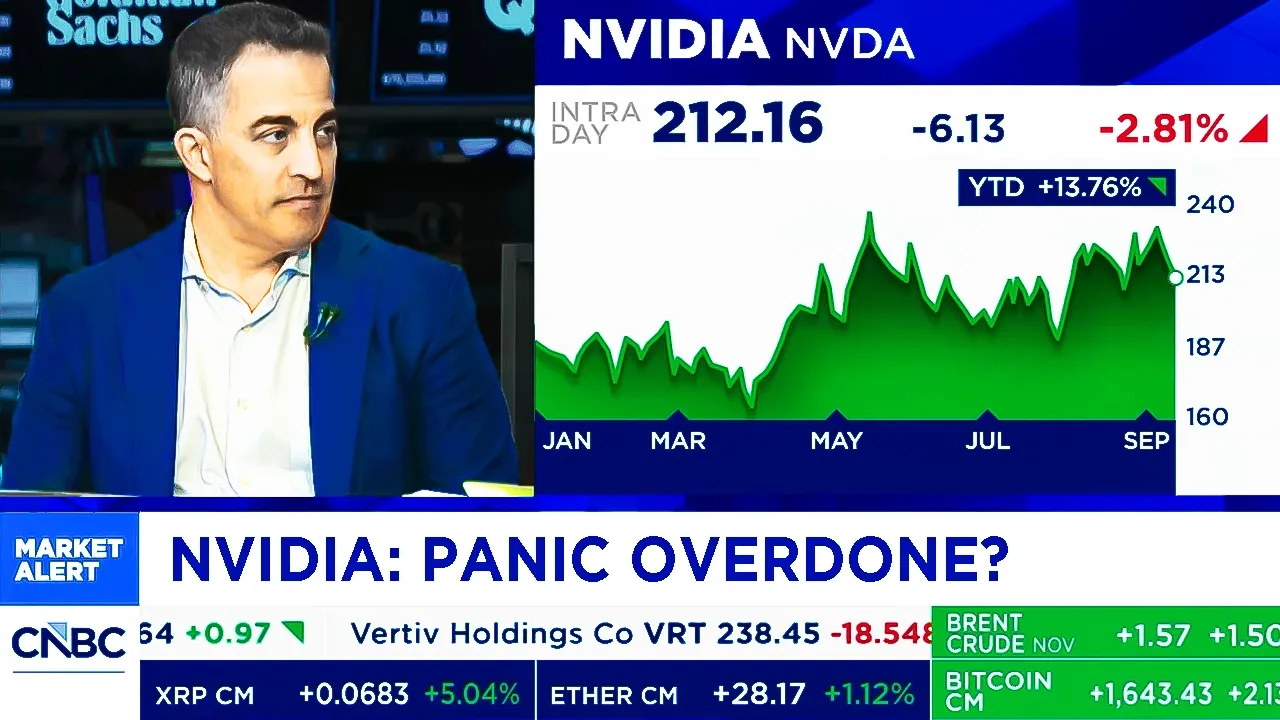
…e to um steer your portfolio in the qual or in the direction of higher quality, more profitable, more durable businesses. And so um you know one example of that if you want to invest in AI data center capex today uh amid some bad headlines I think Nvidia is probably the place to go. It has the most compelling valuation out of that group. Um I think that uh Nvidia is going to gain market share um you know of the large AI capex you know pie that the big hyperscalers are spending today and and the valuation is attractive…
I think Nvidia is probably the place to go.
Contexto extraído por IA one example of that if you want to invest in AI data center capex today uh amid some bad headlines I think Nvidia is probably the place to go. It has the most compelling valuation out of that group. Um I think that uh Nvidia is going to gain market share um you know of the large AI capex you know pie that the big hyperscalers are spending today and and the valuation is attractive.
Transcrição Completa
What do you tell an investor how heavily they should be invested, how much risk they should take on uh between now and the end of the year? >> Yeah, I think it makes sense to um steer your portfolio in the qual or in the direction of higher quality, more profitable, more durable businesses. And so um you know one example of that if you want to invest in AI data center capex today uh amid some bad headlines I think Nvidia is probably the place to go. It has the most compelling valuation out of that group. Um I think that uh Nvidia is going to gain market share um you know of the large AI capex you know pie that the big hyperscalers are spending today and and the valuation is attractive. So I think Nvidia is a good place to kind of high-grade your portfolio if you want data center capex exposure and you can do that across every industry. I think quality is is attractively priced today in the market. >> There were um some real fear-mongering stories going around for today's trade because of the concern and the the long letter from anthropic CEO. Um are you not afraid of a huge selloff and instead trying to focus on big picture? Yeah, I I think that Dario Amade's letter was very reasonably written. I mean, very very well written. Um I think that he has information that the average investor, myself included, um do not have. That's important important to take his perspective into consideration, but um you know, other perspectives matter too. And uh Jensen Wang's, you know, um comments I think are interesting. And then you also just take into account Dario Amade's track record of like long-term predictions. It wasn't too long ago that he was predicting a 10% unemployment um rate here in America and I think it was maybe 25% of white collar employees losing their job or something like that. Um we're nowhere close to scenarios like that today. Those long-term predictions five, six, seven years out, those are extremely tough. Take it from me who's been doing it for 20ome years. It's not easy to make those predictions correct. So, I don't put a whole lot of stock in his letter. I I read it. I think it's very interesting, but I'm not going to base um investment decisions based on solely that today. Um I'd like to see uh I'd like to see more and I think that today's models are already very very capable and people are finding new ways to put them to use and we're going to see that for years and years. So, I'm not terribly concerned about the AI buildout um as a consequence of this weekend's letter. >> Gil, I want to come to you out of the block. you came out with a note this morning. Uh, very intense note. I appreciate that passion. On the morning like this, where is your head at on all things AI? AI is a very powerful technology and right now it's very good at hacking systems. That's it. There is no threat to humanity right now. The only threat is to software systems. And we have an opportunity to take these models and harden those that code bases for those software systems so these terrible things don't happen. The uh very orchestrated campaign by open AI anthropic and degrowth politicians to scare us into regulation is just their attempt to consolidate power. Anthropic and open AI want a a stifled competition. They know that they can handle regulation. They can dictate regulation and that regulation would prevent competition from coming on. At the same time, those politicians are jumping on board and cooperating with this because they want to slow down our progress. And neither of those things is good for the market or for our country. We need to develop this technology. We need to run full speed. That doesn't mean we can't monitor and put guard rails and be careful. But really, the only thing we should be do doing now is hardening the code base. And if these companies were as benevolent as they say they are, they would give us all their best software to harden our code bases for all of our companies and all of our critical infrastructure so that those models can't be used by somebody bad to create damage. But that's not what they're doing. They're demanding regulation to stifle competition. >> And Nancy, when I talk to you, you're always one of the people most bullish on AI. How have the weekend's events altered maybe your view? Um, you wrote in your note the three amigos writing. We have Mike Shepard earlier saying that they are in unison. Does this change anything for you? >> Well, I I think Isabelle, thank you first of all for having me. Um, and congratulations on stepping in for the team. Um, I I actually think that this is more likely to be a hiccup than it is to be an end to the AI trade. The the AI genie is out of the bottle. We're hearing it across sectors in our in our uh earnings calls and uh theme development. My team puts together a list of themes based on what they're hearing from uh cross industry, cross uh sector companies that are uh employing AI and to what advantage. Uh I do think this is I don't want to say it's a PR move, but I think it is a timely uh pause which can't hurt. I don't think a correction would hurt this market either. We've we've run pretty hard pretty fast over the last few years. So I I think if as investors let the the dust settle um and and I think investors still believe in the trade, I think traders are the ones that are driving the short-term volatility. So uh let it settle and then step in and buy the high quality names. The the AI buildout backlog is in place uh and and these these data centers are being built. Um that that will continue to drive growth for some time. What the market is concerned about obviously is where are we two to three years out. I think we will still be in a buildout uh that's a once in a generation technological revolution. Nancy, I want to hinge on what you said earlier that this may be a kind of like a PR move because we do have Enthropic posting their first support um profits and we also have them. I mean, of course, we know that they have their much awaited IPO. I mean, if competitors also pays back releases, does that protect Anthropic's newly won margins or do you think that slower iteration in general will risk losing the momentum that it got? >> Well, so I'm going to answer that backwards, Isabelle. I think um OpenAI was not going to do an IPO this year anyway. So, this gives them some cover. Uh I think Anthropic will move forward and will continue to be a leader in the space. And we know that Elon has always expressed concern, which is prudent. I'm I'm not poo pooing uh the potential uh problems or difficulties that AI will present. But I do think this gives the companies a chance to pull back uh put in place some guard rails which may or may not have much of an impact but will uh soothe fears and then I I do think uh Anthropic continues to go forward uh and will continue to have one of the highest margin businesses uh because their mode or their um flavor of AI is much more sophisticated. And then you're seeing the hyperscalers as potential winners today. Um, Google will continue to be an AI leader. Uh, I I'm less impressed with Meta, but this will cause them to have to spend less potentially. So, there there is good news and the bad news. >> Yeah, definitely. And for let's go to the quote bad news first. So, if this pacing actually holds, Nancy, who is more to lose? Is it the labs raising for frontier capability or are the hyperscalers? Although you just noted that the hyperscalers may be having a good day soon. Yeah, I think it's always the emerging technology companies where investors are more likely to pause, but I again I don't think that'll be permanent. This feels a lot like Deep Seek where we had the initial initial hysteria and then people stepped back and said, "Okay, um this is an opportunity to buy these names. There was lots of sighting of Jevon's paradox." uh and so I think that what will happen is this will will force the naysayers and most of the naysayers in Washington these are people who also read the headlines don't have a deep understanding of the technology don't live in the same world that we live in and um and this gives them a platform uh opposing AI that is I think this will cause them to have to step back AI uh leaders are saying yeah all right we think there are some areas where we can improve rove. Uh you've heard them all say it. It's this yet. This weekend was not the first time. And I think uh that will continue to benefit the big players. Uh the little players will still get funding, but maybe not um across sort of massively across the board. And I actually think that's good uh for the development of of AI and just uh general technological innovation. I think [clears throat] that the obvious losers initially are the infrastructure names. And by that I don't just mean the the quant services or GE vernovas of the world, but I mean the chip makers and the memory providers. I actually think that's an opportunity if weakness prevails. We'll we'll be adding to some of those names where we don't have full positions. But I I don't think there's any need to chase the down trend. Isabella, I think you want to step back, let it settle, and then pick your way through uh as as things kind of calm down a little. Welcome back. Anthropic CEO Daario Amode leading a new push to slow down frontier AI research, unveiling a three-step plan in a new essay over the weekend as AI researchers share their fears for humanity safety. Sam Alman and Elon Musk quickly agreeing with the need to slow down. For more on the impact on the tech trade, let's bring in Ben Wright as head of tech research at Melius. Already having an impact, Ben, with some of these chip stocks selling off, how how is it a gamecher for you in any way on the thesis? Oh, you're mute. He's muted. >> Sorry. >> Sorry. Somehow got muted there. Uh >> yeah. Yeah. >> Dario's model muting me there. So, uh so I think there were a couple good things hidden in here that RSI, uh recursive self-improvement, that train has left the station. And I think that's pretty good. I think that those two companies are ahead and that's going to use a lot of compute and I also think cyber is going to go through the roof and a lot of tokens are going to be used for cyber uh and you're going to need models to actually protect us from the models but obviously no one's going to care about that today. Uh what is going to happen today is that the AI losers will actually go up the ones that might be disrupted from AI and those that potentially benefit from having less of a capex. But uh I actually think these guys will probably get together pretty soon, talk about the guard rails and uh hopefully move forward. But uh they really need to get together and communicate to the street. Um and hopefully like someone like Jensen can herd them together and have them communicate to the street on how they're going to deal with this. >> What? Meaning what? meaning that Trump just tweeted that he doesn't want to regulate this sector to death and apparently it's going to have to come a lot from these leaders. And you know it it is very I mean look you could be very cynical about this whole thing. I mean look they're they're they're running a 100yard dash and Open AAI and Anthropic are sitting on the 70 line and no one else is even close. They are at RSI. No one else has it, not even Google. And that is putting them way ahead of everyone else. So now they're in position to implement the guard rails, implement the regulations that help their companies and help them IPO. And frankly, they're super well resourced, too. So this is um and they could be morally correct and say they got to regulate all this stuff and talk their book at the same time. Um, in [clears throat] short, I think what they should do, but they they need to step back. Like they may be really good at models, but they're not good at talking stocks and what they're doing is freaking the market. >> Wait, muted again. But I guess the point is that the message to the street doesn't necessarily match up to the message to the world when it comes to safety. Um, and and that's, you know, obviously a concern of investors. But I just everybody's weighing in on this. All the corporate leaders, Nikesh Aurora, the CEO of PaloAlto, whose stock is up a lot today. These cyber security names really gaining on some of these safety fears around AI. And I thought this was a notable nugget from Nikesh's post that that he just put up. He basically it was skeptical about it. He said, "Why do we do why why do this?" I do believe deep down this is a commercial strategy, a ninja strategy. The liability associated with a model gone rogue has the potential of wiping out the economic opportunity of any frontier company. How do you best show the duty of care? You show that you care. How do you make sure you don't lose out to your competitors? You get them to do the same. If that becomes the industry standard for duty of care, you have a collective first line of defense. Who do you get to govern this? Yourself. That is what I think will become the Achilles heel. um basically that it's a master plan of Anthropic um and others to to try to help defend themselves against potential this liability as the the risks continue to pile up around things like cyber um and what this self-recursive technology can do. Basically self-improving AI models that that Anthropic has reached. >> Yeah. Uh George Kurt's uh similar tone. The frontier will move at whatever speed it moves. uh pacing what comes next doesn't secure what's already here. And to I mean we had a gentleman on set a moment ago say the genie's out of the bottle. That's almost exactly what guys like Curts are saying. >> There are amazing opportunities around the world where the AI hasn't even come to yet. Which tells us that we're still, you know, probably early in the AI cycle. >> That would be a new m that that means this is a roaring buying opportunity right now. The semi ETF down 4%, you know, Nvidia down. So, is this the kind of thing you'd be leaning into? I mean, to the extent that you can, you know. >> Yeah, Kelly, I think we might look back and say, you know, after a tough summer for the AI trade, the, you know, right now we're also don't have earnings to hang on to. You know, this is that last bean on the pile of reasons not to be there. You know, stock performance being one of them because the short-term investors look at that short-term performance and they don't like it. So, I think you've got some people moving away here when they should be moving in. classic reverse psychology. >> All right, I hope you're all doing well today and staying calm in this market. Monday was a mixed day throughout the market with AI infrastructure stocks trading solidly in the red after what happened this past weekend. I'm going to try and cover what happened this past weekend, but I want to preface by saying that sifting through all of this feels like going through a massive tangled web of confusion with many different opinions and many overlapping factors. Upcoming IPOs, geopolitics, the upcoming election, competitive threats from open source, regulatory capture. There's so much tangled up into this situation and it's still changing rapidly. So things may be different by the time you see this video and I apologize if I miss anything or get anything wrong. Now I'm going to try to give you an idea of what happened and what I think some of the potential implications are. All of this started this past weekend with an essay from anthropic CEO Dario Amade titled we must pace the frontier. In that essay Dario writes quote we must slow the pace at which we improve the capabilities of AI models. Progress will still seem fast and we must make wise use of the time we gain. Daario proposes a three-point framework which includes first embedded thirdparty evaluators at frontier AI companies that have employee-like access. Second, coordination between frontier AI companies and democratic countries to establish common safety standards as well as limits on the rate of unchecked AI progress. And third, global cooperation including attempted coordination between democratic and authoritarian governments. I want to pause for a moment and say something very important. At the time I'm making this video, the only concrete change that has occurred following Daario's essay is that both Anthropic and Open AI have committed to having thirdparty embedded evaluators. That appears to be the only concrete change at the moment. At this point, just about everything else is just talk, musings, speculation, and proposals. Some of it may come to fruition, some of it may not come to fruition. Now, let's continue. After Daario's essay was published, OpenAI Sam Alman posted online saying that he agrees with Daario that they need to pace the frontier. Elon Musk posted saying, quote, "Daario is right that there should be some oversight." Peer review of AI by competitors is the right way to start this off. David Saxs made an interesting post on ext telling anthropic and open AI to go ahead if they want to pace the frontier. David continued by saying, quote, "But stop pretending you need anyone else's permission. Stop pretending antitrust law has to be suspended so you can form a cartel. Stop pretending you need a regulatory approval process that supersedes product liability. Stop pretending meter is independent when it is intertwined with anthropics investors and staff. Stop pretending you need those same evaluators to police competitors who aren't even at the frontier. Most of all, stop pretending the motivation to slow down is purely altruistic. David continued by saying, quote, "So go ahead and pace the frontier. You're the ones setting it." The easiest way not to build super intelligence is for you to agree not to build it. Demanding your preferred regulatory framework, as the price of that will look like blackmail of the public and the political system, just do it. If you do, you'll buy goodwill for the next conversation. If you don't, we'll know this was just another bid for regulatory capture or an election season scop. It's also worth mentioning since David alluded to it. I noticed a Kim made a good point saying that competitors colluding to limit production/output is illegal under antitrust law. I'm not accusing anyone of anything. I'm just mentioning this since David alluded to it in his post when he said, quote, "Stop pretending antitrust law has to be suspended so you can form a cartel." It's very difficult to know the true implications of the situation because, as David alluded to in his post, we don't know what the Frontier Model Company's true intentions are, and we don't know what they will actually do versus what they say. I would probably have a very different view of the situation if Anthropic didn't have a history of repeatedly using what appear to be sensationalized fear-mongering tactics in what appear to be attempts to gain free publicity or potentially attempts to slow down their competition. Not that long ago, Daario was comparing AI systems to weaponizable nuclear materials literally one day after Anthropic released Fable 5 and clawed Mythos 5. And of course, the mainstream media gobbled it up and gave Anthropic's new models a ton of free publicity. You cannot convince me that the timing of that essay's release was coincidental. Many of us remember Daario speaking to Congress about the potential dangers of open- source and openweight AI models in 2023, saying that scaling open- source models was heading down a very dangerous path. Many people viewed those comments as an attempt to get regulators to slow down or stifle potential competition from open source AI models. Daario has a history of publishing essays and opinion pieces discussing the potential dangers of AI. I emphasized the word potential. Just last week, an Anthropic employee posted online wildly speculating that there's a greater than 10% chance that AI wipes out humanity within the next decade. And all of this is happening as Anthropic is preparing to IPO. Look, they may have the best intentions in the world. That's possible. and I don't know what their intentions really are, but I can't ignore all of this important context when considering Daario's essay this past weekend. Now, I want to mention a couple things about Daario's three-point framework in his essay. On the topic of potentially trying to slow down competition, the phrasing under point number two advocating for quote limits on the rate of unchecked AI progress gives plenty of ammo to those who think the frontier model companies like Anthropic are attempting some form of regulatory capture to stifle or slow down their competition. And secondly, on point number three about coordinating with authoritarian governments. Even if American frontier companies were to slow down their development of AI, the idea that authoritarian governments would comply with such restrictions is in total denial of reality. Sure, they might say that they'll comply, but words and actions are two very different things and we have to consider the broader context of what's happening right now. Anthropic is preparing to go public and so there's a very real incentive to get a lot of attention and publicity right now. I'm not saying that's their motive. I'm just stating a fact. And there's also an election in November in which public push back to data center buildout is a major point of contention. I am politically independent and nothing that I say is motivated by politics. That said, we need to consider the timing and context of what's happening. I don't know anyone's true intentions. I don't know what is merely talk and what will actually translate to action. And therefore, it's difficult to know the full implications of everything that was said this past weekend. That said, here are some thoughts to consider as it relates to AI hardware companies and companies associated with data center buildout. There's a big misconception among market participants after everything that happened this past weekend. Let me be clear. Even if there's a slowdown in the training of leading edge frontier models, there's still much more demand for the current models than there is available compute to serve that demand. I thought Iron CEO Dan Roberts made an interesting point when he posted on X saying, quote, even if models never improve from here. Just rolling out what they can already do would take more compute than the world can build for years. And that brings me to a very important point. A slowdown in frontier model development does not automatically mean a slowdown in total spending. Remember, you have to train the models first. But after you train a model, you have to inference and serve the model to users. And it takes a lot of compute to do inference at scale. Even with fewer frontier model releases, you still have growing inference demand with agentic systems, open models, enterprise deployments, cyber security workloads, and so on. In other words, even if Frontier models are released at a slower pace moving forward, you still have growing usage and adoption of the current models, and we should see new use cases unlocked. I don't expect this situation to have a meaningful negative impact on AI infrastructure spending in the short or medium-term. If there's a pacing of the frontier, I think we would just see a shift toward more inference workloads. Additionally, the frontier labs that choose to pace themselves are going to be using a decent amount of compute for evaluation and alignment. That could potentially be a decently large new source of compute demand that many market participants are completely ignoring right now. Ultimately, I seriously question the idea that the frontier labs are going to slow down their training efforts to such an extent that it would have a meaningfully negative impact on total AI infrastructure spending. In fact, as all of this is happening, many have pointed out that while Anthropic is publicly advocating for Pacing the Frontier, they've secured hundreds of billions of dollars worth of compute deals over the past 11 months, and they're getting ready to IPO anyway, despite the supposed concerns. Saying something and actually doing something are two very different things. Pay attention to what they do. On Monday, The Information reported that Anthropic recently signed a 6-year 13.7 billion compute deal with Rumble. That doesn't sound like someone who plans to pull back on compute spending. Nor does it sound like someone who's going to meaningfully slow down their AI development. A potential outcome of the Frontier model company's slowing training is that they could redirect compute that would be used for training to inference that would likely result in better margins at least in a short term. And of course, if you're about to go public, investors care a lot about margins. I noticed the FT published a piece over the weekend saying that Anthropic has told investors it will be profitable for a second consecutive quarter. Importantly, this is adjusted operating profit, not gap net profit. The FTE reports Anthropic's gross margins are above 80% before accounting for revenue sharing with distribution partners and before model training costs. So gross margins are of course less than that number. That said, if Anthropic were to substantially reduce training costs and place a greater emphasis on inference, then you could have a situation where their margins are better, at least in short term. To be clear, that's hypothetical because we don't know what Anthropic's actually going to do. Also, if frontier model companies were to pace the frontier as they suggested, then they would incur extra costs associated with things like evaluation, monitoring, and alignment, which would put pressure on gross margins. I find it very hard to believe that the frontier model companies are going to willingly slow down their own internal development. But if they do, that could potentially lead to stronger margins and faster revenue growth ahead of their IPOs. Ultimately, I do not expect this situation to have a meaningfully negative impact on total AI infrastructure spending anytime soon. I can understand the initial reaction we saw in the market on Monday, but I think many market participants are just simply confused right now and not considering much of the nuance of the situation. As I said earlier, this whole situation is one big tangled confusing mess. So, I can understand the red action we saw on Monday. Markets hate uncertainty. Now, I'm not telling you what to do because I'm legally not allowed to do so. That said, I personally did a little buying on Monday and if we get an even larger dip, I will likely buy some more. Again, I'm not telling you what to do, just sharing what I'm doing and my personal opinion. Also, while Jensen was on stage speaking at the All-In Summit on Monday, the president called him and they both agreed that they're not going to allow a slowdown in the development of AI. >> Put him on speaker mode. >> How do we put How do we put on pus? >> On put him on speaker. >> Speaker. Yeah. >> Right into the microphone. >> We're getting mic. >> Hang on a second. >> Hold on, sir. We're getting a microphone. >> Mr. President, >> you're now talking to the planet. You see, the great thing about life is that Jensen can develop the most complex computer chip in the world that nobody can copy for 10 years, but he can't figure out how to put me on speaker. [laughter] We have to remember this one. So, the AI it's almost >> during the event, Jensen pushed back against a recent apocalyptic comment from a former anthropic researcher, saying that while the comments came from scientists, they were not grounded in science, which he takes issue with. In other news, it was reported late last week that Nvidia is considering investing $10 billion in Anthropics IPO. The information is reporting that Nvidia and Palanteer are limiting their own use of anthropic models due to data/IP concerns. They report that Nvidia is limiting Claude to less sensitive internal tasks because of concerns about proprietary data and model provider data practices. Elon Musk posted online over the weekend saying that he is highly confident SpaceX will be launching Nvidia Verubin Inval 72 AI computers in space next year. With all of the public push back against data center construction, orbital compute is looking more and more promising as a potential long-term solution. In other news, Bloomberg is reporting that Kioia is considering raising at least $10 billion through US ADR listing possibly next year. Looking ahead, we have Micron earnings on September 30th aftermarket close and then Jensen is scheduled to speak again at GTC Berlin on October 21st. Now, in case you're new to the channel, I want to make sure that you have at least a basic understanding of the underlying long-term thesis. So, let's cover that. Now, I don't know what's going to happen in the short term, but from a long-term perspective, I am very confident that Nvidia will be worth much more in future years than it is today. When Jensen was on the Lex Freedman podcast not that long ago, he was very seriously raising the possibility of Nvidia becoming a $3 trillion revenue company in the near future. If that happens in the coming years, then it is very plausible that Nvidia could one day be worth tens of trillions of dollars in market cap. That might sound crazy, but that's what Jensen is implying when he raises the possibility of Nvidia becoming a $3 trillion revenue company. I guess the question at that point is what multiple the street will be willing to give Nvidia. I don't know the answer to that question, but I truly do think that Nvidia will be worth much more in future years than it is today based purely on the fundamental growth of the business. Based on everything I'm seeing, the world is still computed and I expect that to continue at least through the first half of calendar 2028. In a computed environment, developers will use whatever viable compute they can get their hands on. Today, there are no GPUs that are sitting dark due to a lack of demand like there was fiber sitting dark due to a lack of demand at the height of the dotcom bubble. Back then, companies were laying fiber in the hopes that use cases and demand would eventually show up. Today, we are seeing the complete opposite. As I've said many times, when market participants compare this AI revolution to the do- bubble, they ignore the fact that the internet is already here this time. This means that mass adoption of the technology and new use case development at scale are immediately possible. We don't have to wait years for it to show up. It's already here. The world is compute constrained which means there is not enough supply to satisfy demand. New capacity is utilized as soon as it comes online. The hyperscalers are monetizing capacity as soon as it comes online. Each of the hyperscalers spoke about being supply constrained on their most recent earnings calls. Additionally, many of the clouds are building out into contracted demand. They're not blindly building in the hopes that demand will eventually show up. No, they're building out because they have signed contracts and in some cases significant prepayments from their paying customers. This AI revolution is fundamentally different from the dotcom bubble and 2026 will be a pivotal year for the AI industry thanks to the rapid adoption of agentic AI and the proliferation of agentic systems in the world's leading enterprises. The leading AI labs revenues are surging right now. Agentic coding and the implementation of agentic systems in large enterprises are new use cases that are increasing inference demand significantly that subsequently is increasing compute demand. The rapid adoption of agentic AI is why we're seeing an inflection in inference demand. It's why we're seeing the leading AI labs revenues surge. I wish both Anthropic and Open AI were public so the public could see the ramp in their revenues. I think the leading labs surging revenues may be the initial proof point that grabs market participants attention and causes them to realize that there will be a clear ROI on AI infrastructure. I think the leading labs surging revenues will also help assure investors of the longevity of Nvidia's growth since these labs revenues are directly tied to compute. If they had more compute, they would have greater revenues. It really is that simple. Demand is not the problem. The problem is a lack of supply to meet the demand. As I've said previously, I expect the world to be compute constrained at least through the first half of 2028, possibly longer. And so, regardless of what happens in the short term, it's important for long-term investors to remain focused on the fundamentals, maintain a long-term perspective, and remember that we are only in the early stages of aic systems being adopted at scale. This will increase compute demand significantly, and after that, the next surge in compute demand will likely be fueled by physical AI. We're no longer talking about digital agents performing digital tasks. With physical AI, we're talking about physical AI agents performing physical tasks in the real world. NVIDIA CFO has called physical AI quote a multi- trillion dollar opportunity and the next leg of growth for Nvidia. This industry will fundamentally transform society and NVIDIA has positioned themselves to benefit massively. NVIDIA sells the hardware for the data centers where the models are trained. They offer omniverse where the models are taught and tested. And NVIDIA also sells the hardware that allows ondevice real-time inference through NVIDIA AGX, allowing robots to have intelligent interactions with the real world, even when they are not connected to a data center. Notice that NVIDIA is taking a holistic platform approach to physical AI, and they're embedding themselves as the underlying foundation supporting all of it. Over 3 million developers are already building on the Nvidia robotic stack, and this is not getting enough attention. As for production ramps, Blackwell Ultra has ramped and remains in high demand. Vera Rubin is rolling out to customers. Nvidia Gro 3 LPX is in full production. Later on, we're expecting the launch of Reuben Ultra in 2027 and Fineman after that in 2028. We have a clear data center product roadmap stretching into 2028. And Jensen believes that AI infrastructure spinning will reach three to 4 trillion annually by the end of the decade. That means Jensen is expecting growing AI demand and an expanding total addressable market underpinning all of this. I don't think we are anywhere near any type of bubble bursting type of event. With all of this in mind, I seriously think that Nvidia still has plenty of runway ahead of it. And I think this company will be worth substantially more in future years than it is today. At least that's my view of the situation. Quick note before I wrap up. All of the compilations on this channel are edited by Finn Vid with original structure and commentary. Occasionally, the same edits appear elsewhere on YouTube. If you're looking for the original version, it's always here on this channel. Thanks for watching Finn Vid. I appreciate your support. Remember to stay calm in this market. Remember to maintain a long-term perspective and do not make any hasty or irrational decisions. With all of that being said, I hope you all have a great rest of the day. And I'm curious to hear your thoughts about Nvidia in the comments below. Please leave a like on this video so more people will see it. And while you're down there, please consider subscribing. It's free and you can always change your mind. Thanks for watching and hopefully I'll see you in the next
Comentários 0
Entre para participar da discussão.
EntrarAinda não há comentários. Seja o primeiro a compartilhar sua opinião!