But if you tell me if I like Nvidia, I have 14 or 15 times earnings or Apple have 35 times earnings. I think it's a very very clear choice to me. ... it's actually a pretty clear bet for me which one I want to be underweight and which one I want to be overweight today
Contexto extraído por IA
“But if you tell me if I like Nvidia, I have 14 or 15 times earnings or Apple have 35 times earnings. I think it's a very very clear choice to me... it's actually a pretty clear bet for me which one I want to be underweight and which one I want to be overweight today”
But if you tell me if I like Nvidia, I have 14 or 15 times earnings or Apple have 35 times earnings. I think it's a very very clear choice to me. ... it's actually a pretty clear bet for me which one I want to be underweight and which one I want to be overweight today
Contexto extraído por IA
“But if you tell me if I like Nvidia, I have 14 or 15 times earnings or Apple have 35 times earnings. I think it's a very very clear choice to me... it's actually a pretty clear bet for me which one I want to be underweight and which one I want to be overweight today”
Transcrição Completa
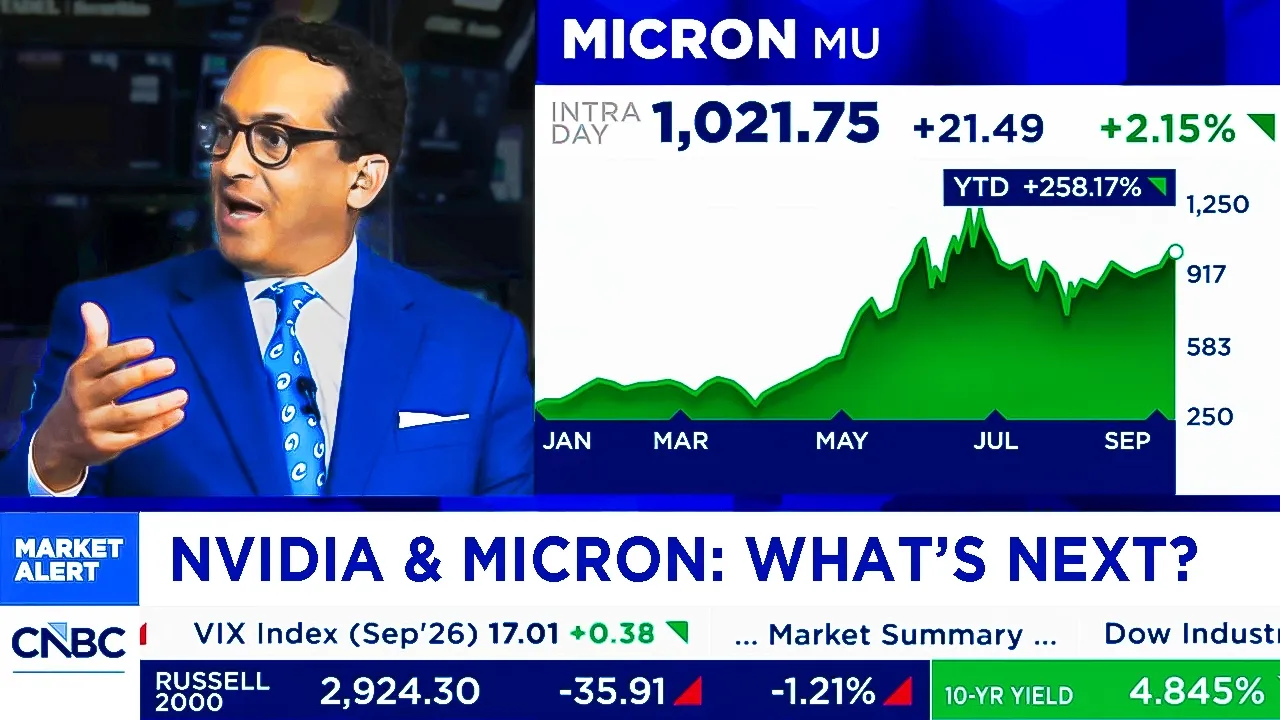
But if you tell me if I like Nvidia, I have 14 or 15 times earnings or Apple have 35 times earnings. I think it's a very very clear choice to me. One's growing 70% year-over-year next year and it's constrained by demand. Uh constrained by supply, right? We we're when I look at the Nvidia print that they just put up, I think there's such a clear path to accelerating capex for the major hyperscalers for the Neoclouds next year. a company growing 70% dominating the open source ecosystem trading at 14 15 times earnings or I got a company that's growing probably mid-s single digits going forward questions around who owns the AI operating system you know it's actually a pretty clear bet for me which one I want to be underweight and which one I want to be overweight today >> um another one of the the the issues that we talked about was oh you know the depreciation cycle of the infrastructure and there were a lot of people out there that were talking about this infrastructure depreciates over you two euros or it appreciates over 18 months or it's like a car, it's half the price when you drive it off the the lot. And we we we we were we were consistent, right? We said the infrastructure is going to be used for far longer than people understand. And and in my last earnings, I spoke about the fact that we had just recontracted uh the the the ampers, the A100s that are from an architecture in uh 2020 all the way out through 2029. And that represents uh the the uh manifestation of different use cases being able to use this infrastructure effectively and profitably uh as uh new infrastructures come along. So you're not going to train your your your your foundation models, but they do an incredible job with with, you know, uh physical AI or with uh you know um uh batch computing and all these other use cases that have been starved for accelerated compute can now engage in using this earlier vintage infrastructure. Incredibly effective. And we were able to uh uh uh contract those GPUs out at uh um you know uh 100 cents on the dollar functionally very close to it um for an additional 3 years taking the useful life out from architectural inception out to 2029. It's an incredible uh uh proof point on the resiliency and value uh and and and the extension of the obsolescence curve associated with this infrastructure. Have you seen the initial supply of Nvidia Ver Rubin ships hit? Have you got enough? Yeah, we have. We were the first ones to deliver them uh in the uh NVL72 configuration. >> I saw Michael Dell post uh X. >> Yeah. Yeah. He's he uh he put that up. That was that was uh um you know he he did uh the building of the infrastructure and we took that and uh uh uh uh took the the the uh uh uh the racks and put them together uh uh provision them took them through our software um uh solutions for provisioning so that we were able to de deliver them to a client. We were the first ones in the world to do that again. And and it really comes down to um the the the way that we have built our software stacks allows us to be able to uh uh very very effectively take new infrastructure um uh and and to kind of bring it online and you know the the the many ways the ecosystem itself kind of relies on us to be able to do that to bring that stuff up which is great. We just uh we're not we're I would say a couple weeks removed from uh Jensen Wong, Nvidia CEO, I mean investor in your company, key player giving you these chips. Um saying demand for his company 70% revenue growth for their next fiscal year could be 100% growth or over if they had supply of chips. What does that growth rate mean for your company? >> Um it means that I uh we got a lot of work to do. >> How so? Um so look you know um it's important to understand that like uh the ecosystem has to come together and deliver uh a fully functional cluster for it to be useful for it to be able to drive economic value. So uh there are lots of different parts of that uh not every part is equal um but you do need all the parts to be able to deliver compute. You need the GPUs from Nvidia. You need uh the racks from Dell. You need the cloud from Corey to be able to serve compute to uh you know the the the foundation labs to be able to serve compute to Caterpillar on the uh enterprise side to be able to serve compute to uh uh startups that are building uh Gentic solutions that are that are being sold into the market. I mean like you can't deliver 95% of it. You got to deliver the whole thing. And really uh it's incredible to watch the orchestration of the ecosystem at large come together to deliver this compute so effectively so quickly um and and in such a performant configuration. >> Can you meet the demand Nvidia see? >> We are struggling to meet demand uh every day. Uh every GPU we have could be sold to multiple different clients. Um uh you know it is a it is a unique moment and it continues to be and I I've really been speaking about this now for for several years and I have been totally consistent about this the demand for the compute that we deliver for the cloud solution that we deliver uh it overwhelms the world's capacity to deliver and continues to do so and uh you know I think uh Jensen reiterated that you know talking about demand out through 2028. Um, >> does this ever come back into balance? >> Oh, yeah. Listen, you know, markets are very good at this. That's what markets do. Um, you know, and and and they are the the best tool that we have in the whole world for for driving things towards balance. But that's not to be confused with the idea that things can remain out of balance for a long time. And you know when you when you think about it like the the concept of delivering intelligence to the world at this uh quality by the the labs uh like that's a unique ingredient uh um that has been released into the global ecosystem and the demand is just voracious. Then I say, well, remember what I just told you about momentum? Look at the semis. Look at the semis. AMD green by 3 and a half%. Micron green. Highix almost 5%. Marll better than 5%. That's key in keeping the market in a relatively good place even in the face of these added risks that we've just identified and discussed. So, one of the advantages Scott Rumner has is identifying exactly where that tactical capital is flowing. And you know, I always like to focus on positioning. And I love where you're going with this, Scott, because if you think about it, I think ultimately that's the most important thing to do is identify the rotation. 2026 has been the story of a rotation. The market just keeps rotating. So, we said last week, what did we see in momentum? We saw that momentum was somewhat washed out, right? The sell-off was washed out. M we felt like it was stabilizing. That's led to a rotation. Higher energy prices, higher yields. Now what is it doing? It's punishing all the bulls that were sitting in healthcare, that were sitting in financial, that were sitting in the S&P equally, that were sitting in small caps, which are down aggressively. So I think you always want to identify where are we in positioning because when you have turbulence and elevated volatility like we're experiencing now, that fosters the next rotation. And I think we're clearly in the midst of >> speaking about rotation. >> All right, if you saw the show yesterday, you know I'm pumped about OpenAI's GPT6 Astra. It is phenomenal. I mentioned it used 100,000 GPUs. It saw internal use of coding agents erupt. So it was $800 a day on average for the median researchers from essentially zero to 7,000 for the elite researchers. They put a lot of cash into this thing. Of course, money was no object if the idea was to leaprog to the AI pack in front of it there. But open also spent at least $22 million to win the Navier Stokes Millennial Prize, right? Essentially to solve a math problem that's existed for 90 years. It it was hard. It was it was supposed to be so hard, in fact, that the odds were only 40% that it would be cracked before 2030, but some are now saying that the company may have stole the solution, that maybe they're playing dirty. And a lot of folks in the industry, a lot of people around technology are upset. I'm going to bring in Annie Sin, managing partner at Bluebird Capital. And Annie, before we get into the functionality and the business aspects of Astro, which I think are phenomenal, you have an engineering background. I mean, just how does it feel, you know, this this whole thing, the way it's gone down, these guys worked hard on this solution, uh, and, you know, they used a codeex platform. OpenAI has access to it. They weren't given proper credit. Just, you know, how would you feel? Yeah, excited to be back and congratulations on your book. Um, can't wait to read it. Um, so there has been some noise around this math problem being solved, right? Uh, Navier Stokes. What I've heard is, uh, they injected a smoothing function into it and it took 88 hours to solve it with, uh, 10,000, you know, parallel agents running. So there's this little question of was it brute force? Why was a smoothing function introduced? But I think we have to look beyond all this noise and this noise will come up. But the fact that a problem that was going to take years and years, what some say 90 years to solve getting solved in 88 hours by machines, even it'd be a mixture of expert of 10,000 different agents >> speaks to the increased capability of these machines and advanced intelligence and we cannot deny that. >> And to be sure, I'm gonna show a chart here. This is a Astra off the charts. Now, this is a company, AON Labs and others like it, and they say they've experienced what they call the biggest jump in vendor bench history. In other words, that that this is it's more ethical and and it's and it makes more money than Claude Fable 5 by far. If that's the case, what does this mean for Open AI for the IPO? What does it mean for the AI story overall? >> A great question. So, uh right now between Open So, Astro 6, then we have Fable 5.1, right? OpenAI has 40 billion ARR. Um I think Altman wants to go IPO this year. Their own CFO has targeted more like uh early 2027 IPO and 40 billion ARR. They're still losing about 14 to 15 billion. Um still they're not yet profitable. >> So I would expect their last raise was at 800 billion. They're probably going to target about 1 trillion. um Anthropic which is probably going to go public uh what end October is targeting more of double2 trillion but their ARR is about 65 billion and they are finally profitable now the key difference between open AI and anthropic and based on all my channel checks talking to my engineering friends is Claude is the most widely used coding agent and it has 70% of the Fortune 100 customers They have pricing power. It's sticky. It's hard. >> This is a horse race, too, that changes a lot. Uh I want to ask you about another story that's that's crossed the line from financial to all media. Uh uh researcher formerly anthropic 26 year kid resigned. He's saying that neither company, open AI or anthropic, that they're acting responsible. There's a 10% chance AI kills us all. Of course, that's always been the fear of open AI from the very beginning. just just what do you make of this this notion that the race for big bucks might be overshadowing a responsibility to overall society? >> Um Charles that is a very very good question and what we need more and more which is not in place is harnesses and guardrails. Now this is a double-edged sword right because China is advancing >> right >> and we don't want to lose to China. What is overregulation going to do? We see Europe it's not advancing as much. So there has to be this fine balance between overregulation and but guard and harnesses has to be create. What this guy is saying has to be taken you know seriously and I think you're going to have more and more people show up and that's why regulation has to come into place. I mean similar to what happened in cryptocurrency remember it was a wild wild west and then we had clarity act and so on so forth. So, same thing has to be built into the system and it will become a safer system because nobody wants to lose the race and um we don't definitely don't want to lose to China. >> No, that's a double-edged sword. SanDisk has been killing it. Uh your DRM your DRAM is is looking great. Look like you know again you had a big pullback the most successful ETF like in history. You had a pullback that was sort of to be expected but Micron also regaining that spark too. >> Yeah, you're absolutely right. Um what what I think is fascinating about about Micron and the rest is of uh really the components in the DRM ETF is you know these names I think were almost overowned in the early part of the summer months significant amount of leverage as we've talked about before. of South Korean investors, uh, US investors and of course um the situation with situational awareness which have these as uh many of their largest positions and core holdings. As that has come off really over the past weeks, Micron and and other names like SanDisk has really kind of spent uh this time consolidating. There was a big question are we going to see from a technical standpoint a breakdown or a breakout? And what did we see kind of uh starting on Friday then leading into yesterday and then into today is that is that breakout that was really needed to again put these names on firmer footing going forward. Micron has earnings coming out at the end of this month. I think expectations of course are high but not crazy high and the positioning going into that is a lot better than it was a few months ago. >> And let's argue the stock extraordinarily cheap. It's still cheap right now by ver by any metric you want to use. Uh but if I look out farther, I think the earnings trajectory is higher. I think the 27 earnings are higher and I I still think that um the tech estimates are just going to be the absolute power of the growth is so high it's going to be hard for these stocks to be bad stocks. >> That's kind of the tug-of-war right now, isn't it? It's this mental game of I know September's generally bad. I see oil going up. I see yields backing up. I don't have earnings to save the day right now, but the earning story is so compelling that why should I get so negative now when the story is still so good from an earnings standpoint. Scott, I'm struck for a market that's what 2% off the highs. There's a lot of bearishness out there. It's easy at the moment to kind of talk yourself down that road, whether it's oil, whether it's rates, whether it's deficit, whether it's war. But I just kind of take a step back and look. I mean, the largest stock in the world is about to make a new high. Nvidia is right on the goal line. >> Some of the former leaders of the AI story are kind of back in gear here. Look at Micron about to break out. SanDisk about to break out. >> Meta, which I showed at the top of this >> Meta coming alive. There's been kind of this resurgence of the funders, as we called it, whether it's Meta, whether it's Apple, Nvidia, >> the banks are still in fairly good condition across the board. Credit conditions relatively benign. So I I think in this tug-of-war in trying to understand is what we're going through right now kind of this seasonal decay that's you know expected or is it the start of some topping process I lean more towards the former not the latter banks are good credits firm trend are generally pretty good I think if you got any weakness between now and say month end um maybe 7250 7300 worst case I'm a buyer of that I think the long-term story is still intact >> I mean if they did hike next week does that upend and your everything's looking pretty good idea. >> I I'm I'm I'm with Chris. I think it creates a one-day selloff that's sharp and then a good opportunity to buy stuff and head a micron's print which is going to be monster which you already heard and then probably a pretty good slew of October earnings. So I just think that the the earnings is still the main story and I think you know honestly we'll see what the 28 numbers look like but if I'm guessing right now they're way too low and the tech complex is going to drive that. It's more than half the earnings growth. So if you just say to yourself, let's say tech grows whatever it is, 50 this year, 25 next year, 20 the year after, do you think tech's going to be 40% cheaper in 18 months, independent of all the tariff stuff and the like it's just proven to be uh the most important factor? And I I think Chris made a great point about, you know, some of the consumer stuff too, you're not seeing income statement issues for low-end consumers in terms of 90-day credit cards, delinquencies, and other stuff. So you know, things will change. We'll have to, you know, um shift as as the data shift. But right now, I think the risk award is to upside the earnings, not downside. >> Is this sort of to smooth the sharp edges of the higher prices that we've recently seen on the iPad and uh some of the Macs because of the high price of memory chips >> a little bit, but it's also to set up that the AirPods Pro are going to come out with a higher price point and possibly with built-in video cameras. So, they wanted to bring the AirPods down a little bit to create more room for the AirPods Pro. And to your point, there's been price increases across the board. Apple had to take price increases this year for two reasons. One is they they're having a phenomenal iPhone year. The iPhone 17 was the best upgrade cycle in several years. So, they didn't want to come off of that with a hangover. So, they had to raise prices to make sure revenue stays stable, as well as much higher memory prices. If you're to walk away with a conclusion today, it's that memory is very expensive. That's very good for Micron and SKH Highix and others. So much so that it made Apple raise prices on most of its products. All right, I hope you're all doing well today and staying calm in this market. Wednesday was a red day throughout much of the market as oil moved decently higher. We also saw yields move higher after the Treasury announced it will buy back $6 billion worth of longerdated debt Thursday. Previously, they said they would buy back at least $4 billion per operation. And so saying they plan to buy $6 billion worth on Thursday appears to have spooked the market, sending yields higher. And all of this is happening as market participants await key inflation data this week with PPI on Thursday and CPI on Friday. And all of this is happening as market participants debate whether or not we will see a rate hike this month or in December. The next Fed rate decision and press conference are scheduled for September 16th. We also get an SCP at this meeting. Something that got a lot of attention on Wednesday, probably more than it should have, was anthropic employees posting online about the existential dangers that AI poses to humanity. Look, I'm not here to accuse anyone of anything, nor am I here to question anyone's motives. I'm just bringing this to your attention because I think this weighed on some stocks associated with the AI buildout on Wednesday. These posts went ultraviral online, and the mainstream media gobbled up the narrative and blasted it non-stop on national television all day long. For what it's worth, Anthropic is preparing to IPO soon. Anthropic has a history of repeatedly using what appear to be sensationalized fear-mongering tactics in what appear to be attempts to gain free publicity, even if that publicity comes at the expense of every other company involved in the AI buildout. Remember Daario comparing AI systems to weaponizable nuclear materials? This is not the first time we've seen this kind of stuff from Anthropic. I'm not saying that that's the motivation behind these posts. That's not at all what I'm saying. I'm just saying that we need to keep the proper context in mind. Now, I do think it's reasonable to have proper guardrails in place and I think many people in the industry would agree with that. That said, wildly speculating that there's a greater than 10% chance humanity gets wiped out by AI within the next decade is not helping anyone, but it does garner a lot of free publicity from the press. I'm not saying that's the motive behind it. I'm just stating the facts of the situation. It's also worth noting that other countries are not going to slow down their AI development, even if the US were to intentionally slow down its own. Just bear that in mind. In other news, OpenAI's CFO Sarah Frier recently said that OpenAI's new Jalapeno chip has taped out. and OpenAI Korea indicated that OpenAI and Samsung are making significant progress on joint research/ production around OpenAI's next generation chips. OpenAI Korea's general manager indicated that demand for memory would continue to grow as more advanced chips are needed to enable faster and more complex computing. As I've said before, this is not zero sum. The world is compute constrained, which means there's already enough room in the market for multiple chip makers to succeed. And the total addressable market is growing at an extraordinarily strong clip. On top of that, the reality is that Open AI is seeing incredibly strong demand, especially now after the launch of GPT6 Astra. And so they need all the compute they can get. They need more compute to train new models as well as compute to serve their existing models. Because of the strong demand they're seeing from users, if OpenAI had more compute, they would have greater revenues. It really is that simple. And so OpenAI's development of its own custom accelerators is not the end of Nvidia. Not at all. The reality is that OpenAI simply cannot get enough supply right now. This is not zero sum. Now, let's cover some memory news. We got some interesting comments from Kioxia CEO. Kioxia ruled out deeper manufacturing cooperation with SKH Heinix, citing potential antitrust problems that was likely viewed as positive from memory stocks on Wednesday, given that market participants are worried about additional supply coming online that could challenge memory makers pricing power. Importantly, Kioia CEO said the company is deliberately not pushing another large nan price increase for now because Kioxia doesn't want high memory costs to suppress AI data center investment. He did not rule out future price increases, but he said Kioxia's priority for now is to maintain prices at their current high levels. We also learned that some customers are already seeking nan supply agreements extending to 2030 and Kioxia is nearing its goal of putting 50% of shipment volume under LTAs. In other news, Apple is raising iPhone prices, likely due to higher memory prices. The new iPhone 18 is up $100 from the comparable prior model, and Apple did something unusual. They also raised prices on several existing iPhones by $100 rather than discounting them after the new launch. That's another reaffirmation of memory makers pricing power in light of the shortage. In other news, I noticed Susuana put out an unusually bullish memory pricing forecast with analyst Medi Hoseni saying memory now represents roughly 50 to 55% of total semiconductor industry revenue versus 20 to 30% historically. More importantly, he forecasts DRAM ASPs rise 50% sequentially this quarter and another 20% in Q4. While NAND ASPs rise 60% this quarter and another 25% in Q4. Those numbers really caught my attention. Looking ahead, Jensen is scheduled to speak at the Goldman Sachs Communicopia and Technology Conference on Thursday, September 10th, starting at 11:50 a.m. Eastern, 8:50 a.m. Pacific. Nvidia's CFO, Colette Crest, spoke at this event in 2025, and Jensen spoke at the event in 2024. Both times, the stock reacted very positively. Now, I'm not saying that's guaranteed to happen this time because, of course, I don't know what the future holds, and anything could happen. That said, this event is for the financial community, and it has historically had an impact on Nvidia's short-term price action. Additionally, whatever Jensen says at the event will have implications for the entire AI ecosystem and those company stocks. So, pay attention to this event on Thursday. Then we have Micron earnings on September 30th. And then Jensen is scheduled to speak again at GTC Berlin on October 21st. Now, in case you're new to the channel, I want to make sure that you have at least a basic understanding of the underlying long-term thesis. So, let's cover that. Now, I don't know what's going to happen in the short term, but from a long-term perspective, I am very confident that Nvidia will be worth much more in future years than it is today. When Jensen was on the Lex Freedman podcast not that long ago, he was very seriously raising the possibility of Nvidia becoming a $3 trillion revenue company in the near future. If that happens in the coming years, then it is very plausible that Nvidia could one day be worth tens of trillions of dollars in market cap. That might sound crazy, but that's what Jensen is implying when he raises the possibility of Nvidia becoming a $3 trillion revenue company. I guess the question at that point is what multiple the street will be willing to give Nvidia. I don't know the answer to that question, but I truly do think that Nvidia will be worth much more in future years than it is today based purely on the fundamental growth of the business. Based on everything I'm seeing, the world is still computed, and I expect that to continue at least through the first half of calendar 2028. In a computed environment, developers will use whatever viable compute they can get their hands on. Today, there are no GPUs that are sitting dark due to a lack of demand. Like, there was fiber sitting dark due to a lack of demand at the height of the dot bubble. Back then, companies were laying fiber in the hopes that use cases and demand would eventually show up. Today, we are seeing the complete opposite. As I've said many times, when market participants compare this AI revolution to the dotcom bubble, they ignore the fact that the internet is already here this time. This means that mass adoption of the technology and new use case development at scale are immediately possible. We don't have to wait years for it to show up. It's already here. The world is compute constrained, which means there is not enough supply to satisfy demand. New capacity is utilized as soon as it comes online. The hyperscalers are monetizing capacity as soon as it comes online. Each of the hyperscalers spoke about being supply constrained on their most recent earnings calls. Additionally, many of the clouds are building out into contracted demand. They're not blindly building in the hopes that demand will eventually show up. No, they're building out because they have signed contracts and in some cases significant prepayments from their paying customers. This AI revolution is fundamentally different from the do-com bubble. And 2026 will be a pivotal year for the AI industry thanks to the rapid adoption of agentic AI and the proliferation of agentic systems in the world's leading enterprises. The leading AI labs revenues are surging right now. Agent coding and the implementation of agentic systems in large enterprises are new use cases that are increasing inference demand significantly that subsequently is increasing compute demand. The rapid adoption of agentic AI is why we're seeing an inflection in inference demand. It's why we're seeing the leading AI labs revenue surge. I wish both Anthropic and Open AI were public so the public could see the ramp in their revenues. I think the leading labs surging revenues may be the initial proof point that grabs market participants attention and causes them to realize that there will be a clear ROI on AI infrastructure. I think the leading labs surging revenues will also help assure investors of the longevity of Nvidia's growth since these labs revenues are directly tied to compute. If they had more compute, they would have greater revenues. It really is that simple. Demand is not the problem. The problem is a lack of supply to meet the demand. As I've said previously, I expect the world to be compute constrained at least through the first half of 2028, possibly longer. And so regardless of what happens in the short term, it's important for long-term investors to remain focused on the fundamentals, maintain a long-term perspective. And remember that we are only in the early stages of aic systems being adopted at scale. This will increase compute demand significantly, and after that, the next surge in compute demand will likely be fueled by physical AI. We're no longer talking about digital agents performing digital tasks. With physical AI, we're talking about physical AI agents performing physical tasks in the real world. NVIDIA CFO has called physical AI, quote, a multi- trillion dollar opportunity and the next leg of growth for NVIDIA. This industry will fundamentally transform society and Nvidia has positioned themselves to benefit massively. NVIDIA sells the hardware for the data centers where the models are trained. They offer omniverse where the models are taught and tested. And Nvidia also sells the hardware that allows ondevice real-time inference through NVIDIA AGX, allowing robots to have intelligent interactions with the real world, even when they are not connected to a data center. Notice that Nvidia is taking a holistic platform approach to physical AI, and they're embedding themselves as the underlying foundation supporting all of it. Over 3 million developers are already building on the Nvidia robotic stack, and this is not getting enough attention. As for production ramps, Blackwell Ultra has ramped and remains in high demand. Vera Rubin is rolling out to customers. Nvidia Gro 3 LPX is in full production. Later on, we're expecting the launch of Reuben Ultra in 2027 and Fineman after that in 2028. We have a clear data center product roadmap stretching into 2028. And Jensen believes that AI infrastructure spending will reach three to 4 trillion annually by the end of the decade. That means Jensen is expecting growing AI demand and an expanding total addressable market underpinning all of this. I don't think we are anywhere near any type of bubble bursting type of event. With all of this in mind, I seriously think that Nvidia still has plenty of runway ahead of it, and I think this company will be worth substantially more in future years than it is today. At least that's my view of the situation. Quick note before I wrap up, all of the compilations on this channel are edited by Finn Vid with original structure and commentary. Occasionally, the same edits appear elsewhere on YouTube. If you're looking for the original version, it's always here on this channel. Thanks for watching, Finn Vid. I appreciate your support. If you see these clips reposted on YouTube and notice that a large portion of the screen has been covered up, like you see here, that's typically being done to hide the Fin Vid logo, it's not unusual for me to spend 6 hours or more putting together a single video. And recently, some videos have taken more than 10 hours of work to create. So, it's incredibly disheartening to spend that much time working on a video only to see another channel repost a compilation and cover up the Finn Vid logo. So, if you see one of these compilations on another channel with part of the screen covered up, there's a good chance they're covering that area to hide the Finn Vid logo. Again, thank you for watching Finn Vid. I really appreciate your support. Remember to stay calm in this market. Remember to maintain a long-term perspective and do not make any hasty or irrational decisions. With all of that being said, I hope you all have a great rest of the day. And I'm curious to hear your thoughts about Nvidia in the comments below. Please leave a like on this video so more people will see it. And while you're down there, please consider subscribing. It's free and you can always change your mind. Thanks for watching and hopefully I'll see you in the next

Comentários 0
Entre para participar da discussão.
EntrarAinda não há comentários. Seja o primeiro a compartilhar sua opinião!