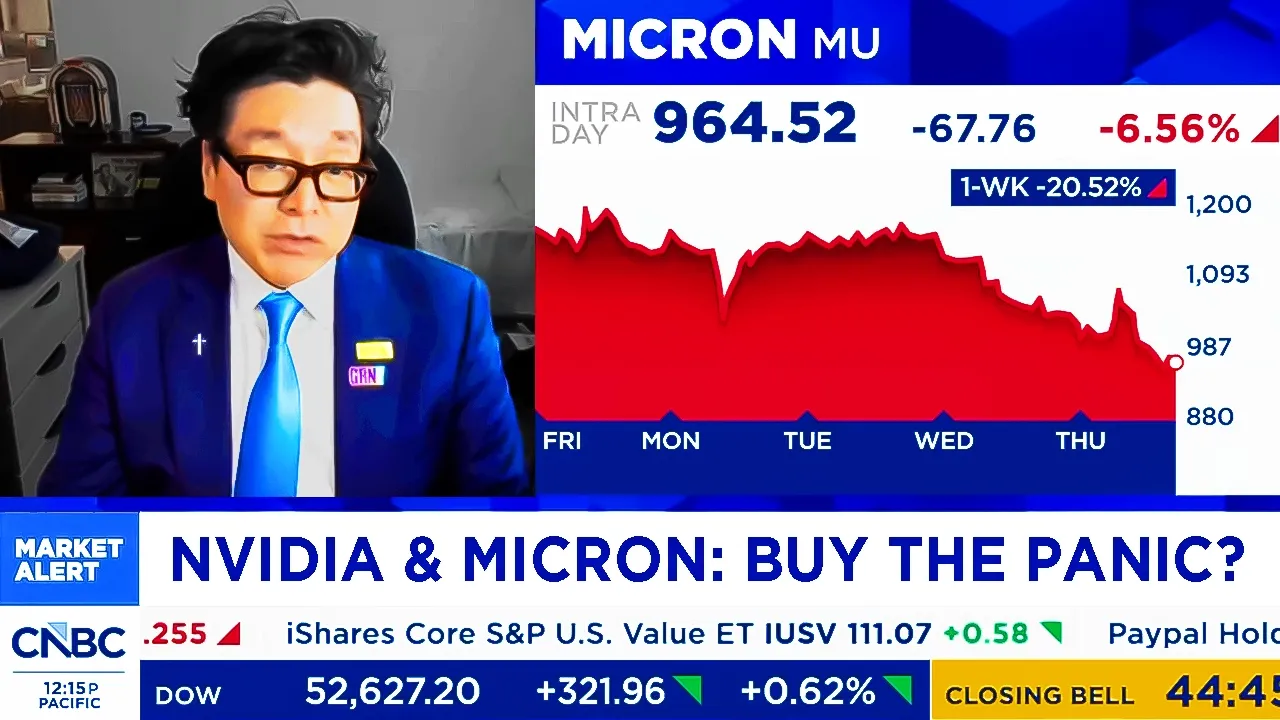
Nvidia is another one. Again, you know, listen, everyone knows the name. We know how well they do. Yep. It finally looked like it was going to move on a good earnings report and it did and then all of a sudden it stalled again. But for you, just an opportunity to get in.
So if you look at this company right here, it just pulled back right at its 200 day moving average. Could be a great opportunity.
Context
Semiconductors are not building the wave. They are building the ocean when it comes to the AI forefront. And Nvidia is the king of chips. So if you look at this company right here, it just pulled back right at its 200 day moving average. Could be a great opportunity.
I continue to be bullish on Nvidia long term as well as bullish on companies like Micron Iron and others probably for the next two years or so, maybe longer depending on what happens.
I continue to be bullish on Nvidia long term as well as bullish on companies like Micron Iron and others probably for the next two years or so, maybe longer depending on what happens.
I continue to be bullish on Nvidia long term as well as bullish on companies like Micron Iron and others probably for the next two years or so, maybe longer depending on what happens.
I seriously think that Nvidia still has plenty of runway ahead of it. And I think this company will be worth substantially more in future years than it is today.
Full Transcript
Uh I thought that Nvidia's program where they might take a stake in new companies is getting them away from hyperscalers. That's the problem because the hyperscalers on the one hand they say yeah we love Nvidia. Then the other hand I speak to them and said boy do we hate Nvidia. I mean you know come on Nvidia is the intellectual property the heart of the data center and it trades as if it's I don't know a steel company forever sake. >> Nvidia trying to reclaim 200. Now that piece about giving companies or startups a chance to get compute in exchange for a cut of revenue, it's an information story. Do we do we buy it? >> I I think that I mean Newor pushed me some stuff that I mean sorry Neworn is a higher mobile. That's why I was thinking about that. Yeah, they've been they've been pushing Nvidia unlocks uh AI compute at scale inviting capital partners to power the AI infrastructure buildout. It makes a lot of sense. Look, Nvidia's got to make it so that when Google comes out and says, "Listen, our TPU is better than what they have," they can say, "Well, you know what? That's Let's see. Uh, do you maybe we shouldn't send you all the Nvidia product that you want." We have to get to that. We have to have Nvidia know how to do a buyback. Stay up there till 10 or 4. Every day, Nvidia gets hit down the last 10 minutes. It's rather remarkable. They need to know how to run a buyback. I wish I worked there just to run the buyback. I could do such a better job. LOOK, I I LOVE THE COMPANY, but they got to know how to do a buyback. There's ways to do it. I ran buybacks. >> Yes. You've been saying, "Where's my Luca? They need my Aluka." >> Oh, my Luca. But I said, "WHY DON'T YOU JUST GO BUY SOMETHING?" HE SAID, "WE ARE we buy our stock." And I said, "But no, but you can buy Netflix." He said, "You know what stock is cheaper? Apple." And I used to laugh. I said, "Stop it. Stop it." And he was so right. And by by the way, he's a great man. >> Look at my stream. Oh, I'm glad he was a great guy. >> I am. Um, by the way, Jim, uh, Meta back to 601. This is like a magnet for this stock. >> Uh, yeah, that's disappointing. I wish that Meta had really come out with a formal declaration about what was happening instead of just trying to help some reporters. Uh, because we need to know why this stock sells at 17 times earnings. Look, I mean, these stocks sell at at pees that are embarrassing. There's just whole industries that have no growth at all that sell at higher pe. The companies are very bad at telling their stories. I'm really surprised. I mean, you know, why isn't Ruth Poor out on the tape saying, you know what, we don't need any more money. We're ready to roll for Google. Why are these companies just not being able to talk about a narrative? >> Well, maybe because the narrative changes all the time. I mean, people still remember the metaverse, Jim. >> Well, look, billions of dollars. >> These are great companies and they make you feel like that they're chumps. >> Just chumps. Now, Sanjay Morotra, Mike Ryan, he knows how to tell a story. I mean, he's got he's hiring tens of thousands of people. Just fantastic. And when he comes on, you say, "You know what? We are the winners. We are the winners when it comes to memory in the world because he quietly gives you the real numbers and he understands how to tell a story." Mark, where did you tell a story? >> I don't know. >> AI's power demands are putting nuclear back in the spotlight. Now, Bella Atomics says it's the first company in the US to use an advanced nuclear reactor to actually generate electricity and then it powered an NVIDIA Blackwell chip. It was a small demonstration, but it comes as the two companies announced a partnership to explore nuclearpowered AI systems. And actually, there's a bit more in there as well. Joining us now is Balor Atomic CEO Isaiah Taylor. Um, I I want to be transparent about the scale of the demonstration. Um, but it was a number of firsts. Explain what happened. >> Yeah, thanks so much for having me on, Ed. We're standing here right now in front of the War 250 reactor where we just powered the Nvidia Spark yesterday, the first ever advanced nuclear reactor to power an AI chip. And you're right, it was a very small demonstration. This reactor only makes 100 kW. That's very intentional. It's part of our philosophy. We like to move quickly in small steps, right? So, this is a small demonstration, but it is a big first. It's also the first time an advanced reactor has been built in American soil outside of the national lab system. And yesterday, we actually became the first ever startup to make nuclear electricity. So, a bunch of awesome historic things in a small demonstration. We're really proud to partner with Nvidia to do it. I think what what is interesting about this is the technology itself, right? Could you just bring us up to date as on where the sort of technology stands today? I appreciate you've outlined it was a first but but the challenges of scaling the benefits of using that technology relative to other energy sources >> 100%. So I mean listen nuclear has been around for a long time and we've built these very large scale plants uh that have made a lot of electricity but the problem with them is that they haven't scaled very well. They take a long time to build. They use a lot of civil infrastructure and these are things that we're not as good at in the United States anymore. So the philosophy of valor Atomics is we want to build modular plants that are manufactured and the other really unique thing is that they are high temperature reactors. This standing behind us here this is a high temperature gas reactor and those high temperatures are actually really good for both efficiency but also for things like air cooling. So a lot of the power debate and AI scaling debate right now is how do we do this without having to tax local communities of water usage. One of the best ways to do that is just to raise the temperature of the reactor. This allows you to reject heat at a higher temperature which means that you don't need water cooling anymore and that was part of our announcement yesterday. >> I I want to stay with the waterless component of it. Um you know Nvidia has been speaking publicly a lot about their the economics of cooling through different technology sets. It is a big focus. They've tried to dispel some misunderstanding that's out there. How does your technology work in that respect and how unique is it in the field? >> Absolutely. There's there's two sides of this equation, right? We need to get the energy generation side to be waterless and we need to get the data center cooling side to be waterless. And that's why with this collaboration with Nvidia is really exciting to us. We realized that we were both working on the problem from different angles. We're working on a nuclear reactor that doesn't need water cooling due to high reject temperatures. And Nvidia has already been working on the data center architecture to do that. And so when you bring these two technologies together, this collaboration for a 30 megawatt data center with no water cooling needed to, you know, extract water from the local community, that's really what's going to allow us to scale. We we think it is very important for the United States to win on AI to win this scaling race. But we need to do that without taxing local communities in both power and water usage. And so Nvidia and Baller Thomas coming together in this collaboration is really solving both sides of that problem. Nvidia has historically made equity investments in all layers of the stack with the argument that they want to support the ecosystem to get them moving faster. Um, have you had any discussion with Jensen or with Nvidia about the idea of there being a financial relationship between Valor and Nvidia? >> You know, I can't announce anything on fundraising uh today. you know, we have a lot of work to do here that we're focusing on and a lot of awesome capital providers behind us allowing us to go do that. But what I will say is that this collaboration is focused on how do we take the next step of scale, right? I think that Nvidia has done a lot of fundamental work on scaling the compute side and the architecture and their DSX architecture. They've done a lot of this really fundamental work on scale and we know that energy has been what is missing. You know, natural gas is going to be a bridge. It's going to be a good bridge, but it only goes so far and we continue to have the climate change question associated with that. And so if we really want to scale and especially outside of the pre-existing natural gas infrastructure in terms of pipelines, we're going to have to do that with uranium. >> I said we just have 45 seconds to end. Demo one, a single spark. What are the milestones that come next in terms of scaling the demo and infrastructure at different levels? Yeah, Valor Atomics likes to take small steps quickly. We're going to go build another reactor. The next one is going to be a lot more powerful than this one. And we'll take the next step in demonstration on the compute side as well. So stay tuned in the next 6 to 12 months. >> Nvidia 17% below its highs. And by the way, uh Nvidia is now cheaper on a forward earnings multiple than the median stock in the S&P 500. And I promise you its earnings growth this year. At least the guidance is way ahead of the median stock in the S&P 500. So that might be an opportunity. >> All right. Nvidia is another one. Again, you know, listen, everyone knows the name. We know how well they do. Yep. It finally looked like it was going to move on a good earnings report and it did and then all of a sudden it stalled again. But for you, just an opportunity to get in. >> Let me say this to all the viewers. Semiconductors are not building the wave. They are building the ocean when it comes to the AI forefront. And Nvidia is the king of chips. So if you look at this company right here, it just pulled back right at its 200 day moving average. Could be a great opportunity. And if you look at Nvidia and Micron, 40% of earnings growth in the S&P this quarter is going to come from those two companies. This is buying winter clothes on sale during the summertime right now. I like this and I like the way it's setting up this month. The DRAM ETF, first backtoback weekly decline since inception, down 23% in a week. That's the kind of stuff that's making this guy to your left a little nervous about that trade. What about you? >> Uh, you know, you never want to be uh trying to catch a falling knife, but to me, I I'm going to probably guess that those pullbacks are viable. I think that momentum still has a long-term history of working very well and it's really central to a lot of quantitative systems. So, I think it comes back. And then on the DRAM trade, I know people are trying to call the end of the cycle, but you know this what we still haven't decided is is there a new cycle because you know robots robots and machines are going to be semiconductor and RAM intensive much more than people. So it might be a long cycle. >> Well, I I don't know that people like the professor for example are trying to call the end of the cycle as much as they're trying to call the end of the craziness, right? I mean stocks going parabolic that that can only go on so long. There is that thing they it's the pause that refreshes, right? They say that for a reason. >> It's true. But what they have to keep in mind is that multiples of stocks like Micron are still, you know, eight times or probably today probably like 10 times now. Well, maybe with the pullback it's probably close to >> but it sort of got from like 8 to 10 >> which is historically maybe rich for stocks like that that are generally deemed to be more cyclical in nature. We're making the call. Many are that no this is different. This is different this time now. Now this is a secular news cycle as you said. >> Yeah. I mean so Nvidia's at 16 times. It reminds me of how Apple was viewed as a hardware phone stock for hardware maker for a long time. People thought it should trade at 10 times earnings until it rerated towards 30. So to me I think there's still that rerating that's going to come with stocks like Nvidia. >> Speaking of earnings, you're going to get them soon, right? The banks are going to start. It's hard to believe they're already right here around the corner. You know th to me when you zoom out this is the recipe for this bull market. This is going to be a bull market that's going to be take go as far as the AI team takes it and semis are the tip of the spear for that. So when you see new models come out compute demand ramps up semis get a bid and that's what we saw. We saw a three-month period where the SMH ETF that we're showing right now was up like 60% in a quarter. You need to get you need to take some of that off and and cool that down a little bit. And it needs to spread back into the hyperscalers and see these hyperscalers come through and have people believe like, okay, they know what they're doing. There's going to be a return on all the spending. And so to get that mix happening right now, I think is healthy. And so there will be a give and take, but when we zoom out, I expect this to be the the recipe that leads the market the market higher. >> So you think earnings season drives people back into the hyperscalers? Yeah, I mean I I think that they've been when you zoom out, you can do the math and you realize there is an ROI coming on this this money they're spending. And to me, yes, you're going to see that in there's going to be some great earning seasons coming out. I and and I think that uh ultimately investors are going to see what management sees, which is that there is an opportunity in front of these guys. Of course, it's scary. We talk about spending a trillion dollars every year and doing this generational whatever you want to call it industrial revolution. Yeah, that's scary. But when you look at the projects and you look at what's happening in the technology, there are returns and so you have to build confidence and that's where you're going to get your conviction. So yeah, I think hyperscalers are part of the broadening. It's just that's been the beaten up area this year which is a little weird. So they're getting bid right now along with the healthcare sector. Nvidia is announcing a new revenue sharing plan today. The company will partner with a AI startups offering its computing infrastructure in exchange for a share of future revenue. Naming two initial partners who will provide the compute power behind this scheme. Similar to Microsoft, Oracle, and Amazon, Nvidia is looking for new ways to secure long-term financial deals with customers. Uh I spoke with Ed Zitron of Easy Primary Research this morning. He's a skeptic of the AI business model in general and its future. sees today's Nvidia move as telling of what's to come. Take a listen. >> I think it could be the NeoClouds because with this rumor of Meta selling their AI capacity, I think companies like Core and especially Nebus and Iran and Cipher Mining and all of them, Terowolf as well, they are all very they're basically outgrowths and they're subsidiaries of Nvidia. Nvidia is now according to the information going to be paying them to rent back their GPUs when they install them in the data center. This is the this is something that only happens in an industry without diverse and real demand. >> It's like there's a kind of gold rush for the mining claims and then the ones who got there first are willing to kind of sell access for other people to search in there as well. And um you know there's obviously a lot of criticism of the whole circularity with Nvidia for a long time now. And um you know it just the complexity continues to grow around all this. You wonder what the underlying organic demand might be. This reminds me of when software companies said to Spaxs, we'll supply you with whatever subscriptions it is for share revenue. I mean, it just sounds very sort of >> we're going to help you finance your growth, >> right? Exactly. And you know, you want to ensure that the whole infrastructure remains refreshing. Maybe there is a a good kind of shortcut for some smaller players out there who just want to plug into what Nvidia can can offer, but uh it's it's hard to keep up with, frankly. >> All right, I hope you're all doing well today and staying calm. in this market. Today was a mixed day in a market and an especially rough day for many tech hardware and data center adjacent stocks. I'm going to address what caused the sell-off in a moment, but first let me quickly cover today's Nvidia news. Today, Nvidia announced they are partnering with AI clouds to deploy large-scale multi-tenant AI factories aligning economics through a revenue sharing and credit support model. Nvidia makes the point that emerging AI companies have historically had limited access to capital intensive infrastructure with long-term commitments being insufficient to unlock financing for compute. Because of this, Nvidia is introducing a new business model that will open up compute access to startups, model builders, enterprises, research organizations, and regional AI players. This new business model enables AI cloud to procure NVIDIA infrastructure for AI native enterprise and ISV customers. Through the partnership, clouds will sell NVIDIA powered cloud services to customers. With Nvidia earning both standard product revenue and a share of the cloud revenue on the supported capacity. This structure accelerates adoption of Nvidia platforms provides Nvidia with a recurring usage linked earning stream and it helps smaller cloud companies get started. Sharon AI and Fermas are among the first companies to work with Nvidia on this new business model. Sharon is deploying 40,000 Nvidia GB 300 GPUs and Fermis is building an AI factory that is expected to scale up to 170,000 Nvidia GPUs. Now I know the skeptics are going to scream circular financing and I get it. That said, this is a very interesting concept and I think it's a win-win for NVIDIA smaller clouds and ultimately for those clouds customers. As for the hypers scale companies, they already had wellestablished businesses that funded the initial phases of their AI buildouts. Now, there are many smaller companies that see the opportunity and they want to build out clouds. Most of those smaller companies do not have large well-established businesses to fund their buildouts. And so, I think it makes a lot of sense for Nvidia to help those companies get things up and running by means of a business structure that is advantageous both for Nvidia and the Neoclouds. Additionally, this news is not an indication of there being no real demand, as some have incorrectly assumed, and I'll talk more about that in a moment. Now, let's address the reason why many tech hardware stocks and data center adjacent stocks traded lower during Thursday's session. The sell-off really got going during Ed Zitron's interview on CNBC. For those of you who don't know, Ed is known for frequently writing bearish takes about tech. I've read some of his work in the past, as some of you have recommended it to me, and I would broadly characterize his writings about the AI buildout as being overly bearish, unreasonably skeptical about the buildout. And although he occasionally brings up valid points of concerns, I find that he often reaches what I believe to be incorrect conclusions. I find that his reasoning and conclusions are often illogical. So that's the context of what we're dealing with here. Now, please hear me well right now. I have nothing against Ed personally, and I genuinely wish him all the best. I want to be clear about that. I have no problem with differences of opinions. That said, it does bother me when someone makes a name for themselves by taking a bare stance on a topic, employing what appear to be sensationalist tactics, and repeatedly propagating inaccurate information or illogical conclusions that result in investors selling long-term positions in great companies that those investors would otherwise make money from if they simply remain invested. That bothers me. Listen to me right now. There are some people who go on TV and are very positive about companies like Nvidia and Micron, but probably 90% of their facts are blatantly wrong. When that happens, and believe me, it does happen. I do not include those clips in these compilations, even though I'm bullish on Nvidia and Micron. And the same is true when there's a bearish guest if the vast majority of their claims are illogical. I thought there were many logical fallacies in Ed's CNBC interview on Thursday, and so I did not include that interview in this compilation. I would rather address his claims directly, piece by piece, which I'm going to do in a moment. Keep in mind, I am not a permable. I'm also not a perma bear. I consider the facts with an open mind, and I try to reach logical conclusions based on facts. Listen to me. We need to be very very careful about listening to people who have made a name for themselves by taking bearish positions in the past. I'm not saying that we should ignore them completely, but I'm saying that we need to be extra careful about accepting what they say is fact. Now, let's address specific claims that Ed made during his CNBC interview. I've broken it up into multiple clips. Let's listen into this first clip and I'll address some of Ed's claims on the other side. >> They talk about I think Sam Orman said, "Well, we can share the benefits of AI and the profits of AI. What profits? What returns? That 5% will have to get congressional approval. Well, the sovereign wealth fund is still an idea at this point, but fundamentally large language models are not the future. The only reason big tech is investing in this is that they've run out of hyperrowth ideas. They don't have a next iPhone. They don't have a new Google search. So, they've put over a trillion dollars with trillions more to come into a kind of a deadend industry because when they when that ends, they'll have to admit that they don't have anything else. >> So, you think AI LLM's overall is a dead end? You see no business model here. You see no utility from AI whatsoever. I see this as in the future as a boring hardwarebased business. The kind of the Oracle licensing hardware model. I think this is a 10 to30 billion TAM industry pretending to be a trillion dollar one and because everyone's propping it up because they have no hyperrowth ideas. Everyone's just kind of pretending it's the kayfabe of the tech industry that really has run out of ideas. Ed says quote I think this is a 10 to30 billion industry pretending to be a trillion dollar one. That take is illogical not based on fact and it is in denial of the actual numbers. It is illogical to say that it's a 10 to30 billion TAM when Anthropic alone announced an ARR surpassing $47 billion in May, which is up from $9 billion just at the end of 2025. I know Ed will say that ARR is not revenues and I'm going to address that in a moment because I have something important to say about that, but focusing on the topic at hand. To say that these companies aren't seeing hyperrowth is to deny reality. It asks the question, what profits? Now, of course, the leading AI companies are reinvesting heavily in their businesses for right now. At this current stage, they're prioritizing growth and capturing market share over short-term profitability. That's very reasonable. That's exactly what most of their investors want them to do at this current stage. I seriously think that Anthropic could be profitable today if they wanted to be. But of course, they need to invest in more capacity so they can serve more demand and train new models. Back in May, the Wall Street Journal reported that during a funding round, Anthropic revealed to investors that its revenue was set to double in the second quarter, which would help Anthropic turn an operating profit for the first time. Additionally, the hyperscalers are monetizing new capacity as soon as it's operational because demand from their paying customers far exceeds supply. We're hearing this across the board from the hyperscalers. To say that there will be no profits from AI is illogical. Alphabet CEO told us on their most recent earnings call that they're specifically compute constrained and would have higher cloud revenue if they had more supply. And before someone starts typing in the comments about Meta having excess supply, I addressed that at length in Wednesday night's video. As I said in that video, I question the idea that Meta already has excess supply. But even if Meta has more supply than what they need for their own internal workloads at Meta, that does not mean that the rest of the world is not compute constraint. The same day that Bloomberg reported that Meta was developing plans for a cloud business, AWS raised rental prices for several Nvidia GPUs by 20% based on supply and demand. They even raised prices for GPUs that launched 6 years ago. They would not raise those prices unless demand is very strong and far exceeds supply. Again, even if Meta has more supply than what they need, that does not mean that the rest of the world is not computed. The world is still computed and AWS just raised rental prices for 6-year-old GPUs because demand far exceeds supply. Now, let's listen to some more of Ed's claims and I'll talk about on the other side. >> It's funny you mentioned Oracle cuz people were quoting the annual yesterday, quote, "Some of our customers, OpenAI may be highly leveraged. We may experience risks of non-payment in our dealings with such parties." Are the are we going to see this from a market standpoint first in shares of hyperscalers? I think we might, but Oracle is a particularly scary one because they are building 7.1 gawatt of capacity just for one customer. And they even said in their annual report that the risk was they might not get paid. Open AAI only loses money. And I think I estimate it's like $75 billion of revenue annually that they will have to pay for the full Stargate data center project in annual compute revenue. Open AAI can't afford that. And if they can't, Larry Ellison can't afford to pay back those bills and Oracle stock will be in jeopardy along with the margin loans that Mr. Ellison holds. It's genuinely dangerous and it's dangerous across the board for neoclouds, for hyperscalers, for every associated party of the LLM industry. >> Is is is Oracle the tip of the spear on that or is it something else? >> I think it could be the neoclouds because with this rumor of Meta selling their AI capacity, I think companies like Core and especially Nebus and Iron and Cipher Mining and all of them, Terraolf as well, they are all very they're basically outgrowths and they're subsidiaries of Nvidia. Nvidia is now according to the information going to be paying them to rent back their GPUs when they install them in the data center. This is the this is something that only happens in an industry without diverse and real demand. All right, let's unpack a few things. First, I think it's entirely valid to mention concerns surrounding spinning commitments and the buildout from companies like Oracle as well as Neoclouds like Horeweave, Nebius, Iron, and others. I don't have a problem with that. But just doing some back of a napkin math, Ed claims that OpenAI will need to spend $75 billion annually for compute related to the Stargate project. I'm seeing indications that OpenAI's ARR may already surpass $40 billion. Of course, we do need to wait for official confirmation on that. Additionally, at the end of March, OpenAI announced they raised $122 billion, as was the case in late 2025. I think fears about OpenAI's ability to meet their spending commitments are largely overblown. ChatGpt has over 1 billion monthly active users. Open AAI will monetize that user base. They're also making a big push into the enterprise and diversifying their revenue mix away from just consumers. Is it possible that Open AI could pull back on spending at some point? Sure, that's entirely possible. Last year, they were talking about $1.4 trillion in spend and then they dialed that back to a much more reasonable $600 billion spread out over multiple years. I think it's plausible that they will be able to make that happen. But again, as was the case in late 2025, I think the fears about OpenAI's spending commitments are largely overblown. And as for the disclaimer from Oracle, Oracle has to include disclaimers like the one that Ed and the host of CNBC mentioned, that's normal. And on the topic of the NeoClouds and Meta Meta, having too much capacity for their own internal needs does not mean that the rest of the world is not compute constraint. Again, AWS just raised prices 20% because demand exceeds supply. Ed's claim that there is no quote diverse and real demand is illogical and it ignores the context of the situation. For companies like Amazon, Microsoft, and Alphabet, they already had wellestablished businesses that they used to fund the initial stages of their AI buildouts. Today, a 1 gawatt data center costs about 50 to$60 billion to build. Most of the Neoclouds do not have that kind of money. They do not have well-established businesses like the hyperscalers that they can use to fund the initial stages of their buildouts. That's valid. And with that context in mind, it makes a lot of sense for Nvidia to step in and help those companies get things off the ground. Some of those smaller companies need an initial boost to get things moving. That's not unreasonable. And interestingly, those Neoclouds are not trying to develop their own custom AS6 or systems like the hyperscalers are. The Neoclouds are very likely to remain customers of Nvidia because Nvidia's platform is the most flexible with the largest install base. Developers choose which platforms they build on and the vast majority of developers want to build on Nvidia's platform. So overall, I think Nvidia helping these companies fund the initial stages of their buildouts is reasonable and nothing to be concerned about. Nvidia helping to fund these early stage companies buildouts is not proof that there isn't any real demand. If there isn't real demand, then how do you explain the strong demand that the hyperscalers are seeing from their paying customers and the compute constraints that exist at the hyperscalers? You cannot unless there is real demand from customers, which there is, and the world is compute constrained, which it is. Now, let's listen into Ed's interview one more time, and I'll address his claims on the other side. Meta is an interesting uh case in this instance because they don't as yet have the third-party cloud services revenue propping it up. But people point to their own top line having accelerated in the first quarter of this year from like 23% to 33% presumably because they're implementing these AI tools or somehow making their platform more productive along those lines. Um and at the same time it shows you the fallback option. We're creating all this capacity even if it's not a business model. the capacity is there. We've gotten the kind of the power and the compute in place. Maybe that helps society down the road. >> Well, the thing is with Meta is I don't necessarily agree. AI is not driving Meta's revenue growth. The fact that they have an effective monopoly on social media is Microsoft, Google, and Meta, and Amazon are all doing a funny little I don't want to call it a scam, but it's a a trick where because their other businesses are still growing, but they never disclose their AI revenues, everyone conflates that with AI driving their growth. In reality, their other businesses are growing and AI is losing the money across the board. You'll notice that neither Microsoft or Amazon, who both share their run rate of AI, will share the actual AI revenues. That tells you that these companies are afraid. Public companies love good news. If they had good news, why wouldn't they share it? That's because they've only got bad news here. Ed says, quote, "AI is not driving Meta's revenue growth. The fact that they have an effective monopoly on social media is, listen to me, that statement is illogical. Having a monopoly in social media does not guarantee accelerating revenue growth. If revenue growth is accelerating, which it is, then that means something fundamental has changed in the business and is driving that acceleration. Accelerating revenue growth doesn't just happen. Consider this. Meta already has billions of users on their platforms. So, if Meta already has billions of users and revenue growth is accelerating, that acceleration is not being fueled by new user growth. In fact, on Meta's most recent earnings report, they reported a quarter overquarter decline in daily active people on their platforms. Again, they already have billions of users, so there's not much room to grow in terms of the number of users on the platforms. So, at meta- scale, how is it possible for them to post accelerating revenue growth? It's possible because they're implementing AI in their core business to extract more value per user. To say that tech companies should break out AI's contribution to their revenues as a separate line item is missing the point entirely. They're using AI to supercharge their existing revenue streams. They're not going to create an entirely new line item on their earnings reports. No, they're going to report their existing line items like they always have and AI's impact will be reflected in the numbers that they report and the numbers are showing acceleration which is proof that a fundamental change has occurred in the business. What is that fundamental change? The implementation of AI in their existing core business. Meta is using AI to provide better recommendations to users and better targeted ads that should show up in Meta's advertising revenue and it is. Meta is not going to break out AI's contribution to advertising revenue as a separate line item because that's completely unnecessary. They're just going to report their advertising revenue like they always have and the numbers speak for themselves. To say that Meta's revenue growth is driven by Meta having a monopoly on social media misses the point entirely. Being an incumbent monopolist, as Ed suggests, does not guarantee accelerating revenue growth. Meta is using AI to drive accelerating revenue growth in their existing business. Let's not conflate the two. Also, in the clip you just watched, Ed says that Amazon and Microsoft won't share their actual AI revenues, but instead will share their ARR or annual revenue run rate. This is a talking point Ed has used before. In this piece, Ed wrote about AI being too expensive. He writes, quote, "Run rates aren't revenues." Listen to me. I have nothing against Ed personally, and I wish him all the best. Respectfully, this is a great example of why I'm not a fan of Ed's work. Hear me out on this. No one in their right mind is claiming that annual revenue run rates are trailing 12-month revenues. Those are two totally different things. That's obvious. But notice what's happening here. You have someone taking an obvious basic fact framing it in a negative light and implying that something nefarious is going on saying that Microsoft and Amazon only have quote bad news here. Ed says that even as these companies AI revenue run rates are rising. Do you see the problem here? I have no problem with differences in opinion. I do have a problem when someone repeatedly takes basic facts employs what appear to be sensationalist tactics and frames those basic facts as if they are evidence of nefarious activity all while profiting off of the hysteria that they themselves sow among individual investors. individual investors who would make money if they weren't scared out of their long-term positions in great companies with improving fundamentals. That's what bothers me about this whole situation. I have nothing against Ed personally and I wish him all the best. And Ed is not the only person who does stuff like this. I really do think that Ed's comments on CNBC are what led to the selloff in many tech hardware and data center adjacent stocks starting around 10:20 a.m. Eastern Thursday morning. And so that's why I'm addressing this. Just because someone claims there is a bubble does not mean there is a bubble. Just because someone claims there is malpractice happening does not mean that there is actually malpractice happening. We have to consider the actual facts to make those determinations. I genuinely wished all the best. And if you have a different opinion than I do on any of the topics I just talked about, that is completely fine. I continue to be bullish on Nvidia long term as well as bullish on companies like Micron Iron and others probably for the next two years or so, maybe longer depending on what happens. I don't know what's going to happen in the short term, but from a long-term perspective, I am very confident that Nvidia will be worth much more in future years than it is today. When Jensen was on the Lex Freedman podcast not that long ago, he was very seriously raising the possibility of Nvidia becoming a $3 trillion revenue company in the near future. If that happens in the coming years, then it is very plausible that Nvidia could one day be worth tens of trillions of dollars in market cap. That might sound crazy, but that's what Jensen is implying when he raises the possibility of Nvidia becoming a $3 trillion revenue company. I guess the question at that point is what multiple the street will be willing to give Nvidia. I don't know the answer to that question, but I truly do think that Nvidia will be worth much more in future years than it is today based purely on the fundamental growth of the business. Based on everything I'm seeing, the world is still computed, and I expect that to continue at least through the first half of calendar 2028. In a computed environment, developers will use whatever viable compute they can get their hands on. Today, there are no GPUs that are sitting dark due to a lack of demand. Like, there was fiber sitting dark due to a lack of demand at the height of the dot bubble. Back then, companies were laying fiber in the hopes that use cases and demand would eventually show up. Today, we are seeing the complete opposite. As I've said many times, when market participants compare this AI revolution to the dotcom bubble, they ignore the fact that the internet is already here this time. This means that mass adoption of the technology and new use case development at scale are immediately possible. We don't have to wait years for it to show up. It's already here. The world is compute constrained, which means there is not enough supply to satisfy demand. New capacity is utilized as soon as it comes online. The hyperscalers are monetizing capacity as soon as it comes online. Each of the hyperscalers spoke about being supply constrained on their most recent earnings calls. Alphabet CEO specifically said that they are compute constrained and would have higher cloud revenues if they had more supply. Additionally, many of the clouds are building out into contracted demand. They're not blindly building in the hopes that demand will eventually show up. No, they're building out because they have signed contracts and in some cases significant prepayments from their paying customers. This AI revolution is fundamentally different from the dot bubble. And 2026 will be a pivotal year for the AI industry thanks to the rapid adoption of Agentic AI and the proliferation of Agentic systems in the world's leading enterprises. The leading AI labs revenues are surging right now. Agentic coding and the implementation of Agentic systems in large enterprises are new use cases that are increasing inference demand significantly that subsequently is increasing compute demand. The rapid adoption of Agentic AI is why we're seeing an inflection in inference demand. It's why we're seeing the leading AI labs revenue surge. I wish both Anthropic and Open AI were public so the public could see the ramp in their revenues. Anthropics ARR has surpassed 47 billion up from $9 billion just at the end of 2025. Open AI is growing rapidly as well. I think the leading labs surging revenues may be the initial proof point that grabs market participants attention and causes them to realize that there will be a clear ROI on AI infrastructure. I think the leading labs surging revenues will also help assure investors of the longevity of Nvidia's growth since these labs revenues are directly tied to compute. If they had more compute, they would have greater revenues. It really is that simple. Demand is not the problem. The problem is a lack of supply to meet the demand. As I've said previously, I expect the world to be compute constrained at least through the first half of 2028, possibly longer. And so regardless of what happens in the short term, it's important for long-term investors to remain focused on the fundamentals, maintain a long-term perspective, and remember that we are only in the early stages of Agenic systems being adopted at scale. This will increase compute demand significantly. And after that, the next surge in comput demand will likely be fueled by physical AI. We're no longer talking about digital agents performing digital tasks. With physical AI, we're talking about physical AI agents performing physical tasks in the real world. NVIDIA CFO has called physical AI, quote, a multi-t trillion dollar opportunity. and the next leg of growth for Nvidia. This industry will fundamentally transform society and Nvidia has positioned themselves to benefit massively. NVIDIA sells the hardware for the data centers where the models are trained. They offer omniverse where the models are taught and tested. And NVIDIA also sells the hardware that allows ondevice real-time inference through NVIDIA AGX allowing robots to have intelligent interactions with the real world even when they are not connected to a data center. Notice that NVIDIA is taking a holistic platform approach to physical AI and they're embedding themselves as the underlying foundation supporting all of it. Over two million developers are already building on the NVIDIA robotic stack and this is not getting enough attention. As for production ramps, Blackwell Ultra has ramped quickly and remains in high demand. Reuben is on track to launch in 2026. Then we're expecting Nvidia Gro 3 LPX in the second half of 2026. Later on, we're expecting the launch of Reuben Ultra in 2027 and Fineman after that in 2028. We have a clear data center product roadmap stretching into 2028 and Jensen believes that AI infrastructure spending will reach 3 to4 trillion annually by the end of the decade. That means Jensen is expecting growing AI demand and an expanding total addressable market underpinning all of this. I don't think we are anywhere near any type of bubble bursting type of event. With all of this in mind, I seriously think that Nvidia still has plenty of runway ahead of it. And I think this company will be worth substantially more in future years than it is today. At least that's my view of the situation. Quick note before I wrap up. All of the compilations on this channel are edited by Finn Vid with original structure and commentary. Occasionally the same edits appear elsewhere on YouTube. If you're looking for the original version, it's always here on this channel. Thanks for watching Finnvid. I appreciate your support. Remember to stay calm in this market. Remember to maintain a long-term perspective and do not make any hasty or irrational decisions. With all of that being said, I hope you all have a great rest of the day and I'm curious to hear your thoughts about Nvidia in the comments below. Please leave a like on this video so more people will see it. And while you're down there, please consider subscribing. It's free and you can always change your mind. Thanks for watching and hopefully I'll see you in the next

Comments 0
Sign in to join the discussion.
Sign inNo comments yet. Be the first to share your thoughts!