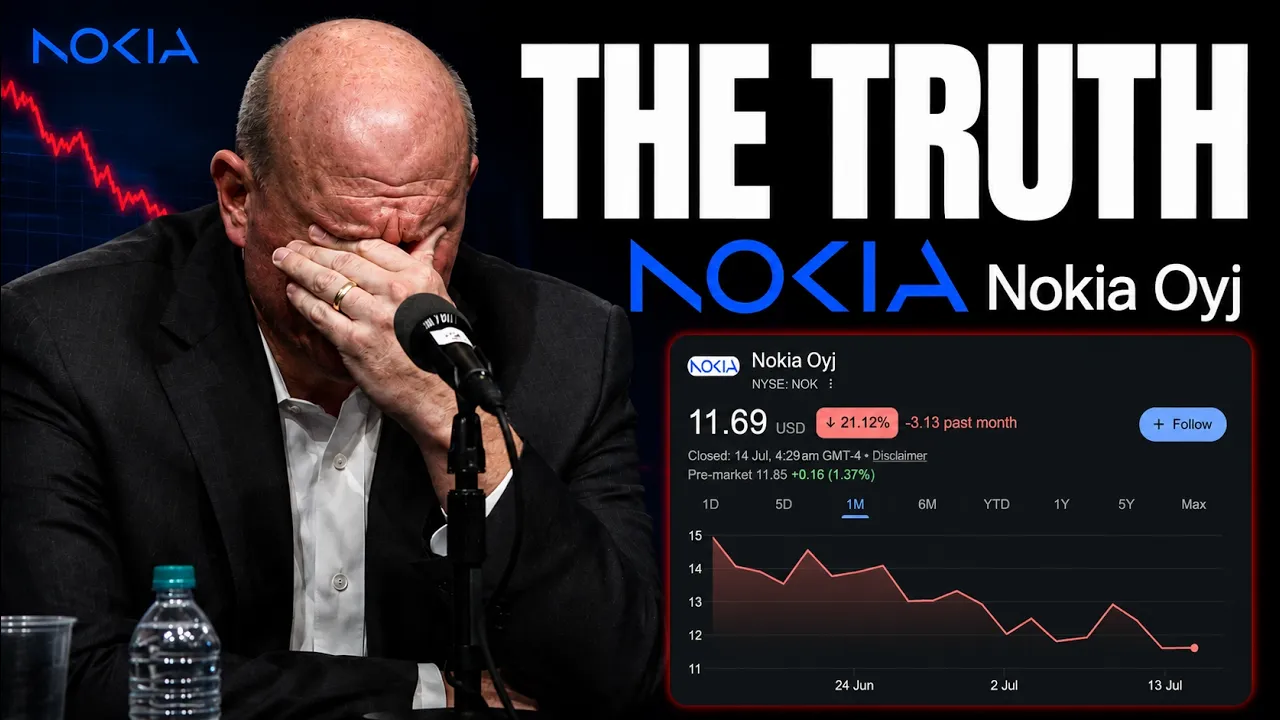
Every Wall Street Analysts are BULLISH on Nokia...But the Stock Just Fell 30%! What Exactly going On

- Video return
- -18.28%
- Calls
- 1
- Buy / Sell
- 1 0
- Published
Recommendations
Entry is the asset's closing price on the publication date. Current is the last close on record.
-
Entry $11.70 14 Jul 2026Current $9.56 05 Aug 2026Result −$2.14
major institutions like JP Morgan recently maintained an overweight rating and raised their price target to $21
Context In fact, major institutions like JP Morgan recently maintained an overweight rating and raised their price target to $21.
Full Transcript
Nokia stock has recently taken a significant hit, falling nearly 30% from its 52- week high of $1745. The stock is currently trading around $1169, leaving many investors wondering what is happening behind the scenes. This sharp decline stands in direct contrast to the overwhelming optimism coming from Wall Street analysts. In fact, major institutions like JP Morgan recently maintained an overweight rating and raised their price target to $21. This implies there is a massive 50% upside from current levels. We are seeing a stark divergence between the actual price action on the daily chart and the bullish narrative circulating in research reports. Investors are facing a classic market riddle where the fundamentals and the technical charts are speaking entirely different languages. Over the last month alone, the stock has slipped over 20%, erasing a large portion of its year-to-ate gains. In this analysis, we are going to dive deep into the real reasons behind this 30% drop. We will separate the temporary trading noise from the long-term reality of Nokia's business model to see if this pullback is a major buying opportunity or a dangerous value trap. To understand the current slide, we must first analyze the financial performance and look at where the revenue is actually coming from. Nokia is no longer the mobile phone company from the early 2000s. Today, the business operates as a global telecommunications infrastructure giant with annual revenues sitting near $19.2 billion. When we look at the most recent first quarter 2026 interim report, the topline numbers reveal a fascinating story of two completely different businesses under one roof. On one hand, Nokia's high-tech optical and cloud business is experiencing explosive growth. AI and cloud customer net sales surged 49% year-over-year, bringing in over€1 billion in new orders during a single quarter. This incredible momentum was supported by a massive bookto-bill ratio of approximately three times. This means that for every 1 of revenue Nokia recorded in this segment, they pulled in €3 of new orders. This represents a clear confirmation that demand for high-speed optical networking is vastly outpacing the company's current ability to deliver it. The growth is primarily driven by their optical networking division which has seen an acceleration in shipments of 800G optical transport equipment to major hyperscalers. However, the legacy side of the business is telling a completely different story. Legacy mobile network operators fell 2% and fixed networks declined 13% during the same period. While management has stated that the double-digit drop in fixed networks is a purposeful shift toward more lucrative products, the reality is that the legacy telecom business remains in a multi-year slump. This creates a massive headwind that drags down the overall topline growth. The market is struggling to value a company that has a hyperrowth AI infrastructure division wrapped inside a slow growing legacy telecom shell. Investors who buy Nokia for its high-speed optical networking are finding themselves tied to declining radio access networks that continue to weigh heavily on profit margins. To truly grasp Nokia's long-term potential, we have to look at the broader industry context and the ongoing global AI infrastructure buildout. High performance artificial intelligence models require an enormous amount of computational power, but they also require a highly sophisticated network to move that data around. This is where Nokia has managed to secure a prime position. In late 2025, the company signed a landmark partnership with Nvidia. Under this agreement, Nvidia made a massive $1 billion equity investment in Nokia, purchasing shares at $61 to become a $2.9% shareholder. The goal of this partnership is to co-develop and deploy AI radio access networks or AI. This represents a fundamental transition from traditional hardwareheavy 5G networks to softwaredefined GPU accelerated computing hubs. Essentially, Nokia and Nvidia are turning cell phone towers into decentralized edge data centers that can process artificial intelligence workloads right at the edge of the network. Large telecommunication operators are already jumping on board with carriers like T-Mo beginning field trials of AI this year. But the transformation does not stop there. In February 2025, Nokia completed its strategic acquisition of Infinina for $2.3 billion. This was a massive move that fundamentally altered the company's DNA. By integrating Infinina's high-end optical technology, Nokia transitioned into a vertically integrated optical chip provider with its own indium phosphide fabrication facilities. This provides Nokia with a massive competitive advantage in a highly supply constrained market. This acquisition has allowed Nokia to successfully diversify its customer base away from struggling telecom carriers and toward cashrich hyperscalers like Google, Microsoft, and Amazon. These tech giants are currently spending hundreds of billions of dollars to construct massive data centers. and they are increasingly selecting Nokia's integrated stacks to power their optical backplanes. Yet, despite these major technological tailwinds, the stock has continued its downward slide. The mismatch between Nokia's highly bullish long-term technology road maps and its near-term stock performance is causing significant friction among retail and institutional investors alike. To see why the market is hesitating, we must look beyond the exciting technology and examine Nokia's profitability and cost structures. In first quarter 2026, Nokia managed to expand its gross margin by 320 basis points to 45.5%. This is an encouraging sign that shows their shift toward higher margin optical products is starting to show up in the numbers. For the full year 2026, management has guided for comparable operating profit to land between€2 billion and€2.5 billion. Additionally, the company expects a solid free cash flow conversion rate from comparable operating profit of between 55 and 75%. While these profitability metrics look stable on paper, they are not yet accelerating fast enough to satisfy the broader market. The major issue lies in Nokia's heavy cost structures. The company spends an enormous amount of money on research and development as well as sales, general, and administrative expenses, which combined to cost nearly 8.5 billion. Because of these large overhead costs, Nokia's operating margins are sitting around 8.4%. 4%. For the stock to trade at a premium, analysts calculate that Nokia must push its operating margins up to 10 or 11%. This margin expansion will either require their total sales to jump toward $25 billion or for management to find at least $500 million in cost savings. Until Nokia can demonstrate that its high margin AI optical sales can completely overwhelm the high fixed costs of its declining mobile division, the overall profitability will remain constrained. The market is demanding concrete evidence of earnings delivery before it is willing to sustain any significant upward momentum. This brings us directly to the valuation metrics which explain exactly why Nokia is experiencing such heavy selling pressure despite the positive news. Even with the recent 30% decline, Nokia is trading at a forward price to earnings ratio of close to 31 times in 2026. Historically, Nokia's median PE multiple has been much lower, hovering around 20 times over the last 5 years. A forward multiple of 31 times is an incredibly steep premium for a company with relatively flat total revenues. This premium shows that the market has already priced in a major portion of the Nvidia backed AI super cycle, leaving zero margin of safety for investors. From a technical perspective, the charts have also turned heavily bearish. In late June, Nokia triggered a head and shoulders breakdown below its 50-day moving average, signaling a deeper technical correction. This technical breakdown has been exacerbated by notable institutional selling. On July 8th FMRLC widely known as Fidelity, disclosed that its indirect ownership in Nokia, fell below the 5% threshold, dropping to 4.87%. When a massive fund like Fidelity trims its position, it places heavy selling pressure on the stock. Regardless of how bullish retail investors might be, investors are realizing that while the long-term artificial intelligence story is compelling, the stock got way ahead of its actual near-term earnings power during its monster 140% rally over the past year. Now, the market is undergoing a healthy and necessary repricing to align the stock's valuation with the realistic timeline of its operational recovery. In conclusion, Nokia is going through a massive fundamental transformation into a premier provider of optical networking and AI infrastructure. Nvidia's $1 billion investment and the Infinina acquisition have successfully changed the company's DNA. However, the legacy telecom decline and a highly premium valuation have triggered a deep 30% pullback. If the upcoming second quarter earnings report on July 23rd can confirm that higher margin optical orders are accelerating fast enough to support these multiples, the stock could find a solid bottom. I don't own any shares of Nokia right now, but I am keeping it on my watch list. This is purely my opinion and my personal journey, so you should always do your own research first. Hey, thanks for watching. I truly respect every viewer who takes the time to seek objective datadriven analysis.
Comments 0
Sign in to join the discussion.
Sign inNo comments yet. Be the first to share your thoughts!